child restraint DODGE DURANGO 2009 2.G User Guide
[x] Cancel search | Manufacturer: DODGE, Model Year: 2009, Model line: DURANGO, Model: DODGE DURANGO 2009 2.GPages: 498, PDF Size: 8.3 MB
Page 67 of 498
Here are some tips for getting the most out of your child
restraint:
•Before buying any restraint system, make sure that it
has a label certifying that it meets all applicable Safety
Standards. The manufacturer recommends that you
try a child restraint in the vehicle seats where you will
use it before you buy it.
•The restraint must be appropriate for your child’s
weight and height. Check the label on the restraint for
weight and height limits.
•Carefully follow the instructions that come with the
restraint. If you install the restraint improperly, it may
not work when you need it.
•The second row seating positions and all third row
seats have either cinching latch plates or an automatic
locking retractor. These are designed to keep the lap
portion tight around the child restraint so that it is not
necessary to use a locking clip.
•Buckle the child into the restraint exactly as the
manufacturer’s instructions tell you.
•When your child restraint is not in use, secure it in the
vehicle with the seat belt or remove it from the vehicle.
Do not leave it loose in the vehicle. In a sudden stop or
collision, it could strike the occupants or seatbacks and
cause serious personal injury.
LATCH - Child Seat Anchorage System (Lower
Anchors and Tether for CHildren)
Your vehicle’s second row seat is equipped with the child
restraint anchorage system called LATCH. The LATCH
system provides for the installation of the child restraint
without using the vehicle’s seat belts, instead securing
the child restraint using lower anchorages and upper
tether straps from the child restraint to the vehicle
structure. LATCH-compatible child restraint systems are
now available. However, because the lower anchorages
are to be introduced over a period of years, child restraint
THINGS TO KNOW BEFORE STARTING YOUR VEHICLE 65
2
Page 68 of 498
systems having attachments for those anchorages will
continue to also have features for installation using the
vehicle’s seat belts. Child restraints having tether straps
and hooks for connection to the top tether anchorages
have been available for some time. For some older child
restraints, many child restraint manufacturers offer
add-on tether strap kits or retro-fit kits. You are urged to
take advantage of all the available attachments provided
with your child restraint in any vehicle.
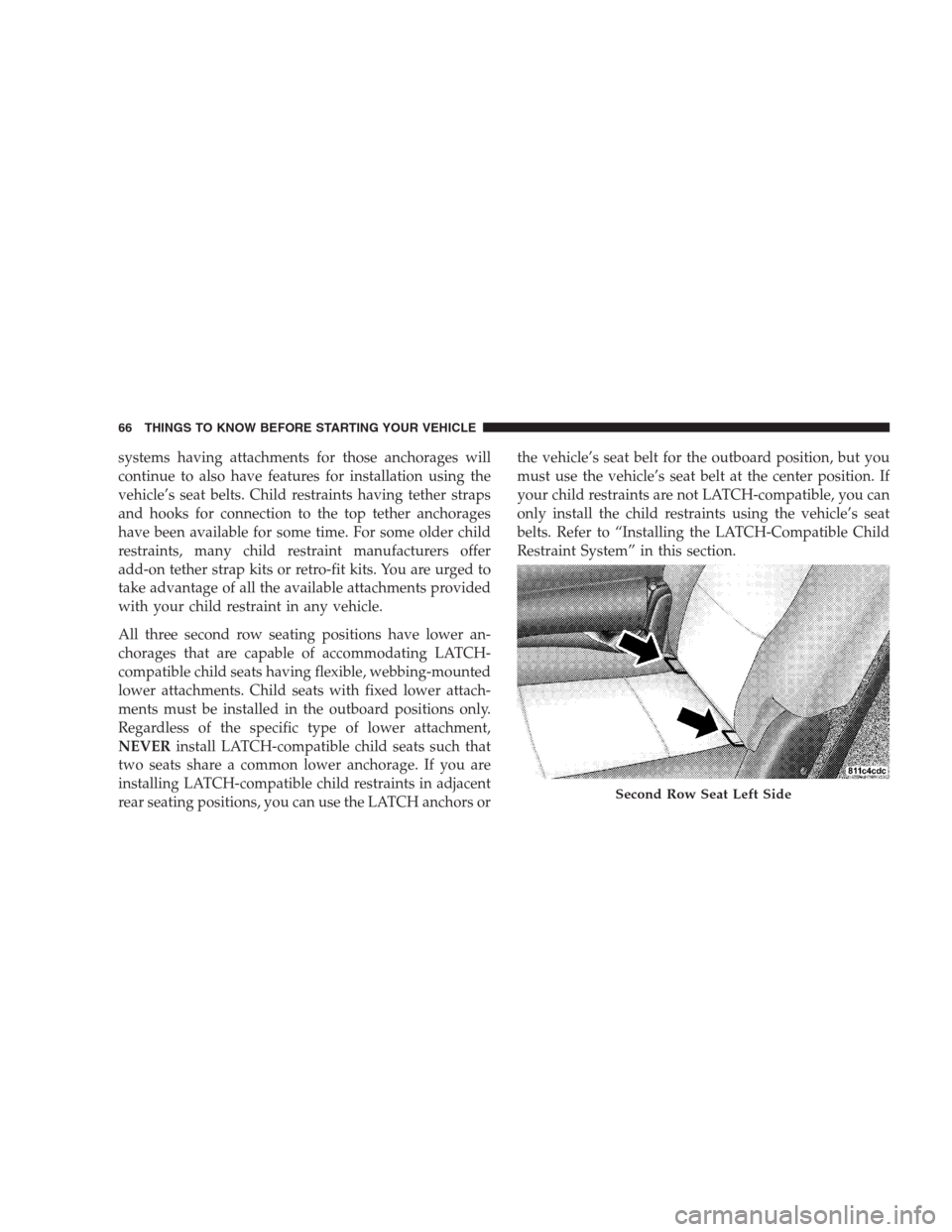
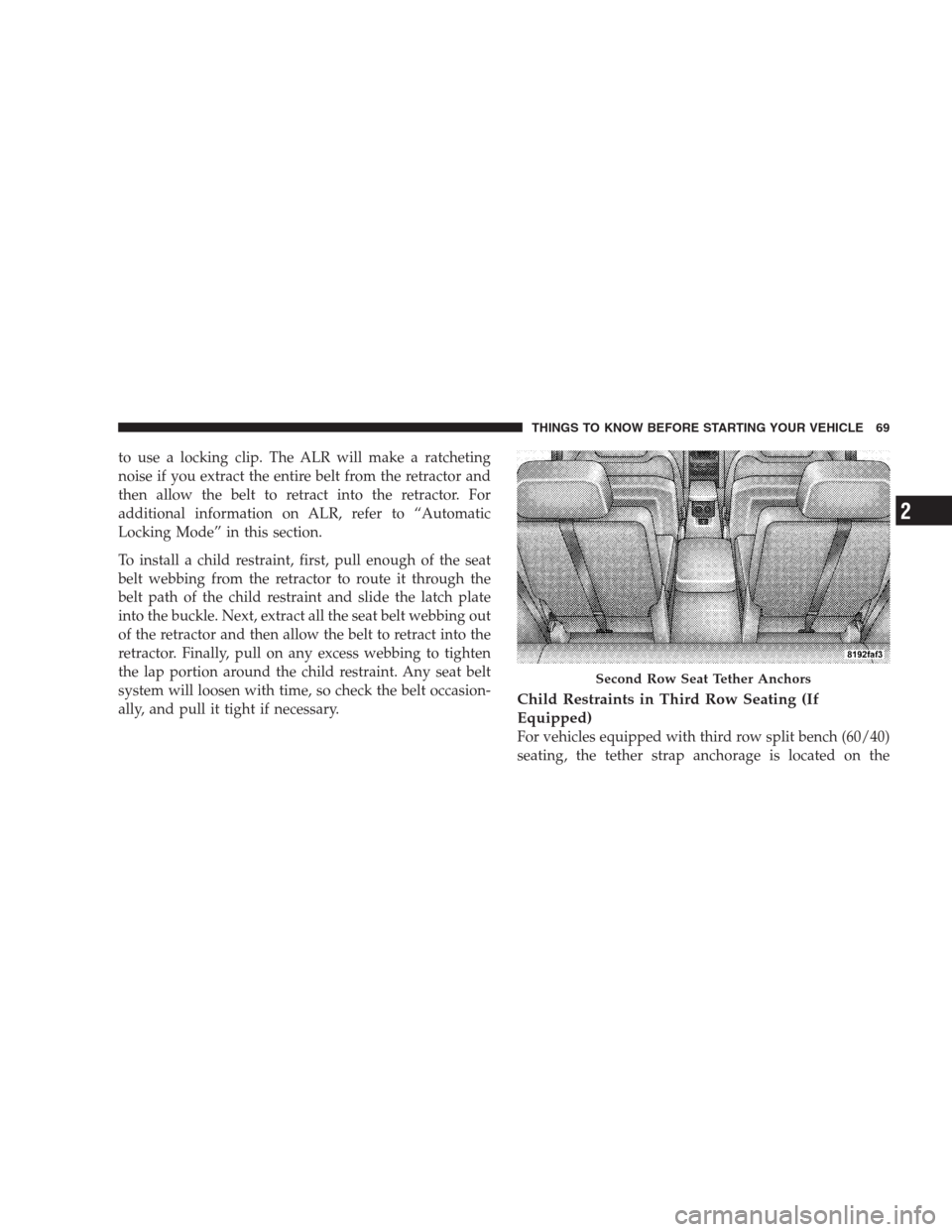
All three second row seating positions have lower an-
chorages that are capable of accommodating LATCH-
compatible child seats having flexible, webbing-mounted
lower attachments. Child seats with fixed lower attach-
ments must be installed in the outboard positions only.
Regardless of the specific type of lower attachment,
NEVERinstall LATCH-compatible child seats such that
two seats share a common lower anchorage. If you are
installing LATCH-compatible child restraints in adjacent
rear seating positions, you can use the LATCH anchors orthe vehicle’s seat belt for the outboard position, but you
must use the vehicle’s seat belt at the center position. If
your child restraints are not LATCH-compatible, you can
only install the child restraints using the vehicle’s seat
belts. Refer to “Installing the LATCH-Compatible Child
Restraint System” in this section.
Second Row Seat Left Side
66 THINGS TO KNOW BEFORE STARTING YOUR VEHICLE
Page 69 of 498
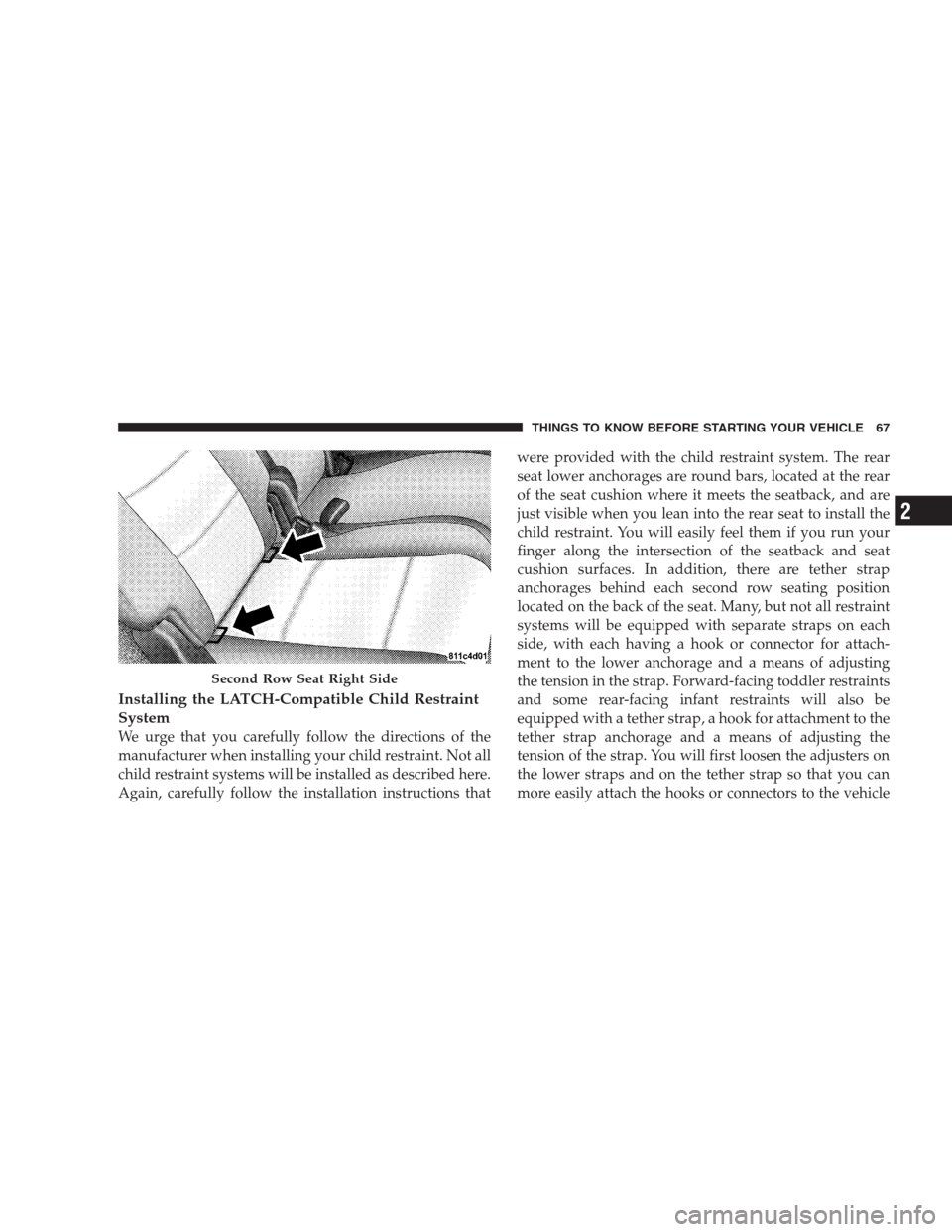
Installing the LATCH-Compatible Child Restraint
System
We urge that you carefully follow the directions of the
manufacturer when installing your child restraint. Not all
child restraint systems will be installed as described here.
Again, carefully follow the installation instructions thatwere provided with the child restraint system. The rear
seat lower anchorages are round bars, located at the rear
of the seat cushion where it meets the seatback, and are
just visible when you lean into the rear seat to install the
child restraint. You will easily feel them if you run your
finger along the intersection of the seatback and seat
cushion surfaces. In addition, there are tether strap
anchorages behind each second row seating position
located on the back of the seat. Many, but not all restraint
systems will be equipped with separate straps on each
side, with each having a hook or connector for attach-
ment to the lower anchorage and a means of adjusting
the tension in the strap. Forward-facing toddler restraints
and some rear-facing infant restraints will also be
equipped with a tether strap, a hook for attachment to the
tether strap anchorage and a means of adjusting the
tension of the strap. You will first loosen the adjusters on
the lower straps and on the tether strap so that you can
more easily attach the hooks or connectors to the vehicle
Second Row Seat Right Side
THINGS TO KNOW BEFORE STARTING YOUR VEHICLE 67
2
Page 70 of 498
anchorages. Next, attach the lower hooks or connectors
over the top of the anchorage bars, pushing aside the seat
cover material. Then attach the tether strap to the anchor-
age located on the back of the seat, being careful to route
the tether strap to provide the most direct path between
the anchor and the child restraint. If your vehicle is
equipped with adjustable rear head restraints, raise the
head restraint and, route the tether strap under the head
restraint and between the two posts. Finally, tighten all
three straps as you push the child restraint rearward and
downward into the seat, removing slack in the straps
according to the child restraint manufacturer’s instruc-
tions.
NOTE:When using the LATCH attaching system to
install a child restraint, please ensure that all seat belts
not being used for occupant restraints are stowed and out
of reach of children. It is recommended that before
installing the child restraint, buckle the seat belt so the
seat belt is tucked behind the child restraint and out ofreach. This should stow the seat belt out of the reach of an
inquisitive child. Remind all children in the vehicle that
the seat belts are not toys and should not be played with,
and never leave an unattended child in the vehicle.
WARNING!
Improper installation of a child restraint to the
LATCH anchorages can lead to failure of an infant or
child restraint. The child could be badly injured or
killed. Follow the manufacturer’s directions exactly
when installing an infant or child restraint.
Installing Child Restraints Using the Vehicle Seat
Belt
The seat belts in the passenger seating positions are
equipped with either an Automatic Locking Retractor
(ALR) or a cinching latch plate or both. Both types of seat
belts are designed to keep the lap portion of the seat belt
tight around the child restraint so that it is not necessary
68 THINGS TO KNOW BEFORE STARTING YOUR VEHICLE
Page 71 of 498
to use a locking clip. The ALR will make a ratcheting
noise if you extract the entire belt from the retractor and
then allow the belt to retract into the retractor. For
additional information on ALR, refer to “Automatic
Locking Mode” in this section.
To install a child restraint, first, pull enough of the seat
belt webbing from the retractor to route it through the
belt path of the child restraint and slide the latch plate
into the buckle. Next, extract all the seat belt webbing out
of the retractor and then allow the belt to retract into the
retractor. Finally, pull on any excess webbing to tighten
the lap portion around the child restraint. Any seat belt
system will loosen with time, so check the belt occasion-
ally, and pull it tight if necessary.
Child Restraints in Third Row Seating (If
Equipped)
For vehicles equipped with third row split bench (60/40)
seating, the tether strap anchorage is located on the
Second Row Seat Tether Anchors
THINGS TO KNOW BEFORE STARTING YOUR VEHICLE 69
2
Page 72 of 498
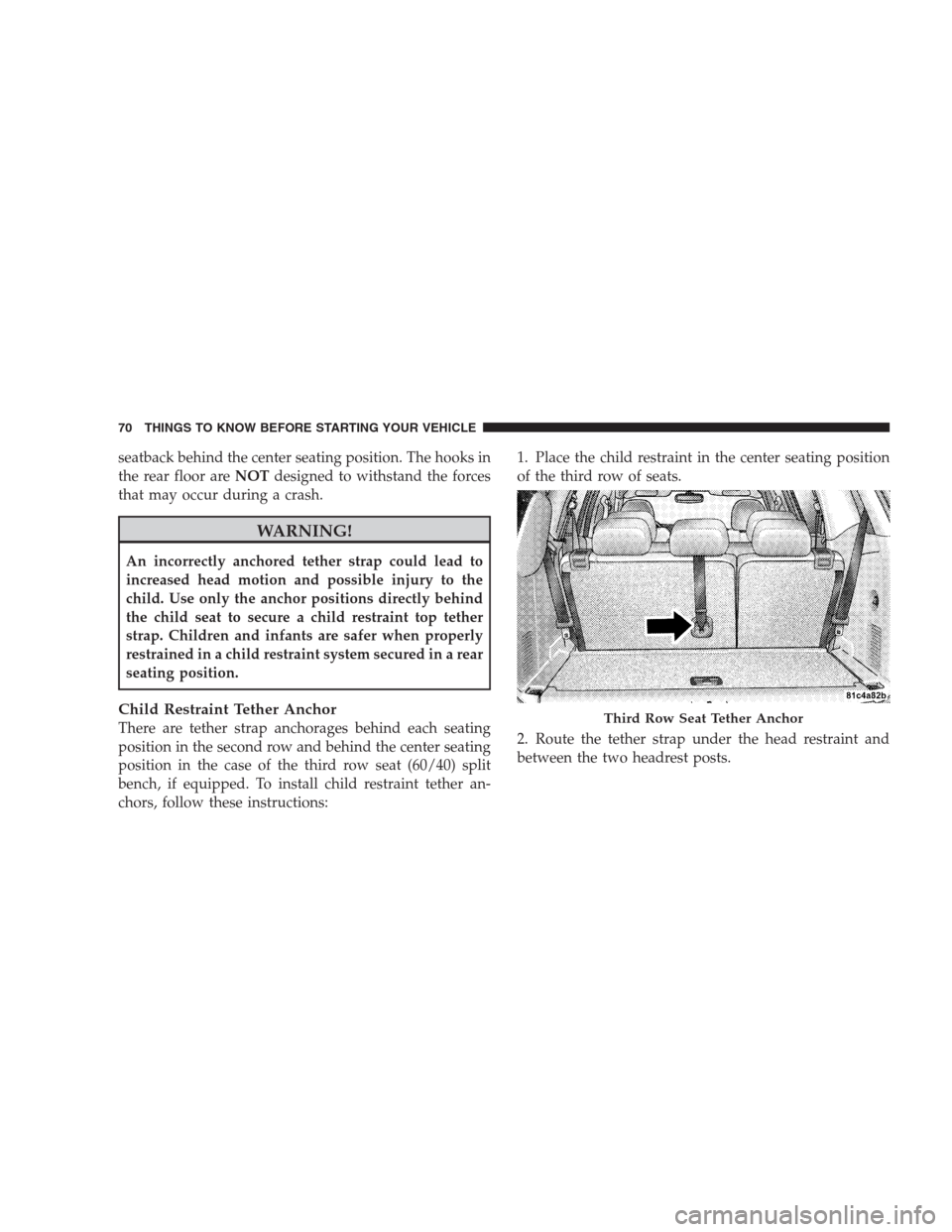
seatback behind the center seating position. The hooks in
the rear floor areNOTdesigned to withstand the forces
that may occur during a crash.
WARNING!
An incorrectly anchored tether strap could lead to
increased head motion and possible injury to the
child. Use only the anchor positions directly behind
the child seat to secure a child restraint top tether
strap. Children and infants are safer when properly
restrained in a child restraint system secured in a rear
seating position.
Child Restraint Tether Anchor
There are tether strap anchorages behind each seating
position in the second row and behind the center seating
position in the case of the third row seat (60/40) split
bench, if equipped. To install child restraint tether an-
chors, follow these instructions:1. Place the child restraint in the center seating position
of the third row of seats.
2. Route the tether strap under the head restraint and
between the two headrest posts.Third Row Seat Tether Anchor
70 THINGS TO KNOW BEFORE STARTING YOUR VEHICLE
Page 73 of 498
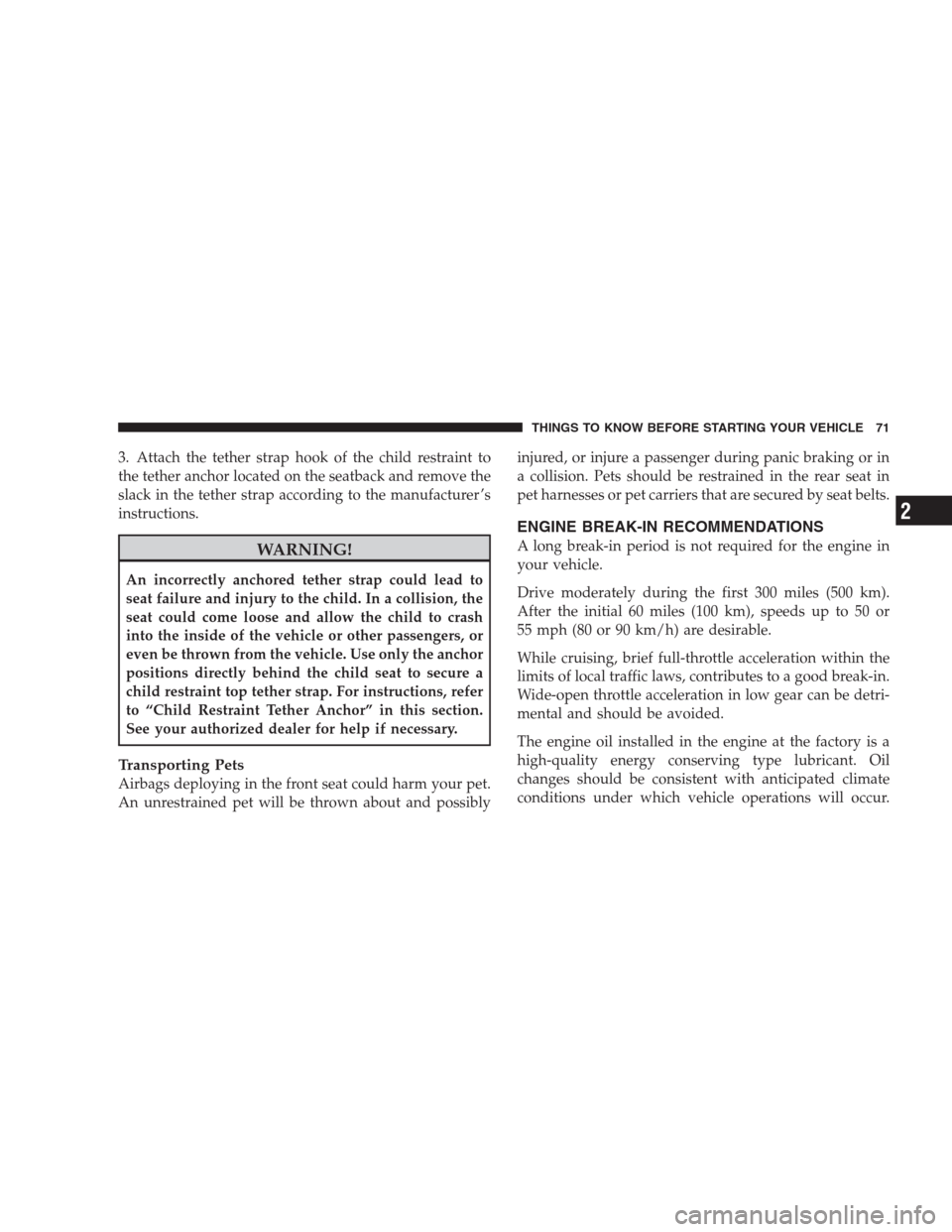
3. Attach the tether strap hook of the child restraint to
the tether anchor located on the seatback and remove the
slack in the tether strap according to the manufacturer ’s
instructions.
WARNING!
An incorrectly anchored tether strap could lead to
seat failure and injury to the child. In a collision, the
seat could come loose and allow the child to crash
into the inside of the vehicle or other passengers, or
even be thrown from the vehicle. Use only the anchor
positions directly behind the child seat to secure a
child restraint top tether strap. For instructions, refer
to “Child Restraint Tether Anchor” in this section.
See your authorized dealer for help if necessary.
Transporting Pets
Airbags deploying in the front seat could harm your pet.
An unrestrained pet will be thrown about and possiblyinjured, or injure a passenger during panic braking or in
a collision. Pets should be restrained in the rear seat in
pet harnesses or pet carriers that are secured by seat belts.
ENGINE BREAK-IN RECOMMENDATIONS
A long break-in period is not required for the engine in
your vehicle.
Drive moderately during the first 300 miles (500 km).
After the initial 60 miles (100 km), speeds up to 50 or
55 mph (80 or 90 km/h) are desirable.
While cruising, brief full-throttle acceleration within the
limits of local traffic laws, contributes to a good break-in.
Wide-open throttle acceleration in low gear can be detri-
mental and should be avoided.
The engine oil installed in the engine at the factory is a
high-quality energy conserving type lubricant. Oil
changes should be consistent with anticipated climate
conditions under which vehicle operations will occur.
THINGS TO KNOW BEFORE STARTING YOUR VEHICLE 71
2
Page 478 of 498
Cargo Organizer........................ 191
Cargo (Vehicle Loading)................... 358
Cellular Phone........................86,268
Center High Mounted Stop Light............ 441
Certification Label....................... 358
Charging.............................. 388
Chart, Tire Sizing........................ 322
Check Engine Light
(Malfunction Indicator Light)............... 399
Checking Your Vehicle For Safety............. 72
Checks, Safety........................... 72
Child Restraint......................62,63,64
Child Restraint Tether Anchors.............65,70
Child Seat.............................. 67
Circuit Breakers......................... 426
Cleaning
Wheels............................. 423
Climate Control......................... 269
Climate Control, Rear Zone..............272,278Clock.....................215,216,220,235,245
Compact Disc (CD) Maintenance............. 267
Compact Spare Tire...................... 332
Compass Calibration..................... 174
Compass Variance....................... 174
Connector
UCI ................................ 255
Universal Consumer Interface (UCI)......... 255
Console, Floor.......................189,190
Console, Overhead....................165,166
Contract, Service........................ 467
Coolant Pressure Cap
(Radiator Cap).................395,396,397,413
Cooling System......................... 410
Adding Coolant (Antifreeze).............. 412
Coolant Capacity...................... 443
Coolant Level......................410,414
Disposal of Used Coolant................ 414
Drain, Flush, and Refill.................. 411
476 INDEX
Page 488 of 498
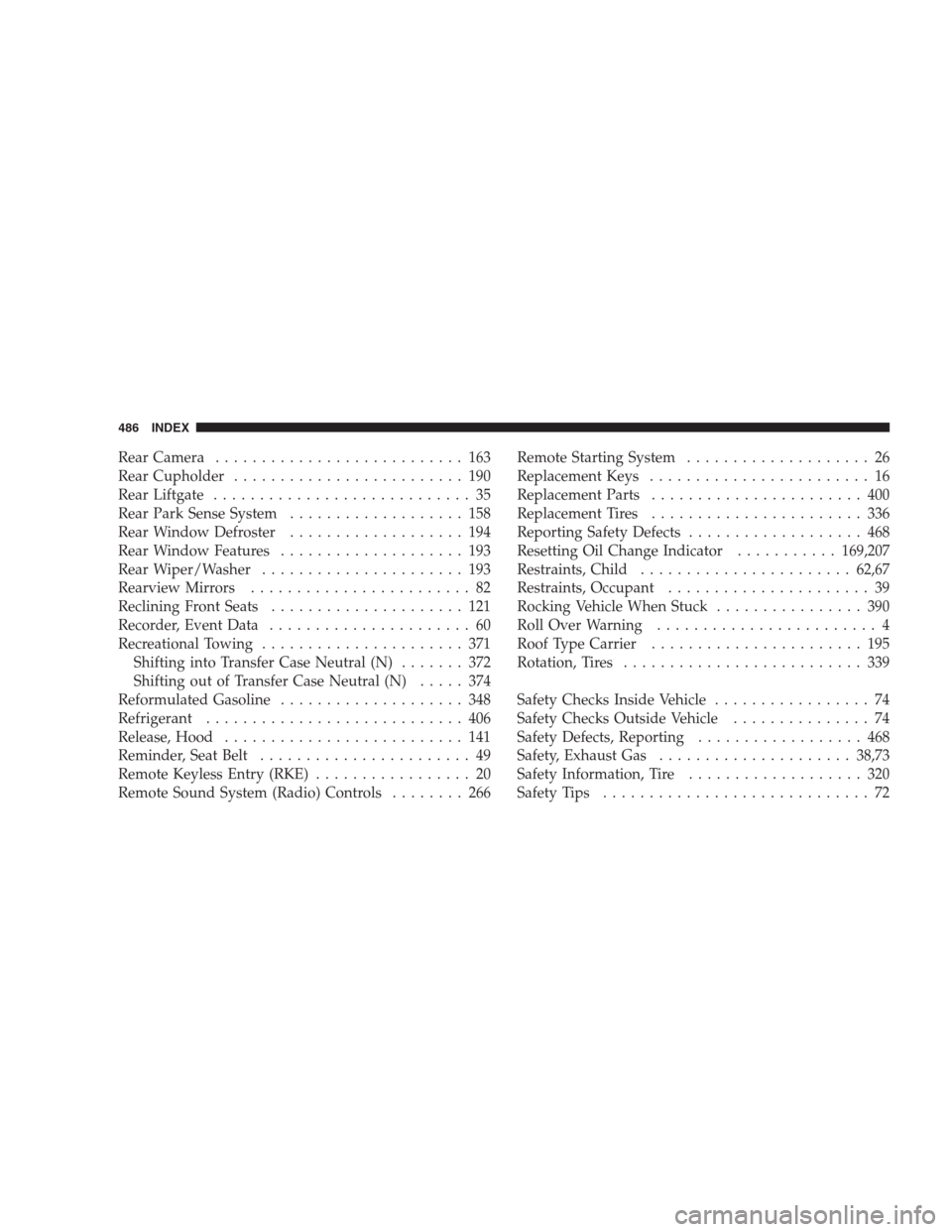
Rear Camera........................... 163
Rear Cupholder......................... 190
Rear Liftgate............................ 35
Rear Park Sense System................... 158
Rear Window Defroster................... 194
Rear Window Features.................... 193
Rear Wiper/Washer...................... 193
Rearview Mirrors........................ 82
Reclining Front Seats..................... 121
Recorder, Event Data...................... 60
Recreational Towing...................... 371
Shifting into Transfer Case Neutral (N)....... 372
Shifting out of Transfer Case Neutral (N)..... 374
Reformulated Gasoline.................... 348
Refrigerant............................ 406
Release, Hood.......................... 141
Reminder, Seat Belt....................... 49
Remote Keyless Entry (RKE)................. 20
Remote Sound System (Radio) Controls........ 266Remote Starting System.................... 26
Replacement Keys........................ 16
Replacement Parts....................... 400
Replacement Tires....................... 336
Reporting Safety Defects................... 468
Resetting Oil Change Indicator...........169,207
Restraints, Child.......................62,67
Restraints, Occupant...................... 39
Rocking Vehicle When Stuck................ 390
Roll Over Warning........................ 4
Roof Type Carrier....................... 195
Rotation, Tires.......................... 339
Safety Checks Inside Vehicle................. 74
Safety Checks Outside Vehicle............... 74
Safety Defects, Reporting.................. 468
Safety, Exhaust Gas.....................38,73
Safety Information, Tire................... 320
Safety Tips............................. 72
486 INDEX
Page 489 of 498
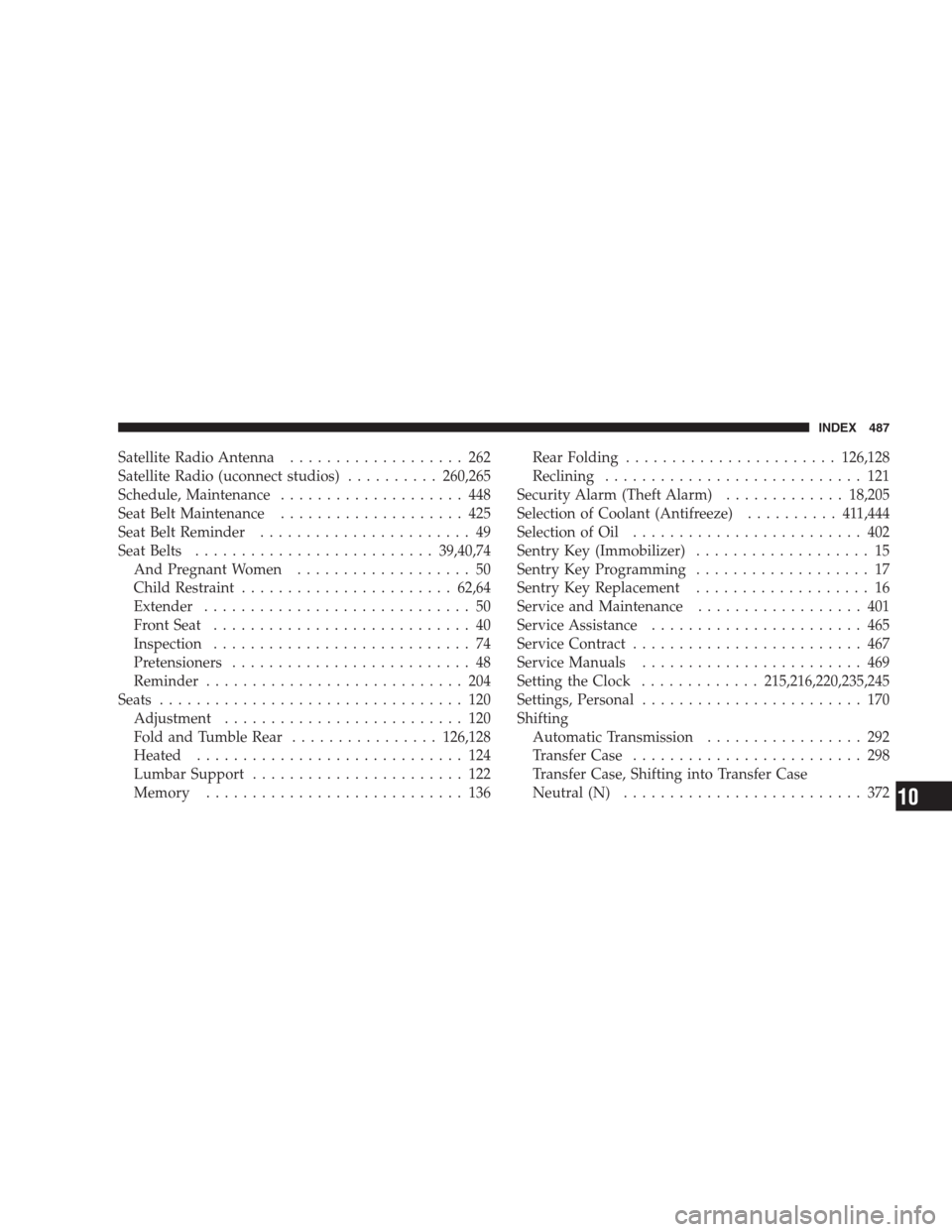
Satellite Radio Antenna................... 262
Satellite Radio (uconnect studios)..........260,265
Schedule, Maintenance.................... 448
Seat Belt Maintenance.................... 425
Seat Belt Reminder....................... 49
Seat Belts..........................39,40,74
And Pregnant Women................... 50
Child Restraint.......................62,64
Extender............................. 50
Front Seat............................ 40
Inspection............................ 74
Pretensioners.......................... 48
Reminder............................ 204
Seats................................. 120
Adjustment.......................... 120
Fold and Tumble Rear................126,128
Heated............................. 124
Lumbar Support....................... 122
Memory............................ 136Rear Folding.......................126,128
Reclining............................ 121
Security Alarm (Theft Alarm).............18,205
Selection of Coolant (Antifreeze).......... 411,444
Selection of Oil......................... 402
Sentry Key (Immobilizer)................... 15
Sentry Key Programming................... 17
Sentry Key Replacement................... 16
Service and Maintenance.................. 401
Service Assistance....................... 465
Service Contract......................... 467
Service Manuals........................ 469
Setting the Clock.............215,216,220,235,245
Settings, Personal........................ 170
Shifting
Automatic Transmission................. 292
Transfer Case......................... 298
Transfer Case, Shifting into Transfer Case
Neutral (N).......................... 372
INDEX 487
10