traction control DODGE DURANGO 2011 3.G User Guide
[x] Cancel search | Manufacturer: DODGE, Model Year: 2011, Model line: DURANGO, Model: DODGE DURANGO 2011 3.GPages: 576, PDF Size: 3.57 MB
Page 371 of 576
Differential (BLD), functions similar to a limited-slip
differential and controls the wheel spin across a driven
axle. If one wheel on a driven axle is spinning faster than
the other, the system will apply the brake of the spinning
wheel. This will allow more engine torque to be applied
to the wheel that is not spinning. This feature remains
active even if ESC system is in the “Partial Off” mode.
Refer to “Electronic Stability Control (ESC)” in this
section for more information.
Brake Assist System (BAS)
The BAS is designed to optimize the vehicle’s braking
capability during emergency braking maneuvers. The
system detects an emergency braking situation by sens-
ing the rate and amount of brake application and then
applies optimum pressure to the brakes. This can help
reduce braking distances. The BAS complements the
anti-lock brake system (ABS). Applying the brakes very
quickly results in the best BAS assistance. To receive thebenefit of the system, you must apply
continuousbrak-
ing pressure during the stopping sequence (do not
“pump” the brakes). Do not reduce brake pedal pressure
unless braking is no longer desired. Once the brake pedal
is released, the BAS is deactivated.
WARNING!
The BAS cannot prevent the natural laws of physics
from acting on the vehicle, nor can it increase the
traction afforded by prevailing road conditions. The
BAS cannot prevent collisions, including those re-
sulting from excessive speed in turns, driving on
very slippery surfaces, or hydroplaning. The capa-
bilities of a BAS-equipped vehicle must never be
exploited in a reckless or dangerous manner which
could jeopardize the user’s safety or the safety of
others.
5
STARTING AND OPERATING 369
Page 373 of 576
ESC uses sensors in the vehicle to determine the vehicle
path intended by the driver and compares it to the actual
path of the vehicle. When the actual path does not match
the intended path, ESC applies the brake of the appro-
priate wheel to assist in counteracting the oversteer or
understeer condition.
•Oversteer - when the vehicle is turning more than
appropriate for the steering wheel position.
•Understeer - when the vehicle is turning less than
appropriate for the steering wheel position.
The “ESC Malfunction Indicator Light” located in the
instrument cluster will start to flash as soon as the tires
lose traction and the ESC system becomes active. The
“ESC Malfunction Indicator Light” also flashes when the
TCS is active. If the “ESC Malfunction Indicator Light”
begins to flash during acceleration, ease up on the accelerator and apply as little throttle as possible. Be sure
to adapt your speed and driving to the prevailing road
conditions.
WARNING!
The Electronic Stability Control (ESC) cannot pre-
vent the natural laws of physics from acting on the
vehicle, nor can it increase the traction afforded by
prevailing road conditions. ESC cannot prevent col-
lisions, including those resulting from excessive
speed in turns, driving on very slippery surfaces, or
hydroplaning. The capabilities of an ESC equipped
vehicle must never be exploited in a reckless or
dangerous manner which could jeopardize the user ’s
safety or the safety of others.
The ESC system has two available operating modes in
AWD AUTO range and two-wheel drive vehicles, and
one operating mode in AWD LOW range.
5
STARTING AND OPERATING 371
Page 375 of 576
NOTE:To improve the vehicle’s traction when driving
with snow chains, or starting off in deep snow, sand, or
gravel, it may be desirable to switch to the “Partial Off”
mode by pressing the “ESC OFF” switch. Once the
situation requiring ESC to be switched to the “Partial
Off” mode is overcome, turn ESC back on by momen-
tarily pressing the “ESC OFF” switch. This may be done
while the vehicle is in motion.
AWD Low Range (LOW)
Partial Off
This is the normal operating mode for ESC in AWD LOW
range. Whenever the vehicle is started in AWD LOW
range, or the transfer case (if equipped) is shifted from
AWD AUTO range or NEUTRAL to AWD LOW range,
the ESC system will be in the “Partial Off” mode.
Trailer Sway Control (TSC)
TSC uses sensors in the vehicle to recognize an exces-
sively swaying trailer and will take the appropriate
actions to attempt to stop the sway. The system may
reduce engine power and apply the brake of the appro-
priate wheel(s) to counteract the sway of the trailer. TSC
will become active automatically once an excessively
swaying trailer is recognized. No driver action is re-
quired. Note that TSC cannot stop all trailers from
swaying. Always use caution when towing a trailer and
follow the trailer tongue weight recommendations. Refer
to “Trailer Towing” in “Starting and Operating” for
further information. When TSC is functioning, the “ESC
Malfunction Indicator Light” will flash, the engine power
may be reduced and you may feel the brakes being
applied to individual wheels to attempt to stop the trailer
from swaying. TSC is disabled when the ESC system is in
the “Partial Off” mode.
5
STARTING AND OPERATING 373
Page 379 of 576
ESC Malfunction Indicator Light And ESC OFF
Indicator Light
The “ESC Malfunction Indicator Light” in the
instrument cluster will come on when the
ignition switch is turned to the ON position. It
should go out with the engine running. If the
“ESC Malfunction Indicator Light” comes on continu-
ously with the engine running, a malfunction has been
detected in the ESC system. If this light remains on after
several ignition cycles, and the vehicle has been driven
several miles (kilometers) at speeds greater than 30 mph
(48 km/h), see your authorized dealer as soon as possible
to have the problem diagnosed and corrected.
The “ESC OFF Indicator Light” indicates the
Electronic Stability Control (ESC) is off. The “ESC Malfunction Indicator Light” (located in the
instrument cluster) starts to flash as soon as the tires lose
traction and the ESC system becomes active. The “ESC
Malfunction Indicator Light” also flashes when TCS is
active. If the “ESC Malfunction Indicator Light” begins to
flash during acceleration, ease up on the accelerator and
apply as little throttle as possible. Be sure to adapt your
speed and driving to the prevailing road conditions.
NOTE:
•The “ESC Malfunction Indicator Light” and the “ESC
OFF Indicator Light” come on momentarily each time
the ignition switch is turned ON.
•Each time the ignition is turned ON, the ESC system
will be ON even if it was turned off previously.
•The ESC system will make buzzing or clicking sounds
when it is active. This is normal; the sounds will stop
when ESC becomes inactive following the maneuver
that caused the ESC activation.
5
STARTING AND OPERATING 377
Page 399 of 576
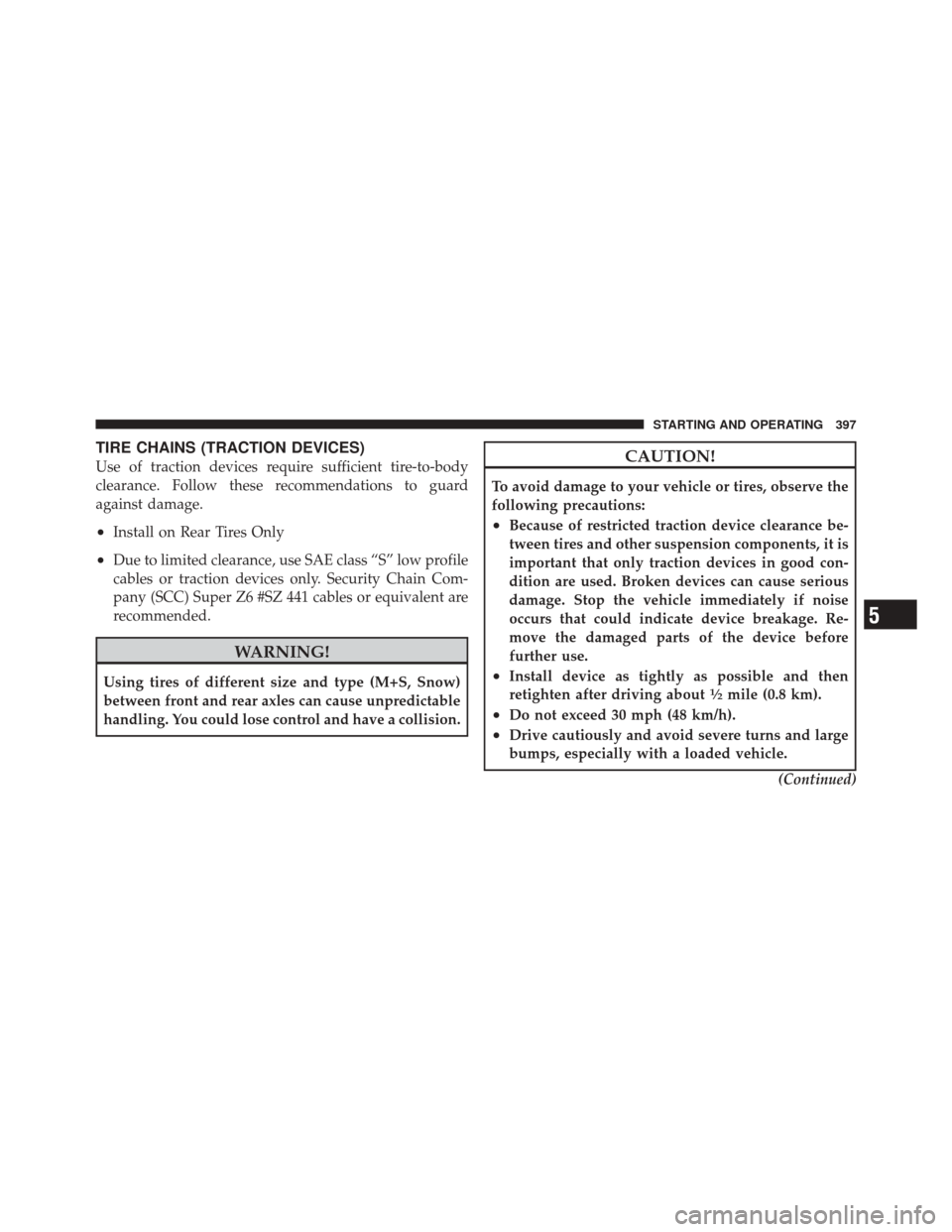
TIRE CHAINS (TRACTION DEVICES)
Use of traction devices require sufficient tire-to-body
clearance. Follow these recommendations to guard
against damage.
•Install on Rear Tires Only
•Due to limited clearance, use SAE class “S” low profile
cables or traction devices only. Security Chain Com-
pany (SCC) Super Z6 #SZ 441 cables or equivalent are
recommended.
WARNING!
Using tires of different size and type (M+S, Snow)
between front and rear axles can cause unpredictable
handling. You could lose control and have a collision.
CAUTION!
To avoid damage to your vehicle or tires, observe the
following precautions:
•Because of restricted traction device clearance be-
tween tires and other suspension components, it is
important that only traction devices in good con-
dition are used. Broken devices can cause serious
damage. Stop the vehicle immediately if noise
occurs that could indicate device breakage. Re-
move the damaged parts of the device before
further use.
•Install device as tightly as possible and then
retighten after driving about12mile (0.8 km).
•Do not exceed 30 mph (48 km/h).
•Drive cautiously and avoid severe turns and large
bumps, especially with a loaded vehicle.(Continued)
5
STARTING AND OPERATING 397
Page 553 of 576

DEPARTMENT OF TRANSPORTATION UNIFORM
TIRE QUALITY GRADES
The following tire grading categories were established by
the National Highway Traffic Safety Administration. The
specific grade rating assigned by the tire’s manufacturer
in each category is shown on the sidewall of the tires on
your vehicle.
All passenger car tires must conform to Federal safety
requirements in addition to these grades.
Treadwear
The Treadwear grade is a comparative rating, based on
the wear rate of the tire when tested under controlled
conditions on a specified government test course. For
example, a tire graded 150 would wear one and one-half
times as well on the government course as a tire graded
100. The relative performance of tires depends upon the
actual conditions of their use, however, and may departsignificantly from the norm due to variations in driving
habits, service practices, and differences in road charac-
teristics and climate.
Traction Grades
The Traction grades, from highest to lowest, are AA, A, B,
and C. These grades represent the tire’s ability to stop on
wet pavement, as measured under controlled conditions
on specified government test surfaces of asphalt and
concrete. A tire marked C may have poor traction perfor-
mance.
WARNING!
The traction grade assigned to this tire is based on
straight-ahead braking traction tests, and does not
include acceleration, cornering, hydroplaning, or
peak traction characteristics.
9
IF YOU NEED CONSUMER ASSISTANCE 551
Page 560 of 576
Electrical Outlet, Auxiliary (Power Outlet)...... 216
Electronic Brake Control System ............. 368
Anti-Lock Brake System ................ 368
Brake Assist System ................... 369
Electronic Roll Mitigation ............... 370
Traction Control System ................ 368
Electronic Roll Mitigation (ERM) ............. 370
Electronic Speed Control (Cruise Control) ....163,166
Electronic Stability Control (ESC) ............. 370
Electronic Vehicle Information Center
(EVIC) ............................. 248,254
Electronically Shifted Transfer Case ........... 351
Emergency, In Case of Hazard Warning Flasher ............... 448
Jacking ............................ 449
Jump Starting ....................... 463
Tow Hooks ......................... 467
Emission Control System Maintenance ......... 478Engine
Air Cleaner ......................... 484
Block Heater ........................ 341
Break-In Recommendations .............. 95
Compartment .................... 475,476
Compartment Identification ..........475,476
Cooling ........................... 494
Exhaust Gas Caution ..............48,97,414
Fails to Start ........................ 340
Flooded, Starting ..................... 340
Fuel Requirements ................. 410,524
Jump Starting ....................... 463
Multi-Displacement ................... 365
Oil ............................ 481,524
Oil Change Interval ................... 482
Oil Disposal ........................ 484
Oil Filter ........................... 484
Oil Filter Disposal .................... 484
Oil Selection ..................... 482,524
558 INDEX
Page 565 of 576
Center Mounted Stop.................. 523
Check Engine (Malfunction Indicator) ...... 262
Daytime Running .................... 149
Dimmer Switch, Headlight .............. 146
Electronic Stability Program (ESP) Indicator . . 377
Exterior ........................... 100
Fog ............................ 248,520
Fuses ............................. 511
Hazard Warning Flasher ............... 448
Headlights ...................... 518,519
Headlights On With Wipers ............. 147
High Beam Indicator .................. 248
Illuminated Entry ..................... 23
Low Fuel .......................... 263
Malfunction Indicator (Check Engine) ...... 245
Map Reading ....................... 152
Reading ........................ 152,204
Rear Servicing ....................... 521
Rear Tail ........................... 521 Seat Belt Reminder
................... 252
Security Alarm (Theft Alarm) ............ 250
Service ............................ 518
Service Engine Soon
(Malfunction Indicator) ................ 245
Side Marker ........................ 521
SmartBeams ........................ 148
Tire Pressure Monitoring (TPMS) ......... 244
Traction Control ..................... 377
Turn Signal ................ 100,146,519,521
Vanity Mirror ....................... 110
Loading Vehicle ......................... 422
Tires .............................. 383
Locks ................................. 33
Automatic Door ...................... 35
Child Protection ...................... 36
Door .............................. 33
Power Door ......................... 34
10
INDEX 563
Page 573 of 576
Tread Wear Indicators................. 394
Tongue Weight/Trailer Weight .............. 431
Torque Converter Clutch .................. 349
Tow Hooks, Emergency ................... 467
Towing ............................ 424,469
Disabled Vehicle ..................... 469
Guide ............................. 430
Recreational ........................ 439
Weight ............................ 430
Traction Control ......................... 368
Trailer Sway Control (TSC) ................. 373
Trailer Towing .......................... 424
Cooling System Tips .................. 438
Hitches ............................ 429
Minimum Requirements ................ 432
Trailer and Tongue Weight .............. 431
Wiring ............................ 435
Trailer Towing Guide ..................... 430
Trailer Weight .......................... 430 Transfer Case
........................... 502
Electronically Shifted .................. 351
Maintenance ........................ 502
Transmission Automatic ....................... 343,503
Maintenance ........................ 503
Shifting ........................... 342
Transmitter Battery Service
(Remote Keyless Entry) .................... 27
Transmitter Programming
(Remote Keyless Entry) .................... 24
Transmitter, Garage Door Opener (HomeLink®) . . 206
Transmitter, Remote Keyless Entry (RKE) ........ 24
Tread Wear Indicators .................... 394
Turn Signals ...................... 248,519,521
UCI Connector ......................... 308
Uconnect™ (Hands-Free Phone) ............. 119
Uniform Tire Quality Grades ................ 551
10
INDEX 571