head DODGE DURANGO 2013 3.G User Guide
[x] Cancel search | Manufacturer: DODGE, Model Year: 2013, Model line: DURANGO, Model: DODGE DURANGO 2013 3.GPages: 699, PDF Size: 5.53 MB
Page 65 of 699
CAUTION!
All occupants, including the driver, should not oper-
ate a vehicle or sit in a vehicle’s seat until the head
restraints are placed in their proper positions in order
to minimize the risk of neck injury in the event of a
collision.
NOTE: For more information on properly adjusting and
positioning the head restraint, refer to “Adjusting Active
Head Restraints” in “Understanding The Features Of
Your Vehicle”.
Resetting Active Head Restraints (AHR)
If the Active Head Restraints are triggered in a collision,
you must reset the head restraint on the driver ’s and
front passenger seat. You can recognize when the Active
Head Restraint has been triggered by the fact that they
have moved forward (as shown in step three of the
resetting procedure).
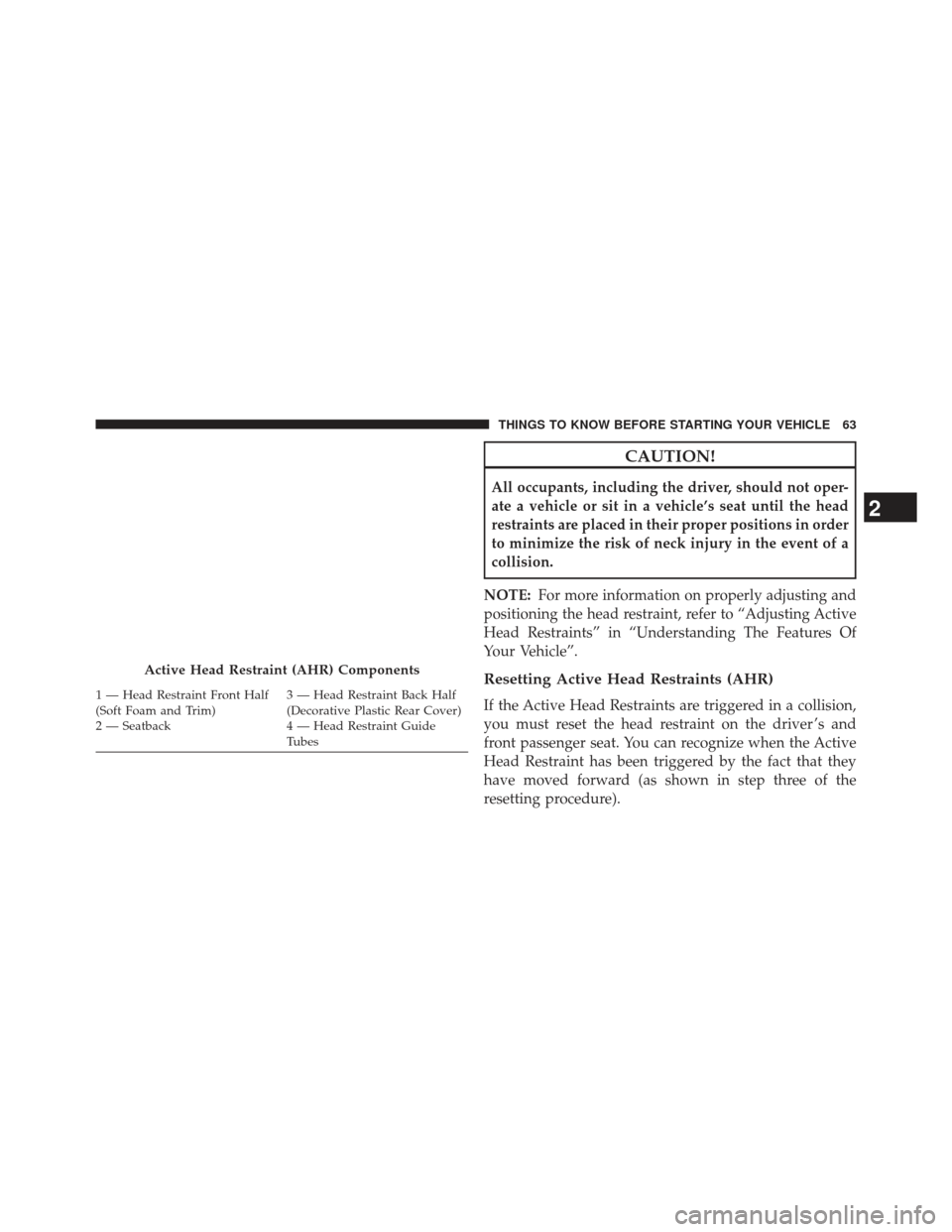
Active Head Restraint (AHR) Components
1 — Head Restraint Front Half
(Soft Foam and Trim) 3 — Head Restraint Back Half
(Decorative Plastic Rear Cover)
2 — Seatback 4 — Head Restraint Guide Tubes
2
THINGS TO KNOW BEFORE STARTING YOUR VEHICLE 63
Page 67 of 699
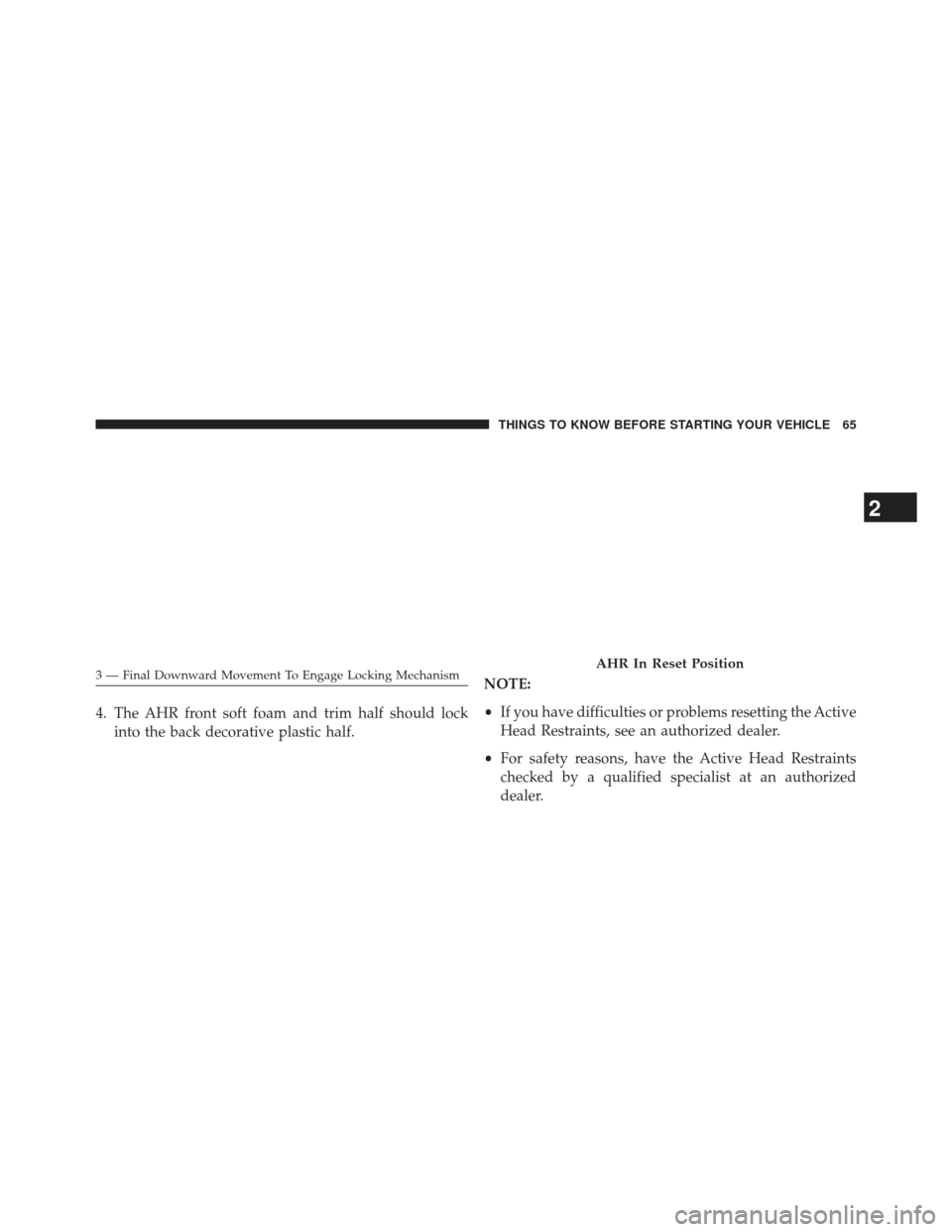
4. The AHR front soft foam and trim half should lockinto the back decorative plastic half. NOTE:
•
If you have difficulties or problems resetting the Active
Head Restraints, see an authorized dealer.
• For safety reasons, have the Active Head Restraints
checked by a qualified specialist at an authorized
dealer.
3 — Final Downward Movement To Engage Locking MechanismAHR In Reset Position
2
THINGS TO KNOW BEFORE STARTING YOUR VEHICLE 65
Page 74 of 699
When the air bag deploys, it opens the seam between the
front and side of the seat’s trim cover. Each air bag
deploys independently; a left side impact deploys the left
air bag only and a right-side impact deploys the right air
bag only.
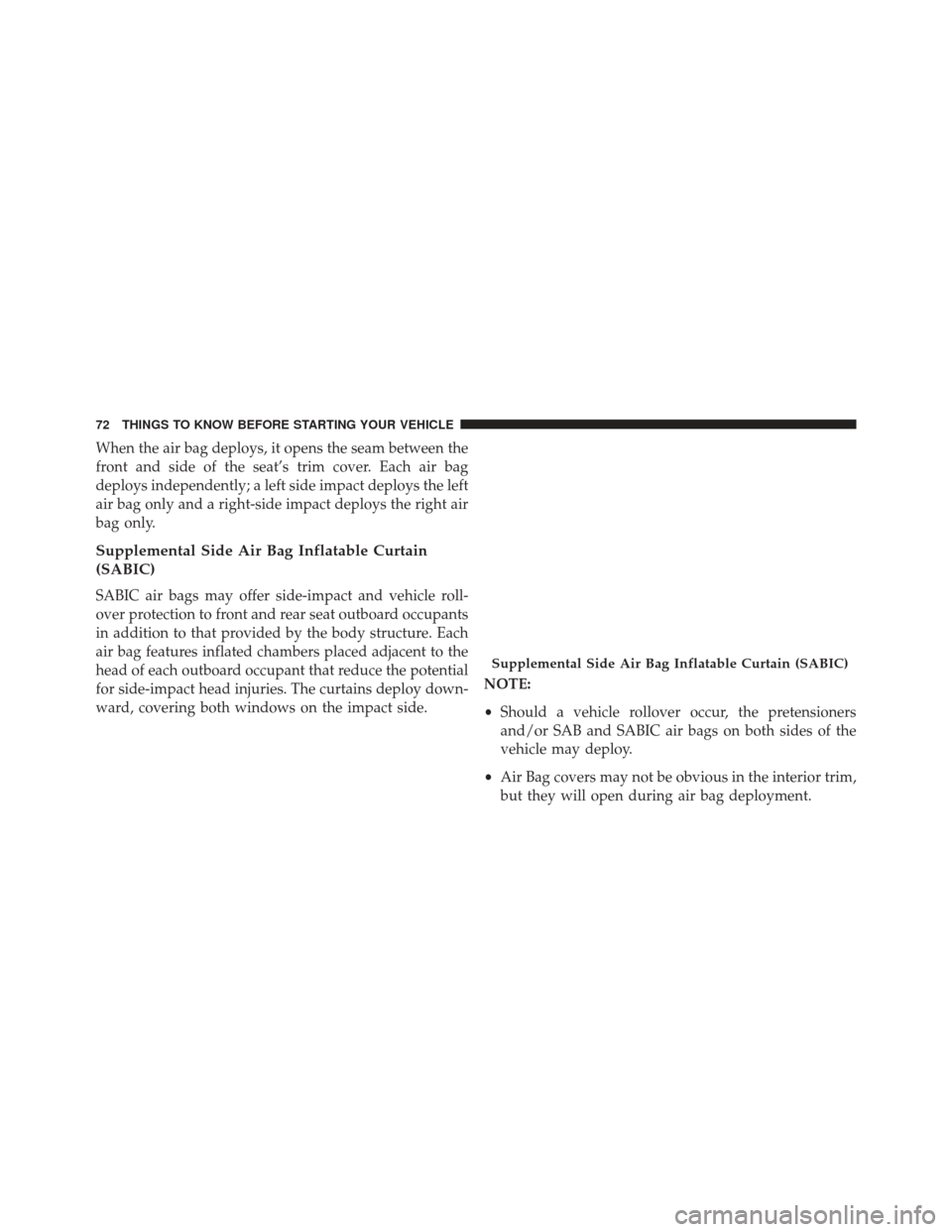
Supplemental Side Air Bag Inflatable Curtain
(SABIC)
SABIC air bags may offer side-impact and vehicle roll-
over protection to front and rear seat outboard occupants
in addition to that provided by the body structure. Each
air bag features inflated chambers placed adjacent to the
head of each outboard occupant that reduce the potential
for side-impact head injuries. The curtains deploy down-
ward, covering both windows on the impact side.NOTE:
•
Should a vehicle rollover occur, the pretensioners
and/or SAB and SABIC air bags on both sides of the
vehicle may deploy.
• Air Bag covers may not be obvious in the interior trim,
but they will open during air bag deployment.
Supplemental Side Air Bag Inflatable Curtain (SABIC)
72 THINGS TO KNOW BEFORE STARTING YOUR VEHICLE
Page 80 of 699
A quantity of non-toxic gas is generated to inflate the
SABIC. The inflating SABIC pushes the outside edge of
the headliner out of the way and covers the window. The
SABIC inflates in about 30 milliseconds (about one-
quarter of the time that it takes to blink your eyes) with
enough force to injure you if you are not belted and
seated properly, or if items are positioned in the area
where the SABIC inflates. This especially applies to
children. The SABIC is only about 3-1/2 in (9 cm) thick
when it is inflated.
Because air bag sensors estimate deceleration over time,
vehicle speed and damage are not good indicators of
whether or not an air bag should have deployed.
NOTE:In a rollover the pretensioners and/or SAB and
SABIC air bags may deploy on both sides of the vehicle.Front And Side Impact Sensors
In front and side impacts, impact sensors can aid the ORC
in determining appropriate response to impact events.
Enhanced Accident Response System
In the event of an impact causing air bag deployment, if
the communication network remains intact, and the
power remains intact, depending on the nature of the
event the ORC will determine whether to have the
Enhanced Accident Response System perform the follow-
ing functions:
• Cut off fuel to the engine.
• Flash hazard lights as long as the battery has power or
until the ignition key is turned off.
• Turn on the interior lights, which remain on as long as
the battery has power or until the ignition key is
removed.
78 THINGS TO KNOW BEFORE STARTING YOUR VEHICLE
Page 94 of 699
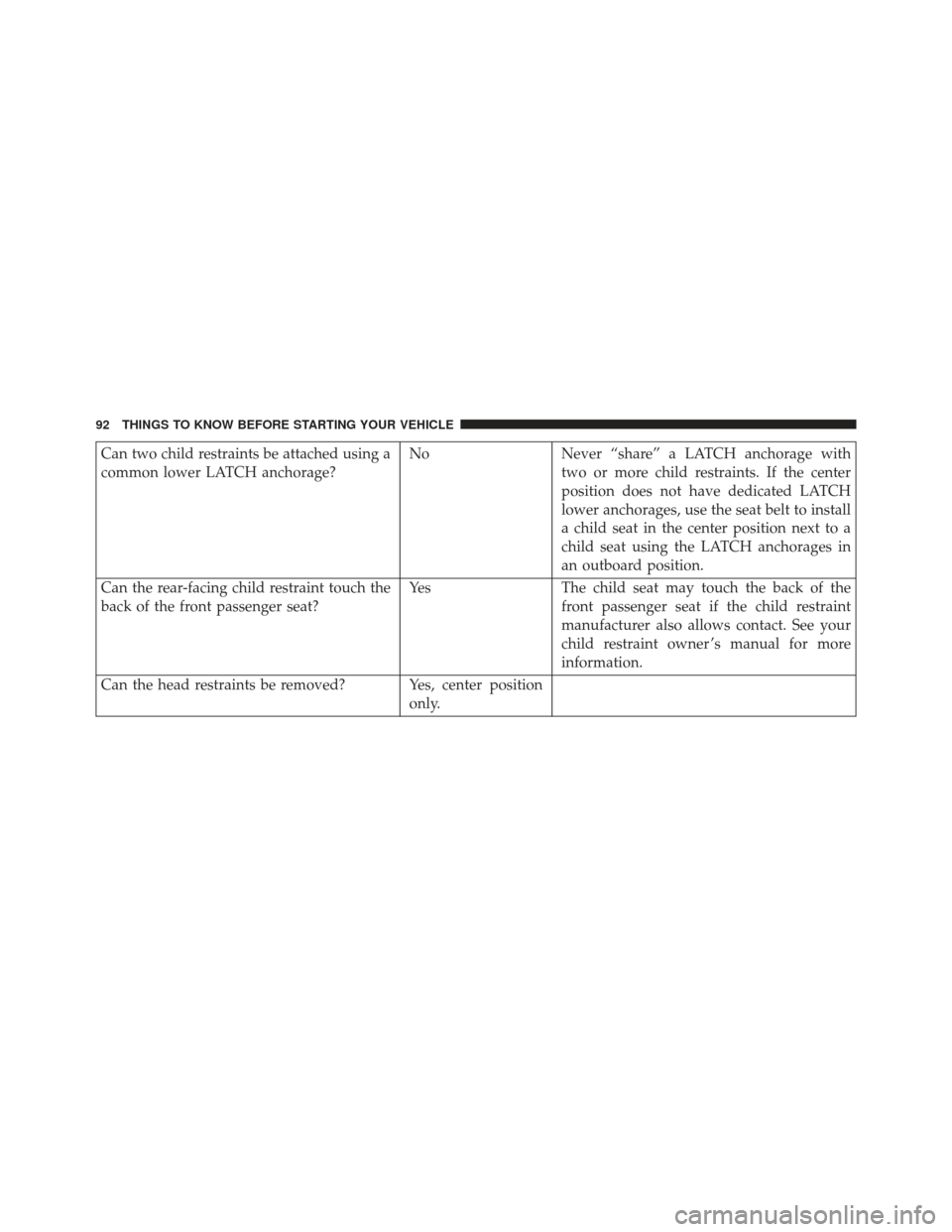
Can two child restraints be attached using a
common lower LATCH anchorage?No Never “share” a LATCH anchorage with
two or more child restraints. If the center
position does not have dedicated LATCH
lower anchorages, use the seat belt to install
a child seat in the center position next to a
child seat using the LATCH anchorages in
an outboard position.
Can the rear-facing child restraint touch the
back of the front passenger seat? Yes
The child seat may touch the back of the
front passenger seat if the child restraint
manufacturer also allows contact. See your
child restraint owner ’s manual for more
information.
Can the head restraints be removed? Yes, center position only.
92 THINGS TO KNOW BEFORE STARTING YOUR VEHICLE
Page 99 of 699
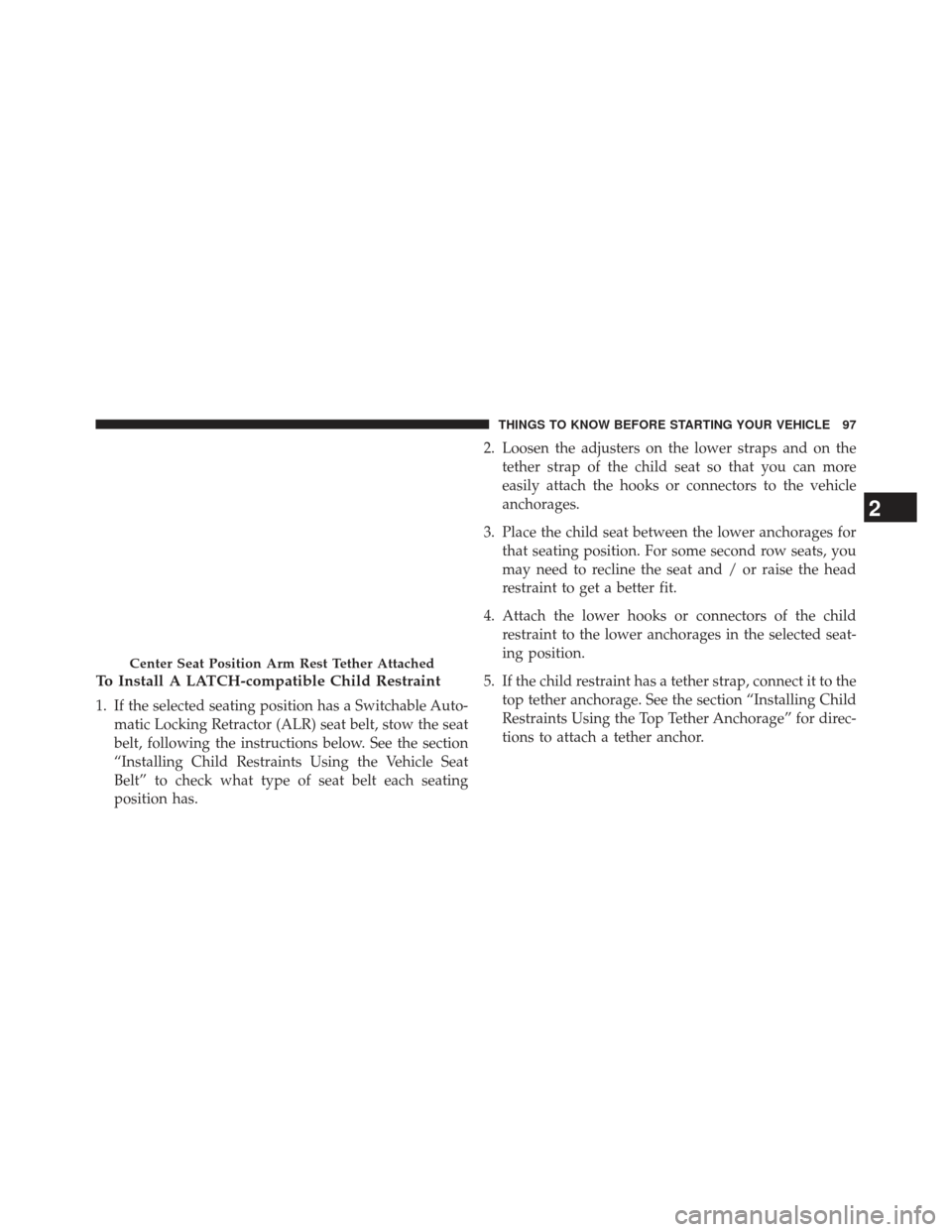
To Install A LATCH-compatible Child Restraint
1. If the selected seating position has a Switchable Auto-matic Locking Retractor (ALR) seat belt, stow the seat
belt, following the instructions below. See the section
“Installing Child Restraints Using the Vehicle Seat
Belt” to check what type of seat belt each seating
position has. 2. Loosen the adjusters on the lower straps and on the
tether strap of the child seat so that you can more
easily attach the hooks or connectors to the vehicle
anchorages.
3. Place the child seat between the lower anchorages for that seating position. For some second row seats, you
may need to recline the seat and / or raise the head
restraint to get a better fit.
4. Attach the lower hooks or connectors of the child restraint to the lower anchorages in the selected seat-
ing position.
5. If the child restraint has a tether strap, connect it to the top tether anchorage. See the section “Installing Child
Restraints Using the Top Tether Anchorage” for direc-
tions to attach a tether anchor.
Center Seat Position Arm Rest Tether Attached
2
THINGS TO KNOW BEFORE STARTING YOUR VEHICLE 97
Page 103 of 699
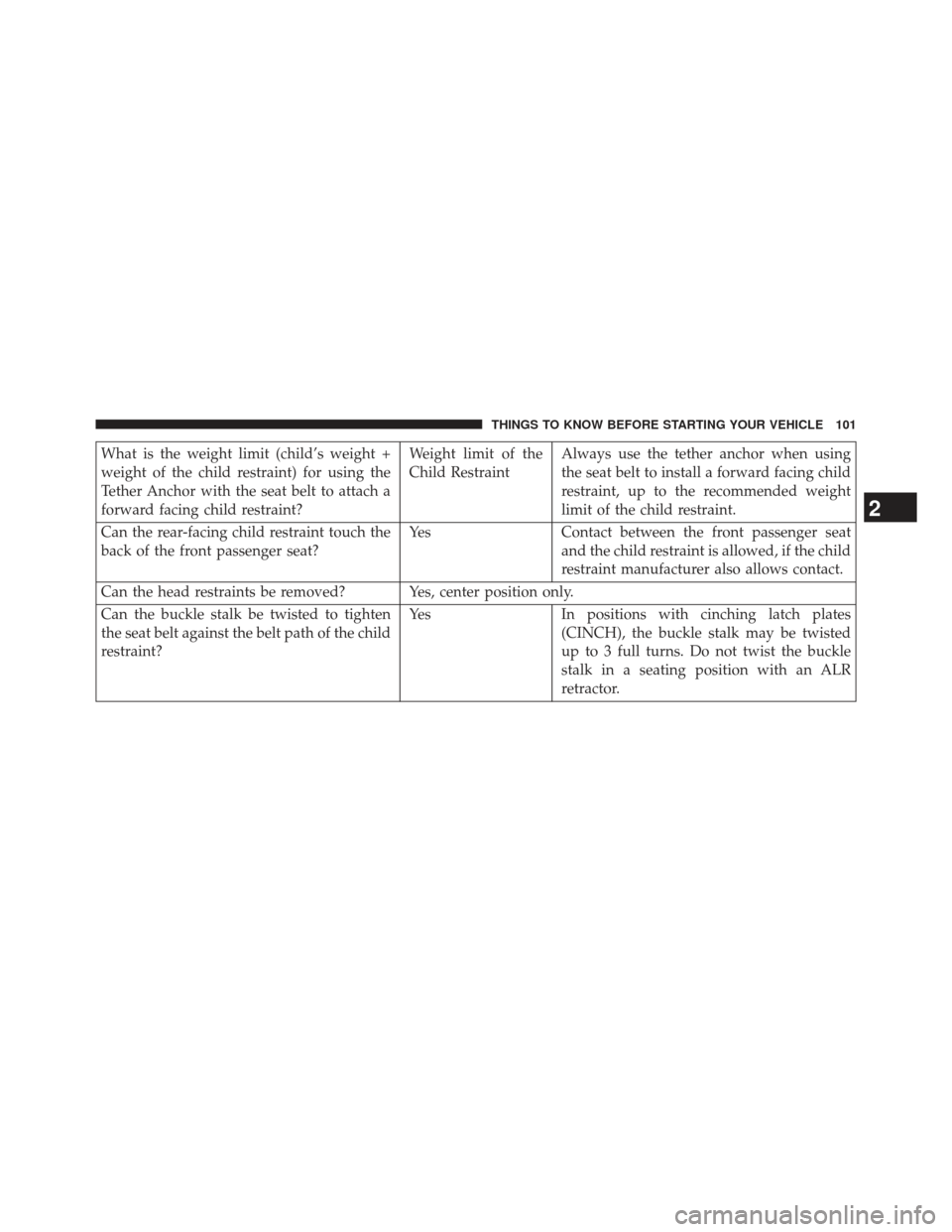
What is the weight limit (child’s weight +
weight of the child restraint) for using the
Tether Anchor with the seat belt to attach a
forward facing child restraint?Weight limit of the
Child Restraint
Always use the tether anchor when using
the seat belt to install a forward facing child
restraint, up to the recommended weight
limit of the child restraint.
Can the rear-facing child restraint touch the
back of the front passenger seat? Yes
Contact between the front passenger seat
and the child restraint is allowed, if the child
restraint manufacturer also allows contact.
Can the head restraints be removed? Yes, center position only.
Can the buckle stalk be twisted to tighten
the seat belt against the belt path of the child
restraint? Yes
In positions with cinching latch plates
(CINCH), the buckle stalk may be twisted
up to 3 full turns. Do not twist the buckle
stalk in a seating position with an ALR
retractor.
2
THINGS TO KNOW BEFORE STARTING YOUR VEHICLE 101
Page 104 of 699
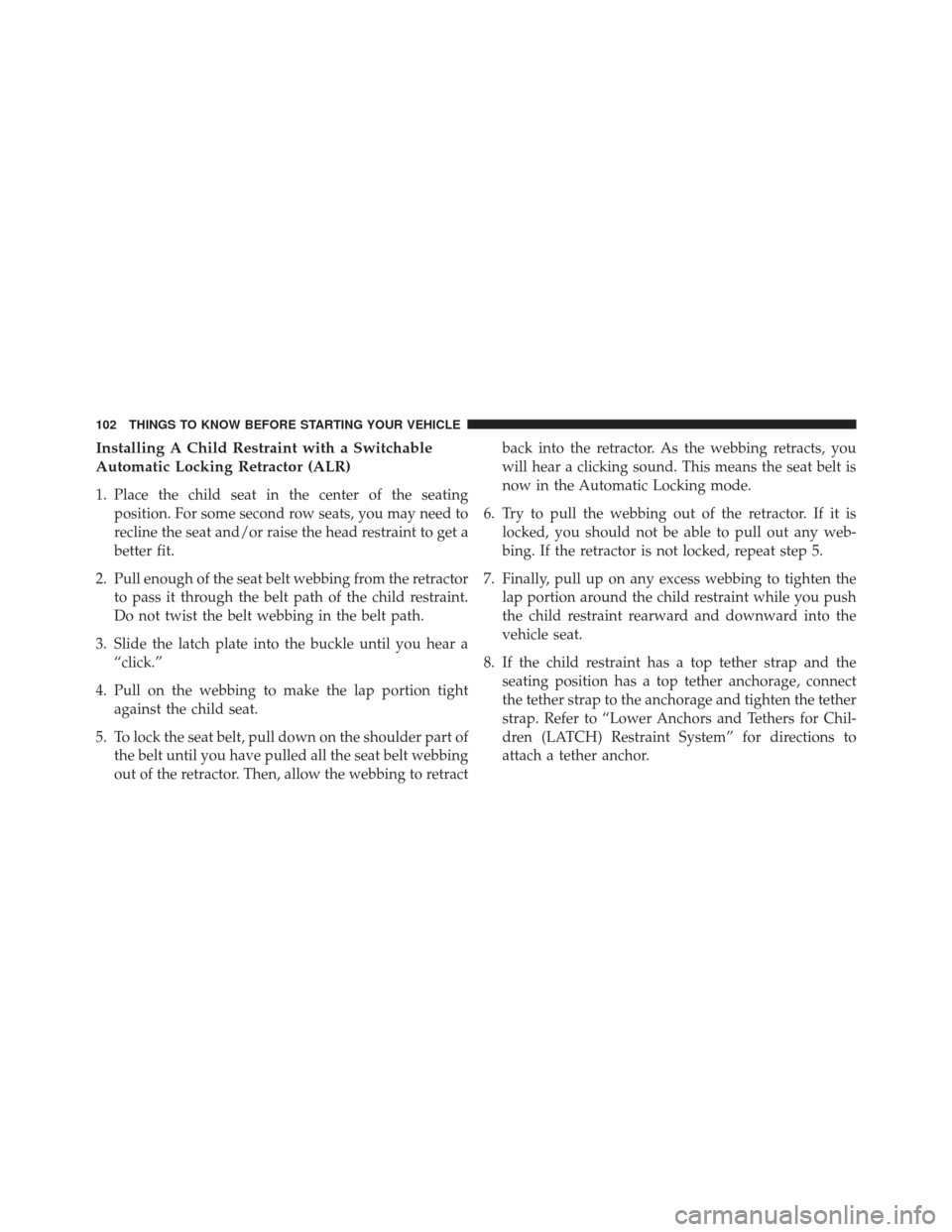
Installing A Child Restraint with a Switchable
Automatic Locking Retractor (ALR)
1. Place the child seat in the center of the seatingposition. For some second row seats, you may need to
recline the seat and/or raise the head restraint to get a
better fit.
2. Pull enough of the seat belt webbing from the retractor to pass it through the belt path of the child restraint.
Do not twist the belt webbing in the belt path.
3. Slide the latch plate into the buckle until you hear a “click.”
4. Pull on the webbing to make the lap portion tight against the child seat.
5. To lock the seat belt, pull down on the shoulder part of the belt until you have pulled all the seat belt webbing
out of the retractor. Then, allow the webbing to retract back into the retractor. As the webbing retracts, you
will hear a clicking sound. This means the seat belt is
now in the Automatic Locking mode.
6. Try to pull the webbing out of the retractor. If it is locked, you should not be able to pull out any web-
bing. If the retractor is not locked, repeat step 5.
7. Finally, pull up on any excess webbing to tighten the lap portion around the child restraint while you push
the child restraint rearward and downward into the
vehicle seat.
8. If the child restraint has a top tether strap and the seating position has a top tether anchorage, connect
the tether strap to the anchorage and tighten the tether
strap. Refer to “Lower Anchors and Tethers for Chil-
dren (LATCH) Restraint System” for directions to
attach a tether anchor.
102 THINGS TO KNOW BEFORE STARTING YOUR VEHICLE
Page 105 of 699
9. Test that the child restraint is installed tightly bypulling back and forth on the child seat at the belt
path. It should not move more than 1 inch (25.4 mm)
in any direction.
Any seat belt system will loosen with time, so check the
belt occasionally, and pull it tight if necessary.
Installing A Child Restraint With A Cinching
Latch Plate (CINCH) — If Equipped
1. Place the child seat in the center of the seating position. For some second row seats, you may need to
recline the seat and / or raise the head restraint to get
a better fit.
2. Next, pull enough of the seat belt webbing from the retractor to pass it through the belt path of the child
restraint. Do not twist the belt webbing in the belt
path. 3. Slide the latch plate into the buckle until you hear a
“click.”
4. Finally, pull up on any excess webbing to tighten the lap portion around the child restraint while you push
the child restraint rearward and downward into the
vehicle seat.
5. If the child restraint has a top tether strap and the seating position has a top tether anchorage, connect
the tether strap to the anchorage and tighten the tether
strap. Refer to “Lower Anchors and Tethers for Chil-
dren (LATCH) Restraint System” for directions to
attach a tether anchor.
6. Test that the child restraint is installed tightly by pulling back and forth on the child seat at the belt
path. It should not move more than 1 inch (25.4 mm)
in any direction.
2
THINGS TO KNOW BEFORE STARTING YOUR VEHICLE 103
Page 108 of 699
3. Route the tether strap to provide the most direct pathfor the strap between the anchor and the child seat. If
your vehicle is equipped with adjustable rear head
restraints, raise the head restraint, and where possible,
route the tether strap under the head restraint and
between the two posts. If not possible, lower the head
restraint and pass the tether strap around the outboard
side of the head restraint.
4. For the center seating position, route the tether strap over the seatback and headrest then attach the hook to
the tether anchor located on the back of the seat.
5. Attach the tether strap hook of the child restraint to the top tether anchorage as shown in the diagram.
Top Tether Strap Mounting (60/40 Seat)
106 THINGS TO KNOW BEFORE STARTING YOUR VEHICLE