wheel DODGE DURANGO 2015 3.G Owners Manual
[x] Cancel search | Manufacturer: DODGE, Model Year: 2015, Model line: DURANGO, Model: DODGE DURANGO 2015 3.GPages: 689, PDF Size: 20.05 MB
Page 575 of 689

WARNING!
Fast spinning tires can be dangerous. Forces gener-
ated by excessive wheel speeds may cause damage, or
even failure, of the axle and tires. A tire could
explode and injure someone. Do not spin your vehi-
cle’s wheels faster than 30 mph (48 km/h) or for
longer than 30 seconds continuously without stop-
ping when you are stuck and do not let anyone near
a spinning wheel, no matter what the speed.
CAUTION!
•When “rocking” a stuck vehicle by shifting be-
tween DRIVE and REVERSE, do not spin the
wheels faster than 15 mph (24 km/h), or drivetrain
damage may result.
(Continued)
CAUTION!(Continued)
•Revving the engine or spinning the wheels too fast
may lead to transmission overheating and failure.
It can also damage the tires. Do not spin the wheels
above 30 mph (48 km/h) while in gear (no trans-
mission shifting occurring).
EMERGENCY TOW HOOKS — IF EQUIPPED
If your vehicle is equipped with tow hooks, there will be
one in the rear and two mounted on the front of the
vehicle. The rear hook will be located on the driver’s side
of the vehicle.
NOTE:For off-road recovery, it is recommended to use
both of the front tow hooks to minimize the risk of
damage to the vehicle.
6
WHAT TO DO IN EMERGENCIES 573
Page 580 of 689
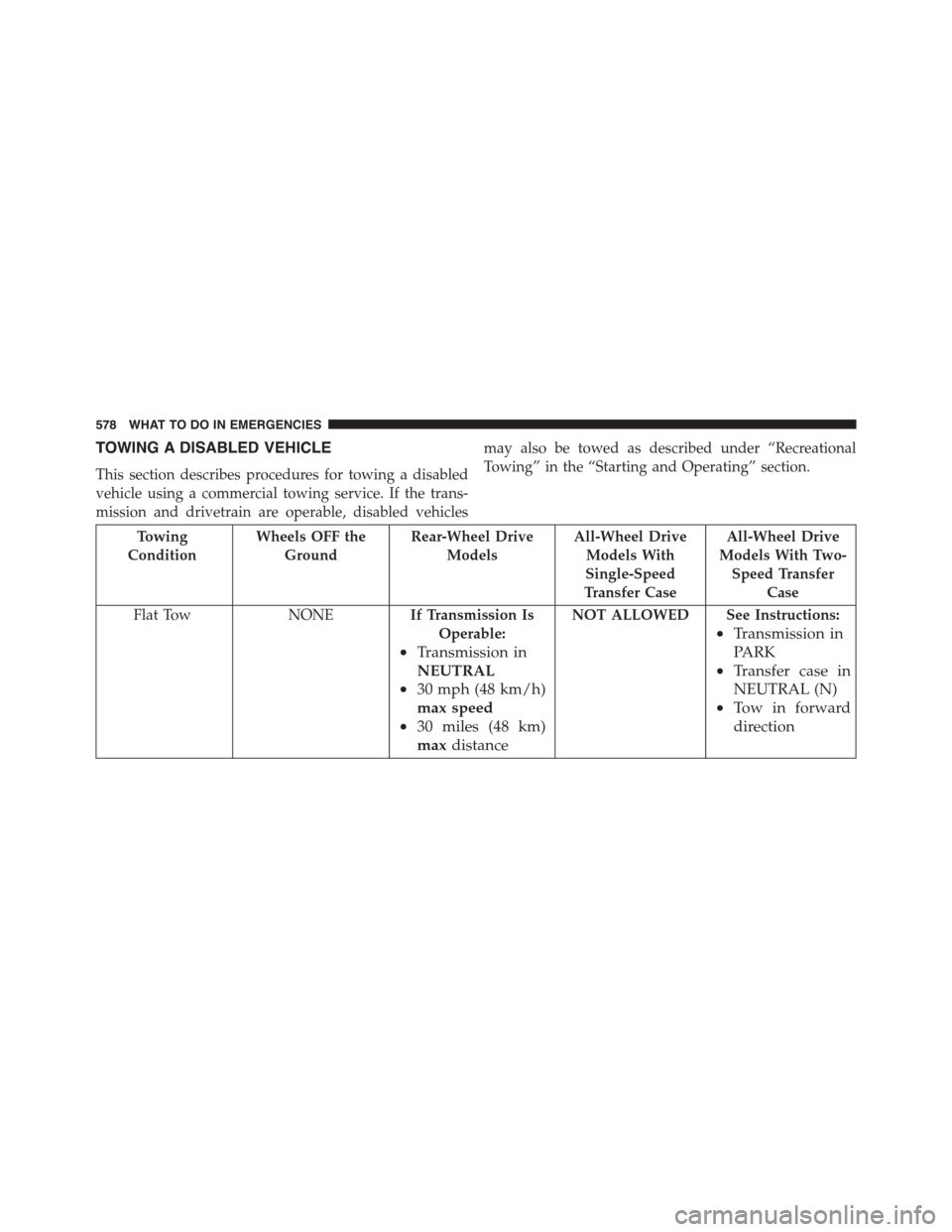
TOWING A DISABLED VEHICLE
This section describes procedures for towing a disabled
vehicle using a commercial towing service. If the trans-
mission and drivetrain are operable, disabled vehicles
may also be towed as described under “Recreational
Towing” in the “Starting and Operating” section.
Towing
Condition
Wheels OFF the
Ground
Rear-Wheel Drive
Models
All-Wheel Drive
Models With
Single-Speed
Transfer Case
All-Wheel Drive
Models With Two-
Speed Transfer
Case
Flat TowNONEIf Transmission Is
Operable:
•Transmission in
NEUTRAL
•30 mph (48 km/h)
max speed
•30 miles (48 km)
maxdistance
NOT ALLOWED See Instructions:
•Transmission in
PARK
•Transfer case in
NEUTRAL (N)
•Tow in forward
direction
578 WHAT TO DO IN EMERGENCIES
Page 581 of 689
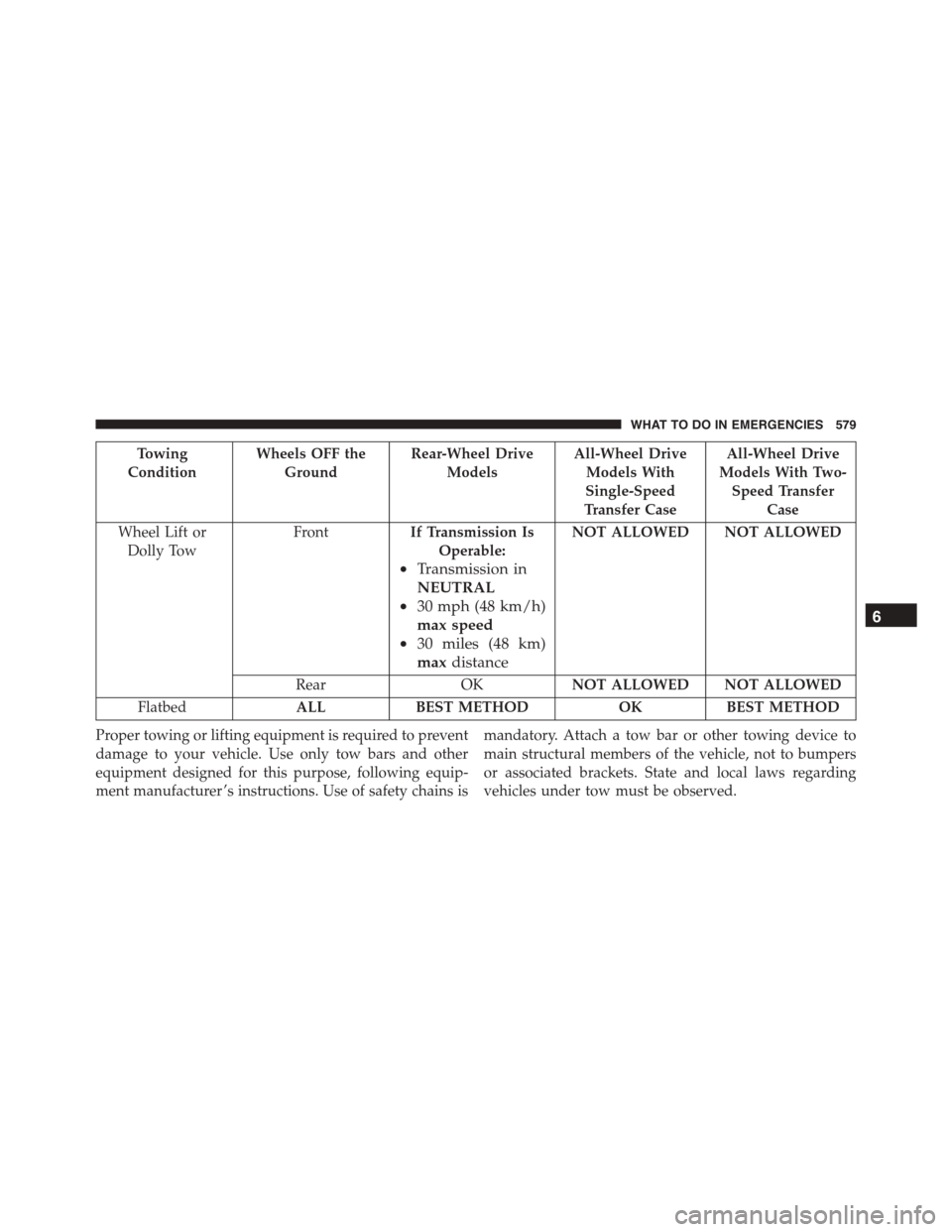
Towing
Condition
Wheels OFF the
Ground
Rear-Wheel Drive
Models
All-Wheel Drive
Models With
Single-Speed
Transfer Case
All-Wheel Drive
Models With Two-
Speed Transfer
Case
Wheel Lift or
Dolly Tow
FrontIf Transmission Is
Operable:
•Transmission in
NEUTRAL
•30 mph (48 km/h)
max speed
•30 miles (48 km)
maxdistance
NOT ALLOWED NOT ALLOWED
Rear OKNOT ALLOWED NOT ALLOWED
FlatbedALL BEST METHOD OK BEST METHOD
Proper towing or lifting equipment is required to prevent
damage to your vehicle. Use only tow bars and other
equipment designed for this purpose, following equip-
ment manufacturer ’s instructions. Use of safety chains is
mandatory. Attach a tow bar or other towing device to
main structural members of the vehicle, not to bumpers
or associated brackets. State and local laws regarding
vehicles under tow must be observed.
6
WHAT TO DO IN EMERGENCIES 579
Page 582 of 689
If you must use the accessories (wipers, defrosters, etc.)
while being towed, the ignition must be in the ON/RUN
position, not the ACC position.
If the key fob is unavailable or the vehicle’s battery is
discharged, refer to “Manual Park Release” in this section
for instructions on shifting the transmission out of PARK
for towing.
CAUTION!
•Do not use sling type equipment when towing.
Vehicle damage may occur.
•When securing the vehicle to a flat bed truck, do
not attach to front or rear suspension components.
Damage to your vehicle may result from improper
towing.
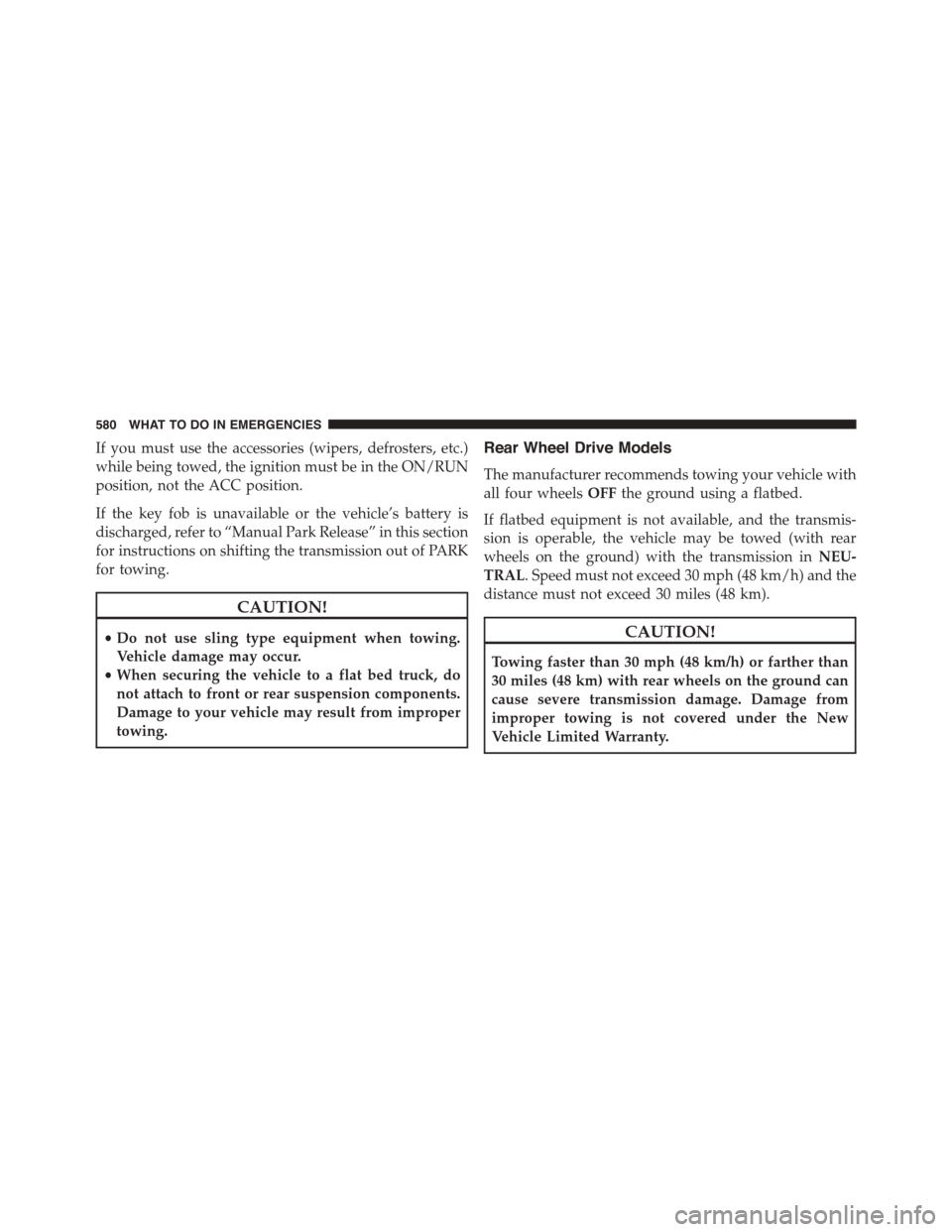
Rear Wheel Drive Models
The manufacturer recommends towing your vehicle with
all four wheelsOFFthe ground using a flatbed.
If flatbed equipment is not available, and the transmis-
sion is operable, the vehicle may be towed (with rear
wheels on the ground) with the transmission inNEU-
TRAL. Speed must not exceed 30 mph (48 km/h) and the
distance must not exceed 30 miles (48 km).
CAUTION!
Towing faster than 30 mph (48 km/h) or farther than
30 miles (48 km) with rear wheels on the ground can
cause severe transmission damage. Damage from
improper towing is not covered under the New
Vehicle Limited Warranty.
580 WHAT TO DO IN EMERGENCIES
Page 583 of 689
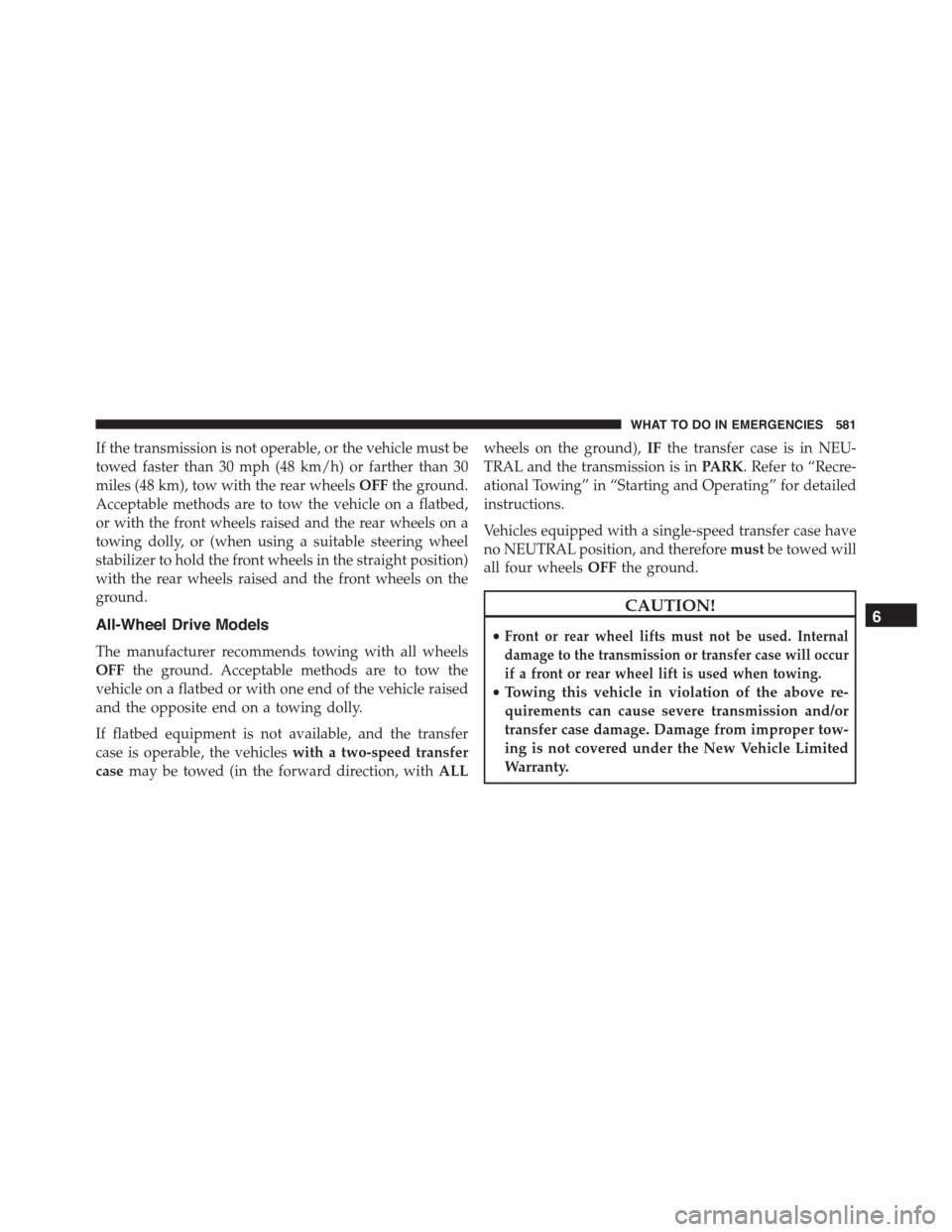
If the transmission is not operable, or the vehicle must be
towed faster than 30 mph (48 km/h) or farther than 30
miles (48 km), tow with the rear wheelsOFFthe ground.
Acceptable methods are to tow the vehicle on a flatbed,
or with the front wheels raised and the rear wheels on a
towing dolly, or (when using a suitable steering wheel
stabilizer to hold the front wheels in the straight position)
with the rear wheels raised and the front wheels on the
ground.
All-Wheel Drive Models
The manufacturer recommends towing with all wheels
OFFthe ground. Acceptable methods are to tow the
vehicle on a flatbed or with one end of the vehicle raised
and the opposite end on a towing dolly.
If flatbed equipment is not available, and the transfer
case is operable, the vehicleswith a two-speed transfer
casemay be towed (in the forward direction, withALL
wheels on the ground),IFthe transfer case is in NEU-
TRAL and the transmission is inPARK. Refer to “Recre-
ational Towing” in “Starting and Operating” for detailed
instructions.
Vehicles equipped with a single-speed transfer case have
no NEUTRAL position, and thereforemustbe towed will
all four wheelsOFFthe ground.
CAUTION!
•Front or rear wheel lifts must not be used. Internal
damage to the transmission or transfer case will occur
if a front or rear wheel lift is used when towing.
•Towing this vehicle in violation of the above re-
quirements can cause severe transmission and/or
transfer case damage. Damage from improper tow-
ing is not covered under the New Vehicle Limited
Warranty.
6
WHAT TO DO IN EMERGENCIES 581
Page 623 of 689
Special Care
•If you drive on salted or dusty roads or if you drive
near the ocean, hose off the undercarriage at least once
a month.
•It is important that the drain holes in the lower edges
of the doors, rocker panels, and trunk be kept clear and
open.
•If you detect any stone chips or scratches in the paint,
touch them up immediately. The cost of such repairs is
considered the responsibility of the owner.
•If your vehicle is damaged due to a collision or similar
cause that destroys the paint and protective coating,
have your vehicle repaired as soon as possible. The
cost of such repairs is considered the responsibility of
the owner.
•If you carry special cargo such as chemicals, fertilizers,
de-icer salt, etc., be sure that such materials are well
packaged and sealed.
•If a lot of driving is done on gravel roads, consider
mud or stone shields behind each wheel.
•Use MOPAR® Touch Up Paint on scratches as soon as
possible. Your authorized dealer has touch up paint to
match the color of your vehicle.
Wheel And Wheel Trim Care
•All wheels and wheel trim, especially aluminum and
chrome plated wheels, should be cleaned regularly
with a mild soap and water to prevent corrosion.
•To remove heavy soil and/or excessive brake dust, use
MOPAR® Wheel Cleaner.
7
MAINTAINING YOUR VEHICLE 621
Page 624 of 689
NOTE:If your vehicle is equipped with Dark Vapor or
Black Satin Chrome wheels DO NOT USE wheel cleaners,
abrasives or polishing compounds. They will perma-
nently damage this finish and such damage is not cov-
ered by the New Vehicle Limited Warranty. USE ONLY
MILD SOAP AND WATER WITH A SOFT CLOTH. Used
on a regular basis this is all that is required to maintain
this finish.
CAUTION!
Do not use scouring pads, steel wool, a bristle brush,
or metal polishes. Do not use oven cleaner. These
products may damage the wheel’s protective finish.
Avoid automatic car washes that use acidic solutions
or harsh brushes that may damage the wheel’s pro-
tective finish. Only MOPAR® Wheel Cleaner or
equivalent is recommended.
Stain Repel Fabric Cleaning Procedure — If
Equipped
Stain Repel seats may be cleaned in the following man-
ner:
•Remove as much of the stain as possible by blotting
with a clean, dry towel.
•Blot any remaining stain with a clean, damp towel.
•For tough stains, apply MOPAR® Total Clean, or a
mild soap solution to a clean, damp cloth and remove
stain. Use a fresh, damp towel to remove soap residue.
•For grease stains, apply MOPAR® Multi-Purpose
Cleaner to a clean, damp cloth and remove stain. Use
a fresh, damp towel to remove soap residue.
•Do not use any harsh solvents or any other form of
protectants on Stain Repel products.
622 MAINTAINING YOUR VEHICLE
Page 634 of 689
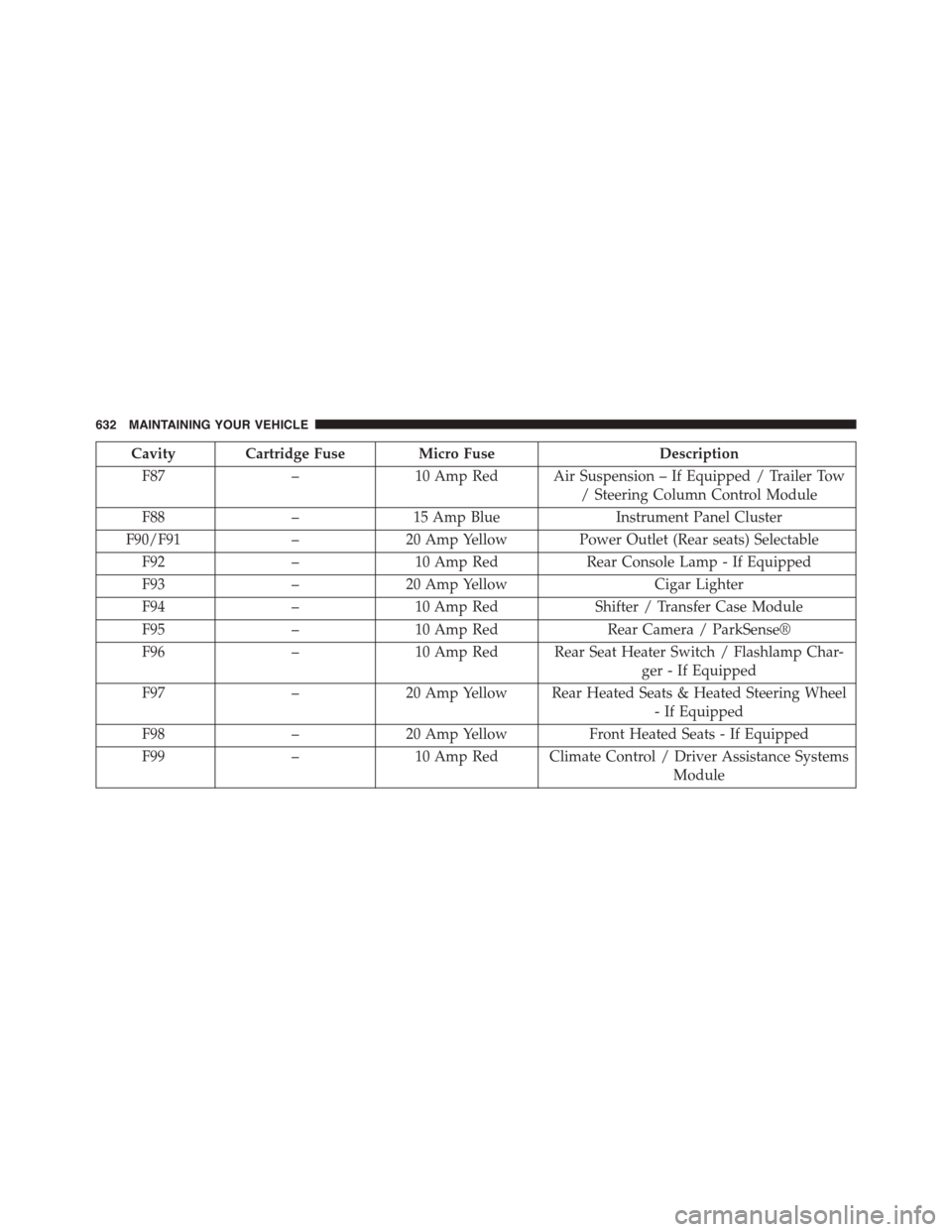
Cavity Cartridge Fuse Micro FuseDescription
F87–10 Amp Red Air Suspension – If Equipped / Trailer Tow
/ Steering Column Control Module
F88–15 Amp BlueInstrument Panel Cluster
F90/F91–20 Amp Yellow Power Outlet (Rear seats) Selectable
F92–10 Amp RedRear Console Lamp - If Equipped
F93–20 Amp YellowCigar Lighter
F94–10 Amp RedShifter / Transfer Case Module
F95–10 Amp RedRear Camera / ParkSense®
F96–10 Amp Red Rear Seat Heater Switch / Flashlamp Char-
ger - If Equipped
F97–20 Amp Yellow Rear Heated Seats & Heated Steering Wheel
- If Equipped
F98–20 Amp YellowFront Heated Seats - If Equipped
F99–10 Amp Red Climate Control / Driver Assistance Systems
Module
632 MAINTAINING YOUR VEHICLE
Page 639 of 689
WARNING!
A transient high voltage occurs at the bulb sockets of
High Intensity Discharge (HID) headlamps when the
headlamp switch is turned ON. It may cause serious
electrical shock or electrocution if not serviced prop-
erly. See your authorized dealer for service.
NOTE:On vehicles equipped with High Intensity Dis-
charge (HID) headlamps, when the headlamps are
turned on, there is a blue hue to the lamps. This dimin-
ishes and becomes more white after approximately 10
seconds, as the system charges.
Bi-Halogen Headlamps — If Equipped
1. Turn the steering wheel to the left to replace the bulb
from the right hand lamp, or to the right to replace the
bulb from the left hand lamp.
2. Turn the access cap located on the wheel liner coun-
terclockwise to remove from liner.
3. Locate the headlamp bulb access cap through the
opening in the wheel liner.
4. Firmly grasp the access cap and rotate counterclock-
wise to remove lamp housing.
5. Firmly grasp the low/high beam bulb and connector
assembly and rotate counterclockwise to remove from
housing.
6. Disconnect the electrical connector and then connect
the replacement bulb.
7. Install the bulb and connector assembly into the
headlamp housing and rotate clockwise to lock in
place.
8. Install the bulb access cap in the headlamp housing
and rotate clockwise to lock it in place.
7
MAINTAINING YOUR VEHICLE 637
Page 640 of 689
9. Install the access cap in the wheel liner and rotate
clockwise to lock it in place.
CAUTION!
Do not touch the new bulb with your fingers. Oil
contamination will severely shorten bulb life. If the
bulb comes in contact with any oily surface, clean the
bulb with rubbing alcohol.
Front Turn Signal
1. Open the hood.
2. Turn the turn signal bulb one–quarter turn counter-
clockwise to remove from housing.
3. Disconnect the electrical connector and replace the
bulb.
CAUTION!
Do not touch the new bulb with your fingers. Oil
contamination will severely shorten bulb life. If the
bulb comes in contact with any oily surface, clean the
bulb with rubbing alcohol.
Front Fog Lamps
1. Reach through the cutout in the splash shield and
rotate the bulb’s electrical connector one-quarter turn
counterclockwise and remove it from the fog lamp
housing.
2. Remove the bulb from the connector and install the
replacement bulb.
3. Install the bulb and connector assembly into the fog
lamp housing and rotate the connector one-quarter
turn clockwise to lock it in place.
638 MAINTAINING YOUR VEHICLE