wheel DODGE DURANGO 2015 3.G Manual Online
[x] Cancel search | Manufacturer: DODGE, Model Year: 2015, Model line: DURANGO, Model: DODGE DURANGO 2015 3.GPages: 689, PDF Size: 20.05 MB
Page 558 of 689
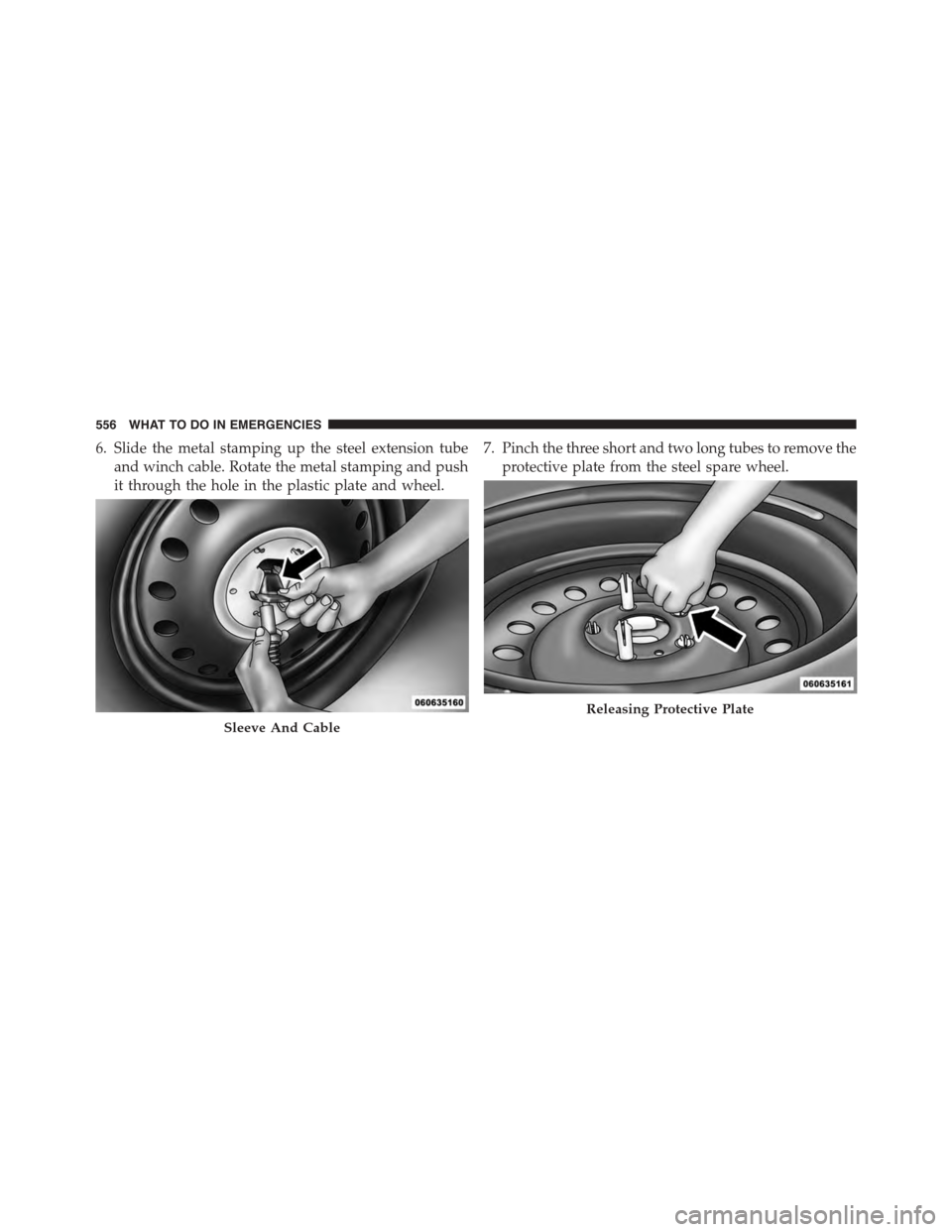
6. Slide the metal stamping up the steel extension tube
and winch cable. Rotate the metal stamping and push
it through the hole in the plastic plate and wheel.
7. Pinch the three short and two long tubes to remove the
protective plate from the steel spare wheel.
Sleeve And Cable
Releasing Protective Plate
556 WHAT TO DO IN EMERGENCIES
Page 559 of 689
Preparations For Jacking
1. Park the vehicle on a firm, level surface as far from the
edge of the roadway as possible. Avoid icy or slippery
areas.
WARNING!
Do not attempt to change a tire on the side of the
vehicle close to moving traffic, pull far enough off
the road to avoid being hit when operating the jack
or changing the wheel.
2. Turn on the Hazard Warning flasher.
3. Set the parking brake.
4. Place the gear selector into PARK.
5. Turn OFF the ignition.
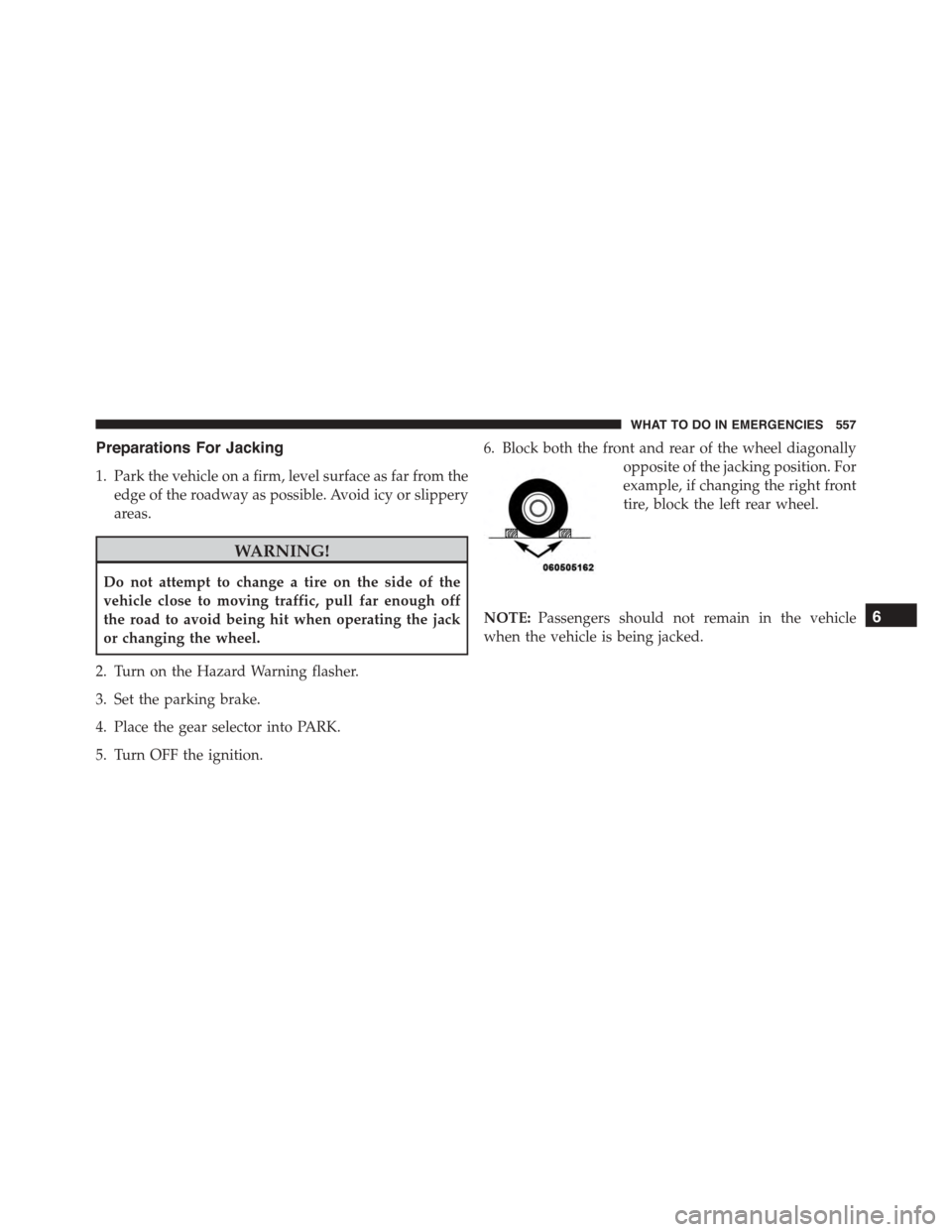
6. Block both the front and rear of the wheel diagonally
opposite of the jacking position. For
example, if changing the right front
tire, block the left rear wheel.
NOTE:Passengers should not remain in the vehicle
when the vehicle is being jacked.
6
WHAT TO DO IN EMERGENCIES 557
Page 560 of 689
Jacking Instructions
WARNING!
Carefully follow these tire changing warnings to
help prevent personal injury or damage to your
vehicle:
•Always park on a firm, level surface as far from the
edge of the roadway as possible before raising the
vehicle.
•Turn on the Hazard Warning flasher.
•Block the wheel diagonally opposite the wheel to
be raised.
•Set the parking brake firmly and set the automatic
transmission in PARK.
•Never start or run the engine with the vehicle on a
jack.
(Continued)
WARNING!(Continued)
•Do not let anyone sit in the vehicle when it is on a
jack.
•Do not get under the vehicle when it is on a jack. If
you need to get under a raised vehicle, take it to a
service center where it can be raised on a lift.
•Only use the jack in the positions indicated and for
lifting this vehicle during a tire change.
•If working on or near a roadway, be extremely
careful of motor traffic.
•To assure that spare tires, flat or inflated, are
securely stowed, spares must be stowed with the
valve stem facing the ground.
558 WHAT TO DO IN EMERGENCIES
Page 561 of 689
CAUTION!
Do not attempt to raise the vehicle by jacking on
locations other than those indicated in the Jacking
Instructions for this vehicle.
1. Loosen (but do not remove) the wheel lug nuts by
turning them to the left, one turn, while the wheel is
still on the ground.
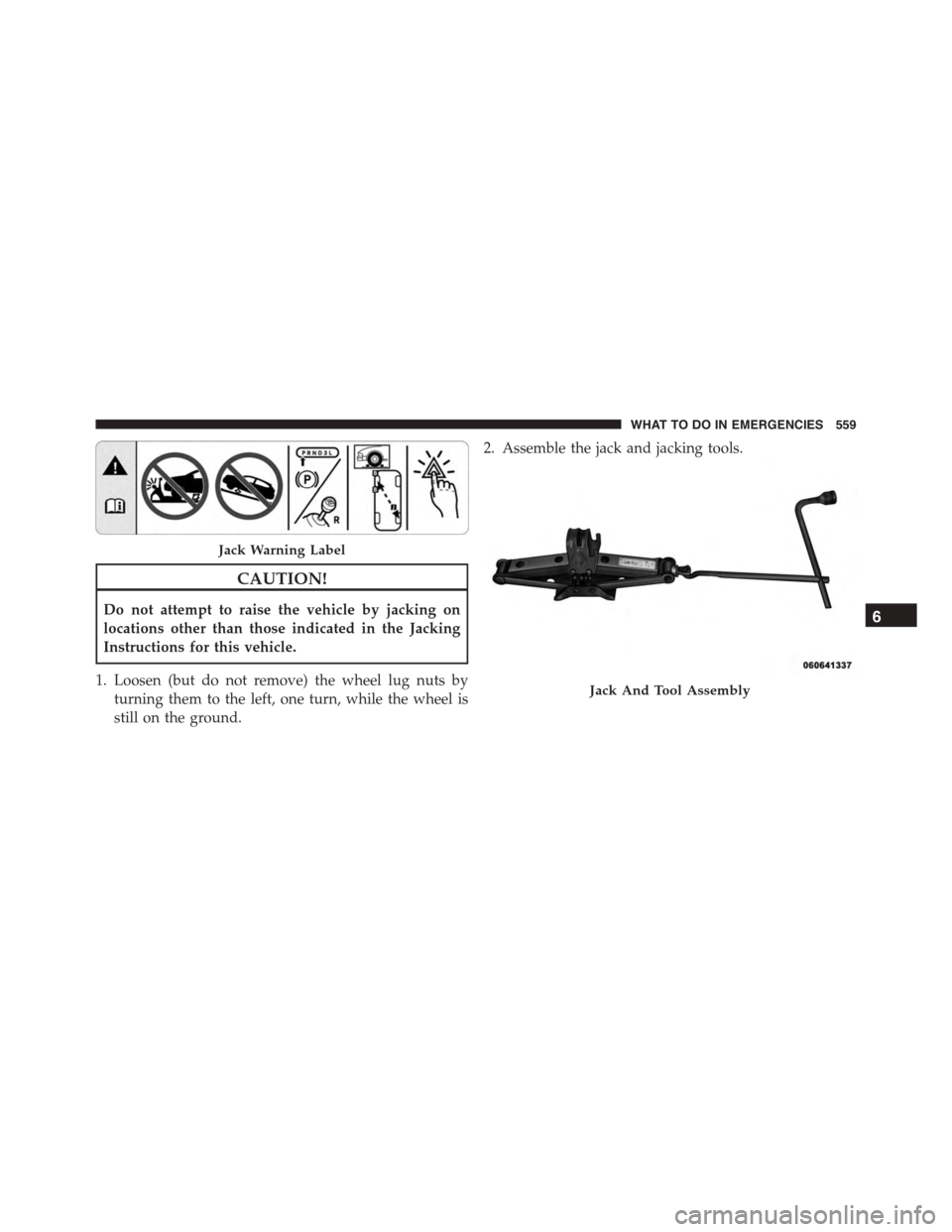
2. Assemble the jack and jacking tools.
Jack Warning Label
Jack And Tool Assembly
6
WHAT TO DO IN EMERGENCIES 559
Page 564 of 689
5. Raise the vehicle by turning the jack screw clockwise.
Raise the vehicle just enough to remove the flat tire.
WARNING!
Raising the vehicle higher than necessary can make
the vehicle less stable. It could slip off the jack and
hurt someone near it. Raise the vehicle only enough
to remove the tire.
6. Remove the lug nuts and wheel.
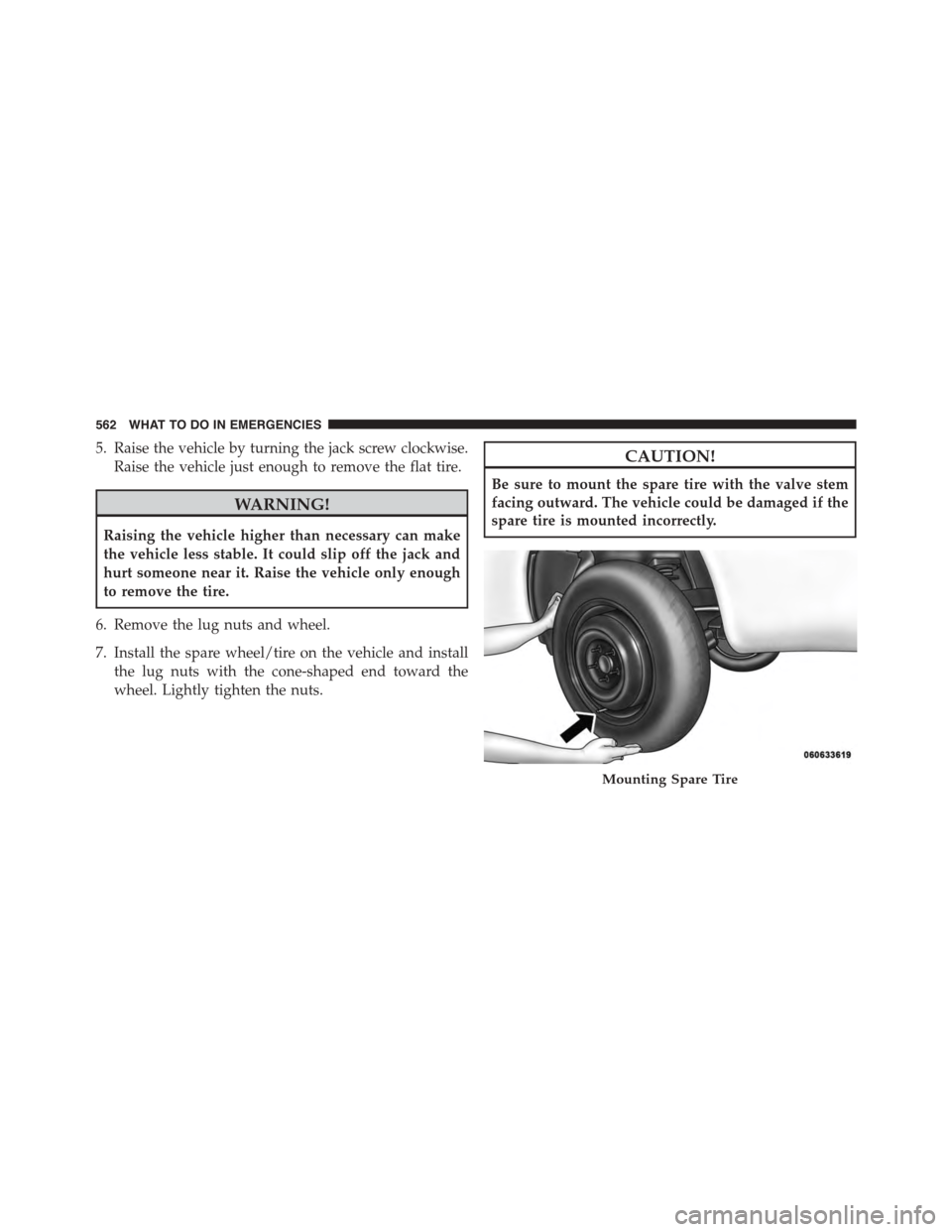
7. Install the spare wheel/tire on the vehicle and install
the lug nuts with the cone-shaped end toward the
wheel. Lightly tighten the nuts.
CAUTION!
Be sure to mount the spare tire with the valve stem
facing outward. The vehicle could be damaged if the
spare tire is mounted incorrectly.
Mounting Spare Tire
562 WHAT TO DO IN EMERGENCIES
Page 565 of 689
WARNING!
To avoid the risk of forcing the vehicle off the jack,
do not fully tighten the lug nuts until the vehicle has
been lowered. Failure to follow this warning may
result in personal injury.
8. Lower the vehicle by turning the jack screw counter-
clockwise, and remove the jack and wheel blocks.
9. Finish tightening the lug nuts. Push down on the
wrench while at the end of the handle for increased
leverage. Tighten the lug nuts in a star pattern until
each nut has been tightened twice. Refer to Torque
Specifications in this section for proper lug nut torque.
If in doubt about the correct tightness, have them
checked with a torque wrench by your authorized
dealer or at a service station.
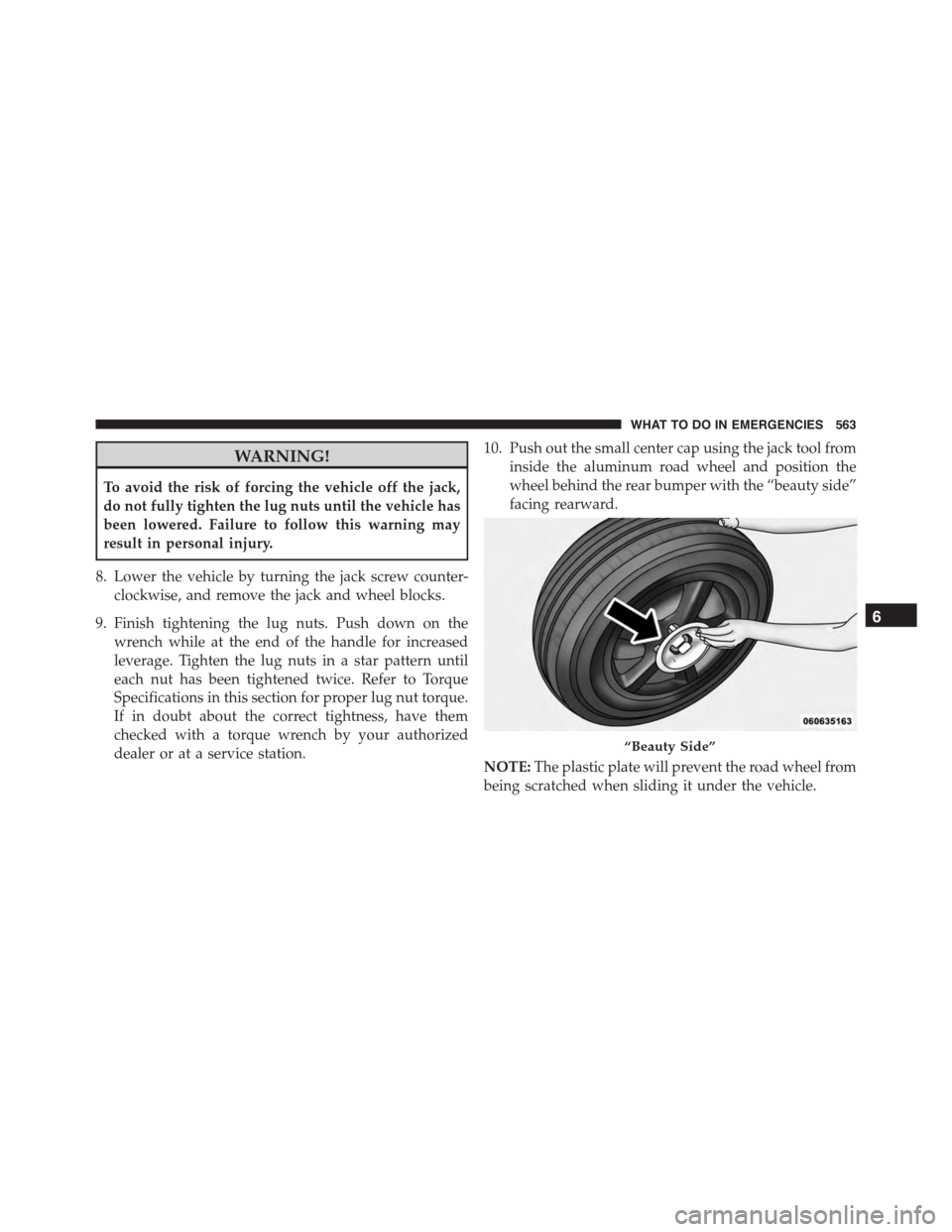
10. Push out the small center cap using the jack tool from
inside the aluminum road wheel and position the
wheel behind the rear bumper with the “beauty side”
facing rearward.
NOTE:The plastic plate will prevent the road wheel from
being scratched when sliding it under the vehicle.
“Beauty Side”
6
WHAT TO DO IN EMERGENCIES 563
Page 566 of 689
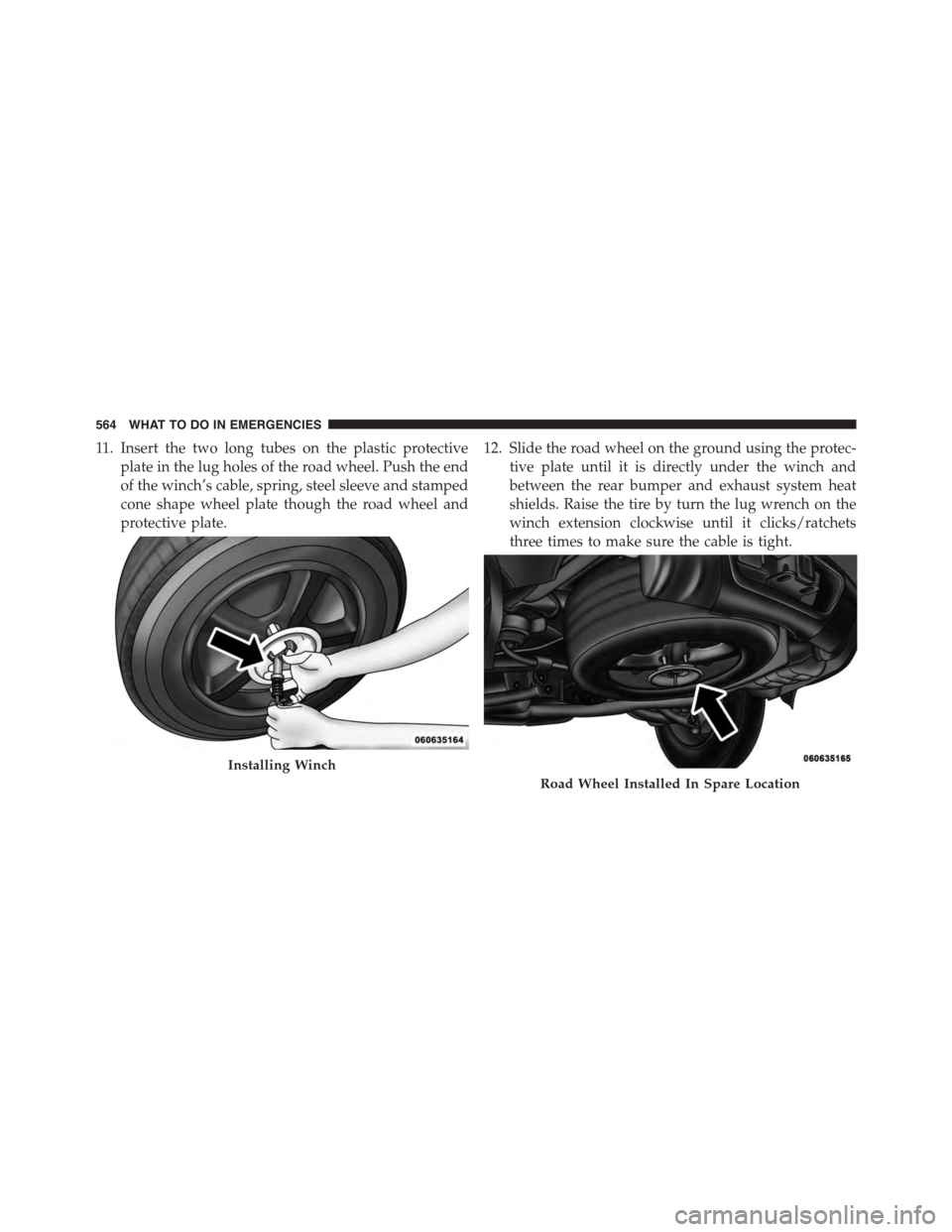
11. Insert the two long tubes on the plastic protective
plate in the lug holes of the road wheel. Push the end
of the winch’s cable, spring, steel sleeve and stamped
cone shape wheel plate though the road wheel and
protective plate.
12. Slide the road wheel on the ground using the protec-
tive plate until it is directly under the winch and
between the rear bumper and exhaust system heat
shields. Raise the tire by turn the lug wrench on the
winch extension clockwise until it clicks/ratchets
three times to make sure the cable is tight.
Installing Winch
Road Wheel Installed In Spare Location
564 WHAT TO DO IN EMERGENCIES
Page 567 of 689
NOTE:Double check to ensure the tire is snug against the
underbody of the vehicle. Damage to the winch cable
may result if the vehicle is driven with the tire loose.
WARNING!
Do not use power tools to winch the tire up or down.
Impact-type tools may damage the winch mecha-
nism.
13. Lower the jack to the fully closed position. Return the
tools to the proper positions in the tool bag. Fold the
flap on the tool bag under the tools and roll the tools
in the bag underneath the others. Use the Velcro
straps to secure the tool bag to the jack with the lug
wrench on the forward side of the jack. Expand the
jack on the bracket by turning the thumb screw
clockwise until it is tight to prevent rattles.
14. Reinstall the plastic plug into the floor of the cargo
area. Roll up and store the Jack, Tool Kit and Tire
Changing Instructions. Reinstall the cover for the jack
in the rear storage bin.
15. Have the aluminum road wheel and tire repaired as
soon as possible and properly secure the spare tire,
jack and tool kit.
WARNING!
A loose tire or jack thrown forward in a collision or
hard stop could endanger the occupants of the ve-
hicle. Always stow the jack parts and the spare tire in
the places provided.
6
WHAT TO DO IN EMERGENCIES 565
Page 568 of 689
Road Tire Installation
1. Mount the road tire on the axle.
2. Install the remaining lug nuts with the cone shaped
end of the nut toward the wheel. Lightly tighten the
lug nuts.
WARNING!
To avoid the risk of forcing the vehicle off the jack,
do not tighten the lug nuts fully until the vehicle has
been lowered. Failure to follow this warning may
result in personal injury.
3. Lower the vehicle to the ground by turning the jack
handle counterclockwise.
4. Refer to Torque Table for proper lug nut torque.
5. After 25 miles (40 km) check the lug nut torque with a
torque wrench to ensure that all lug nuts are properly
seated against the wheel.
CAP-LESS FUEL FILL FUNNEL
The funnel for the Cap-Less Fuel System is located with
the jack and tire changing tools. If your vehicle is out of
fuel and an auxiliary fuel can is needed, insert the funnel
into the filler neck and proceed to fill the vehicle.
566 WHAT TO DO IN EMERGENCIES
Page 574 of 689

CAUTION!(Continued)
the vehicle’s battery will discharge sufficiently to
degrade battery life and/or prevent the engine from
starting.
FREEING A STUCK VEHICLE
If your vehicle becomes stuck in mud, sand or snow, it
can often be moved using a rocking motion. Turn the
steering wheel right and left to clear the area around the
front wheels. Then shift back and forth between DRIVE
and REVERSE while gently pushing the accelerator.
NOTE:Shifts between DRIVE and REVERSE can only be
achieved at wheel speeds of 5 mph (8 km/h) or less.
Whenever the transmission remains in NEUTRAL for
more than two seconds, you must push the brake pedal
to engage DRIVE or REVERSE.
Use the least amount of accelerator pedal pressure that
will maintain the rocking motion without spinning the
wheels or racing the engine.
NOTE:Push the#ESC Off#switch, to place the Electronic
Stability Control (ESC) system in#Partial Off#mode,
before rocking the vehicle. Refer to “Electronic Brake
Control” in “Starting And Operating” for further infor-
mation. Once the vehicle has been freed, push the#ESC
Off#switch again to restore#ESC On#mode.
CAUTION!
Racing the engine or spinning the wheels may lead to
transmission overheating and failure. Allow the en-
gine to idle with the transmission in NEUTRAL for at
least one minute after every five rocking-motion
cycles. This will minimize overheating and reduce
the risk of transmission failure during prolonged
efforts to free a stuck vehicle.
572 WHAT TO DO IN EMERGENCIES