engine oil DODGE DURANGO 2015 3.G User Guide
[x] Cancel search | Manufacturer: DODGE, Model Year: 2015, Model line: DURANGO, Model: DODGE DURANGO 2015 3.GPages: 689, PDF Size: 20.05 MB
Page 511 of 689
•Change the engine oil and oil filter.
•Disconnect and reconnect the battery to reset the
engine controller memory.
More extensive repairs will be required for prolonged
exposure to E-85 fuel.
MMT In Gasoline
Methylcyclopentadienyl Manganese Tricarbonyl (MMT)
is a manganese-containing metallic additive that is
blended into some gasoline to increase octane. Gasoline
blended with MMT provides no performance advantage
beyond gasoline of the same octane number without
MMT. Gasoline blended with MMT reduces spark plug
life and reduces emissions system performance in some
vehicles. The manufacturer recommends that gasoline
without MMT be used in your vehicle. The MMT content
of gasoline may not be indicated on the gasoline pump,
therefore, you should ask your gasoline retailer whether
the gasoline contains MMT. MMT is prohibited in Federal
and California reformulated gasoline.
Materials Added To Fuel
All gasoline sold in the United States is required to
contain effective detergent additives. Use of additional
detergents or other additives is not needed under normal
conditions and they would result in additional cost.
Therefore, you should not have to add anything to the
fuel.
5
STARTING AND OPERATING 509
Page 515 of 689
NOTE:
•Use seasonally adjusted E-85 fuel (ASTM D5798). With
non-seasonally adjusted E-85 fuel, hard starting and
rough idle following start up may be experienced even
if the above recommendations are followed, especially
when the ambient temperature is below 32°F (0°C).
•Some additives used in regular gasoline are not fully
compatible with E-85 and may form deposits in your
engine. To eliminate driveability issues that may be
caused by these deposits, a supplemental gasoline
additive, such as MOPAR® Injector Cleanup or
Techron may be used.
Selection Of Engine Oil For Flexible Fuel Vehicles
(E-85) And Gasoline Vehicles
FFV vehicles operated on E-85 require specially formu-
lated engine oils. These special requirements are included
in MOPAR® engine oils, and in equivalent oils meeting
Chrysler Specification MS-6395. It is recommended that
engine oils that are API Certified and meet the require-
ments of Material Standard MS-6395 be used. MS-6395
contains additional requirements, developed during ex-
tensive fleet testing, to provide additional protection to
Chrysler Group LLC engines.
Starting
The characteristics of E-85 fuel make it unsuitable for use
when ambient temperatures fall below 0°F (-18°C). In the
range of 0°F (-18°C) to 32°F (0°C), an increase in the time
it takes for your engine to start may be experienced, and
a deterioration in driveability (sags and/or hesitations)
until the engine is fully warmed up. These issues may be
improved with the use of seasonally adjusted E-85 fuel.
NOTE:Use of the engine block heater (if equipped) may
improve engine start time when using E-85 fuel when the
ambient temperature is less than 32°F (0°C).
5
STARTING AND OPERATING 513
Page 551 of 689
CAUTION!
Driving with a hot cooling system could damage
your vehicle. If the temperature gauge reads HOT
(H), pull over and stop the vehicle. Idle the vehicle
with the air conditioner turned off until the pointer
drops back into the normal range. If the pointer
remains on HOT (H), and you hear continuous
chimes, turn the engine off immediately and call for
service.
WARNING!
You or others can be badly burned by hot engine
coolant (antifreeze) or steam from your radiator. If
you see or hear steam coming from under the hood,
do not open the hood until the radiator has had time
to cool. Never try to open a cooling system pressure
cap when the radiator or coolant bottle is hot.
WHEEL AND TIRE TORQUE SPECIFICATIONS
Proper lug nut/bolt torque is very important to ensure
that the wheel is properly mounted to the vehicle. Any
time a wheel has been removed and reinstalled on the
vehicle the lug nuts/bolts should be torqued using a
properly calibrated torque wrench.
Torque Specifications
Lug Nut/Bolt Torque **Lug Nut/
Bolt Size
Lug Nut/
Bolt Socket
Size
130 Ft-Lbs (176 N·m) M14 x 1.50 22 mm
**Use only Chrysler recommended lug nuts/bolts and
clean or remove any dirt or oil before tightening.
Inspect the wheel mounting surface prior to mounting
the tire and remove any corrosion or loose particles.
6
WHAT TO DO IN EMERGENCIES 549
Page 585 of 689

MAINTAINING YOUR VEHICLE
CONTENTS
!ENGINE COMPARTMENT — 3.6L..........585
!ENGINE COMPARTMENT — 5.7L..........586
!ONBOARD DIAGNOSTIC SYSTEM (OBD II) . . .587
!EMISSIONS INSPECTION AND MAINTENANCE
PROGRAMS..........................588
!REPLACEMENT PARTS..................589
!DEALER SERVICE......................589
!MAINTENANCE PROCEDURES...........590
▫Engine Oil..........................591
▫Engine Oil Filter......................594
▫Engine Air Cleaner Filter................594
▫Maintenance-Free Battery...............595
▫Air Conditioner Maintenance.............596
▫Body Lubrication.....................601
▫Windshield Wiper Blades...............602
▫Adding Washer Fluid..................604
▫Exhaust System......................605
▫Cooling System......................607
▫Brake System........................613
▫Front/Rear Axle Fluid..................615
7
Page 587 of 689
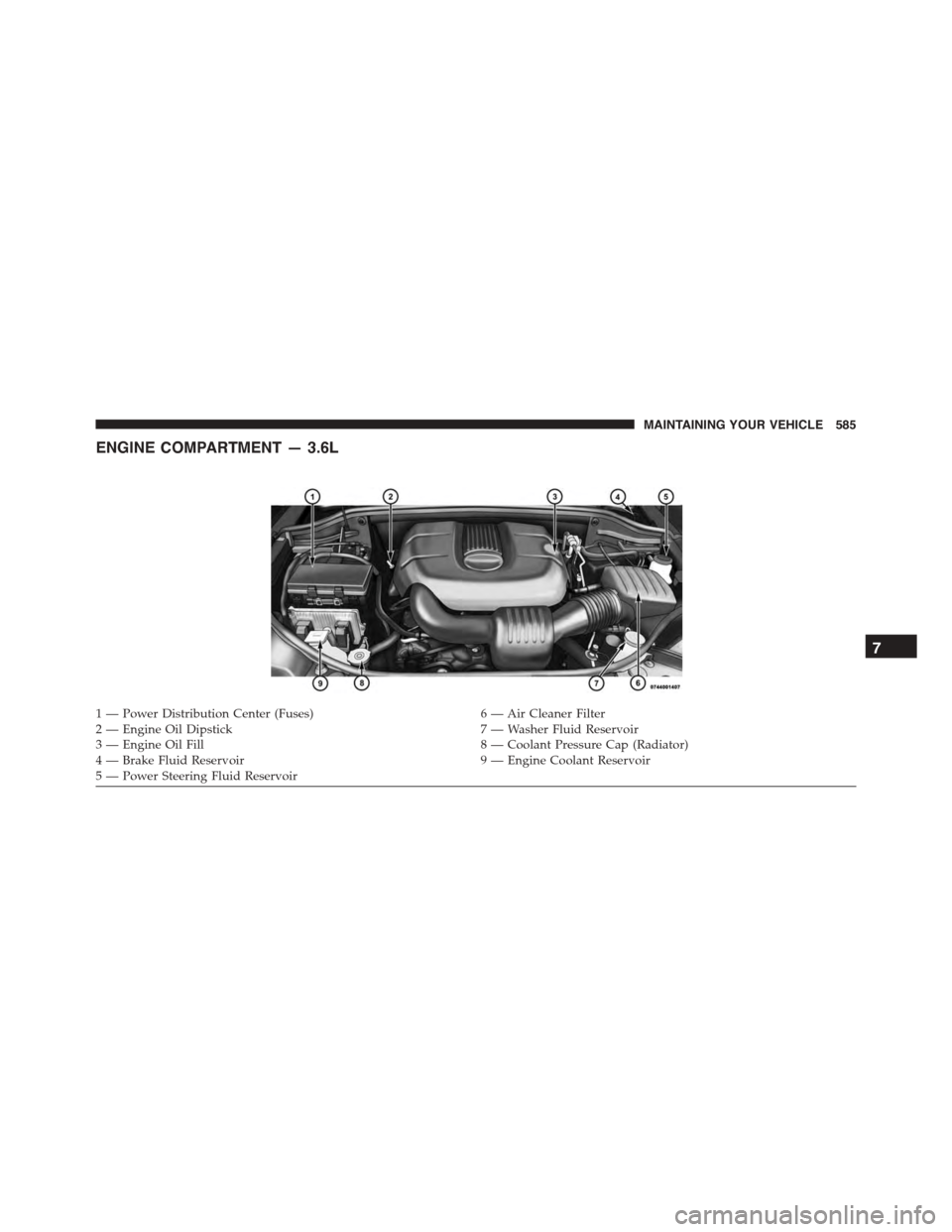
ENGINE COMPARTMENT — 3.6L
1 — Power Distribution Center (Fuses)6 — Air Cleaner Filter2 — Engine Oil Dipstick7 — Washer Fluid Reservoir3 — Engine Oil Fill8 — Coolant Pressure Cap (Radiator)4—BrakeFluidReservoir9—EngineCoolantReservoir5 — Power Steering Fluid Reservoir
7
MAINTAINING YOUR VEHICLE 585
Page 588 of 689
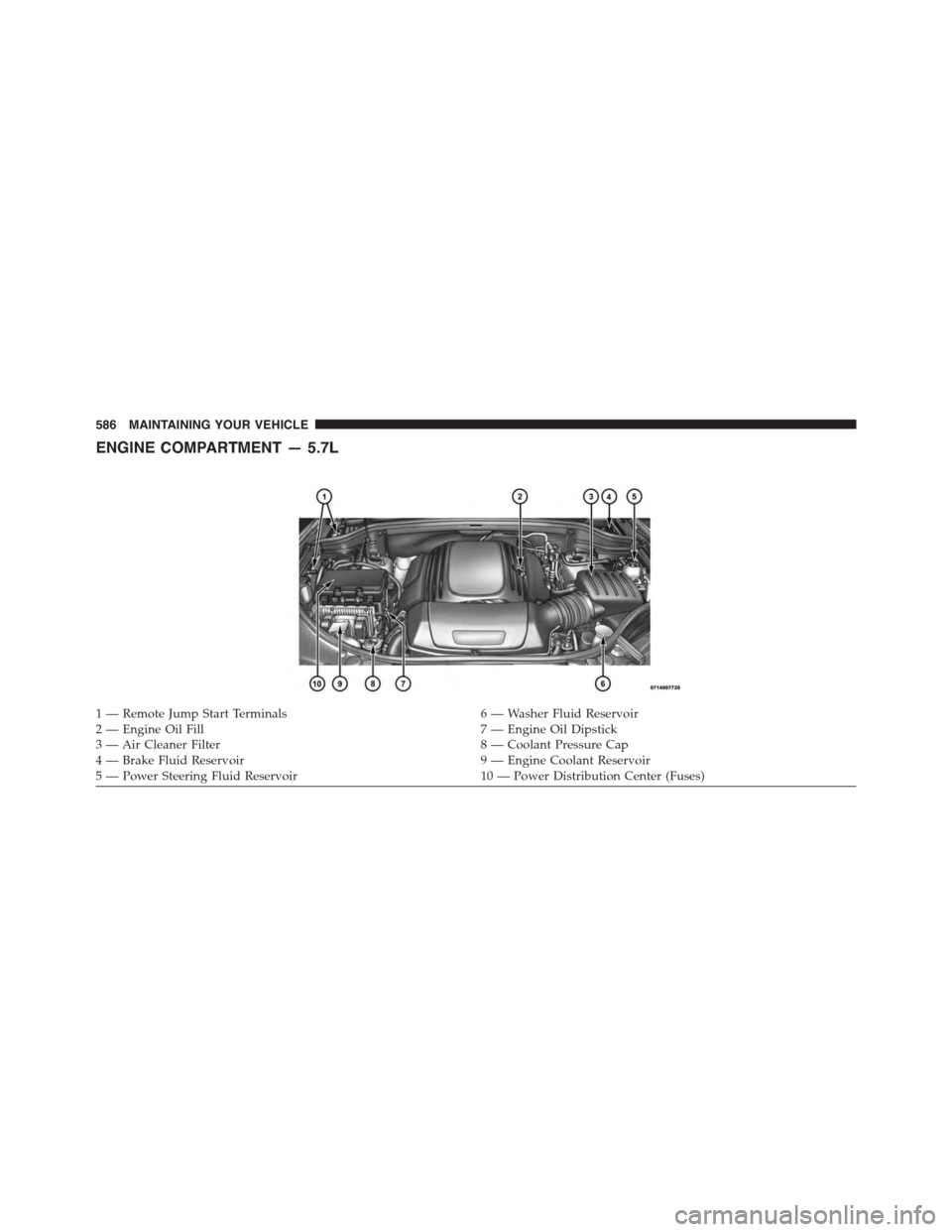
ENGINE COMPARTMENT — 5.7L
1 — Remote Jump Start Terminals6 — Washer Fluid Reservoir2—EngineOilFill7—EngineOilDipstick3 — Air Cleaner Filter8 — Coolant Pressure Cap4—BrakeFluidReservoir9—EngineCoolantReservoir5 — Power Steering Fluid Reservoir10 — Power Distribution Center (Fuses)
586 MAINTAINING YOUR VEHICLE
Page 593 of 689
CAUTION!(Continued)
•Your vehicle has been built with improved fluids
that protect the performance and durability of your
vehicle and also allow extended maintenance inter-
vals. Do not use chemical flushes in these compo-
nents as the chemicals can damage your engine,
transmission, power steering or air conditioning.
Such damage is not covered by the New Vehicle
Limited Warranty. If a flush is needed because of
component malfunction, use only the specified
fluid for the flushing procedure.
Engine Oil
Checking Oil Level
To assure proper lubrication of your vehicle’s engine, the
engine oil must be maintained at the correct level. Check
the oil level at regular intervals, such as every fuel stop.
The best time to check the engine oil level is about five
minutes after a fully warmed up engine is shut off.
Checking the oil while the vehicle is on level ground will
improve the accuracy of the oil level readings. Always
maintain the oil level within the SAFE zone on the
dipstick. Adding one quart of oil when the reading is at
the bottom of the SAFE zone will result in a reading at the
top of the safe zone on these engines.
CAUTION!
Overfilling or underfilling the crankcase will cause
aeration or loss of oil pressure. This could damage
your engine.
7
MAINTAINING YOUR VEHICLE 591
Page 594 of 689
Change Engine Oil
The oil change indicator system will remind you that it is
time to take your vehicle in for scheduled maintenance.
Refer to the “Maintenance Schedule” for further informa-
tion.
NOTE: Under no circumstances should oil change in-
tervals exceed 10,000 miles (16,000 km) or twelve
months, whichever occurs first.
Engine Oil Selection
For best performance and maximum protection under all
types of operating conditions, the manufacturer only
recommends engine oils that are API Certified and meet
the requirements of Chrysler Material Standard MS-6395.
American Petroleum Institute (API) Engine Oil
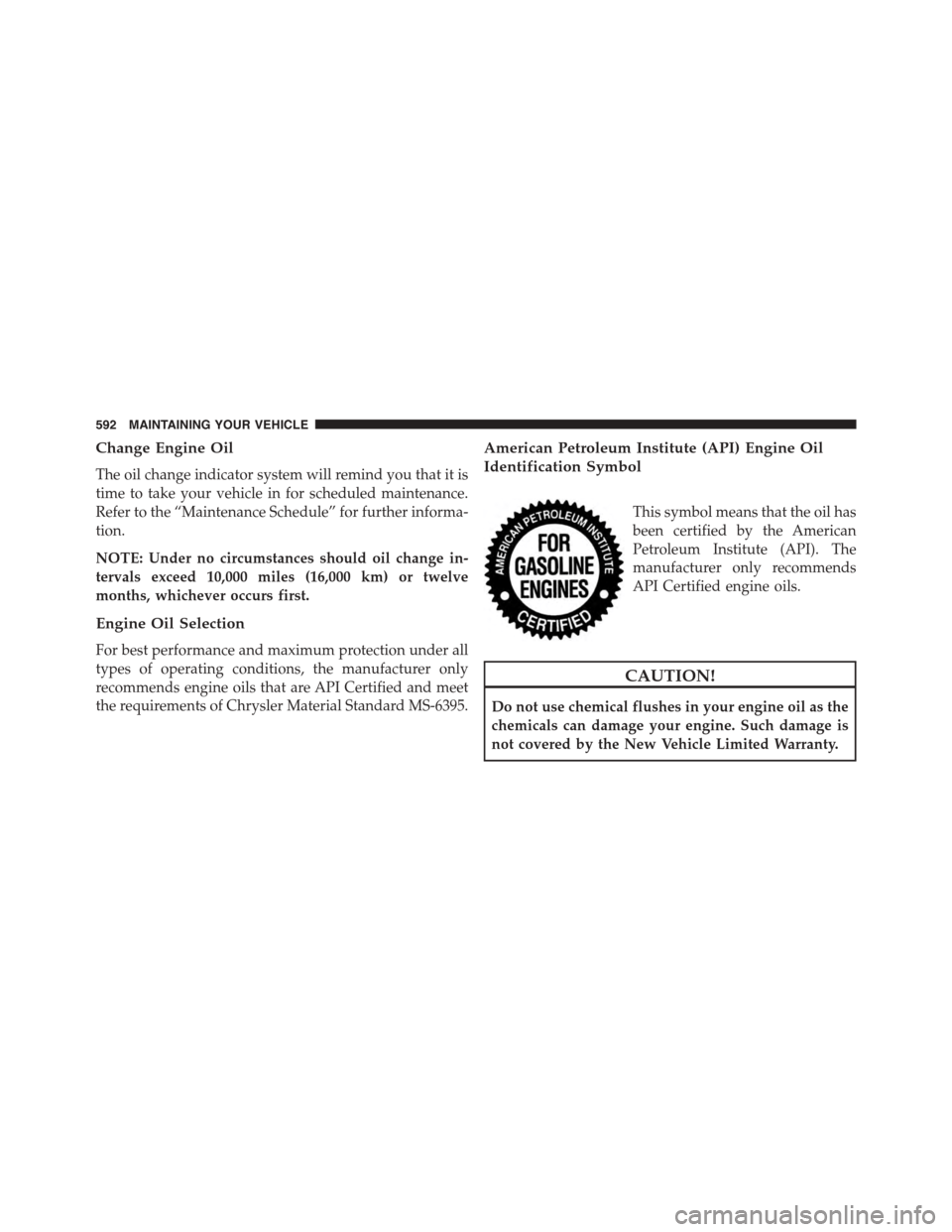
Identification Symbol
This symbol means that the oil has
been certified by the American
Petroleum Institute (API). The
manufacturer only recommends
API Certified engine oils.
CAUTION!
Do not use chemical flushes in your engine oil as the
chemicals can damage your engine. Such damage is
not covered by the New Vehicle Limited Warranty.
592 MAINTAINING YOUR VEHICLE
Page 595 of 689
Engine Oil Viscosity — 3.6L Engine
MOPAR® SAE 5W-20 engine oil approved to Chrysler
Material Standard MS-6395 such as Pennzoil®, Shell
Helix® or equivalent is recommended for all operating
temperatures. This engine oil improves low temperature
starting and vehicle fuel economy.
The engine oil filler cap also shows the recommended
engine oil viscosity for your engine. For information on
engine oil filler cap location, refer to the “Engine Com-
partment” illustration in this section.
NOTE:MOPAR® SAE 5W-30 engine oil approved to
Chrysler Material Standard MS-6395 such as Pennzoil®,
Shell Helix® or equivalent may be used when SAE 5W-20
engine oil meeting MS-6395 is not available.
Engine Oil Viscosity — 5.7L Engine
MOPAR® SAE 5W-20 engine oil or equivalent such as
Pennzoil® or Shell Helix® is recommended for all oper-
ating temperatures. This engine oil improves low tem-
perature starting and vehicle fuel economy.
The engine oil filler cap also shows the recommended engine
oil viscosity for your engine. For information on engine oil
filler cap location, refer to “Engine Compartment” in “Main-
taining Your Vehicle” for further information.
NOTE:Vehicles equipped with a 5.7L engine must use
SAE 5W-20 oil. Failure to do so may result in improper
operation of the Fuel Saver Technology. Refer to “Fuel
Saver Technology – If Equipped” in “Starting and Oper-
ating” for further information.
Lubricants that do not have both, the engine oil certifi-
cation mark and the correct SAE viscosity grade number
should not be used.
7
MAINTAINING YOUR VEHICLE 593
Page 596 of 689
Materials Added To Engine Oil
The manufacturer strongly recommends against the ad-
dition of any additives (other than leak detection dyes) to
the engine oil. Engine oil is an engineered product and its
performance may be impaired by supplemental addi-
tives.
Disposing Of Used Engine Oil And Oil Filters
Care should be taken in disposing of used engine oil and
oil filters from your vehicle. Used oil and oil filters,
indiscriminately discarded, can present a problem to the
environment. Contact your authorized dealer, service
station or governmental agency for advice on how and
where used oil and oil filters can be safely discarded in
your area.
Engine Oil Filter
The engine oil filter should be replaced with a new filter
at every engine oil change.
Engine Oil Filter Selection
This manufacturer’s engines have a full-flow type oil
filter. Use a filter of this type for replacement. The quality
of replacement filters varies considerably. Only high
quality filters should be used to assure most efficient
service. MOPAR® engine oil filters are a high quality oil
filter and are recommended.
Engine Air Cleaner Filter
Refer to the “Maintenance Schedule” for the proper
maintenance intervals.
WARNING!
The air induction system (air cleaner, hoses, etc.) can
provide a measure of protection in the case of engine
backfire. Do not remove the air induction system (air
cleaner, hoses, etc.) unless such removal is necessary
(Continued)
594 MAINTAINING YOUR VEHICLE