manual trans DODGE DURANGO 2015 3.G User Guide
[x] Cancel search | Manufacturer: DODGE, Model Year: 2015, Model line: DURANGO, Model: DODGE DURANGO 2015 3.GPages: 689, PDF Size: 20.05 MB
Page 440 of 689
In the event of a momentary problem, the transmission
can be reset to regain all forward gears by performing the
following steps:
NOTE:In cases where the instrument cluster message
indicates the transmission may not re-engage after en-
gine shutdown, perform this procedure only in a desired
location (preferably, at your authorized dealer).
1. Stop the vehicle.
2. Shift the transmission into PARK, if possible. If not,
shift the transmission to NEUTRAL.
3. Press and hold the ignition switch until the engine
turns OFF.
4. Wait approximately 30 seconds.
5. Restart the engine.
6. Shift into the desired gear range. If the problem is no
longer detected, the transmission will return to normal
operation.
NOTE:Even if the transmission can be reset, we recom-
mend that you visit your authorized dealer at your
earliest possible convenience. Your authorized dealer has
diagnostic equipment to determine if the problem could
recur.
If the transmission cannot be reset, authorized dealer
service is required.
AutoStick
AutoStick is a driver-interactive transmission feature
providing manual shift control, giving you more control
of the vehicle. AutoStick allows you to maximize engine
braking, eliminate undesirable upshifts and downshifts,
and improve overall vehicle performance. This system
438 STARTING AND OPERATING
Page 441 of 689
can also provide you with more control during passing,
city driving, cold slippery conditions, mountain driving,
trailer towing, and many other situations.
Operation
When the transmission is in DRIVE, it will operate
automatically, shifting between the eight available gears.
To engage AutoStick, simply tap one of the steering
wheel-mounted shift paddles (+/-). Tapping (-) to enter
AutoStick mode will downshift the transmission to the
next lower gear, while using (+) to enter AutoStick mode
will retain the current gear. When AutoStick is active, the
current transmission gear is displayed in the instrument
cluster.
In AutoStick mode, the transmission will shift up or
down when (+/-) is manually selected by the driver,
unless an engine lugging or overspeed condition would
result. It will remain in the selected gear until another
upshift or downshift is chosen, except as described
below.
•The transmission will automatically downshift as the
vehicle slows (to prevent engine lugging) and will
display the current gear.
•The transmission will automatically downshift to first
gear when coming to a stop. After a stop, the driver
should manually upshift (+) the transmission as the
vehicle is accelerated.
•You can start out, from a stop, in first or second gear.
Tapping (+) at a stop will allow starting in second gear.
Starting out in second gear can be helpful in snowy or
icy conditions.
•If a requested downshift would cause the engine to
over-speed, that shift will not occur.
5
STARTING AND OPERATING 439
Page 445 of 689
If One Or More Shift Conditions Are Not Met:
1. The indicator light for the current position will remain
ON.
2. The newly selected position indicator light will con-
tinue to flash.
3. The transfer casewill notshift.
NOTE:Before retrying a selection, make certain that all
the necessary requirements for selecting a new transfer
case position have been met. To retry the selection, turn
the control knob back to the current position, wait five
seconds, and retry selection. To find the shift require-
ments, refer to the#Shifting Procedure#for your transfer
case, located in this section of the owner’s manual.
The “SERV AWD” Warning Light monitors the electronic
shift all-wheel drive system. If this light remains on after
engine start up or illuminates during driving, it means
that the all-wheel drive system is not functioning prop-
erly and that service is required.
WARNING!
Always engage the parking brake when powering
down the vehicle if the “SERV AWD Warning Light”
is illuminated. Not engaging the parking brake may
allow the vehicle to roll which may cause personal
injury.
NOTE:Do not attempt to make a shift while only the
front or rear wheels are spinning. This could cause
damage to driveline components.
When operating your vehicle in LOW RANGE, the
engine speed is approximately three times that of the
AWD AUTO position at a given road speed. Take care not
to overspeed the engine and do not exceed 25 mph
(40 km/h).
5
STARTING AND OPERATING 443
Page 454 of 689
Traction Downhill
Shift the transmission into a low gear, and the transfer
case into LOW range. Let the vehicle go slowly down the
hill with all four wheels turning against engine compres-
sion drag. This will permit you to control the vehicle
speed and direction.
When descending mountains or hills, repeated braking
can cause brake fade with loss of braking control. Avoid
repeated heavy braking by downshifting the transmis-
sion whenever possible.
After Driving Off-Road
Off-road operation puts more stress on your vehicle than
does most on-road driving. After going off-road, it is
always a good idea to check for damage. That way you
can get any problems taken care of right away and have
your vehicle ready when you need it.
•Completely inspect the underbody of your vehicle.
Check tires, body structure, steering, suspension, and
exhaust system for damage.
•Inspect the radiator for mud and debris and clean as
required.
•Check threaded fasteners for looseness, particularly on
the chassis, drivetrain components, steering, and sus-
pension. Retighten them, if required, and torque to the
values specified in the Service Manual.
•Check for accumulations of plants or brush. These
things could be a fire hazard. They might hide damage
to fuel lines, brake hoses, axle pinion seals, and
propeller shafts.
•After extended operation in mud, sand, water, or
similar dirty conditions, have the radiator, fan, brake
rotors, wheels, brake linings, and axle yokes inspected
and cleaned as soon as possible.
452 STARTING AND OPERATING
Page 537 of 689
Towing Tips
Before setting out on a trip, practice turning, stopping
and backing the trailer up in an area away from heavy
traffic.
Automatic Transmission
The DRIVE range can be selected when towing. The
transmission controls include a drive strategy to avoid
frequent shifting when towing. However, if frequent
shifting does occur while in DRIVE, you can use the
AutoStick shift control to manually select a lower gear.
NOTE:Using a lower gear while operating the vehicle
under heavy loading conditions, will improve perfor-
mance and extend transmission life by reducing exces-
sive shifting and heat buildup. This action will also
provide better engine braking.
AutoStick
•When using the AutoStick shift control, select the
highest gear that allows for adequate performance and
avoids frequent downshifts. For example, choose “5” if
the desired speed can be maintained. Choose “4” or
“3” if needed to maintain the desired speed.
•To prevent excess heat generation, avoid continuous
driving at high RPM. Reduce vehicle speed as neces-
sary to avoid extended driving at high RPM. Return to
a higher gear or vehicle speed when grade and road
conditions allow.
Electronic Speed Control — If Equipped
•Do not use in hilly terrain or with heavy loads.
•When using the speed control, if you experience speed
drops greater than 10 mph (16 km/h), disengage until
you can get back to cruising speed.
5
STARTING AND OPERATING 535
Page 576 of 689
WARNING!
•Do not use a chain for freeing a stuck vehicle.
Chains may break, causing serious injury or death.
•Stand clear of vehicles when pulling with tow
hooks. Tow straps may become disengaged, caus-
ing serious injury.
CAUTION!
Tow hooks are for emergency use only, to rescue a
vehicle stranded off road. Do not use tow hooks for
tow truck hookup or highway towing. You could
damage your vehicle.
MANUAL PARK RELEASE
WARNING!
Always secure your vehicle by fully applying the
parking brake, before activating the Manual Park
Release. Activating the Manual Park Release will
allow your vehicle to roll away if it is not secured by
the parking brake or by proper connection to a tow
vehicle. Activating the Manual Park Release on an
unsecured vehicle could lead to serious injury or
death for those in or around the vehicle.
In order to move the vehicle in cases where the transmis-
sion will not shift out of PARK (such as a dead battery),
a Manual Park Release is available.
Follow these steps to use the Manual Park Release:
1. Firmly apply the parking brake.
574 WHAT TO DO IN EMERGENCIES
Page 578 of 689
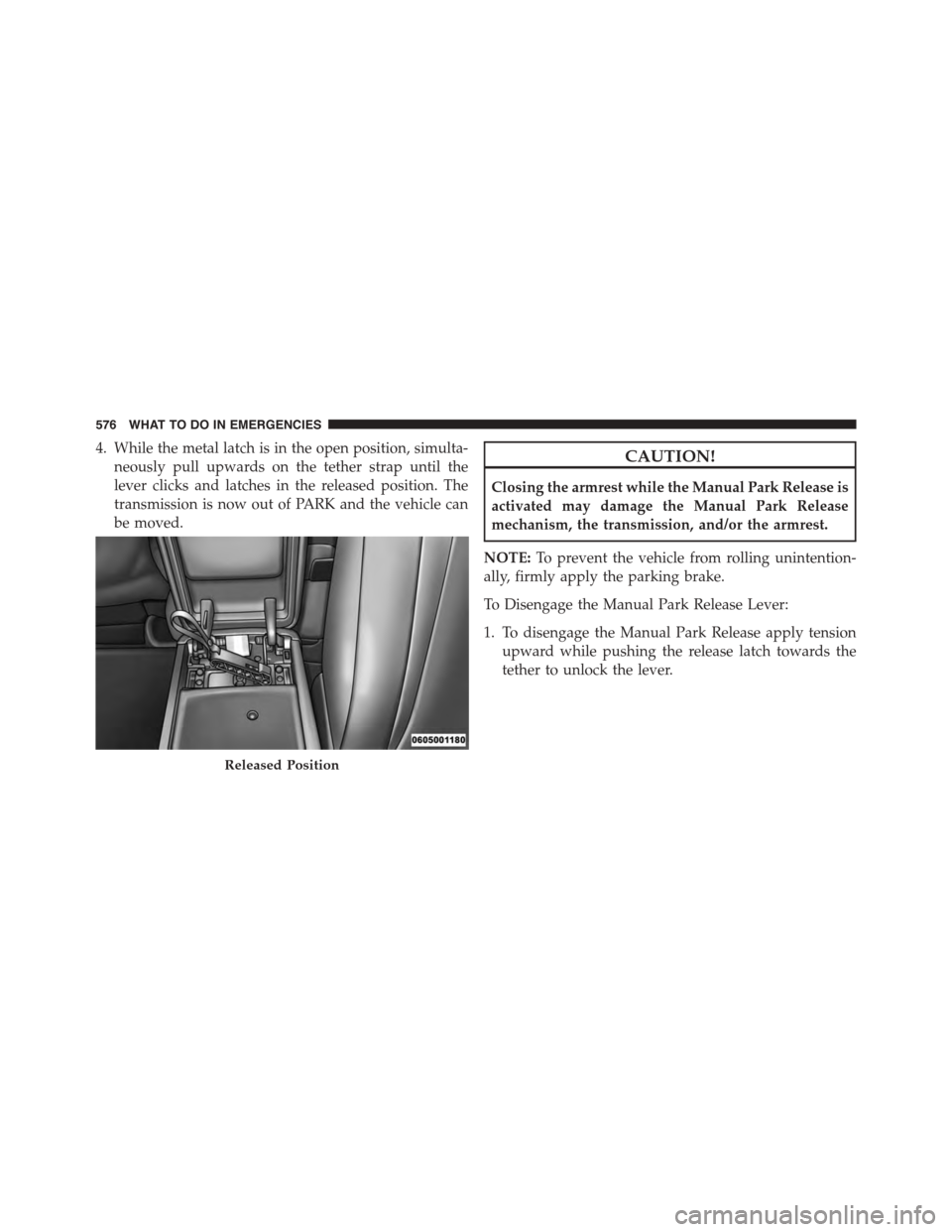
4. While the metal latch is in the open position, simulta-
neously pull upwards on the tether strap until the
lever clicks and latches in the released position. The
transmission is now out of PARK and the vehicle can
be moved.
CAUTION!
Closing the armrest while the Manual Park Release is
activated may damage the Manual Park Release
mechanism, the transmission, and/or the armrest.
NOTE:To prevent the vehicle from rolling unintention-
ally, firmly apply the parking brake.
To Disengage the Manual Park Release Lever:
1. To disengage the Manual Park Release apply tension
upward while pushing the release latch towards the
tether to unlock the lever.
Released Position
576 WHAT TO DO IN EMERGENCIES
Page 582 of 689
If you must use the accessories (wipers, defrosters, etc.)
while being towed, the ignition must be in the ON/RUN
position, not the ACC position.
If the key fob is unavailable or the vehicle’s battery is
discharged, refer to “Manual Park Release” in this section
for instructions on shifting the transmission out of PARK
for towing.
CAUTION!
•Do not use sling type equipment when towing.
Vehicle damage may occur.
•When securing the vehicle to a flat bed truck, do
not attach to front or rear suspension components.
Damage to your vehicle may result from improper
towing.
Rear Wheel Drive Models
The manufacturer recommends towing your vehicle with
all four wheelsOFFthe ground using a flatbed.
If flatbed equipment is not available, and the transmis-
sion is operable, the vehicle may be towed (with rear
wheels on the ground) with the transmission inNEU-
TRAL. Speed must not exceed 30 mph (48 km/h) and the
distance must not exceed 30 miles (48 km).
CAUTION!
Towing faster than 30 mph (48 km/h) or farther than
30 miles (48 km) with rear wheels on the ground can
cause severe transmission damage. Damage from
improper towing is not covered under the New
Vehicle Limited Warranty.
580 WHAT TO DO IN EMERGENCIES
Page 683 of 689
Disarm The System.......................20
Tamper Alert...........................21
Security System...........................19
SENTRY KEY®
FCC General Information..................18
Key Programming.......................18
Sentry Key (Immobilizer)....................16
Sentry Key Replacement.....................18
Service Assistance.........................657
Service Contract..........................659
Service Manuals..........................662
Shifting................................428
Automatic Transmission..................428
Shoulder Belts............................52
Signals, Turn.............................112
Snow Chains (Tire Chains)...................496
Snow Plow..............................536
Snow Tires..............................488
Spare Tire...............................490
Spark Plugs.............................642
Speed Control (Cruise Control)................191
Speedometer.............................292
Starting.................................27
Automatic Transmission..................422
Cold Weather..........................426
Engine Block Heater.....................427
Engine Fails to Start.....................426
Remote...............................27
Starting and Operating.....................422
Starting Procedures........................422
Steering
Power...............................453
Tilt Column...........................187
Wheel, Heated.........................190
Wheel, Tilt............................187
Steering Wheel Audio Controls...............377
Steering Wheel Mounted Sound System Controls . . .377
Storage................................634
10
INDEX 681