traction control DODGE DURANGO 2016 3.G User Guide
[x] Cancel search | Manufacturer: DODGE, Model Year: 2016, Model line: DURANGO, Model: DODGE DURANGO 2016 3.GPages: 739, PDF Size: 5.52 MB
Page 510 of 739
CAUTION!
If the “Brake” Warning Light remains on with the
parking brake released, a brake system malfunction
is indicated. Have the brake system serviced by an
authorized dealer immediately.
BRAKE SYSTEM
Your vehicle is equipped with dual hydraulic brake
systems. If either of the two hydraulic systems loses
normal capability, the remaining system will still func-
tion. However, there will be some loss of overall braking
effectiveness. You may notice increased pedal travel
during application, greater pedal force required to slow
or stop, and potential activation of the “Brake System
Warning Light.”
In the event power assist is lost for any reason (i.e.,
repeated brake applications with the engine off) thebrakes will still function. However, the effort required to
brake the vehicle will be much greater than that required
with the power system operating.
ELECTRONIC BRAKE CONTROL SYSTEM
Your vehicle is equipped with an advanced Electronic
Brake Control system (EBC). This system includes Elec-
tronic Brake Force Distribution (EBD), Anti-Lock Brake
System (ABS), Brake Assist System (BAS), Hill Start
Assist (HSA), Traction Control System (TCS), Electronic
Stability Control (ESC), and Electronic Roll Mitigation
(ERM). These systems work together to enhance both
vehicle stability and control in various driving condi-
tions.
Your vehicle may also be equipped with Trailer Sway
Control (TSC), Ready Alert Braking (RAB), Rain Brake
Support (RBS), and Dynamic Steering Torque (DST).
508 STARTING AND OPERATING
Page 517 of 739
4. Start the engine.
5. Rotate the steering wheel slightly more than one-halfturn to the left.
6. Push the “ESC Off” button located in the lower switch bank below the climate control four times within
twenty seconds. The “ESC Off Indicator Light” should
turn on and turn off two times.
7. Rotate the steering wheel back to center and then an additional slighty more than one-half turn to the right.
8. Turn the ignition switch to the OFF position and then back to the ON position. If the sequence was com-
pleted properly, the “ESC Off Indicator Light” will
blink several times to confirm HSA is disabled.
9. Repeat these steps if you want to return this feature to its previous setting.Traction Control System (TCS)
This system monitors the amount of wheel spin of each of
the driven wheels. If wheel spin is detected, the TCS may
apply brake pressure to the spinning wheel(s) and/or
reduce engine power to provide enhanced acceleration
and stability. A feature of the TCS, Brake Limited Differ-
ential (BLD), functions similar to a limited slip differen-
tial and controls the wheel spin across a driven axle. If
one wheel on a driven axle is spinning faster than the
other, the system will apply the brake of the spinning
wheel. This will allow more engine torque to be applied
to the wheel that is not spinning. BLD may remain
enabled even if TCS and ESC are in a reduced mode.
5
STARTING AND OPERATING 515
Page 518 of 739
Electronic Stability Control (ESC)
This system enhances directional control and stability of
the vehicle under various driving conditions. ESC cor-
rects for oversteering or understeering of the vehicle by
applying the brake of the appropriate wheel(s) to assist in
counteracting the oversteer or understeer condition. En-
gine power may also be reduced to help the vehicle
maintain the desired path.
ESC uses sensors in the vehicle to determine the vehicle
path intended by the driver and compares it to the actual
path of the vehicle. When the actual path does not match
the intended path, ESC applies the brake of the appro-
priate wheel to assist in counteracting the oversteer or
understeer condition.
•Oversteer - when the vehicle is turning more than
appropriate for the steering wheel position.
• Understeer - when the vehicle is turning less than
appropriate for the steering wheel position. The “ESC Activation/Malfunction Indicator Light” lo-
cated in the instrument cluster will start to flash as soon
as the ESC system becomes active. The “ESC Activation/
Malfunction Indicator Light” also flashes when the TCS
is active. If the “ESC Activation/Malfunction Indicator
Light” begins to flash during acceleration, ease up on the
accelerator and apply as little throttle as possible. Be sure
to adapt your speed and driving to the prevailing road
conditions.
WARNING!
•
Electronic Stability Control (ESC) cannot prevent
the natural laws of physics from acting on the
vehicle, nor can it increase the traction afforded by
prevailing road conditions. ESC cannot prevent
accidents, including those resulting from excessive
speed in turns, driving on very slippery surfaces, or
(Continued)
516 STARTING AND OPERATING
Page 522 of 739
running. If the “ESC Activation/Malfunction Indicator
Light” comes on continuously with the engine running, a
malfunction has been detected in the ESC system. If this
light remains on after several ignition cycles, and the
vehicle has been driven several miles (kilometers) at
speeds greater than 30 mph (48 km/h), see your autho-
rized dealer as soon as possible to have the problem
diagnosed and corrected.
The “ESC Activation/Malfunction Indicator Light” (lo-
cated in the instrument cluster) starts to flash as soon as
the tires lose traction and the ESC system becomes active.
The “ESC Activation/Malfunction Indicator Light” also
flashes when TCS is active. If the “ESC Activation/
Malfunction Indicator Light” begins to flash during ac-
celeration, ease up on the accelerator and apply as little
throttle as possible. Be sure to adapt your speed and
driving to the prevailing road conditions.NOTE:
•
The “ESC Activation/Malfunction Indicator Light”
and the “ESC OFF Indicator Light” come on momen-
tarily each time the ignition switch is turned ON.
• Each time the ignition is turned ON, the ESC system
will be ON even if it was turned off previously.
• The ESC system will make buzzing or clicking sounds
when it is active. This is normal; the sounds will stop
when ESC becomes inactive following the maneuver
that caused the ESC activation.
The “ESC OFF Indicator Light” indicates the
customer has elected to have the Electronic
Stability Control (ESC) in a reduced mode.
520 STARTING AND OPERATING
Page 543 of 739
Summer tires do not contain the all season designation or
mountain/snowflake symbol on the tire sidewall. Use
Summer tires only in sets of four; failure to do so may
adversely affect the safety and handling of your vehicle.
WARNING!
Do not use Summer tires in snow/ice conditions. You
could lose vehicle control, resulting in severe injury
or death. Driving too fast for conditions also creates
the possibility of loss of vehicle control.
Snow Tires
Some areas of the country require the use of snow tires
during the Winter. Snow tires can be identified by a
“mountain/snowflake” symbol on the tire sidewall.If you need snow tires, select tires
equivalent in size and type to the origi-
nal equipment tires. Use snow tires
only in sets of four; failure to do so
may adversely affect the safety and
handling of your vehicle.
Snow tires generally have lower speed ratings than what
was originally equipped with your vehicle and should
not be operated at sustained speeds over 75 mph
(120 km/h). For speeds above 75 mph (120 km/h) refer to
original equipment or an authorized tire dealer for
recommended safe operating speeds, loading and cold
tire inflation pressures.
While studded tires improve performance on ice, skid
and traction capability on wet or dry surfaces may be
poorer than that of non-studded tires. Some states pro-
hibit studded tires; therefore, local laws should be
checked before using these tire types.
5
STARTING AND OPERATING 541
Page 551 of 739
CAUTION!
Replacing original tires with tires of a different size
may result in false speedometer and odometer read-
ings.
TIRE CHAINS (TRACTION DEVICES)
Use of traction devices require sufficient tire-to-body
clearance. Follow these recommendations to guard
against damage.
•Traction device must be of proper size for the tire, as
recommended by the traction device manufacturer.
• Install on Rear Tires Only
• Due to limited clearance, the THULE XG-12 PRO
traction device or equivalent is recommended on
P265/60R18 or 265/50R20 tires.
WARNING!
Using tires of different size and type (M+S, Snow)
between front and rear axles can cause unpredictable
handling. You could lose control and have a collision.
CAUTION!
To avoid damage to your vehicle or tires, observe the
following precautions:
• Because of restricted traction device clearance be-
tween tires and other suspension components, it is
important that only traction devices in good condi-
tion are used. Broken devices can cause serious
damage. Stop the vehicle immediately if noise
occurs that could indicate device breakage. Remove
the damaged parts of the device before further use.
(Continued)
5
STARTING AND OPERATING 549
Page 714 of 739
significantly from the norm due to variations in driving
habits, service practices, and differences in road charac-
teristics and climate.
Traction Grades
The Traction grades, from highest to lowest, are AA, A, B,
and C. These grades represent the tire’s ability to stop on
wet pavement, as measured under controlled conditions
on specified government test surfaces of asphalt and
concrete. A tire marked C may have poor traction perfor-
mance.
WARNING!
The traction grade assigned to this tire is based on
straight-ahead braking traction tests, and does not
include acceleration, cornering, hydroplaning, or
peak traction characteristics.
Temperature Grades
The temperature grades are A (the highest), B, and C,
representing the tire’s resistance to the generation of heat
and its ability to dissipate heat, when tested under
controlled conditions on a specified indoor laboratory
test wheel. Sustained high temperature can cause the
material of the tire to degenerate and reduce tire life, and
excessive temperature can lead to sudden tire failure. The
grade C corresponds to a level of performance, which all
passenger vehicle tires must meet under the Federal
Motor Vehicle Safety Standard No. 109. Grades B and A
represent higher levels of performance on the laboratory
test wheel, than the minimum required by law.
712 IF YOU NEED CONSUMER ASSISTANCE
Page 722 of 739
Daytime Running Lights....................177
Dealer Service ........................... .640
Defroster, Rear Window .....................278
Defroster, Windshield ......................113
Dipsticks Oil (Engine) .......................... .641
Disabled Vehicle Towing ....................628
Disposal Antifreeze (Engine Coolant) ................662
Door Ajar .............................. .307
Door Ajar Light ......................... .307
Door Locks ..............................34
Child-Protection Door Lock — Rear Doors ......36
Door Locks ......................... .34, 36
KeyFob...............................34
Remote ...............................34
Remote Keyless Entry (RKE) ................34
Door Opener, Garage ...................... .244Driver Information Display
DID................................ .329
Instrument Cluster Display ................329
Driving ............................... .499
DVD Player (Video Entertainment System) .......382
Economy (Fuel) Mode ..................... .482
Electrical Outlet, Auxiliary (Power Outlet) ........257
Electric Rear Window Defrost .................278
Electric Remote Mirrors .....................133
Electronically Shifted Transfer Case .............492
Electronic Brake Control System ...............508
Anti-Lock Brake System ..................509
Electronic Roll Mitigation .................521
Traction Control System ...................515
Electronic Speed Control (Cruise Control) .193, 194, 197
Electronic Stability Control (ESC) ..............516
Electronic Throttle Control Warning Light ........305
720 INDEX
Page 727 of 739
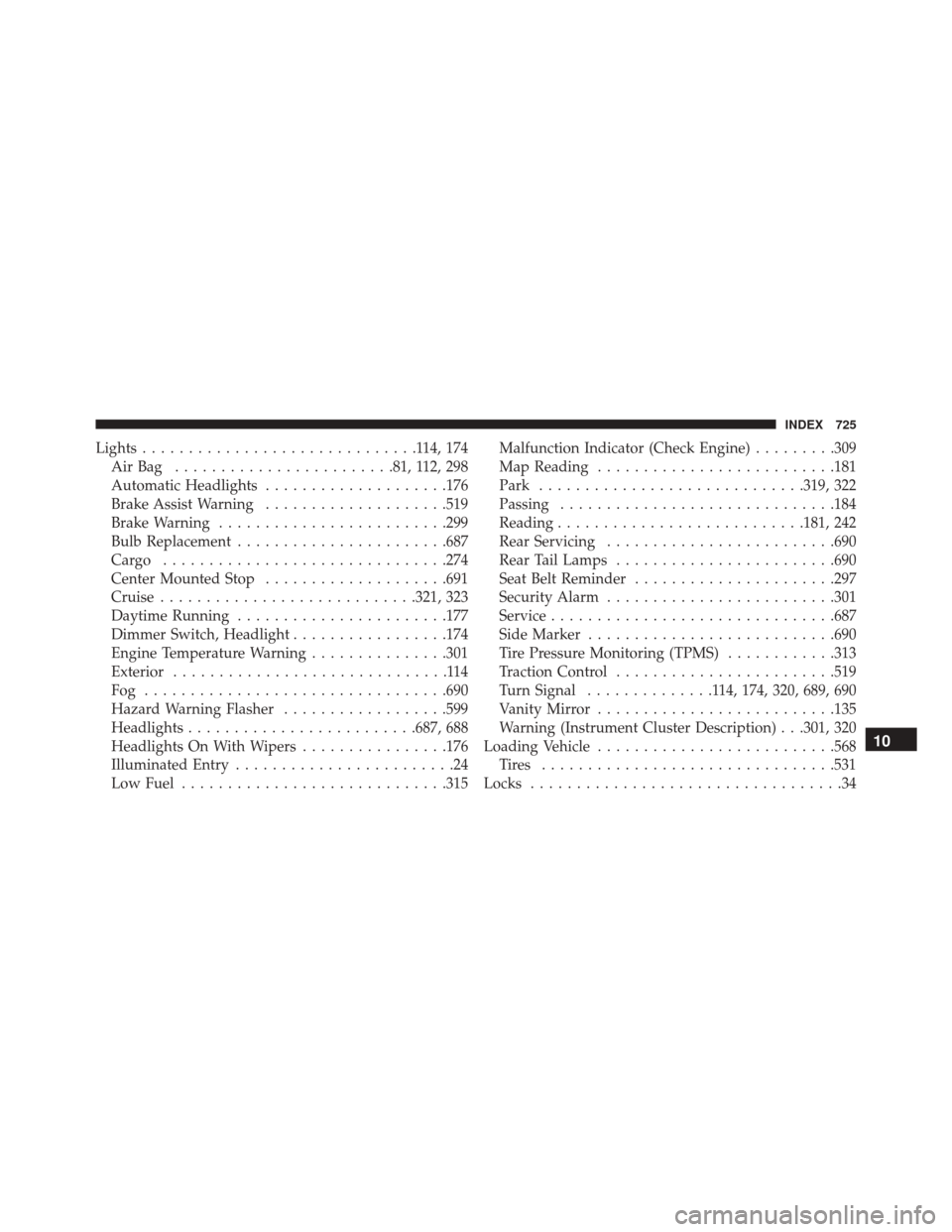
Lights..............................114,174
AirBag ........................81, 112, 298
Automatic Headlights ....................176
Brake Assist Warning ....................519
Brake Warning ........................ .299
Bulb Replacement ...................... .687
Cargo .............................. .274
Center Mounted Stop ....................691
Cruise ........................... .321, 323
Daytime Running ...................... .177
Dimmer Switch, Headlight .................174
Engine Temperature Warning ...............301
Exterior ..............................114
Fog ................................ .690
Hazard Warning Flasher ..................599
Headlights ........................ .687, 688
Headlights On With Wipers ................176
Illuminated Entry ........................24
Low Fuel ............................ .315Malfunction Indicator (Check Engine)
.........309
Map Reading ......................... .181
Park ............................ .319, 322
Passing ............................. .184
Reading .......................... .181, 242
Rear Servicing ........................ .690
Rear Tail Lamps ....................... .690
Seat Belt Reminder ..................... .297
Security Alarm ........................ .301
Service .............................. .687
Side Marker .......................... .690
Tire Pressure Monitoring (TPMS) ............313
Traction Control ....................... .519
Turn Signal ..............114, 174, 320, 689, 690
Vanity Mirror ......................... .135
Warning (Instrument Cluster Description) . . .301, 320
Loading Vehicle ......................... .568
Tires ............................... .531
Locks ..................................
34
10
INDEX 725
Page 735 of 739
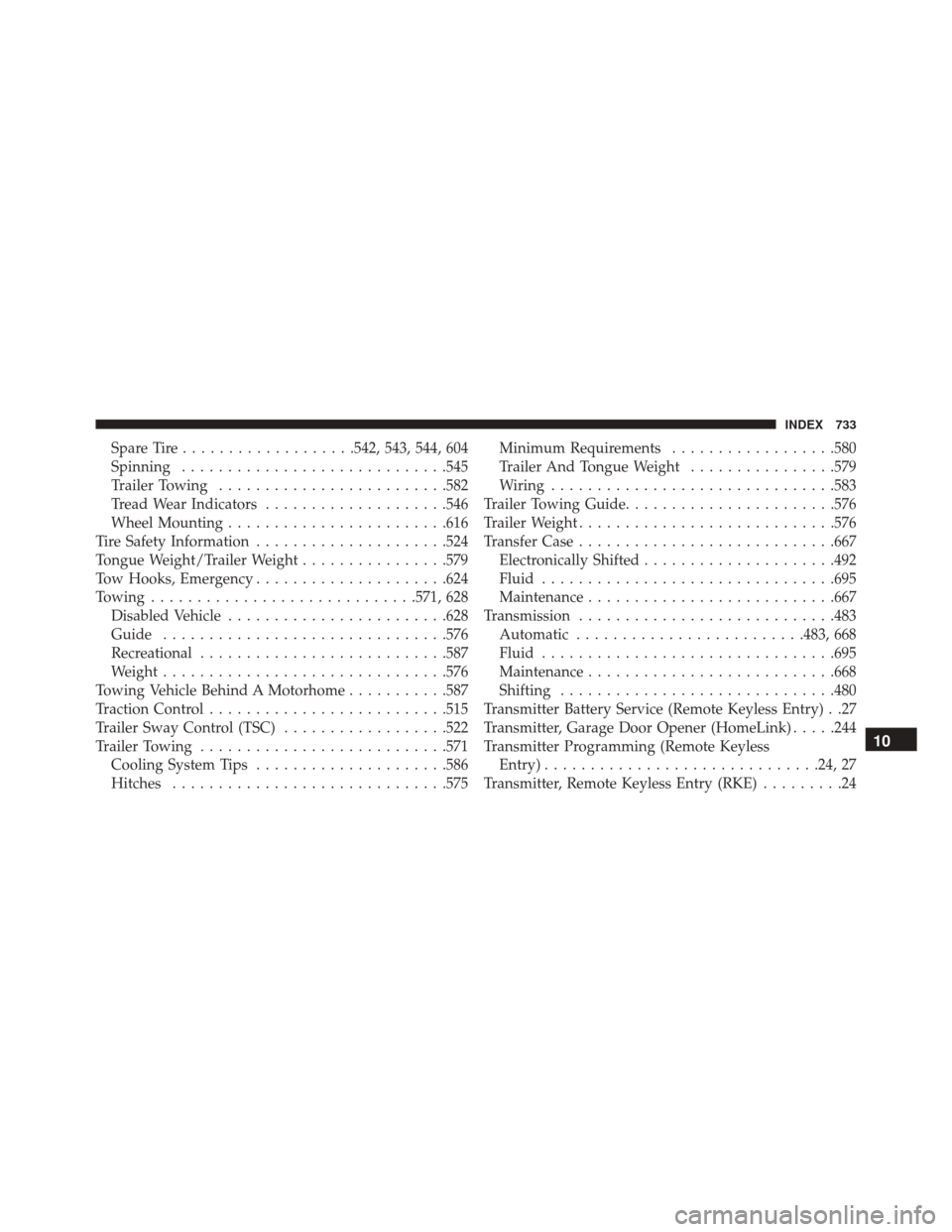
Spare Tire...................542, 543, 544, 604
Spinning ............................ .545
Trailer Towing ........................ .582
Tread Wear Indicators ....................546
Wheel Mounting ....................... .616
Tire Safety Information .....................524
Tongue Weight/Trailer Weight ................579
Tow Hooks, Emergency .....................624
Towing ............................ .571, 628
Disabled Vehicle ....................... .628
Guide .............................. .576
Recreational .......................... .587
Weight .............................. .576
Towing Vehicle Behind A Motorhome ...........587
Traction Control ......................... .515
Trailer Sway Control (TSC) ..................522
Trailer Towing .......................... .571
Cooling System Tips .....................586
Hitches ............................. .575Minimum Requirements
..................580
Trailer And Tongue Weight ................579
Wiring .............................. .583
Trailer Towing Guide ...................... .576
Trailer Weight ........................... .576
Transfer Case ........................... .667
Electronically Shifted .....................492
Fluid ............................... .695
Maintenance .......................... .667
Transmission ........................... .483
Automatic ........................ .483, 668
Fluid ............................... .695
Maintenance .......................... .668
Shifting ............................. .480
Transmitter Battery Service (Remote Keyless Entry) . .27
Transmitter, Garage Door Opener (HomeLink) .....244
T
ransmitter Programming (Remote Keyless Entry) ............................. .24, 27
Transmitter, Remote Keyless Entry (RKE) .........2410
INDEX 733