engine DODGE DURANGO 2016 3.G Repair Manual
[x] Cancel search | Manufacturer: DODGE, Model Year: 2016, Model line: DURANGO, Model: DODGE DURANGO 2016 3.GPages: 739, PDF Size: 5.52 MB
Page 478 of 739
The engine will shut down, the tachometer will move to
the zero position and the Stop/Start telltale will illumi-
nate indicating you are in Autostop. Customer settings
will be maintained upon return to an engine running
condition.
Possible Reasons The Engine Does Not Autostop
Prior to engine shut down, the system will check many
safety and comfort conditions to see if they are fulfilled.
Detailed information about the operation of the Stop/
Start system may be viewed in the DID Stop/Start
Screen. In the following situations the engine will not
stop:
•Driver ’s seat belt is not buckled.
• Driver ’s door is not closed.
• Battery temperature is too warm or cold.
• Battery charge is low. •
The vehicle is on a steep grade.
• Cabin heating or cooling is in process and an accept-
able cabin temperature has not been achieved.
• HVAC is set to full defrost mode at a high blower
speed.
• HVAC set to MAX A/C.
• Engine has not reached normal operating temperature.
• The transmission is not in a forward gear.
• Hood is open.
• Vehicle is in 4LO transfer case mode.
• Brake pedal is not pressed with sufficient pressure.
Other Factors Which Can Inhibit Autostop Include:
• Fuel level.
• Accelerator pedal input.
476 STARTING AND OPERATING
Page 479 of 739
•Engine temp too high.
• 5 MPH threshold not achieved from previous AU-
TOSTOP.
• Steering angle beyond threshold.
• ACC is on and speed is set.
It may be possible for the vehicle to be driven several
times without the STOP/START system going into a
STOP/START READY state under more extreme condi-
tions of the items listed above.
To Start The Engine While In Autostop Mode
While in a forward gear, the engine will start when the
brake pedal is released or the throttle pedal is depressed.
The transmission will automatically re-engage upon en-
gine restart. Conditions That Will Cause The Engine To Start Auto-
matically While In Autostop Mode:
•
The transmission selector is moved out of DRIVE.
• To maintain cabin temperature comfort.
• HVAC is set to full defrost mode.
• HVAC system temperature or fan speed is manually
adjusted.
• Battery voltage drops too low.
• Low brake vacuum (e.g. after several brake pedal
applications).
• STOP/START OFF switch is pressed.
• A STOP/START system error occurs.
• 4WD system is put into 4LO mode.
5
STARTING AND OPERATING 477
Page 480 of 739
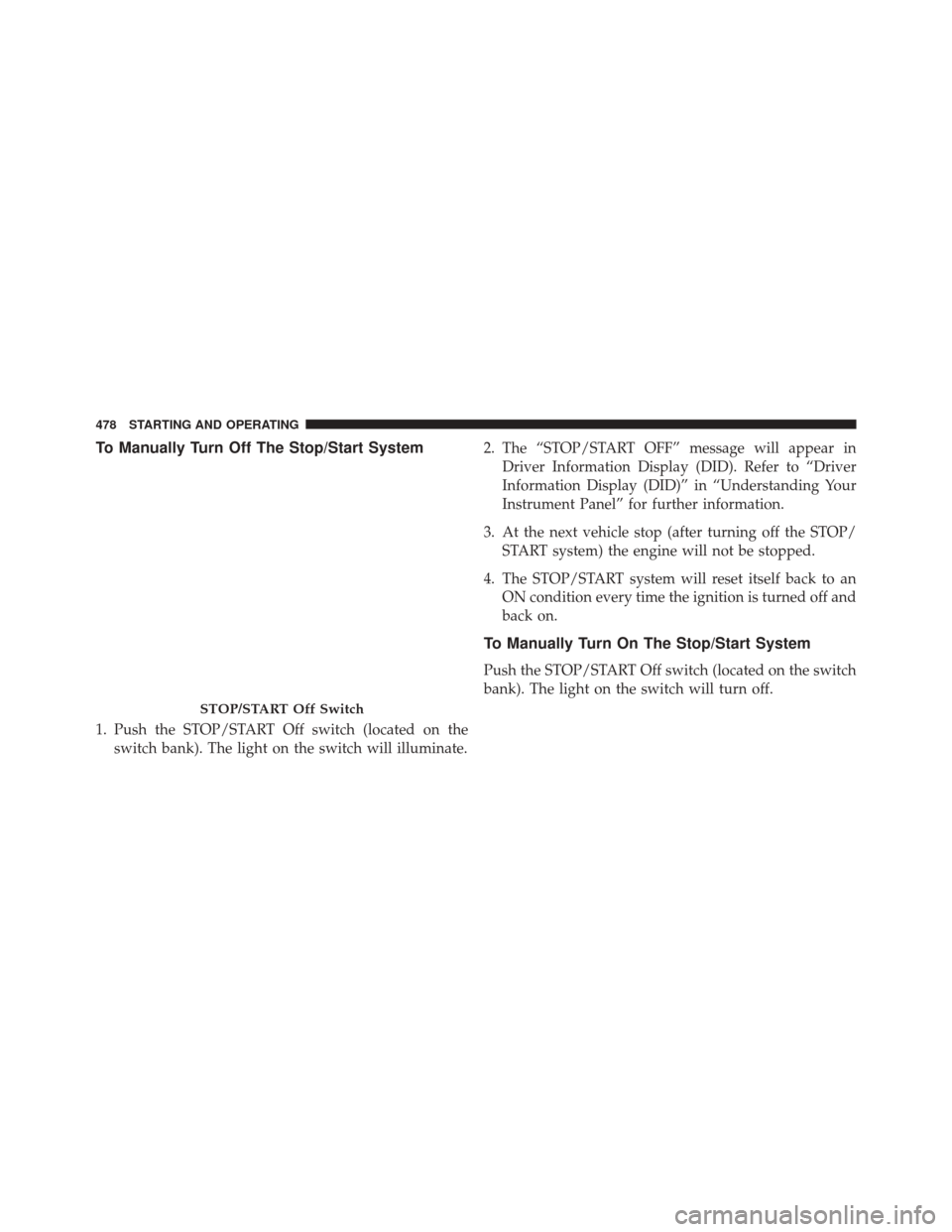
To Manually Turn Off The Stop/Start System
1. Push the STOP/START Off switch (located on theswitch bank). The light on the switch will illuminate. 2. The “STOP/START OFF” message will appear in
Driver Information Display (DID). Refer to “Driver
Information Display (DID)” in “Understanding Your
Instrument Panel” for further information.
3. At the next vehicle stop (after turning off the STOP/ START system) the engine will not be stopped.
4. The STOP/START system will reset itself back to an ON condition every time the ignition is turned off and
back on.
To Manually Turn On The Stop/Start System
Push the STOP/START Off switch (located on the switch
bank). The light on the switch will turn off.
STOP/START Off Switch
478 STARTING AND OPERATING
Page 481 of 739
System Malfunction
If there is a malfunction in the STOP/START system, the
system will not shut down the engine. A “SERVICE
STOP/START SYSTEM” message will appear in the
Driver Information Display (DID). Refer to “Driver In-
formation Display (DID)“ in “Understanding Your In-
strument Panel” for further information.
If the “SERVICE STOP/START SYSTEM” message ap-
pears in the DID, have the system checked by your
authorized dealer.
ENGINE BLOCK HEATER — IF EQUIPPED
The engine block heater warms the engine, and permits
quicker starts in cold weather. Connect the cord to a
standard 110-115 Volt AC electrical outlet with a
grounded, three-wire extension cord.The engine block heater must be plugged in at least one
hour to have an adequate warming effect on the engine.
The engine block heater cord is located:
•
3.6L Engine — Coiled and strapped to the engine oil
dipstick tube.
• 5.7L Engine — Bundled and fastened to the injector
harness.
WARNING!
Remember to disconnect the engine block heater
cord before driving. Damage to the 110-115 Volt
electrical cord could cause electrocution.
5
STARTING AND OPERATING 479
Page 482 of 739
AUTOMATIC TRANSMISSION
WARNING!
•It is dangerous to shift out of PARK or NEUTRAL
if the engine speed is higher than idle speed. If
your foot is not firmly pressing the brake pedal, the
vehicle could accelerate quickly forward or in re-
verse. You could lose control of the vehicle and hit
someone or something. Only shift into gear when
the engine is idling normally and your foot is
firmly pressing the brake pedal.
• Unintended movement of a vehicle could injure
those in or near the vehicle. As with all vehicles,
you should never exit a vehicle while the engine is
running. Before exiting a vehicle, always apply the
parking brake, shift the transmission into PARK,
and make sure the keyless ignition node is in the
(Continued)
WARNING! (Continued)
\bOFF\bmode. Remove the Key Fob from the vehicle,
and lock the vehicle. When the keyless ignition is
in the OFF mode, the transmission is locked in
PARK, securing the vehicle against unwanted
movement.
• Never leave children alone in a vehicle, or with
access to an unlocked vehicle. Allowing children to
be in a vehicle unattended is dangerous for a
number of reasons. A child or others could be
seriously or fatally injured. Children should be
warned not to touch the parking brake, brake pedal
or the transmission gear selector.
• When leaving the vehicle, always make sure the
keyless ignition node is in the “OFF” mode, re-
move the key fob from the vehicle and lock the
vehicle.
(Continued)
480 STARTING AND OPERATING
Page 483 of 739
WARNING!(Continued)
•Do not leave the Key Fob in or near the vehicle (or
in a location accessible to children), and do not
leave the ignition in the ACC or ON/RUN mode. A
child could operate power windows, other controls,
or move the vehicle.
CAUTION!
Damage to the transmission may occur if the follow-
ing precautions are not observed:
• Shift into or out of PARK or REVERSE only after
the vehicle has come to a complete stop.
• Do not shift between PARK, REVERSE, NEU-
TRAL, or DRIVE when the engine is above idle
speed.
• Before shifting into any gear, make sure your foot
is firmly pressing the brake pedal. NOTE:
You must press and hold the brake pedal while
shifting out of PARK.
Key Ignition Park Interlock
This vehicle is equipped with a Key Ignition Park Inter-
lock which requires the transmission to be in PARK
before the engine can be turned off. This helps the driver
avoid inadvertently leaving the vehicle without placing
the transmission in PARK.
This system also locks the transmission in PARK when-
ever the ignition switch is in the OFF position.
Brake/Transmission Shift Interlock System
This vehicle is equipped with a Brake Transmission Shift
Interlock System (BTSI) that holds the transmission gear
selector in PARK unless the brakes are applied. To shift
the transmission out of PARK, the engine must be
running and the brake pedal must be pressed.
5
STARTING AND OPERATING 481
Page 486 of 739
transmission gear, and will display the current gear in the
instrument cluster. Refer to “AutoStick” in this section for
further information.Gear Ranges
DO NOT race the engine when shifting from PARK or
NEUTRAL into another gear range.
NOTE:After selecting any gear range, wait a moment to
allow the selected gear to engage before accelerating.
This is especially important when the engine is cold.
PARK (P)
This range supplements the parking brake by locking the
transmission. The engine can be started in this range.
Never attempt to use PARK while the vehicle is in
motion. Apply the parking brake when leaving the
vehicle in this range.
When parking on a level surface, you may shift the
transmission into PARK first, and then apply the parking
brake.
Electronic Gear Selector
484 STARTING AND OPERATING
Page 487 of 739
When parking on a hill, apply the parking brake before
shifting the transmission to PARK. As an added precau-
tion, turn the front wheels toward the curb on a downhill
grade and away from the curb on an uphill grade.
NOTE:On vehicles equipped with the electronically
shifted transfer case, ensure that the transfer case is in
AWD AUTO or LOW RANGE position on the AWD
Control Switch. Ensure that the NEUTRAL position light
is NOT illuminated.
WARNING!
• Never use the PARK position as a substitute for the
parking brake. Always apply the parking brake
fully when parked to guard against vehicle move-
ment and possible injury or damage.
(Continued)
WARNING! (Continued)
•Your vehicle could move and injure you and others
if it is not in PARK. Make sure the transmission is
in PARK before leaving the vehicle.
• It is dangerous to shift out of PARK or NEUTRAL
if the engine speed is higher than idle speed. If
your foot is not firmly pressing the brake pedal, the
vehicle could accelerate quickly forward or in re-
verse. You could lose control of the vehicle and hit
someone or something. Only shift into gear when
the engine is idling normally and your foot is
firmly pressing the brake pedal.
•
Unintended movement of a vehicle could injure
those in or near the vehicle. As with all vehicles, you
should never exit a vehicle while the engine is
running. Before exiting a vehicle, always apply the
parking brake, shift the transmission into PARK, and
(Continued)
5
STARTING AND OPERATING 485
Page 488 of 739
WARNING!(Continued)
make sure the keyless ignition node is in the \bOFF\b
mode. Remove the Key Fob from the vehicle, and
lock the vehicle. When the keyless ignition is in the
“OFF” mode, the transmission is locked in PARK,
securing the vehicle against unwanted movement.
• Never leave children alone in a vehicle, or with
access to an unlocked vehicle. Allowing children to
be in a vehicle unattended is dangerous for a
number of reasons. A child or others could be
seriously or fatally injured. Children should be
warned not to touch the parking brake, brake pedal
or the transmission gear selector.
• Do not leave the Key Fob in or near the vehicle (or
in a location accessible to children), and do not
leave the ignition in the ACC or ON/RUN mode. A
child could operate power windows, other controls,
or move the vehicle. NOTE:
•
Before moving the transmission gear selector out of
PARK, you must start the engine and also press the
brake pedal. Otherwise, damage to the gear selector
could result.
• DO NOT race the engine when shifting from PARK or
NEUTRAL into another gear range, as this can damage
the drivetrain.
The following indicator should be used to ensure that
you have engaged the transmission into the PARK posi-
tion:
• With brake pedal released, look at the transmission
gear position display and verify that it indicates the
PARK position (P).
486 STARTING AND OPERATING
Page 489 of 739
REVERSE (R)
This range is for moving the vehicle backward. Shift into
REVERSE only after the vehicle has come to a complete
stop.
NEUTRAL (N)
Use this range when the vehicle is standing for prolonged
periods with the engine running. Apply the parking
brake and shift the transmission into PARK if you must
leave the vehicle.
WARNING!
Do not coast in NEUTRAL and never turn off the
ignition to coast down a hill. These are unsafe
practices that limit your response to changing traffic
or road conditions. You might lose control of the
vehicle and have a collision.
CAUTION!
Towing the vehicle, coasting, or driving for any other
reason with the transmission in NEUTRAL can cause
severe transmission damage. Refer to “Recreational
Towing” in “Starting And Operating” and “Towing A
Disabled Vehicle” in “What To Do In Emergencies”
for further information.
DRIVE (D)
This range should be used for most city and highway
driving. It provides the smoothest upshifts and down-
shifts, and the best fuel economy. The transmission
automatically upshifts through all forward gears. The
DRIVE position provides optimum driving characteris-
tics under all normal operating conditions.
5
STARTING AND OPERATING 487