climate control DODGE DURANGO 2017 3.G Owner's Manual
[x] Cancel search | Manufacturer: DODGE, Model Year: 2017, Model line: DURANGO, Model: DODGE DURANGO 2017 3.GPages: 584, PDF Size: 5.14 MB
Page 357 of 584
Get Started
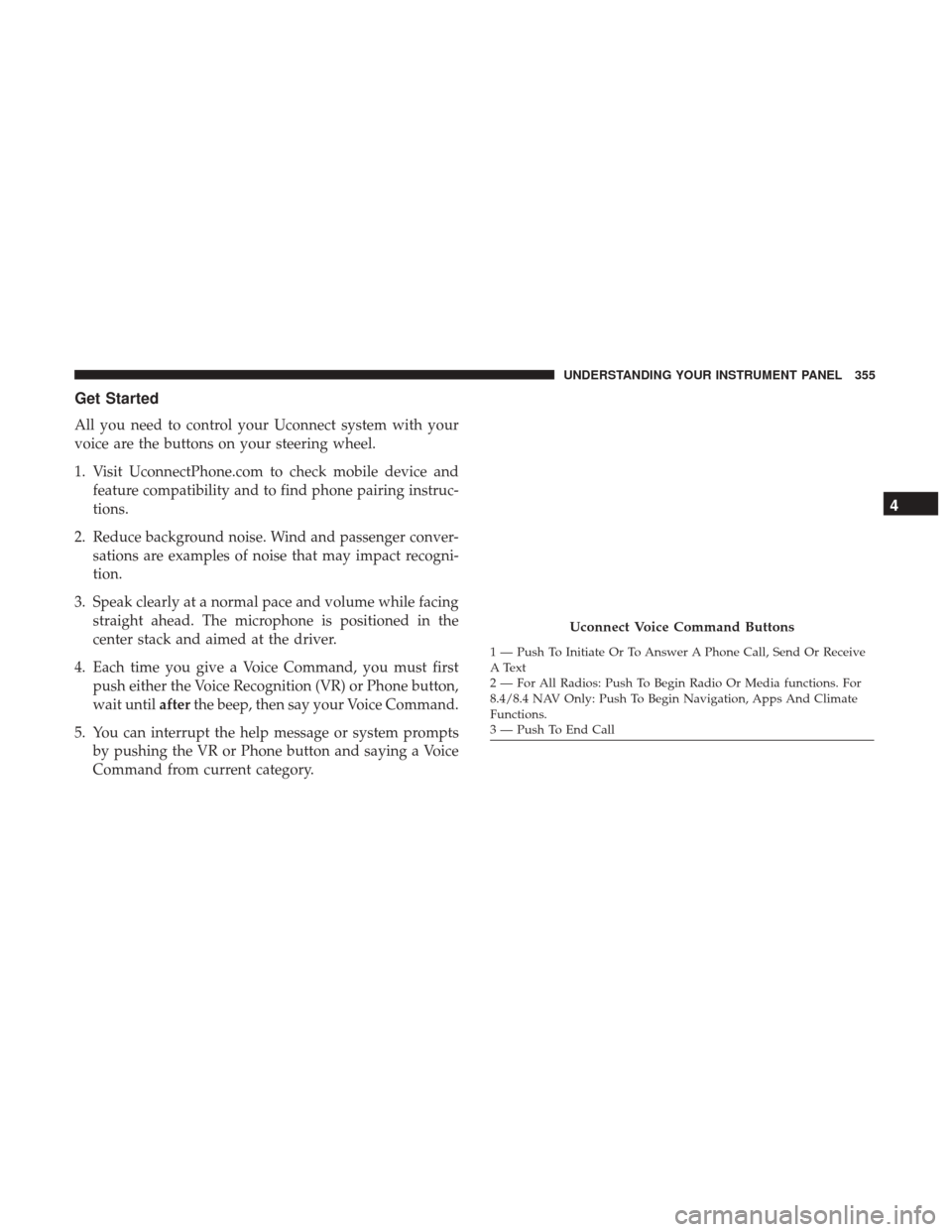
All you need to control your Uconnect system with your
voice are the buttons on your steering wheel.
1. Visit UconnectPhone.com to check mobile device andfeature compatibility and to find phone pairing instruc-
tions.
2. Reduce background noise. Wind and passenger conver- sations are examples of noise that may impact recogni-
tion.
3. Speak clearly at a normal pace and volume while facing straight ahead. The microphone is positioned in the
center stack and aimed at the driver.
4. Each time you give a Voice Command, you must first push either the Voice Recognition (VR) or Phone button,
wait until afterthe beep, then say your Voice Command.
5. You can interrupt the help message or system prompts by pushing the VR or Phone button and saying a Voice
Command from current category.
Uconnect Voice Command Buttons
1 — Push To Initiate Or To Answer A Phone Call, Send Or Receive
A Text
2 — For All Radios: Push To Begin Radio Or Media functions. For
8.4/8.4 NAV Only: Push To Begin Navigation, Apps And Climate
Functions.
3 — Push To End Call
4
UNDERSTANDING YOUR INSTRUMENT PANEL 355
Page 363 of 584
Climate (8.4/8.4 NAV)
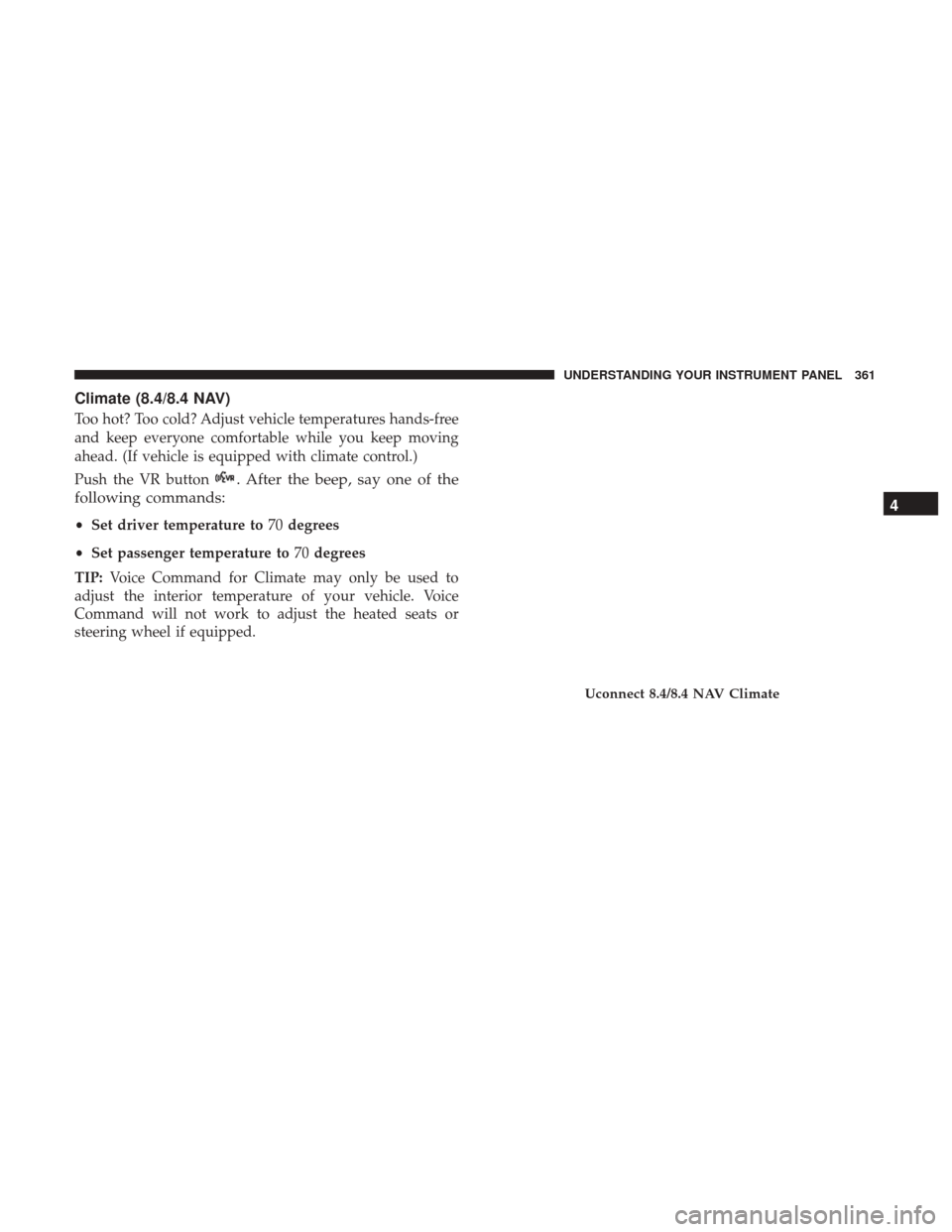
Too hot? Too cold? Adjust vehicle temperatures hands-free
and keep everyone comfortable while you keep moving
ahead. (If vehicle is equipped with climate control.)
Push the VR button
. After the beep, say one of the
following commands:
• Set driver temperature to 70degrees
• Set passenger temperature to 70degrees
TIP: Voice Command for Climate may only be used to
adjust the interior temperature of your vehicle. Voice
Command will not work to adjust the heated seats or
steering wheel if equipped.
Uconnect 8.4/8.4 NAV Climate
4
UNDERSTANDING YOUR INSTRUMENT PANEL 361
Page 413 of 584
Disabling And Enabling HSA
This feature can be turned on or turned off. To change the
current setting, proceed as follows:
•
For vehicles equipped with the Instrument Cluster Dis-
play, refer to “Instrument Cluster Display” in “Under-
standing Your Instrument Panel” for further information.
• If disabling HSA using Uconnect Settings, refer to
“Uconnect Settings” in “Understanding Your Instrument
Panel” for further information.
For vehicles not equipped with the instrument cluster
display, perform the following steps:
1.
Center the steering wheel (front wheels pointing straight
forward).
2. Shift the transmission into PARK.
3. Apply the parking brake.
4. Start the engine.
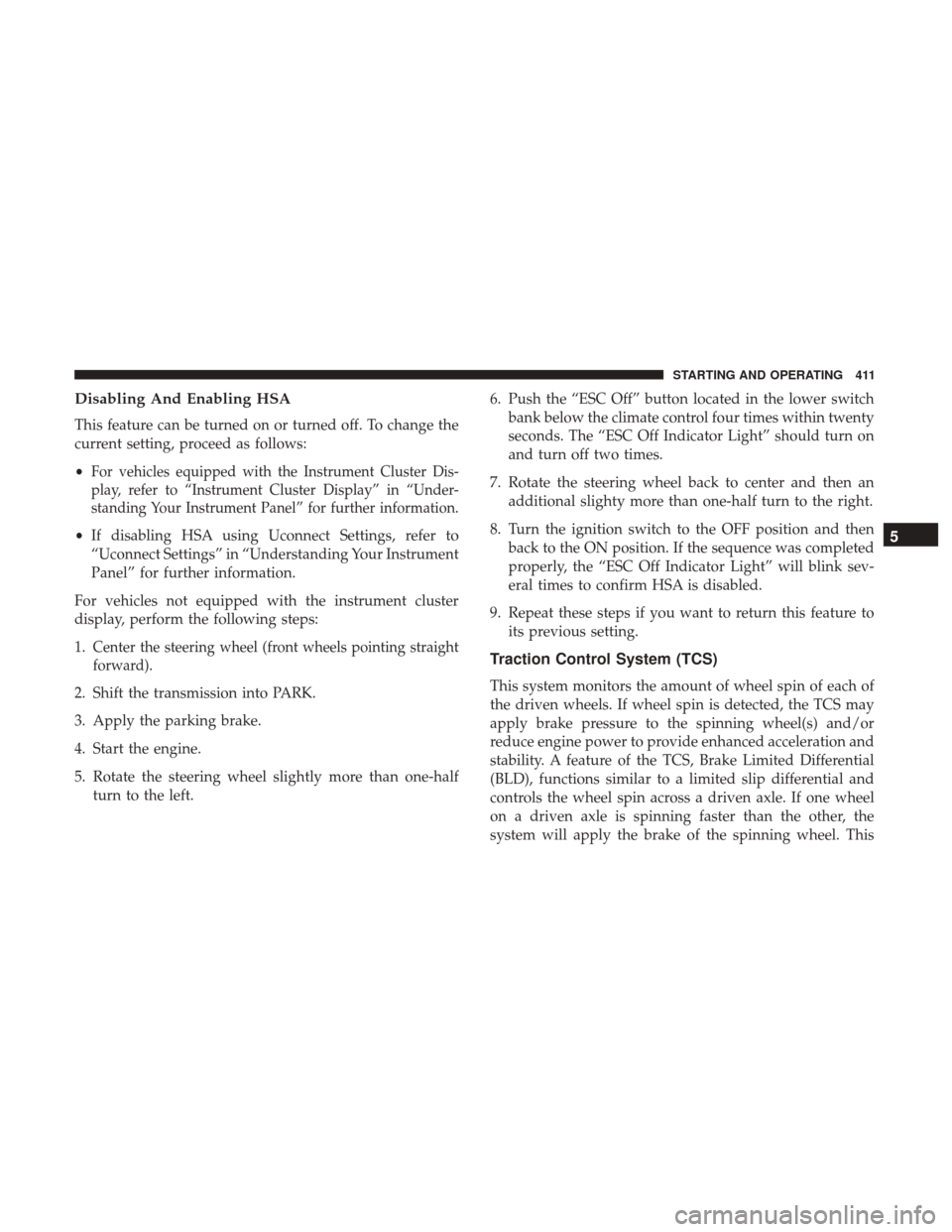
5. Rotate the steering wheel slightly more than one-half turn to the left. 6. Push the “ESC Off” button located in the lower switch
bank below the climate control four times within twenty
seconds. The “ESC Off Indicator Light” should turn on
and turn off two times.
7. Rotate the steering wheel back to center and then an additional slighty more than one-half turn to the right.
8. Turn the ignition switch to the OFF position and then back to the ON position. If the sequence was completed
properly, the “ESC Off Indicator Light” will blink sev-
eral times to confirm HSA is disabled.
9. Repeat these steps if you want to return this feature to its previous setting.
Traction Control System (TCS)
This system monitors the amount of wheel spin of each of
the driven wheels. If wheel spin is detected, the TCS may
apply brake pressure to the spinning wheel(s) and/or
reduce engine power to provide enhanced acceleration and
stability. A feature of the TCS, Brake Limited Differential
(BLD), functions similar to a limited slip differential and
controls the wheel spin across a driven axle. If one wheel
on a driven axle is spinning faster than the other, the
system will apply the brake of the spinning wheel. This
5
STARTING AND OPERATING 411
Page 476 of 584
HAZARD WARNING FLASHERS
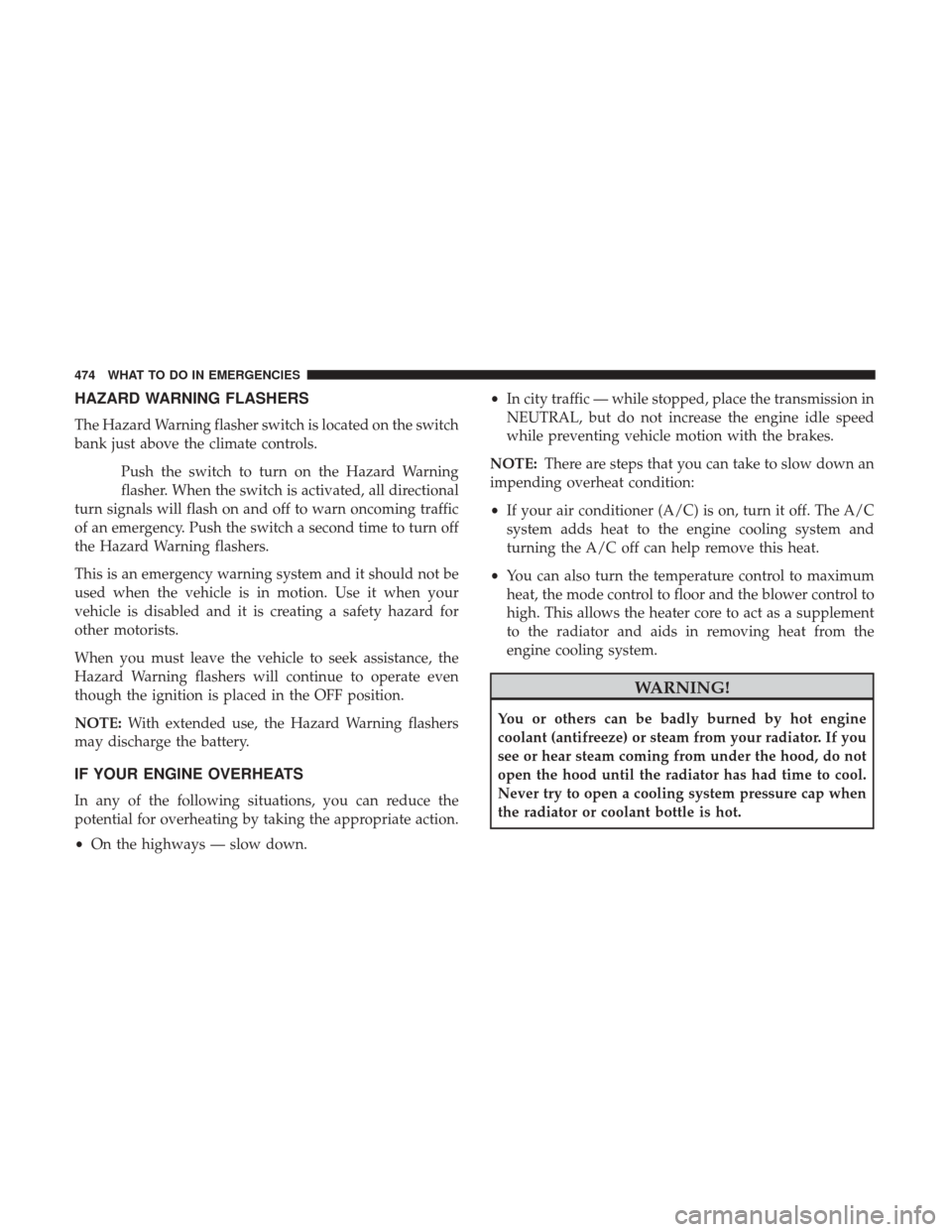
The Hazard Warning flasher switch is located on the switch
bank just above the climate controls.Push the switch to turn on the Hazard Warning
flasher. When the switch is activated, all directional
turn signals will flash on and off to warn oncoming traffic
of an emergency. Push the switch a second time to turn off
the Hazard Warning flashers.
This is an emergency warning system and it should not be
used when the vehicle is in motion. Use it when your
vehicle is disabled and it is creating a safety hazard for
other motorists.
When you must leave the vehicle to seek assistance, the
Hazard Warning flashers will continue to operate even
though the ignition is placed in the OFF position.
NOTE: With extended use, the Hazard Warning flashers
may discharge the battery.
IF YOUR ENGINE OVERHEATS
In any of the following situations, you can reduce the
potential for overheating by taking the appropriate action.
• On the highways — slow down. •
In city traffic — while stopped, place the transmission in
NEUTRAL, but do not increase the engine idle speed
while preventing vehicle motion with the brakes.
NOTE: There are steps that you can take to slow down an
impending overheat condition:
• If your air conditioner (A/C) is on, turn it off. The A/C
system adds heat to the engine cooling system and
turning the A/C off can help remove this heat.
• You can also turn the temperature control to maximum
heat, the mode control to floor and the blower control to
high. This allows the heater core to act as a supplement
to the radiator and aids in removing heat from the
engine cooling system.
WARNING!
You or others can be badly burned by hot engine
coolant (antifreeze) or steam from your radiator. If you
see or hear steam coming from under the hood, do not
open the hood until the radiator has had time to cool.
Never try to open a cooling system pressure cap when
the radiator or coolant bottle is hot.
474 WHAT TO DO IN EMERGENCIES
Page 538 of 584
CavityCartridge Fuse Micro Fuse Description
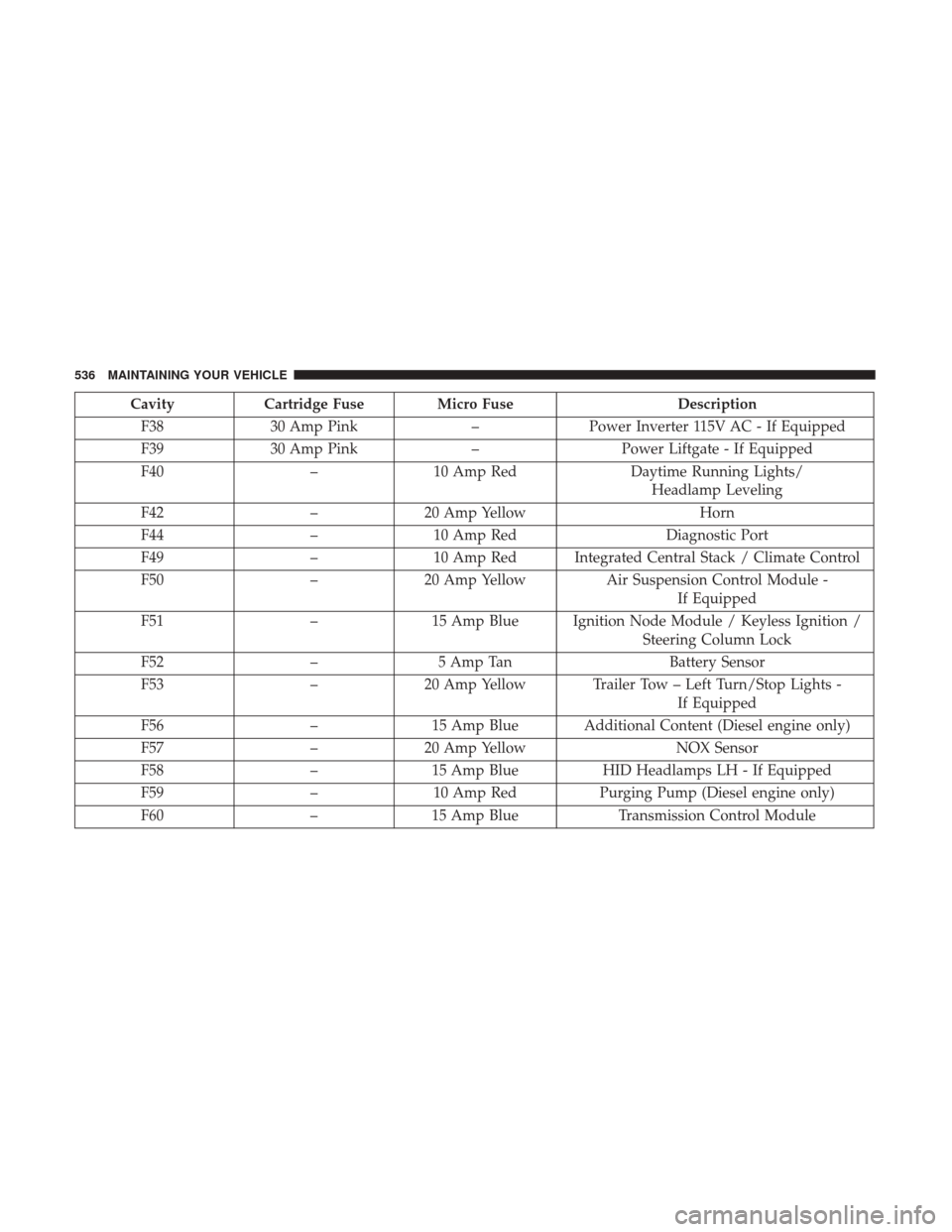
F38 30 Amp Pink –Power Inverter 115V AC - If Equipped
F39 30 Amp Pink –Power Liftgate - If Equipped
F40 –10 Amp Red Daytime Running Lights/
Headlamp Leveling
F42 –20 Amp Yellow Horn
F44 –10 Amp Red Diagnostic Port
F49 –10 Amp Red Integrated Central Stack / Climate Control
F50 –20 Amp Yellow Air Suspension Control Module -
If Equipped
F51 –15 Amp Blue Ignition Node Module / Keyless Ignition /
Steering Column Lock
F52 –5 Amp Tan Battery Sensor
F53 –20 Amp Yellow Trailer Tow – Left Turn/Stop Lights -
If Equipped
F56 –15 Amp Blue Additional Content (Diesel engine only)
F57 –20 Amp Yellow NOX Sensor
F58 –15 Amp Blue HID Headlamps LH - If Equipped
F59 –10 Amp Red Purging Pump (Diesel engine only)
F60 –15 Amp Blue Transmission Control Module
536 MAINTAINING YOUR VEHICLE
Page 541 of 584
CavityCartridge Fuse Micro Fuse Description
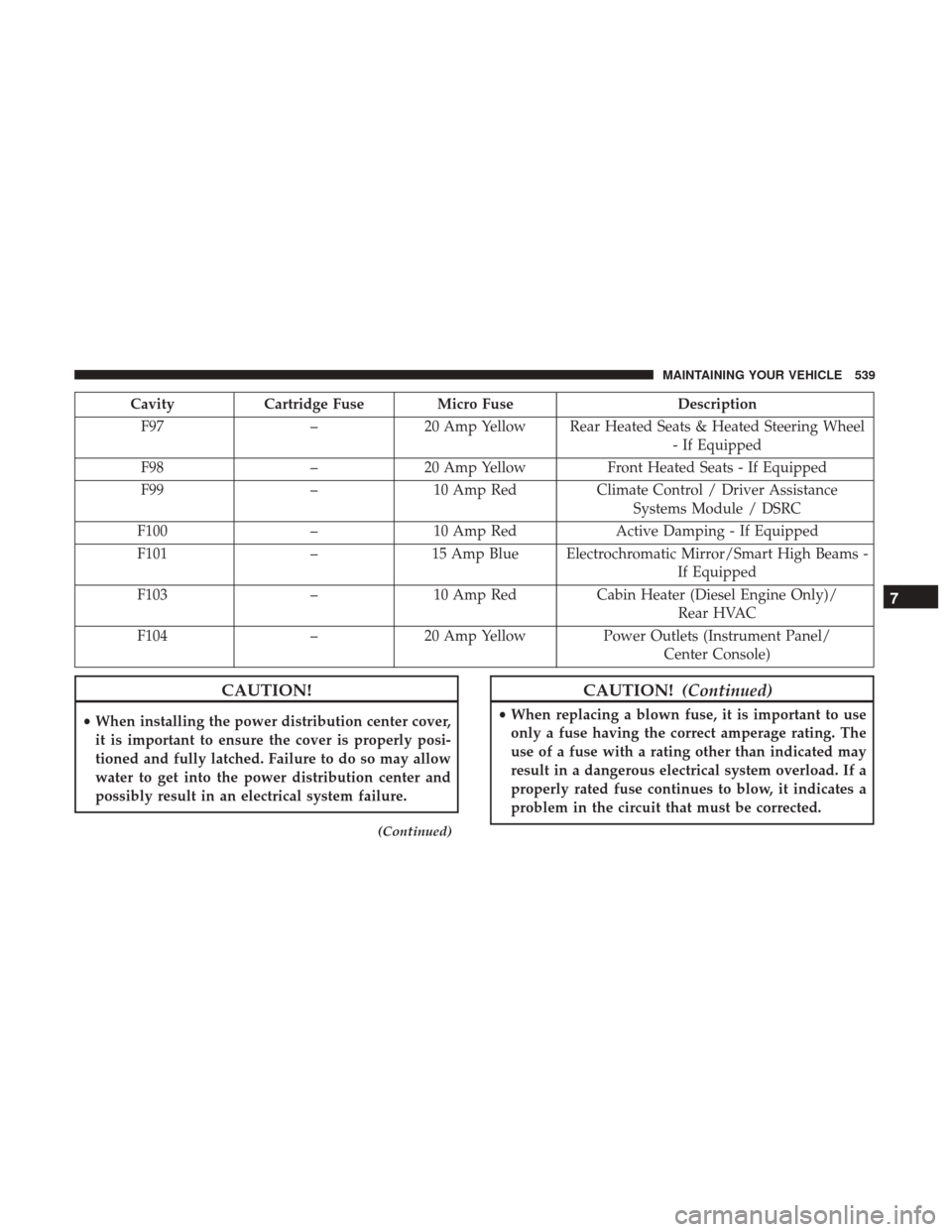
F97 –20 Amp Yellow Rear Heated Seats & Heated Steering Wheel
- If Equipped
F98 –20 Amp Yellow Front Heated Seats - If Equipped
F99 –10 Amp Red Climate Control / Driver Assistance
Systems Module / DSRC
F100 –10 Amp Red Active Damping - If Equipped
F101 –15 Amp Blue Electrochromatic Mirror/Smart High Beams -
If Equipped
F103 –10 Amp Red Cabin Heater (Diesel Engine Only)/
Rear HVAC
F104 –20 Amp Yellow Power Outlets (Instrument Panel/
Center Console)
CAUTION!
•When installing the power distribution center cover,
it is important to ensure the cover is properly posi-
tioned and fully latched. Failure to do so may allow
water to get into the power distribution center and
possibly result in an electrical system failure.
(Continued)
CAUTION! (Continued)
•When replacing a blown fuse, it is important to use
only a fuse having the correct amperage rating. The
use of a fuse with a rating other than indicated may
result in a dangerous electrical system overload. If a
properly rated fuse continues to blow, it indicates a
problem in the circuit that must be corrected.
7
MAINTAINING YOUR VEHICLE 539
Page 565 of 584
Owner’s Manuals
These Owner’s Manuals have been prepared with the
assistance of service and engineering specialists to acquaint
you with specific FCA US LLC vehicles. Included are
starting, operating, emergency and maintenance proce-
dures as well as specifications, capabilities and safety tips.
Call toll free at:
•1-800-890-4038 (U.S.)
• 1-800-387-1143 (Canada)
Or
Visit us on the Worldwide Web at:
• www.techauthority.comDEPARTMENT OF TRANSPORTATION UNIFORM
TIRE QUALITY GRADES
The following tire grading categories were established by
the National Highway Traffic Safety Administration. The
specific grade rating assigned by the tire’s manufacturer in
each category is shown on the sidewall of the tires on your
vehicle.
All passenger vehicle tires must conform to Federal safety
requirements in addition to these grades.
Treadwear
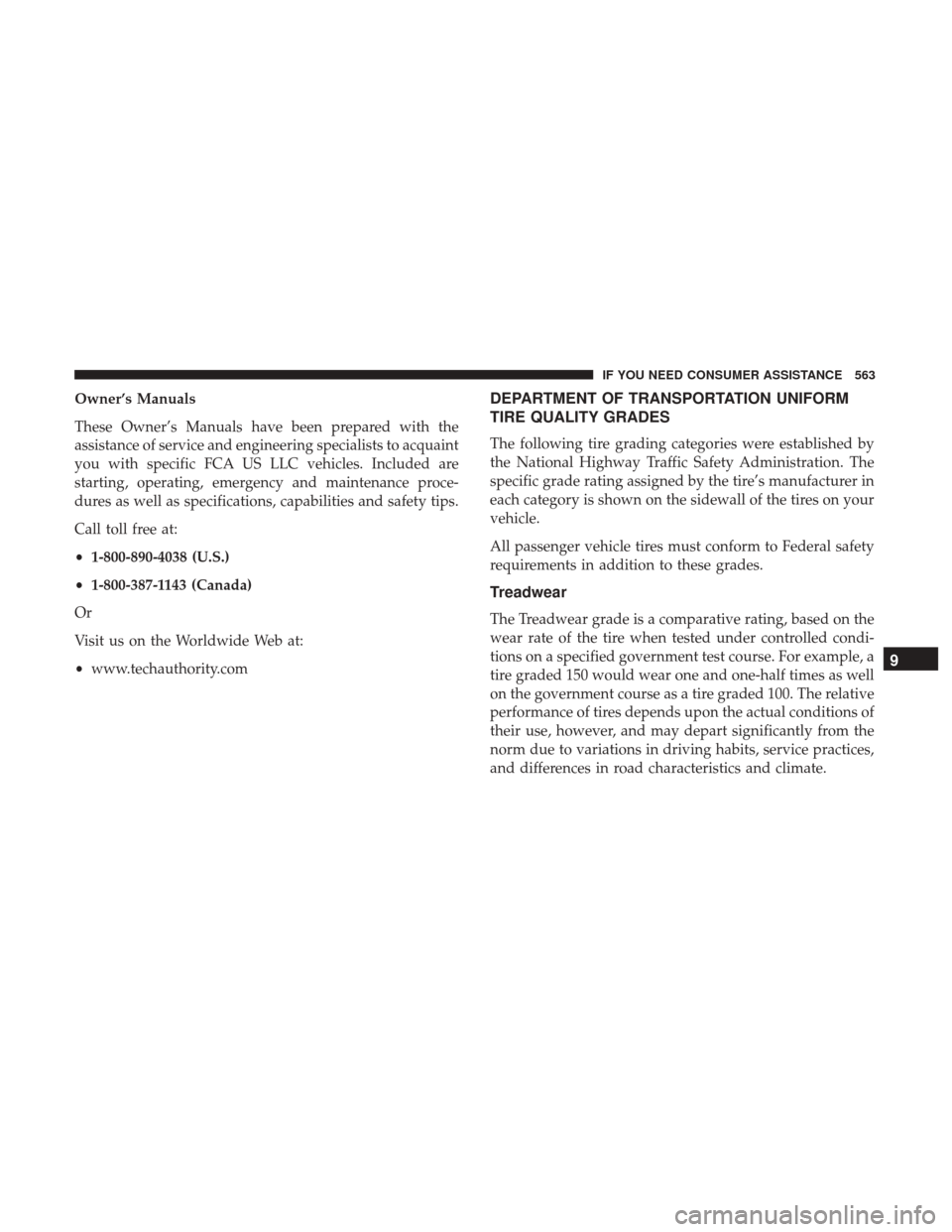
The Treadwear grade is a comparative rating, based on the
wear rate of the tire when tested under controlled condi-
tions on a specified government test course. For example, a
tire graded 150 would wear one and one-half times as well
on the government course as a tire graded 100. The relative
performance of tires depends upon the actual conditions of
their use, however, and may depart significantly from the
norm due to variations in driving habits, service practices,
and differences in road characteristics and climate.
9
IF YOU NEED CONSUMER ASSISTANCE 563
Page 570 of 584
Changing A Flat Tire....................... .476
Chart, Tire Sizing .......................... .419
Check Engine Light (Malfunction Indicator Light). . . .506
Checking Your Vehicle For Safety ................84
Checks, Safety .............................84
Child Restraint .............................63
Child Restraints Booster Seats ............................68
Child Restraints ..........................63
Child Seat Installation ......................80
How To Stow An Unused ALR Seat Belt .........77
Infants And Child Restraints .................66
Locating The LATCH Anchorages ..............73
Lower Anchors And Tethers For Children ........70
Older Children And Child Restraints ...........67
Seating Positions ..........................69
Child Safety Locks ..........................28
Clean Air Gasoline ........................ .445
Cleaning Wheels ............................... .530
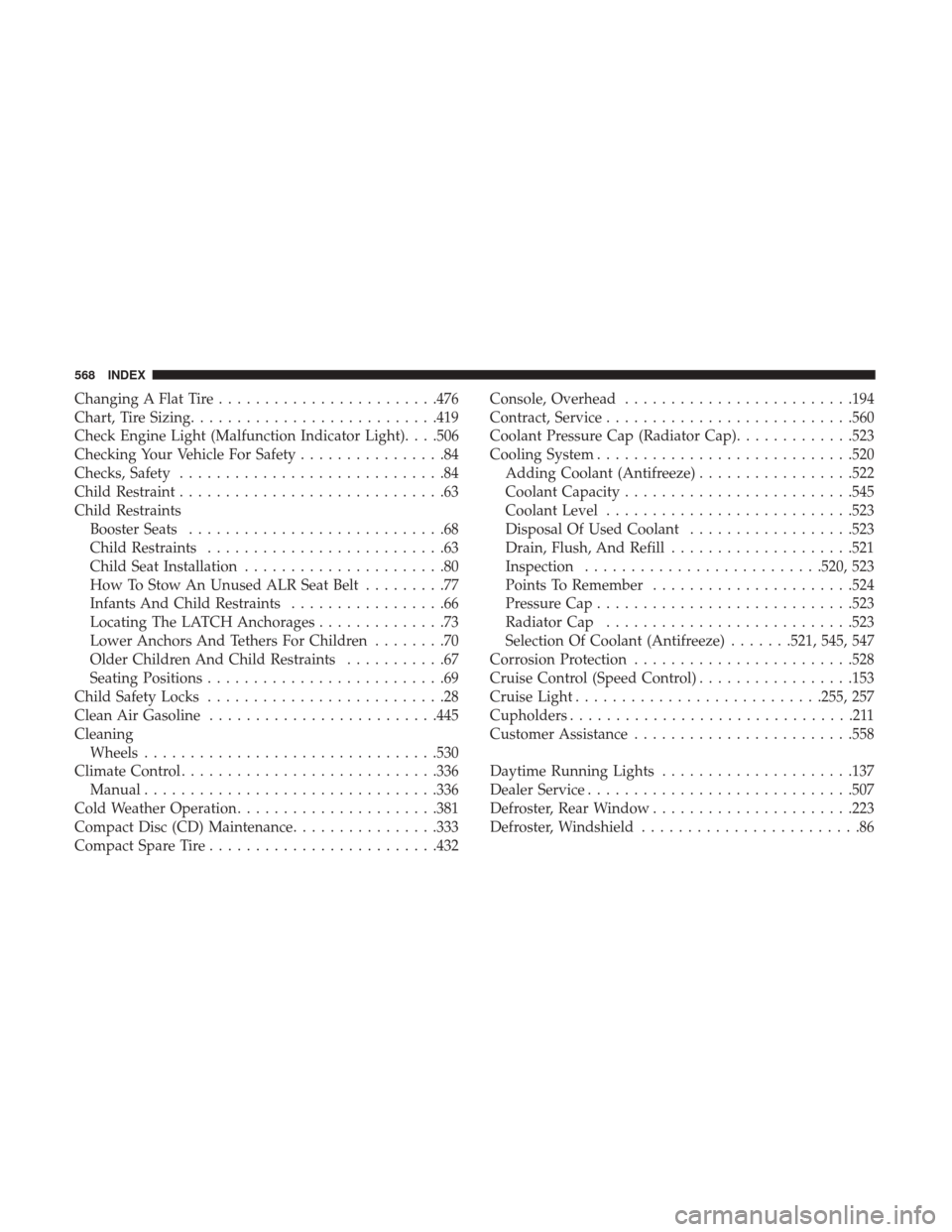
Climate Control ........................... .336
Manual ............................... .336
Cold Weather Operation ..................... .381
Compact Disc (CD) Maintenance ................333
Compact Spare Tire ........................ .432Console, Overhead
........................ .194
Contract, Service .......................... .560
Coolant Pressure Cap (Radiator Cap) .............523
Cooling System ........................... .520
Adding Coolant (Antifreeze) .................522
Coolant Capacity ........................ .545
Coolant Level .......................... .523
Disposal Of Used Coolant ..................523
Drain, Flush, And Refill ....................521
Inspection ......................... .520, 523
Points To Remember ..................... .524
Pressure Cap ........................... .523
Radiator Cap .......................... .523
Selection Of Coolant (Antifreeze) .......521, 545, 547
Corrosion Protection ....................... .528
Cr
uise Control (Speed Control) .................153
Cruise Light .......................... .255, 257
Cupholders ...............................211
Customer Assistance ....................... .558
Daytime Running Lights .....................137
Dealer Service ............................ .507
Defroster, Rear Window ..................... .223
Defroster, Windshield ........................86
568 INDEX