set DODGE DURANGO 2019 Vehicle Warranty
[x] Cancel search | Manufacturer: DODGE, Model Year: 2019, Model line: DURANGO, Model: DODGE DURANGO 2019Pages: 270, PDF Size: 2.52 MB
Page 15 of 270

Example: If garage temperature = 68°F (20°C) and the outside tempera-
ture = 32°F (0°C) then the cold tire inflation pressure should be increased
by 3 psi (21 kPa), which equals 1 psi (7 kPa) for every 12°F (7°C) for this
outside temperature condition.
Tire pressure may increase from 2 to 6 psi (13 to 40 kPa) during operation.
DO NOT reduce this normal pressure build up or your tire pressure will
be too low.
Tire Pressures For High Speed Operation
The manufacturer advocates driving at safe speeds and within posted
speed limits. Where speed limits or conditions are such that the vehicle
can be driven at high speeds, maintaining correct tire inflation pressure is
very important. Increased tire pressure and reduced vehicle loading may
be required for high-speed vehicle operation. Refer to an authorized tire
dealer or original equipment vehicle dealer for recommended safe
operating speeds, loading and cold tire inflation pressures.
WARNING!
High speed driving with your vehicle under maximum load is
dangerous. The added strain on your tires could cause them to fail.
You could have a serious collision. Do not drive a vehicle loaded to
the maximum capacity at continuous speeds above 75 mph
(120 km/h).
Radial Ply Tires
WARNING!
Combining radial ply tires with other types of tires on your vehicle
will cause your vehicle to handle poorly. The instability could cause
a collision. Always use radial ply tires in sets of four. Never combine
them with other types of tires.
TIRES14
Page 20 of 270

Tire Types
All Season Tires — If Equipped
All Season tires provide traction for all seasons (Spring, Summer, Fall, and
Winter). Traction levels may vary between different all season tires. All
season tires can be identified by the M+S, M&S, M/S or MS designation on
the tire sidewall. Use all season tires only in sets of four; failure to do so may
adversely affect the safety and handling of your vehicle.
Summer Or Three Season Tires — If Equipped
Summer tires provide traction in both wet and dry conditions, and are
not intended to be driven in snow or on ice. If your vehicle is equipped
with Summer tires, be aware these tires are not designed for Winter or
cold driving conditions. Install Winter tires on your vehicle when
ambient temperatures are less than 40°F (5°C) or if roads are covered with
ice or snow. For more information, contact an authorized dealer.
Summer tires do not contain the all season designation or mountain/
snowflake symbol on the tire sidewall. Use Summer tires only in sets of
four; failure to do so may adversely affect the safety and handling of your
vehicle.
WARNING!
Do not use Summer tires in snow/ice conditions. You could lose
vehicle control, resulting in severe injury or death. Driving too fast
for conditions also creates the possibility of loss of vehicle control.
Snow Tires
Some areas of the country require the use of snow tires during the Winter.
Snow tires can be identified by a “mountain/snowflake” symbol on the
tire sidewall.If you need snow tires, select tires equivalent in size
and type to the original equipment tires. Use snow
tires only in sets of four; failure to do so may adversely
affect the safety and handling of your vehicle.
Snow tires generally have lower speed ratings than
what was originally equipped with your vehicle and
should not be operated at sustained speeds over 75 mph (120 km/h). For
speeds above 75 mph (120 km/h) refer to original equipment or an
TIRES
19
Page 39 of 270

BFGOODRICH® DOES NOT RECOMMEND MIXING SELF SUPPORT-
ING STRUCTURE (SSS) TIRES WITH NON-SSS TIRES OTHER THAN
THE TEMPORARY USE OF THE SPARE TIRE.
WINTER DRIVING
Tires which meet the Rubber manufactures Association (RMA) definition
of snow tires are marked M/S, M&S. On such tires, this designation is
molded into the sidewall. Tires without this notation are not recom-
mended for winter driving.While All-Season tires are designed to provide reliable
performance in some winter conditions, the use of four
(4) winter tires is recommended for optimum perfor-
mance. Tires designated for use in severe winter condi-
tions are marked on at least one sidewall with the letter
“M” and “S” plus a pictograph of a mountain with a snowflake on it.
TIRE ROTATION AND REPLACEMENT
To obtain maximum tire wear, it may be necessary to rotate your tires. Refer
to your vehicle owner ’s manual for instructions on tire rotation. If you do
not have an owner‘s manual for your vehicle, BFGoodrich® recommends
rotating your tires every 6,000 to 8,000 miles (10,000 to 12,000 km).
Monthly inspection for tire wear is recommended. Your tires should be
rotated at the first sign of irregular wear, even if it occurs before 6,000
miles (10,000 km). This is true for all vehicles.
When rotating tires with a directional tread pattern, observe the arrows
molded on the sidewall which show the direction the tire should turn.
Care must be taken to maintain the proper turning direction.
Some Tire Pressure Monitoring systems (TPMS) may not recognize that a
tire has been moved to a different position on your vehicle. Make certain
that your TPMS system is reset, if necessary, so as to correctly identify the
location of each tire on your vehicle. Refer to your vehicle owner ’s
manual or your vehicle dealer.
Determine whether rotated tires require tire inflation adjustment as front
and rear position tire pressure may vary according to the vehicle manufac-
turer ’s specification due to the actual load on that wheel position. Some
vehicles may have different sized tires mounted on the front and rear axles,
and these different sized tires have rotation restrictions. Always check the
vehicle owner ’s manual for the proper rotation recommendations.
BFGOODRICH TIRES
38
Page 57 of 270
TIPS FOR SAFE TIRE INFLATION
WARNING!
Inflating an unsecured tire is dangerous. If it bursts, it could be
hurled into the air with explosive force resulting in serious personal
injury or death. Never inflate a tire unless it is secured to the vehicle
or a tire mounting machine.
• Check your tire pressures, including your spare tire, monthly and
before long trips or carrying extra weight. Be sure to use an accurate
pressure gauge.
• Check inflation pressure when the tires are “cold.” Tires are considered
“cold” when the vehicle has been parked for three hours or more, or if
the vehicle has been driven less than a mile at moderate speed.
• Never release pressure from a hot tire in order to reach the recom-
mended cold tire pressure. Normal driving causes tires to run hotter
and inflation pressure to increase. If you reduce inflation pressure
when your tires are hot, you may dangerously underinflate your tires.
• If it is necessary to adjust inflation pressure when your tires are “hot,”
set their pressure to 4 psi (28 kPa) above the recommended cold
inflation pressure. Recheck the inflation pressure when the tires are
cold.
• If your tires lose more than 2 psi (14 kPa) per month, the tire, the valve,
or wheel may be damaged. Consult a qualified tire service professional
for an inspection.
• Use valve caps to keep the valves clear of debris and to help guard
against inflation pressure loss.
BRIDGESTONE® - FIRESTONE®
56
Page 73 of 270
RFT TIRES WITH RUN-FLAT TECHNOLOGY
If your vehicle is equipped with
Bridgestone or Firestone brand RFT
tires, this chapter presents specific
maintenance and safety issues asso-
ciated with these tires that are in addition to those covered elsewhere in
this manual.
What is RFT? Run-Flat Technology tires are extraordinary tires that
utilize specially designed components to temporarily support your
vehicle in the event of inflation pressure loss, such as from a puncture.
This gives you the ability to drive to a convenient and safe location to
change your tire (if equipped with a spare) or have it inspected for
possible repair or replacement.
Naturally, certain run-flat and low pressure operating limitations apply,
which varies according to the specific self-supporting tire design. Like all
tires, during normal operation, they must be properly inflated and
maintained. Regardless of the design or quality, no tire is indestructible.
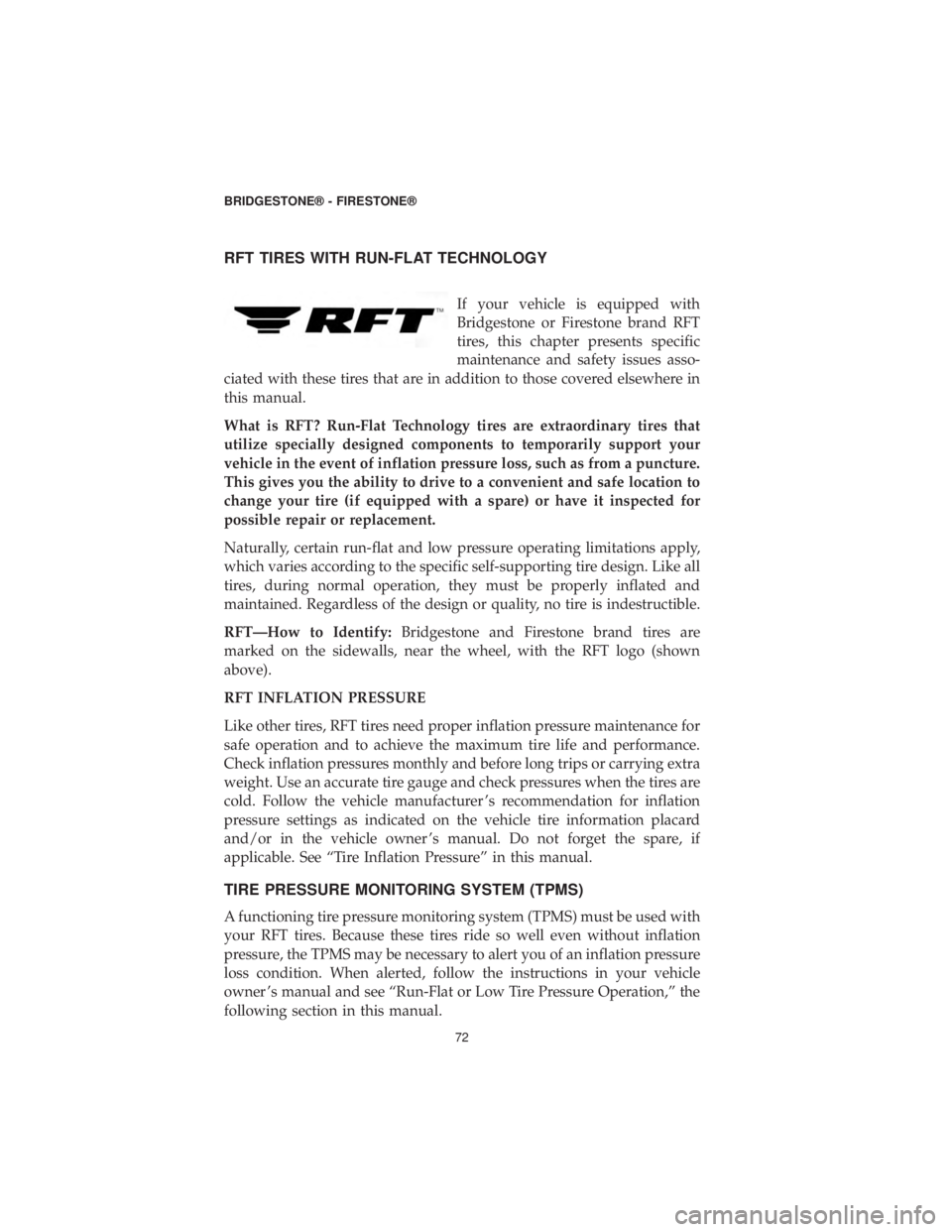
RFT—How to Identify: Bridgestone and Firestone brand tires are
marked on the sidewalls, near the wheel, with the RFT logo (shown
above).
RFT INFLATION PRESSURE
Like other tires, RFT tires need proper inflation pressure maintenance for
safe operation and to achieve the maximum tire life and performance.
Check inflation pressures monthly and before long trips or carrying extra
weight. Use an accurate tire gauge and check pressures when the tires are
cold. Follow the vehicle manufacturer ’s recommendation for inflation
pressure settings as indicated on the vehicle tire information placard
and/or in the vehicle owner ’s manual. Do not forget the spare, if
applicable. See “Tire Inflation Pressure” in this manual.
TIRE PRESSURE MONITORING SYSTEM (TPMS)
A functioning tire pressure monitoring system (TPMS) must be used with
your RFT tires. Because these tires ride so well even without inflation
pressure, the TPMS may be necessary to alert you of an inflation pressure
loss condition. When alerted, follow the instructions in your vehicle
owner ’s manual and see “Run-Flat or Low Tire Pressure Operation,” the
following section in this manual.
BRIDGESTONE® - FIRESTONE®
72
Page 82 of 270
LIMITED WARRANTY
ORIGINAL EQUIPMENT
PASSENGER AND LIGHT TRUCK TIRES
Including
Tires with Run-Flat Technology
ELIGIBILITY
This Limited Warranty covers BRIDGESTONE and FIRESTONE brand
passenger and light truck tires, including RFT and temporary spare tires,
originally installed by the vehicle manufacturer on a new vehicle. You are
covered under the terms of this Limited Warranty if the tire was
produced after July 4, 2004 (DOT serial 2704 or later) and has been used
only on the vehicle on which it was originally installed in non-
commercial service.
WHAT IS WARRANTED AND FOR HOW LONG
Before wearing down to 2/32 inch (1.6 mm) remaining original tread
depth (i.e. worn down to the top of the built-in indicators in the tread
grooves) and within 6 years from the date of purchase (proof of purchase
date required; without proof of purchase date, then within 6 years from
the date of tire manufacture), for any reason other than those excluded in
the section entitled “What This Limited Warranty Does Not Cover,” any
eligible tire that becomes unusable for any reason within the manufac-
turer ’s control will be replaced with an equivalent new tire on the basis
set forth in this Limited Warranty.
WHAT THIS LIMITED WARRANTY DOES NOT COVER
This Limited Warranty does not cover the following:
1. Tire damage or irregular wear due to: A. Road hazards, including, without limitation: Puncture, cut, impact
break, stone drill, bruise, bulge, snag, etc.
BRIDGESTONE® - FIRESTONE®
81
Page 90 of 270

•Improper operation or maintenance: This includes, but is not limited
to, effects caused by:
A. Improper tire inflation and/or improper load/speed practices:
These practices can cause excessive operational temperatures and
stresses that exceed the tire’s capabilities.
B. Improper or insufficient tire rotation:
C. Improper vehicle alignment
D. Damage due to:
– Rim irregularities or rim damage
– Snow chains
– Vehicle mechanical problems, including brake problems, and vehicle wheel alignment.
– Extreme temperature exposure
– Negligent and abusive driving such as tire spinning, or racing;
– Improper tire storage
– Automotive accident
– Chemical corrosion or fire
– Use contrary to the vehicle manufacturer ’s tire recommenda- tions.
– Misuse or misapplication
• Improper Mounting or Demountin
• Alteration: such as, but not limited to, adding a white inlay on
blackwall, tread regrooving, tire truing or siping, or adding sealant
materials to the tire.
• Weather checking/cracking: Not covered after 48 months from the
date of purchase.
• Failure to observe safety and maintenance precautions set forth in
Section 6.
ATTENTION AUTHORIZED DEALERS: CTA RESERVES THE
RIGHT TO THE FINAL INSPECTION DECISION FOR ALL
RETURNED TIRES ON CONDITIONS UNDER SECTION 3.
THIS WARRANTY IS MADE IN LIEU OF ALL OTHER WARRAN-
TIES, EXPRESS OR IMPLIED, AND CTA EXPRESSLY DIS-
CLAIMS ALL IMPLIED WARRANTIES, INCLUDING, BUT NOT
LIMITED TO, WARRANTIES OF MERCHANTABILITY OR FIT-
NESS FOR A PARTICULAR PURPOSE. SOME U.S. STATES
CONTINENTAL TIRE
89
Page 91 of 270

AND/OR CANADIAN PROVINCES DO NOT ALLOW LIMITA-
TIONS ON THE DURATION OF AN IMPLIED WARRANTY, SO
THE ABOVE MAY NOT APPLY TO YOU.
TO THE EXTENT PERMITTED BY LAW, CTA DISCLAIMS
LlABILITY FOR ALL CONSEQUENTIAL AND INCIDENTAL
DAMAGES. THE REMEDIES SET FORTH IN THIS LIMITED
WARRANTY ARE THE SOLE AND EXCLUSIVE REMEDIES FOR
BREACH OF WARRANTY. SOME U.S. STATES AND/OR CANA-
DIAN PROVINCES DO NOT ALLOW THE EXCLUSION OR
LIMITATION OF INCIDENTAL OR CONSEQUENTIAL DAM-
AGES, SO THE ABOVE LIMITATION OR EXCLUSION MAY
NOT APPLY TO YOU. THIS WARRANTY GIVES YOU SPECIFIC
LEGAL RIGHTS, AND YOU MAY ALSO HAVE OTHER RIGHTS
WHICH VARY FROM U.S. STATE TO STATE AND/OR CANA-
DIAN PROVINCE TO PROVINCE.
THIS IS THE ONLY EXPRESS WARRANTY MADE BY CTA. NO
CTA EMPLOYEE, RETAILER, OR DEALER HAS THE AUTHOR-
ITY TO MAKE ANY WARRANTY, REPRESENTATION, PROMISE
OR AGREEMENT ON BEHALF OF CTA EXCEPT AS EXPRESSLY
WRITTEN IN THIS LIMITED WARRANTY AND ADJUSTMENT
POLICY. IN OBSERVANCE OF U.S. FEDERAL LAW, THIS LIM-
ITED WARRANTY AND ADJUSTMENT POLICY HAS BEEN
DESIGNATED A “LIMITED WARRANTY”. CTA DOES NOT
INTEND TO REPRESENT THROUGH THIS LIMITED WAR-
RANTY AND ADJUSTMENT POLICY THAT TIRE FAILURES
CAN OR CANNOT HAPPEN.
4. CTA’S OBLIGATIONS
Replacement of eligible tires will be made by the dealer where you
purchased your vehicle or by an alternate Authorized Dealer. CTA will
replace the tire pursuant to the terms of this Warranty. Tires that are
replaced under this Warranty become the property of CTA.
5. OWNER’S OBLIGATIONS
To make an eligible claim under this Warranty, the owner must present
a claim, with the tire to an Authorized Dealer. For the nearest
Authorized Dealer, consult the Continental brand internet address(es),
or the 800 telephone number(s) shown on the back of this Warranty.
CONTINENTAL TIRE
90
Page 96 of 270

FALKEN TIRE CORPORATION
FALKEN
MADE BY SUMITOMO RUBBER INDUSTRIES
Congratulations!
Your new vehicle is fitted with high performance and high quality Falken
tires.
In order to guarantee that you receive the best performance and quality
from your new Falken tires, we recommend that you read and follow all
of the maintenance and safety tips provided in this document. We also
suggest that you have your Falken tires periodically inspected and
maintained by a qualified tire service professional.
A) TIRE CARE AND RECOMMENDATIONS
PROPER INFLATION AND FUEL ECONOMY
Ensure maximum performance and a long life from your tires by
checking the air pressures at least once a month and set them to the
vehicle manufacturer ’s recommended pressure(s) listed on the vehicle’s
tire placard or in your owner ’s manual. Always check and adjust your air
pressure when your tires are cold, preferably first thing in the morning
before driving. Never release air pressure from tires when they are hot.
Wait until the tires cool down and recheck, adding air or releasing as
required. Falken endorses the use of nitrogen in your tires because it
helps your tires maintain optimal pressure for longer periods of time and
reduces the amount of moisture inside of the tire and wheel assembly.
*Some plus size applications may require different air pressure(s) than
what is listed on your vehicle’s placard or owner ’s manual. In this case,
please consult your tire dealer or Falken Tire for proper inflation
pressure(s).
FALKEN TIRE CORPORATION
95
Page 97 of 270

TIRE INFLATION PRESSURE
Tires need to be properly inflated to effectively operate and perform as
intended. Tires carry the weight of the vehicle, passengers, and cargo as
well as bear the forces of braking, accelerating, and turning. The vehicle
manufacturer sets the inflation pressures for the original equipment tires
that are on your vehicle.
Driving with improperly inflated tires is dangerous. An under inflated
tire will generate excessive heat build-up that will cause damage to the
internal structure and inner liner of the tire. Besides tire damage,
improper tire inflation pressures can also affect your vehicle’s ride and
handling, tire tread wear, and fuel economy. It is recommended to always
keep all of your tires, including the spare, at the vehicle manufacturer ’s
recommended inflation pressures and be sure to check the air pressure
monthly and before going on long road trips or carrying extra weight in
your vehicle.
Your vehicle’s tire placard and/or owner ’s manual will list the cold
inflation pressure(s) for your vehicle’s original equipment tires, including
the spare. The placard can be found on the driver ’s side door or door
jamb area. If you have questions about understanding your vehicle’s tire
placard, please refer to your owner ’s manual or ask a qualified tire
service professional.
Example of what your tire placard looks like:
FALKEN TIRE CORPORATION96