maintenance DODGE DURANGO 2021 Vehicle Warranty
[x] Cancel search | Manufacturer: DODGE, Model Year: 2021, Model line: DURANGO, Model: DODGE DURANGO 2021Pages: 262, PDF Size: 10.42 MB
Page 58 of 262

BRIDGESTONE® - FIRESTONE®
57
You should visually inspect your tires on a regular basis throughout
their life, and you should have your tires periodically evaluated by a
qualified tire service professional when your vehicle is serviced such
as routine maintenance intervals, oil changes, and tire rotations. In
particular, note the following tips for spotting tire damage:
• After striking anything unusual in the roadway, have a qualified tire
s
ervice professional demount the tire and inspect it for damage. A
tire may not have visible signs of damage on the tire surface. Yet, the
tire may suddenly fail without warning, a day, a week, or even
months later.
• Inspect your tires for cuts, cracks, splits or bruises in the tread and
s
idewall areas. Bumps or bulges may indicate a separation within
the tire body. Have your tire inspected by a qualified tire service
professional. It may be necessary to have it removed from the wheel
for a complete inspection.
• Inspect your tires for adequate tread depth. When the tire is worn to
t
he built-in indicators at 2/32 inch (1.6 mm) or less tread groove
de
pth, or the tire cord or fabric is exposed, the tire is dangerously
worn and must be replaced immediately.
• Inspect your tires for uneven wear. Wear on one side of the tread or
f
lat spots in the tread may indicate a problem with the tire or vehicle.
Consult a qualified tire service professional.
• Inspect your wheels also. If you have a bent or cracked wheel, it
m
ust be replaced.
• Don’t forget to check the spare tire.
M
ake sure your tires, including the spare tire, continue to be regularly
in
spected after 5 years of service to determine if they can continue in
service. Even when your tires appear to be usable from their external
appearance or the tread depth may have not reached the minimum
wear out depth, it is recommended that all tires (including spare tires
and “temporary use” spares) more than 10 years old be replaced with
new tires.
The 10 year period after the date of production is not an indicator of
ac
tual service life for any individual tire. Some tires will need to be
replaced before 10 years due to conditions such as punctures, impact
damage, improper inflation, overloading, tread wear or other
conditions involving use or misuse of the tire. If a tire is worn out or
otherwise unserviceable from damage or conditions of use, it should
be replaced regardless of when it was produced or placed in service.
Page 71 of 262

BRIDGESTONE® - FIRESTONE®
70
The spare tire in your vehicle is intended to be used as a spare when
needed. The spare tire carrier is not intended to be used for long term
storage, except for “temporary use” tires. For more information, see
“Your Spare Tire” and “Radial Tire Rotation” in this manual.
TIRE SERVICE CUSTOMER SATISFACTION
Normal tire maintenance and Limited Warranty services are available
at
locations across the US and Canada. For more information, visit us
on the internet at
www.bridgestonetire.com
, or please call the
Technical Service Department:
US: 800-356-4644 or Canada: 800-267-1318
A
dditional information on the care and service of automobile and
li
ght truck tires is available from the following organizations:
U.S. Tire Manufacturers Association 1400 K Street, N.W. Washington,
DC
20005-2403
https://www.ustires.org
Rubber Association of Canada 2000 Argentia Road, Plaza 4, Suite 250
Mi
ssissauga, Ontario L5N 1W1
https://www.tracanada.ca
TIRE REGISTRATION
Registration of your tires is an important safety precaution since it
en
ables the manufacturer to notify you in the event of a recall. When
you purchase replacement tires, the retailer will provide a registration
card on which the tire identification numbers have been recorded; fill
in your name and address on the card and mail it promptly. Some
retailers may submit the registration for you. You do not need to
register tires which come as original equipment on new vehicles—the
vehicle and tire manufacturers handle that for you.
WARNING!
Improper storage can damage your tires in ways that may not be
vi
sible and can lead to a failure resulting in serious personal
injury or death.
Page 72 of 262
BRIDGESTONE® - FIRESTONE®
71
RFT TIRES WITH RUN-FLAT TECHNOLOGY
If your vehicle is equipped with
Bridgestone® or Firestone® brand
RF
T tires, this chapter presents
specific maintenance and safety issues
associated with these tires that are in addition to those covered
elsewhere in this manual.
What is RFT? Run-Flat Technology tires are extraordinary tires that
ut
ilize specially designed components to temporarily support your
vehicle in the event of inflation pressure loss, such as from a
puncture. This gives you the ability to drive to a convenient and safe
location to change your tire (if equipped with a spare) or have it
inspected for possible repair or replacement.
Naturally, certain run-flat and low pressure operating limitations
ap
ply, which varies according to the specific self-supporting tire
design. Like all tires, during normal operation, they must be properly
inflated and maintained. Regardless of the design or quality, no tire is
indestructible.
RFT — How to Identify: B
ridgestone® and Firestone® brand tires are
marked on the sidewalls, near the wheel, with the RFT logo (shown
above).
RFT INFLATION PRESSURE
Like other tires, RFT tires need proper inflation pressure maintenance
fo
r safe operation and to achieve the maximum tire life and
performance. Check inflation pressures monthly and before long trips
or carrying extra weight. Use an accurate tire gauge and check
pressures when the tires are cold. Follow the vehicle manufacturer’s
recommendation for inflation pressure settings as indicated on the
vehicle tire information placard and/or in the vehicle Owner’s
Manual. Do not forget the spare, if applicable. See “Tire Inflation
Pressure” in this manual.
TIRE PRESSURE MONITORING SYSTEM (TPMS)
A functioning Tire Pressure Monitoring System (TPMS) must be used
wi
th your Run Flat tires. These tires ride so well even without inflation
pressure, the TPMS may be necessary to alert you of an inflation
pressure loss condition. When alerted, follow the instructions in your
vehicle Owner’s Manual and see “Run-Flat or Low Tire Pressure
Operation,” the following section in this manual.
Page 73 of 262
BRIDGESTONE® - FIRESTONE®
72
The vehicle or TPMS manufacturer may advise checking the TPMS
regularly to confirm it is in working order. In addition, a new pressure
sensor, certain components, or reprogramming may be necessary
when a tire is serviced. Consult your vehicle Owner’s Manual, vehicle
manufacturer, or a Bridgestone® Firestone® Run-Flat Certified
Retailer for questions regarding TPMS operation and service.
RUN-FLAT OR LOW TIRE PRESSURE OPERATION
General Instructions
The Tire Pressure Monitoring System (TPMS) required in your vehicle
m a
y have different methods of alerting you when your tire has lost
inflation pressure. The international standard for the definition of
run-flat operation is pressure at or below 10 psi (70 kPa); however,
some vehicle manufacturers may have established a different pressure
limit. Consult your vehicle Owner’s Manual for the details of your
TPMS. Once the TPMS has indicated that a tire has reduced inflation
pressure, the run-flat mode of operation has commenced. During this
phase of operation, please follow these instructions:
• Reduce speed as much as safely and reasonably possible; do not
e
xceed 50 mph (80 km/h).The greater the speed, the less distance
t
he tire can travel.
• Avoid abrupt or aggressive acceleration, braking, or cornering
m
aneuvers as much as safely and reasonably possible. Pot holes
and other road hazards should be avoided. Careful driving limits
potential damage to the tire, wheel, and vehicle.
• Proceed to a safe and convenient location for tire service as soon
a
s possible. Take note of your mileage; your operation distance is
limited. See "Distance — How Far You Can Drive,” the next section
in this manual.
WARNING!
Serious personal injury or death may result from a tire failure or
ac
cident due to improper run-flat or low tire pressure operation.
Read and follow the instructions below, and the other
maintenance and safety recommendations elsewhere in this
manual.
Page 75 of 262

BRIDGESTONE® - FIRESTONE®
74
SPECIAL SERVICE AND REPAIR ISSUES
Run-Flat Certified Retailers
Because of the advanced technology and design of Run-Flat tires and
th
e required Tire Pressure Monitoring Systems (TPMS), Bridgestone®
Firestone® Run-Flat Certified Retailers are specially trained to sell and
service RFT tires.
Run-Flat Certified Retailers have the necessary equipment and are
sp
ecially trained to properly mount and demount RFT tires and to
handle TPMS devices. Conventional mounting equipment may
irreparably damage RFT tires and an improper repair is unsafe and
will void the Limited Warranty. Accordingly, it is important to go to
a Bridgestone® Firestone® Run-Flat Certified Retailer for tire
maintenance and replacement.
Call toll-free 1-877-BFS-4RFT or, 87
7-237-4738 or visit
www.bridgestonetire.com
to locate the nearest Bridgestone®
Firestone® Run-Flat Certified Retailer.
Inspection after Run-Flat or Low Pressure Operation
Following run-flat or low tire pressure operation, or in the event of
an
y other tire damage or unusual condition, it is very important to
obtain a proper and complete tire evaluation as soon as possible.
Rotation
Follow the vehicle manufacturer’s recommendations, or rotate every
5,
000 miles per the recommendations in this manual (see “Radial Tire
Ro
tation”). In some cases, TPMS devices require reprogramming with
each tire rotation.
RFT Tire Replacement
Do not replace or mix RFT tires with conventional tires, unless on an
em
ergency/temporary basis. Conventional tires do not have run-flat
capability and the handling characteristics of the vehicle with these
tires may be different. If a conventional tire is used on an emergency/
temporary basis, verify that its size, load capacity, inflation pressure,
and speed rating specifications meet the requirements of the vehicle.
Replace any conventional tire with the proper RFT tire as soon as
possible.
Page 82 of 262

BRIDGESTONE® - FIRESTONE®
81
•Improper use or operation, including, without limitation:
Improper inflation pressure, overloading, tire/wheel spinning,
use of an improper wheel, tire chain damage, misuse, misappli -
cation, negligence, tire alteration, or for racing or competition
pu
rposes.
• Insufficient or improper maintenance,
including, without
limitation: Failure to rotate tires as recommended in this manual,
wheel misalignment, worn suspension components, improper
tire mounting or demounting, tire/wheel assembly imbalance,
or other vehicle conditions, defects, or characteristics.
• Contamination or degradation
by petroleum products or other
chemicals, fire or other externally generated heat, or water or
other material trapped inside the tire during mounting or infla -
tion.
• Improper repair.
Improper repair voids this Limited Warranty
• For RFT tires only, improper run-flat or low tire pressure oper -
a
tion, including, without limitation: Exceeding speed, distance,
o
r other run-flat/lowpressure operation limitations.
2. Rapid tread wear or wear-out. Original equipment tires have no
m
ileage warranty.
3. Weather/ozone cracking after 4 years from date of tire manufac -
t
ure.
4. Ride disturbance or vibration after 1/32 inch (0.8mm) of tread
we
ar use.
5. Tires with sealant, balance, or other filler material that was not
o
riginally applied or inserted by the tire manufacturer.
6. Tires used in commercial service.
7
. Tires purchased and normally used outside the United States and
C
anada.
8. The cost of applicable federal, state, and local taxes.
9
. Failure to follow any of the safety and maintenance recommenda -
t
ions or warnings contained in this manual.
This Limited Warranty is in addition to and/or may be limited by any
ot
her applicable written warranty you may have received concerning
special tires or situations.
Page 84 of 262

BRIDGESTONE® - FIRESTONE®
83
This Limited Warranty applies only to consumers actually using the
tire in the United States and Canada. For warranty conditions outside
the United States and Canada, see your local Bridgestone® Firestone®
distributor.
Obligations under this policy may not be enlarged or altered by anyone.
In accordance with Federal Law, this Limited Warranty has been
de
signated as a "Limited Warranty.” Nothing in this Limited
Warranty is intended to be a representation that tire failures cannot
occur. This Limited Warranty is given in the United States by
Bridgestone® Firestone® North American Tire, LLC, 535 Marriott Dr.,
Nashville, TN 37214 and in Canada by Bridgestone® Firestone®
Canada Inc., 5770 Hurontario St., Suite 400, Mississauga, Ontario,
Canada L5R 3G5.
OWNER’S OBLIGATIONS
In order to keep this Limited Warranty valid, we require you to have
y o
ur tires regularly inspected and rotated per the recommendations
outlined in the sections of this manual entitled "Tire Damage,
Inspection and Service Life” and “Radial Tire Rotation” and to furnish
proof of same in order to receive an adjustment. Such proof should
show the date, mileage, and servicing location. A sales receipt
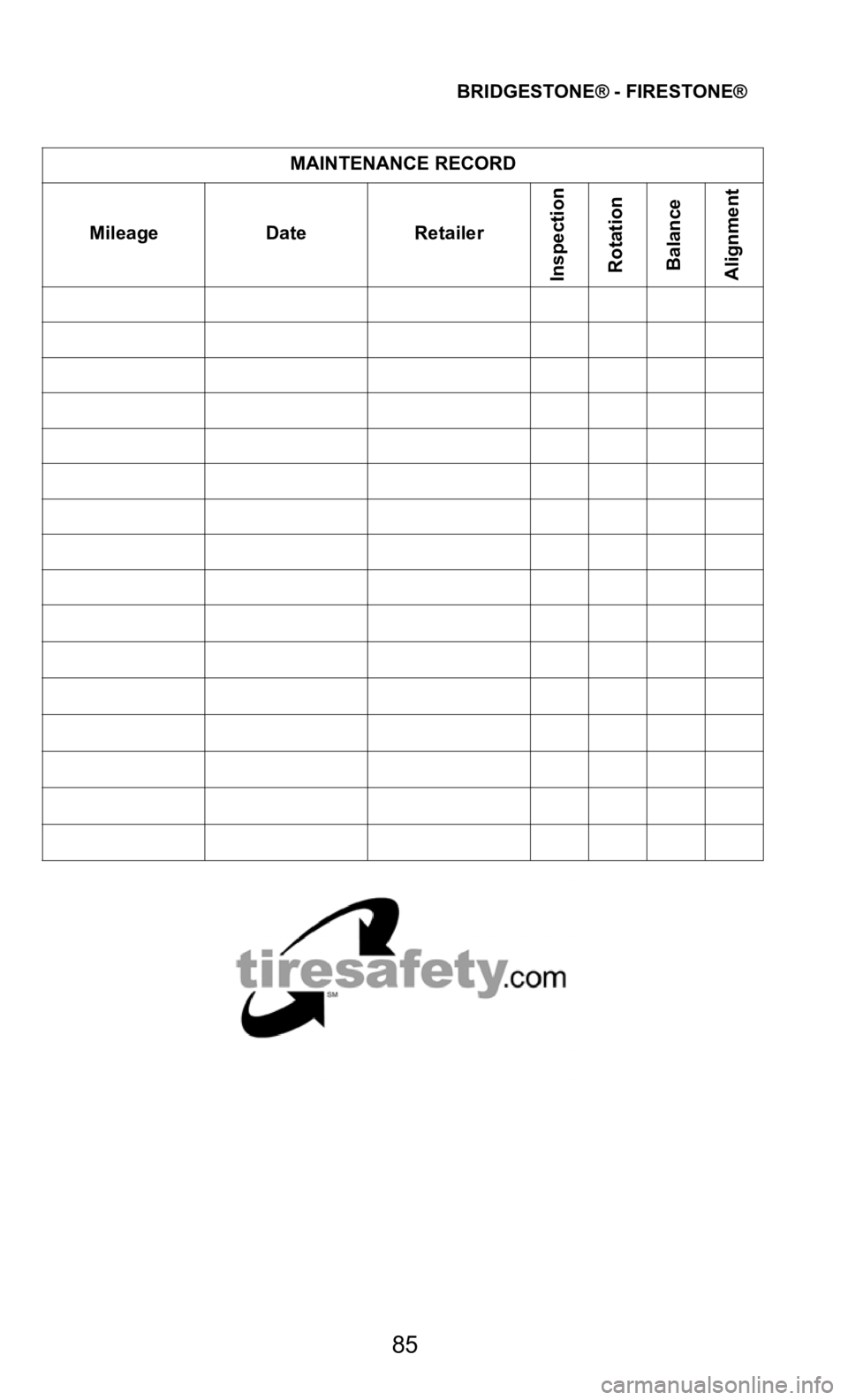
containing this information will suffice. In addition, a “Maintenance
Record” is included on the back cover of this manual. It is your
obligation to maintain proper tire inflation pressures as specified by
the vehicle manufacturer and to operate the vehicle within tire/
vehicle load capacity and speed limitations. It is also your obligation
to maintain proper wheel alignment and tire/wheel assembly
balance. To request an adjustment, you must present the tire to an
authorized Bridgestone® Firestone® retailer. Complete and sign the
customer section of the Bridgestone® Firestone® North American
Tire, LLC Limited Warranty adjustment form and pay appropriate
replacement price, taxes, disposal fee, and service charges, if any.
ARBITRATION
You and Bridgestone® Firestone® North American Tire, LLC agree
t h
at all claims, disputes, and controversies between you and it,
including any of its agents, employees, successors, or assigns, arising
out of or in connection with this Limited Warranty, or any other
warranties, expressed or implied, including a failure of warranty and
the validity of this arbitration clause, but excluding claims for
personal injury or property damage, shall be resolved by binding
Page 86 of 262
BRIDGESTONE® - FIRESTONE®
85
MAINTENANCE RECORD
Mileage DateRetailer
Inspection
RotationBalance
Alignme nt
Page 89 of 262

CONTINENTAL TIRE
88
•Improper operation or maintenance: This includes, but is not
limited to, effects caused by:
1. Improper tire inflation and/or improper load/speed prac -
t
ices: These practices can cause excessive operational
t
emperatures and stresses that exceed the tire’s capabilities.
2. Improper or insufficient tire rotation
3
. Improper vehicle alignment
4
. D amage due to:
–
Rim irregularities or rim damage
–
Snow chains
–
Vehicle mechanical problems, including brake problems,
a
nd vehicle wheel alignment
– Extreme temperature exposure
–
Negligent and abusive driving such as tire spinning, or
r
acing
– Improper tire storage
–
Automotive accident
–
Chemical corrosion or fire
–
Use contrary to the vehicle manufacturer’s tire recommen -
d
ations
– Misuse or misapplication
•
Improper Mounting or Demounting
•Alteration: such as, but not limited to, adding a white inlay on
black wall, tread regrooving, tire truing or siping, or adding
sealant materials to the tire.
•
Weather checking/cracking: Not covered after 48 months from
th
e date of purchase.
• Failure to observe safety and maintenance precautions set forth
i
n the Safety Warning Section.
ATTENTION AUTHORIZED DEALERS: CONTINENTAL TIRE
TH
E AMERICAS, LLC (CTA) RESERVES THE RIGHT TO THE
FINAL INSPECTION DECISION FOR ALL RETURNED TIRES
ON CONDITIONS UNDER SECTION 3.
THIS WARRANTY IS MADE IN LIEU OF ALL OTHER
WA
RRANTIES, EXPRESS OR IMPLIED, AND CTA EXPRESSLY
DISCLAIMS ALL IMPLIED WARRANTIES, INCLUDING, BUT
Page 91 of 262

CONTINENTAL TIRE
90
Owner must present new vehicle registration form or new vehicle
sales invoice indicating the date of purchase. Owner will be re -
quired to sign the CTA Limited Warranty Claim Form or dealer re -
placement sales receipt.
Owner is responsible for paying all applicable taxes charged by the
se
rvicing dealer and is also responsible for paying shipping, local
tire-disposal fees and parts or service regardless of mileage or
months of service. This includes payment for tire rotation, align -
ment, towing, road service, valve stems and tire repairs.
Owner is responsible for maintaining proper tire air pressure and
fo
r proper maintenance of the tire.
6. SAFETY WARNING:
I
gnoring any of the safety and information contained in this war -
ranty may result in tire failure, causing serious injury or death.
• Tire failure due to under inflation/overloading. Follow vehicle
o
wner’s manual or tire placard in vehicle for proper inflation and
loading.
• Explosion of tire/rim assembly due to improper tire mounting.
T
ire mounting / demounting can be dangerous. It should be
performed only by a trained tire specialist using proper tools and
procedures. Prior to tire mounting/demounting, the Rubber
Manufacturers Association (RMA) wall charts and manuals
should be read to obtain the proper procedures. The failure to
follow these procedures may result in faulty positioning of the
tire and/or rim, which may cause the assembly to burst with
force sufficient to cause injury or death.
• Tire failure due to damage.
Inspect your tires frequently for
scrapes, bulges, separations, cuts, snags and other damage from
road hazards. Damage from impact can occur to the inner
portions of your tire without being visible to the outside. If you
suspect a tire has been damaged from striking anything unusual
in the road, you must have the tire removed from the rim and
inspected both inside and out by a trained tire specialist. Air loss
or unusual tire wear can also be warning signs that a tire may
have internal damage. If you notice these conditions, have your
tire inspected by a trained individual.
• Tire failure due to excessive tire spinning.
Avoid tire spinning.
The centrifugal force generated by a free-spinning tire/rim
assembly may cause a sudden tire explosion resulting in vehicle