wheel size DODGE DURANGO 2021 Vehicle Warranty
[x] Cancel search | Manufacturer: DODGE, Model Year: 2021, Model line: DURANGO, Model: DODGE DURANGO 2021Pages: 262, PDF Size: 10.42 MB
Page 78 of 262
BRIDGESTONE® - FIRESTONE®
77
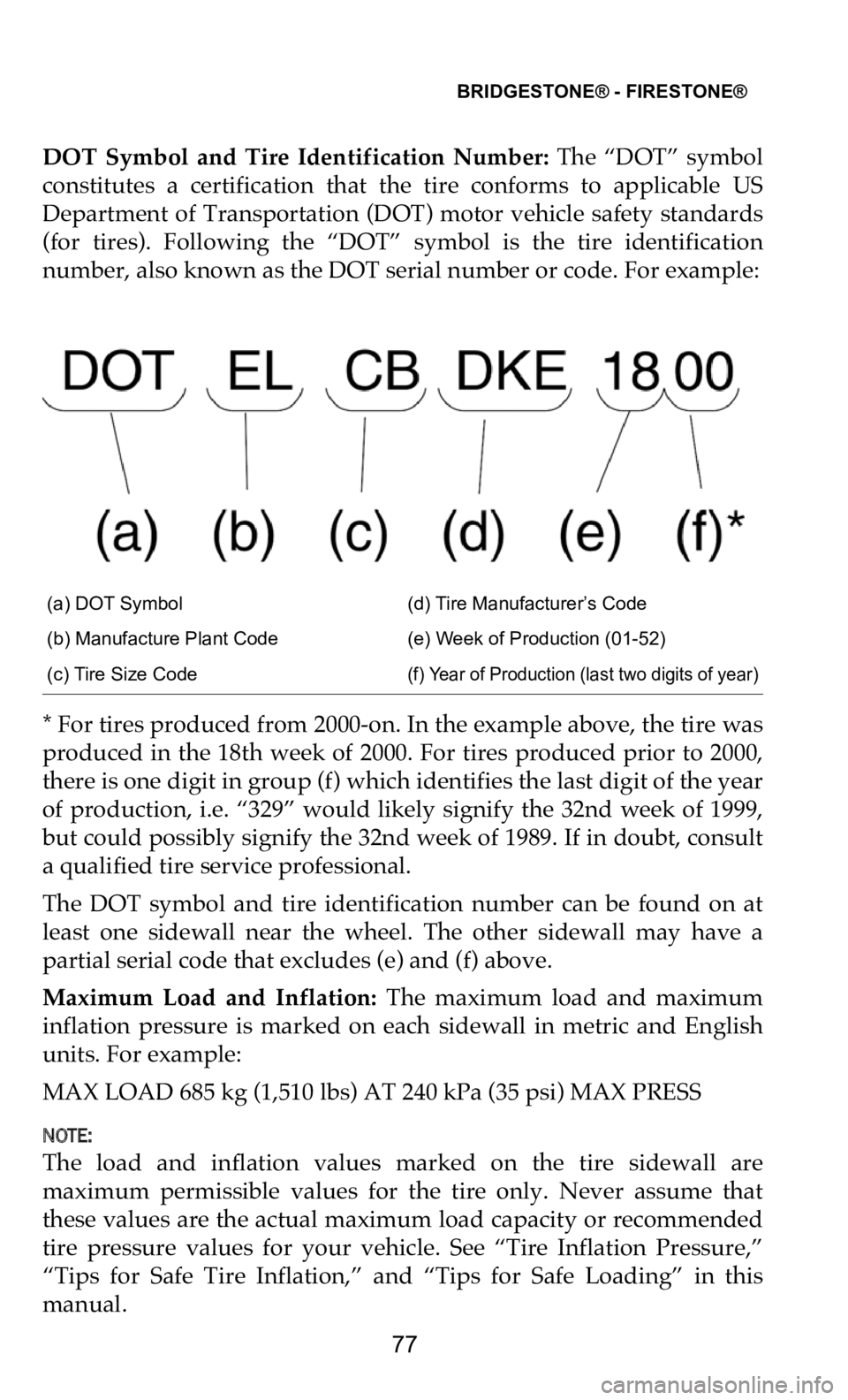
DOT Symbol and Tire Identification Number: The “DOT” symbol
constitutes a certification that the tire conforms to applicable US
Department of Transportation (DOT) motor vehicle safety standards
(for tires). Following the “DOT” symbol is the tire identification
number, also known as the DOT serial number or code. For example:
* For tires produced from 2000-on. In the example above, the tire was
p r
oduced in the 18th week of 2000. For tires produced prior to 2000,
there is one digit in group (f) which identifies the last digit of the year
of production, i.e. “329” would likely signify the 32nd week of 1999,
but could possibly signify the 32nd week of 1989. If in doubt, consult
a qualified tire service professional.
The DOT symbol and tire identification number can be found on at
le
ast one sidewall near the wheel. The other sidewall may have a
partial serial code that excludes (e) and (f) above.
Maximum Load and Inflation: T
he maximum load and maximum
inflation pressure is marked on each sidewall in metric and English
units. For example:
MAX LOAD 685 kg (1,510 lbs) AT 240 kPa (35 psi) MAX PRESS
NOTE:
The load and inflation values marked on the tire sidewall are
ma
ximum permissible values for the tire only. Never assume that
these values are the actual maximum load capacity or recommended
tire pressure values for your vehicle. See “Tire Inflation Pressure,”
“Tips for Safe Tire Inflation,” and “Tips for Safe Loading” in this
manual.
(a) DOT Symbol (d) Tire Manufacturer’s Code
(b) Manufacture Plant Code (e) Week of Production (01-52)
(c) Tire Size Code
(f) Year of Production (last two digits of year)
Page 95 of 262

FALKEN TIRE CORPORATION
94
FALKEN TIRE CORPORATION
FALKEN
MADE BY SUMITOMO RUBBER INDUSTRIES
Congratulations!
Your new vehicle is fitted with high performance and high quality
Fa
lken tires.
In order to guarantee that you receive the best performance and
qu
ality from your new Falken tires, we recommend that you read and
follow all of the maintenance and safety tips provided in this
document. We also suggest that you have your Falken tires
periodically inspected and maintained by a qualified tire service
professional.
A) TIRE CARE AND RECOMMENDATIONS
PROPER INFLATION AND FUEL ECONOMY
Ensure maximum performance and a long life from your tires by
ch
ecking the air pressures at least once a month and set them to the
vehicle manufacturer’s recommended pressure(s) listed on the
vehicle’s tire placard or in your Owner’s Manual. Always check and
adjust your air pressure when your tires are cold, preferably first thing
in the morning before driving. Never release air pressure from tires
when they are hot. Wait until the tires cool down and recheck, adding
air or releasing as required. Falken endorses the use of nitrogen in
your tires because it helps your tires maintain optimal pressure for
longer periods of time and reduces the amount of moisture inside of
the tire and wheel assembly.
*Some plus size applications may require different air pressure(s)
t h
an what is listed on your vehicle’s placard or Owner’s Manual. In
this case, please consult your tire dealer or Falken Tire for proper
inflation pressure(s).
Page 99 of 262

FALKEN TIRE CORPORATION
98
TIRE REPAIRS
In the event that you get a flat tire while driving, it is best to find a
ne
arby, safe place to stop and install your spare tire or call a tow truck.
The less distance that you drive on your low or flat tire, the better
chances your tire has of being repairable. Once you are able to get to
your local servicing tire dealer, have them dismount the tire from the
rim and thoroughly inspect the inside of the tire. It is important to
know the difference between a proper tire repair and an improper one
because it can be critical to you and your vehicle’s safety. An improper
repair could pose a safety threat to you and your family and could also
affect your tire’s manufacturer warranty. Here are some tips in
determining if your damaged tire can be properly repaired or not:
• A lways have the tire removed from the wheel and inspected before
a
ny repair is performed.
• Tires with less than 1.6
mm (2/32 of an inch) of tread should NOT
be
repaired.
• Never repair a tire with a puncture larger than 6
mm (1/4 of an
in
ch).
• Repairs should be limited to the tread area only.
•
Repairs cannot overlap one another.
•
A plug and patch or plug/patch combo should be used to effectively
r
epair a tire puncture.
• If anything seems questionable at any time during the repair
p
rocess, ask your service advisor for more details and/or call the
tire manufacturer to make sure the tire’s warranty is not being
voided.
TIRE MIX USAGE
WARNING!
Never mix tires of different size or construction and/or type on
an
y axle. (Except for temporary use as a spare tire.) Always refer to
the vehicle’s owner manual for proper tire fitments.
Page 126 of 262

GOODYEAR® DUNLOP® TIRES
125
•TIRE SPINNING. On slippery surfaces such as snow, mud, ice, etc.,
do not spin tires in excess of 35 mph (55 km/h), as indicated on the
sp
eedometer.
• EXCESSIVE WHEEL SPINNING.
This can also result in tire disin-
tegration or axle failure.
TIRE CARE AND MAINTENANCE GUIDE
The easiest way to help ensure satisfactory mileage and performance
f r
om your Goodyear® or Dunlop® tires is to give them a simple but
frequent (at least monthly) inspection for proper inflation, even tread
wear and the presence of any damage.
DO MAINTAIN PROPER INFLATION PRESSURE IN YOUR TIRES
Proper inflation pressure is necessary for optimum tire performance,
sa
fety and fuel economy. Check inflation pressures at least once a
month and before long trips. Use an accurate tire pressure gauge.
Always check pressures when the tires are cold (when the vehicle has
been driven less than one mile). If you must check inflation when the
tires are hot, add 4 psi (27 kPa) to the recommended cold inflation
pressure. It is difficult to tell just by looking at radial tires whether
they are underinflated.*
WARNING!
Vehicle handling, traction, ride comfort and other performance
pa
rameters may be significantly affected by a change in tire size
or type. Before replacing tires, always consult and follow the
vehicle owner’s manual because some vehicle manufacturers
prohibit changing tire size. When selecting tires that are different
from the original equipment size make certain:
1. The tires have adequate load-carrying capacity based on the
v
ehicle placard,
2. The tires have sufficient inflation pressure to carry the load and
3
. There is proper clearance with no interference points between
t
he tire and vehicle.
The consumer must be aware to always drive safely and obey all
tr
affic laws. Avoid sudden, sharp turns or aggressive lane
changes. Failure to follow any of these warnings may result in
loss of control of the vehicle, leading to an accident and serious
injury or death.
Page 129 of 262

GOODYEAR® DUNLOP® TIRES
128
THE CONVENIENCE (TEMPORARY) SPARE
The Convenience (Temporary) Spare is designed, built and tested to
th
e high engineering standards set by North America’s leading car
manufacturers and to Goodyear’s own high standards of quality
control. It is designed to take up a minimum of storage space and, at
the same time, fulfill the function of a spare tire when needed. The
spare is kept in its storage space, fully inflated at 60 psi. To be sure it
is always ready for use, the air pressure should be checked on a
regular basis.
The Convenience (Temporary) Spare can be used in combination with
th
e original tires on your vehicle. You can expect a tire tread life of up
to 3,000 miles (4,800 kilometers), depending on road conditions and
yo
ur driving habits. To conserve tire tread life, return the spare to the
storage area as soon as it is convenient to have the standard tire
repaired or replaced.
The Convenience (Temporary) Spare weighs less than a standard tire
so
it’s easier to handle. It also helps reduce the total car weight, which
contributes to fuel economy. The wheels used with the Convenience
(Temporary) Spare are specifically designed for use with high
pressure spares and should never be used with any other type tire.
DO NOT ATTEMPT TO MOUNT YOUR OWN TIRES
Serious injury or death may result from explosion of tire/rim
as
sembly due to improper mounting procedures. Follow tire
manufacturer’s instructions and match tire diameter to rim diameter.
Mount light truck radials on rims approved for radial service. Do not
apply bead sealer. This can inhibit bead seating. Lubricate beads and
tire rim (including tube or flap) contact surfaces. Lock assembly on
mounting machine or place in safety cage. STAND BACK and never
exceed 40 psi to seat beads. Never use a volatile substance or a rubber
“donut” (also known as a bead expander or “O-Ring”) to aid bead
seating. Only specially trained persons should mount tires.
DO NOT MIX TIRES OF DIFFERENT SIZES AND TYPES ON THE
SA
ME AXLE
For optimum handling and control, Goodyear® recommends fitment
of
four tires of the same type and size unless otherwise specified by the
vehicle manufacturer.
Page 131 of 262

GOODYEAR® DUNLOP® TIRES
130
FOLLOW THESE ADDITIONAL GUIDELINES
When installing only two tires, fit the tires with the deepest tread
de
pth on the rear axle. If radials and non-radials must be fitted to the
same vehicle, fit radials on rear axle. Never mix radials and
non-radials on the same axle. When fitting winter tires or all-season
tires to performance vehicles, always fit in sets of four. It is not
recommended to fit tires with different speed ratings. If tires with
different speed ratings are installed on a vehicle, they should be
installed with like pairs on the same axle.
The speed capability of the vehicle will become limited to that of the
lo
west speed rated tires.
Use of lift kits with some vehicle/tire combinations can cause
in
stability. When changing tire sizes, always consult dealer for
optimum rim width and carefully check vehicle/tire clearances.
RETREADED TIRES
Retreaded passenger and light truck tires are not warranted by
Goodyear® for any reason. Speed ratings and US Department of
Transportation (DOT) test compliance certifications are voided for
retreaded tires.
DO MAINTAIN VEHICLE SUSPENSION, WHEEL ALIGNMENT AND
BA
LANCE AND ROTATE YOUR TIRES
Lack of rotation, worn suspension parts, underinflation/ overinflation,
whe
el imbalance and misalignment can cause vibration or irregular tire
wear. Rotate your tires according to your vehicle manufacturer’s
recommendations or at maximum intervals of 6,000 miles / 10,000 km.
FOR ADDITIONAL INFORMATION, SEE THE “BE TIRE
SM
ART/ PLAY YOUR PART BROCHURE” PUBLISHED BY THE
RUBBER MANUFACTURERS ASSOCIATION (RMA). A COPY
OF THIS BROCHURE CAN BE DOWNLOADED FROM THE RMA
WEBSITE:
www.ustires.org/publications
.
CAUTION!
Never substitute a “Standard Load” (SL) tire for an Extra Load
( X
L) or Reinforced tire. If the vehicle was originally equipped
with “Extra Load” (XL) or Reinforced tires, replace those tires with
similar-sized Extra Load (XL) or Reinforced tires.
Page 138 of 262

HANKOOK TIRES
137
of incidental or consequential damages, so the above limitation or
exclusion may not apply to you. This warranty gives you specific
legal rights, and you may also have the rights which vary from
province to province in Canada, and from state to state in the USA
HANKOOK’S OBLIGATIONS
Replacement qualifying under this warranty will be made by a
pa
rticipating Hankook Dealer or a participating car dealer.
OWNER’S OBLIGATIONS
1. You must present the tire to a participating Hankook Dealer or a
p
articipating car dealer.
2. For free replacement, a proof of purchase date such as car dealer
i
nvoice should be presented.
3. No claim will be recognized unless submitted on a Hankook claim
f
orm completely filled out and signed by the owner or a partici -
pating Hankook Dealer or car dealer.
WARNING FOR YOUR SAFETY
• TIRE DEMOUNTING AND MOUNTING
Improper tire mounting and inflation procedures may cause tire beads
to break with explosive force during installation of the tire on the rim,
causing personal injury and property damage. Follow the Rubber
Manufacturers Association (RMA) installation and safety procedure for
mounting and inflating tires. Tire and rim must match in size. Rim parts
must match by manufacturer’s design. Clean rim. Lubricate rim and
beads. Do not exceed the maximum recommended pressure to seat
beads on rim. Use remote control inflation equipment and inflation
cage.
NOTE:
• Never inflate over 40 psi to seat beads.
• Mount radial ply tires only on rims designated by wheel manufac -
t
urer as suitable for radial tire.
• O nly specially trained persons shall mount tires.
• AIR PRESSURE
Check the pressure in your tires, including your spare, at least
mo
nthly, and always before and during extended driving. Check
tires cold (at least three hours after the vehicle has been stopped and
before it is driven more than 1 mile or 1.6 kilometers). Do not reduce
Page 158 of 262

MICHELIN®
157
NOTE:
your vehicle manufacturer may provide additional tire warranty
co
verage over and above what is provided by Michelin. Consult your
vehicle Owner’s Manual for further information.
NOTE:
Some Michelin® Self-Supporting Zero Pressure (ZP) tires can only be
mo
unted on special SH-M (Symmetric Hump - Modified) wheels.
These tires bear the special SH-M designation, molded into the side -
wall of the tire, next to the ZP designation. DO NOT MOUNT A TIRE
WI
TH THE SH-M DESIGNATION ON THE SIDEWALL ON A
STANDARD WHEEL. DOING SO VOIDS THIS LIMITED
WARRANTY AND COULD CAUSE THE TIRE TO BECOME
UNSERVICEABLE AT LOW OR ZERO PRESSURE, RESULTING IN
SERIOUS PERSONAL INJURY OR DEATH.
Treadwear – Mileage Warranty Coverage for Michelin® Passenger
an
d Light Truck Tires
Michelin® passenger and light truck tires are covered by a
ma
nufacturer’s limited warranty for treadwear. For the mileage
warranty associated with a specific tire line, please see your
Michelin® tire retailer or visit us at
www.michelinman.com/home
.
Some vehicles come from the vehicle manufacturer with “split
fi
tments” – meaning different size tires on the front and rear axles.
Because these tires cannot be rotated as recommended by Michelin®,
the mileage warranty on each rear tire will cover half the number of
miles as the standard mileage warranty for that particular tire design.
Michelin® Self-Supporting Zero Pressure (ZP) tires have the same
mileage warranty as the standard tire line of which they are a part, up
to but not exceeding 30,000 miles. DOT-approved competition tires
(e
.g., Michelin® Pilot® Sport Cup tires) are excluded from any
mileage warranty. Michelin® Winter tires must be used during winter
months only, defined as a period beginning on or after September 1st
of a given year and ending no later than April 30th of the following
year. Michelin® winter tires require documentation of the timing of
the installation and removal of the tires each winter to maintain
coverage under the limited warranty for treadwear.
An important reminder:
No tire manufacturer can guarantee you a certain number of miles
fr
om a given tire. Driving habits, driving conditions, road conditions,
and vehicle maintenance all play a part in the tread life of a tire. If a
tire does not reach the warranted mileage, and the owner of the tires
Page 168 of 262

MICHELIN®
167
instructions for checking pressures when tires are hot. When tires
have cooled, check air pressure again. If any tire has lost more than
5 PSI from the previous pressure check, have the tire inspected at
once by an authorized PAX® System Retailer for PAX® tires or a
participating Michelin® tire retailer or representative of your
vehicle manufacturer if your vehicle Owner’s Manual so advises.
Failure to do so may cause irreparable damage to the tire and result
in sudden tire destruction and personal injury.
TIRE PRESSURE MONITORING SYSTEMS (TPMS):
Your vehicle may be equipped with a Tire Pressure Monitoring
Sy
stem (TPMS) that is designed to monitor the pressure of tires
mounted on your vehicle and sends a signal to the driver if a tire
pressure falls below a predetermined level. A TPMS should not
replace monthly manual pressure checks for all four tires and the
spare. We recommend that you manually monitor and check tire
pressure inflation with a pressure gauge. Your tires should have the
recommended pressure listed by your vehicle’s manufacturer. This
information can be found in the vehicle Owner’s Manual and often on
a placard located in the vehicle’s door jamb, inside the fuel hatch, or
on the glove compartment door. If you have a plus size fitment that
requires a higher inflation pressure, your tire pressure monitoring
system will require re-calibration to new inflation pressure. Refer to
your tire dealer/installer of plus size tires for proper inflation
pressure.
We recommend checking air pressure once each month, and before a
l o
ng trip. Whether you have a full-sized or mini-spare, make sure that
it is properly inflated as well. If the TPMS generates improper
monitoring or signals we recommend that you consult your Owner’s
Manual provided with your vehicle and follow-up with your vehicle’s
manufacturer.
TIRE SPINNING
Do not spin wheels in excess of 35 mph (55 km/h) as indicated on the
sp
eedometer. Excessive speed in a free-running, unloaded tire can
cause it to “explode” from centrifugal force. The energy released by
such an explosion is sufficient to cause serious physical injury or
death. Never allow anyone to stand near or behind the spinning tire.
When in mud, sand, snow, ice or other slippery conditions, do not
en
gage in excessive wheel spin. Accelerating the motor excessively,
particularly with automatic transmission vehicles, may cause a drive
Page 173 of 262

MICHELIN®
172
DO NOT OVERLOAD - DRIVING ON ANY OVERLOADED TIRE IS
DANGEROUS
The maximum load rating of your tires is molded on the tire sidewall.
Do
not exceed this rating. Follow the loading instructions of FCA US
LLC for your vehicle and this will ensure that your tires are not
overloaded. Tires which are loaded beyond their maximum allowable
loads for the particular application will build up excessive heat that
may result in sudden tire destruction.
Do not exceed the gross axle weight rating for any axle on your
ve
hicle.
TRAILER TOWING
If you anticipate towing a trailer, you should visit any Michelin® tire
re
tailer for advice concerning the correct size tire and pressures. Tire
size and pressures will depend upon the type and size of trailer and
hitch utilized, but in no case must the maximum cold inflation
pressure or tire load rating be exceeded. Check the tire decal and the
owner’s manual supplied by FCA US LLC for your vehicle for further
recommendations on trailer towing.
MICHELIN® PAX® System Tires/Self-Supporting Zero Pressure
(Z
P) Tires and Trailer Towing
Operation of Pax® or ZP tires at low or zero air pressure with a trailer
in
tow, is dangerous and is not recommended. If the low pressure
warning indicator is activated when a trailer is in tow, stop, disconnect
the trailer, and do not continue to tow the trailer until the tire has been
repaired and re-inflated to the proper air pressure. If the tire cannot be
repaired, it must be replaced with a new full size, PAX®/ZP tire, and
inflated to the proper air pressure, before the trailer can be safely
towed again.
WHEEL ALIGNMENT AND BALANCING ARE IMPORTANT
FO
R SAFETY AND MAXIMUM MILEAGE FROM YOUR TIRES.
CHECK HOW YOUR TIRES ARE WEARING AT LEAST ONCE
EA
CH MONTH
If your tires are wearing unevenly, such as the inside shoulder of the
ti
re wearing faster than the rest of the tread, or if you detect excessive
vibration, your vehicle may be out of alignment or balance. These
conditions not only shorten the life of your tires but adversely affect
the handling characteristics of your vehicle, which could be
dangerous. If you detect irregular wear or vibration, have your