wheel size DODGE DURANGO 2021 Vehicle Warranty
[x] Cancel search | Manufacturer: DODGE, Model Year: 2021, Model line: DURANGO, Model: DODGE DURANGO 2021Pages: 262, PDF Size: 10.42 MB
Page 174 of 262
MICHELIN®
173
alignment and balance checked immediately. Tires which have been
ran underinflated will show more wear on the shoulders than in the
center of the tread.
TIRE MIXING
Michelin® tires are radial tires and for best performance it is
re
commended that the same size and type of tire be used on all four
wheel positions. Before mixing tires of different types in any
configuration on any vehicle, be sure to check the vehicle
manufacturer’s owner‘s manual for its recommendations.
It is especially important to check the vehicle manufacturer’s Owner’s
Ma
nual when mixing, matching, or replacing tires on 4-wheel drive
vehicles, as this may require special precautions.
MICHELIN® DOES NOT RECOMMEND MIXING PAX® SYSTEM
TI
RES WITH NON-PAX TIRES/SELF-SUPPORTING ZERO
PRESSURE (ZP) TIRES WITH NON-ZP TIRES OTHER THAN THE
TEMPORARY USE OF THE SPARE IF THE VEHICLE IS SO
EQUIPPED.
WINTER DRIVING
Tires which meet the US Tire Manufacturers Association (USMTA)
de
finition of snow tires are marked M/S, or M&S. On such tires, this
designation is molded into the sidewall. Tires without this notation
are not recommended or Winter driving.
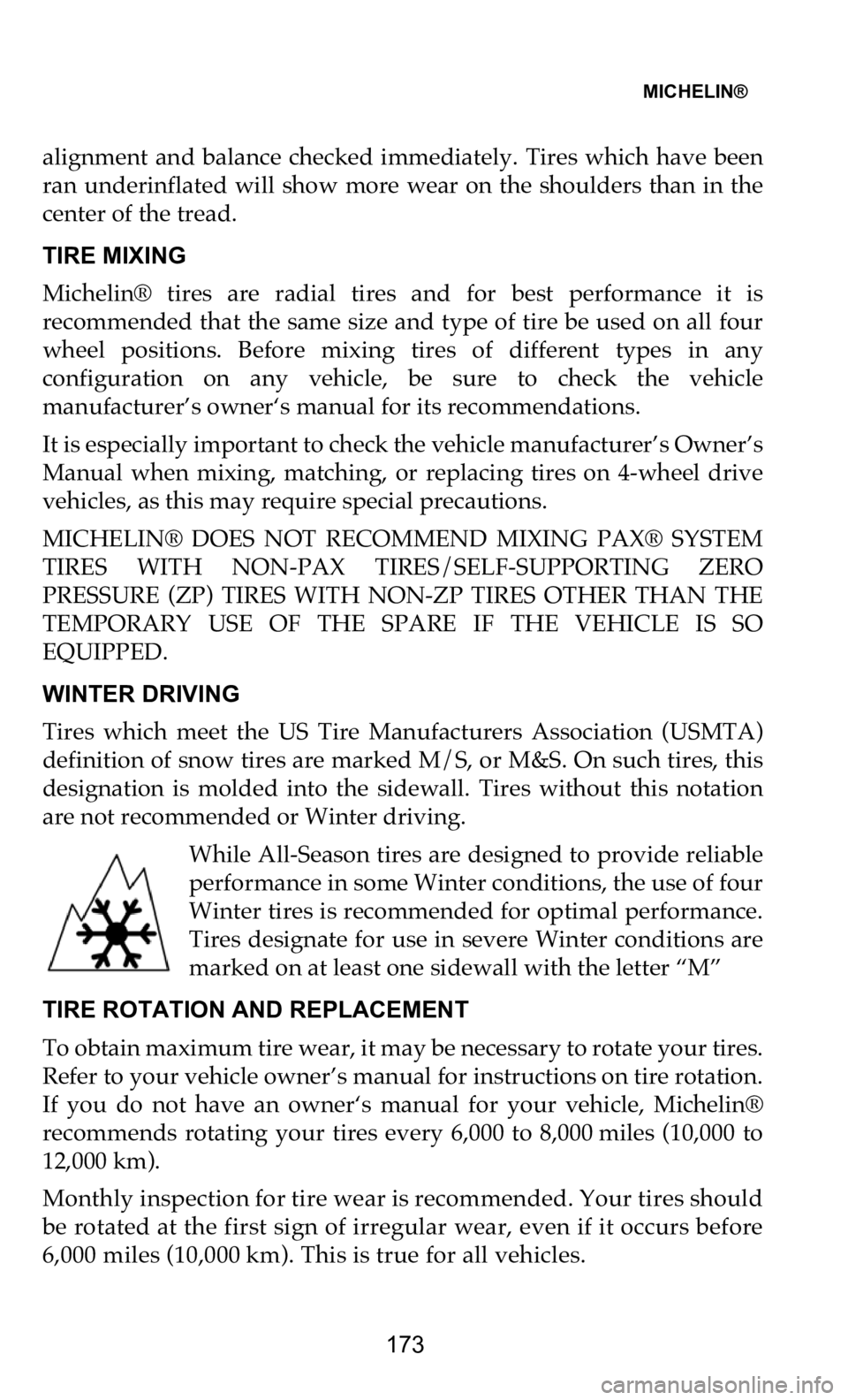
While All-Season tires are designed to provide reliable
performance in some Winter conditions, the use of four
Wi
nter tires is recommended for optimal performance.
Tires designate for use in severe Winter conditions are
marked on at least one sidewall with the letter “M”
TIRE ROTATION AND REPLACEMENT
To obtain maximum tire wear, it may be necessary to rotate your tires.
Re
fer to your vehicle owner’s manual for instructions on tire rotation.
If you do not have an owner‘s manual for your vehicle, Michelin®
recommends rotating your tires every 6,000 to 8,000 miles (10,000 to
12
,000 km).
Monthly inspection for tire wear is recommended. Your tires should
be
rotated at the first sign of irregular wear, even if it occurs before
6,000 miles (10,000 km). This is true for all vehicles.
Page 175 of 262

MICHELIN®
174
When rotating tires with a directional tread pattern, observe the
arrows molded on the sidewall which show the direction the tire
should turn. Care must be taken to maintain the proper turning
direction.
Some Tire Pressure Monitoring Systems (TPMS) may not recognize
th
at a tire has been moved to a different position on your vehicle.
Make certain that your TPMS system is reset, if necessary, so as to
correctly identify the location of each tire on your vehicle. Refer to
your vehicle owner’s manual or your vehicle dealer.
Determine whether rotated tires require tire inflation adjustment as
fr
ont and rear position tire pressure may vary according to the vehicle
manufacturer’s specification due to the actual load on that wheel
position. Some vehicles may have different sized tires mounted on the
front and rear axles, and these different sized tires have rotation
restrictions. Always check the vehicle owner’s manual for the proper
rotation recommendations.
Full-size Spare
Full-size spare tires (not temporary spares) of the same size and
co
nstruction should be used in a five tire rotation. Always check the
inflation pressure of the full-size spare immediately before
incorporating it into rotation. Follow the vehicle manufacturer’s
recommended pattern for rotation, or if not available, see a qualified
tire technician.
Replacement of Two Tires
It is recommended that all four tires are replaced at the same time.
Ho
wever, when only two tires are replaced, the new tires should be
put on the rear. The new tires, with deeper tread, may provide better
grip and water evacuation in wet driving conditions.
CUSTOMIZATION OF TIRES, WHEELS, OR SUSPENSION ON
SU
VS AND LIGHT TRUCKS
Due to their size, weight and higher center of gravity, vehicles such as
SU
Vs and light trucks do not have the same handling characteristics
as automobiles. Because of these differing characteristics, failure to
operate your SUV/truck in a proper and safe manner can increase the
likelihood of vehicle rollover. Modifications to your SUV/truck tire
size, tire type, wheels or suspension can change its handling
characteristics and further increase the likelihood of vehicle rollover.
Whether your SUV/truck has the original equipment configuration
for tires, wheels and suspension or whether any of these items have
Page 177 of 262

MICHELIN®
176
protection throughout the normal use of the tire. Consequently, when
tires sit outdoors, unused for long periods of time (a month or more)
their surfaces become dry and more susceptible to ozone and weather
checking and the casing becomes susceptible to flat spotting. For this
reason, tires should always be stored in a cool, dry, clean, indoor
environment. If storage is for one month or more, eliminate the
weight from the tires by raising the vehicle or by removing the tires
from the vehicle. Failure to store tires in accordance with these
instructions could result in damage to your tires or premature aging
of the tires and sudden tire failure.
When tires are stored, be sure they are placed away from sources of
he
at and ozone such as hot pipes and electric generators. Be sure that
surfaces on which tires are stored are clean and free from grease,
gasoline or other substances which could deteriorate the rubber. Tires
exposed to these materials during storage or driving could be
subject to sudden failure.
FOLLOW THESE MOUNTING RECOMMENDATIONS
Tire changing can be dangerous and must be done by professionally
tr
ained persons using proper tools and procedures as specified by
the Rubber Manufacturers Association (RMA). PAX® System tires
must be mounted and dismounted only by specially trained,
authorized PAX System retailers, utilizing PAX® System
authorized equipment.
Your tires should be mounted on wheels of correct size and type and
wh
ich are in good, clean condition. Wheels that are bent, chipped,
rusted (steel wheels) or corroded (alloy wheels) may cause tire
damage. The inside of the tire must be free from foreign material.
Have your retailer check the wheels before mounting new tires.
Mismatched tires and rims can explode during mounting. Also,
mismatched tires and rims can result in dangerous tire failure on the
road. If a tire is mounted by error on the wrong-sized rim, do not
remount it on the proper rim, scrap it. It may have been damaged
internally (which is not externally visible) by having been
dangerously stretched and could fail on the highway.
Old valves may leak. When new tubeless tires are mounted, have
ne
w valves of the correct type installed. Tubeless tires must only be
mounted on wheels designed for tubeless tires i.e., wheels which
have safety humps or ledges. As with any other tire air valve, the
PAX® System valve stem-pressure sensor combination must be in
Page 179 of 262

MICHELIN®
178
APPLICATIONS, THE TIRES MAY BECOME UNSERVICEABLE AT
LOW OR ZERO PRESSURE, CAUSING SERIOUS PERSONAL
INJURY OR DEATH.
SPECIAL MOUNTING INSTRUCTIONS FOR MICHELIN® TRX™
TI
RES
The MICHELIN® TRX™ tire is a tubeless tire that must only be
mo
unted on special wheels (TR or JM type) with millimetric seat
diameter. If TRX tires are mounted on standard wheels, they will not
retain air due to an air escape feature designed into the bead area of
these tires.
Do not try to override this feature by mounting TRX tires with
tu
bes. The MICHELIN® TRX™ tire must be used on all wheel
positions.
TEMPORARY TYPE SPARE TIRES
When using any temporary type spare tire, be sure to follow the
ve
hicle manufacturer’s instructions.
READING THE DOT
DOT XXXX XXXX XXX (prior to August 2000)
DOT XXXX XXXX XXX (1990-1999)
DOT XXXX XXXX XXXX (after July 2000)
THE DOT
The “DOT” symbol certifies tire manufacturer’s compliance with US
De
partment of Transportation tire safety standards. Next to the
symbol is the tire identification or “serial number”. The first two
characters identify the plant where the tire was manufactured. The
next two characters reflect the tire size. The following one to four
digits may be used at the tire manufacturer’s option as a descriptive
code. The last three characters are numbers identifying the week and
year of manufacture. (Example: “O25” means second week of the year
of decade, eg.: 1995, 1985, etc.) For the 1990-1999 decade MICHELIN®
brand tires are marked with a triangle pointing to the last three
numeric characters. Tires produced after July 2000 have an additional
digit to identify a given decade. For example, 2800 means the tire was
pr
oduced during the 28th week of 2000; 0201 during the 2nd week of
2001. If the last digits of your DOT number contains three numeric
characters and is not marked with a triangle, consult a qualified tire
technician to determine the year of manufacture.
Page 199 of 262

PIRELLI TIRES
198
What Is Not Covered By The Warranty?
• Tires on any vehicle registered and normally operated outside the
U
nited States of America or Canada.
• Tires transferred from the vehicle on which they were originally
i
nstalled.
• Tires misapplied due to insufficient Speed Rating, Load Index,
u
ndersized or oversized tires.
• Tires damaged from improper mounting/dismounting practices,
a
buse, misuse, or neglect.
• Tire dealer/retailer services: mounting, dismounting, balancing,
s
tudding, tire rotation, or wheel alignment.
• Mileage warranty on tires fitted as Original Equipment (Pirelli
b
rand tires supplied as original equipment on new vehicles).
• Passenger tires ( Euro-metric / P-metric ) used on commercial vehi -
c
les or used in commercial applications.
• Tires in which anything other than air or nitrogen has been used as
t
he support medium.
• Tires injected with liquid balancer or sealant or any other balancing
m
aterial.
• Tires which have been modified by the addition or removal of mate -
r
ial or any tire intentionally altered to change its appearance.
• Tires improperly repaired or with repairs not conforming to Tire
a
nd Rubber Association of Canada standards, or with section
repairs, or with a self-vulcanizing plug only or patch only.
• Tires which have been recapped, or retreaded, or regrooved.
•
Tires used in racing or other competitive events.
•
Tires removed in multiples when only one tire can be claimed, or is
s
uspect of a claim.
• Ride related anomalies after the first 2/32” of treadwear.
•
Tires which become unserviceable because of tire operation in
e
xcess of tire/wheel manufacturers’ specifications and recommen -
dations, including spinning.
• Tires which become unserviceable because of a mechanical irregu -
l
arity in the vehicle such as misalignment, defective brakes, defec -
tive shock absorbers or struts, or improper rims.
Page 207 of 262

PIRELLI TIRES
206
5. DOT Street Legal Competition Tires
P Zero Trofeo and P Zero Corsa tire lines use special tire construction
an
d compounds to achieve their distinctive performance in dry
conditions. As a result of that, their performance in cold temperatures,
heavy rain or standing water will be decreased. Use extreme caution
and drive slowly on wet roads.
The minimum tread depth will be reached earlier than normal road
ti
res, resulting in reduced tread life.
6. Winter Tires
The standard Pirelli tires may be effective in light snow conditions.
Ho
wever, for winter use, you may wish to install winter tires. During
winter use, Pirelli strongly recommends the fitment of four winter
tires. Please check your vehicle owner’s manual concerning winter tire
size recommendation. If the winter tires have a lower speed rating
than the original equipment tires, vehicle handling may be affected,
and the vehicle maximum speed must be reduced to the winter tire
speed rating.
Pirelli requires
that studded tires be installed on all four positions.
Installing studded tires only on the drive positions of any vehicle,
including a front wheel drive vehicle, may cause adverse handling
characteristics.
7. Run Flat Tires
Always refer to the vehicle owners’ manual with respect to specific
sa
fety and operating information relating to the vehicle. Damaged
Run Flat tires or Run Flat tires that have experienced a loss of pressure
should immediately be replaced with another Run Flat tire of identical
size and Service Description (Load Index and Speed Symbol).
Run Flat tires have been developed based on the specifications of the
ve
hicles on which they are mounted. Accordingly, Run Flat tires
should only be mounted on vehicles specifically manufactured to
accommodate Run Flat tires.
Run Flat tires must be mounted in conjunction with a functional Tire
Pr
essure Monitoring System (TPMS).
The mounting of tires and installation of the TPMS should be carried
ou
t by a specialized dealer.
Page 208 of 262

PIRELLI TIRES
207
8. Tire Replacement
The tires fitted to your vehicle as original equipment were tested and
ap
proved by the vehicle manufacturer and the tire manufacturer and
take into account all aspects of the vehicle’s operation. Changes in the
tire size, type or construction should not be made without seeking
advice from the vehicle or tire manufacturer or an authorized Pirelli
dealer since unapproved tires on your vehicle could adversely affect
steering, handling, braking and traction. The tire information (tire
size, load index and speed symbol) as found on the vehicle placard or
in the owner’s manual should always be followed when replacing
tires.
It is strongly recommended that Pirelli tires be mounted in sets of four
w i
th the same tread type. Pirelli tires should not be mixed with other
tire brands. It is necessary to follow this procedure because different
tire constructions have different handling characteristics. Tires on the
same axle must be the same manufacturer, brand, tire size, load index,
speed rating and Pirelli part number.
When changing only two tires on a vehicle which is homogeneously fitted
(f
our tires of the same tire size), fit the new tires on the rear axle. This
applies to all vehicles regardless of their drive axle. (Front or Rear Drive).
On all wheel drive or four wheel drive vehicles the tires must always
be
replaced in sets of four.
When replacing tires on light truck vehicles, you should always follow
th
e vehicle manufacturer’s recommendations. Passenger and light
truck tires are not interchangeable, due to differences in their
pressures and load carrying capacity.
P-Metric and Euro-metric Interchangeability: Euro-metric (Example:
22
5/45R17) tires have a load index which is equal to or greater than
that of the same size P-metric (Example: P225/45R17) tire. Therefore,
they have the same or higher load carrying capacity at the maximum
rated inflation pressure. Always check with your tire dealer or Pirelli
Tire Consumer Affairs to be sure of the exact interchangeability to
maintain proper vehicle dynamics.
Please be aware that it is important that, before fitting the suggested
ti
res, the fitment is allowed by the technical specifications of the
vehicle, the vehicle manufacturer and the relevant homologations.
Pirelli Tire does not express any view as to the compatibility of the
wheel/tire combination with the technical specifications for the
chassis and vehicle.
Page 214 of 262

TOYO TIRES® – LIMITED WARRANTY
213
WHAT IS NOT COVERED?
This Limited Warranty does not cover the following categories of
cl
aims:
Rapid Treadwear: Original equipment tires are not guaranteed to last
a
specified number of miles.
Damage from road hazards (not limited to cuts, snags, bruises, impact
br
eaks, bulges, punctures, stone drills, chips, and scales), fire, theft, or
collision.
Conditions arising from improper tire/vehicle maintenance or use,
no
t limited to:
• Irregular or excessive treadwear due to: Incorrect inflation; over -
l
oading; vehicle misalignment; failure to rotate tires; and poor or
de
fective mechanical condition of brakes, shocks, and wheels; or
other factors attributable to the vehicle or wheel.
• Any tire which has been run with low air pressure or while flat.
•
Damage due to abuse; vandalism; tire alteration; tire spinning;
r
acing; or other competitive activities.
• Damage, corrosion, or deterioration from using oil-based chemicals,
w
ater-based sealers, balancing substances, or flammable gases.
• Damage from improper use of tire chains.
T
ires with the DOT identification number removed or rendered
il
legible.
Improper mounting, balancing or repair, not limited to:
• Improper tire mounting, or tire/wheel assembly imbalance.
•
Damage from incorrect mounting or dismounting of the tire, incor -
r
ect wheel size, water or other material trapped inside the tire
du
ring mounting, or failure to keep the tires balanced.
• Damage resulting from improper repair materials or procedures.
F
ailure to meet conditions of this Limited Warranty, not limited to:
• Any tire that is not an Eligible Tire.
•
Any tire for which mileage and tire rotation records are not avail -
a
ble or verifiable.
• Any tire not presented and available for Toyo Tires’ inspection.
•
Any tire worn beyond the treadwear indicators (less than 2/32” of
r
emaining tread).
• Uniformity issues after the first 25% of treadwear.
Page 230 of 262
TOYO TIRES® – LIMITED WARRANTY
229
The following procedures concerning replacement tires must be
followed:
• Confirm that the load-carrying capacity is greater than or equal to
t
he loadcarying capacity of the OE tire size at the pressure indicated
on the vehicle Tire Information Placard.
• Carefully note any differences between recommendations for front
a
nd rear axle positions regarding the tire size and/or inflation pres-
sure.
• The speed rating must be equal to or greater than what is specified
b
y the vehicle manufacturer if the speed capability of the vehicle is
to be maintained.
• Tires should be mounted on approved wheel widths. If changing
t
ire sizes, check to make sure the wheel has adequate load and infla -
tion pressure capacity.
• Body and chassis clearance must be checked on the vehicle’s front
a
nd rear axles.
In addition to the above, light truck tire replacements should take into
co
nsideration the following:
• Proper spacing between dual tires is necessary for optimum tire
p
erformance. If chains are used, particular care must be taken to
assure adequate clearance between loaded tires to avoid damage
from the chains. The allowable outside diameter difference between
a tire and its dual mate is 1/4 inch (6.4 mm) for light truck tires.
WARNING!
• Failure to install tires with adequate load capacity will result in
t
ire fatigue and sudden tire failure. This could lead to loss of
vehicle control, possibly resulting in personal injury or death.
• Certain vehicle performance parameters, including ride comfort
a
nd handling, may be affected by substitute tire sizes. In some
cases, particularly for SUVs and light trucks, a failure to follow
the vehicle manufacturer’s recommendations for tire replace -
ment could adversely affect the safe handling of the vehicle,
po
ssibly resulting in a loss of vehicle control leading to personal
injury or death.
Page 231 of 262

TOYO TIRES® – LIMITED WARRANTY
230
(Continued)
CONSIDERATIONS IN PLUS SIZING
Always refer to and follow the vehicle manufacturer’s replacement
ti
re recommendations. In some cases, a vehicle manufacturer may
specifically advise against the application of replacement tires that are
not of the original size or type.
TIRE AND WHEEL MATCHING AND MOUNTING
WARNING!
Any attempt to mount a tire on a wheel with a different diameter
wi
ll result in an explosion of the tire/wheel assembly that could
cause severe personal injury or death.
Prior to mounting any tire, always check the wheel identification
st
amp to verify the correct wheel diameter. Always check the tire
size molded onto the sidewall.
Never exceed 40 psi when seating the tire beads onto the wheel.
Always stand well clear of any tire mounting operation. This is
es
pecially important when the service operator inflates the tire. If
the tire has been improperly mounted, it could burst with
explosive force causing serious personal injury or death.
A new valve stem must be installed on the wheel each time a
wo
rn out passenger or light truck tire is replaced.
Removing and replacing tires on wheels can be dangerous.
Attempting to mount tires with improper tools or procedures
co
uld result in a tire explosion, causing serious personal injury or
death. This is a job for your authorized Toyo Tires dealer or other
qualified tire service location only.
Serious personal injury or death can result from:
• Failure to select the proper tire and wheel. The tire must match
t
he width and diameter requirements of the wheel. When
mounting truck type radial tires use only wheels approved for
radial tires.
• Failure to inspect both the tire and wheel. The wheel must be
f
ree of cracks, dents, chips, and rust. The tire must be free of bead
damage, cuts, and punctures.