mileage DODGE DURANGO 2021 Vehicle Warranty
[x] Cancel search | Manufacturer: DODGE, Model Year: 2021, Model line: DURANGO, Model: DODGE DURANGO 2021Pages: 262, PDF Size: 10.42 MB
Page 36 of 262

BFGOODRICH® TIRES
35
DO NOT OVERLOAD - DRIVING ON ANY OVERLOADED TIRE
IS DANGEROUS
The maximum load rating of your tires is molded on the tire sidewall.
Do
not exceed this rating. Follow the loading instructions of FCA US
LLC and this will ensure that your tires are not overloaded. Tires
which are loaded beyond their maximum allowable loads for the
particular application will build up excessive heat that may result in
sudden tire destruction.
Do not exceed the Gross Axle Weight Rating (GAWR) for any axle on
yo
ur vehicle.
TRAILER TOWING
If you anticipate towing a trailer, you should visit any BFGoodrich®
ti
re retailer for advice concerning the correct size tire and pressures.
Tire size and pressures will depend upon the type and size of trailer
and hitch utilized, but in no case must the maximum cold inflation
pressure or tire load rating be exceeded. Check the tire decal and the
Owner’s Manual supplied by FCA US LLC for further
recommendations on trailer towing.
WHEEL ALIGNMENT AND BALANCING ARE IMPORTANT
FO
R SAFETY AND MAXIMUM MILEAGE FROM YOUR TIRES
CHECK HOW YOUR TIRES ARE WEARING AT LEAST ONCE
EA
CH MONTH
If your tires are wearing unevenly, such as the inside shoulder of the
ti
re wearing faster than the rest of the tread, or if you detect excessive
vibration, your vehicle may be out of alignment or balance. These
conditions not only shorten the life of your tires but adversely affect
the handling characteristics of your vehicle, which could be
dangerous. If you detect irregular wear or vibration, have your
alignment and balance checked immediately. Tires which have been
run underinflated will show more wear on the shoulders than in the
center of the tread.
TIRE MIXING
BFGoodrich® tires are radial tires and for best performance it is
r e
commended that the same size and type of tire be used on all four
wheel positions. Before mixing tires of different types in any
configuration on any vehicle, be sure to check the vehicle
manufacturer’s Owner‘s Manual for its recommendations.
Page 51 of 262
BRIDGESTONE® - FIRESTONE®
50
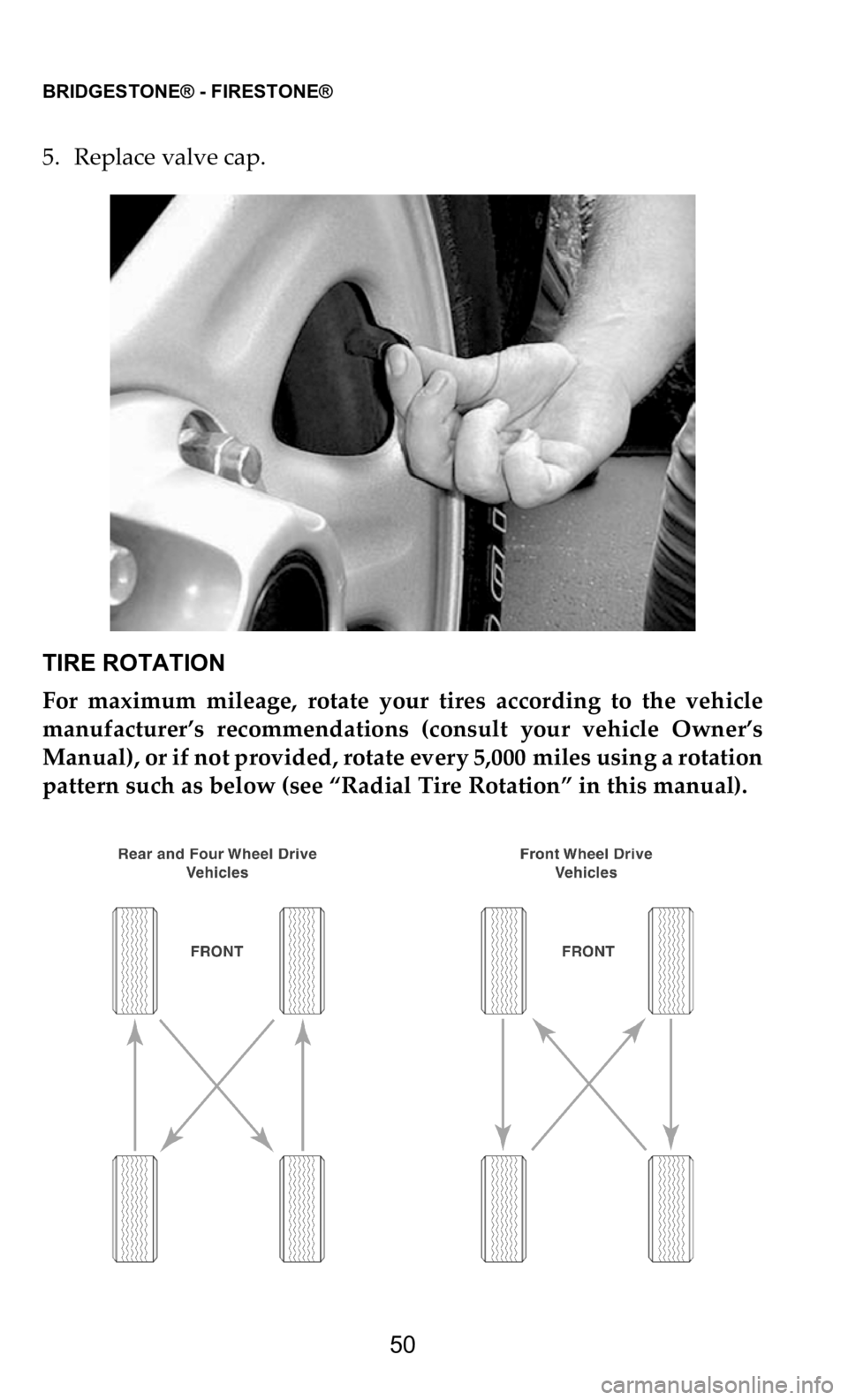
5. Replace valve cap.
TIRE ROTATION
For maximum mileage, rotate your tires according to the vehicle
m a
nufacturer’s recommendations (consult your vehicle Owner’s
Manual), or if not provided, rotate every 5,000 miles using a rotation
pa
ttern such as below (see “Radial Tire Rotation” in this manual).
Page 54 of 262
BRIDGESTONE® - FIRESTONE®
53
These situations can cause a tire failure, even at a later date, which
could lead to serious personal injury or death. Consult the vehicle tire
information placard and/or Owner’s Manual for the recommended
inflation pressures. In addition to tire damage, improper inflation
pressure may also:
• Adversely affect vehicle ride and handling.
•
Reduce tire tread wear.
•
Affect fuel economy.
T
herefore, follow these important recommendations for tire and
ve
hicle safety, mileage, and economy:
• Always keep the vehicle manufacturer’s recommended inflation p
ressure in all your tires, including the spare.
• Check their pressure monthly and before long trips or carrying e
xtra weight.
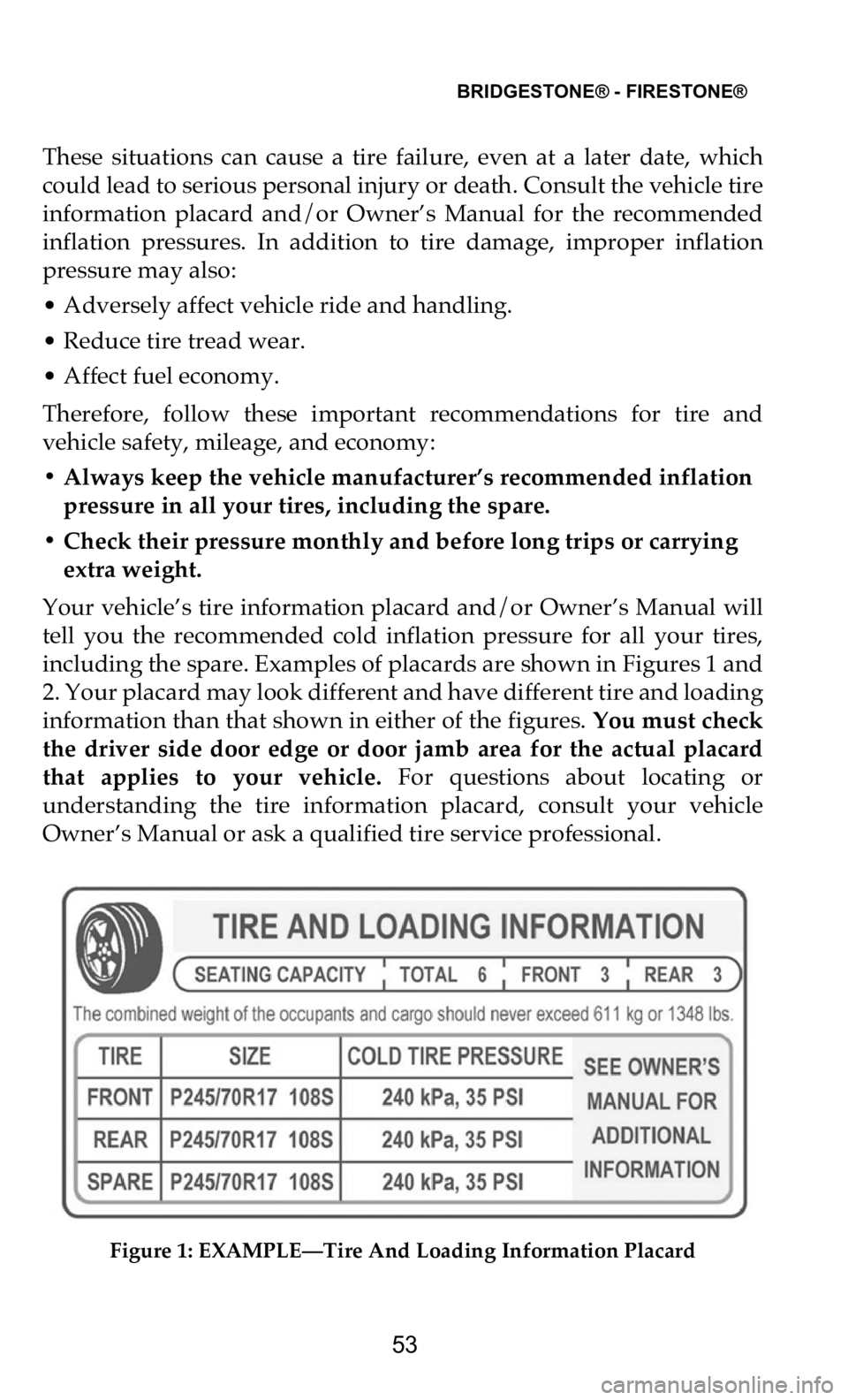
Your vehicle’s tire information placard and/or Owner’s Manual will
te
ll you the recommended cold inflation pressure for all your tires,
including the spare. Examples of placards are shown in Figures 1 and
2. Your placard may look different and have different tire and loading
information than that shown in either of the figures. You must check
the driver side door edge or door jamb area for the actual placard
that applies to your vehicle. For questions about locating or
understanding the tire information placard, consult your vehicle
Owner’s Manual or ask a qualified tire service professional.
Figure 1: EXAMPLE—Tire And Loading Information Placard
Page 73 of 262

BRIDGESTONE® - FIRESTONE®
72
The vehicle or TPMS manufacturer may advise checking the TPMS
regularly to confirm it is in working order. In addition, a new pressure
sensor, certain components, or reprogramming may be necessary
when a tire is serviced. Consult your vehicle Owner’s Manual, vehicle
manufacturer, or a Bridgestone® Firestone® Run-Flat Certified
Retailer for questions regarding TPMS operation and service.
RUN-FLAT OR LOW TIRE PRESSURE OPERATION
General Instructions
The Tire Pressure Monitoring System (TPMS) required in your vehicle
m a
y have different methods of alerting you when your tire has lost
inflation pressure. The international standard for the definition of
run-flat operation is pressure at or below 10 psi (70 kPa); however,
some vehicle manufacturers may have established a different pressure
limit. Consult your vehicle Owner’s Manual for the details of your
TPMS. Once the TPMS has indicated that a tire has reduced inflation
pressure, the run-flat mode of operation has commenced. During this
phase of operation, please follow these instructions:
• Reduce speed as much as safely and reasonably possible; do not
e
xceed 50 mph (80 km/h).The greater the speed, the less distance
t
he tire can travel.
• Avoid abrupt or aggressive acceleration, braking, or cornering
m
aneuvers as much as safely and reasonably possible. Pot holes
and other road hazards should be avoided. Careful driving limits
potential damage to the tire, wheel, and vehicle.
• Proceed to a safe and convenient location for tire service as soon
a
s possible. Take note of your mileage; your operation distance is
limited. See "Distance — How Far You Can Drive,” the next section
in this manual.
WARNING!
Serious personal injury or death may result from a tire failure or
ac
cident due to improper run-flat or low tire pressure operation.
Read and follow the instructions below, and the other
maintenance and safety recommendations elsewhere in this
manual.
Page 74 of 262

BRIDGESTONE® - FIRESTONE®
73
•If an unusual vibration or vehicle handling difficulty arises, stop
driving as soon as safely and reasonably possible. The tire may be
about to suddenly fail. Release the accelerator and gradually reduce
speed. The tire will need to be replaced before proceeding.
• If towing a trailer, stop driving as soon as safely and reasonably
p
ossible. In this condition, it is potentially dangerous to operate a
vehicle/trailer combination. If possible, disconnect the trailer and
proceed as noted above. Do not continue to tow any trailer until
proper tire service or replacement has been performed.
• Do not touch a tire recently run-low or run-flat (it may be very
h
ot). Allow the tire to cool before handling.
DISTANCE — HOW FAR YOU CAN DRIVE
Factors affecting run-flat or low tire pressure operating distance
in
clude vehicle speed, load, and maneuvering; the amount of inflation
pressure loss; the extent of any tire damage; and ambient temperature.
The tire may be marked on the sidewall with run-flat or low tire
pr
essure operating speed and/or distance limitations, which vary by
tire design and vehicle application (consult your vehicle owner’s
manual). By international standard, RFT tires have a baseline
limitation in run-flat mode of the following:
NOTE:
• Maximum distance values are determined under controlled condi -
tions, which may vary in actual use.
• Your mileage capability may be less, or more, depending on your
s
pecific operating conditions.
• If in doubt, do not exceed the 50
mile (80 km) limitation.
• Seek tire service as soon as possible to minimize tire damage.
Maximum Speed: 50 mph (80 km/h)
Maximum Distance: 50 miles (80 km)
Page 84 of 262

BRIDGESTONE® - FIRESTONE®
83
This Limited Warranty applies only to consumers actually using the
tire in the United States and Canada. For warranty conditions outside
the United States and Canada, see your local Bridgestone® Firestone®
distributor.
Obligations under this policy may not be enlarged or altered by anyone.
In accordance with Federal Law, this Limited Warranty has been
de
signated as a "Limited Warranty.” Nothing in this Limited
Warranty is intended to be a representation that tire failures cannot
occur. This Limited Warranty is given in the United States by
Bridgestone® Firestone® North American Tire, LLC, 535 Marriott Dr.,
Nashville, TN 37214 and in Canada by Bridgestone® Firestone®
Canada Inc., 5770 Hurontario St., Suite 400, Mississauga, Ontario,
Canada L5R 3G5.
OWNER’S OBLIGATIONS
In order to keep this Limited Warranty valid, we require you to have
y o
ur tires regularly inspected and rotated per the recommendations
outlined in the sections of this manual entitled "Tire Damage,
Inspection and Service Life” and “Radial Tire Rotation” and to furnish
proof of same in order to receive an adjustment. Such proof should
show the date, mileage, and servicing location. A sales receipt
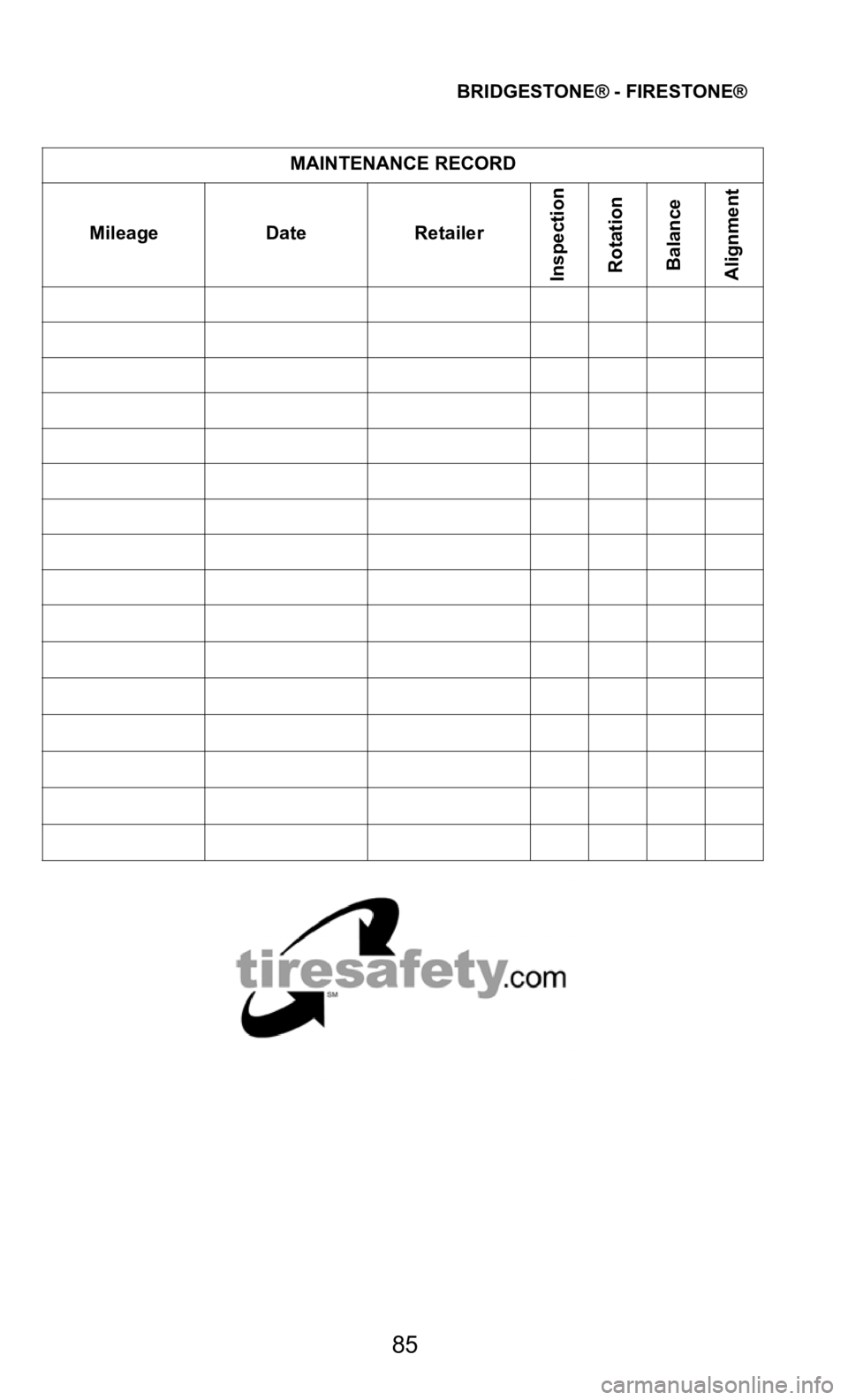
containing this information will suffice. In addition, a “Maintenance
Record” is included on the back cover of this manual. It is your
obligation to maintain proper tire inflation pressures as specified by
the vehicle manufacturer and to operate the vehicle within tire/
vehicle load capacity and speed limitations. It is also your obligation
to maintain proper wheel alignment and tire/wheel assembly
balance. To request an adjustment, you must present the tire to an
authorized Bridgestone® Firestone® retailer. Complete and sign the
customer section of the Bridgestone® Firestone® North American
Tire, LLC Limited Warranty adjustment form and pay appropriate
replacement price, taxes, disposal fee, and service charges, if any.
ARBITRATION
You and Bridgestone® Firestone® North American Tire, LLC agree
t h
at all claims, disputes, and controversies between you and it,
including any of its agents, employees, successors, or assigns, arising
out of or in connection with this Limited Warranty, or any other
warranties, expressed or implied, including a failure of warranty and
the validity of this arbitration clause, but excluding claims for
personal injury or property damage, shall be resolved by binding
Page 86 of 262
BRIDGESTONE® - FIRESTONE®
85
MAINTENANCE RECORD
Mileage DateRetailer
Inspection
RotationBalance
Alignme nt
Page 88 of 262

CONTINENTAL TIRE
87
TEMPORARY SPARE: If a temporary spare tire becomes unser -
viceable from a condition other than those listed in Section 3,
du
ring the first 1/32nd (0.8 mm) of tread wear, then it will be re -
placed with a **comparable new Continental brand TS tire FREE
OF
CHARGE, including mounting and balancing. The owner pays
all applicable taxes. After this "Free Replacement Period" for your
temporary spare tire expires, no warranty claim will be accepted.
After the Free Replacement Period: T
he tire (except temporary
spare tire) may still be eligible for a pro rata replacement up to
72 months from date of original purchase until the tread is worn
do
wn to the tread wear indicators (2/32nds of an inch or 1.6 mm of
tr
ead remaining.) If an eligible tire becomes unserviceable under
the stipulations of this Limited Warranty and Adjustment policy it
will be replaced with a **comparable new Continental brand tire,
charging the owner a pro-rated amount. Owner pays all applicable
taxes (including F.E.T.), mounting and balancing charges.
The replacement tire price will be determined by multiplying the
pe
rcentage of the usable tread worn by the Dealers Selling Price
(excluding all applicable taxes) at the time of the adjustment. The
usable tread is the original tread down to the tread wear indicators
(2/32nds of an inch or 1.6 mm of tread remaining.)
** A "comparable" new Continental brand tire may be of either the
sa
me tire line or the same basic construction but with a different
sidewall or tread configuration. If a higher priced tire is selected,
the consumer will pay the difference in price.
3. WHAT IS NOT COVERED BY THIS WARRANTY
T
HE FOLLOWING ARE NOT COVERED:
• Road Hazard:
Any tire with road hazard damage, which
includes,but is not limited to: cuts, snags, punctures, bruises, and
impact breaks.
• Ride/Vibration:
Any ride/vibration complaint after the first 2/32nds
(1.6 mm) of an inch of treadwear or 12 months of service, which -
ever comes first.
• Repairs:
If a tire is returned under complaint and the reason for
the tire’s disablement is in any way associated with a repair, or
with the situation that led to the repair, the manufacturer’s
warranty is invalidated.
• Mileage: Mileage is not covered under this policy.
Page 91 of 262

CONTINENTAL TIRE
90
Owner must present new vehicle registration form or new vehicle
sales invoice indicating the date of purchase. Owner will be re -
quired to sign the CTA Limited Warranty Claim Form or dealer re -
placement sales receipt.
Owner is responsible for paying all applicable taxes charged by the
se
rvicing dealer and is also responsible for paying shipping, local
tire-disposal fees and parts or service regardless of mileage or
months of service. This includes payment for tire rotation, align -
ment, towing, road service, valve stems and tire repairs.
Owner is responsible for maintaining proper tire air pressure and
fo
r proper maintenance of the tire.
6. SAFETY WARNING:
I
gnoring any of the safety and information contained in this war -
ranty may result in tire failure, causing serious injury or death.
• Tire failure due to under inflation/overloading. Follow vehicle
o
wner’s manual or tire placard in vehicle for proper inflation and
loading.
• Explosion of tire/rim assembly due to improper tire mounting.
T
ire mounting / demounting can be dangerous. It should be
performed only by a trained tire specialist using proper tools and
procedures. Prior to tire mounting/demounting, the Rubber
Manufacturers Association (RMA) wall charts and manuals
should be read to obtain the proper procedures. The failure to
follow these procedures may result in faulty positioning of the
tire and/or rim, which may cause the assembly to burst with
force sufficient to cause injury or death.
• Tire failure due to damage.
Inspect your tires frequently for
scrapes, bulges, separations, cuts, snags and other damage from
road hazards. Damage from impact can occur to the inner
portions of your tire without being visible to the outside. If you
suspect a tire has been damaged from striking anything unusual
in the road, you must have the tire removed from the rim and
inspected both inside and out by a trained tire specialist. Air loss
or unusual tire wear can also be warning signs that a tire may
have internal damage. If you notice these conditions, have your
tire inspected by a trained individual.
• Tire failure due to excessive tire spinning.
Avoid tire spinning.
The centrifugal force generated by a free-spinning tire/rim
assembly may cause a sudden tire explosion resulting in vehicle
Page 97 of 262

FALKEN TIRE CORPORATION
96
CHECKING YOUR TIRE’S AIR PRESSURE
Checking your air pressure at least once a month is vital to help your
ti
res perform properly and help you get the best gas mileage possible.
Tires can lose up to 7 kPa (1 psi) per month under normal conditions
and lose up to 7 kPa (1 PSI) per every 9°C (16°F) drop in temperature.
Here are some simple steps on how to check the air pressures in your
tires:
1. Remove the valve stem cap.
2
. Place the end of the tire gauge firmly against the tire’s valve stem.
3
. Read the current pressure displayed on the gauge that is currently
i
n the tire.
4. Increase pressure at this time (if needed) and recheck with your tire
g
auge.
5. Replace the valve stem cap.
6
. Repeat until all of your tires have been checked and adjusted
a
ccordingly.
TIRE PRESSURE MONITORING SYSTEM (TPMS) A Tire Pressure Monitoring System (TPMS) is a safety
system found in most vehicles manufactured after 2005.
Th
ere are pressure sensing transmitters mounted inside of
each tire that sends readings to the central computer in your
vehicle. The TPMS system will alert you when one or more
of your tires are underinflated by 25% or more by turning on
a warning light on your vehicle’s dashboard or Heads Up Display
(HUD) screen. This means that one or more of your tires may have a
low-pressure condition. Follow the instructions in your Owner’s
Manual.