fuel pressure DODGE DURANGO 2022 User Guide
[x] Cancel search | Manufacturer: DODGE, Model Year: 2022, Model line: DURANGO, Model: DODGE DURANGO 2022Pages: 332, PDF Size: 19.82 MB
Page 167 of 332
MULTIMEDIA165
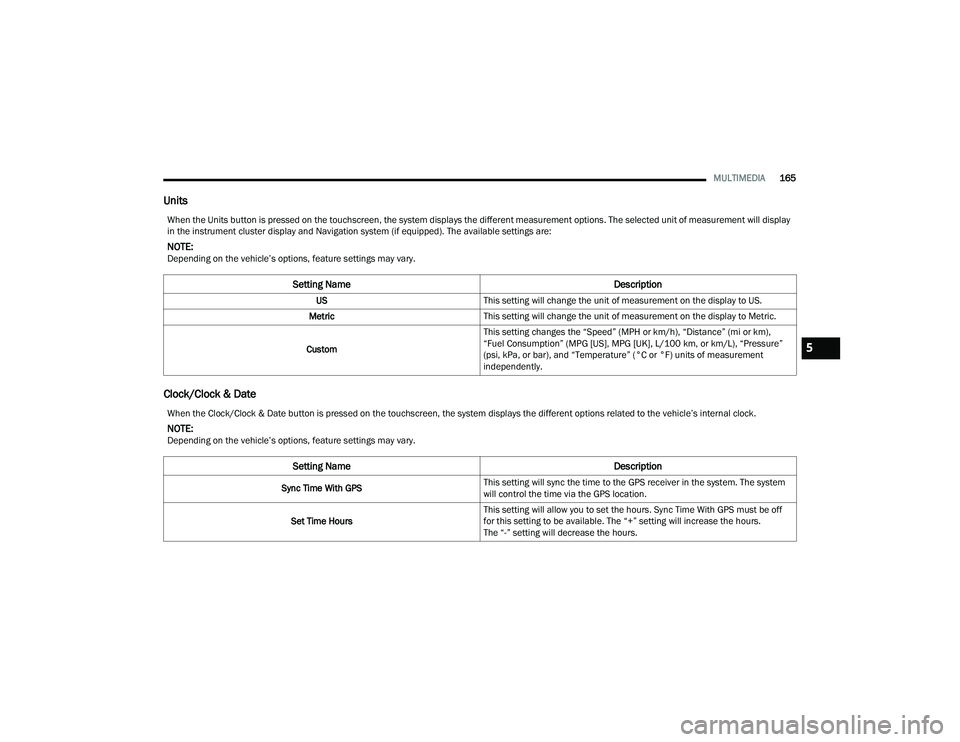
Units
Clock/Clock & Date
When the Units button is pressed on the touchscreen, the system displays the different measurement options. The selected unit of measurement will display
in the instrument cluster display and Navigation system (if equipped). The available settings are:
NOTE:Depending on the vehicle’s options, feature settings may vary.
Setting Name Description
USThis setting will change the unit of measurement on the display to US.
Metric This setting will change the unit of measurement on the display to Metric.
Custom This setting changes the “Speed” (MPH or km/h), “Distance” (mi or km),
“Fuel Consumption” (MPG [US], MPG [UK], L/100 km, or km/L), “Pressure”
(psi, kPa, or bar), and “Temperature” (°C or °F) units of measurement
independently.
When the Clock/Clock & Date button is pressed on the touchscreen, the system displays the different options related to the vehicle’s internal clock.
NOTE:Depending on the vehicle’s options, feature settings may vary.
Setting Name
Description
Sync Time With GPSThis setting will sync the time to the GPS receiver in the system. The system
will control the time via the GPS location.
Set Time Hours This setting will allow you to set the hours. Sync Time With GPS must be off
for this setting to be available. The “+” setting will increase the hours.
The “-” setting will decrease the hours.
5
22_WD_OM_EN_USC_t.book Page 165
Page 196 of 332
194SAFETY
(Continued)
For example, your vehicle has a recommended
cold (parked for more than three hours) tire
pressure of 33 psi (227 kPa). If the ambient
temperature is 68°F (20°C) and the measured tire
pressure is 28 psi (193 kPa), a temperature drop
to 20°F (-7°C) will decrease the tire pressure to
approximately 24 psi (165 kPa). This tire pressure
is sufficiently low enough to turn on the TPMS
Warning Light. Driving the vehicle may cause the
tire pressure to rise to approximately 28 psi
(193 kPa), but the TPMS Warning Light will still be
on. In this situation, the TPMS Warning Light will
turn off only after the tires have been inflated to
the vehicle’s recommended cold tire pressure
value.
NOTE:
The TPMS is not intended to replace normal tire
care and maintenance, or to provide warning of
a tire failure or condition.
The TPMS should not be used as a tire pressure
gauge while adjusting your tire pressure.
Driving on a significantly underinflated tire
causes the tire to overheat and can lead to tire
failure. Underinflation also reduces fuel effi
-
ciency and tire tread life, and may affect the
vehicle’s handling and stopping ability.
The TPMS is not a substitute for proper tire
maintenance, and it is the driver’s responsibility
to maintain correct tire pressure using an accu -
rate tire gauge, even if underinflation has not
reached the level to trigger illumination of the
TPMS Warning Light.
Seasonal temperature changes will affect tire
pressure, and the TPMS will monitor the actual
tire pressure in the tire.
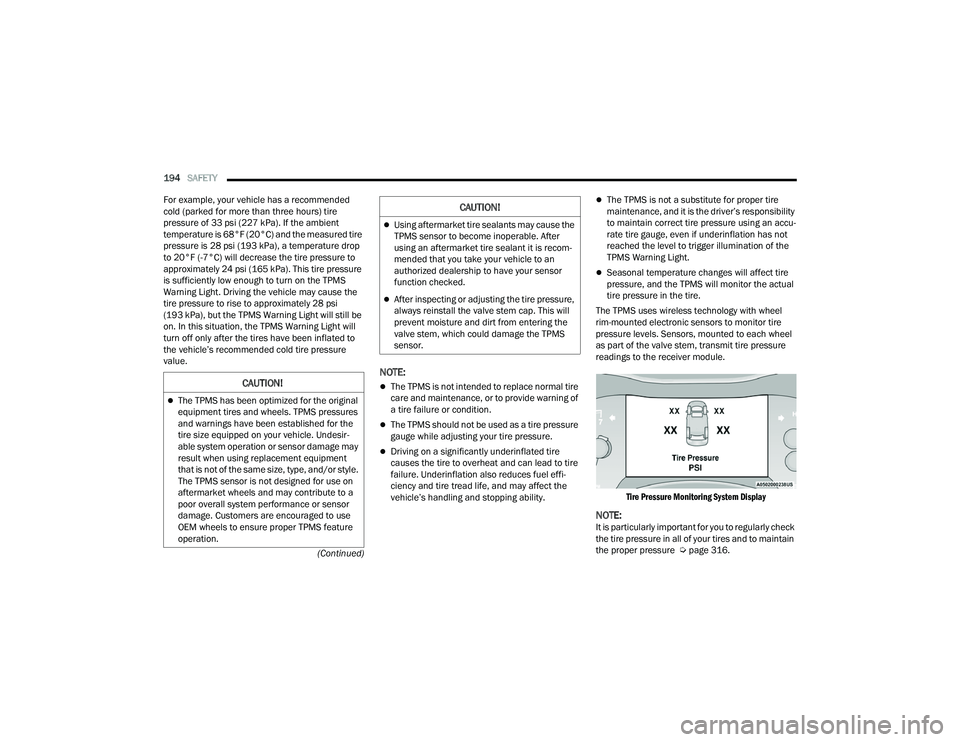
The TPMS uses wireless technology with wheel
rim-mounted electronic sensors to monitor tire
pressure levels. Sensors, mounted to each wheel
as part of the valve stem, transmit tire pressure
readings to the receiver module.
Tire Pressure Monitoring System Display
NOTE:It is particularly important for you to regularly check
the tire pressure in all of your tires and to maintain
the proper pressure Ú page 316.
CAUTION!
The TPMS has been optimized for the original
equipment tires and wheels. TPMS pressures
and warnings have been established for the
tire size equipped on your vehicle. Undesir -
able system operation or sensor damage may
result when using replacement equipment
that is not of the same size, type, and/or style.
The TPMS sensor is not designed for use on
aftermarket wheels and may contribute to a
poor overall system performance or sensor
damage. Customers are encouraged to use
OEM wheels to ensure proper TPMS feature
operation.
Using aftermarket tire sealants may cause the
TPMS sensor to become inoperable. After
using an aftermarket tire sealant it is recom -
mended that you take your vehicle to an
authorized dealership to have your sensor
function checked.
After inspecting or adjusting the tire pressure,
always reinstall the valve stem cap. This will
prevent moisture and dirt from entering the
valve stem, which could damage the TPMS
sensor.
CAUTION!
22_WD_OM_EN_USC_t.book Page 194
Page 257 of 332
255
SERVICING AND MAINTENANCE
SCHEDULED SERVICING
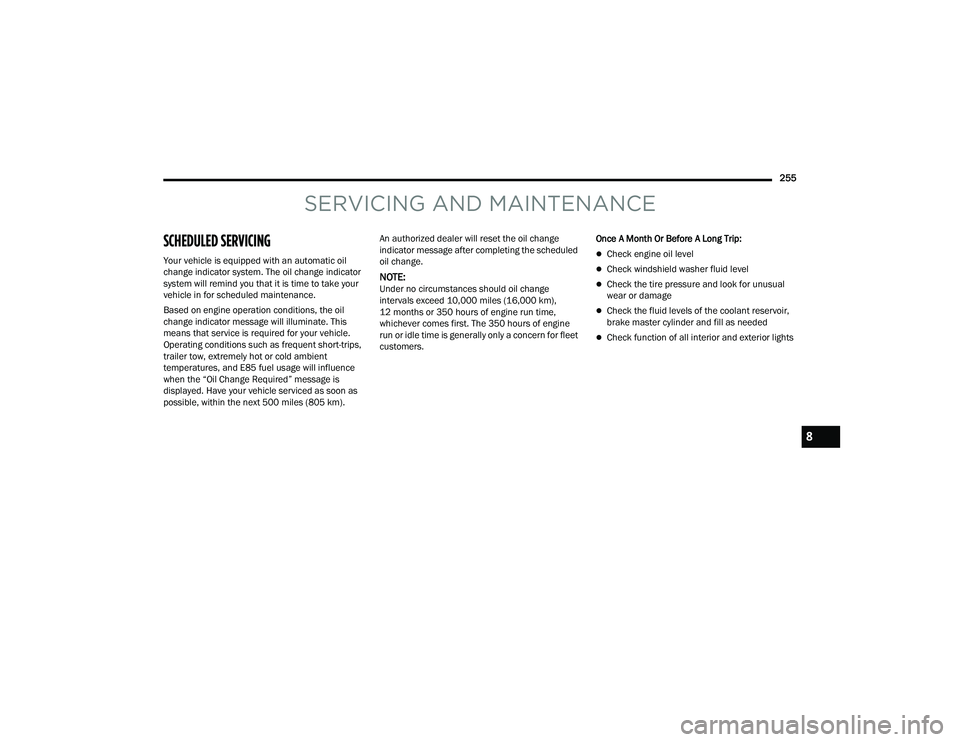
Your vehicle is equipped with an automatic oil
change indicator system. The oil change indicator
system will remind you that it is time to take your
vehicle in for scheduled maintenance.
Based on engine operation conditions, the oil
change indicator message will illuminate. This
means that service is required for your vehicle.
Operating conditions such as frequent short-trips,
trailer tow, extremely hot or cold ambient
temperatures, and E85 fuel usage will influence
when the “Oil Change Required” message is
displayed. Have your vehicle serviced as soon as
possible, within the next 500 miles (805 km).An authorized dealer will reset the oil change
indicator message after completing the scheduled
oil change.
NOTE:Under no circumstances should oil change
intervals exceed 10,000 miles (16,000 km),
12 months or 350 hours of engine run time,
whichever comes first. The 350 hours of engine
run or idle time is generally only a concern for fleet
customers.
Once A Month Or Before A Long Trip:
Check engine oil level
Check windshield washer fluid level
Check the tire pressure and look for unusual
wear or damage
Check the fluid levels of the coolant reservoir,
brake master cylinder and fill as needed
Check function of all interior and exterior lights
8
22_WD_OM_EN_USC_t.book Page 255
Page 263 of 332
SERVICING AND MAINTENANCE261
(Continued)
CHECKING OIL LEVEL
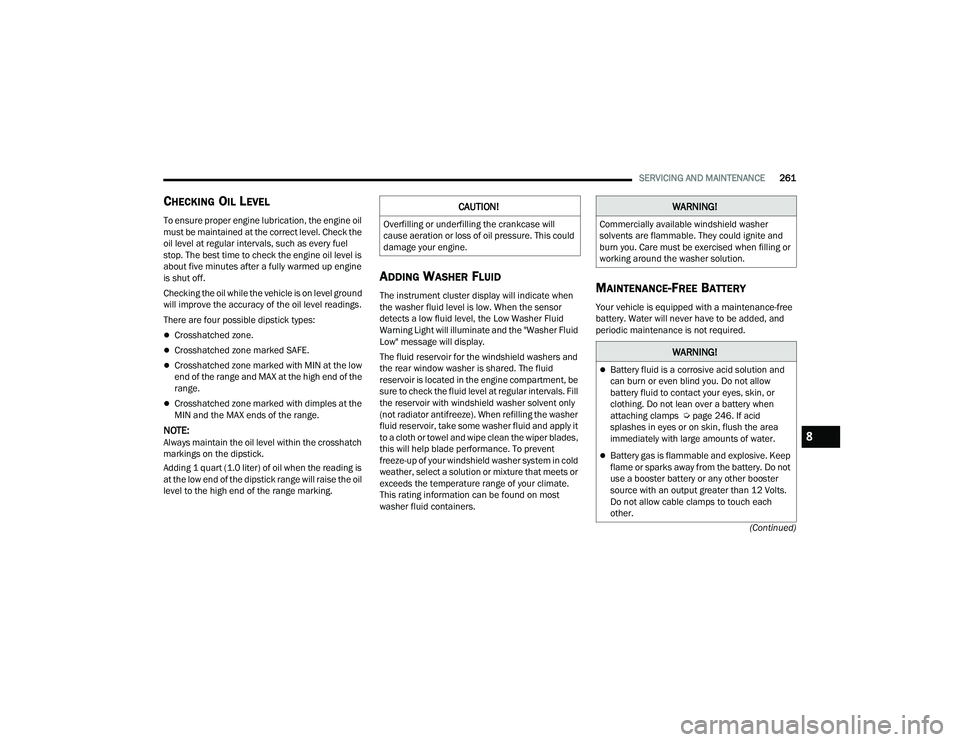
To ensure proper engine lubrication, the engine oil
must be maintained at the correct level. Check the
oil level at regular intervals, such as every fuel
stop. The best time to check the engine oil level is
about five minutes after a fully warmed up engine
is shut off.
Checking the oil while the vehicle is on level ground
will improve the accuracy of the oil level readings.
There are four possible dipstick types:
Crosshatched zone.
Crosshatched zone marked SAFE.
Crosshatched zone marked with MIN at the low
end of the range and MAX at the high end of the
range.
Crosshatched zone marked with dimples at the
MIN and the MAX ends of the range.
NOTE:Always maintain the oil level within the crosshatch
markings on the dipstick.
Adding 1 quart (1.0 liter) of oil when the reading is
at the low end of the dipstick range will raise the oil
level to the high end of the range marking.
ADDING WASHER FLUID
The instrument cluster display will indicate when
the washer fluid level is low. When the sensor
detects a low fluid level, the Low Washer Fluid
Warning Light will illuminate and the "Washer Fluid
Low" message will display.
The fluid reservoir for the windshield washers and
the rear window washer is shared. The fluid
reservoir is located in the engine compartment, be
sure to check the fluid level at regular intervals. Fill
the reservoir with windshield washer solvent only
(not radiator antifreeze). When refilling the washer
fluid reservoir, take some washer fluid and apply it
to a cloth or towel and wipe clean the wiper blades,
this will help blade performance. To prevent
freeze-up of your windshield washer system in cold
weather, select a solution or mixture that meets or
exceeds the temperature range of your climate.
This rating information can be found on most
washer fluid containers.MAINTENANCE-FREE BATTERY
Your vehicle is equipped with a maintenance-free
battery. Water will never have to be added, and
periodic maintenance is not required.
CAUTION!
Overfilling or underfilling the crankcase will
cause aeration or loss of oil pressure. This could
damage your engine.
WARNING!
Commercially available windshield washer
solvents are flammable. They could ignite and
burn you. Care must be exercised when filling or
working around the washer solution.
WARNING!
Battery fluid is a corrosive acid solution and
can burn or even blind you. Do not allow
battery fluid to contact your eyes, skin, or
clothing. Do not lean over a battery when
attaching clamps Ú page 246. If acid
splashes in eyes or on skin, flush the area
immediately with large amounts of water.
Battery gas is flammable and explosive. Keep
flame or sparks away from the battery. Do not
use a booster battery or any other booster
source with an output greater than 12 Volts.
Do not allow cable clamps to touch each
other.
8
22_WD_OM_EN_USC_t.book Page 261
Page 295 of 332
SERVICING AND MAINTENANCE293
(Continued)
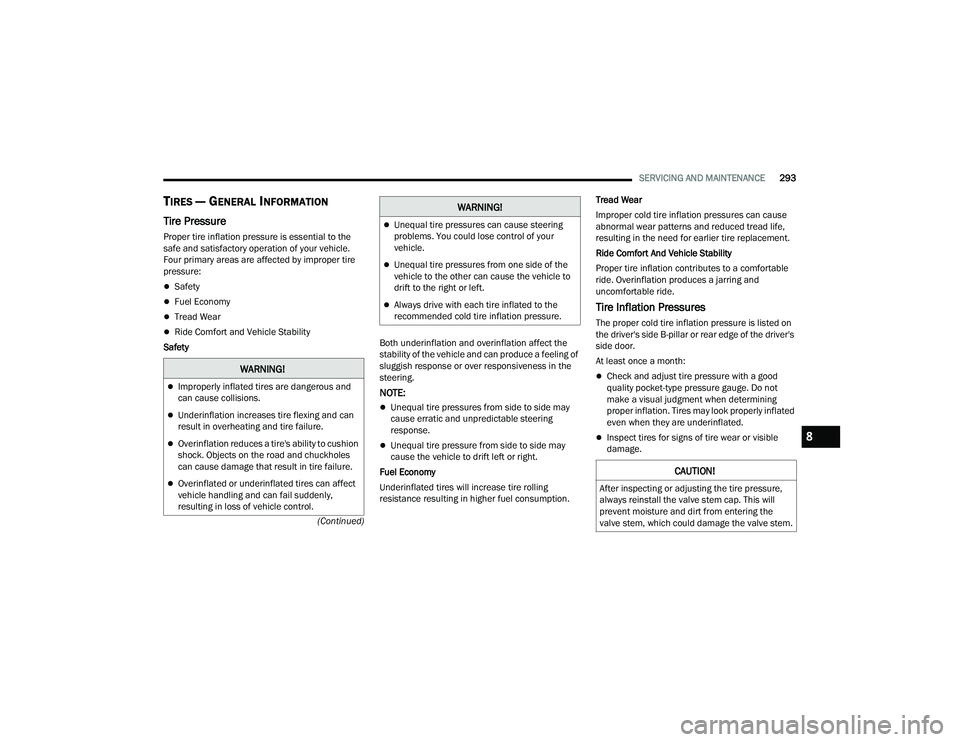
TIRES — GENERAL INFORMATION
Tire Pressure
Proper tire inflation pressure is essential to the
safe and satisfactory operation of your vehicle.
Four primary areas are affected by improper tire
pressure:
Safety
Fuel Economy
Tread Wear
Ride Comfort and Vehicle Stability
Safety Both underinflation and overinflation affect the
stability of the vehicle and can produce a feeling of
sluggish response or over responsiveness in the
steering.
NOTE:
Unequal tire pressures from side to side may
cause erratic and unpredictable steering
response.
Unequal tire pressure from side to side may
cause the vehicle to drift left or right.
Fuel Economy
Underinflated tires will increase tire rolling
resistance resulting in higher fuel consumption. Tread Wear
Improper cold tire inflation pressures can cause
abnormal wear patterns and reduced tread life,
resulting in the need for earlier tire replacement.
Ride Comfort And Vehicle Stability
Proper tire inflation contributes to a comfortable
ride. Overinflation produces a jarring and
uncomfortable ride.
Tire Inflation Pressures
The proper cold tire inflation pressure is listed on
the driver's side B-pillar or rear edge of the driver's
side door.
At least once a month:
Check and adjust tire pressure with a good
quality pocket-type pressure gauge. Do not
make a visual judgment when determining
proper inflation. Tires may look properly inflated
even when they are underinflated.
Inspect tires for signs of tire wear or visible
damage.
WARNING!
Improperly inflated tires are dangerous and
can cause collisions.
Underinflation increases tire flexing and can
result in overheating and tire failure.
Overinflation reduces a tire's ability to cushion
shock. Objects on the road and chuckholes
can cause damage that result in tire failure.
Overinflated or underinflated tires can affect
vehicle handling and can fail suddenly,
resulting in loss of vehicle control.
Unequal tire pressures can cause steering
problems. You could lose control of your
vehicle.
Unequal tire pressures from one side of the
vehicle to the other can cause the vehicle to
drift to the right or left.
Always drive with each tire inflated to the
recommended cold tire inflation pressure.
WARNING!
CAUTION!
After inspecting or adjusting the tire pressure,
always reinstall the valve stem cap. This will
prevent moisture and dirt from entering the
valve stem, which could damage the valve stem.
8
22_WD_OM_EN_USC_t.book Page 293
Page 319 of 332
317
INDEX
A
About Your Brakes......................................... 307Adaptive Cruise Control (ACC)
(Cruise Control).................................... 116, 118Adding Engine Coolant (Antifreeze)............... 273Adding Fuel.................................................... 137Additives, Fuel............................................... 309AdjustDown.................................................... 34, 35Forward................................................ 34, 35Rearward.............................................. 34, 35Up......................................................... 34, 35Air BagAir Bag Operation...................................... 206Air Bag Warning Light...................... 204, 207Driver Knee Air Bag................................... 211Enhanced Accident Response......... 214, 254Event Data Recorder (EDR)....................... 254Front Air Bag............................................. 207If Deployment Occurs................................ 213Knee Impact Bolsters................................ 211Maintaining Your Air Bag System.............. 215Maintenance............................................. 215
Redundant Air Bag Warning Light............. 205Side Air Bags............................................ 211Transporting Pets..................................... 232Air Bag Light.................................. 89, 204, 232Air Cleaner, Engine
(Engine Air Cleaner Filter)............................. 263Air Conditioner Maintenance........................ 264Air Conditioner Refrigerant.................. 264, 265Air Conditioner System................................. 264Air ConditioningRear............................................................. 59Air Conditioning Filter.................... 61, 264, 265Air Conditioning System................................... 60Air Conditioning, Operating Tips....................... 61Air Filter........................................................ 263Air PressureTires......................................................... 293AlarmArm The System................................... 21, 22Disarm The System..................................... 21Rearm The System...................................... 22Security Alarm............................................. 92Alarm SystemSecurity Alarm............................................. 21
All Wheel Drive (AWD)................................... 109Alterations/ModificationsVehicle.........................................................10Antifreeze (Engine Coolant).................. 272, 311Disposal.................................................... 273Anti-Lock Brake System (ABS)....................... 182Anti-Lock Warning Light...................................92Assist, Hill Start............................................. 186Audio Systems (Radio).................................. 156Auto Down Power Windows..............................70Automatic Headlights.......................................49Automatic High Beams.....................................48Automatic Temperature Control (ATC)..............60Automatic Transmission......................... 99, 105Adding Fluid.............................................. 275Fluid And Filter Change............................. 275Fluid Change............................................. 275Fluid Level Check...................................... 275Fluid Type........................................ 276, 312Special Additives...................................... 275Automatic Transmission Limp Home Mode... 108Auxiliary Driving Systems.............................. 188Auxiliary Electrical Outlet (Power Outlet)..........66Auxiliary Power Outlet......................................66Axle Fluid....................................................... 31211
22_WD_OM_EN_USC_t.book Page 317
Page 324 of 332
322 Locks Child Protection
........................................... 25Manual........................................................ 22Power Door.................................................. 23Lubrication, Body........................................... 267Lug Nuts/Bolts.............................................. 307Luggage Carrier............................................... 76
M
Maintenance................................................... 72Maintenance Free Battery............................. 261Maintenance Schedule.................................. 255Malfunction Indicator Light
(Check Engine)......................................... 93, 98ManualService...................................................... 315Memory Feature (Memory Seats).................... 27Memory Seat................................................... 27Memory Seats And Radio................................ 27Methanol....................................................... 309Mirrors............................................................. 41Electric Remote........................................... 42Exterior Folding........................................... 42Heated........................................................ 42Outside........................................................ 42Rearview............................................ 41, 235Vanity.......................................................... 41Modifications/AlterationsVehicle........................................................ 10
Monitor, Tire Pressure System...................... 193Mopar Parts.................................................. 315Multi-Function Control Lever............................ 47
N
New Vehicle Break-In Period......................... 102
O
Occupant Restraints..................................... 196Octane Rating, Gasoline (Fuel)............ 308, 309Oil Change Indicator........................................ 84Reset........................................................... 84Oil Filter, Change.......................................... 263Oil Filter, Selection........................................ 263Oil Pressure Light............................................. 91Oil, Engine..................................................... 262Capacity.................................................... 311Checking................................................... 261Dipstick.................................................... 261Disposal................................................... 263Filter......................................................... 263Filter Disposal........................................... 263Identification Logo.................................... 263Materials Added To.................................. 263Pressure Warning Light............................... 91Recommendation............................ 262, 311Synthetic.................................................. 263Viscosity................................................... 311Onboard Diagnostic System............................. 97Operating Precautions..................................... 97
Operator ManualOwner's Manual........................................ 315Outside Rearview Mirrors.................................42
P
Paint Care..................................................... 304Parking Brake............................................... 103ParkSense System, Rear............................... 127Passive Entry....................................................23Pets............................................................... 232Pinch Protection...............................................72Placard, Tire And Loading Information.......... 290PowerBrakes...................................................... 307Distribution Center (Fuses)....................... 277Door Locks...................................................23Inverter........................................................68Liftgate........................................................73Mirrors.........................................................42Outlet (Auxiliary Electrical Outlet).................66Seats...........................................................34Steering........................................... 114, 312Sunroof........................................................71Tilt/Telescoping Steering Column................26Windows......................................................69Power SeatsDown....................................................34, 35Forward................................................34, 35Rearward..............................................34, 35Up.........................................................34, 35
22_WD_OM_EN_USC_t.book Page 322