air DODGE DURANGO 2022 Repair Manual
[x] Cancel search | Manufacturer: DODGE, Model Year: 2022, Model line: DURANGO, Model: DODGE DURANGO 2022Pages: 332, PDF Size: 19.82 MB
Page 243 of 332
IN CASE OF EMERGENCY241
SPARE TIRE REMOVAL
Remove the spare tire before attempting to jack up
the vehicle. The spare tire is stowed underneath
the rear cargo area on the outside of the vehicle.
For spare tire removal, see the following steps:
1. Remove the jack tools from the bag.
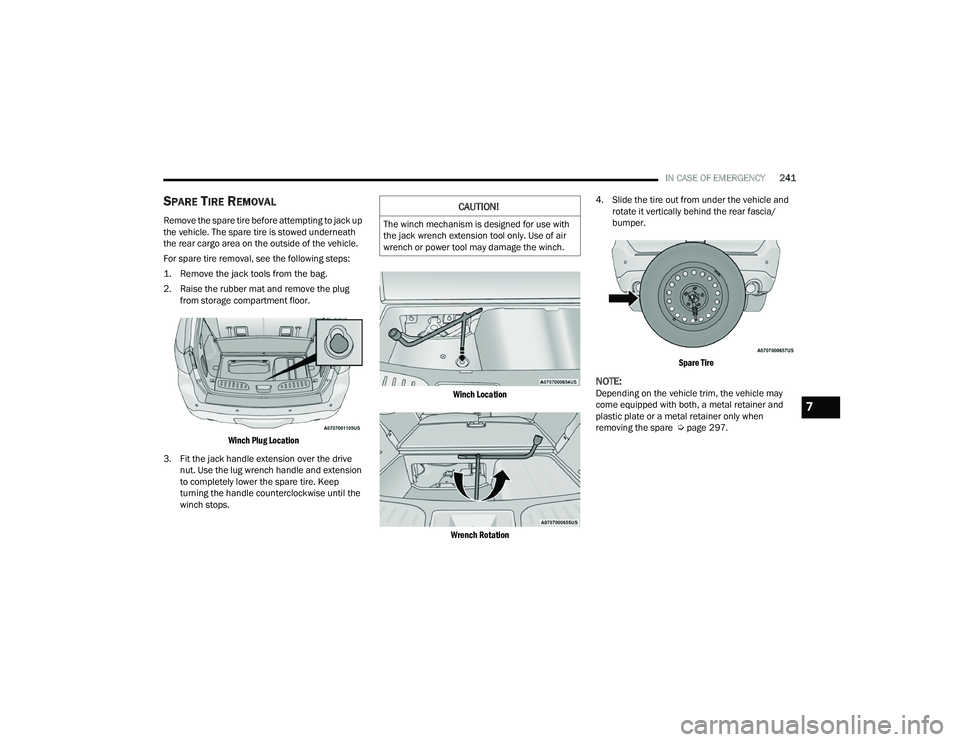
2. Raise the rubber mat and remove the plug
from storage compartment floor.
Winch Plug Location
3. Fit the jack handle extension over the drive nut. Use the lug wrench handle and extension
to completely lower the spare tire. Keep
turning the handle counterclockwise until the
winch stops.
Winch Location
Wrench Rotation
4. Slide the tire out from under the vehicle and
rotate it vertically behind the rear fascia/
bumper.
Spare Tire
NOTE:Depending on the vehicle trim, the vehicle may
come equipped with both, a metal retainer and
plastic plate or a metal retainer only when
removing the spare Ú page 297.
CAUTION!
The winch mechanism is designed for use with
the jack wrench extension tool only. Use of air
wrench or power tool may damage the winch.
7
22_WD_OM_EN_USC_t.book Page 241
Page 247 of 332
IN CASE OF EMERGENCY245
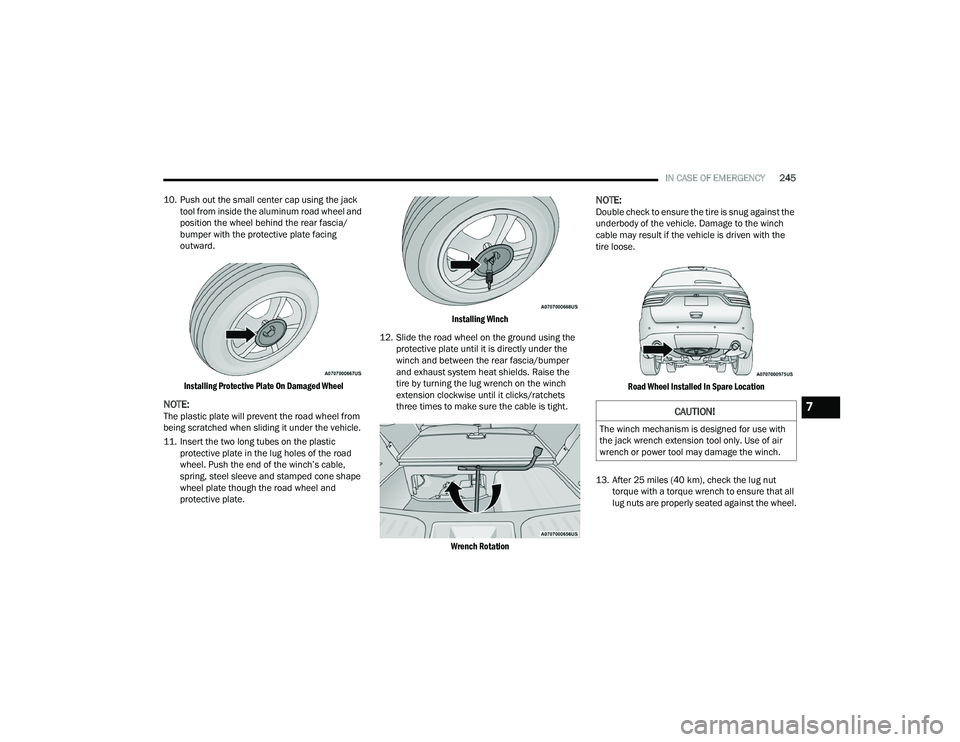
10. Push out the small center cap using the jack tool from inside the aluminum road wheel and
position the wheel behind the rear fascia/
bumper with the protective plate facing
outward.
Installing Protective Plate On Damaged Wheel
NOTE:The plastic plate will prevent the road wheel from
being scratched when sliding it under the vehicle.
11. Insert the two long tubes on the plastic protective plate in the lug holes of the road
wheel. Push the end of the winch’s cable,
spring, steel sleeve and stamped cone shape
wheel plate though the road wheel and
protective plate.
Installing Winch
12. Slide the road wheel on the ground using the protective plate until it is directly under the
winch and between the rear fascia/bumper
and exhaust system heat shields. Raise the
tire by turning the lug wrench on the winch
extension clockwise until it clicks/ratchets
three times to make sure the cable is tight.
Wrench Rotation
NOTE:Double check to ensure the tire is snug against the
underbody of the vehicle. Damage to the winch
cable may result if the vehicle is driven with the
tire loose.
Road Wheel Installed In Spare Location
13. After 25 miles (40 km), check the lug nut torque with a torque wrench to ensure that all
lug nuts are properly seated against the wheel.
CAUTION!
The winch mechanism is designed for use with
the jack wrench extension tool only. Use of air
wrench or power tool may damage the winch.
7
22_WD_OM_EN_USC_t.book Page 245
Page 248 of 332
246IN CASE OF EMERGENCY
14. Lower the jack to the fully closed position. Return the tools to the proper positions in the
tool bag. Fold the flap on the tool bag under
the tools and roll the tools in the bag
underneath the others. Use the hook and loop
fasteners to secure the tool bag to the jack
with the lug wrench on the forward side of the
jack. Expand the jack on the bracket by turning
the thumb screw clockwise until it is tight to
prevent rattles.
15. Reinstall the plastic plug into the floor of the cargo area. Roll up and store the Jack, Tool Kit
and Tire Changing Instructions. Reinstall the
cover for the jack in the rear storage bin.
16. Have the aluminum road wheel and tire repaired as soon as possible and properly
secure the spare tire, jack and tool kit.
JUMP STARTING
If your vehicle has a discharged battery, it can be
jump started using a set of jumper cables and a
battery in another vehicle, or by using a portable
battery booster pack. Jump starting can be
dangerous if done improperly, so please follow the
procedures in this section carefully.
NOTE:When using a portable battery booster pack, follow
the manufacturer's operating instructions and
precautions.
PREPARATIONS FOR JUMP START
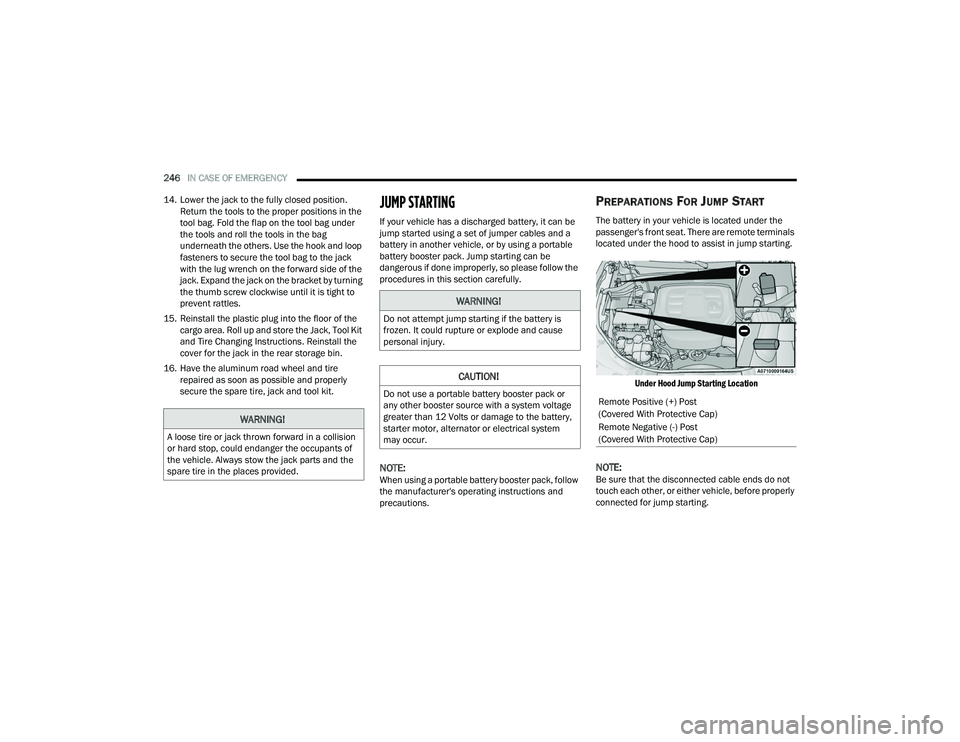
The battery in your vehicle is located under the
passenger's front seat. There are remote terminals
located under the hood to assist in jump starting.
Under Hood Jump Starting Location
NOTE:Be sure that the disconnected cable ends do not
touch each other, or either vehicle, before properly
connected for jump starting.
WARNING!
A loose tire or jack thrown forward in a collision
or hard stop, could endanger the occupants of
the vehicle. Always stow the jack parts and the
spare tire in the places provided.
WARNING!
Do not attempt jump starting if the battery is
frozen. It could rupture or explode and cause
personal injury.
CAUTION!
Do not use a portable battery booster pack or
any other booster source with a system voltage
greater than 12 Volts or damage to the battery,
starter motor, alternator or electrical system
may occur.Remote Positive (+) Post
(Covered With Protective Cap)
Remote Negative (-) Post
(Covered With Protective Cap)
22_WD_OM_EN_USC_t.book Page 246
Page 252 of 332
250IN CASE OF EMERGENCY
In the event it is observed that the temperature
gauge is moving towards or close to the HOT (H)
position, you can reduce the potential for
overheating by taking the appropriate action.
On the highways — slow down.
In city traffic — while stopped, place the trans -
mission in NEUTRAL (N), but do not increase the
engine idle speed while preventing vehicle
motion with the brakes.
If your Air Conditioner (A/C) is on, turn it off. The
A/C system adds heat to the engine cooling
system and turning the A/C off can help remove
this heat.
You can also turn the temperature control to
maximum heat, the mode control to floor and
the blower control to high. This allows the heater
core to act as a supplement to the radiator and
aids in removing heat from the engine cooling
system.
MANUAL PARK RELEASE
In order to move the vehicle in cases where the
transmission will not shift out of PARK (P) (such as
a depleted battery), a Manual Park Release is
available. Follow these steps to use the Manual Park
Release:
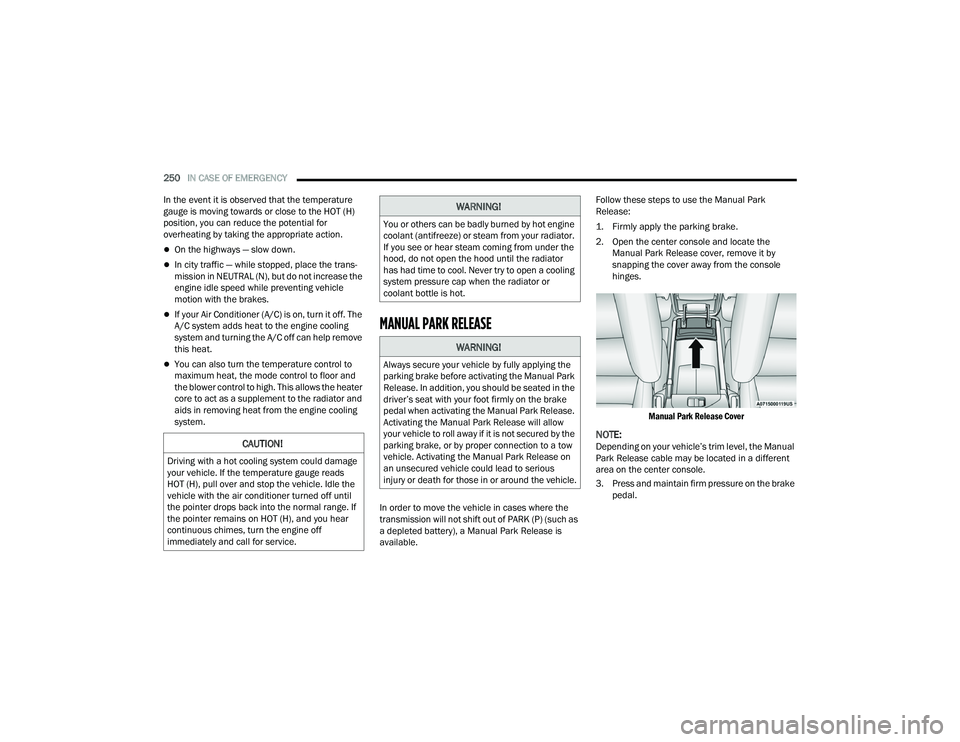
1. Firmly apply the parking brake.
2. Open the center console and locate the
Manual Park Release cover, remove it by
snapping the cover away from the console
hinges.
Manual Park Release Cover
NOTE:Depending on your vehicle’s trim level, the Manual
Park Release cable may be located in a different
area on the center console.
3. Press and maintain firm pressure on the brake pedal.CAUTION!
Driving with a hot cooling system could damage
your vehicle. If the temperature gauge reads
HOT (H), pull over and stop the vehicle. Idle the
vehicle with the air conditioner turned off until
the pointer drops back into the normal range. If
the pointer remains on HOT (H), and you hear
continuous chimes, turn the engine off
immediately and call for service.
WARNING!
You or others can be badly burned by hot engine
coolant (antifreeze) or steam from your radiator.
If you see or hear steam coming from under the
hood, do not open the hood until the radiator
has had time to cool. Never try to open a cooling
system pressure cap when the radiator or
coolant bottle is hot.
WARNING!
Always secure your vehicle by fully applying the
parking brake before activating the Manual Park
Release. In addition, you should be seated in the
driver’s seat with your foot firmly on the brake
pedal when activating the Manual Park Release.
Activating the Manual Park Release will allow
your vehicle to roll away if it is not secured by the
parking brake, or by proper connection to a tow
vehicle. Activating the Manual Park Release on
an unsecured vehicle could lead to serious
injury or death for those in or around the vehicle.
22_WD_OM_EN_USC_t.book Page 250
Page 256 of 332
254IN CASE OF EMERGENCY
(Continued)
REAR WHEEL DRIVE MODELS
FCA US LLC recommends towing your vehicle with
all four wheels OFF the ground using a flatbed.
If flatbed equipment is not available, and the
transmission is operable, the vehicle may be towed
(with rear wheels off the ground) under the
following conditions:
The transmission must be in NEUTRAL (N).
For instructions on shifting the transmission to
NEUTRAL (N) when the engine is off
Ú page 250.
The towing speed must not exceed 30 mph
(48 km/h).
The towing distance must not exceed 30 miles
(48 km).
If the transmission is not operable, or the vehicle
must be towed faster than 30 mph (48 km/h) or
farther than 30 miles (48 km), tow with the rear
wheels OFF the ground. Acceptable methods are to tow the vehicle on a flatbed, or with the front
wheels raised and the rear wheels on a towing
dolly, or (when using a suitable steering wheel
stabilizer to hold the front wheels in the straight
position) with the rear wheels raised and the front
wheels
ON the ground.
ALL WHEEL DRIVE MODELS
FCA US LLC recommends towing with all wheels
OFF the ground. Acceptable methods are to tow
the vehicle on a flatbed or with one end of the
vehicle raised and the opposite end on a towing
dolly.
If flatbed equipment is not available, and the
transfer case is operable, vehicles with a
two-speed transfer case may be towed (in the
forward direction, with ALL wheels on the ground),
IF the transfer case is in NEUTRAL (N) and the
transmission is in PARK Úpage 149.
Vehicles equipped with a single-speed transfer
case have no NEUTRAL (N) position, and therefore
must be towed will all four wheels OFF the ground.ENHANCED ACCIDENT RESPONSE SYSTEM
(EARS)
This vehicle is equipped with an Enhanced
Accident Response System.
This feature is a communication network that
takes effect in the event of an impact Úpage 214.
EVENT DATA RECORDER (EDR)
This vehicle is equipped with an event data
recorder (EDR). The main purpose of an EDR is to
record data that will assist in understanding how a
vehicle’s systems performed under certain crash
or near crash-like situations, such as an air bag
deployment or hitting a road obstacle Úpage 215.CAUTION!
Towing faster than 30 mph (48 km/h) or
farther than 30 miles (48 km) with rear
wheels on the ground can cause severe trans -
mission damage. Damage from improper
towing is not covered under the New Vehicle
Limited Warranty.
CAUTION!
Front or rear wheel lifts must not be used
(if the remaining wheels are on the ground).
Internal damage to the transmission or
transfer case will occur if a front or rear wheel
lift is used when towing.
Towing this vehicle in violation of the above
requirements can cause severe transmission
and/or transfer case damage. Damage from
improper towing is not covered under the New
Vehicle Limited Warranty.
CAUTION!
22_WD_OM_EN_USC_t.book Page 254
Page 258 of 332
256SERVICING AND MAINTENANCE
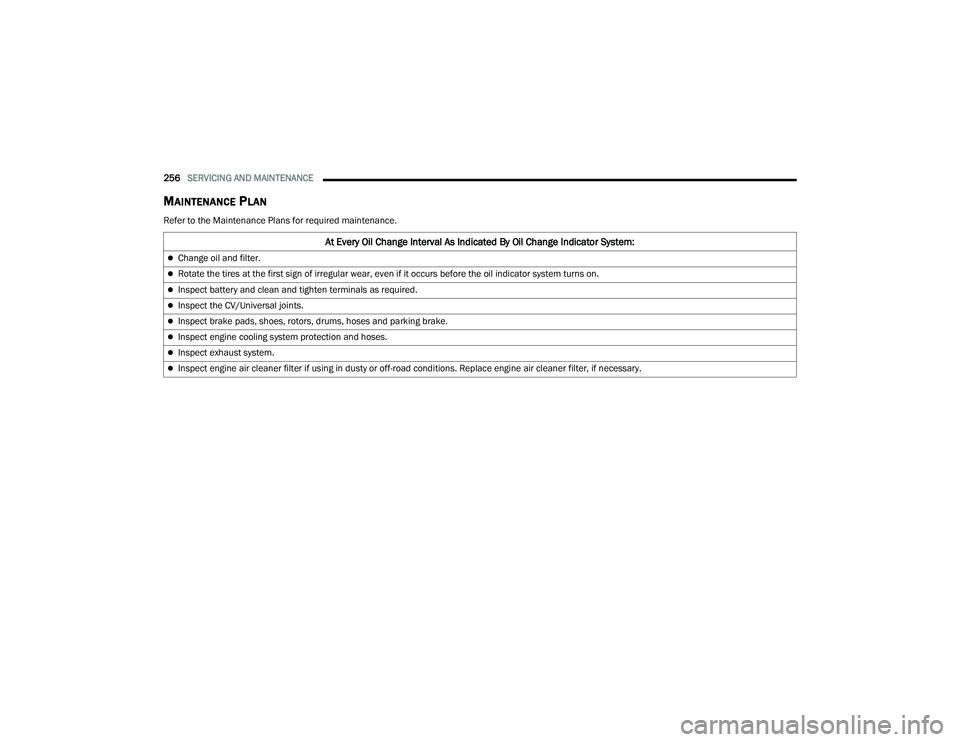
MAINTENANCE PLAN
Refer to the Maintenance Plans for required maintenance.
At Every Oil Change Interval As Indicated By Oil Change Indicator System:
Change oil and filter.
Rotate the tires at the first sign of irregular wear, even if it occurs before the oil indicator system turns on.
Inspect battery and clean and tighten terminals as required.
Inspect the CV/Universal joints.
Inspect brake pads, shoes, rotors, drums, hoses and parking brake.
Inspect engine cooling system protection and hoses.
Inspect exhaust system.
Inspect engine air cleaner filter if using in dusty or off-road conditions. Replace engine air cleaner filter, if necessary.
22_WD_OM_EN_USC_t.book Page 256
Page 259 of 332
SERVICING AND MAINTENANCE257
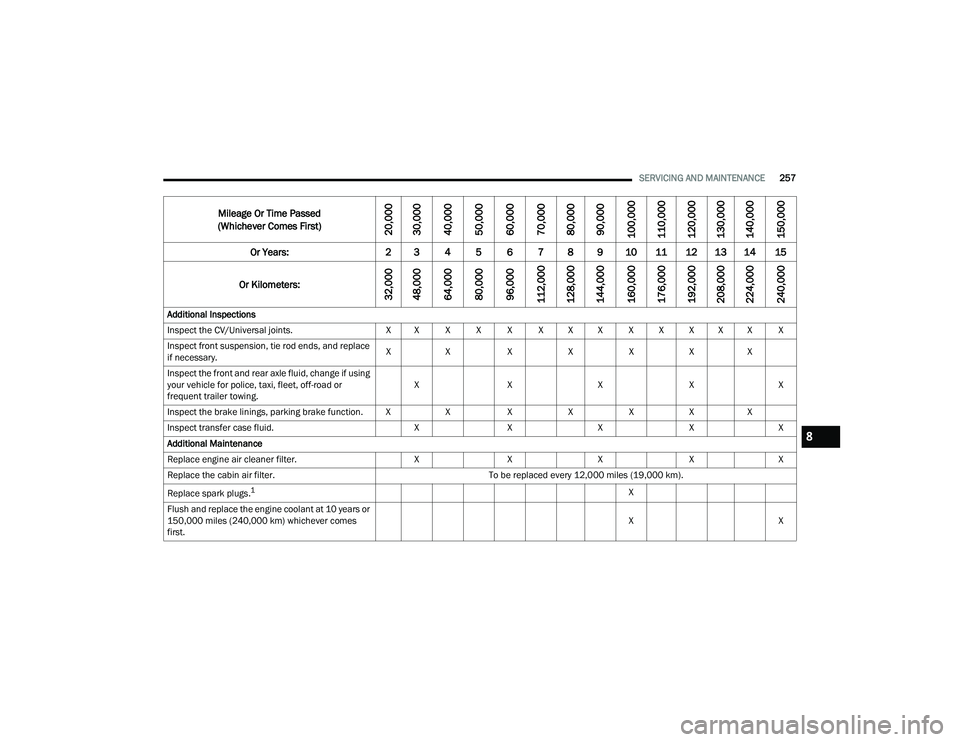
Mileage Or Time Passed
(Whichever Comes First)
20,000
30,000
40,000
50,000
60,000
70,000
80,000
90,000
100,000
110,000
120,000
130,000
140,000
150,000
Or Years: 2 3 4 5 6 7 8 9 10 11 12 13 14 15
Or Kilometers:
32,000
48,000
64,000
80,000
96,000
112,000
128,000
144,000
160,000
176,000
192,000
208,000
224,000
240,000
Additional Inspections
Inspect the CV/Universal joints. X X X X X X X X X X X X X X
Inspect front suspension, tie rod ends, and replace
if necessary. X
X XXXXX
Inspect the front and rear axle fluid, change if using
your vehicle for police, taxi, fleet, off-road or
frequent trailer towing. X
XX XX
Inspect the brake linings, parking brake function. X XXXXXX
Inspect transfer case fluid. XXX XX
Additional Maintenance
Replace engine air cleaner filter. XXX XX
Replace the cabin air filter. To be replaced every 12,000 miles (19,000 km).
Replace spark plugs.
1X
Flush and replace the engine coolant at 10 years or
150,000 miles (240,000 km) whichever comes
first. X
X
8
22_WD_OM_EN_USC_t.book Page 257
Page 261 of 332
SERVICING AND MAINTENANCE259
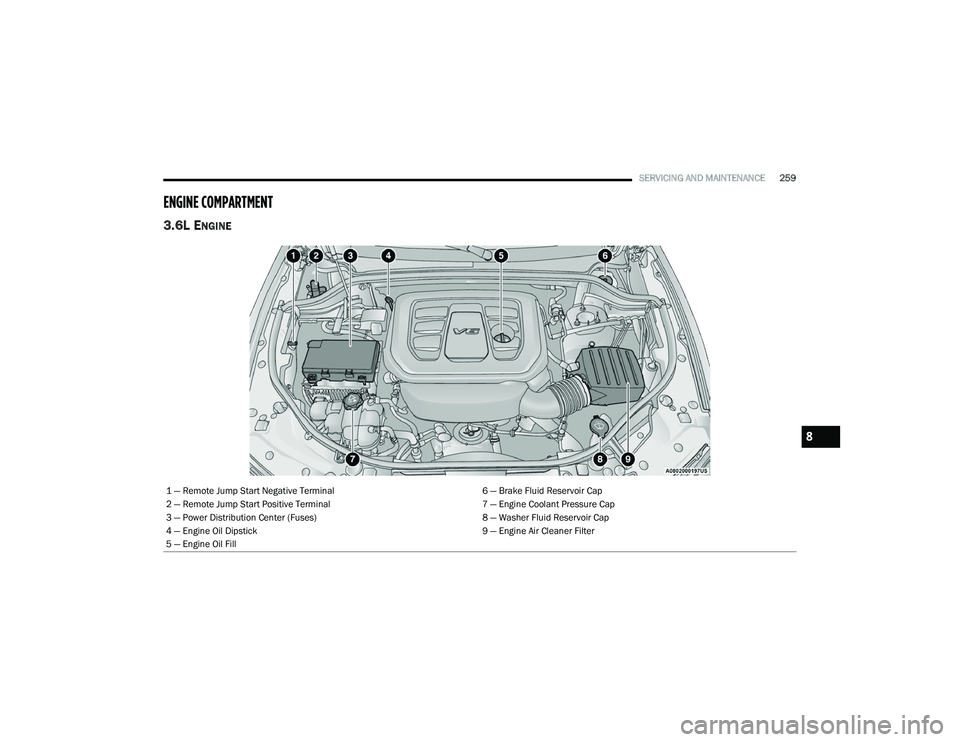
ENGINE COMPARTMENT
3.6L ENGINE
1 — Remote Jump Start Negative Terminal 6 — Brake Fluid Reservoir Cap
2 — Remote Jump Start Positive Terminal 7 — Engine Coolant Pressure Cap
3 — Power Distribution Center (Fuses) 8 — Washer Fluid Reservoir Cap
4 — Engine Oil Dipstick 9 — Engine Air Cleaner Filter
5 — Engine Oil Fill
8
22_WD_OM_EN_USC_t.book Page 259
Page 262 of 332
260SERVICING AND MAINTENANCE
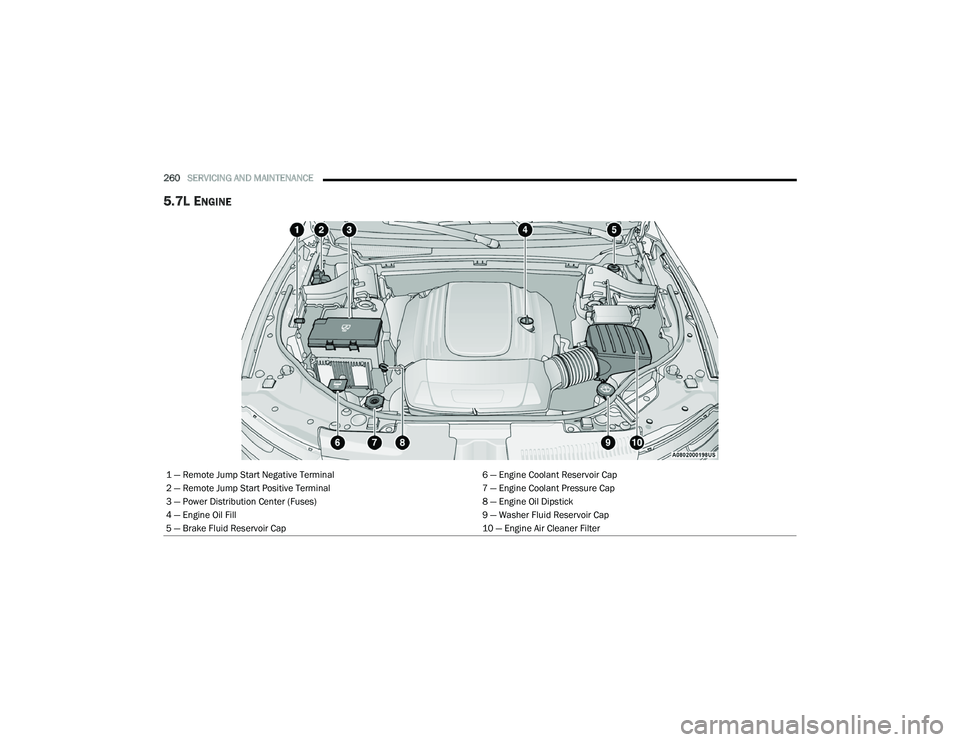
5.7L ENGINE
1 — Remote Jump Start Negative Terminal 6 — Engine Coolant Reservoir Cap
2 — Remote Jump Start Positive Terminal 7 — Engine Coolant Pressure Cap
3 — Power Distribution Center (Fuses) 8 — Engine Oil Dipstick
4 — Engine Oil Fill 9 — Washer Fluid Reservoir Cap
5 — Brake Fluid Reservoir Cap 10 — Engine Air Cleaner Filter
22_WD_OM_EN_USC_t.book Page 260
Page 265 of 332
SERVICING AND MAINTENANCE263
Light (MIL) comes on, see the nearest authorized
dealer.
American Petroleum Institute (API)
Approved Engine Oil
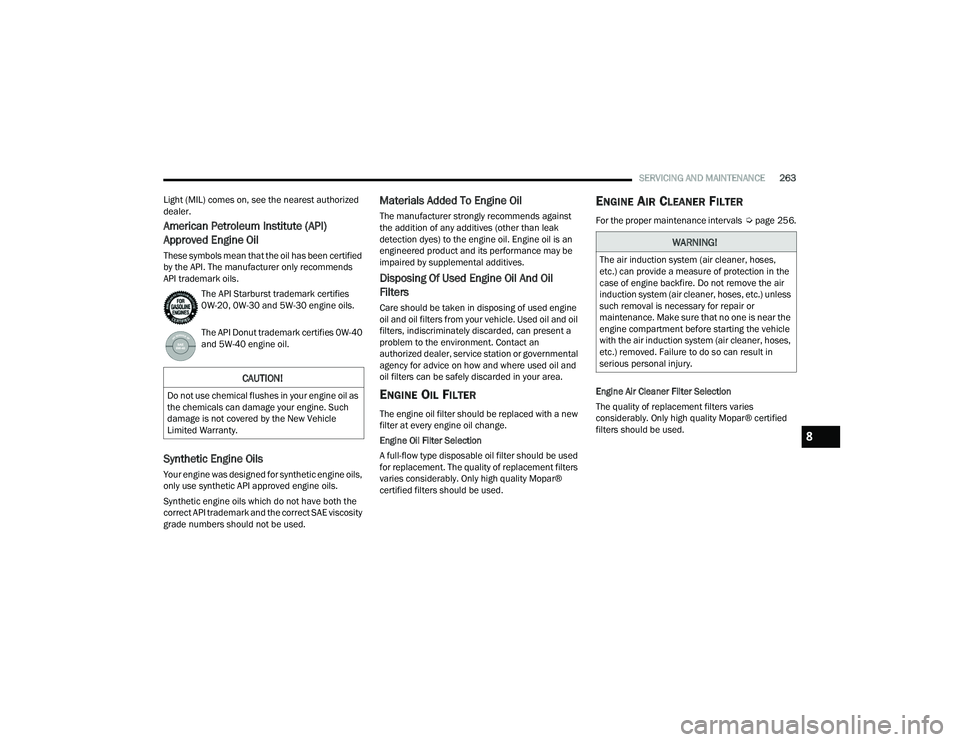
These symbols mean that the oil has been certified
by the API. The manufacturer only recommends
API trademark oils. The API Starburst trademark certifies
0W-20, 0W-30 and 5W-30 engine oils.
The API Donut trademark certifies 0W-40
and 5W-40 engine oil.
Synthetic Engine Oils
Your engine was designed for synthetic engine oils,
only use synthetic API approved engine oils.
Synthetic engine oils which do not have both the
correct API trademark and the correct SAE viscosity
grade numbers should not be used.
Materials Added To Engine Oil
The manufacturer strongly recommends against
the addition of any additives (other than leak
detection dyes) to the engine oil. Engine oil is an
engineered product and its performance may be
impaired by supplemental additives.
Disposing Of Used Engine Oil And Oil
Filters
Care should be taken in disposing of used engine
oil and oil filters from your vehicle. Used oil and oil
filters, indiscriminately discarded, can present a
problem to the environment. Contact an
authorized dealer, service station or governmental
agency for advice on how and where used oil and
oil filters can be safely discarded in your area.
ENGINE OIL FILTER
The engine oil filter should be replaced with a new
filter at every engine oil change.
Engine Oil Filter Selection
A full-flow type disposable oil filter should be used
for replacement. The quality of replacement filters
varies considerably. Only high quality Mopar®
certified filters should be used.
ENGINE AIR CLEANER FILTER
For the proper maintenance intervals Úpage 256.
Engine Air Cleaner Filter Selection
The quality of replacement filters varies
considerably. Only high quality Mopar® certified
filters should be used.
CAUTION!
Do not use chemical flushes in your engine oil as
the chemicals can damage your engine. Such
damage is not covered by the New Vehicle
Limited Warranty.
WARNING!
The air induction system (air cleaner, hoses,
etc.) can provide a measure of protection in the
case of engine backfire. Do not remove the air
induction system (air cleaner, hoses, etc.) unless
such removal is necessary for repair or
maintenance. Make sure that no one is near the
engine compartment before starting the vehicle
with the air induction system (air cleaner, hoses,
etc.) removed. Failure to do so can result in
serious personal injury.
8
22_WD_OM_EN_USC_t.book Page 263