service DODGE DURANGO 2022 Vehicle Warranty
[x] Cancel search | Manufacturer: DODGE, Model Year: 2022, Model line: DURANGO, Model: DODGE DURANGO 2022Pages: 200, PDF Size: 6.72 MB
Page 49 of 200
BRIDGESTONE® - FIRESTONE®
48
WINTER TIRES
In Winter driving conditions, vehicle control and safe operation under braking and
cornering is especially dependent upon the rear tires. For this reason, Winter tires are
best applied to all wheel positions. Some vehicles have specific recommendations
regarding Winter tire use; consult your vehicle Owner’s Manual and tire information
placard.
• If Winter tires are to be applied to the front axle of any vehicle, they must also be a
pplied to the rear axle for safe operation. This applies to all passenger cars and light
trucks, including Front Wheel Drive (FWD), Four Wheel Drive (4WD) and All Wheel Drive
(AWD) vehicles.
• I f Winter tires are to be applied to the rear axle of any vehicle, it is recommended that
t
hey also be installed on the front axle.
• I t is generally acceptable to apply a tire with a lower speed rating than your original
t
ires for use in Winter weather conditions; however, speed should be reduced accord -
ingly. All Winter tires should be the same speed rating. See “Tire Speed Ratings” in this
m a
nual.
• W inter tires used in warmer, Summer weather conditions may wear more rapidly.
•
Studded Winter tires follow the same recommendations as above; consult a qualified
t
ire service professional for information regarding any seasonal restrictions.
TIRE MIXING
WARNING!
Winter driving presents special challenges for vehicle mobility. The use of winter tires
(including studs and chains)—while improving traction performance in snow and
ice—requires special care with regard to acceleration, braking, cornering, and speed. It
is important to drive with care, not only on snow and ice, but on dry and wet roads as
well.
WARNING!
Driving your vehicle with an improper mix of tires is dangerous. Your vehicle’s handling
characteristics can be seriously affected. You could have an accident resulting in
serious personal injury or death. Consult your vehicle owner’s manual and a qualified
tire service professional for proper tire replacement.
Page 50 of 200

BRIDGESTONE® - FIRESTONE®
49
HIGH SPEED DRIVING
• Regardless of the speed and handling capabilities of your car and its tires, a loss of vehicle control can result from exceeding the maximum speed allowed by law or
warranted by traffic, weather, vehicle, or road conditions.
• H igh-speed driving should be left to trained professionals operating under controlled
c
onditions.
• N o tire, regardless of its design or speed rating, has unlimited capacity for speed, and
a
sudden tire failure can occur if its limits are exceeded. See “Tire Speed Ratings,” the
next section in this manual.
Refer to your vehicle Owner’s Manual for any tire pressure recommendations for high
s p
eed driving.
TIRE SPEED RATINGS
A tire bearing a letter “speed rating” designation indicates the tire’s speed capability
according to standardized laboratory tests. This speed rating system is intended to
permit comparison of the speed capabilities of different tires. When replacing your tires,
consult your vehicle Owner’s Manual and tire information placard for recommendations,
if any, concerning the use of speed rated tires.
• To avoid reducing the speed capability of the vehicle, replace a speed rated tire only w
ith another tire having at least the same speed rating. It is the “top speed” of the
“slowest” tire on the vehicle which limits the vehicle’s top speed without tire failure.
• T he tire’s speed rating is void if the tire is repaired, retreaded, damaged, abused, or
o
therwise altered from its original condition. Thereafter, it should be treated as a
non-speed rated tire.
• N on-speed rated tires are usually for ordinary passenger car or light truck service and
n
ot for high speed driving.
• F or winter tires used in cold weather conditions, it is generally acceptable to apply a
t
ire with a lower speed rating than your original tires; however, speed should be
reduced accordingly. All winter tires should be the same speed rating. Some vehicles
have specific recommendations regarding winter tire use; consult your vehicle
Owner’s Manual and tire information placard. See “Winter Tires” in this manual.
These speed ratings are based on standardized laboratory tests under specific,
co
ntrolled conditions. While these tests may relate to performance on the road,
real-world driving is rarely identical to any test conditions. Your tire’s actual speed
capability may be less than its rated speed since it is affected by factors such as inflation
WARNING!
Driving at high speed is dangerous and can cause a vehicle accident, including
serious personal injury or death.
Page 51 of 200

BRIDGESTONE® - FIRESTONE®
50
pressure, load, tire condition (including damage), wear, vehicle condition (including
alignment), driving conditions, and duration at which the speed is sustained. Use the
following chart to compare the speed ratings of tires.
The tire’s speed rating designation appears on the tire sidewall with the tire size.
Ex
amples:
* In standardized laboratory tests that relate to highway speeds. Actual tire speed and performance
capability depend on factors such as inflation pressure, load, tire condition, wear, and driving conditions.
** Any tire having a maximum speed capability above 149 mph (240 km/h) may, at the tire manufacturer’s
d i
scretion, include a “Z” in the size designation (i.e. P275/40ZR17).
*** For tires having a maximum speed capability above 186 mph (300 km/h), a “Z” must appear in the size
d e
signation and a “Y” marked in brackets (as shown) in the service description.
**** Consult the tire manufacturer for maximum speed capability.
Speed
Symbol Speed Category*
mph km/h
M 81130
Q 99160
R 106 170
S 112 180
T 118 190
U 124 200
H 130 210
V 149 240
Z** >149 >240
W 168 270
Y 186 300
(Y)*** >186
P275/40ZR17 max > 149 mph (240 km/h)****
P275/40R17 93Wmax = 168 mph (270 km/h)
P275/40ZR17 93Wmax = 168 mph (270 km/h)
P275/40ZR17 93Ymax = 186 mph (300 km/h)
P275/40ZR17 93(Y)max > 186 mph (300 km/h) ****
Page 53 of 200
BRIDGESTONE® - FIRESTONE®
52
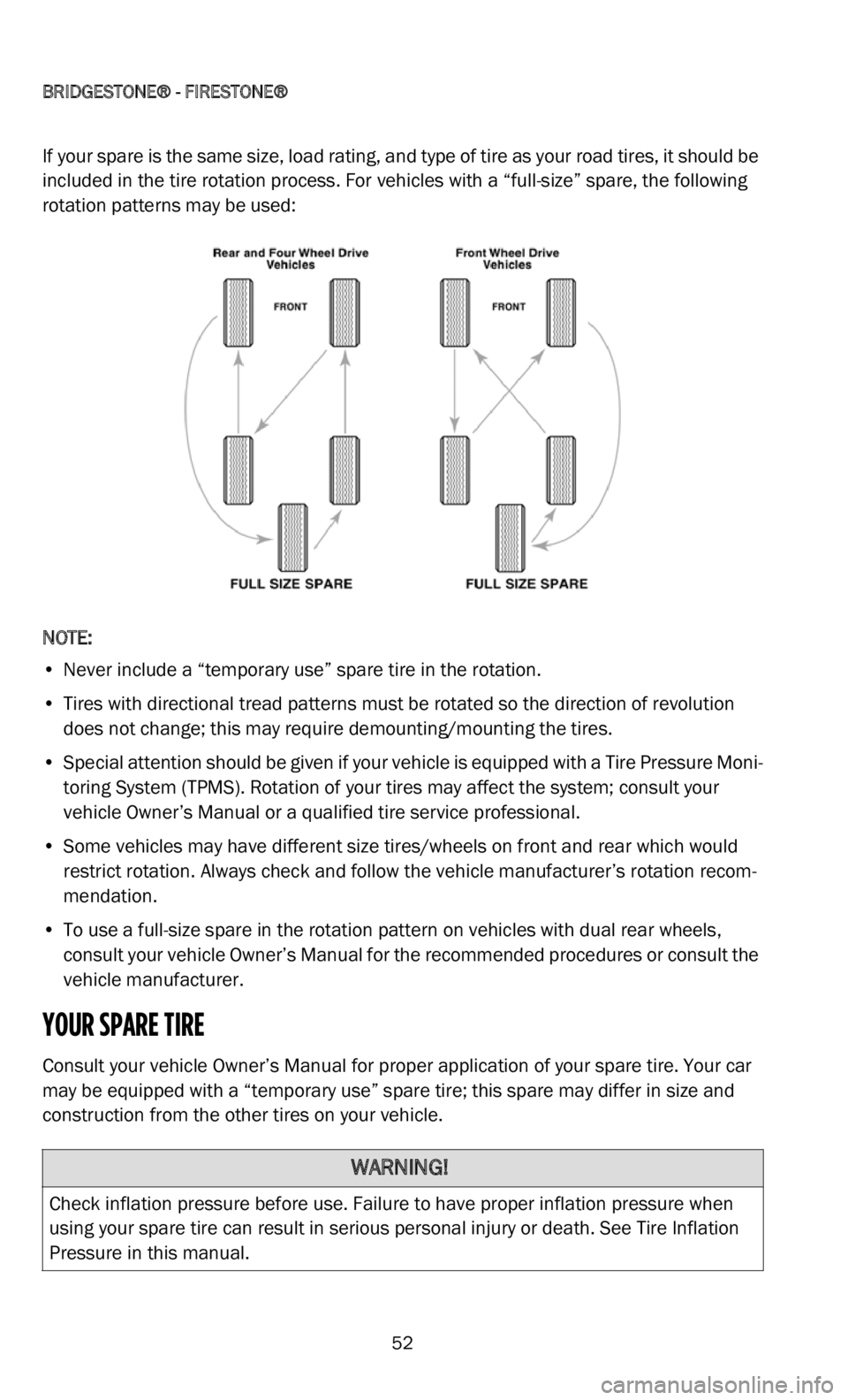
If your spare is the same size, load rating, and type of tire as your road tires, it should be
included in the tire rotation process. For vehicles with a “full-size” spare, the following
rotation patterns may be used:
NOTE:
• Never include a “temporary use” spare tire in the rotation.
•
Tires with directional tread patterns must be rotated so the direction of revolution
d
oes not change; this may require demounting/mounting the tires.
• S pecial attention should be given if your vehicle is equipped with a Tire Pressure Moni -
t
oring System (TPMS). Rotation of your tires may affect the system; consult your
v e
hicle Owner’s Manual or a qualified tire service professional.
• S ome vehicles may have different size tires/wheels on front and rear which would
r
estrict rotation. Always check and follow the vehicle manufacturer’s rotation recom -
mendation.
• T o use a full-size spare in the rotation pattern on vehicles with dual rear wheels,
c
onsult your vehicle Owner’s Manual for the recommended procedures or consult the
vehicle manufacturer.
YOUR SPARE TIRE
Consult your vehicle Owner’s Manual for proper application of your spare tire. Your car
may be equipped with a “temporary use” spare tire; this spare may differ in size and
construction from the other tires on your vehicle.
WARNING!
Check inflation pressure before use. Failure to have proper inflation pressure when
using your spare tire can result in serious personal injury or death. See Tire Inflation
Pressure in this manual.
Page 54 of 200
BRIDGESTONE® - FIRESTONE®
53
The spare tire in your vehicle is intended to be used as a spare when needed. The spare
tire carrier is not intended to be used for long term storage, except for “temporary use”
tires. If your spare is the same size, load rating, and type of tire as your road tires, it
should be included in the tire rotation process; see “Radial Tire Rotation” in this manual
for more information.
The spare should be included in regular tire inspections and inflation pressure checks.
In
addition, it should be replaced 10 years after date of manufacture, regardless of
condition or tread depth. For more information, see the “Tire Damage, Inspection and
Service Life” in this manual.
TIRE STORAGE
Tires should be stored indoors in a cool, dry place where water cannot collect inside
them. Tires should be placed away from electric generators/motors and sources of heat
such as hot pipes. Storage surfaces should be clean and free of grease, gasoline or other
substances which can deteriorate the rubber.
The spare tire in your vehicle is intended to be used as a spare when needed. The spare
t i
re carrier is not intended to be used for long term storage, except for “temporary use”
tires. For more information, see “Your Spare Tire” and “Radial Tire Rotation” in this
manual.
TIRE SERVICE CUSTOMER SATISFACTION
Normal tire maintenance and Limited Warranty services are available at locations across
the US and Canada. For more information, visit us on the internet at
www.bridgestonetire.com , or please call the Technical Service Department:
US: 8 00-356-4644 or Canada: 800-267-1318.
A
dditional information on the care and service of automobile and light truck tires is
a v
ailable from the following organizations:
U.S. Tire Manufacturers Association 1400 K Street, N.W. Washington, DC 20005-2403
https://www.ustires.org/
Rubber Association of Canada 2000 Argentia Road, Plaza 4, Suite 250 Mississauga,
O n
tario L5N 1W1 https://www.tracanada.ca/
WARNING!
Mounting a “temporary use” tire on a wheel which is not specifically designed for it, or
placing another type tire on a wheel designated for temporary use, can be dangerous.
Your vehicle’s handling characteristics can be seriously affected. You could have an
accident resulting in serious personal injury or death. Consult your vehicle owner’s
manual for proper application of your “temporary use” spare tire.
WARNING!
Improper storage can damage your tires in ways that may not be visible and can lead
to a failure resulting in serious personal injury or death.
Page 56 of 200

BRIDGESTONE® - FIRESTONE®
55
The vehicle or TPMS manufacturer may advise checking the TPMS regularly to confirm it
is in working order. In addition, a new pressure sensor, certain components, or
reprogramming may be necessary when a tire is serviced. Consult your vehicle Owner’s
Manual, vehicle manufacturer, or a Bridgestone® Firestone® Run-Flat Certified Retailer
for questions regarding TPMS operation and service.
RUN-FLAT OR LOW TIRE PRESSURE OPERATION
General Instructions
The Tire Pressure Monitoring System (TPMS) required in your vehicle may have different
m e
thods of alerting you when your tire has lost inflation pressure. The international
standard for the definition of run-flat operation is pressure at or below 10 psi (70 kPa);
however, some vehicle manufacturers may have established a different pressure limit.
Consult your vehicle Owner’s Manual for the details of your TPMS. Once the TPMS has
indicated that a tire has reduced inflation pressure, the run-flat mode of operation has
commenced. During this phase of operation, please follow these instructions:
• Reduce speed as much as safely and reasonably possible; do not exceed 50 m
ph
(8
0 km/h). The greater the speed, the less distance the tire can travel.
• Avoid abrupt or aggressive acceleration, braking, or cornering maneuvers as much as
s
afely and reasonably possible. Pot holes and other road hazards should be avoided.
Careful driving limits potential damage to the tire, wheel, and vehicle.
• Proceed to a safe and convenient location for tire service as soon as possible.
Take
note of your mileage; your operation distance is limited. See "Distance—How Far You
Can Drive,” the next section in this manual.
• If an unusual vibration or vehicle handling difficulty arises, stop driving as soon as
s
afely and reasonably possible. The tire may be about to suddenly fail. Release the
accelerator and gradually reduce speed. The tire will need to be replaced before
proceeding.
• If towing a trailer, stop driving as soon as safely and reasonably possible. In this condi -
t
ion, it is potentially dangerous to operate a vehicle/trailer combination. I
f possible,
disconnect the trailer and proceed as noted above. Do not continue to tow any trailer
until proper tire service or replacement has been performed.
• Do not touch a tire recently run-low or run-flat (it may be very hot).
Allow the tire to cool
before handling.
WARNING!
Serious personal injury or death may result from a tire failure or accident due to
improper run-flat or low tire pressure operation. Read and follow the instructions
below, and the other maintenance and safety recommendations elsewhere in this
manual.
Page 57 of 200

BRIDGESTONE® - FIRESTONE®
56
DISTANCE—HOW FAR YOU CAN DRIVE
Factors affecting run-flat or low tire pressure operating distance include vehicle speed,
load, and maneuvering; the amount of inflation pressure loss; the extent of any tire
damage; and ambient temperature.
The tire may be marked on the sidewall with run-flat or low tire pressure operating speed
an
d/or distance limitations, which vary by tire design and vehicle application (consult
your vehicle owner’s manual). By international standard, RFT tires have a baseline
limitation in run-flat mode of the following:
NOTE:
• M aximum distance values are determined under controlled conditions, which may
v
ary in actual use.
• Y our mileage capability may be less, or more, depending on your specific operating
c
onditions.
• I f in doubt, do not exceed the 50
mile (80 km) limitation.
• S eek tire service as soon as possible to minimize tire damage.
SPECIAL SERVICE AND REPAIR ISSUES
Run-Flat Certified Retailers
Because of the advanced technology and design of Run-Flat tires and the required Tire
Pr
essure Monitoring Systems (TPMS), Bridgestone® Firestone® Run-Flat Certified
Retailers are specially trained to sell and service RFT tires.
Run-Flat Certified Retailers have the necessary equipment and are specially trained to
p r
operly mount and demount RFT tires and to handle TPMS devices. Conventional
mounting equipment may irreparably damage RFT tires and an improper repair is unsafe
and will void the Limited Warranty. Accordingly, it is important to go to a Bridgestone®
Firestone® Run-Flat Certified Retailer for tire maintenance and replacement.
Call toll-free 1-877-BFS-4RFT or, 87
7-237-4738 or visit www.bridgestonetire.com to
locate the nearest Bridgestone® Firestone® Run-Flat Certified Retailer.
Inspection after Run-Flat or Low Pressure Operation
Following run-flat or low tire pressure operation, or in the event of any other tire damage
or
unusual condition, it is very important to obtain a proper and complete tire evaluation
as soon as possible.
Rotation
Follow the vehicle manufacturer’s recommendations, or rotate every 5,000 miles per the
r e
commendations in this manual (see “Radial Tire Rotation”). In some cases, TPMS
devices require reprogramming with each tire rotation. Maximum Speed:
50 mph (80 km/h)
Maximum Distance: 50 miles (80 km)
Page 60 of 200

BRIDGESTONE® - FIRESTONE®
59
DOT Symbol and Tire Identification Number: The “DOT” symbol constitutes a certification
that the tire conforms to applicable US Department of Transportation (DOT) motor
vehicle safety standards (for tires). Following the “DOT” symbol is the tire identification
number, also known as the DOT serial number or code. For example:
The DOT symbol and tire identification number can be found on at least one sidewall near
th
e wheel. The other sidewall may have a partial serial code that excludes (e) and (f)
above.
Maximum Load and Inflation: T
he maximum load and maximum inflation pressure is
marked on each sidewall in metric and English units. For example:
MAX LOAD 685 kg (1,510 lbs) AT 240 kPa (35 psi) MAX PRESS
NOTE:
The load and inflation values marked on the tire sidewall are maximum permissible
v a
lues for the tire only. Never assume that these values are the actual maximum load
capacity or recommended tire pressure values for your vehicle. See “Tire Inflation Pres -
sure,” “Tips for Safe Tire Inflation,” and “Tips for Safe Loading” in this manual.
Ply Composition and Materials: T
he actual number of plies in the sidewall and tread area
and the generic name(s) of their cord material(s) are marked on at least one sidewall. For
example:
• T READ 2 PLY POLYESTER + 2 STEEL
•
SIDEWALL 2 PLY POLYESTER
R
adial: Radial ply tires will have the word "radial" on at least one sidewall. An “R” in the
t
ire size designation also indicates radial ply construction.
Tubeless or Tube Type: T
ires are marked as either “tubeless” or “tube type,” whichever
is applicable, on at least one sidewall.
(a) DOT Symbol (d) Tire Manufacturer’s Code
(b) Manufacture Plant Code (e) Week of Production (01-52)
(c) Tire Size Code (f) Year of Production (last two digits of year)
* For tires produced from 2000-on. In the example above, the tire was produced in the 18th week of
2000. For tires produced prior to 2000, there is one digit in group (f) which identifies the last digit of the
year of production, i.e. “329” would likely signify the 32nd week of 1999, but could possibly signify the
32nd week of 1989. If in doubt, consult a qualified tire service professional.
Page 61 of 200

BRIDGESTONE® - FIRESTONE®
60
UNIFORM TIRE QUALITY GRADING
The Uniform Tire Quality Grading (“UTQG”) standards are intended to assist you in
making an informed choice in your purchase of passenger car tires by providing
information indicating relative performance of these tires in the areas of tread wear, wet
braking traction (straight-ahead), and temperature resistance. All passenger car tires
must conform to federal safety requirements in addition to these grades.
Treadwear
The treadwear grade is a comparative rating based on the wear rate of the tire when
te
sted under controlled conditions on a specified government test course. For example,
a tire graded 150 would wear one and one half (1 1/2) times as well on the government
course as a tire graded 100. The relative performance of tires depends upon the actual
conditions of their use, however, and may depart significantly from the norm due to
variation in driving habits, service practices and differences in road characteristics and
climate.
Traction
The traction grades, from highest to lowest, are AA, A, B, and C. Those grades represent
t h
e tire’s ability to stop on wet pavement as measured under controlled conditions on
specified government test surfaces of asphalt and concrete.
NOTE:
The traction grade assigned to a tire is based on straight-ahead braking traction tests,
an
d does not include acceleration, cornering, hydroplaning, or peak traction characteris -
tics.
Temperature
The temperature grades are A (the highest), B, and C, representing the tire’s resistance
t o
the generation of heat and its ability to dissipate heat when tested under controlled
conditions on a specified indoor laboratory test wheel. Sustained high temperature can
cause the material of the tire to degenerate and reduce tire life, and excessive
temperature can lead to sudden tire failure. The grade C corresponds to a level of
performance which all passenger car tires must meet under the Federal Motor Vehicle
Safety Standard No. 109. Grades B and A represent higher levels of performance on the
laboratory test wheel than the minimum required by law.
WARNING!
The temperature grade is established for a tire that is properly inflated and not
overloaded. Excessive speed, underinflation, or excessive loading, either separately or
in combination, can cause heat buildup and a possible tire failure.
Page 62 of 200

BRIDGESTONE® - FIRESTONE®
61
LIMITED WARRANTY
ORIGINAL EQUIPMENT
PASSENGER AND LIGHT TRUCK TIRES
Including Tires with Run-Flat Technology
ELIGIBILITY
This Limited Warranty covers Bridgestone® and Firestone® brand passenger and light
t r
uck tires, including RFT and temporary spare tires, originally installed by the vehicle
manufacturer on a new vehicle. You are covered under the terms of this Limited Warranty
if the tire was produced after July 4, 2004 (DOT serial 2704 or later) and has been used
only on the vehicle on which it was originally installed in non-commercial service.
WHAT IS WARRANTED AND FOR HOW LONG
Before wearing down to 2/32 of an inch (1.6 mm) remaining original tread depth (i.e.
w o
rn down to the top of the built-in indicators in the tread grooves) and within 6 years
from the date of purchase (proof of purchase date required; without proof of purchase
date, then within 6 years from the date of tire manufacture), for any reason other than
those excluded in the section entitled “What This Limited Warranty Does Not Cover,” any
eligible tire that becomes unusable for any reason within the manufacturer’s control will
be replaced with an equivalent new tire on the basis set forth in this Limited Warranty.
WHAT THIS LIMITED WARRANTY DOES NOT COVER
This Limited Warranty does not cover the following:
1. T ire damage or irregular wear due to:
• Road hazards,
including, without limitation: Puncture, cut, impact break, stone
drill, bruise, bulge, snag, etc.
• Improper use or operation,
including, without limitation: Improper inflation pres -
sure, overloading, tire/wheel spinning, use of an improper wheel, tire chain
d a
mage, misuse, misapplication, negligence, tire alteration, or for racing or
competition purposes.
• Insufficient or improper maintenance,
including, without limitation: Failure to
rotate tires as recommended in this manual, wheel misalignment, worn suspen -