tire type DODGE DURANGO 2022 Vehicle Warranty
[x] Cancel search | Manufacturer: DODGE, Model Year: 2022, Model line: DURANGO, Model: DODGE DURANGO 2022Pages: 200, PDF Size: 6.72 MB
Page 132 of 200

MICHELIN®
131
misalignment of your vehicle. When driving on such roads, drive carefully and slowly, and
before driving again at normal or highway speeds, examine your tires for any damage,
such as cuts, bulges, penetrations, unusual wear patterns, etc.
WEAR-BARS
Michelin® tires contain “Wear-Bars” in the grooves of the tire tread which show up when
o n
ly 2/32 of an inch (1.6 mm) of tread is remaining. At this stage, your tires must be
r e
placed. Tires worn beyond this stage are extremely dangerous.
DO NOT OVERLOAD - DRIVING ON ANY OVERLOADED TIRE IS DANGEROUS
The maximum load rating of your tires is molded on the tire sidewall. Do not exceed this
rating. Follow the loading instructions of FCA US LLC for your vehicle and this will ensure
that your tires are not overloaded. Tires which are loaded beyond their maximum
allowable loads for the particular application will build up excessive heat that may result
in sudden tire destruction.
Do not exceed the gross axle weight rating for any axle on your vehicle.
TRAILER TOWING
If you anticipate towing a trailer, you should visit any Michelin® tire retailer for advice
c o
ncerning the correct size tire and pressures. Tire size and pressures will depend upon
the type and size of trailer and hitch utilized, but in no case must the maximum cold
inflation pressure or tire load rating be exceeded. Check the tire decal and the owner’s
manual supplied by FCA US LLC for your vehicle for further recommendations on trailer
towing.
MICHELIN® PAX® System Tires/Self-Supporting Zero Pressure (ZP) Tires and Trailer
T o
wing
Operation of Pax® or ZP tires at low or zero air pressure with a trailer in tow, is dangerous
a n
d is not recommended. If the low pressure warning indicator is activated when a trailer
is in tow, stop, disconnect the trailer, and do not continue to tow the trailer until the tire
has been repaired and re-inflated to the proper air pressure. If the tire cannot be
repaired, it must be replaced with a new full size, PAX®/ZP tire, and inflated to the proper
air pressure, before the trailer can be safely towed again.
WHEEL ALIGNMENT AND BALANCING ARE IMPORTANT FOR SAFETY AND MAXIMUM
M I
LEAGE FROM YOUR TIRES.
CHECK HOW YOUR TIRES ARE WEARING AT LEAST ONCE EACH MONTH
If your tires are wearing unevenly, such as the inside shoulder of the tire wearing faster
th
an the rest of the tread, or if you detect excessive vibration, your vehicle may be out of
alignment or balance. These conditions not only shorten the life of your tires but
adversely affect the handling characteristics of your vehicle, which could be dangerous.
If you detect irregular wear or vibration, have your alignment and balance checked
immediately. Tires which have been ran underinflated will show more wear on the
shoulders than in the center of the tread.
Page 133 of 200

MICHELIN®
132
TIRE MIXING
Michelin® tires are radial tires and for best performance it is recommended that the
same size and type of tire be used on all four wheel positions. Before mixing tires of
different types in any configuration on any vehicle, be sure to check the vehicle
manufacturer’s owner‘s manual for its recommendations.
It is especially important to check the vehicle manufacturer’s Owner’s Manual when
mi
xing, matching, or replacing tires on 4-wheel drive vehicles, as this may require special
precautions.
MICHELIN® DOES NOT RECOMMEND MIXING PAX® SYSTEM TIRES WITH NON-PAX®
T I
RES/SELF-SUPPORTING ZERO PRESSURE (ZP) TIRES WITH NON-ZP TIRES OTHER THAN
THE TEMPORARY USE OF THE SPARE IF THE VEHICLE IS SO EQUIPPED.
WINTER DRIVING
Tires which meet the US Tire Manufacturers Association (USMTA) definition of snow tires
are marked M/S, or M&S. On such tires, this designation is molded into the sidewall.
Tires without this notation are not recommended or Winter driving.
While All-Season tires are designed to provide reliable performance in some
Winter conditions, the use of four Winter tires is recommended for optimal
p e
rformance. Tires designate for use in severe Winter conditions are marked
on at least one sidewall with the letter “M”.
TIRE ROTATION AND REPLACEMENT
To obtain maximum tire wear, it may be necessary to rotate your tires. Refer to your
vehicle owner’s manual for instructions on tire rotation. If you do not have an owner‘s
manual for your vehicle, Michelin® recommends rotating your tires every 6,000 to
8,000 miles (10,000 to 12,000 km).
Monthly inspection for tire wear is recommended. Your tires should be rotated at the first
s i
gn of irregular wear, even if it occurs before 6,000 miles (10,000 km). This is true for
a l
l vehicles.
When rotating tires with a directional tread pattern, observe the arrows molded on the
s i
dewall which show the direction the tire should turn. Care must be taken to maintain
the proper turning direction.
Some Tire Pressure Monitoring Systems (TPMS) may not recognize that a tire has been
m o
ved to a different position on your vehicle. Make certain that your TPMS system is
reset, if necessary, so as to correctly identify the location of each tire on your vehicle.
Refer to your vehicle owner’s manual or your vehicle dealer.
Determine whether rotated tires require tire inflation adjustment as front and rear
p o
sition tire pressure may vary according to the vehicle manufacturer’s specification due
to the actual load on that wheel position. Some vehicles may have different sized tires
mounted on the front and rear axles, and these different sized tires have rotation
restrictions. Always check the vehicle owner’s manual for the proper rotation
recommendations.
Page 134 of 200

MICHELIN®
133
Full-size Spare
Full-size spare tires (not temporary spares) of the same size and construction should be
u s
ed in a five tire rotation. Always check the inflation pressure of the full-size spare
immediately before incorporating it into rotation. Follow the vehicle manufacturer’s
recommended pattern for rotation, or if not available, see a qualified tire technician.
Replacement of Two Tires
It is recommended that all four tires are replaced at the same time. However, when only
t w
o tires are replaced, the new tires should be put on the rear. The new tires, with deeper
tread, may provide better grip and water evacuation in wet driving conditions.
CUSTOMIZATION OF TIRES, WHEELS, OR SUSPENSION ON SUVS AND LIGHT
TRUCKS
Due to their size, weight and higher center of gravity, vehicles such as SUVs and light
trucks do not have the same handling characteristics as automobiles. Because of these
differing characteristics, failure to operate your SUV/truck in a proper and safe manner
can increase the likelihood of vehicle rollover. Modifications to your SUV/truck tire size,
tire type, wheels or suspension can change its handling characteristics and further
increase the likelihood of vehicle rollover. Whether your SUV/truck has the original
equipment configuration for tires, wheels and suspension or whether any of these items
have been modified, always drive safely, avoid sudden, sharp turns or lane changes and
obey all traffic laws. Failure to do so may result in loss of vehicle control leading to an
accident and serious injury or death.
TIRE ALTERATIONS
Do not make or allow to be made any alterations on your tires. Alterations may prevent
proper performance, leading to tire damage which can result in an accident. Tires which
become unserviceable due to alterations such as truing, whitewall inlays, addition of
balancing or sealant liquids, or the use of tire dressing containing petroleum distillates
are excluded from warranty coverage.
REPAIRS WHEREVER POSSIBLE, SEE YOUR MICHELIN® TIRE RETAILER AT ONCE
If any MICHELIN® tire sustains a puncture, have the tire demounted and thoroughly
inspected by any MICHELIN® tire retailer for possible damage that may have occurred.
A tread area puncture in any MICHELIN® passenger or light truck tire can be repaired
provided that the puncture hole is not more than 1/4 inch in diameter, not more than
o n
e radial cable per casing ply is damaged, and the tire has not been damaged further
by the puncturing object or by running underinflated. Tire punctures consistent with
these guidelines can be repaired by following the US Tire Manufacturers Association
(USTMA) recommended repair procedures.
TIRE REPAIRS
Repairs of all tires must be of the combined plug and inside patch type. Your MICHELIN®
PAX® System tires must be removed from the wheel for inspection prior to repair. Plug
only repairs are improper. A tire should be removed from the rim and inspected prior to
Page 135 of 200

MICHELIN®
134
repair. Any tire repair done without removing the tire from the rim is improper. An
improperly repaired tire will cause further damage to the tire by either leaking air or
allowing air, moisture and contaminants to enter the structure of the tire. An improperly
repaired tire can fail suddenly at a later date.
Never repair a tire with less than 2/32nds of an inch tread remaining. At this tread depth,
th
e tire is worn out and must be replaced.
STORAGE
Tires contain waxes and emollients to protect their outer surfaces from ozone and
weather checking. As the tire rolls and flexes, the waxes and emollients continually
migrate to the surface, replenishing this protection throughout the normal use of the tire.
Consequently, when tires sit outdoors, unused for long periods of time (a month or more)
their surfaces become dry and more susceptible to ozone and weather checking and the
casing becomes susceptible to flat spotting. For this reason, tires should always be
stored in a cool, dry, clean, indoor environment. If storage is for one month or more,
eliminate the weight from the tires by raising the vehicle or by removing the tires from
the vehicle. Failure to store tires in accordance with these instructions could result in
damage to your tires or premature aging of the tires and sudden tire failure.
When tires are stored, be sure they are placed away from sources of heat and ozone such
a s
hot pipes and electric generators. Be sure that surfaces on which tires are stored are
clean and free from grease, gasoline or other substances which could deteriorate the
rubber. Tires exposed to these materials during storage or driving could be subject to
sudden failure.
FOLLOW THESE MOUNTING RECOMMENDATIONS
Tire changing can be dangerous and must be done by professionally trained persons
using proper tools and procedures as specified by the Rubber Manufacturers
Association (RMA). PAX® System tires must be mounted and dismounted only by
specially trained, authorized PAX® System retailers, utilizing PAX® System authorized
equipment.
Your tires should be mounted on wheels of correct size and type and which are in good,
cle
an condition. Wheels that are bent, chipped, rusted (steel wheels) or corroded (alloy
wheels) may cause tire damage. The inside of the tire must be free from foreign material.
Have your retailer check the wheels before mounting new tires. Mismatched tires and
rims can explode during mounting. Also, mismatched tires and rims can result in
dangerous tire failure on the road. If a tire is mounted by error on the wrong-sized rim, do
not remount it on the proper rim, scrap it. It may have been damaged internally (which is
not externally visible) by having been dangerously stretched and could fail on the
highway.
Old valves may leak. When new tubeless tires are mounted, have new valves of the
c o
rrect type installed. Tubeless tires must only be mounted on wheels designed for
tubeless tires i.e., wheels which have safety humps or ledges. As with any other tire air
valve, the PAX® System valve stem-pressure sensor combination must be in good
Page 136 of 200

MICHELIN®
135
condition to assure its performance. Always utilize valve caps capable of containing the
tire’s air pressure, should the valve core leak. The valve cap is the primary seal against
air loss.
It is recommended that you have your tires and wheels balanced. Tires and wheels which
a r
e not balanced may cause steering difficulties, a bumpy ride, and irregular tire wear.
SPECIAL MOUNTING INSTRUCTIONS FOR PAX® SYSTEM TIRES
PAX® System wheels are different from all other wheels. Never attempt to mount a
non-PAX® System tire on a PAX® System wheel, or a PAX® System tire on a non-PAX®
System wheel. Attempting to do so could cause serious injury or death. All PAX® System
components (tire, wheel, support ring, pressure sensor and gel) must be utilized. Never
utilize a PAX® System tire and wheel without every other properly functioning component
part, correctly installed by an Authorized PAX® System retailer. The PAX® System must
be used on all wheel positions.
After a low or zero pressure driving event, the PAX® System tire and wheel may be hot to
th
e touch. Always allow a PAX® System tire to cool before attempting to handle it. Failure
to do so could result in injury.
SPECIAL MOUNTING INSTRUCTIONS FOR SELF-SUPPORTING ZERO PRESSURE™ (ZP)
T I
RES
ZP tires can be more difficult to mount than conventional tires. They should be mounted
a n
d demounted only by a properly trained tire professional. ZP tires can generate a
tremendous amount of heat when run at low or zero pressure. ALWAYS ALLOW A ZP TIRE
TO COOL BEFORE ATTEMPTING TO HANDLE IT. FAILURE TO DO SO COULD RESULT IN
INJURY.
MICHELIN® ZP tires are tubeless tires designed to operate in emergency conditions at
lo
w or zero air pressure.
MICHELIN® SELF SUPPORTING Zero Pressure™ (ZP) TIRES AND SPECIAL SYMMETRIC
H U
MP-MODIFIED (SH-M) WHEELS
Some MICHELIN® ZP tires can only perform with zero pressure capability when mounted
o n
special SH-M wheels. These tires bear the SH-M designation immediately following
the ZP designation on the sidewall of the tire. DO NOT MOUNT ZP TIRES WITH THE SH-M
DESIGNATION ON STANDARD WHEELS. IN SUCH APPLICATIONS, THE TIRES MAY
BECOME UNSERVICEABLE AT LOW OR ZERO PRESSURE, CAUSING SERIOUS PERSONAL
INJURY OR DEATH.
SPECIAL MOUNTING INSTRUCTIONS FOR MICHELIN® TRX™ TIRES
The MICHELIN® TRX™ tire is a tubeless tire that must only be mounted on special wheels
( T
R or JM type) with millimetric seat diameter. If TRX tires are mounted on standard
wheels, they will not retain air due to an air escape feature designed into the bead area
of these tires.
Do not try to override this feature by mounting TRX tires with tubes. The MICHELIN®
T R
X™ tire must be used on all wheel positions.
Page 137 of 200

MICHELIN®
136
TEMPORARY TYPE SPARE TIRES
When using any temporary type spare tire, be sure to follow the vehicle manufacturer’s
in
structions.
READING THE DOT
DOT XXXX XXXX XXX (prior to August 2000)
DOT XXXX XXXX XXX (1990-1999)
DOT XXXX XXXX XXXX (after July 2000)
THE DOT
The “DOT” symbol certifies tire manufacturer’s compliance with US Department of
Transportation tire safety standards. Next to the symbol is the tire identification or “serial
number”. The first two characters identify the plant where the tire was manufactured.
The next two characters reflect the tire size. The following one to four digits may be used
at the tire manufacturer’s option as a descriptive code. The last three characters are
numbers identifying the week and year of manufacture. (Example: “O25” means second
week of the year of decade, eg.: 1995, 1985, etc.) For the 1990-1999 decade
MICHELIN® brand tires are marked with a triangle pointing to the last three numeric
characters. Tires produced after July 2000 have an additional digit to identify a given
decade. For example, 2800 means the tire was produced during the 28th week of 2000;
0 2
01 during the 2nd week of 2001. If the last digits of your DOT number contains three
numeric characters and is not marked with a triangle, consult a qualified tire technician
to determine the year of manufacture.
SERVICE LIFE FOR PASSENGER CAR AND LIGHT TRUCK TIRES INCLUDING SPARE
TIRES
The following recommendation applies to passenger car and light truck tires. Tires are
composed of various types of material and rubber compounds, having performance
properties essential to the proper functioning of the tire itself. These component
properties evolve over time. For each tire, this evolution depends upon many factors
such as weather, storage conditions, and conditions of use (load, speed, inflation
pressure, maintenance etc.) to which the tire is subjected throughout its life. This
service-related evolution varies widely so that accurately predicting the serviceable life
of any specific tire in advance is not possible.
That is why, in addition to regular inspections and inflation pressure maintenance by
c o
nsumers, it is recommended to have passenger car and light truck tires, including
spare tires, inspected regularly by a qualified tire specialist, such as a tire dealer, who
will assess the tire’s suitability for continued service. Tires which have been in use for five
years or more should continue to be inspected by a specialist at least annually.
Consumers are strongly encouraged to be aware not only of their tires’ visual condition
and inflation pressure but also of any change in dynamic performance such as increased
air loss, noise or vibration, which could be an indication that the tires need to be removed
from service to prevent tire failure. It is impossible to predict when tires should be
Page 142 of 200

NEXEN TIRE
141
MILEAGE TREAD WEAR LIMITED WARRANTY
Most patterns manufactured by Nexen Tire are assigned a mileage warranty that
protects the consumer against premature tread wear. If a tire reaches the end of its
“usable tread life” before the stated mileage warranty, the consumer will be issued a
replacement Nexen Tire on a pro rata basis, which means the consumer will be
responsible for a percentage of the replacement cost. In order to maintain tread wear
warranty, all tires must be rotated at least every 5,000-6,000 miles (8,000-10,000 km).
U n
der all circumstances, the cost of mounting, balancing and any other service charges
including applicable taxes are required to be paid by the consumer.
WHAT IS NOT COVERED UNDER THIS LIMITED WARRANTY
• Ride complaints after the first 2/32 of an inch of tread wear or replacement of three or more tires from the same vehicle will not be accepted.
• R oad hazard damage such as cuts, snags, punctures or tire repair, bruises, impact
b
reaks, etc. Check Road Hazard Replacement Program for patterns that are covered
against this type of damage.
• P remature or irregular wear due to vehicle mechanical deficiencies or failure to rotate
t
he tires at recommended intervals.
• T ires on any vehicle registered and normally operated outside the United States.
•
Damage from incorrect mounting or dismounting of the tire, incorrect application,
w
ater or other material trapped inside the tire during mounting or failure to balance
the tires.
• D amage from overinflation or underinflation, overloading, fire, theft, and defective
v
ehicle mechanical conditions.
• R acing, off road use and misapplications of tire to vehicle.
•
Ozone or weather cracking on tires after 48
months from the date of manufacture or
ot
her abuse, misuse, tire alteration, run flat.
• A ny tires worn beyond the wear indicators. Less than 2/32 of an inch remaining tread
d
epth.
• F lat spotting caused by improper storage or brake lock.
•
Accident, fire, chemical corrosion, tire alteration or vandalism.
•
Tire which DOT identification number and/or brand name removed intentionally.
•
Loss of time or use, inconvenience or any incidental or consequential damage.
•
Original equipment tires on new vehicle. See separate warranty, if applicable, in your
v
ehicle’s glove box.
• T ires purchased as used.
•
Tires used on Recreational Vehicles (For camping & Motor homes, etc.) or in commer -
c
ial service.
Page 158 of 200
PIRELLI TIRES
157
identified with a pictograph of a mountain with a snowflake on the sidewalls and must
meet specific snow performance test requirements. Pirelli Winter tires do not carry a
mileage warranty.
The information provided above is an overview of tire types. Tread patterns and rubber
c o
mpounds vary among the seasonal tire types and provide varying performance
characteristics and limitations based on your individual needs and vehicle specifications.
Summer performance tires are different than winter and all season types. To determine
which Pirelli lines carry a Limited Treadwear Warranty, please refer to The PTI Treadwear
Mileage Warranty Conditions and Mileage Warranty sections found in this document.
3. Pressure Recommendations
Recommended tire inflation pressures for your vehicle can be found either on your
vehicle’s tire placard or in your vehicle owner’s manual. Correct pressures are related to
load, speed and vehicle handling and are vital for even braking, maximum traction and
good tire life. Under no circumstances should your tire’s cold inflation pressure be less
than that indicated on your vehicle’s tire placard or in your vehicle owner’s manual or
higher than the maximum cold inflation pressure molded on to the tire’s sidewall.
Underinflation causes excessive flexing, deterioration of the tire and rapid wear of the
tread edges. Overinflation results in an uncomfortable ride, a reduced area of tire contact
with the road surface (i.e., smaller tire footprint), higher susceptibility to impact damage
and rapid wear on the tread center.
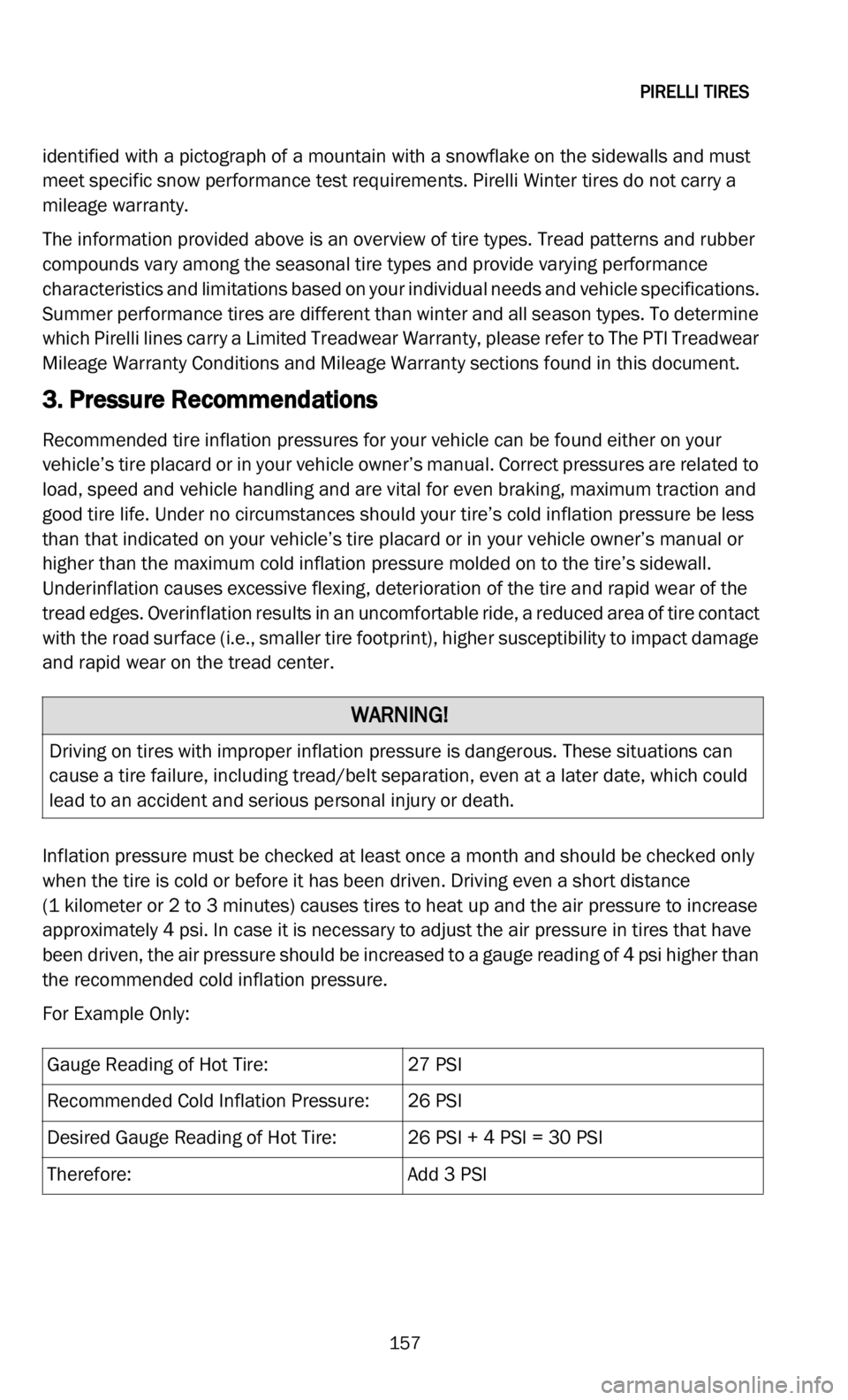
Inflation pressure must be checked at least once a month and should be checked only
w h
en the tire is cold or before it has been driven. Driving even a short distance
(1 kilometer or 2 to 3 minutes) causes tires to heat up and the air pressure to increase
a p
proximately 4 psi. In case it is necessary to adjust the air pressure in tires that have
been driven, the air pressure should be increased to a gauge reading of 4 psi higher than
the recommended cold inflation pressure.
For Example Only:
WARNING!
Driving on tires with improper inflation pressure is dangerous. These situations can
cause a tire failure, including tread/belt separation, even at a later date, which could
lead to an accident and serious personal injury or death.
Gauge Reading of Hot Tire: 27 PSI
Recommended Cold Inflation Pressure: 26 PSI
Desired Gauge Reading of Hot Tire: 26 PSI + 4 PSI = 30 PSI
Therefore: Add 3 PSI
Page 160 of 200

PIRELLI TIRES
159
8. Tire Replacement
The tires fitted to your vehicle as original equipment were tested and approved by the
vehicle manufacturer and the tire manufacturer and take into account all aspects of the
vehicle’s operation. Changes in the tire size, type or construction should not be made
without seeking advice from the vehicle or tire manufacturer or an authorized Pirelli
dealer since unapproved tires on your vehicle could adversely affect steering, handling,
braking and traction. The tire information (tire size, load index and speed symbol) as
found on the vehicle placard or in the owner’s manual should always be followed when
replacing tires.
It is strongly recommended that Pirelli tires be mounted in sets of four with the same
t r
ead type. Pirelli tires should not be mixed with other tire brands. It is necessary to follow
this procedure because different tire constructions have different handling
characteristics. Tires on the same axle must be the same manufacturer, brand, tire size,
load index, speed rating and Pirelli part number.
When changing only two tires on a vehicle which is homogeneously fitted (four tires of the
sa
me tire size), fit the new tires on the rear axle. This applies to all vehicles regardless of
their drive axle. (Front or Rear Drive).
On all wheel drive or four wheel drive vehicles the tires must always be replaced in sets
o f
four.
When replacing tires on light truck vehicles, you should always follow the vehicle
m a
nufacturer’s recommendations. Passenger and light truck tires are not
interchangeable, due to differences in their pressures and load carrying capacity.
P-Metric and Euro-metric Interchangeability: Euro-metric (Example: 225/45R17) tires
h a
ve a load index which is equal to or greater than that of the same size P-metric
(Example: P225/45R17) tire. Therefore, they have the same or higher load carrying
capacity at the maximum rated inflation pressure. Always check with your tire dealer or
Pirelli Tire Consumer Affairs to be sure of the exact interchangeability to maintain proper
vehicle dynamics.
Please be aware that it is important that, before fitting the suggested tires, the fitment is
a l
lowed by the technical specifications of the vehicle, the vehicle manufacturer and the
relevant homologations. Pirelli Tire does not express any view as to the compatibility of
the wheel/tire combination with the technical specifications for the chassis and vehicle.
TO MAINTAIN PROPER VEHICLE DYNAMICS AND LOAD CARRYING CAPACITY,
R E
PLACEMENT TIRES MUST ALWAYS HAVE A LOAD INDEX AND SPEED SYMBOL EQUAL
TO OR GREATER THAN THOSE FITTED AS ORIGINAL EQUIPMENT.
When making plus size fitments, you should consult with the dealer regarding any
s u
spension or braking system modifications which may be recommended for the vehicle.
9. Tire Inspection
As a minimum, tires (including the spare tire) should be examined and air pressure
checked monthly and always prior to long trips. They should also be examined if you
strike any unusual object on the road. Tires showing bulges, cracks, cuts, penetrations
or uneven wear must be dismounted and examined by an authorized Pirelli tire dealer
Page 161 of 200
PIRELLI TIRES
160
and replaced if necessary. Pirelli tires have treadwear indicators in the tread grooves,
which show up when the tread has worn to 2/32 of an inch remaining. At this point, your
tires must be replaced because they are illegal and dangerous.
The mere passage of time (age) does not cause tires to deteriorate, but rather exposure
to
outside forces. Such outside forces can include, but are not limited to: road hazards,
punctures, improper repairs, misalignment, underinflated operation, overinflated
operation, excessive heat caused by over deflected operation, excessive exposure to
ozone, improper storage conditions, etc. Tire companies can only have an impact on a
few of these exposures. Tire companies add antiozinants and anti-oxidants
(anti-degradation compounds) to minimize degradation. Pirelli believes that since there
is no way to accurately predict what outside forces a tire will be exposed to there is no
scientifically supportable age limit that can be set for tires.
To avoid cosmetic damage, use a mild soap solution to clean sidewalls and rinse off with
l o
w-pressure tap water. Never apply cleaners or dressings to enhance sidewall
appearance to avoid removal of antioxidants, which are intended to prevent ozone
degradation. The removal of anti-oxidants may degrade the rubber and can lead to
sidewall cracking. Use of high-pressure sprayers may cause sidewall damage.
10. Tire Rotation
Pirelli recommends that you follow the tire rotation procedure as defined in your vehicle
owner’s manual. If there is no procedure, PTI recommends tire rotation every 8,000 to
11,000 kilometers to optimize your tire wear.
11. Tire Repair
Punctures, nail holes or cuts located in the tread area of Pirelli radial tires may be
repaired if the diameter does not exceed six mm. The repair material used must seal the
inner liner and fill the injury to be considered a permanent repair. Tire and Rubber
Association of Canada and industry approved repair methods include a combination of
plug and patch; chemical or hot vulcanizing patches, and head type plugs, all applied
from inside the tire. A self-vulcanizing plug repair may be used only in conjunction with a
patch repair, but not by itself. Plugs may cause further damage to the tire, they are not
always airtight and the plug may fail. If a tire puncture exceeds six mm or is located in
the shoulder or sidewall deflection areas, the tire must be replaced. Never resort to tubes
(in tubeless tires) or sleeves or large thick patches, which can upset the balance and may
result in a sudden failure at highway speeds and high operating temperatures.
WARNING!
Driving on a damaged tire is dangerous, as the tire can suddenly fail, which can lead
to an accident and serious personal injury or death.
WARNING!
Driving on an improperly repaired tire is dangerous, as the tire can suddenly fail, which
can lead to an accident and serious personal injury or death.