tire type DODGE DURANGO 2022 Vehicle Warranty
[x] Cancel search | Manufacturer: DODGE, Model Year: 2022, Model line: DURANGO, Model: DODGE DURANGO 2022Pages: 200, PDF Size: 6.72 MB
Page 162 of 200

PIRELLI TIRES
161
PIRELLI TIRE DOES NOT ENDORSE:
• T he use of tire sealants in Pirelli tires to repair, even temporarily, a puncture
•
The repairing of V, W, Y or Z Speed Rated tires
•
The repairing of Run Flat tires
12. Storage
Should you need to store tires after removal from a vehicle (as in the case of winter tires),
they should be stored in a cool, dry place. To protect your tires from damage related to:
heat, water, ozone and direct sunlight, it is suggested you place them in opaque,
waterproof containers (e.g., plastic trash bags).
13. Tubes in Tubeless Tires
Under no circumstances are tubes to be used in Pirelli tires marked “Tubeless”. This
includes tires that have been repaired. If the tire’s pressure retention ability has been
affected, so as to necessitate a tube being installed, the tire must be replaced.
14. Tire Valves
Whenever new tires are installed on your wheels, new tire valves of the correct type must
be installed. During your routine tire inspection, verify that all your valves have proper
valve caps. Replace as necessary, since the valve cap is also a seal against pressure
loss.
15. Tire Demounting and Mounting
Tire fitting is best left to professionals who have the proper tools and equipment to
perform the task properly and safely. Your tires should be mounted or demounted, using
Tire and Rubber Association of Canada procedures or the vehicle manufacturers’
recommendations. Your wheels should be in good, clean condition. Wheels should be
inspected for distortion, dents, cracks, rust and foreign matter, and be replaced as
necessary. NEVER EXCEED 40 PSI WHEN SEATING BEADS.
16. Tire/Wheel Alignment and Balancing
Tire/Wheel alignment specifications are issued by your vehicle manufacturer and your
vehicle must be kept within these tolerances. You should have your alignment checked
annually or whenever you notice any irregular wear or vibrations. Tire/Wheel assemblies
should be balanced each time a tire is fitted to a wheel. Tire/Wheel alignment and
balancing are important for safety and maximum performance and mileage from your
tires.
For more information or service regarding Pirelli tires, please contact your nearest
A u
thorized Pirelli Dealer. To locate an authorized Pirelli Dealer in your area, refer to the
Dealer Locator section on the Pirelli web site at www.ca.pirelli.com.
P ZERO, P ZERO CORSA, P ZERO ROSSO, P ZERO NERO, CINTURATO, SCORPION,
S C
ORPION ZERO, SCORPION VERDE, P3000, P1, P4, P5, P6, P7 are trademarks of Pirelli
Tyre S.p.A.
“Confidence Program” is a trademark of Pirelli Tire Inc.
Page 173 of 200
TOYO TIRES® – LIMITED WARRANTY
172
WORN OUT TIRES
Tires must be replaced when tread is worn to 2/32 of an inch (1.6 mm). Treadwear
in
dicators on Toyo Tires® treads show the 2/32 of an inch depth (1.6 mm). Most states
r e
quire that tires be replaced when the tread depth is worn to 2/32 of an inch (1.6 mm).
T i
res may lose sufficient wet and snow traction before reaching 2/32 of an inch (1.6 mm)
o f
wear. Many wet weather accidents result from skidding on worn out tires.
Excessively worn tires are more susceptible to penetrations. Consider replacing your tires
e a
rlier if you drive in snow or wet conditions.
Any retail tire dealer will be glad to measure your tire’s tread depth for you. Toyo Tires®
r e
commends that tires be replaced in matched sets of four.
TIRE REPAIRS
If any tire has sustained a puncture, have the tire dismounted and inspected internally
by an authorized Toyo Tires® dealer for possible damage that may have occurred. Only
specially trained personnel using the proper tools and procedures should repair tires.
• N ever repair a tire with 2/32 of an inch (1.6
mm) or less tread remaining. At this tread
de
pth, the tire is worn out and must be replaced.
• N ever repair a tire with a puncture larger than 1/4 of an inch (6.4
mm) in diameter.
Su
ch tires cannot be properly repaired and must be replaced.
• R epairs of all tires (radial and non-radial) must be of the plug and inside patch type.
U
sing plugs alone on any type of tire is not a safe repair.
WARNING!
Continued operation of your vehicle with excessively worn tires may lead to loss of
vehicle control in adverse weather conditions, tire failure, and serious personal injury
or death.
WARNING!
• Before having your tire repaired, tell your authorized Toyo Tires® dealer if you have used an aerosol puncture sealant to inflate/ seal the tire. Aerosol puncture sealants
could contain a highly flammable, explosive gas.
• D riving on an improperly repaired tire is dangerous. An improper repair can cause
f
urther damage to the tire. It could fail suddenly, which can result in loss of vehicle
control and lead to serious personal injury or death. To insure safety, go to your
authorized Toyo Tires® dealer for professional inspection and proper tire repairs.
• C osmetic Tire Alterations Can Be Dangerous! Remember — Do not perform or allow
a
nyone to perform any alterations to your tires. Alterations may prevent proper
performance, leading to tire damage, which could result in sudden tire failure and
loss of vehicle control and lead to serious personal injury or death.
Page 174 of 200
TOYO TIRES® – LIMITED WARRANTY
173
• Do not use a rope type plug for repair. A tire must be removed from the wheel and inspected for interior damage. Any tire repair done without removing the tire from the
wheel is improper and unsafe.
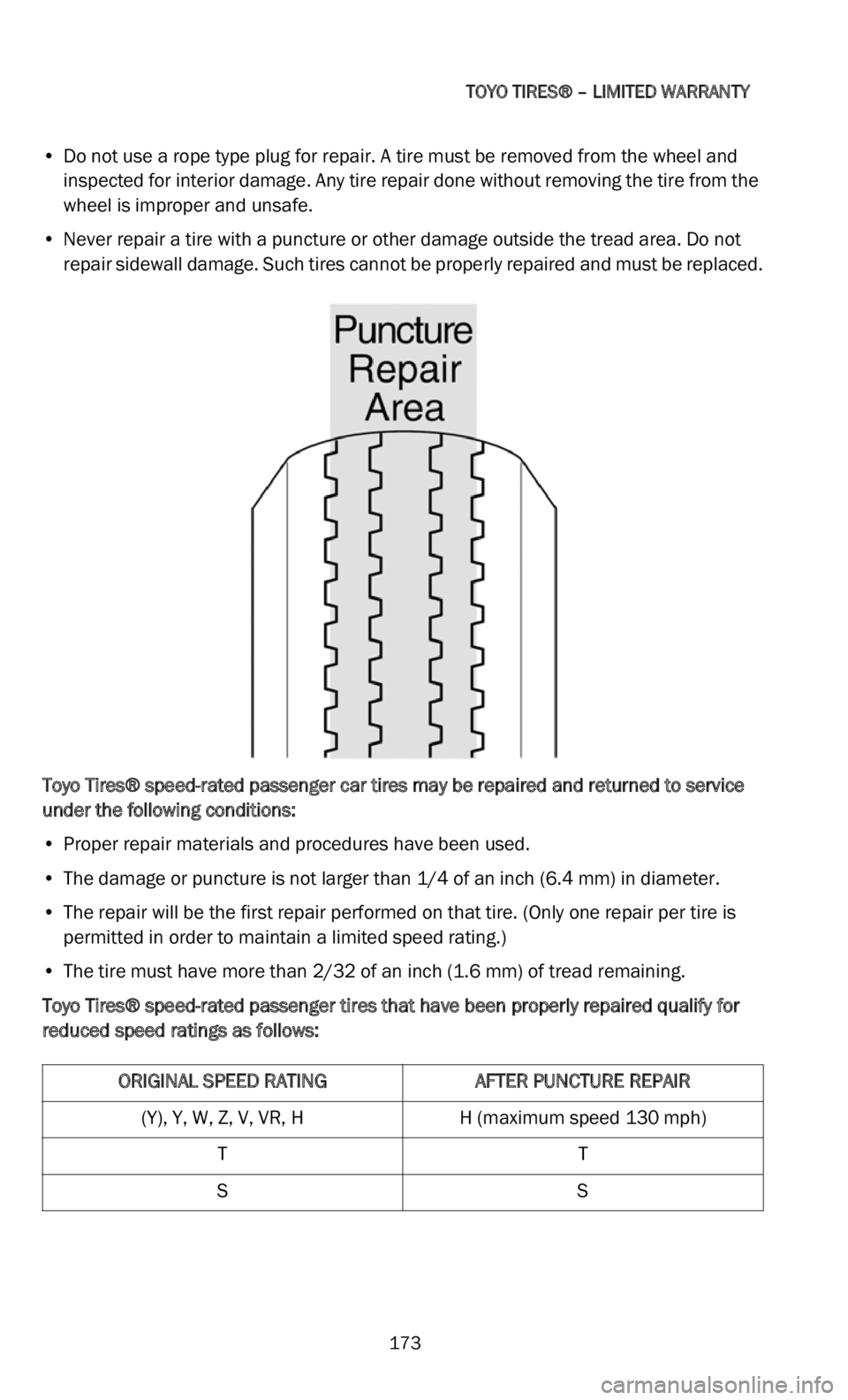
• N ever repair a tire with a puncture or other damage outside the tread area. Do not
r
epair sidewall damage. Such tires cannot be properly repaired and must be replaced.
Toyo Tires® speed-rated passenger car tires may be repaired and returned to service
u n
der the following conditions:
• P roper repair materials and procedures have been used.
•
The damage or puncture is not larger than 1/4 of an inch (6.4
mm) in diameter.
• T he repair will be the first repair performed on that tire. (Only one repair per tire is
p
ermitted in order to maintain a limited speed rating.)
• T he tire must have more than 2/32 of an inch (1.6
mm) of tread remaining.
Toyo Tires® speed-rated passenger tires that have been properly repaired qualify for
r e
duced speed ratings as follows:
ORIGINAL SPEED RATING AFTER PUNCTURE REPAIR
(Y), Y, W, Z, V, VR, H H (maximum speed 130 mph)
T T
S S
Page 176 of 200
TOYO TIRES® – LIMITED WARRANTY
175
(Continued)
In addition to the above, light truck tire replacements should take into consideration the
following:
• P roper spacing between dual tires is necessary for optimum tire performance. If
c
hains are used, particular care must be taken to assure adequate clearance between
loaded tires to avoid damage from the chains. The allowable outside diameter differ -
ence between a tire and its dual mate is 1/4 inch (6.4 mm) for light truck tires.
CONSIDERATIONS IN PLUS SIZING
Always refer to and follow the vehicle manufacturer’s replacement tire
r e
commendations. In some cases, a vehicle manufacturer may specifically advise
against the application of replacement tires that are not of the original size or type.
TIRE AND WHEEL MATCHING AND MOUNTING
WARNING!
Any attempt to mount a tire on a wheel with a different diameter will result in an
explosion of the tire/wheel assembly that could cause severe personal injury or death.
Prior to mounting any tire, always check the wheel identification stamp to verify the
c o
rrect wheel diameter. Always check the tire size molded onto the sidewall.
Never exceed 40 psi when seating the tire beads onto the wheel.
Always stand well clear of any tire mounting operation. This is especially important
wh
en the service operator inflates the tire. If the tire has been improperly mounted, it
could burst with explosive force causing serious personal injury or death.
A new valve stem must be installed on the wheel each time a worn out passenger or
l i
ght truck tire is replaced.
Removing and replacing tires on wheels can be dangerous.
Attempting to mount tires with improper tools or procedures could result in a tire
ex
plosion, causing serious personal injury or death. This is a job for your authorized
Toyo Tires® dealer or other qualified tire service location only.
Serious personal injury or death can result from:
• F ailure to select the proper tire and wheel. The tire must match the width and diam -
e
ter requirements of the wheel. When mounting truck type radial tires use only
w h
eels approved for radial tires.
• F ailure to inspect both the tire and wheel. The wheel must be free of cracks, dents,
c
hips, and rust. The tire must be free of bead damage, cuts, and punctures.
• F ailure to follow proper procedures. For proper mounting procedures, consult the US
T
ire Manufacturers Association’s publication “Care and Service of Automobile and
Light Truck Tires” (ref.: https://www.ustires.org).
Page 178 of 200
TOYO TIRES® – LIMITED WARRANTY
177
FOUR-WHEEL DRIVE (4WD) AND ALL-WHEEL DRIVE (AWD) VEHICLES
If no instructions for tire mixing appear in the vehicle Owner’s Manual, follow these
guidelines:
• D o not mix tire sizes. All four tires must be marked with the same tire size, unless
o
therwise specified by the vehicle manufacturer. This also applies to winter/snow
tires.
• D o not mix tread pattern types such as all-terrain and all- season.
STUDLESS WINTER/SNOW TIRES
• It is always preferable to apply winter/snow tires to all wheel positions, including dual
tires, to maintain vehicle mobility and control.
• I f winter/snow tires are applied to the f
ront axle of any vehicle, winter/snow tires must
also be installed on the
rear axle. DO NOT apply winter/snow tires only to the front
axle. This applies to all passenger and light truck vehicles, including front-wheel- drive,
4WD, and AWD vehicles.
• If winter/snow tires are installed on the rear axle of any vehicle, it is recommended
(but not required) that they also be installed on the
front axle.
STUDDED WINTER/SNOW TIRES
• Studded winter/snow tires have higher traction qualities under most winter weather conditions.
• I f studded winter/snow tires are installed on the f
ront axle of any vehicle, studded
winter/snow tires must also be installed on the
rear axle. DO NOT apply studded
winter/snow tires only to the front axle.
• If studded winter/snow tires are installed on the rear axle of any vehicle, it is strongly
recommended that they should also be installed on the
front axle. Only if studded
winter/snow tires are installed on all wheel positions of a vehicle will optimum
handling characteristics be achieved.
WARNING!
Unless winter/snow tires on the rear axle have comparable traction qualities to the
tires on the front axle, the vehicle may experience adverse handling characteristics.
This may result in loss of vehicle control, which can lead to serious personal injury or
death.
WARNING!
Installing only two studded winter/snow tires on the front axle of any vehicle (including
front-wheel-drive vehicles) without studded winter/snow tires on the rear axle can
cause adverse vehicle handling characteristics. This can result in a loss of vehicle
control, which could cause serious personal injury or death.
Page 182 of 200

TOYO TIRES® – LIMITED WARRANTY
181
Remember to follow your vehicle Owner’s Manual for tire rotation intervals. Your Limited
Warranty recommends Toyo Tires® brand tires to be rotated as follows:
• E very 3,500
miles or less for high performance (low profile) tires.
• E very 7,500
miles or less for standard passenger and light truck tires.
More frequent rotation or a thorough vehicle inspection may be necessary if, upon
i n
spection, irregular or erratic treadwear is beginning to appear.
It is important to remember the following:
• These tire rotation recommendations do not take into account different tire and c
onstruction types mixed on the vehicle.
• S ome tires cannot be rotated in the manner described. Such tires include unidirec -
t
ional tires. Unidirectional tread patterns must be rotated front-to-rear only so that the
d i
rection of revolution does not change.
• S ome vehicles are designed with different tire sizes on the front and rear axles.
N
ormally, such combinations will not allow rotation. Prior to rotating, consult the
vehicle Owner’s Manual.
• F or vehicles with dual rear wheels, see the vehicle Owner’s Manual for the vehicle
m
anufacturer’s procedures. If your vehicle Owner’s Manual is not available, please
contact the vehicle manufacturer.
• S ome vehicles are equipped with wheels that limit the choice of rotation pattern.
C
onsult the vehicle Owner’s Manual.
• D o not include temporary spare tires in the rotation pattern. However, if your spare tire
i
s the same size and type as a road tire (for LT tires of the same size, type, and load
rating), it should be included in the tire rotation process. The proper procedure is to
use the vehicle manufacturer’s recommended tire rotation procedures, or if not avail -
able, to use the appropriate rotation pattern shown, inserting the spare in the right
r e
ar position. Place the tire that would have gone to the right rear in the spare tire
storage position as the new spare.
• I mportant! After rotation, adjust the pressure of the individual tires to the vehicle
m
anufacturer’s recommendation or the inflation pressure recommended by Toyo
Tires® for an optional fitment according to the tire’s new location on the vehicle.
• D o not mix speed-rated tires on the same axle. Higher speed-rated tires must remain
o
n the rear axle. Consult an authorized Toyo Tires® dealer.
TIRE SPEED RATING
All Toyo Tires® passenger, light truck, and truck tires have a maximum speed rating
based on size and type. Tires must never be operated in excess of their rated speed limit!
Consult your tire dealer or contact Toyo Tires® at 1-800-442-8696 (Pacific Time) or
1-888-444-8696 (Eastern Time) if you are not sure about the maximum speed rating of
your tires.
Page 186 of 200
TOYO TIRES® – LIMITED WARRANTY
185
ADVERSE WEATHER DRIVING
Take special care when driving in adverse weather conditions.
• R ain and snow – Driving in rain or snow considerably reduces the traction between
y
our tires and the road surface. You must always reduce your speed to allow additional
stopping distance between you and the vehicles ahead of you.
• H ydroplaning and wet weather driving – Hydroplaning occurs on wet roads and refers
t
o the loss of tire contact with the road due to the build-up of water between the tire
contact patch and the road surface. Three main factors affect hydroplaning and,
consequently, your tire traction on wet roads:
1. V ehicle Speed – As speed increases, wet traction is considerably reduced.
2
. W ater Depth – The deeper the water, the sooner your tires will lose traction. Even thin
w
ater layers can create sufficient lubrication to cause traction loss at low speeds,
depending on road conditions.
3. T ire Tread Depth – As your tires wear down, their decreased ability to resist hydro -
p
laning can result in a complete loss of traction and vehicle control. You should
a l
ways reduce your speed with consideration for the traffic around you.
Driving on ice and snow – Your all-season tires were designed to provide higher
levels of snow traction compared to non-all- season tires. You have all-season
tires if you find the letters “M&S” are molded into the sidewall near the bead.
These letters mean “Mud and Snow.” Tires designed for use in severe snow con -
ditions generally have tread patterns, structure, and materials for giving superior
p e
rformance. These tires are marked with the “M&S” designation plus a moun -
tain/snowflake symbol . Even the best all-season tires will not provide accept -
able levels of traction if you drive too fast in snow or ice conditions and if you do
n o
t allow more stopping distance on icy roads compared to dry road surfaces.
Your ability to safely maneuver your vehicle in snow or ice conditions is consid -
erably reduced if your tires are too worn to provide adequate road grip.
SAFE USE OF TEMPORARY SPARE TIRES
• The temporary spare tire is designed for temporary use only. It must not be used
continuously as a standard tire. The temporary spare tire should be returned to the
trunk as soon as it is convenient to have your standard tire repaired or replaced.
• T he temporary spare tire should not be used for speeds exceeding 50
mph.
• N ever use chains on temporary spare tires, because it could cause damage to your
v
ehicle.
WARNING!
The spare tire your car is equipped with may be of a different size and construction
from the other tires on your vehicle. When using any temporary type spare tire, be sure
to follow the vehicle manufacturer’s instructions. Failure to observe recommended
precautions could lead to erratic vehicle behavior and/or tire damage, possibly
resulting in an accident and serious personal injury or death.
Page 187 of 200

TOYO TIRES® – LIMITED WARRANTY
186
• When you replace the temporary tire, replace it only with the same type of tire.
• A full-size spare tire in your vehicle is intended for use as a spare when needed. Please
s
ee the “Tire Rotation” section for the proper procedures for including the same size
construction and speed-rated tire (for LT tires of the same size, type, and load rating)
in the rotation pattern. Do not rotate a temporary spare tire.
TIRE STORAGE
Tires should be stored indoors in a cool dry place where water cannot collect inside the
tires. The tires should be placed away from harmful ozone-producing electric generators
and motors and sources of heat such as hot pipes. Storage surfaces should be clean and
free of grease, gasoline, or other substances, which can deteriorate the rubber.
COMPETITION TIRE STORAGE
The rubber compounds used in these tires have unique properties that, when compared
to other tires, can cause them to lose some of their flexibility when used or handled in
conditions below 15° F (-9° C). This loss in flexibility can lead to potential cracking and
other damage to the tire. To minimize the chances of this happening, you are advised to
follow these instructions:
1. Do not move or operate the car with these tires in conditions below 15° F (-9° C).
2
. A void moving these tires in conditions below 15° F (-9° C).
3
. B efore mounting and dismounting, store these tires for at least 24 hours in a
t
emperature-controlled environment of 68° F (20° C) or warmer.
WARNING!
• Check inflation pressure before using your spare tire. Failure to have proper inflation pressure when using your spare tire may cause loss of vehicle control, which could
result in serious personal injury or death. Maintain spare tire inflation pressures
based on the vehicle Owner’s Manual or the Tire Information Placard.
• “ T” Type high-pressure temporary spare tires should not be used with any other
w
heel, nor should standard tires, snow tires, wheel covers, or trim rings be used on
the high-pressure spare tire wheel. If you fail to follow this warning, your vehicle’s
handling characteristics can be seriously affected. You could have an accident
resulting in serious personal injury or death. Consult your vehicle Owner’s Manual for
the proper use of your “temporary use” spare tire.
• D o not operate your vehicle with more than one temporary spare in use (this does
n
ot apply to a full size spare), and only operate it at limited speeds and distances as
indicated on the sidewall of the tire.
• T he “T” Type temporary spare tire may lower ground clearance when used. Avoid
d
riving over large obstacles and other road hazards. Check your vehicle Owner’s
Manual for other special clearance precautions when using the “T” Type temporary
spare tire provided in your vehicle.
Page 189 of 200
TOYO TIRES® – LIMITED WARRANTY
188
REPLACEMENT TIRES FOR LIGHT TRUCKS – P-METRIC VS . LT-TRUCK
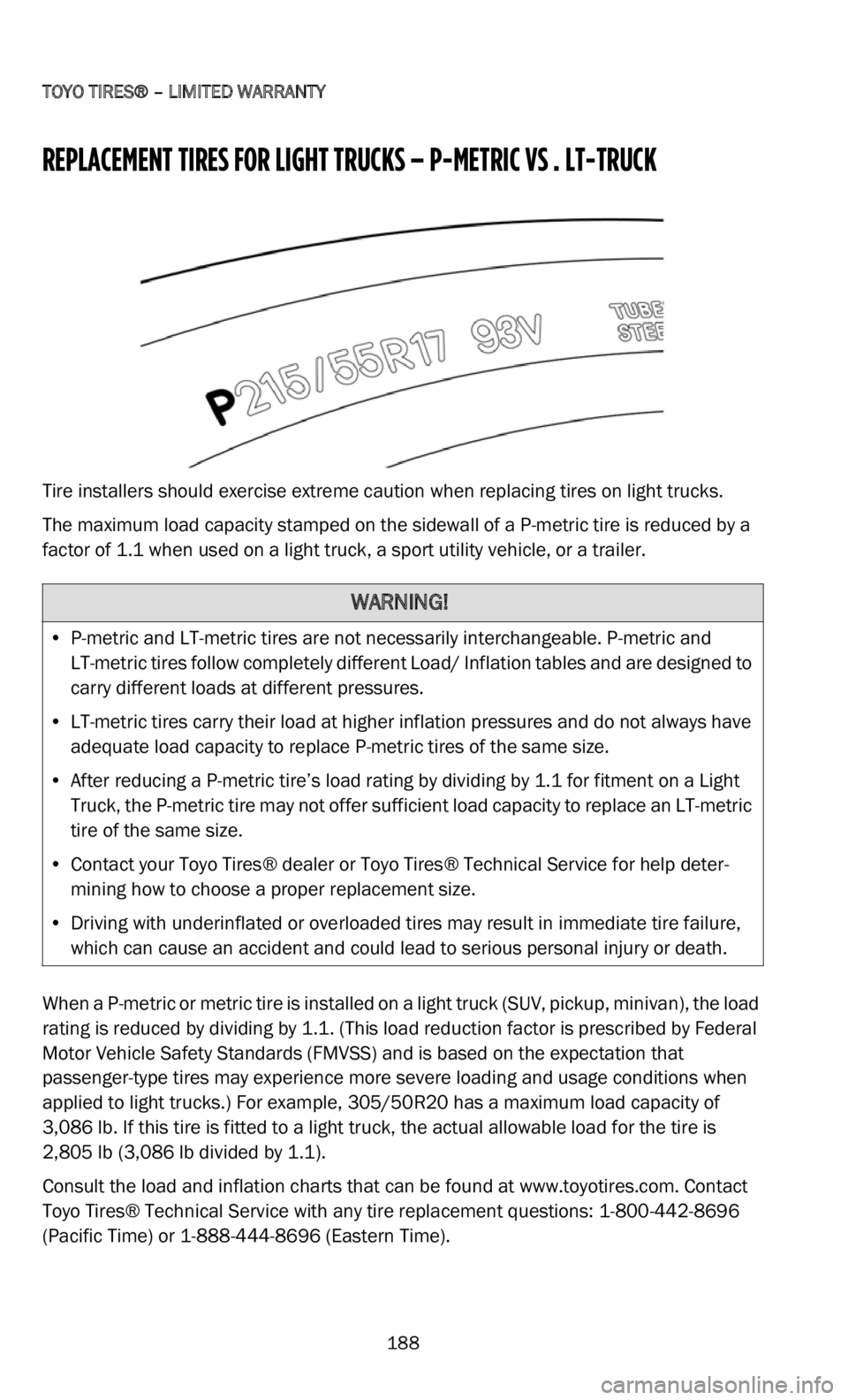
Tire installers should exercise extreme caution when replacing tires on light trucks.
The maximum load capacity stamped on the sidewall of a P-metric tire is reduced by a
fa
ctor of 1.1 when used on a light truck, a sport utility vehicle, or a trailer.
When a P-metric or metric tire is installed on a light truck (SUV, pickup, minivan), the load
r a
ting is reduced by dividing by 1.1. (This load reduction factor is prescribed by Federal
Motor Vehicle Safety Standards (FMVSS) and is based on the expectation that
passenger-type tires may experience more severe loading and usage conditions when
applied to light trucks.) For example, 305/50R20 has a maximum load capacity of
3,086 lb. If this tire is fitted to a light truck, the actual allowable load for the tire is
2,805 lb (3,086 lb divided by 1.1).
Consult the load and inflation charts that can be found at www.toyotires.com. Contact
Toyo Tires® Technical Service with any tire replacement questions: 1 -
800-442-8696
(Pacific Time) or 1-888-444-8696 (Eastern Time).
WARNING!
• P-metric and LT-metric tires are not necessarily interchangeable. P-metric and LT-metric tires follow completely different Load/ Inflation tables and are designed to
carry different loads at different pressures.
• LT -metric tires carry their load at higher inflation pressures and do not always have
a
dequate load capacity to replace P-metric tires of the same size.
• A fter reducing a P-metric tire’s load rating by dividing by 1.1 for fitment on a Light
T
ruck, the P-metric tire may not offer sufficient load capacity to replace an LT-metric
tire of the same size.
• C ontact your Toyo Tires® dealer or Toyo Tires® Technical Service for help deter -
m
ining how to choose a proper replacement size.
• D riving with underinflated or overloaded tires may result in immediate tire failure,
w
hich can cause an accident and could lead to serious personal injury or death.
Page 190 of 200
TOYO TIRES® – LIMITED WARRANTY
189
VEHICLES WITH MODIFIED SUSPENSION
USEFUL TIRE INFORMATION
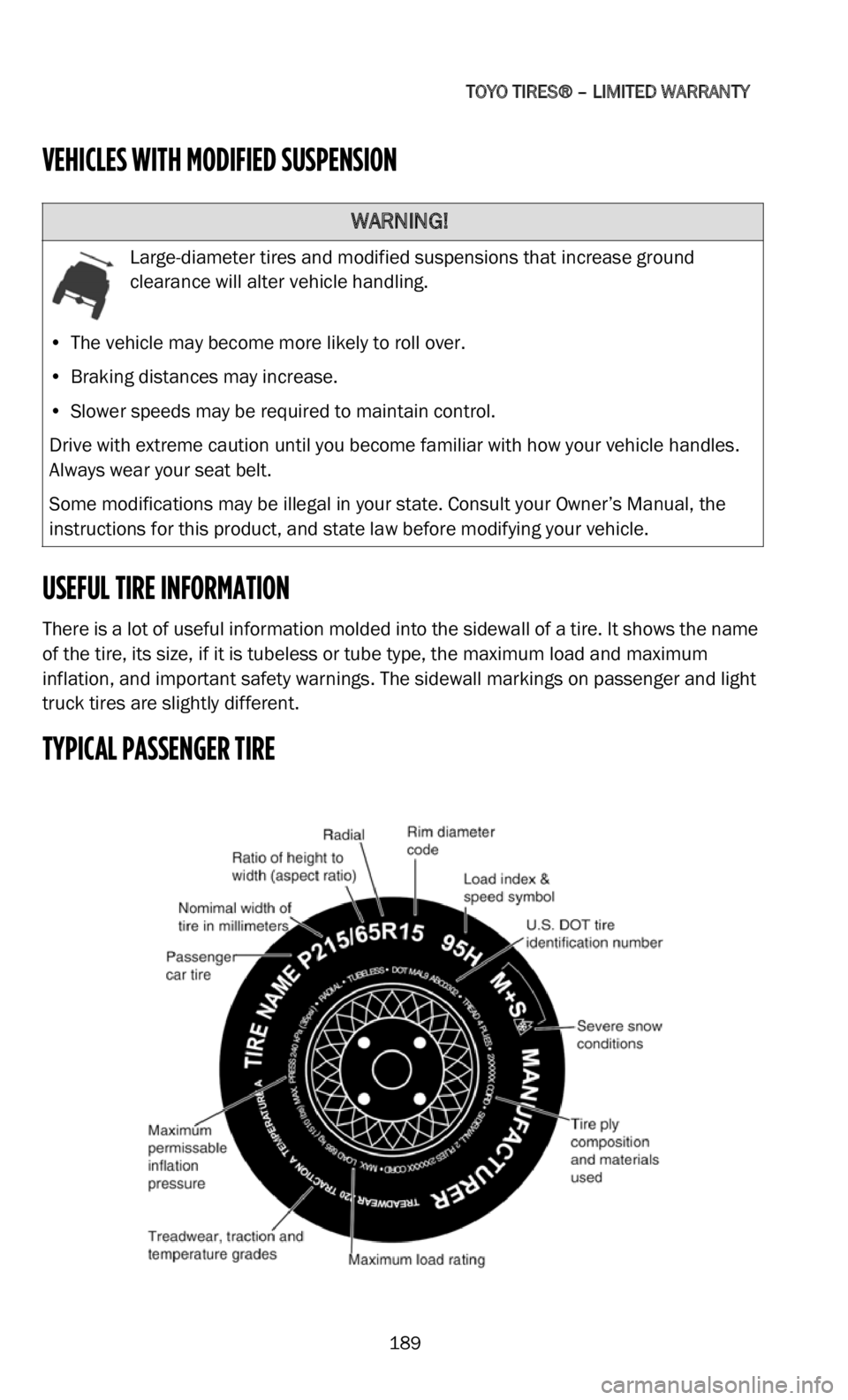
There is a lot of useful information molded into the sidewall of a tire. It shows the name
of the tire, its size, if it is tubeless or tube type, the maximum load and maximum
inflation, and important safety warnings. The sidewall markings on passenger and light
truck tires are slightly different.
TYPICAL PASSENGER TIRE
WARNING!
Large-diameter tires and modified suspensions that increase ground
clearance will alter vehicle handling.
• The vehicle may become more likely to roll over.
•
Braking distances may increase.
•
Slower speeds may be required to maintain control.
D
rive with extreme caution until you become familiar with how your vehicle handles.
A lw
ays wear your seat belt.
Some modifications may be illegal in your state. Consult your Owner’s Manual, the
i n
structions for this product, and state law before modifying your vehicle.