ECO DODGE DURANGO 2022 Vehicle Warranty
[x] Cancel search | Manufacturer: DODGE, Model Year: 2022, Model line: DURANGO, Model: DODGE DURANGO 2022Pages: 200, PDF Size: 6.72 MB
Page 6 of 200
TIRES
5
Tire Loading And Tire Pressure
NOTE:
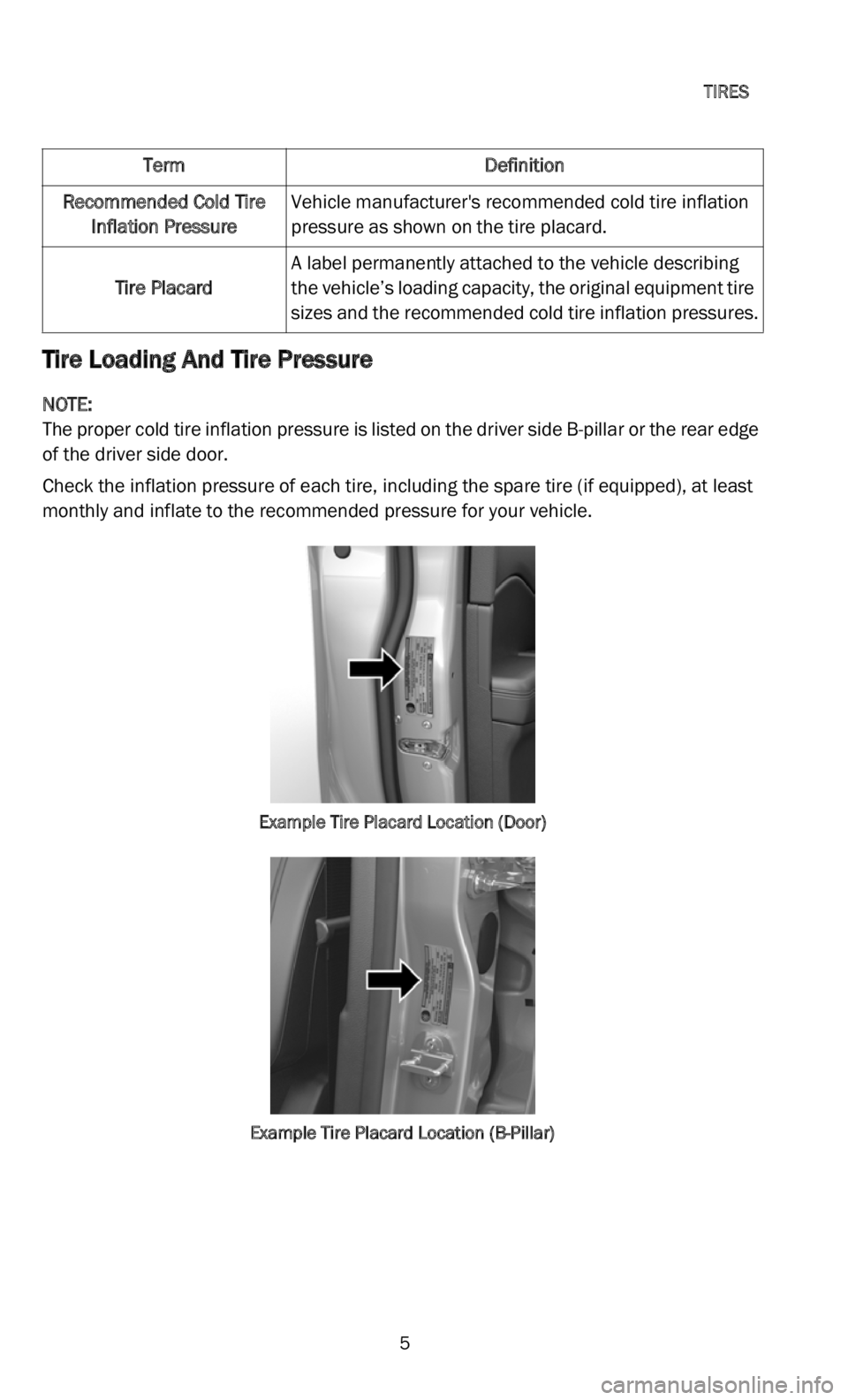
The proper cold tire inflation pressure is listed on the driver side B-pillar or the rear edge
of
the driver side door.
Check the inflation pressure of each tire, including the spare tire (if equipped), at least
mo n
thly and inflate to the recommended pressure for your vehicle.
Example Tire Placard Location (Door)
Example Tire Placard Location (B-Pillar)
Recommended Cold Tire Inflation Pressure Vehicle manufacturer's recommended cold tire inflation
pre
ssure as shown on the tire placard.
Tire Placard A label permanently attached to the vehicle describing
th
e
vehicle’s loading capacity, the original equipment tire
sizes and the recommended cold tire inflation pressures.
Term Definition
Page 9 of 200
TIRES
8
WARNING!
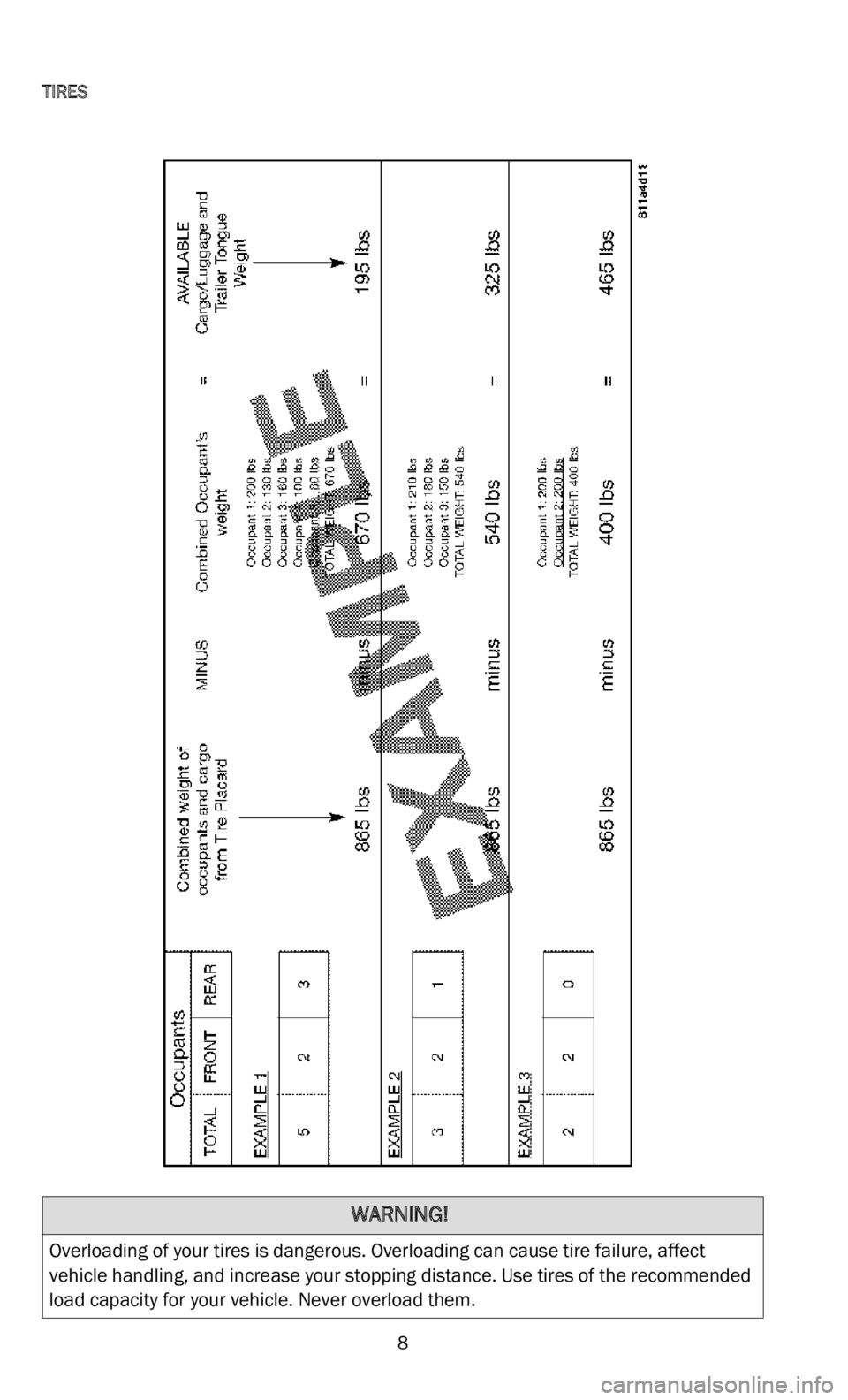
Overloading of your tires is dangerous. Overloading can cause tire failure, affect
vehicle handling, and increase your stopping distance. Use tires of the recommended
load capacity for your vehicle. Never overload them.
Page 10 of 200

TIRES
9
Tires — General Information
Tire Pressure
Proper tire inflation pressure is essential to the safe and satisfactory operation of your
vehicle. Four primary areas are affected by improper tire pressure:
• Safety and Vehicle Stability
• Ec
onomy
• Tr
ead Wear
• Ri
de Comfort
S a
fety
Both underinflation and overinflation affect the stability of the vehicle and can produce
a f
eeling of sluggish response or over responsiveness in the steering.
NOTE:
• U nequal tire pressures from side to side may cause erratic and unpredictable steering
r e
sponse.
• Unequal tire pressure from side to side may cause the vehicle to drift left or right.
F u
el Economy
Underinflated tires will increase tire rolling resistance, resulting in higher fuel
co n
sumption.
WARNING!
• Improperly inflated tires are dangerous and can cause collisions.
• Underinflation increases tire flexing and can result in overheating and tire failure.
•Ov
erinflation reduces a tire's ability to cushion shock. Objects on the road and chuck -
h o
les can cause damage that result in tire failure.
• Overinflated or underinflated tires can affect vehicle handling and can fail suddenly, re
sulting in loss of vehicle control.
• Unequal tire pressures can cause steering problems. You could lose control of your ve
hicle.
• Unequal tire pressures from one side of the vehicle to the other can cause the ve
hicle to drift to the right or left.
• Always drive with each tire inflated to the recommended cold tire inflation pressure.
Page 12 of 200
TIRES
11
Tire Pressures For High Speed Operation
FCA US LLC advocates driving at safe speeds and within posted speed limits. Where
speed limits or conditions are such that the vehicle can be driven at high speeds,
maintaining correct tire inflation pressure is very important. Increased tire pressure and
reduced vehicle loading may be required for high-speed vehicle operation. Refer to an
authorized tire dealer or original equipment vehicle dealer for recommended safe
operating speeds, loading and cold tire inflation pressures.
Radial Ply Tires
Tire Repair
If your tire becomes damaged, it may be repaired if it meets the following criteria:
• The tire has not been driven on when flat.
• Th
e damage is only on the tread section of your tire (sidewall damage is not repair -
a b
le).
• The puncture is no greater than a ¼ of an inch (6 m
m).
Consult an authorized tire dealer for tire repairs and additional information.
Damaged Run Flat tires, or Run Flat tires that have experienced a loss of pressure should
be
replaced immediately with another Run Flat tire of identical size and service
description (Load Index and Speed Symbol).
Run Flat Tires — If Equipped
Run Flat tires allow you the capability to drive 50 miles (80 km) at 50 mph (80 km/h)
aft
er a rapid loss of inflation pressure. This rapid loss of inflation is referred to as the Run
Flat mode. A Run Flat mode occurs when the tire inflation pressure is of/or below 14 psi
(96 kPa). Once a Run Flat tire reaches the Run Flat mode, it has limited driving
capabilities and needs to be replaced immediately. A Run Flat tire is not repairable.
It is not recommended to drive a vehicle loaded at full capacity or to tow a trailer while a
tir
e is in the Run Flat mode.
See the Tire Pressure Monitoring System (TPMS) section for more information.
WARNING!
High speed driving with your vehicle under maximum load is dangerous. The added
strain on your tires could cause them to fail. You could have a serious collision. Do not
drive a vehicle loaded to maximum capacity at continuous speeds above 75 mph
(1 2
0 km/h).
WARNING!
Combining radial ply tires with other types of tires on your vehicle will cause your
vehicle to handle poorly. The instability could cause a collision. Always use radial ply
tires in sets of four. Never combine them with other types of tires.
Page 13 of 200
TIRES
12
Tire Spinning
When stuck in mud, sand, snow, or ice conditions, do not spin your vehicle's wheels
above 30 mph (48 km/h) or for longer than 30 seconds continuously without stopping.
Refer to “Freeing A Stuck Vehicle” in “In Case Of Emergency” in your Owner’s Manual for
fu r
ther information.
Tread Wear Indicators
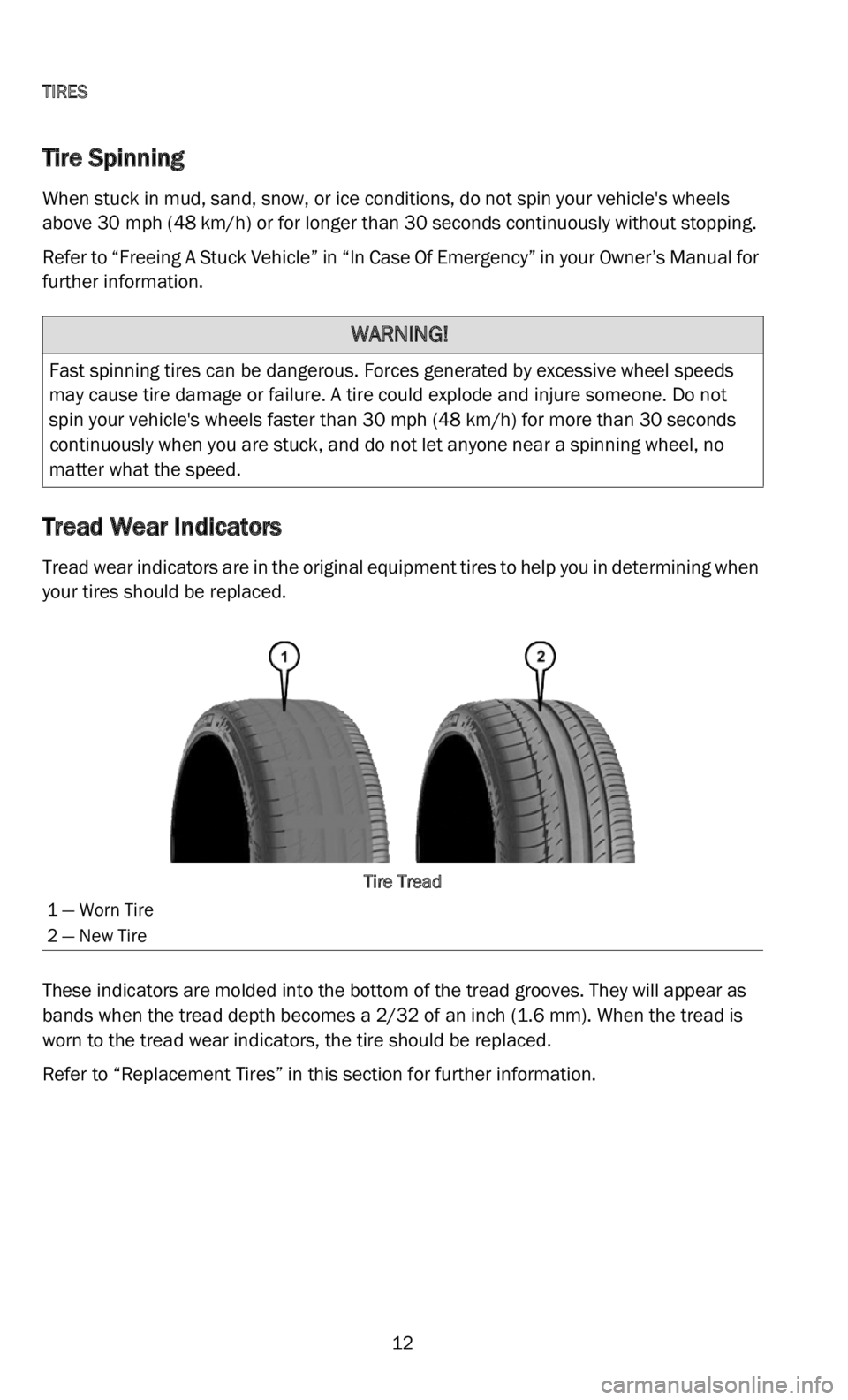
Tread wear indicators are in the original equipment tires to help you in determining when
your tires should be replaced.
Tire Tread
These indicators are molded into the bottom of the tread grooves. They will appear as
bands when the tread depth becomes a 2/32 of an inch (1.6 mm). When the tread is
wo r
n to the tread wear indicators, the tire should be replaced.
Refer to “Replacement Tires” in this section for further information.
WARNING!
Fast spinning tires can be dangerous. Forces generated by excessive wheel speeds
may cause tire damage or failure. A tire could explode and injure someone. Do not
spin your vehicle's wheels faster than 30 mph (48 km/h) for more than 30 seconds
co n
tinuously when you are stuck, and do not let anyone near a spinning wheel, no
matter what the speed.
1 — Worn Tire
2 — New Tire
Page 14 of 200

TIRES
13
Life Of Tire
The service life of a tire is dependent upon varying factors including, but not limited to:
• D riving style.
•
Tire pressure - Improper cold tire inflation pressures can cause uneven wear patterns
t
o develop across the tire tread. These abnormal wear patterns will reduce tread life,
resulting in the need for earlier tire replacement.
• D istance driven.
•
Performance tires, tires with a speed rating of V or higher, and Summer tires typically
h
ave a reduced tread life. Rotation of these tires per the vehicle scheduled mainte -
nance is highly recommended.
Keep dismounted tires in a cool, dry place with as little exposure to light as possible.
P r
otect tires from contact with oil, grease, and gasoline.
Replacement Tires
The tires on your new vehicle provide a balance of many characteristics. They should be
inspected regularly for wear and correct cold tire inflation pressures. FCA US LLC strongly
recommends that you use tires equivalent to the originals in size, quality and
performance when replacement is needed. Refer to the paragraph on “Tread Wear
Indicators” in this section. Refer to the Tire and Loading Information placard or the
Vehicle Certification Label for the size designation of your tires. The Load Index and
Speed Symbol for your tires will be found on the original equipment tire sidewall.
See the Tire Sizing Chart example found in the “Tire Safety Information” section of this
ma
nual for more information relating to the Load Index and Speed Symbol of a tire.
It is recommended to replace the two front tires or two rear tires as a pair. Replacing just
o n
e tire can seriously affect your vehicle’s handling. If you ever replace a wheel, make
sure that the wheel’s specifications match those of the original wheels.
It is recommended you contact an authorized tire dealer or original equipment dealer with
a n
y questions you may have on tire specifications or capability. Failure to use equivalent
replacement tires may adversely affect the safety, handling, and ride of your vehicle.
WARNING!
Tires and the spare tire should be replaced after six years, regardless of the remaining
tread. Failure to follow this warning can result in sudden tire failure. You could lose
control and have a collision resulting in serious injury or death.
Page 16 of 200

TIRES
15
Snow Tires
Some areas of the country require the use of snow tires during the winter. Snow tires can
be identified by a “mountain/snowflake” symbol on the tire sidewall. If you need snow tires, select tires equivalent in size and type to the original
equipment tires. Use snow tires only in sets of four; failure to do so may
ad
versely affect the safety and handling of your vehicle.
Snow tires generally have lower speed ratings than what was originally equipped with
y o
ur vehicle and should not be operated at sustained speeds over 75 mph (120 km/h).
F o
r speeds above 75 mph (120 km/h) refer to original equipment or an authorized tire
d e
aler for recommended safe operating speeds, loading and cold tire inflation
pressures.
While studded tires improve performance on ice, skid and traction capability on wet or
d r
y surfaces may be poorer than that of non-studded tires. Some states prohibit studded
tires; therefore, local laws should be checked before using these tire types.
Spare Tires — If Equipped
Spare Tire Matching Original Equipped Tire And Wheel —
If Equipped
Your vehicle may be equipped with a spare tire and wheel equivalent in look and function
to the original equipment tire and wheel found on the front or rear axle of your vehicle.
This spare tire may be used in the tire rotation for your vehicle. If your vehicle has this
option, refer to an authorized tire dealer for the recommended tire rotation pattern.
Compact Spare Tire — If Equipped
The compact spare is for temporary emergency use only. You can identify if your vehicle
is equipped with a compact spare by looking at the spare tire description on the Tire and
Loading Information Placard located on the driver side door opening or on the sidewall
of the tire. Compact spare tire descriptions begin with the letter “T” or “S” preceding the
size designation. Example: T145/80D18 103M.
T, S = Temporary Spare Tire
Since this tire has limited tread life, the original equipment tire should be repaired (or
r e
placed) and reinstalled on your vehicle at the first opportunity.
Do not install a wheel cover or attempt to mount a conventional tire on the compact
s p
are wheel, since the wheel is designed specifically for the compact spare tire. Do not
install more than one compact spare tire and wheel on the vehicle at any given time.
CAUTION!
Because of the reduced ground clearance, do not take your vehicle through an
automatic car wash with a compact or limited use temporary spare installed. Damage
to the vehicle may result.
Page 22 of 200

21
BFGOODRICH® TIRES
ABOUT THIS WARRANTY
As the original purchaser of a BFGoodrich® brand passenger or light truck tire, you are
covered by all the benefits and conditions (subject to the maintenance
recommendations and safety warnings) contained in this booklet. To ensure your
understanding of and compliance with the terms and conditions of this warranty, please
read it carefully. It is essential that you also read and understand the safety and
maintenance recommendations for tires contained in this booklet.
WHAT IS COVERED AND FOR HOW LONG
Passenger and Light Truck Tires
BFGoodrich® brand passenger and light truck tires, used in normal service on the
veh
icle on which they were originally fitted and in accordance with the maintenance
recommendations and safety warnings contained in the attached Owner’s Manual, are
covered by this warranty against defects in workmanship and materials for the life of the
original usable tread, or six years from the date of purchase, whichever occurs first. At
that time, all warranties, express or implied, expire. The life of the original usable tread
is the original tread down to the level of the tread wear indicators - 2/32nds of an inch
(1.6 mm) of tread remaining. Date of purchase is documented by new vehicle
reg
istration or tire sales invoice. If no proof of purchase is available, coverage will be
based on the date of manufacture. Replacement will be made in accordance with the
terms and conditions described under “How Replacement Charges are Calculated”.
NOTE:
Your vehicle manufacturer may provide additional tire warranty coverage over and above
wh a
t is provided by BFGoodrich®. Consult your vehicle Owner’s Manual for further infor -
mation.
WHAT IS NOT COVERED
Tires Which Become Unserviceable Due To:
• Road hazard injury (e.g., a cut, snag, bruise, impact damage or puncture)
• In
correct mounting of the tire, tire/wheel imbalance or improper repair
• Mi
sapplication, improper maintenance, racing, underinflation, overinflation or other
a b
use
• Operation without a properly functioning low pressure warning system, for Comp T/A® ZR
SSS tires
• Uneven or rapid wear which is caused by mechanical irregularity in the vehicle such as wh
eel misalignment, a measured tread difference of 2/32 of an inch (1.6 mm) or
mo r
e across the tread on the same tire
• Accident, fire, chemical corrosion, tire alteration or vandalism
• Fl
at spotting caused by improper storage or brake lock
Page 23 of 200

BFGOODRICH® TIRES
22
• The adding of liquid, solid or gaseous materials other than air, nitrogen or carbon dioxide for example, waterbase sealers or balancing substances
• O zone or weather checking
HOW REPLACEMENT CHARGES ARE CALCULATED
Passenger And Light Truck Tires Workmanship/Materials
A tire which becomes unserviceable due to a condition covered by this workmanship and
ma
terials limited warranty will be replaced with a comparable new BFGoodrich® brand
tire, free of charge, when 2/32 of an inch (1.6 mm) or less of the original tread is worn,
( o
r 25% or less, whichever is more beneficial to you) and within 12 months of the date of
p u
rchase. The cost of mounting and balancing the tire is included. You pay the cost of
any other service charges and applicable taxes.
When more than 2/32 of an inch (1.6 mm) of the original tread has been worn (or more
t h
an 25%, whichever is more beneficial to you) or after 12 months from the date of
p u
rchase, you must pay the cost of a comparable new BFGoodrich® brand passenger or
light truck replacement tire on a prorated basis. The retailer shall determine the charge
by multiplying the percentage of the original usable tread worn by the current selling
price at the adjustment location or the price on the current BFGoodrich® brand Base
Price List, whichever is lower. This list is based on a predetermined price intended to
fairly represent the actual selling price of the tire.
You pay the cost of mounting, balancing, and or any other service charges and applicable
t a
xes.
WHAT YOU MUST DO WHEN MAKING A CLAIM
When making a claim under the terms of this limited warranty you must present your
tire(s), your vehicle, and your original invoice to a participating BFGoodrich® brand tire
retailer. BFGoodrich® brand tire retailers are listed in the yellow pages under “Tire
Dealers-Retail”. Personal identification (i.e. Driver’s License, Credit Card, etc.) and
vehicle registration may be required. You pay any service charges for normal vehicle and
tire maintenance.
CONDITIONS AND EXCLUSIONS
This limited warranty does not provide compensation for loss of time, loss of use of
vehicle, inconvenience or incidental or consequential damages.
Tires presented for claim remain the property of the consumer and BFGoodrich® brand
a c
cepts no responsibility for loss of, or damage to, tires which are in the custody or
control of a BFGoodrich® tire retailer for the purpose of inspection for warranty
adjustment.
In the event of a disputed claim, the consumer must make the tire available for further
i n
spection. Tires accepted for claim become the property of Michelin North America Inc.
No BFGoodrich® brand representative, employee or retailer has the authority to make or
i m
ply any representation, promise or agreement, which in any way varies from the terms
of this limited warranty. This limited warranty applies only in the United States and Canada.
Page 24 of 200

BFGOODRICH® TIRES
23
SAFETY MAINTENANCE INFORMATION
Read your Tire Owner’s Manual, the information on the sidewall of your tires, your vehicle
Owner’s Manual and vehicle tire information placard for essential safety and
maintenance information.
When service is required:
1. C ontact a participating BFGoodrich® tire retailer listed in your yellow pages.
2
. I f additional assistance is needed in locating a BFGoodrich® retailer, please call or
w
rite to the Consumer Care Department listed in this book.
You should have complete confidence in your new BFGoodrich® tires. Still it is important
t o
register your tires in the event that we need to contact you. For online tire registration,
visit https://www.tireregistration.com/ .
TIRE DISABLEMENT SAFETY WARNING
Any tire may fail as a result of an improperly repaired puncture, impact damage, improper
inflation, overloading or other conditions resulting from use or misuse. Tire failures, such
as a rapid air loss or a tread and belt detachment, may increase risk of injury or death
and/or property damage. To reduce the risk of a tire failure, BFGoodrich® recommends
you thoroughly read and follow the recommendations in this BFGoodrich® Limited
Warranty/Owner’s Manual, the vehicle Owner’s Manual, tire placard information, and tire
sidewall information regarding safety warnings, proper tire use and maintenance.
CONTROLLABILITY
CONTROLLING A VEHICLE WHEN A TIRE FAILURE OCCURS
If a tire failure occurs, you may hear a loud noise, feel a vibration, and/or the vehicle may
pu
ll toward the side of the failed tire. If possible, step on the accelerator momentarily to
maintain forward momentum and ensure vehicle control.
It is important that you DO NOT BRAKE OR ABRUPTLY TURN THE STEERING WHEEL.
Slowly remove your foot from the accelerator and hold the steering wheel firmly while
s t
eering to remain in your lane. Once the vehicle has slowed and is fully under control,
apply the brakes gently; safely pull over to the shoulder and come to a stop. Inspect the
tires. If one or more tires look flat or low, show detachment or other damage, remove tire
assembly and replace it with a properly inflated spare. Bumps or bulges may indicate
detachment within the tire body and require inspection by a qualified tire technician.
WARNING!
DISREGARDING ANY OF THE SAFETY PRECAUTIONS AND/OR INSTRUCTIONS
CONTAINED IN THIS MANUAL MAY RESULT IN TIRE FAILURE OR EXPLOSION CAUSING
SERIOUS PERSONAL INJURY OR DEATH.