Page 150 DODGE DURANGO 2023 User Guide
[x] Cancel search | Manufacturer: DODGE, Model Year: 2023, Model line: DURANGO, Model: DODGE DURANGO 2023Pages: 328, PDF Size: 13.82 MB
Page 254 of 328
252SERVICING AND MAINTENANCE
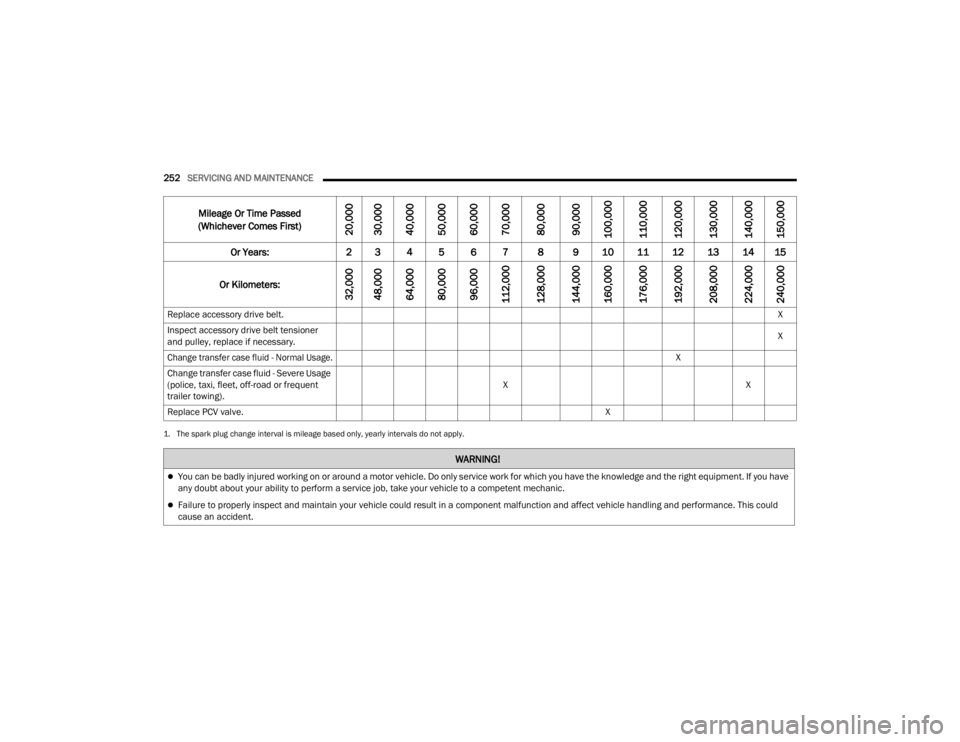
Replace accessory drive belt. X
Inspect accessory drive belt tensioner
and pulley, replace if necessary. X
Change transfer case fluid - Normal Usage.
X
Change transfer case fluid - Severe Usage
(police, taxi, fleet, off-road or frequent
trailer towing). X
X
Replace PCV valve. X
1. The spark plug change interval is mileage based only, yearly intervals do not apply.
Mileage Or Time Passed
(Whichever Comes First)
20,000
30,000
40,000
50,000
60,000
70,000
80,000
90,000
100,000
110,000
120,000
130,000
140,000
150,000
Or Years: 2 3 4 5 6 7 8 9 10 11 12 13 14 15
Or Kilometers:
32,000
48,000
64,000
80,000
96,000
112,000
128,000
144,000
160,000
176,000
192,000
208,000
224,000
240,000
WARNING!
You can be badly injured working on or around a motor vehicle. Do only service work for which you have the knowledge and the right equipment. If you have
any doubt about your ability to perform a service job, take your vehicle to a competent mechanic.
Failure to properly inspect and maintain your vehicle could result in a component malfunction and affect vehicle handling and performance. This could
cause an accident.
23_WD_OM_EN_USC_t.book Page 252
Page 268 of 328
266SERVICING AND MAINTENANCE
Engine Coolant Checks
Check the engine coolant (antifreeze) protection
every 12 months (before the onset of freezing
weather, where applicable). If the engine coolant is
dirty, the system should be drained, flushed, and
refilled with fresh Organic Additive Technology
(OAT) coolant (conforming to MS.90032) by an
authorized dealer. Check the front of the A/C
condenser for any accumulation of bugs, leaves,
etc. If dirty, clean by gently spraying water from a
garden hose vertically down the face of the
condenser.
Check the engine cooling system hoses for brittle
rubber, cracking, tears, cuts, and tightness of the
connection at the coolant recovery bottle and
radiator. Inspect the entire system for leaks. DO
NOT REMOVE THE COOLANT PRESSURE CAP
WHEN THE COOLING SYSTEM IS HOT.
Cooling System — Drain, Flush And Refill
NOTE:Some vehicles require special tools to add coolant
properly. Failure to fill these systems properly
could lead to severe internal engine damage. If any
coolant is needed to be added to the system
please contact an authorized dealer.
If the engine coolant (antifreeze) is dirty or
contains visible sediment, have an authorized
dealer clean and flush with OAT coolant
(conforming to MS.90032). For the proper maintenance intervals
Úpage 250.
Selection Of Coolant
For further information Ú page 307.
NOTE:
Mixing of engine coolant (antifreeze) other than
specified Organic Additive Technology (OAT)
engine coolant, may result in engine damage
and may decrease corrosion protection. OAT
engine coolant is different and should not be
mixed with Hybrid Organic Additive Technology
(HOAT) engine coolant or any “globally compat -
ible” coolant. If a non-OAT engine coolant is
introduced into the cooling system in an emer -
gency, the cooling system will need to be
drained, flushed, and refilled with fresh OAT
coolant (conforming to MS.90032), by an autho -
rized dealer as soon as possible.
Do not use water alone or alcohol-based engine
coolant products. Do not use additional rust
inhibitors or antirust products, as they may not
be compatible with the radiator engine coolant
and may plug the radiator.
This vehicle has not been designed for use with
propylene glycol-based engine coolant. Use of
propylene glycol-based engine coolant is not
recommended.
Some vehicles require special tools to add
coolant properly. Failure to fill these systems
properly could lead to severe internal engine damage. If any coolant is needed to be added to
the system please contact an authorized dealer.
Adding Coolant
Your vehicle has been built with an improved
engine coolant (OAT coolant conforming to
MS.90032) that allows extended maintenance
intervals. This engine coolant (antifreeze) can be
used up to 10 years or 150,000 miles
(240,000 km) before replacement. To prevent
reducing this extended maintenance period, it is
important to use the same engine coolant (OAT
coolant conforming to MS.90032) throughout the
life of your vehicle.
Please review these recommendations for using
Organic Additive Technology (OAT) engine coolant
that meets the requirements of the manufacturer
Material Standard MS.90032. When adding
engine coolant:
We recommend using Mopar® Antifreeze/
Coolant 10 Year/150,000 Mile (240,000 km)
Formula OAT that meets the requirements of the
manufacturer Material Standard MS.90032.
Mix a minimum solution of 50% OAT engine
coolant that meets the requirements of the
manufacturer Material Standard MS.90032
and distilled water. Use higher concentrations
(not to exceed 70%) if temperatures below
−34°F (−37°C) are anticipated. Please contact
an authorized dealer for assistance.
23_WD_OM_EN_USC_t.book Page 266
Page 289 of 328
SERVICING AND MAINTENANCE287
To determine the maximum loading conditions of
your vehicle, locate the statement “The combined
weight of occupants and cargo should never
exceed XXX kg or XXX lbs” on the Tire And Loading
Information Placard. The combined weight of
occupants, cargo/luggage and trailer tongue
weight (if applicable) should never exceed the
weight referenced here.
Steps For Determining Correct Load Limit—
(1) Locate the statement “The combined
weight of occupants and cargo should
never exceed XXX kg or XXX lbs.” on your
vehicle's placard.
(2) Determine the combined weight of
the driver and passengers that will be
riding in your vehicle.
(3) Subtract the combined weight of the
driver and passengers from XXX kg or
XXX lbs. (4) The resulting figure equals the
available amount of cargo and luggage
load capacity. For example, if “XXX”
amount equals 1400 lbs. and there will
be five 150 lb passengers in your
vehicle, the amount of available cargo
and luggage load capacity is 650 lbs.
(1400-750 (5x150) = 650 lbs.)
(5) Determine the combined weight of
luggage and cargo being loaded on the
vehicle. That weight may not safely
exceed the available cargo and luggage
load capacity calculated in Step 4.
(6) If your vehicle will be towing a trailer,
load from your trailer will be transferred
to your vehicle. Consult this manual to
determine how this reduces the
available cargo and luggage load
capacity of your vehicle.
Metric Example For Load Limit
For example, if “XXX” amount equals 635 kg and
there will be five 68 kg passengers in your vehicle,
the amount of available cargo and luggage load
capacity is 295 kg (635-340 (5x68) = 295 kg) as
shown in step 4.
NOTE:
If your vehicle will be towing a trailer, load from
your trailer will be transferred to your vehicle.
The following table shows examples on how to
calculate total load, cargo/luggage, and towing
capacities of your vehicle with varying seating
configurations and number and size of occu
-
pants. This table is for illustration purposes only
and may not be accurate for the seating and
load carry capacity of your vehicle.
For the following example, the combined weight
of occupants and cargo should never exceed
865 lbs (392 kg).
8
23_WD_OM_EN_USC_t.book Page 287
Page 300 of 328
298SERVICING AND MAINTENANCE
DEPARTMENT OF TRANSPORTATION
UNIFORM TIRE QUALITY GRADES
The following tire grading categories
were established by the National
Highway Traffic Safety Administration.
The specific grade rating assigned by the
tire's manufacturer in each category is
shown on the sidewall of the tires on
your vehicle.
All passenger vehicle tires must conform
to Federal safety requirements in
addition to these grades.
TREADWEAR
The Treadwear grade is a comparative
rating, based on the wear rate of the tire
when tested under controlled conditions
on a specified government test course.
For example, a tire graded 150 would
wear one and one-half times as well on
the government course as a tire graded
100. The relative performance of tires
depends upon the actual conditions of
their use, however, and may depart
significantly from the norm due to variations in driving habits, service
practices, and differences in road
characteristics and climate.
TRACTION GRADES
The Traction grades, from highest to
lowest, are AA, A, B, and C. These grades
represent the tire's ability to stop on wet
pavement, as measured under
controlled conditions on specified
government test surfaces of asphalt and
concrete. A tire marked C may have poor
traction performance.
TEMPERATURE GRADES
The Temperature grades are A (the
highest), B, and C, representing the tire's
resistance to the generation of heat and
its ability to dissipate heat, when tested
under controlled conditions on a
specified indoor laboratory test wheel.
Sustained high temperature can cause
the material of the tire to degenerate
and reduce tire life, and excessive
temperature can lead to sudden tire
failure. The grade C corresponds to a
level of performance, which all
passenger vehicle tires must meet
under the Federal Motor Vehicle Safety
Standard No. 109. Grades B and A
represent higher levels of performance
on the laboratory test wheel, than the
minimum required by law.
WARNING!
The traction grade assigned to this tire is based
on straight-ahead braking traction tests, and
does not include acceleration, cornering,
hydroplaning, or peak traction characteristics.
WARNING!
The temperature grade for this tire is
established for a tire that is properly inflated and
not overloaded. Excessive speed, underinflation,
or excessive loading, either separately or in
combination, can cause heat buildup and
possible tire failure.
23_WD_OM_EN_USC_t.book Page 298
Page 309 of 328
TECHNICAL SPECIFICATIONS307
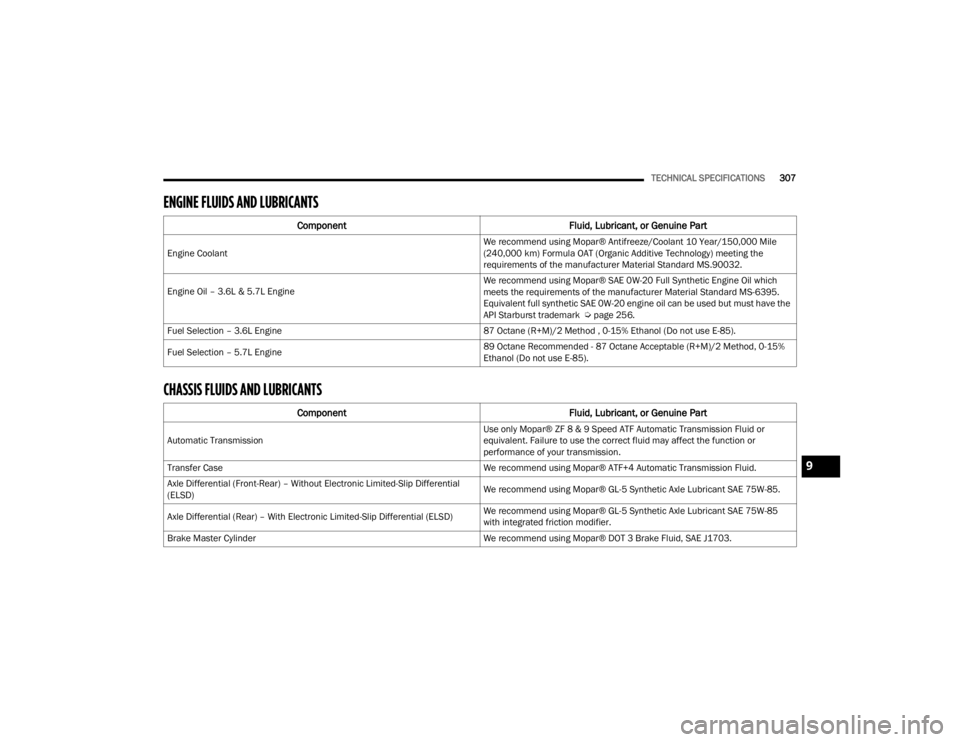
ENGINE FLUIDS AND LUBRICANTS
CHASSIS FLUIDS AND LUBRICANTS
Component Fluid, Lubricant, or Genuine Part
Engine Coolant We recommend using Mopar® Antifreeze/Coolant 10 Year/150,000 Mile
(240,000 km) Formula OAT (Organic Additive Technology) meeting the
requirements of the manufacturer Material Standard MS.90032.
Engine Oil – 3.6L & 5.7L Engine
We recommend using Mopar® SAE 0W-20 Full Synthetic Engine Oil which
meets the requirements of the manufacturer Material Standard MS-6395.
Equivalent full synthetic SAE 0W-20 engine oil can be used but must have the
API Starburst trademark Ú
page 256.
Fuel Selection – 3.6L Engine 87 Octane (R+M)/2 Method , 0-15% Ethanol (Do not use E-85).
Fuel Selection – 5.7L Engine 89 Octane Recommended - 87 Octane Acceptable (R+M)/2 Method, 0-15%
Ethanol (Do not use E-85).
Component
Fluid, Lubricant, or Genuine Part
Automatic Transmission Use only Mopar® ZF 8 & 9 Speed ATF Automatic Transmission Fluid or
equivalent. Failure to use the correct fluid may affect the function or
performance of your transmission.
Transfer Case We recommend using Mopar® ATF+4 Automatic Transmission Fluid.
Axle Differential (Front-Rear) – Without Electronic Limited-Slip Differential
(ELSD) We recommend using Mopar® GL-5 Synthetic Axle Lubricant SAE 75W-85.
Axle Differential (Rear) – With Electronic Limited-Slip Differential (ELSD) We recommend using Mopar® GL-5 Synthetic Axle Lubricant SAE 75W-85
with integrated friction modifier.
Brake Master Cylinder We recommend using Mopar® DOT 3 Brake Fluid, SAE J1703.
9
23_WD_OM_EN_USC_t.book Page 307
Page 317 of 328

315
Door Locks
............................................... 21, 25Child-Protection Door Lock — Rear Doors.... 25Doors............................................................... 21Driver’s Seat Back Tilt..................................... 28Driving........................................................... 150
E
Economy (Fuel) Mode.................................... 104Electric Brake Control System....................... 178Anti-Lock Brake System............................. 177Electronic Roll Mitigation................. 179, 182Electric Remote Mirrors................................... 41Electrical Outlet, Auxiliary (Power Outlet)......... 65Electronic Speed Control (Cruise Control)...... 116Electronic Stability Control (ESC)...................180Electronic Throttle Control Warning Light........ 89Electronically Shifted Transfer Case.... 108, 109Emergency Gas Can Refueling...................... 242Emergency, In Case Of Freeing Vehicle When Stuck...................... 245Hazard Warning Flasher............................ 229Jacking...................................................... 232Jump Starting............................................ 239Emission Control System Maintenance........... 96
Engine........................................................... 253Air Cleaner................................................ 257Break-In Recommendations..................... 101Checking Oil Level.................................... 255Compartment.................................. 253, 254Compartment Identification............. 253, 254Cooling..................................................... 265Exhaust Gas Caution................................ 228Fails To Start............................................ 101Flooded, Starting...................................... 101Fuel Requirements.......................... 303, 306Jump Starting........................................... 239Oil.................................................... 256, 306Oil Filler Cap............................................. 253Oil Filter.................................................... 257Oil Selection........................... 256, 306, 307Oil Synthetic............................................. 257Starting........................................................ 98Engine Oil Life Reset
b
.................................. 82
Enhanced Accident Response Feature...209, 248
Ethanol......................................................... 304Exhaust Gas Cautions................................... 228Exhaust System................................... 228, 264Exterior Lights............................... 45, 227, 278
F
FiltersAir Cleaner
................................................ 257Air Conditioning........................ 60, 257, 259Engine Oil................................................. 257Engine Oil Disposal................................... 257Flashers........................................................ 229Hazard Warning........................................ 229Turn Signals.............................. 95, 227, 280Flash-To-Pass...................................................47Flooded Engine Starting................................ 101Fluid Capacities............................................ 306Fluid Leaks.................................................... 228Fluid Level ChecksBrake........................................................ 268Engine Oil................................................. 255Fluids And Lubricants.................................... 307Fog Lights..................................................... 280Fog Lights, Service........................................ 280Fold-Flat Seats.................................................28Folding Rear Seats...........................................30Forward Collision Warning............................ 186Four-Way Hazard Flasher.............................. 229Freeing A Stuck Vehicle................................. 245Front Axle (Differential)................................. 269
11
23_WD_OM_EN_USC_t.book Page 315