fuel DODGE DURANGO 2023 Owner's Guide
[x] Cancel search | Manufacturer: DODGE, Model Year: 2023, Model line: DURANGO, Model: DODGE DURANGO 2023Pages: 328, PDF Size: 13.82 MB
Page 243 of 328
IN CASE OF EMERGENCY241
NOTE:Make sure at all times that unused ends of jumper
cables are not contacting each other or either
vehicle while making connections.
Connecting The Jumper Cables
1. Connect the positive
(+) end of the jumper
cable to the remote positive (+)
post of the
discharged vehicle.
2. Connect the opposite end of the positive (+)
jumper cable to the positive (+) post of the
booster battery.
3. Connect the negative (-) end of the jumper
cable to the negative (-) post of the booster
battery.
4. Connect the opposite end of the negative (-)
jumper cable to the remote negative (-) post
(exposed metallic/unpainted post of the
discharge vehicle) located on the right hand
side next to the underhood fuse box. 5. Start the engine in the vehicle that has the
booster battery, let the engine idle a few
minutes, and then start the engine in the
vehicle with the discharged battery.
6. Once the engine is started, follow the discon -
necting procedure.
Disconnecting The Jumper Cables
1. Disconnect the negative
(-) end of the jumper
cable from the remote negative (-)
post of the
discharged vehicle.
2. Disconnect the opposite end of the negative (-)
jumper cable from the negative (-) post of the
booster battery.
3. Disconnect the positive (+) end of the jumper
cable from the positive (+) post of the booster
battery. 4. Disconnect the opposite end of the positive
(+)
jumper cable from the remote positive (+) post
of the discharged vehicle.
5. Reinstall the protective covers over the remote positive (+) and negative (-) posts of the
discharged vehicle.
If frequent jump starting is required to start your
vehicle have the battery and charging system
tested at an authorized dealer.
WARNING!
Do not connect the jumper cable to the negative
(-) post of the discharged battery. The resulting
electrical spark could cause the battery to
explode and could result in personal injury.
CAUTION!
Do not run the booster vehicle engine above
2,000 RPM since it provides no charging benefit,
wastes fuel, and can damage booster vehicle
engine.
CAUTION!
Accessories plugged into the vehicle power
outlets draw power from the vehicle’s battery,
even when not in use (i.e., cellular devices, etc.).
Eventually, if plugged in long enough without
engine operation, the vehicle’s battery will
discharge sufficiently to degrade battery life
and/or prevent the engine from starting.
7
23_WD_OM_EN_USC_t.book Page 241
Page 244 of 328
242IN CASE OF EMERGENCY
REFUELING IN EMERGENCY – IF EQUIPPED
The vehicle is equipped with a refueling funnel for
a Cap-Less Fuel System. The fuel funnel can be
found in the rear cargo area with the jack and
tools. If refueling is necessary, while using an
approved gas can, insert the refueling funnel into
the filler neck opening. Take care to open both
flappers with the funnel to avoid spills.
NOTE:In certain cold conditions, ice may prevent the fuel
door from opening. If this occurs, lightly push on
the fuel door to break the ice buildup and
re-release the fuel door using the inside release
button. Do not pry on the door.
Refueling Funnel
Emergency Gas Can Refueling
Most gas cans will not open the flapper doors. A
funnel is provided to allow emergency refueling
with a gas can.
See the following steps for refueling:
1. Retrieve funnel from the rear cargo storage area.
Refueling Funnel Location
2. Insert funnel into same filler pipe opening as the fuel nozzle.
Inserting Funnel
3. Ensure funnel is inserted fully to hold flapper doors open.
4. Pour fuel into funnel opening.
WARNING!
Never have any smoking materials lit in or
near the vehicle when the fuel door is open or
the tank is being filled.
Never add fuel when the engine is running.
This is in violation of most state and federal
fire regulations and may cause the Malfunc -
tion Indicator Light to turn on.
A fire may result if fuel is pumped into a
portable container that is inside of a vehicle.
You could be burned. Always place fuel
containers on the ground while filling.
23_WD_OM_EN_USC_t.book Page 242
Page 245 of 328
IN CASE OF EMERGENCY243
5. Remove funnel from filler pipe, clean off prior to putting back in the spare tire storage area.
IF YOUR ENGINE OVERHEATS
If the vehicle is overheating, it will need to be
serviced by an authorized dealer.
Potential signs of vehicle overheating can be:
Temperature gauge is at HOT (H)
Strong smell of coolant
White smoke coming from engine or exhaust
Coolant bottle coolant has bubbles present In the event it is observed that the temperature
gauge is moving towards or close to the HOT (H)
position, you can reduce the potential for
overheating by taking the appropriate action.
On the highways — slow down.
In city traffic — while stopped, place the trans
-
mission in NEUTRAL (N), but do not increase the
engine idle speed while preventing vehicle
motion with the brakes.
If your Air Conditioner (A/C) is on, turn it off. The
A/C system adds heat to the engine cooling
system and turning the A/C off can help remove
this heat.
You can also turn the temperature control to
maximum heat, the mode control to floor and
the blower control to high. This allows the heater
core to act as a supplement to the radiator and
aids in removing heat from the engine cooling
system.
MANUAL PARK RELEASE
In order to move the vehicle in cases where the
transmission will not shift out of PARK (P) (such as
a depleted battery), a Manual Park Release is
available.
CAUTION!
To avoid fuel spillage and overfilling, do not “top
off” the fuel tank after filling.
WARNING!
You or others can be badly burned by hot engine
coolant (antifreeze) or steam from your radiator.
If you see or hear steam coming from under the
hood, do not open the hood until the radiator
has had time to cool. Never try to open a cooling
system pressure cap when the radiator or
coolant bottle is hot.CAUTION!
Driving with a hot cooling system could damage
your vehicle. If the temperature gauge reads
HOT (H), pull over and stop the vehicle. Idle the
vehicle with the air conditioner turned off until
the pointer drops back into the normal range. If
the pointer remains on HOT (H), and you hear
continuous chimes, turn the engine off
immediately and call for service.
WARNING!
Always secure your vehicle by fully applying the
parking brake before activating the Manual Park
Release. In addition, you should be seated in the
driver’s seat with your foot firmly on the brake
pedal when activating the Manual Park Release.
Activating the Manual Park Release will allow
your vehicle to roll away if it is not secured by the
parking brake, or by proper connection to a tow
vehicle. Activating the Manual Park Release on
an unsecured vehicle could lead to serious
injury or death for those in or around the vehicle.
7
23_WD_OM_EN_USC_t.book Page 243
Page 251 of 328
249
SERVICING AND MAINTENANCE
SCHEDULED SERVICING
Your vehicle is equipped with an automatic oil
change indicator system. The oil change indicator
system will remind you that it is time to take your
vehicle in for scheduled maintenance.
Based on engine operation conditions, the oil
change indicator message will illuminate. This
means that service is required for your vehicle.
Operating conditions such as frequent short-trips,
trailer tow, extremely hot or cold ambient
temperatures, and E85 fuel usage will influence
when the “Oil Change Required” message is
displayed. Have your vehicle serviced as soon as
possible, within the next 500 miles (805 km).An authorized dealer will reset the oil change
indicator message after completing the scheduled
oil change.
NOTE:Under no circumstances should oil change
intervals exceed 10,000 miles (16,000 km),
12 months or 350 hours of engine run time,
whichever comes first. The 350 hours of engine
run or idle time is generally only a concern for fleet
customers.
Once A Month Or Before A Long Trip:
Check engine oil level
Check windshield washer fluid level
Check the tire pressure and look for unusual
wear or damage
Check the fluid levels of the coolant reservoir,
brake master cylinder and fill as needed
Check function of all interior and exterior lights
8
23_WD_OM_EN_USC_t.book Page 249
Page 257 of 328
SERVICING AND MAINTENANCE255
CHECKING OIL LEVEL
To ensure proper engine lubrication, the engine oil
must be maintained at the correct level. Check the
oil level at regular intervals, such as every fuel
stop. The best time to check the engine oil level is
about five minutes after a fully warmed up engine
is shut off.
Checking the oil while the vehicle is on level ground
will improve the accuracy of the oil level readings.
There are four possible dipstick types:
Crosshatched zone.
Crosshatched zone marked SAFE.
Crosshatched zone marked with MIN at the low
end of the range and MAX at the high end of the
range.
Crosshatched zone marked with dimples at the
MIN and the MAX ends of the range.
NOTE:Always maintain the oil level within the crosshatch
markings on the dipstick.
Adding 1 qt (1.0 L) of oil when the reading is at the
low end of the dipstick range will raise the oil level
to the high end of the range marking.
ADDING WASHER FLUID
The instrument cluster display will indicate when
the washer fluid level is low. When the sensor
detects a low fluid level, the Low Washer Fluid
Warning Light will illuminate and the "Washer Fluid
Low" message will display.
The fluid reservoir for the windshield washers and
the rear window washer is shared. The fluid
reservoir is located in the engine compartment, be
sure to check the fluid level at regular intervals. Fill
the reservoir with windshield washer solvent only
(not radiator antifreeze). When refilling the washer
fluid reservoir, take some washer fluid and apply it
to a cloth or towel and wipe clean the wiper blades,
this will help blade performance. To prevent
freeze-up of your windshield washer system in cold
weather, select a solution or mixture that meets or
exceeds the temperature range of your climate.
This rating information can be found on most
washer fluid containers.MAINTENANCE-FREE BATTERY
Your vehicle is equipped with a maintenance-free
battery. Water will never have to be added, and
periodic maintenance is not required.
CAUTION!
Overfilling or underfilling the crankcase will
cause aeration or loss of oil pressure. This could
damage your engine.
WARNING!
Commercially available windshield washer
solvents are flammable. They could ignite and
burn you. Care must be exercised when filling or
working around the washer solution.
WARNING!
Battery fluid is a corrosive acid solution and
can burn or even blind you. Do not allow
battery fluid to contact your eyes, skin, or
clothing. Do not lean over a battery when
attaching clamps Úpage 239. If acid
splashes in eyes or on skin, flush the area
immediately with large amounts of water.
Battery gas is flammable and explosive. Keep
flame or sparks away from the battery. Do not
use a booster battery or any other booster
source with an output greater than 12 Volts. Do
not allow cable clamps to touch each other.
Battery posts, terminals, and related accesso -
ries contain lead and lead compounds. Wash
hands after handling.
8
23_WD_OM_EN_USC_t.book Page 255
Page 267 of 328
SERVICING AND MAINTENANCE265
Under normal operating conditions, the catalytic
converter will not require maintenance. However, it
is important to keep the engine properly tuned to
ensure proper catalyst operation and prevent
possible catalyst damage.
NOTE:Intentional tampering with emissions control
systems can result in civil penalties being
assessed against you.
In unusual situations involving grossly
malfunctioning engine operation, a scorching odor
may suggest severe and abnormal catalyst
overheating. If this occurs, stop the vehicle, turn off
the engine and allow it to cool. Service, including a
tune-up to the manufacturer's specifications,
should be obtained immediately.
To minimize the possibility of catalytic converter
damage:
Do not interrupt the ignition when the transmis -
sion is in gear and the vehicle is in motion.
Do not try to start the vehicle by pushing or
towing the vehicle.
Do not idle the engine with any ignition compo -
nents disconnected or removed, such as when
diagnostic testing, or for prolonged periods
during very rough idle or malfunctioning oper -
ating conditions.
COOLING SYSTEMCAUTION!
The catalytic converter requires the use of
unleaded fuel only. Leaded gasoline will
destroy the effectiveness of the catalyst as an
emissions control device and may seriously
reduce engine performance and cause
serious damage to the engine.
Damage to the catalytic converter can result if
your vehicle is not kept in proper operating
condition. In the event of engine malfunction,
particularly involving engine misfire or other
apparent loss of performance, have your
vehicle serviced promptly. Continued opera -
tion of your vehicle with a severe malfunction
could cause the converter to overheat,
resulting in possible damage to the converter
and vehicle.
WARNING!
You or others can be badly burned by hot
engine coolant (antifreeze) or steam from your
radiator. If you see or hear steam coming from
under the hood, do not open the hood until the
radiator has had time to cool. Never open a
cooling system pressure cap when the radi -
ator or coolant bottle is hot.
Keep hands, tools, clothing, and jewelry away
from the radiator cooling fan when the hood is
raised. The fan starts automatically and may
start at any time, whether the engine is
running or not.
When working near the radiator cooling fan,
disconnect the fan motor lead or turn the igni -
tion to the OFF mode. The fan is temperature
controlled and can start at any time the igni -
tion is in the ON mode.
8
23_WD_OM_EN_USC_t.book Page 265
Page 275 of 328
SERVICING AND MAINTENANCE273
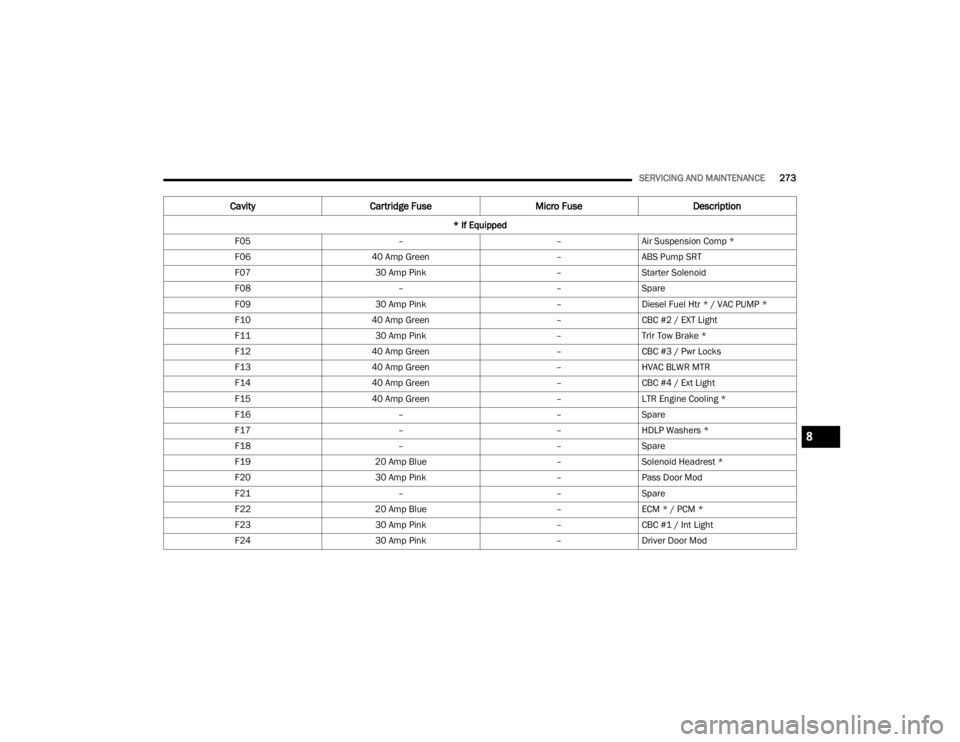
F05 ––Air Suspension Comp *
F06 40 Amp Green –ABS Pump SRT
F07 30 Amp Pink –Starter Solenoid
F08 ––Spare
F09 30 Amp Pink –Diesel Fuel Htr * / VAC PUMP *
F10 40 Amp Green –CBC #2 / EXT Light
F11 30 Amp Pink –Trlr Tow Brake *
F12 40 Amp Green –CBC #3 / Pwr Locks
F13 40 Amp Green –HVAC BLWR MTR
F14 40 Amp Green –CBC #4 / Ext Light
F15 40 Amp Green –LTR Engine Cooling *
F16 ––Spare
F17 ––HDLP Washers *
F18 ––Spare
F19 20 Amp Blue –Solenoid Headrest *
F20 30 Amp Pink –Pass Door Mod
F21 ––Spare
F22 20 Amp Blue –ECM * / PCM *
F23 30 Amp Pink –CBC #1 / Int Light
F24 30 Amp Pink –Driver Door Mod
Cavity Cartridge Fuse Micro FuseDescription
* If Equipped
8
23_WD_OM_EN_USC_t.book Page 273
Page 277 of 328
SERVICING AND MAINTENANCE275
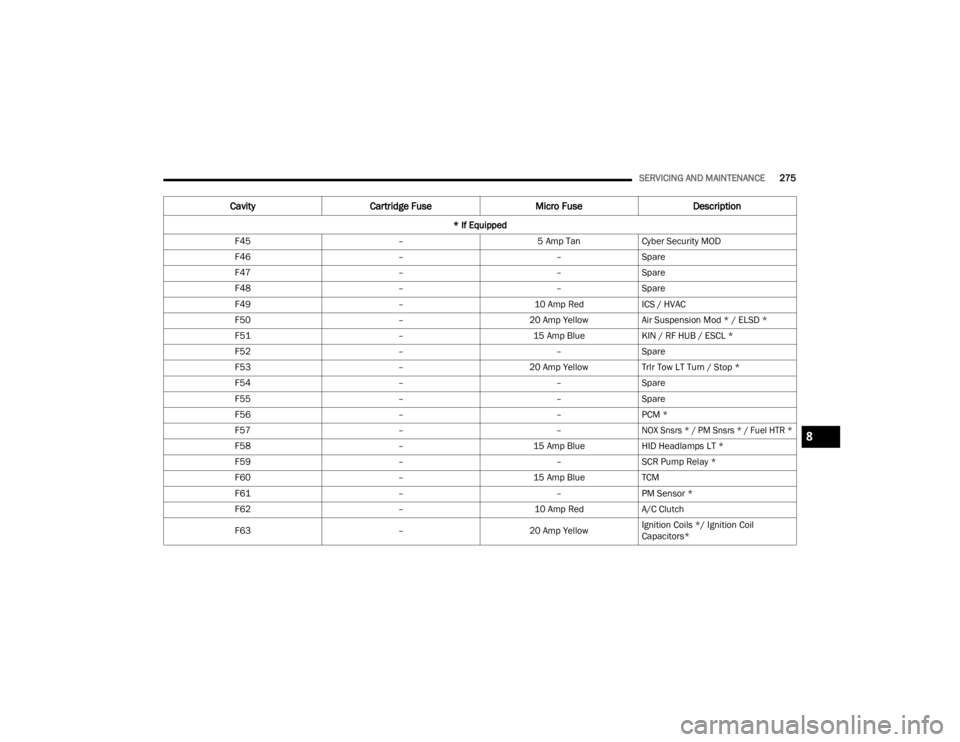
F45 –5 Amp TanCyber Security MOD
F46 ––Spare
F47 ––Spare
F48 ––Spare
F49 –10 Amp RedICS / HVAC
F50 –20 Amp YellowAir Suspension Mod * / ELSD *
F51 –15 Amp BlueKIN / RF HUB / ESCL *
F52 ––Spare
F53 –20 Amp YellowTrlr Tow LT Turn / Stop *
F54 ––Spare
F55 ––Spare
F56 ––PCM *
F57 ––
NOX Snsrs * / PM Snsrs * / Fuel HTR *
F58 –15 Amp BlueHID Headlamps LT *
F59 ––SCR Pump Relay *
F60 –15 Amp BlueTCM
F61 ––PM Sensor *
F62 –10 Amp RedA/C Clutch
F63 –20 Amp YellowIgnition Coils */ Ignition Coil
Capacitors*
Cavity
Cartridge Fuse Micro FuseDescription
* If Equipped
8
23_WD_OM_EN_USC_t.book Page 275
Page 278 of 328
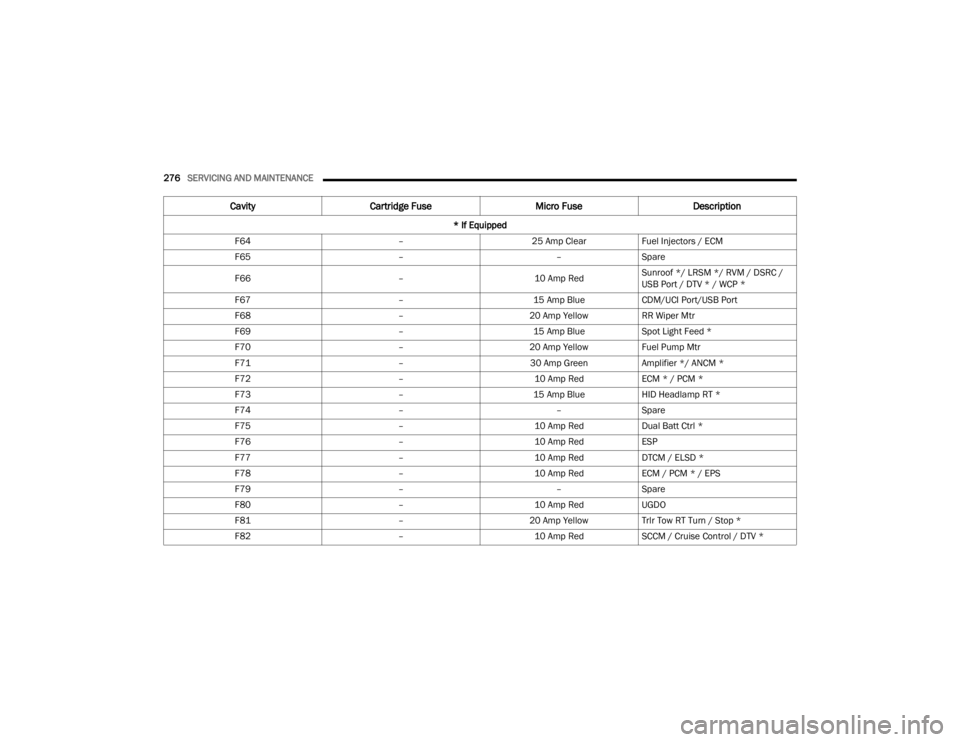
276SERVICING AND MAINTENANCE
F64 –25 Amp ClearFuel Injectors / ECM
F65 ––Spare
F66 –10 Amp RedSunroof */ LRSM */ RVM / DSRC /
USB Port / DTV * / WCP *
F67 –15 Amp BlueCDM/UCI Port/USB Port
F68 –20 Amp YellowRR Wiper Mtr
F69 –15 Amp BlueSpot Light Feed *
F70 –20 Amp YellowFuel Pump Mtr
F71 –30 Amp GreenAmplifier */ ANCM *
F72 –10 Amp RedECM * / PCM *
F73 –15 Amp BlueHID Headlamp RT *
F74 ––Spare
F75 –10 Amp RedDual Batt Ctrl *
F76 –10 Amp RedESP
F77 –10 Amp RedDTCM / ELSD *
F78 –10 Amp RedECM / PCM * / EPS
F79 ––Spare
F80 –10 Amp RedUGDO
F81 –20 Amp YellowTrlr Tow RT Turn / Stop *
F82 –10 Amp RedSCCM / Cruise Control / DTV *
Cavity Cartridge Fuse Micro FuseDescription
* If Equipped
23_WD_OM_EN_USC_t.book Page 276
Page 279 of 328
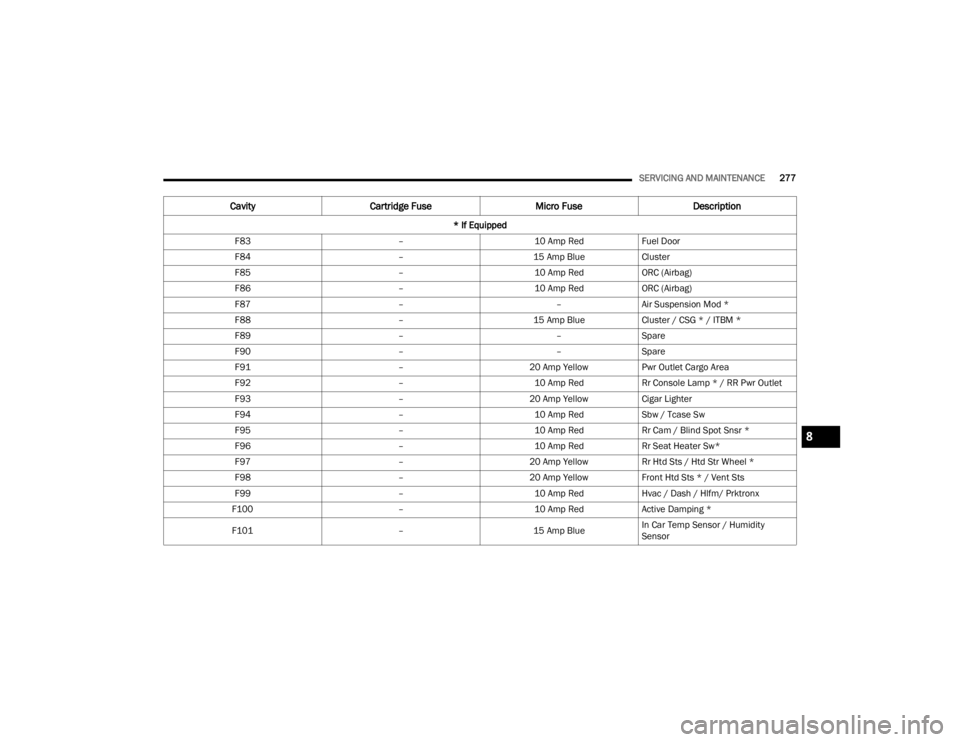
SERVICING AND MAINTENANCE277
F83 –10 Amp RedFuel Door
F84 –15 Amp BlueCluster
F85 –10 Amp RedORC (Airbag)
F86 –10 Amp RedORC (Airbag)
F87 ––Air Suspension Mod *
F88 –15 Amp BlueCluster / CSG * / ITBM *
F89 ––Spare
F90 ––Spare
F91 –20 Amp YellowPwr Outlet Cargo Area
F92 –10 Amp RedRr Console Lamp * / RR Pwr Outlet
F93 –20 Amp YellowCigar Lighter
F94 –10 Amp RedSbw / Tcase Sw
F95 –10 Amp RedRr Cam / Blind Spot Snsr *
F96 –10 Amp RedRr Seat Heater Sw*
F97 –20 Amp YellowRr Htd Sts / Htd Str Wheel *
F98 –20 Amp YellowFront Htd Sts * / Vent Sts
F99 –10 Amp RedHvac / Dash / Hlfm/ Prktronx
F100 –10 Amp RedActive Damping *
F101 –15 Amp BlueIn Car Temp Sensor / Humidity
Sensor
Cavity
Cartridge Fuse Micro FuseDescription
* If Equipped
8
23_WD_OM_EN_USC_t.book Page 277