coolant flush DODGE DURANGO SRT 2018 Owners Manual
[x] Cancel search | Manufacturer: DODGE, Model Year: 2018, Model line: DURANGO SRT, Model: DODGE DURANGO SRT 2018Pages: 568, PDF Size: 6.54 MB
Page 396 of 568
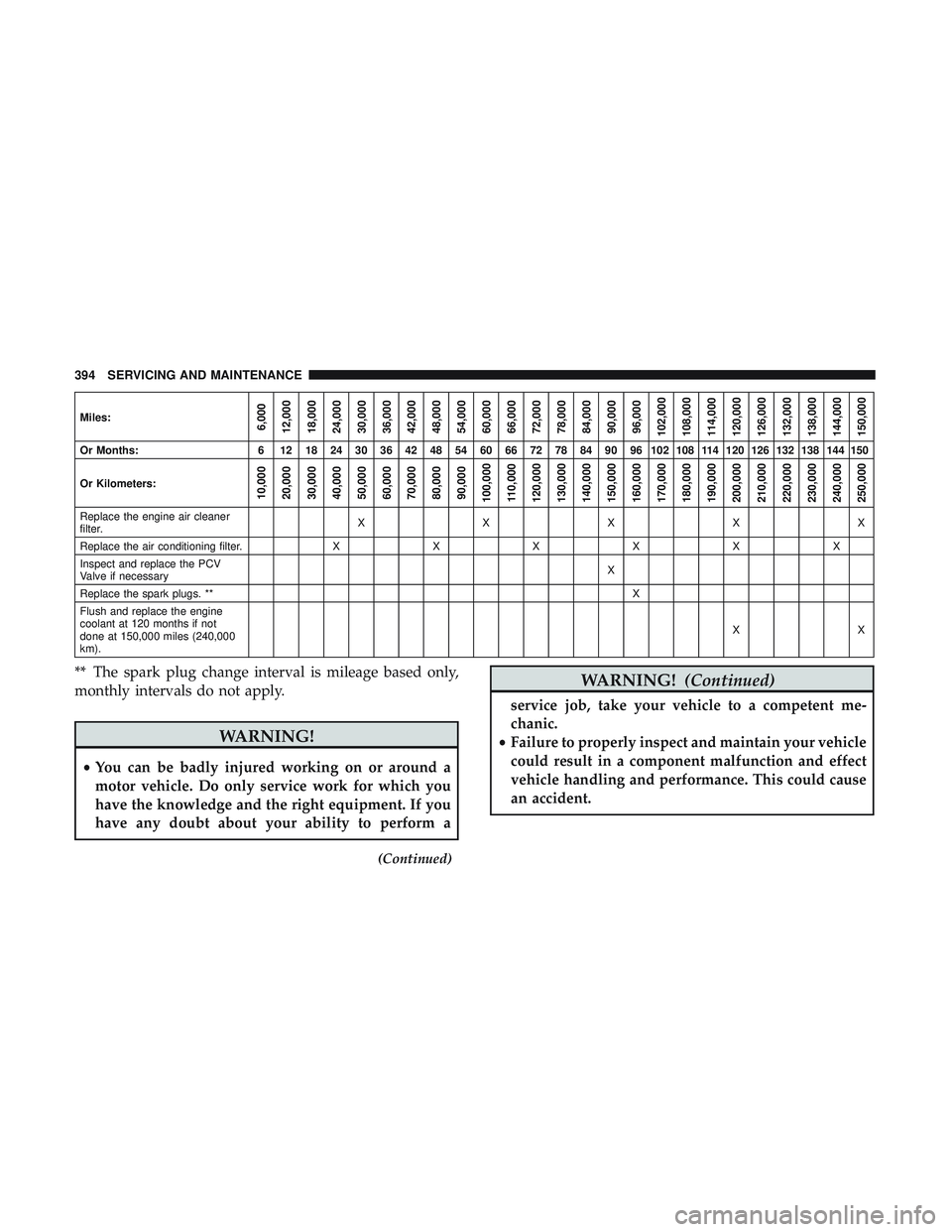
Miles:6,000
12,000
18,000
24,000
30,000
36,000
42,000
48,000
54,000
60,000
66,000
72,000
78,000
84,000
90,000
96,000
102,000
108,000 114,000
120,000
126,000
132,000
138,000
144,000
150,000
Or Months: 6 12 18 24 30 36 42 48 54 60 66 72 78 84 90 96 102 108 114 120 126 132 138 144 150
Or Kilometers:
10,000
20,000
30,000
40,000
50,000
60,000
70,000
80,000
90,000
100,000
110,000
120,000
130,000
140,000
150,000
160,000
170,000
180,000
190,000
200,000
210,000
220,000
230,000
240,000
250,000
Replace the engine air cleaner
filter. XXXXX
Replace the air conditioning filter. X X X X X X
Inspect and replace the PCV
Valve if necessary X
Replace the spark plugs. ** X
Flush and replace the engine
coolant at 120 months if not
done at 150,000 miles (240,000
km). XX
** The spark plug change interval is mileage based only,
monthly intervals do not apply.
WARNING!
•
You can be badly injured working on or around a
motor vehicle. Do only service work for which you
have the knowledge and the right equipment. If you
have any doubt about your ability to perform a
(Continued)
WARNING! (Continued)
service job, take your vehicle to a competent me-
chanic.
• Failure to properly inspect and maintain your vehicle
could result in a component malfunction and effect
vehicle handling and performance. This could cause
an accident.
394 SERVICING AND MAINTENANCE
Page 414 of 568
In unusual situations involving grossly malfunctioning
engine operation, a scorching odor may suggest severe and
abnormal catalyst overheating. If this occurs, stop the
vehicle, turn off the engine and allow it to cool. Service,
including a tune-up to manufacturer’s specifications,
should be obtained immediately.
To minimize the possibility of catalytic converter damage:
•Do not interrupt the ignition when the transmission is in
gear and the vehicle is in motion.
• Do not try to start the vehicle by pushing or towing the
vehicle.
• Do not idle the engine with any ignition components
disconnected or removed, such as when diagnostic
testing, or for prolonged periods during very rough idle
or malfunctioning operating conditions.
Cooling System
WARNING!
•You or others can be badly burned by hot engine
coolant (antifreeze) or steam from your radiator. If
you see or hear steam coming from under the hood,
(Continued)
WARNING! (Continued)
do not open the hood until the radiator has had time
to cool. Never open a cooling system pressure cap
when the radiator or coolant bottle is hot.
• Keep hands, tools, clothing, and jewelry away from
the radiator cooling fan when the hood is raised. The
fan starts automatically and may start at any time,
whether the engine is running or not.
• When working near the radiator cooling fan, discon-
nect the fan motor lead or turn the ignition to the
OFF mode. The fan is temperature controlled and can
start at any time the ignition is in the ON mode.
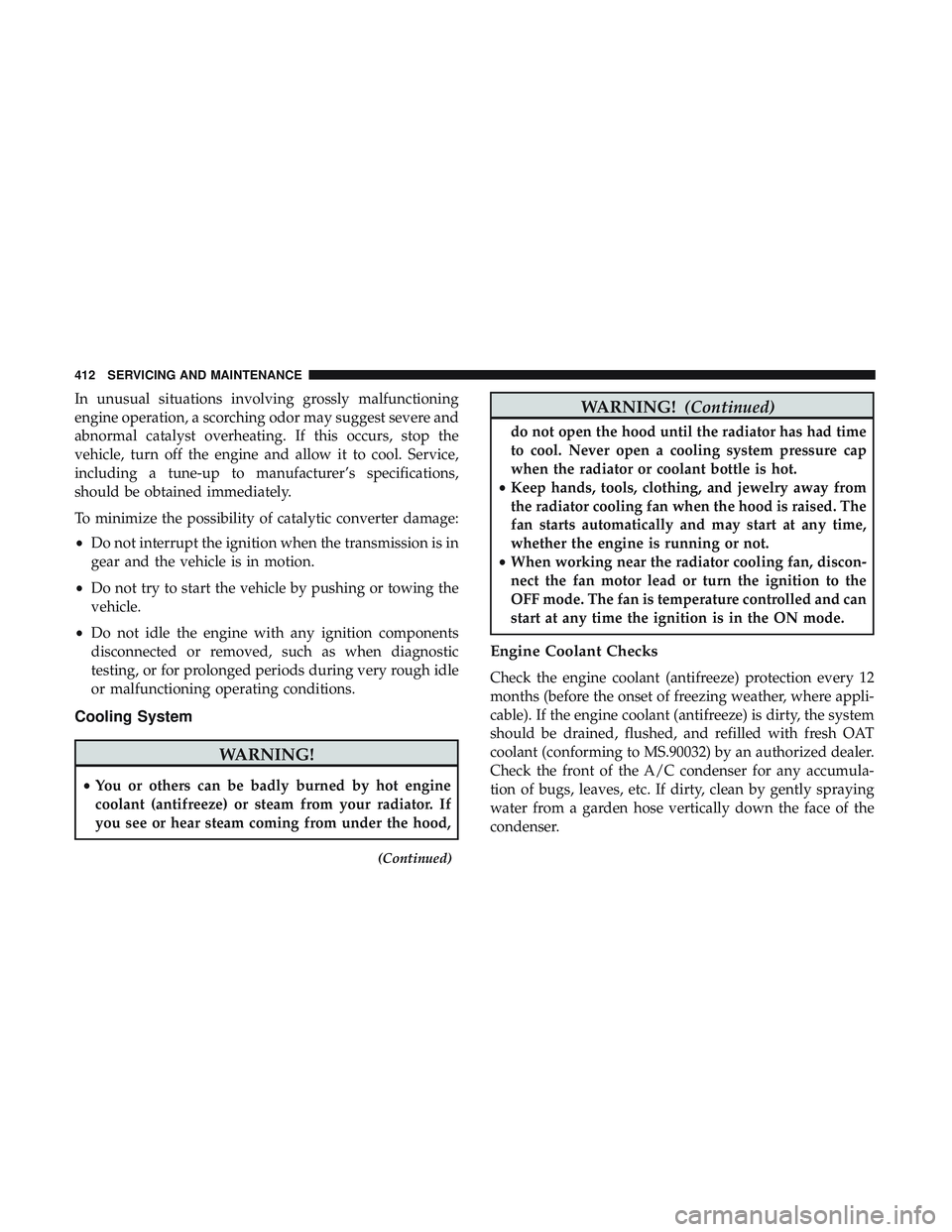
Engine Coolant Checks
Check the engine coolant (antifreeze) protection every 12
months (before the onset of freezing weather, where appli-
cable). If the engine coolant (antifreeze) is dirty, the system
should be drained, flushed, and refilled with fresh OAT
coolant (conforming to MS.90032) by an authorized dealer.
Check the front of the A/C condenser for any accumula-
tion of bugs, leaves, etc. If dirty, clean by gently spraying
water from a garden hose vertically down the face of the
condenser.
412 SERVICING AND MAINTENANCE
Page 415 of 568

Check the engine cooling system hoses for brittle rubber,
cracking, tears, cuts, and tightness of the connection at the
coolant recovery bottle and radiator. Inspect the entire
system for leaks. DO NOT REMOVE THE COOLANT
PRESSURE CAP WHEN THE COOLING SYSTEM IS HOT.
Cooling System — Drain, Flush And Refill
NOTE:Some vehicles require special tools to add coolant
properly. Failure to fill these systems properly could lead to
severe internal engine damage. If any coolant is needed to be
added to the system please contact your local authorized dealer.
If the engine coolant (antifreeze) is dirty or contains visible
sediment, have an authorized dealer clean and flush with
OAT coolant (antifreeze) (conforming to MS.90032).
Refer to the “Maintenance Plan” in this section for the
proper maintenance intervals.
Selection Of Coolant
Refer to “Fluids And Lubricants” in “Technical Specifica-
tions” for further information.
NOTE:
•
Mixing of engine coolant (antifreeze) other than specified
Organic Additive Technology (OAT) engine coolant (anti-
freeze), may result in engine damage and may decrease corrosion protection. Organic Additive Technology (OAT)
engine coolant is different and should not be mixed with
Hybrid Organic Additive Technology (HOAT) engine cool-
ant (antifreeze) or any “globally compatible” coolant (anti-
freeze). If a non-OAT engine coolant (antifreeze) is intro-
duced into the cooling system in an emergency, the cooling
system will need to be drained, flushed, and refilled with
fresh OAT coolant (conforming to MS.90032), by an autho-
rized dealer as soon as possible.
•
Do not use water alone or alcohol-based engine coolant
(antifreeze) products. Do not use additional rust inhibi-
tors or antirust products, as they may not be compatible
with the radiator engine coolant and may plug the
radiator.
• This vehicle has not been designed for use with propyl-
ene glycol-based engine coolant (antifreeze). Use of
propylene glycolbased engine coolant (antifreeze) is not
recommended.
• Some vehicles require special tools to add coolant prop-
erly. Failure to fill these systems properly could lead to
severe internal engine damage. If any coolant is needed
to be added to the system please contact an authorized
dealer.
8
SERVICING AND MAINTENANCE 413
Page 416 of 568
Adding Coolant
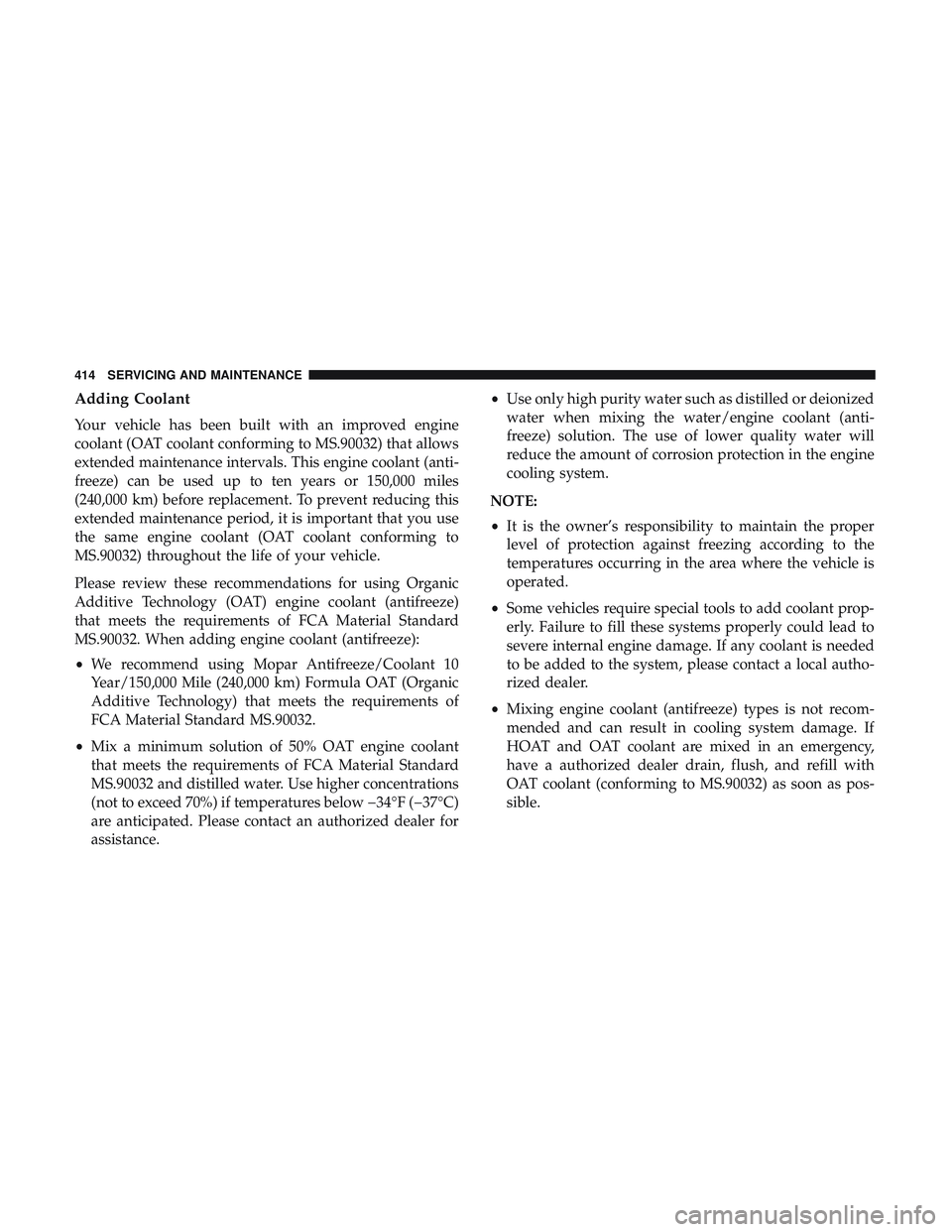
Your vehicle has been built with an improved engine
coolant (OAT coolant conforming to MS.90032) that allows
extended maintenance intervals. This engine coolant (anti-
freeze) can be used up to ten years or 150,000 miles
(240,000 km) before replacement. To prevent reducing this
extended maintenance period, it is important that you use
the same engine coolant (OAT coolant conforming to
MS.90032) throughout the life of your vehicle.
Please review these recommendations for using Organic
Additive Technology (OAT) engine coolant (antifreeze)
that meets the requirements of FCA Material Standard
MS.90032. When adding engine coolant (antifreeze):
•We recommend using Mopar Antifreeze/Coolant 10
Year/150,000 Mile (240,000 km) Formula OAT (Organic
Additive Technology) that meets the requirements of
FCA Material Standard MS.90032.
• Mix a minimum solution of 50% OAT engine coolant
that meets the requirements of FCA Material Standard
MS.90032 and distilled water. Use higher concentrations
(not to exceed 70%) if temperatures below 34°F (37°C)
are anticipated. Please contact an authorized dealer for
assistance. •
Use only high purity water such as distilled or deionized
water when mixing the water/engine coolant (anti-
freeze) solution. The use of lower quality water will
reduce the amount of corrosion protection in the engine
cooling system.
NOTE:
• It is the owner’s responsibility to maintain the proper
level of protection against freezing according to the
temperatures occurring in the area where the vehicle is
operated.
• Some vehicles require special tools to add coolant prop-
erly. Failure to fill these systems properly could lead to
severe internal engine damage. If any coolant is needed
to be added to the system, please contact a local autho-
rized dealer.
• Mixing engine coolant (antifreeze) types is not recom-
mended and can result in cooling system damage. If
HOAT and OAT coolant are mixed in an emergency,
have a authorized dealer drain, flush, and refill with
OAT coolant (conforming to MS.90032) as soon as pos-
sible.
414 SERVICING AND MAINTENANCE
Page 554 of 568
Carbon Monoxide Warning................248, 456
Cargo Area Cover .......................106, 107
Cargo Compartment ........................106
Light .................................106
Luggage Carrier ........................ .127
Cargo Light ............................. .106
Cargo Tie-Downs .......................... .107
Car Washes ...............................445
Cellular Phone ............................525
Center High Mounted Stop Light ...............362
Chains, Tire ............................. .441
Changing A Flat Tire ........................420
Chart, Tire Sizing .......................... .422
Check Engine Light (Malfunction Indicator Light). . . .164
Checking Your Vehicle For Safety ...............248
Checks, Safety ............................ .248
Child Restraint ............................224
Child Restraints Booster Seats ............................227
Child Seat Installation .....................242
How To Stow An unused ALR Seat Belt ........239
Infant And Child Restraints .................226
Locating The LATCH Anchorages .............232
Lower Anchors And Tethers For Children .......229
Older Children And Child Restraints ...........226Seating Positions
........................ .228
Child Safety Locks ..........................38
Clean Air Gasoline ........................ .453
Cleaning Wheels ............................... .440
Climate Control ............................81
Automatic ..............................82
Cold Weather Operation ..................... .262
Compact Disc (CD) Maintenance ................541
Compact Spare Tire ........................ .438
Contract, Service .......................... .546
Cooling Pressure Cap (Radiator Cap) ............415
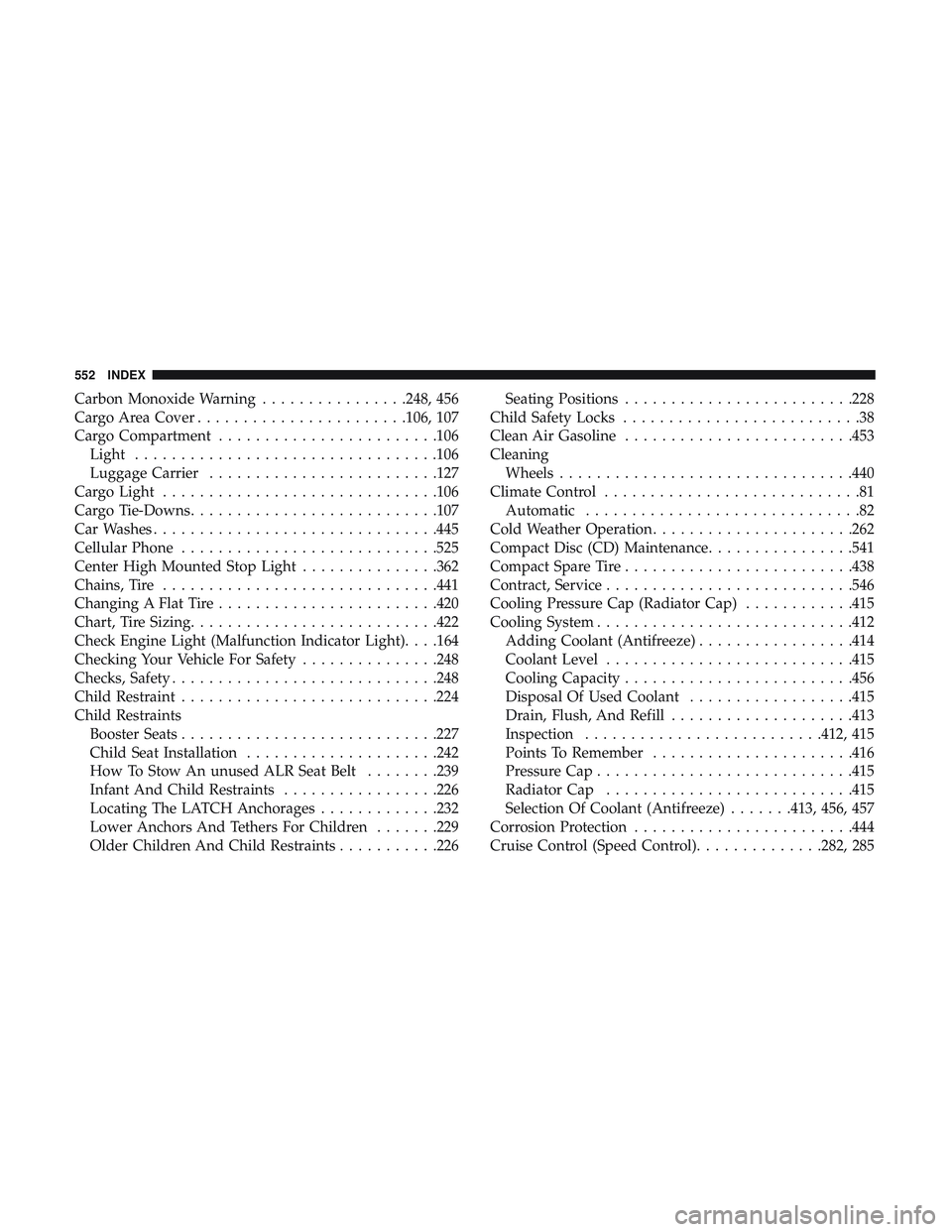
Cooling System............................412
Adding
Coolant (Antifreeze) .................414
Coolant Level .......................... .415
Cooling Capacity ........................ .456
Disposal Of Used Coolant ..................415
Drain, Flush, And Refill ....................413
Inspection ..........................412, 415
Points To Remember ..................... .416
Pressure Cap ............................415
Radiator Cap .......................... .415
Selection Of Coolant (Antifreeze) .......413, 456, 457
Corrosion Protection ........................444
Cruise Control (Speed Control) ..............282, 285
552 INDEX