service DODGE GRAND CARAVAN 2004 Workshop Manual
[x] Cancel search | Manufacturer: DODGE, Model Year: 2004, Model line: GRAND CARAVAN, Model: DODGE GRAND CARAVAN 2004Pages: 397, PDF Size: 7.59 MB
Page 314 of 397
Power Steering Ð Fluid Check
Checking the power steering fluid level at a defined
service interval is not required. The fluid should only be
checked if a leak is suspected, abnormal noises are
apparent, and/or the system is not functioning as antici-
pated. Coordinate inspection efforts through a certified
DaimlerChrysler Dealership. 9
WARNING!Fluid level should be checked on a level surface and
with the engine off to prevent injury from moving
parts and to insure accurate fluid level reading. Do
not overfill. Use only manufacturers recommended
power steering fluid. If necessary, add fluid to restore to the proper indicated
level. With a clean cloth, wipe any spilled fluid from all
surfaces. Refer to Recommended Fluids, Lubricants, and
Genuine Parts for correct fluid type.
Front Suspension Ball Joints
The front suspension ball joints are permanently sealed.
No regular maintenance is required for these compo-
nents.
Steering Shaft Seal
The steering shaft seal, at the point where the shaft passes
through the bulkhead, is lubricated when it is installed. If
the seal becomes noisy when the steering shaft is turned,
it should be lubricated. Use only manufacturers recom-
mended lubricant, refer to Recommended Fluids, Lubri-
cants and Genuine Parts for correct lubricant type.314 MAINTAINING YOUR VEHICLE
Page 315 of 397
Steering Linkage
The tie rod end ball joints are permanently lubricated and
do not require periodic maintenance.
Drive Shaft Universal Joints
Your vehicle has constant velocity universal joints. Peri-
odic lubrication of these joints is not required. However,
the joint boots should be inspected for external leakage or
damage when other maintenance is performed. If leakage
or damage is evident, the universal joint boot and grease
should be replaced immediately.
Continued operation could result in failure of the univer-
sal joint due to water and dirt contamination of the
grease. This would require complete replacement of the
joint assembly. Body Lubrication
Locks and all body pivot points, including such items as
seat tracks, doors, liftgate, sliding doors and hood hinges,
should be lubricated periodically to assure quiet, easy
operation and to protect against rust and wear. Prior to
the application of any lubricant, the parts concerned
should be wiped clean to remove dust and grit; after
lubricating excess oil and grease should be removed.
Particular attention should also be given to hood latching
components to insure proper function. When performing
other underhood services, the hood latch, release mecha-
nism and safety catch should be cleaned and lubricated.
The external lock cylinders should be lubricated twice a
year, preferably in the fall and spring. Apply a small
amount of a high quality lubricant such as Mopar t Lock
Cylinder Lubricant directly into the lock cylinder. MAINTAINING YOUR VEHICLE 315
7
Page 321 of 397
Disposal of Used Engine Coolant
Used ethylene glycol based engine coolant is a regulated
substance requiring proper disposal. Check with your
local authorities to determine the disposal rules for your
community. To prevent ingestion by animals or children
do not store ethylene glycol based engine coolant in open
containers or allow it to remain in puddles on the
ground. If ingested by a child, contact a physician
immediately. Clean up any ground spills immediately.
Coolant Level
The coolant recovery bottle provides a quick visual
method for determining that the coolant level is ad-
equate. With the engine cold, the level of the coolant in
the coolant recovery bottle should be between the
ªMAXº and ªMINº marks. The radiator normally re-
mains completely full, so there is no need to remove the
radiator cap except for checking coolant freeze point or
replacement with new antifreeze coolant. Your service
attendant should be advised of this. So long as the engine operating temperature is satisfactory, the coolant recov-
ery bottle need only be checked once a month.
When additional coolant is needed to maintain the
proper level, it should be added to the coolant recovery
bottle. Do not overfill.
Points to Remember
NOTE: When the vehicle is stopped after a few miles of
operation, you may observe vapor coming from the front
of the engine compartment. This is normally a result of
moisture from rain, snow, or high humidity accumulat-
ing on the radiator and being vaporized when the
thermostat opens, allowing hot water to enter the radia-
tor.
If an examination of your engine compartment shows no
evidence of radiator or hose leaks, the vehicle may be
safely driven. The vapor will soon dissipate.
² Do not overfill the coolant recovery bottle. MAINTAINING YOUR VEHICLE 321
7
Page 323 of 397
Insure nylon tubing in these areas has not melted or
collapsed.
Inspect all hose connections such as clamps and cou-
plings to make sure they are secure and no leaks are
present.
Components should be replaced immediately if there is
any evidence of wear or damage that could cause failure.
Brakes
In order to assure brake system performance, all brake
system components should be inspected periodically.
Suggested service intervals can be found in the Mainte-
nance Schedules. WARNING!Riding the brakes can lead to brake failure and
possibly an accident. Driving with your foot resting
or riding on the brake pedal can result in abnormally
high brake temperatures, excessive lining wear, and
possible brake damage. You wouldn't have your full
braking capacity in an emergency.
Brake And Power Steering Hoses
When the vehicle is serviced for scheduled maintenance,
inspect surface of hoses and nylon tubing for evidence of
heat and mechanical damage. Hard and brittle rubber,
cracking, tears, cuts, abrasion, and excessive swelling
indicate deterioration of the rubber. Particular attention
should be made to examining those hose surfaces nearest
to high heat sources, such as the exhaust manifold. MAINTAINING YOUR VEHICLE 323
7
Page 324 of 397
Insure nylon tubing in these areas has not melted or
collapsed.
Inspect all hose connections such as clamps and cou-
plings to make sure they are secure and no leaks are
present.
NOTE: Often, fluid such as oil, power steering fluid,
and brake fluid are used during assembly plant opera-
tions to facilitate the assembly of hoses to couplings.
Therefore, oil wetness at the hose-coupling area is not
necessarily an indication of leakage. Actual dripping of
hot fluid when systems are under pressure (during
vehicle operation), should be noted before hose is re-
placed based on leakage.
NOTE: Inspection of brake hoses should be performed
whenever the brake system is serviced and every engine
oil change. Inspect hydraulic brake hoses for surface
cracking, scuffing, or worn spots. If there is any evidence
of cracking, scuffing, or worn spots, the hose should be replaced immediately! Eventual deterioration of the hose
can take place resulting in a possibility of a burst failure.
WARNING!Worn brake hoses can burst and cause brake failure.
You could have an accident. If you see any signs of
cracking, scuffing, or worn spots, have the brake
hoses replaced immediately.
Master Cylinder Ð ABS Brakes Brake Fluid Level
Check
The fluid level in the master cylinder should be checked
when performing underhood services, or immediately if
the brake system warning light indicates system failure.
Clean the top of the master cylinder area before removing
the cap. Add fluid to bring the level up to the top of the
ªFULLº mark on the side of the master cylinder reservoir.324 MAINTAINING YOUR VEHICLE
Page 326 of 397
Fuel System Hoses
Electronic Fuel Injection high pressure fuel systems are
designed with hoses and clamps which have unique
material characteristics to provide adequate sealing and
resist attack by deteriorated gasoline.
You are urged to use only the manufacturers specified
hoses and clamps, or their equivalent in material and
specification, in any fuel system servicing. It is manda-
tory to replace all clamps that have been loosened or
removed during service. Care should be taken in install-
ing new clamps to insure they are properly torqued.
Automatic Transmission
The automatic transmission and differential assembly are
contained within a single housing.
All automatic transmissions are equipped with a conven-
tional filler tube and dipstick. If fluid is added, it should
be added through the dipstick hole in the case. The dipstick is located just behind the radiator, lower
right side.
Selection of Lubricant
It is important that the proper lubricant is used in the
transmission to assure optimum transmission perfor-
mance. Use only manufacturers recommended transmis-
sion fluid, refer to Recommended Fluids, Lubricants and
Genuine Parts for correct fluid type. It is important that
the transmission fluid be maintained at the prescribed
level using the recommended fluid.326 MAINTAINING YOUR VEHICLE
Page 327 of 397
CAUTION!Using a transmission fluid other than the manufac-
turers recommended fluid may cause deterioration
in transmission shift quality and/or torque converter
shudder. Using a transmission fluid other than the
manufacturers recommended fluid will result in
more frequent fluid and filter changes. Refer to
Recommended Fluids, Lubricants and Genuine Parts
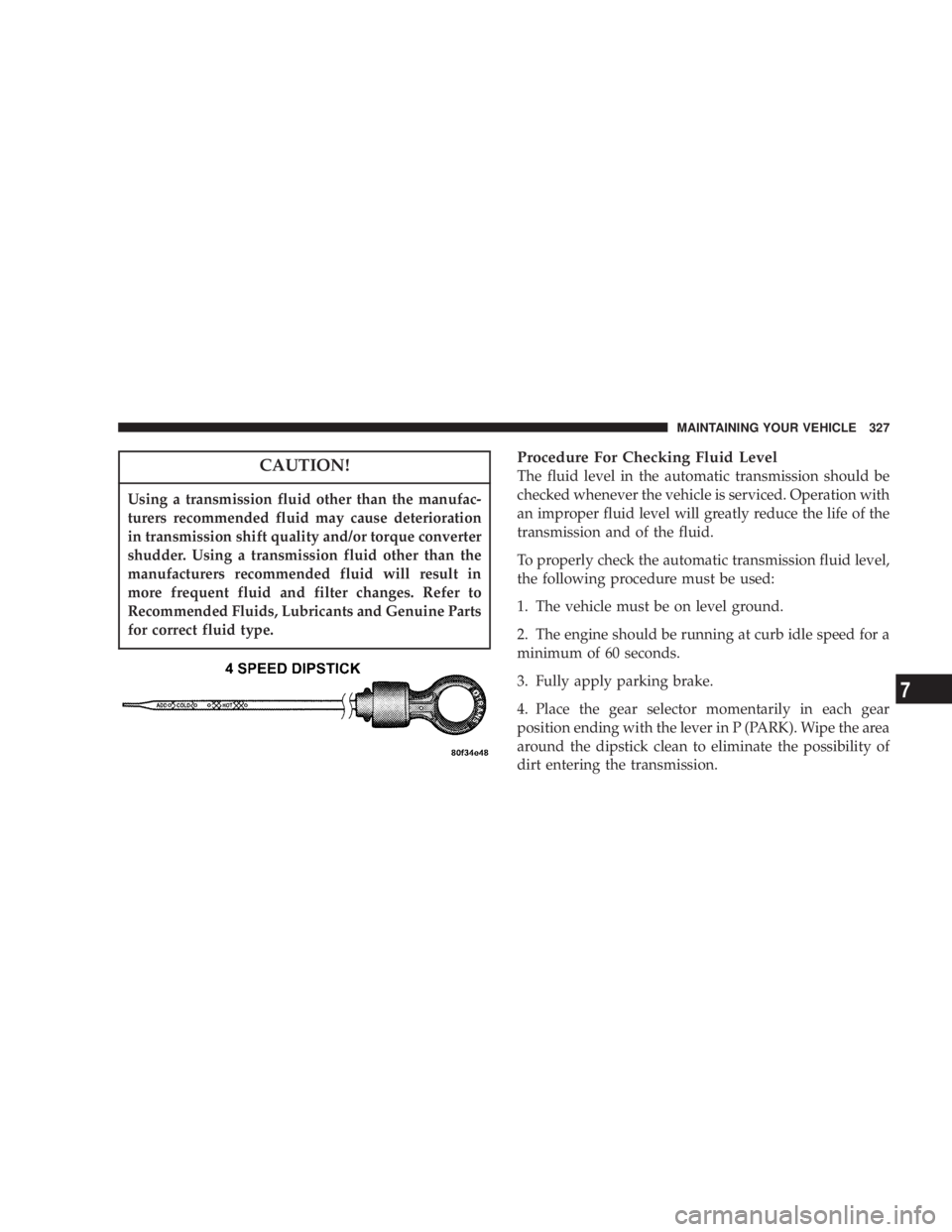
for correct fluid type. Procedure For Checking Fluid Level
The fluid level in the automatic transmission should be
checked whenever the vehicle is serviced. Operation with
an improper fluid level will greatly reduce the life of the
transmission and of the fluid.
To properly check the automatic transmission fluid level,
the following procedure must be used:
1. The vehicle must be on level ground.
2. The engine should be running at curb idle speed for a
minimum of 60 seconds.
3. Fully apply parking brake.
4. Place the gear selector momentarily in each gear
position ending with the lever in P (PARK). Wipe the area
around the dipstick clean to eliminate the possibility of
dirt entering the transmission. MAINTAINING YOUR VEHICLE 327
7
Page 329 of 397
NOTE: Refer to Section 8 of this manual for Mainte-
nance Schedules.
If the transmission is disassembled for any reason, the
fluid and filter should be changed.
Special Additives
Do not add any fluid additives to the transmission. The
only exception to this policy is the use of special dyes to
aid in detecting fluid leaks. The use of transmission
sealers should be avoided as they may adversely affect
seals. All Wheel Drive (AWD)
Under normal operating conditions, periodic fluid level
checks and lubricant changes for the Power Transfer
Unit, Overrunning Clutch and Rear Carrier, are not
required. However when the vehicle is serviced for other
reasons, the exterior surface of these components should
be inspected for evidence of fluid leaks. Confirmed leaks
should be repaired as soon as possible.
Power Transfer Unit
The fluid should be maintained at the bottom of the filler
hole opening. If it becomes necessary to add or replace
the fluid, use only the manufacturers recommended
fluid, refer to Recommended Fluids, Lubricants and
Genuine Parts for correct fluid type.
Overrunning Clutch
The fluid should be maintained at the bottom of the filler
hole opening. If it becomes necessary to add or replace
the fluid, use only the manufacturers recommended MAINTAINING YOUR VEHICLE 329
7
Page 330 of 397
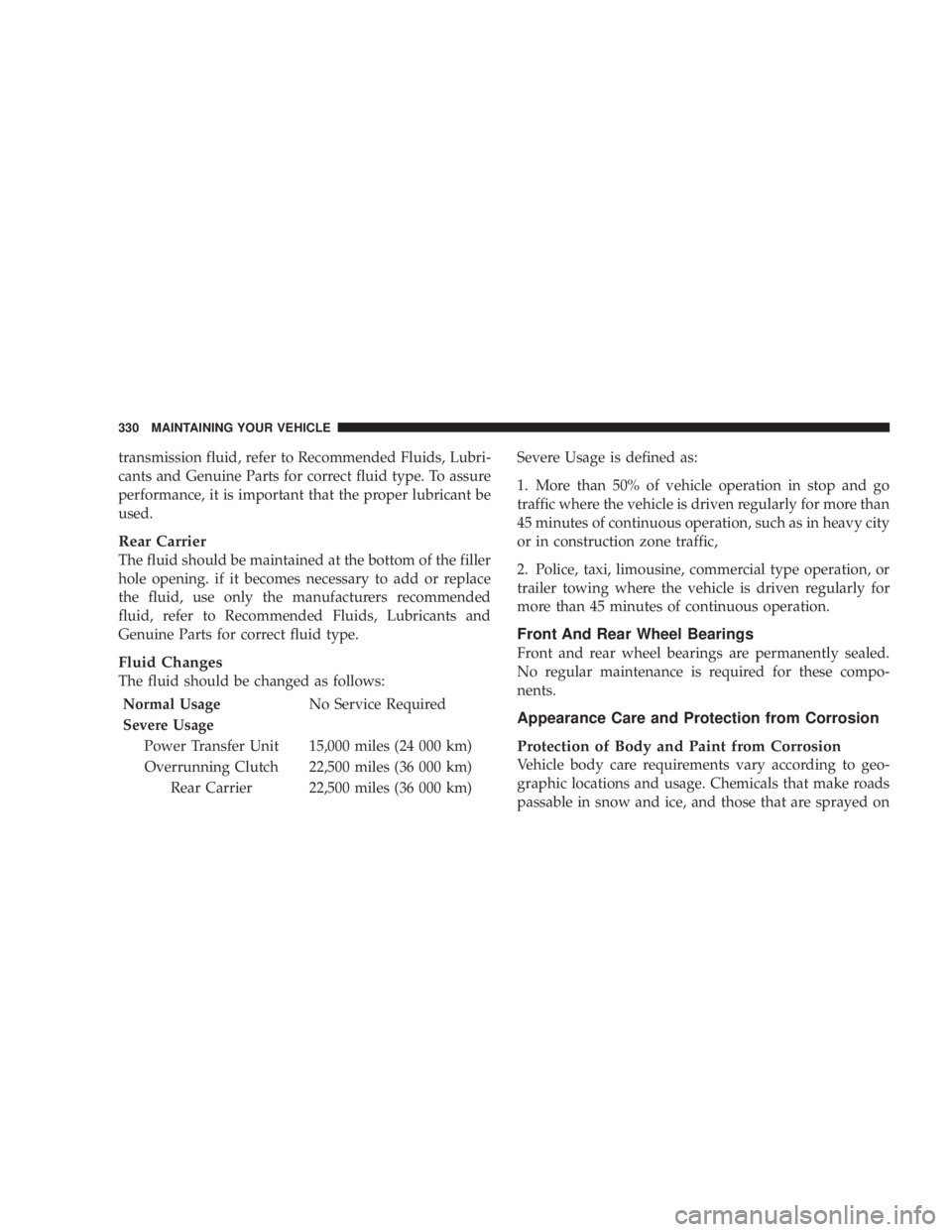
transmission fluid, refer to Recommended Fluids, Lubri-
cants and Genuine Parts for correct fluid type. To assure
performance, it is important that the proper lubricant be
used.
Rear Carrier
The fluid should be maintained at the bottom of the filler
hole opening. if it becomes necessary to add or replace
the fluid, use only the manufacturers recommended
fluid, refer to Recommended Fluids, Lubricants and
Genuine Parts for correct fluid type.
Fluid Changes
The fluid should be changed as follows:
Normal Usage No Service Required
Severe Usage
Power Transfer Unit 15,000 miles (24 000 km)
Overrunning Clutch 22,500 miles (36 000 km)
Rear Carrier 22,500 miles (36 000 km) Severe Usage is defined as:
1. More than 50% of vehicle operation in stop and go
traffic where the vehicle is driven regularly for more than
45 minutes of continuous operation, such as in heavy city
or in construction zone traffic,
2. Police, taxi, limousine, commercial type operation, or
trailer towing where the vehicle is driven regularly for
more than 45 minutes of continuous operation.
Front And Rear Wheel Bearings
Front and rear wheel bearings are permanently sealed.
No regular maintenance is required for these compo-
nents.
Appearance Care and Protection from Corrosion
Protection of Body and Paint from Corrosion
Vehicle body care requirements vary according to geo-
graphic locations and usage. Chemicals that make roads
passable in snow and ice, and those that are sprayed on330 MAINTAINING YOUR VEHICLE
Page 337 of 397
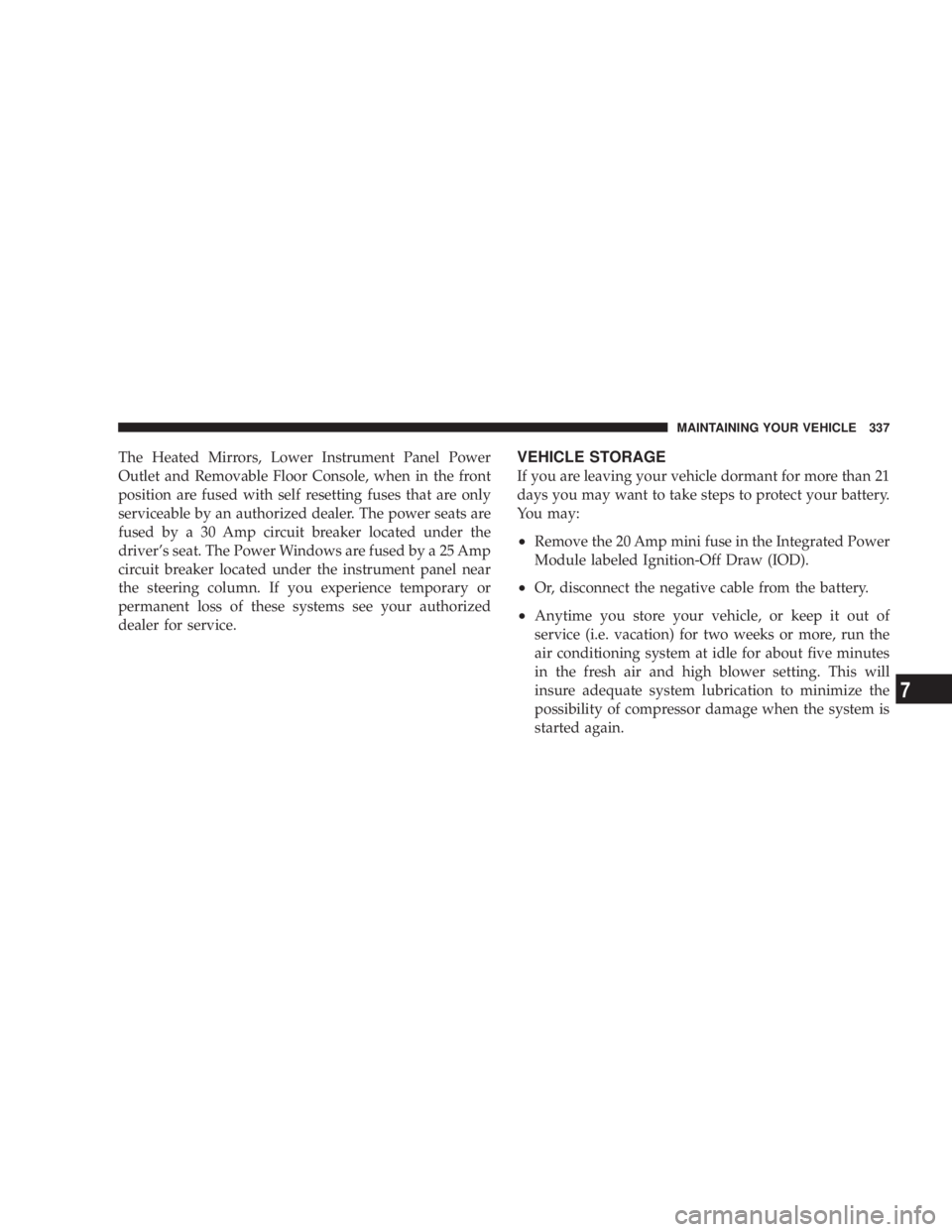
The Heated Mirrors, Lower Instrument Panel Power
Outlet and Removable Floor Console, when in the front
position are fused with self resetting fuses that are only
serviceable by an authorized dealer. The power seats are
fused by a 30 Amp circuit breaker located under the
driver's seat. The Power Windows are fused by a 25 Amp
circuit breaker located under the instrument panel near
the steering column. If you experience temporary or
permanent loss of these systems see your authorized
dealer for service. VEHICLE STORAGE
If you are leaving your vehicle dormant for more than 21
days you may want to take steps to protect your battery.
You may:
² Remove the 20 Amp mini fuse in the Integrated Power
Module labeled Ignition-Off Draw (IOD).
² Or, disconnect the negative cable from the battery.
² Anytime you store your vehicle, or keep it out of
service (i.e. vacation) for two weeks or more, run the
air conditioning system at idle for about five minutes
in the fresh air and high blower setting. This will
insure adequate system lubrication to minimize the
possibility of compressor damage when the system is
started again. MAINTAINING YOUR VEHICLE 337
7