ECO mode DODGE GRAND CARAVAN 2008 5.G Workshop Manual
[x] Cancel search | Manufacturer: DODGE, Model Year: 2008, Model line: GRAND CARAVAN, Model: DODGE GRAND CARAVAN 2008 5.GPages: 531, PDF Size: 7.72 MB
Page 309 of 531
The primary control for the rear blower is on the front
climate control unit located on the instrument panel.
The front climate control unit has five positions, off, rear,
and a range of blower speeds. Only when the primary
control for the rear blower is in the REAR position do the
second seat occupants have control of the rear blower
speed.
REAR MANUAL CLIMATE CONTROL ZONE Ð IF
EQUIPPED
The Rear Manual Climate Control Zone system has floor
air outlets at the rear of the right side sliding door and
overhead outlets at each outboard rear seating position.
The unit provides warm or cool air through the floor and
upper outlets.
The rear blower and temperature controls for the rear
seat passengers are located in the headliner near the
center of the vehicle.
Rear Blower Control
The primary control for the rear blower is on the front
climate control unit located on the instrument panel.
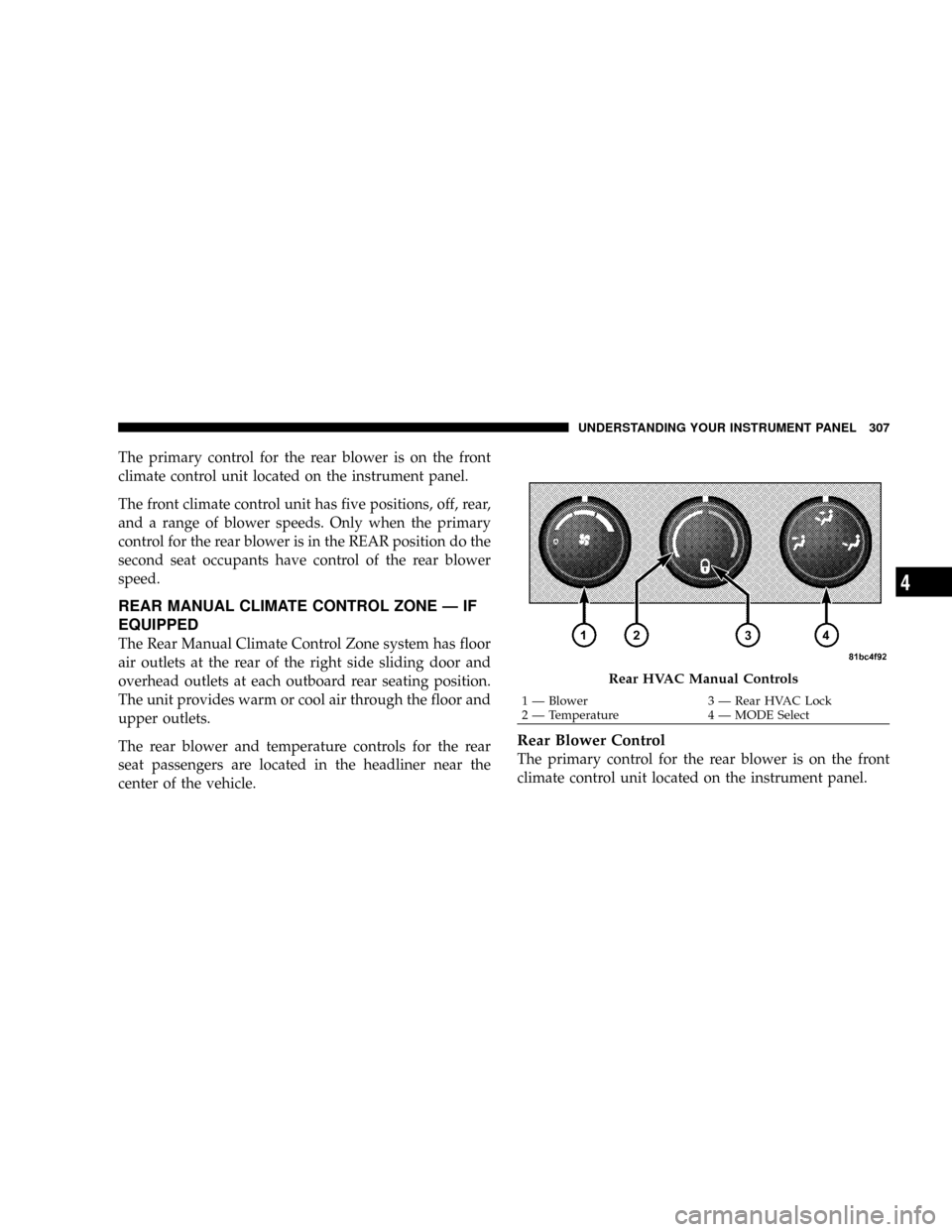
Rear HVAC Manual Controls
1 Ð Blower 3 Ð Rear HVAC Lock
2 Ð Temperature 4 Ð MODE SelectUNDERSTANDING YOUR INSTRUMENT PANEL 307
4
Page 310 of 531
Only when the front control for the rear blower is in the
RRposition do the second seat occupants have control of
the rear blower speed.
The rear blower control, located in the rear overhead
console has an off position and a range of blower speeds.
This allows the second seat occupants to control the
volume of air circulated in the rear of the vehicle.
CAUTION!
Interior air enters the Manual Rear Zone Climate
Control system through an intake grille located in the
passenger side trim panel behind the third seat. The
heater outlets are located in the passenger side trim
panel just behind the sliding door. Do not block or
place objects directly in front of the inlet grille or
heater outlets. The electrical system could overload
causing damage to the blower motor.
Rear Temperature Control
When the blower knob on the front climate control unit is
set to any position other thanRR, the rear temperature
selection follows the setting of the rear temperature
control knob on the front climate control unit. The rear
mode selection follows the setting of the rear mode
control knob.
To change the temperature in the rear of the vehicle,
rotate the temperature control knob counterclockwise for
cold and clockwise for heated air.
When rear controls are locked by the front system, the
lock symbol on the temperature knob is illuminated and
the rear overhead adjustments are ignored.
The rear airflow modes will mirror the front unit opera-
tion. Rear PANEL mode is automatically selected when
the front control is in the PANEL mode. When the front
unit is in BI-LEVEL mode, airflow will be emitted from
both the upper and lower rear outlets. When the front
308 UNDERSTANDING YOUR INSTRUMENT PANEL
Page 316 of 531
The SNOWFLAKE mode or A/C button allows
the operator to manually activate or deactivate the
air conditioning system. When in SNOWFLAKE
mode the ATC display is on, cool, dehumidified air flows
through the air outlets. If ECONOMY mode is desired,
press the SNOWFLAKE button to turn off the SNOW-
FLAKE mode in the ATC display and deactivate the A/C
system. Note: If fog or mist appears on the windshield or
side glass, select DEFROST mode and increase blower
speed.
RECIRCULATION Control
When outside air contains smoke, odors, or
high humidity, or if rapid cooling is desired,
you may wish to recirculate interior air by
pressing the RECIRCULATION mode control
button. RECIRCULATION mode should only be used
temporarily. The recirculation symbol will illuminate in
the display when this button is selected. Push the buttona second time to turn off the RECIRCULATION mode
LED and allow outside air into the vehicle.
NOTE:In cold weather, use of the RECIRCULATION
mode may lead to excessive window fogging. The RE-
CIRCULATION mode is not allowed in the FLOOR, MIX
and DEFROST modes to improve window clearing op-
eration. Recirculation will be disabled automatically if
these modes are selected. Recirculation will be disabled
automatically if these modes are selected.
Rear Automatic Temperature Control (ATC) Ð If
Equipped
The Rear ATC System has floor air outlets at the rear of
the right side sliding door and overhead outlets at each
outboard rear seating positions. The system provides
heated air through the floor outlets or cool, dehumidified
air through the headliner outlets.
314 UNDERSTANDING YOUR INSTRUMENT PANEL
Page 317 of 531
The REAR SYSTEM control for the Rear ATC System is
on the front ATC control unit located on the instrument
panel.
Pressing the REAR LOCK button for the Rear ATC
System from the front ATC control unit, illuminates a
LOCK symbol in the rear display. The rear temperature
and air source are controlled from the front ATC control
unit.
Rear second row occupants can only adjust the rear ATC
control when the REAR LOCK button is turned off.
The Rear ATC System is located in the headliner near the
center of the vehicle.
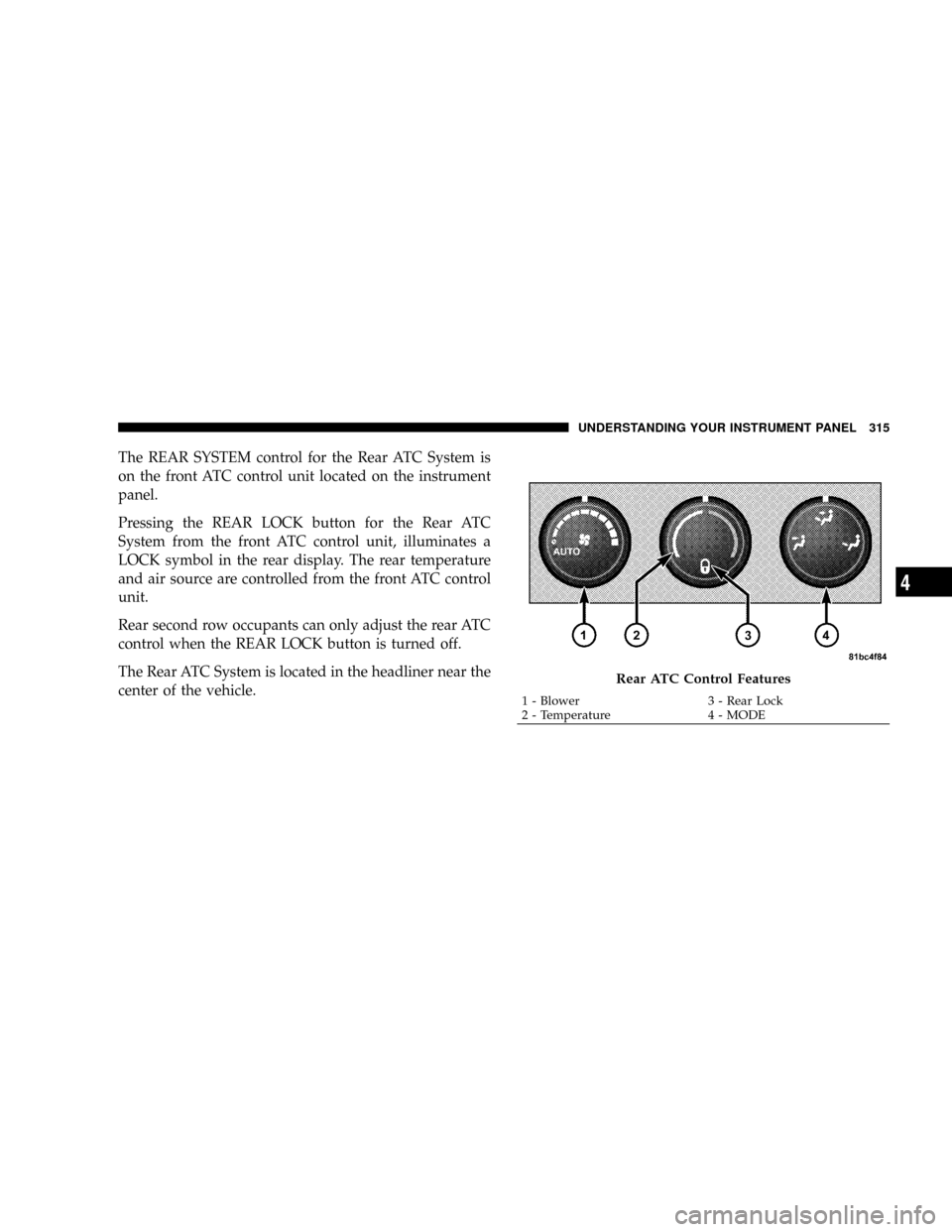
Rear ATC Control Features
1 - Blower 3 - Rear Lock
2 - Temperature 4 - MODEUNDERSTANDING YOUR INSTRUMENT PANEL 315
4
Page 320 of 531
HEADLINER Mode
Air comes from the outlets in the headliner. Each of
these outlets can be individually adjusted to direct
the flow of air. Moving the air vanes of the outlets to one
side will shut off the airflow.
SUMMER OPERATION
The engine cooling system in air conditioned vehicles
must be protected with a high-quality antifreeze coolant
to provide proper corrosion protection and to protect
against engine overheating. A 50% solution of ethylene
glycol antifreeze coolant in water is recommended. Refer
to section 7, ªMaintenance Proceduresº, of this manual
for proper coolant selection.
WINTER OPERATION
To ensure the best possible heater and defroster perfor-
mance, make sure the engine cooling system is function-
ing properly and the proper amount, type, and concen-
tration of coolant is used. Refer to section 7,ªMaintenance Proceduresº, of this manual for proper
coolant selection. Use of the air RECIRCULATION mode
during winter months is not recommended because it
may cause window fogging.
VACATION/STORAGE
Anytime you store your vehicle, or keep it out of service
(i.e., vacation) for two weeks or more, run the air
conditioning system at idle for about five minutes in the
fresh air and high blower setting. This will ensure
adequate system lubrication to minimize the possibility
of compressor damage when the system is started again.
WINDOW FOGGING
Vehicle windows tend to fog on the inside in mild rainy
or humid weather. To clear the windows, select DE-
FROST or MIX mode and increase the front blower
speed. Do not use the RECIRCULATION mode without
A/C for long periods, as fogging may occur.
318 UNDERSTANDING YOUR INSTRUMENT PANEL
Page 334 of 531
REVERSE
Use REVERSE for moving the vehicle rearward. Shift into
REVERSE only after the vehicle has come to a complete
stop.
NEUTRAL
Shift the gear selector lever into this gear only after the
vehicle has come to a complete stop. The engine may be
started in this range.
WARNING!
Do not coast in NEUTRAL and never turn off the
ignition to coast down a hill. These are unsafe
practices that limit your response to changing traffic
or road conditions. You might lose control of the
vehicle and have an accident.
DRIVE Ð Six-Speed Transmission
This range should be used for most city and highway
driving. It provides the smoothest upshifts, downshifts,
and best fuel economy. However, use the Electronic
Range Select (ERS) mode by moving the leverÐ/+and
select the ª5º range when frequent transmission shifting
occurs while using the DRIVE range, such as when
operating the vehicle under heavy loading conditions,
(i.e., in hilly terrain, traveling into strong head winds or
while towing heavy trailers). Under these conditions,
using the ª5º range will improve performance and
extend transmission life by reducing excessive shifting
and heat build-up.
DRIVE Ð Four-Speed Transmission
This range should be used for most city and highway
driving. It provides the smoothest upshifts, downshifts,
and best fuel economy. However, select the ª3º range
when frequent transmission shifting occurs while using
the DRIVE range, such as when operating the vehicle
332 STARTING AND OPERATING
Page 412 of 531
HAZARD WARNING FLASHER
The hazard flasher switch is located in the center of
the instrument panel below the radio.
To engage the Hazard Warning Flashers, depress the
switch on the instrument panel. When the Hazard Warn-
ing Switch is activated, all directional turn signals will
flash on and off to warn oncoming traffic of an emer-
gency. Push the switch a second time to turn off the
flashers.
This is an emergency warning system and should not be
used when the vehicle is in motion. Use it when your
vehicle is disabled and is creating a safety hazard for
other motorists.
When you must leave the vehicle to seek assistance, the
Hazard Warning Flashers will continue to operate even
though the ignition switch is OFF.NOTE:With extended use, the Hazard Warning Flash-
ers may wear down your battery.
IF YOUR ENGINE OVERHEATS
In any of the following situations, you can reduce the
potential for overheating by taking the appropriate ac-
tion.
²On the highways Ð Slow down.
²In city traffic Ð While stopped, shift the transmission
gear selector lever into NEUTRAL, but do not increase
engine idle speed.
NOTE:There are steps that you can take to slow down
an impending overheat condition. If your air conditioner
is on, turn it off. The air conditioning system adds heat to
the engine cooling system and turning off the A/C
removes this heat. You can also turn the Temperature
control to maximum heat, the Mode control to floor, and
410 WHAT TO DO IN EMERGENCIES