seats DODGE GRAND CARAVAN 2009 5.G User Guide
[x] Cancel search | Manufacturer: DODGE, Model Year: 2009, Model line: GRAND CARAVAN, Model: DODGE GRAND CARAVAN 2009 5.GPages: 535, PDF Size: 18.61 MB
Page 82 of 535
Safety experts recommend that children ride
rearward-facing in the vehicle until they are at least
one year old and weigh at least 20 lbs (9 kg). Two types
of child restraints can be used rearward-facing: infant
carriers and convertible child seats. Both types of child
restraints are held in the vehicle by the lap/shoulder
belt or the LATCH child restraint anchorage system.
Refer to “Lower Anchors and Tether for CHildren
(LATCH)” later in this section.
The infant carrier is only used rearward-facing in the
vehicle. It is recommended for children who weigh up
to about 20 lbs (9 kg). Convertible child seats can be
used either rearward-facing or forward-facing in the
vehicle. Convertible child seats often have a higher
weight limit in the rearward-facing direction than
infant carriers do, so they can be used rearward-facing
by children who weigh more than 20 lbs (9 kg) but are
less than one year old.
WARNING!
Rearward-facing child seats must NEVER be used in
the front seat of a vehicle with a front passenger
airbag. An airbag deployment could cause severe
injury or death to infants in this position.
Rearward-facing child seats and infant carriers must
NEVER
be used while the second row Swivel ’n Go
seats are in the rearward-facing position. WARNING!
Never place any child seat, booster seat, or infant
carrier in the Swivel ’n Go seat while it is in the
rearward-facing position. The swivel seat should be
locked in the forward position when using any child
seat, booster seat, or infant carriers, with the vehicle
in motion. Failure to do so could result in serious
injury or even death.
80 THINGS TO KNOW BEFORE STARTING YOUR VEHICLE
Page 83 of 535
Older Children and Child RestraintsChildren who weigh more than 20 lbs (9 kg) and who are
older than one year can ride forward-facing in the
vehicle. Forward-facing child seats and convertible child
seats used in the forward-facing direction are for children
who weigh 20 to 40 lbs (9 to 18 kg) and who are older
than one year. These child seats are also held in the
vehicle by the lap/shoulder belt or the LATCH child
restraint anchorage system. Refer to “Lower Anchors and
Tether for CHildren (LATCH)” later in this section.
An aftermarket belt-positioning booster seat is for chil-
dren weighing more than 40 lbs (18 kg), but who are still
too small to properly fit the vehicle’s seat belts. If the
child can not sit with knees bent over the vehicles seat
cushion while the child’s back is against the seatback,
they should use a belt-positioning booster seat. The child
and booster seat are held in the vehicle by the lap/
shoulder belt.
Children Too Large for Booster Seats
Children who are large enough to wear the shoulder belt
comfortably, and whose legs are long enough to bend
over the front of the seat when their back is against the
seatback, should use the lap/shoulder belt in a rear seat.
Make sure that the child is upright in the seat.
The lap portion should be low on the hips and as snug
as possible.
Check belt fit periodically. A child’s squirming or
slouching can move the belt out of position.
If the shoulder belt contacts the face or neck, move the
child closer to the center of the vehicle. If this doesn’t
help, move the child to the center rear seating position
and use the lap belt. Never allow a child to put the
shoulder belt under an arm or behind their back.
THINGS TO KNOW BEFORE STARTING YOUR VEHICLE 81
2
Page 86 of 535
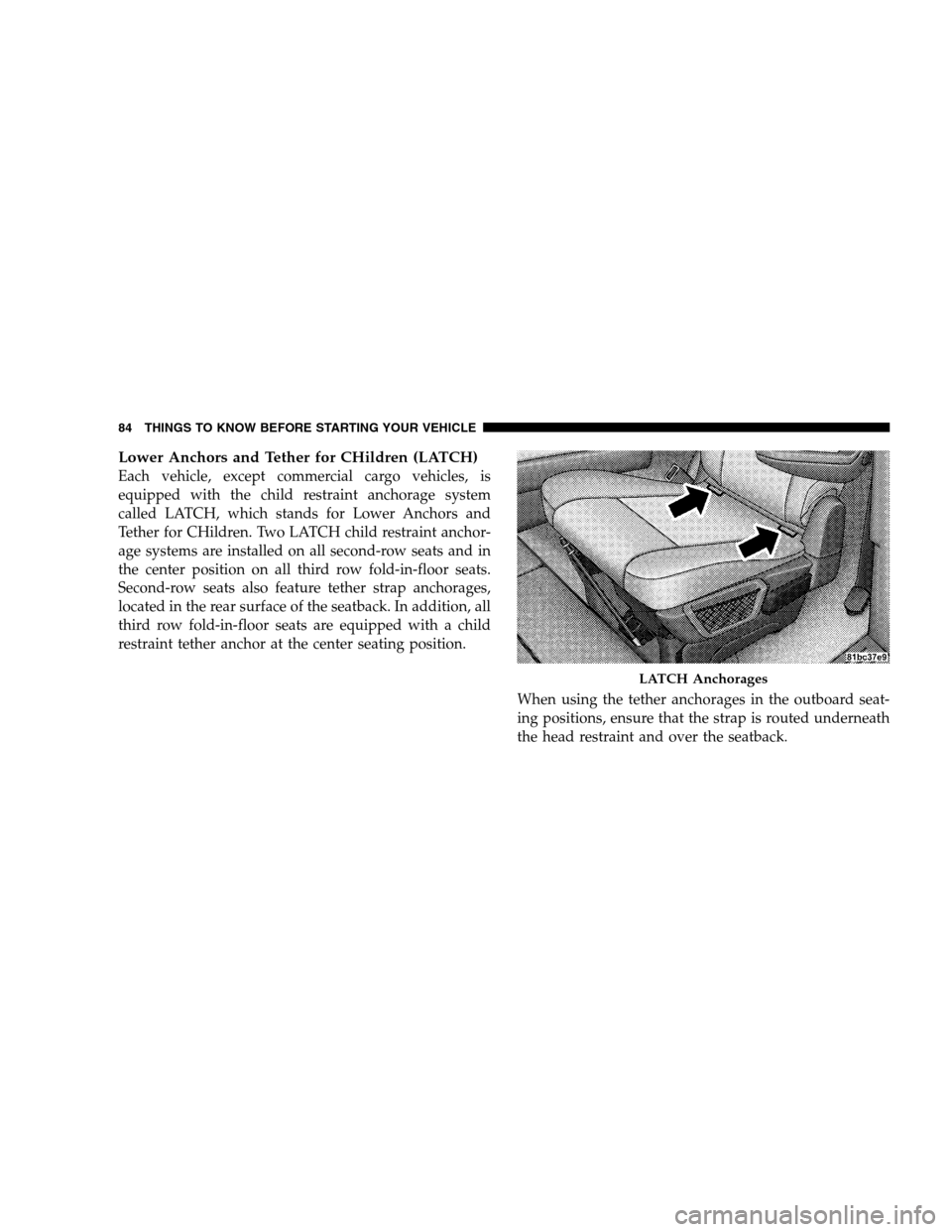
Lower Anchors and Tether for CHildren (LATCH)Each vehicle, except commercial cargo vehicles, is
equipped with the child restraint anchorage system
called LATCH, which stands for Lower Anchors and
Tether for CHildren. Two LATCH child restraint anchor-
age systems are installed on all second-row seats and in
the center position on all third row fold-in-floor seats.
Second-row seats also feature tether strap anchorages,
located in the rear surface of the seatback. In addition, all
third row fold-in-floor seats are equipped with a child
restraint tether anchor at the center seating position.
When using the tether anchorages in the outboard seat-
ing positions, ensure that the strap is routed underneath
the head restraint and over the seatback. LATCH Anchorages
84 THINGS
TO KNOW BEFORE STARTING YOUR VEHICLE
Page 90 of 535
REAR SEAT DELETE FEATURE (COMMERCIAL
VEHICLES ONL
Y) — IF EQUIPPED
Commercial cargo vehicles are not designed for use as a
family vehicle and are not intended for carrying children
in the front passenger seat. However, if you must carry a
child in a vehicle without a rear seat, the passenger seat
should be moved to the full rearward position and the
child must be in a proper restraint system based on its
age, size and weight. WARNING!
NEVER carry a child in a rear facing infant carrier in
a vehicle without rear seats. In an accident, serious
injury or death may occur from the deploying pas-
senger airbag.
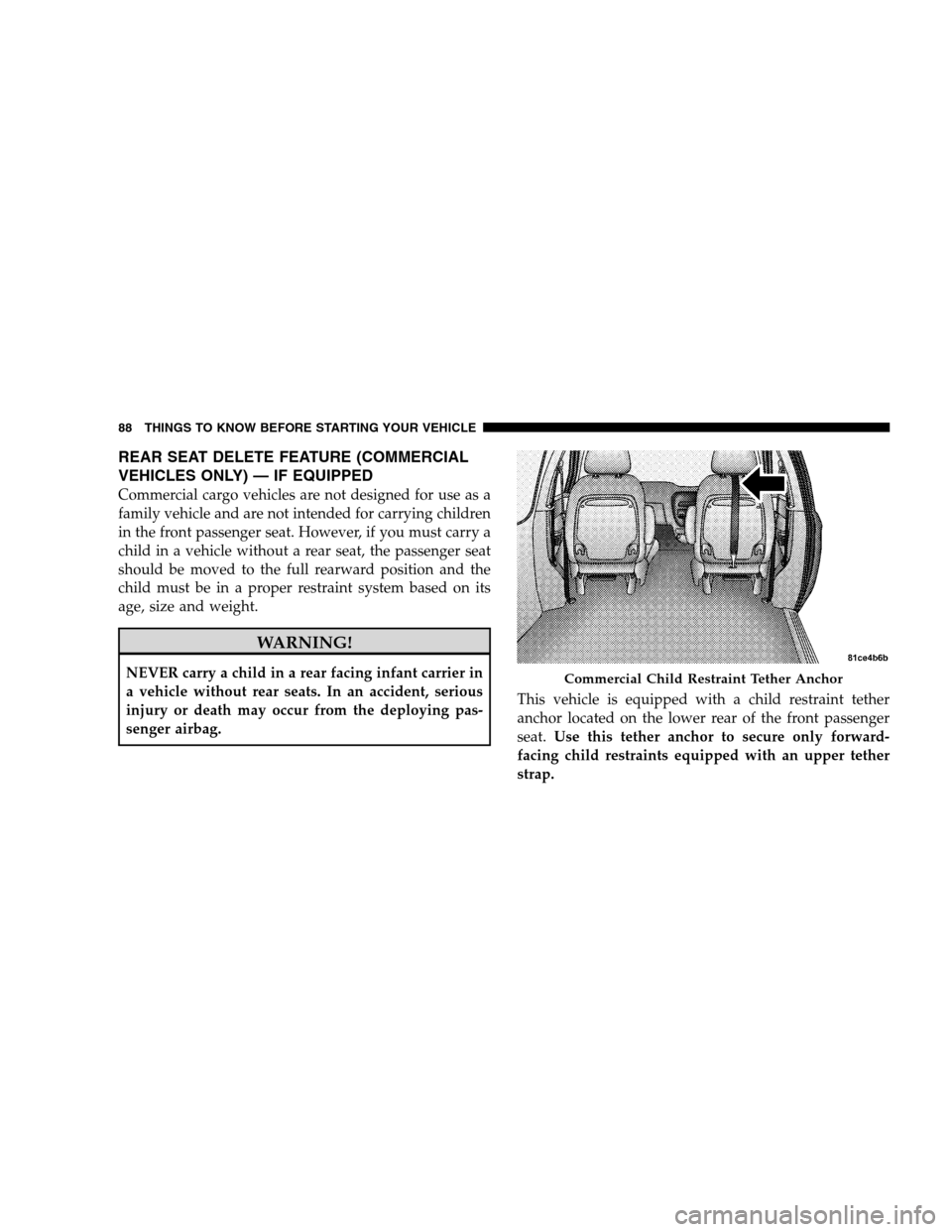
This vehicle is equipped with a child restraint tether
anchor located on the lower rear of the front passenger
seat.
Use this tether anchor to secure only forward-
facing child restraints equipped with an upper tether
strap. Commercial Child Restraint Tether Anchor
88 THINGS
TO KNOW BEFORE STARTING YOUR VEHICLE
Page 91 of 535
WARNING!Rearward-facing infant restraints must never be se-
cured in the passenger seat of a vehicle with a
passenger airbag. In an accident, a passenger airbag
may deploy causing severe injury or death to infants
riding in rearward-facing infant restraints.
Restraining Infants and Small Children with Seat
Delete Feature (Commercial Vehicles Only)
There are different sizes and types of restraints for
children from newborn size to the child almost large
enough for an adult safety belt. Use the restraint that is
correct for your child:
The rearward-facing infant carrier is for babies weigh-
ing up to about 20 lbs (9 kg), and less than one year
old. THIS TYPE OF SEAT CANNOT BE USED IN A
VEHICLE EQUIPPED WITH THE REAR SEAT DE-
LETE FEATURE (Commercial Vehicles Only).
The forward-facing child seat is for children from
about 20 to 40 lbs (9 to 18 kg), and more than one year
old.
A convertible child seat, one that is designed to be
used for children who are too heavy for a rearward-
facing infant seat, may be used IN THE FORWARD
FACING POSITION ONLY, IT MUST NEVER BE
INSTALLED FACING TO THE REAR IN A VEHICLE
EQUIPPED WITH THE REAR SEAT DELETE FEA-
TURE (Commercial Vehicles Only). When a convert-
ible seat is properly installed facing forward, the
vehicle seat should be adjusted to the
rear most
position.
Children more than 40 lbs (18 kg) should be secured in
the passenger seat in a child restraint or belt-
positioning booster seat with the seat adjusted to the
rear most position. Older children who do not use
child restraints or belt-positioning booster seats
THINGS TO KNOW BEFORE STARTING YOUR VEHICLE 89 2
Page 94 of 535
SAFETY TIPS
Transporting
Passengers
NEVER TRANSPORT PASSENGERS IN THE CARGO
AREA. WARNING!
It is extremely dangerous to ride in a cargo area,
inside or outside of a vehicle. In a collision, people
riding in these areas are more likely to be seri-
ously injured or killed.
Do not allow people to ride in any area of your
vehicle that is not equipped with seats and seat
belts.
Be sure everyone in your vehicle is in a seat and
using a seat belt properly.
Exhaust Gas WARNING!
Exhaust gases can injure or kill. They contain carbon
monoxide (CO), which is colorless and odorless.
Breathing it can make you unconscious and can
eventually poison you. To avoid breathing (CO)
follow these safety tips:
Do not run the engine in a closed garage or in confined
areas any longer than needed to move your vehicle in or
out of the area.
If it is necessary to sit in a parked vehicle with the engine
running, adjust your heating or cooling controls to force
outside air into the vehicle. Set the blower at high speed.
92 THINGS TO KNOW BEFORE STARTING YOUR VEHICLE
Page 98 of 535
▫Phone Call Features . . . . . . . . . . . . . . . . . 123
▫ uconnectt phone Features . . . . . . . . . . . . . 126
▫ Advanced Phone Connectivity . . . . . . . . . . 131
▫ Things You Should Know About Your
uconnectt phone . . . . . . . . . . . . . . . . . . . . . 132
▫ General Information . . . . . . . . . . . . . . . . . 141
m Voice Recognition (VR) System — If
Equipped . . . . . . . . . . . . . . . . . . . . . . . . . . . . 141
▫ Voice Recognition (VR) System Operation . . 141
▫ Commands . . . . . . . . . . . . . . . . . . . . . . . 143
▫ Voice Training . . . . . . . . . . . . . . . . . . . . . 146
m Seats . . . . . . . . . . . . . . . . . . . . . . . . . . . . . 146
▫ Manual Front And Second Row Seat
Adjuster . . . . . . . . . . . . . . . . . . . . . . . . . . . 147 ▫
Eight–Way Driver And Passenger Power Seat
— If Equipped . . . . . . . . . . . . . . . . . . . . . . 148
▫ Adjustable Head Restraints . . . . . . . . . . . . 149
▫ Heated Seats — If Equipped . . . . . . . . . . . 150
▫ Manual Reclining Seats — If Equipped . . . . 151
▫ Manual Lumbar Adjust Lever — If
Equipped . . . . . . . . . . . . . . . . . . . . . . . . . . 152
▫ Stow ’n Got Seating — If Equipped . . . . . . 153
▫ Easy Access Seating . . . . . . . . . . . . . . . . . 156
▫ Swivel ’n Got Premium Seating — If
Equipped . . . . . . . . . . . . . . . . . . . . . . . . . . 157
▫ Second Row Bench Seat — If Equipped . . . 165
▫ Third Row Power Seat — If Equipped . . . . 166
96 UNDERSTANDING THE FEATURES OF YOUR VEHICLE
Page 148 of 535
NOTE:Keep in mind that you have to press the VR
button first and wait for the beep before speaking the
“Barge In” commands.
Voice Training
For users experiencing difficulty with the system recog-
nizing their voice commands or numbers, uconnectt
phone Voice Training feature may be used.
1. Press the VR button, say “System Setup” and once you
are in that menu then say “Voice Training.” This will train
your own voice to the system and will improve recogni-
tion.
2. Repeat the words and phrases when prompted by
uconnectt phone. For best results, the Voice Training
session should be completed when the vehicle is parked,
engine running, all windows closed, and the blower fan
switched off. This procedure may be repeated with a new
user. The system will adapt to the last trained voice only.
SEATS
Seats are a primary part of the Occupant Restraint System
of the vehicle. They need to be used properly for safe
operation of the vehicle. WARNING!
DO NOT allow people to ride in any area of your
vehicle that is not equipped with seats and seat
belts. In a collision, people riding in these areas
are more likely to be seriously injured or killed.
Be sure everyone in your vehicle is in a seat and
using a seat belt properly.
146 UNDERSTANDING THE FEATURES OF YOUR VEHICLE
Page 152 of 535
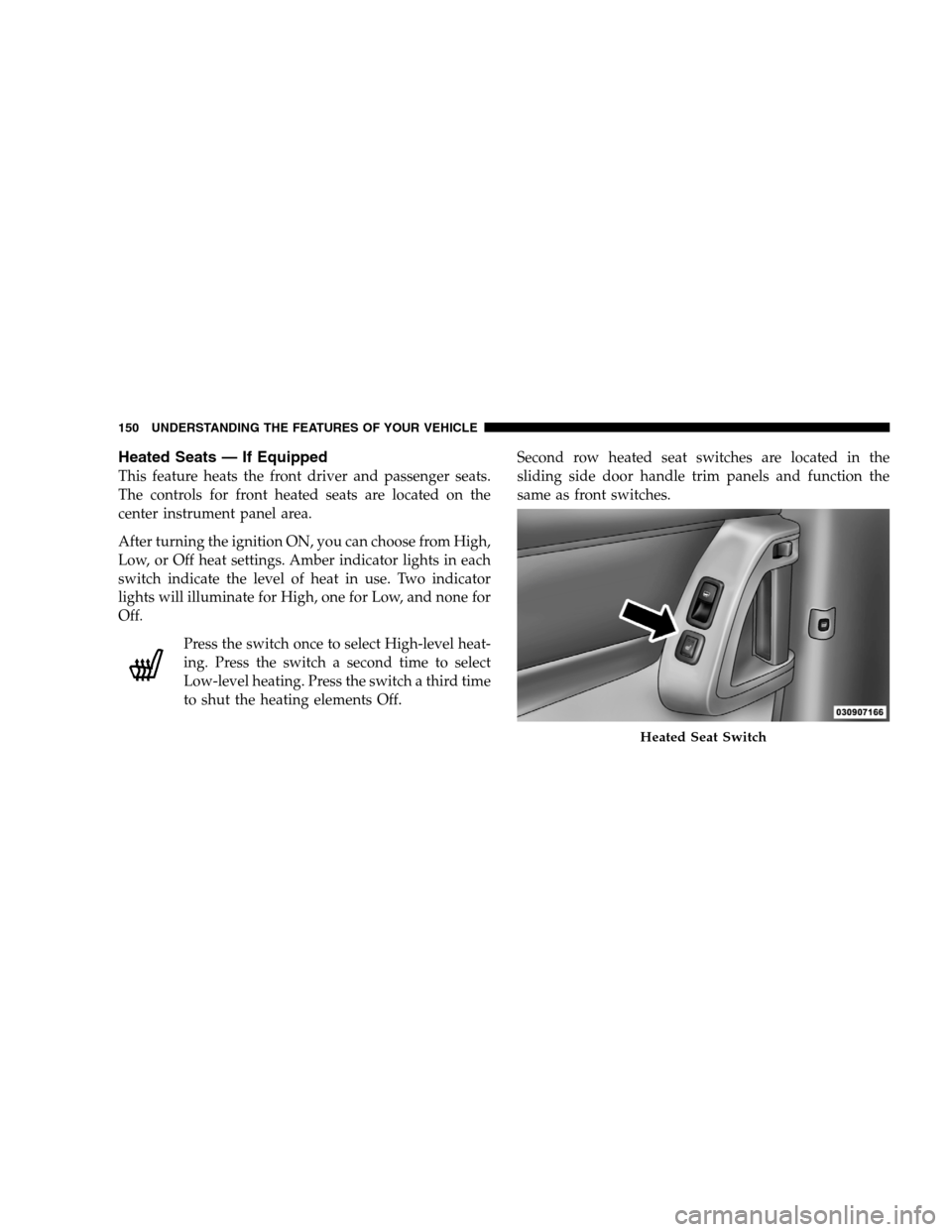
Heated Seats — If EquippedThis feature heats the front driver and passenger seats.
The controls for front heated seats are located on the
center instrument panel area.
After turning the ignition ON, you can choose from High,
Low, or Off heat settings. Amber indicator lights in each
switch indicate the level of heat in use. Two indicator
lights will illuminate for High, one for Low, and none for
Off.
Press the switch once to select High-level heat-
ing. Press the switch a second time to select
Low-level heating. Press the switch a third time
to shut the heating elements Off. Second row heated seat switches are located in the
sliding side door handle trim panels and function the
same as front switches. Heated Seat Switch
150 UNDERST
ANDING THE FEATURES OF YOUR VEHICLE
Page 153 of 535
WARNING!Persons who are unable to feel pain to the skin
because of advanced age, chronic illness, diabetes,
spinal cord injury, medication, alcohol use, exhaus-
tion or other physical condition must exercise care
when using the seat heater. It may cause burns even
at low temperatures, especially if used for long
periods of time. DO NOT place anything on the seat
that insulates against heat, such as a blanket or
cushion. This may cause the seat heater to overheat.
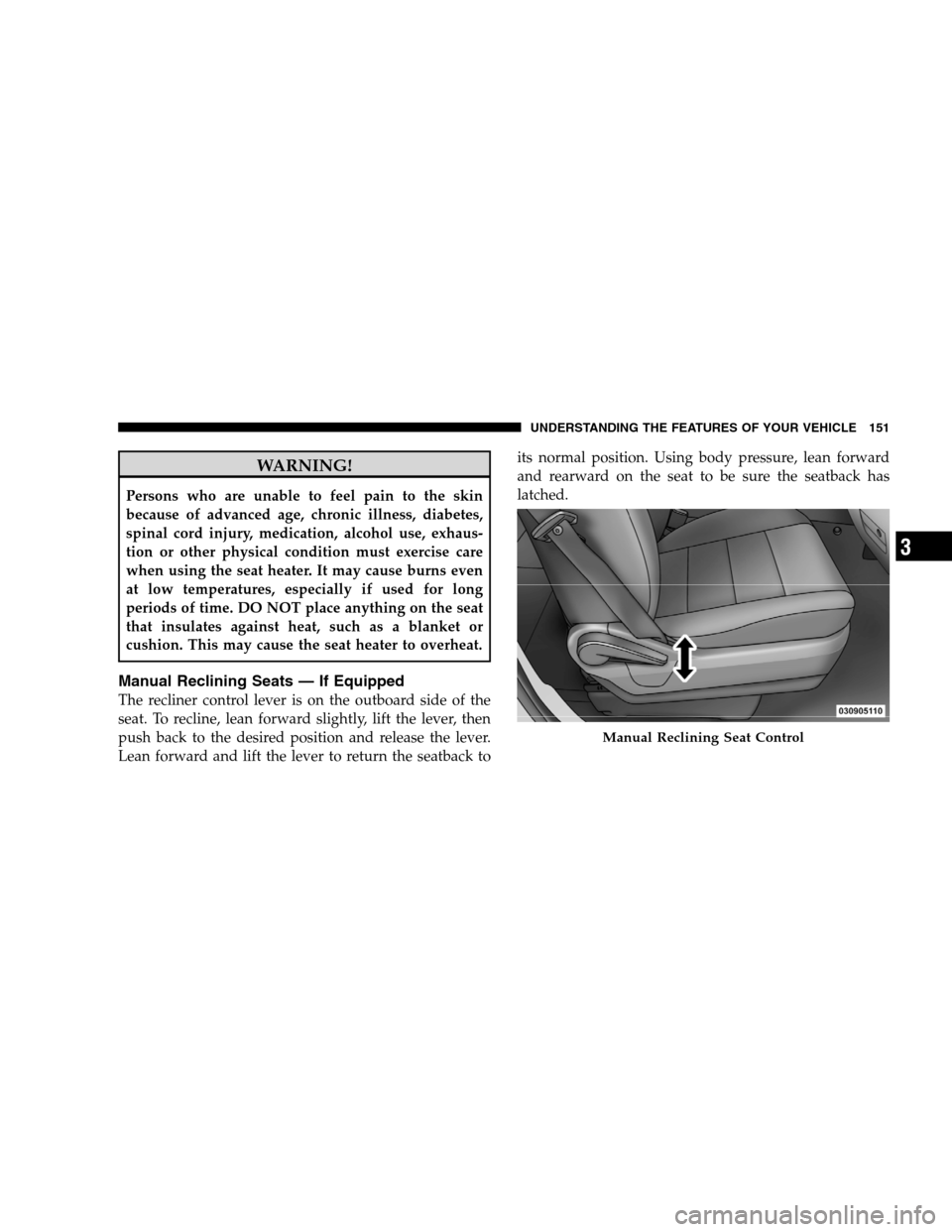
Manual Reclining Seats — If Equipped
The recliner control lever is on the outboard side of the
seat. To recline, lean forward slightly, lift the lever, then
push back to the desired position and release the lever.
Lean forward and lift the lever to return the seatback to
its normal position. Using body pressure, lean forward
and rearward on the seat to be sure the seatback has
latched. Manual Reclining Seat Control
UNDERSTANDING
THE FEATURES OF YOUR VEHICLE 151 3