brake fluid DODGE GRAND CARAVAN 2009 5.G Owners Manual
[x] Cancel search | Manufacturer: DODGE, Model Year: 2009, Model line: GRAND CARAVAN, Model: DODGE GRAND CARAVAN 2009 5.GPages: 535, PDF Size: 18.61 MB
Page 96 of 535
DefrosterCheck operation by selecting the defrost mode and place
the blower control on high speed. You should be able to
feel the air directed against the windshield. See your
authorized dealer for service if your defroster is
inoperable.
Periodic Safety Checks You Should Make Outside
the Vehicle
Tires
Examine tires for excessive tread wear and uneven wear
patterns. Check for stones, nails, glass, or other objects
lodged in the tread. Inspect the tread and sidewall for
cuts and cracks. Check the wheel nuts for tightness.
Check the tires (including spare) for proper pressure.
Lights
Have someone observe the operation of exterior lights
while you work the controls. Check turn signal and high
beam indicator lights on the instrument panel.
Door Latches
Check for positive closing, latching, and locking.
Fluid Leaks
Check area under vehicle after overnight parking for fuel,
engine coolant, oil, or other fluid leaks. Also, if gasoline
fumes are detected or if fuel, power steering fluid, or
brake fluid leaks are suspected, the cause should be
located and corrected immediately.
94 THINGS TO KNOW BEFORE STARTING YOUR VEHICLE
Page 244 of 535
If the ABS light is on, the brake system should be serviced
as soon as possible to restore the benefits of Anti-Lock
brakes. If the ABS light does not turn on when the
Ignition switch is turned to the ON position, have the
light inspected by an authorized dealer.
8. Brake Warning LightThis light monitors various brake functions,
including brake fluid level and parking brake
application. If the brake light turns on, it may
indicate that the parking brake is applied, that
the brake fluid level is low, or that there is a problem with
the anti-lock brake system reservoir.
If the light remains on when the parking brake has been
disengaged, and the fluid level is at the full mark on the
master cylinder reservoir, it indicates a possible brake
hydraulic system malfunction or that a problem with the
Brake Booster has been detected by the Anti-Lock Brake System (ABS) / Electronic Stability Program (ESP) sys-
tem. In this case, the light will remain on until the
condition has been corrected. If the problem is related to
the brake booster, the ABS pump will run when applying
the brake and a brake pedal pulsation may be felt during
each stop.
The dual brake system provides a reserve braking capac-
ity in the event of a failure to a portion of the hydraulic
system. A leak in either half of the dual brake system is
indicated by the Brake Warning Light which will turn on
when the brake fluid level in the master cylinder has
dropped below a specified level.
The light will remain on until the cause is corrected.
NOTE:
The light may flash momentarily during sharp
cornering maneuvers which change fluid level condi-
tions. The vehicle should have service performed, and
the brake fluid level checked. 242 UNDERSTANDING YOUR INSTRUMENT PANEL
Page 328 of 535
mDriving Through Water . . . . . . . . . . . . . . . . 340
▫ Flowing/Rising Water . . . . . . . . . . . . . . . . 340
▫ Shallow Standing Water . . . . . . . . . . . . . . 340
m Power Steering . . . . . . . . . . . . . . . . . . . . . . 342
▫ Power Steering Fluid Check . . . . . . . . . . . 342
m Parking Brake . . . . . . . . . . . . . . . . . . . . . . . 343
m Anti-Lock Brake System (ABS) . . . . . . . . . . . 345
▫ Anti-Lock Brake Warning Light . . . . . . . . . 347
m Electronic Brake Control System . . . . . . . . . . 347
▫ Traction Control System (TCS) . . . . . . . . . . 347
▫ Brake Assist System (BAS) . . . . . . . . . . . . . 348
▫ Electronic Stability Program (ESP) . . . . . . . 349
▫ ESP/BAS Warning Light . . . . . . . . . . . . . . 351 m
Tire Safety Information . . . . . . . . . . . . . . . . 352
▫ Tire Markings . . . . . . . . . . . . . . . . . . . . . 352
▫ Tire Identification Number (TIN) . . . . . . . . 355
▫ Tire Loading And Tire Pressure . . . . . . . . . 356
m Tires — General Information . . . . . . . . . . . . 360
▫ Tire Pressure . . . . . . . . . . . . . . . . . . . . . . 360
m Tire Chains . . . . . . . . . . . . . . . . . . . . . . . . . 367
m Snow Tires . . . . . . . . . . . . . . . . . . . . . . . . . 369
m Tire Rotation . . . . . . . . . . . . . . . . . . . . . . . . 369
m Tire Pressure Monitor System (TPMS) . . . . . . 370
▫ Base System . . . . . . . . . . . . . . . . . . . . . . . 372
▫ Premium System — If Equipped . . . . . . . . 374
326 STARTING AND OPERATING
Page 343 of 535
CAUTION! (Continued)
Driving through standing water may cause dam-
age to your vehicle’s drivetrain components. Al-
ways inspect your vehicle’s fluids (i.e., engine oil,
transmission/transaxle, axle, etc.) for signs of con-
tamination (i.e., fluid that is milky or foamy in
appearance) after driving through standing water.
Do not continue to operate the vehicle if any fluid
appears contaminated, as this may result in further
damage. Such damage is not covered by the New
Vehicle Limited Warranty.
Getting water inside your vehicle’s engine can
cause it to lock up and stall out, and cause serious
internal damage to the engine. Such damage is not
covered by the New Vehicle Limited Warranty. WARNING!
Driving through standing water limits your vehi-
cle’s traction capabilities. Do not exceed 5 mph
(8 km/h) when driving through standing water.
Driving through standing water limits your vehi-
cle’s braking capabilities, which increases stop-
ping distances. Therefore, after driving through
standing water, drive slowly and lightly press on
the brake pedal several times to dry the brakes.
Getting water inside your vehicle’s engine can
cause it to lock up and stall out, and leave you
stranded.
Failure to follow these warnings may result in
injuries that are serious or fatal to you, your
passengers, and others around you.
STARTING AND OPERATING 341 5
Page 345 of 535
apparent, and/or the system is not functioning as antici-
pated. Coordinate inspection efforts through an autho-
rized dealer.CAUTION!
Do not use chemical flushes in your power steering
system as the chemicals can damage your power
steering components. Such damage is not covered by
the New Vehicle Limited Warranty.
WARNING!
Fluid level should be checked on a level surface and
with the engine off to prevent injury from moving
parts and to ensure accurate fluid level reading. Do
not overfill. Use only manufacturer’s recommended
power steering fluid.
If necessary, add fluid to restore to the proper indicated
level. With a clean cloth, wipe any spilled fluid from all
surfaces. Refer to “Fluids, Lubricants, and Genuine
Parts” in Section 7 for the correct fluid type.
PARKING BRAKE
When the parking brake is applied with the ignition
switch ON, the “Brake Warning Light” in the instrument
cluster will turn on.
NOTE:
This light only shows that the parking brake is
applied. It does not show the degree of brake application.
STARTING AND OPERATING 343 5
Page 434 of 535
▫Cooling System . . . . . . . . . . . . . . . . . . . . 451
▫ Brakes . . . . . . . . . . . . . . . . . . . . . . . . . . . 456
▫ Automatic Transaxle . . . . . . . . . . . . . . . . . 458
▫ Appearance Care And Protection From
Corrosion . . . . . . . . . . . . . . . . . . . . . . . . . . 461
▫ Cleaning The Instrument Panel
Cupholders . . . . . . . . . . . . . . . . . . . . . . . . 466
m Fuses . . . . . . . . . . . . . . . . . . . . . . . . . . . . . 467
▫ Totally Integrated Power Module (TIPM) . . 467
m Vehicle Storage . . . . . . . . . . . . . . . . . . . . . . 475
m Replacement Light Bulbs . . . . . . . . . . . . . . . 475
m Bulb Replacement . . . . . . . . . . . . . . . . . . . . 476
▫ Headlamps . . . . . . . . . . . . . . . . . . . . . . . 476 ▫
Front Park/Turn Signal Lamps . . . . . . . . . 477
▫ Fog Lamps . . . . . . . . . . . . . . . . . . . . . . . . 477
▫ Rear Tail, Stop, Turn Signal, Side Marker
And Backup Lamps . . . . . . . . . . . . . . . . . . . 478
▫ Center High-Mounted Stop Lamp
(CHMSL) . . . . . . . . . . . . . . . . . . . . . . . . . . 479
▫ License Lamp . . . . . . . . . . . . . . . . . . . . . . 479
m Fluids And Capacities . . . . . . . . . . . . . . . . . 480
m Fluids, Lubricants And Genuine Parts . . . . . . 481
▫ Engine . . . . . . . . . . . . . . . . . . . . . . . . . . . 481
▫ Chassis . . . . . . . . . . . . . . . . . . . . . . . . . . 482
432 MAINTAINING YOUR VEHICLE
Page 435 of 535
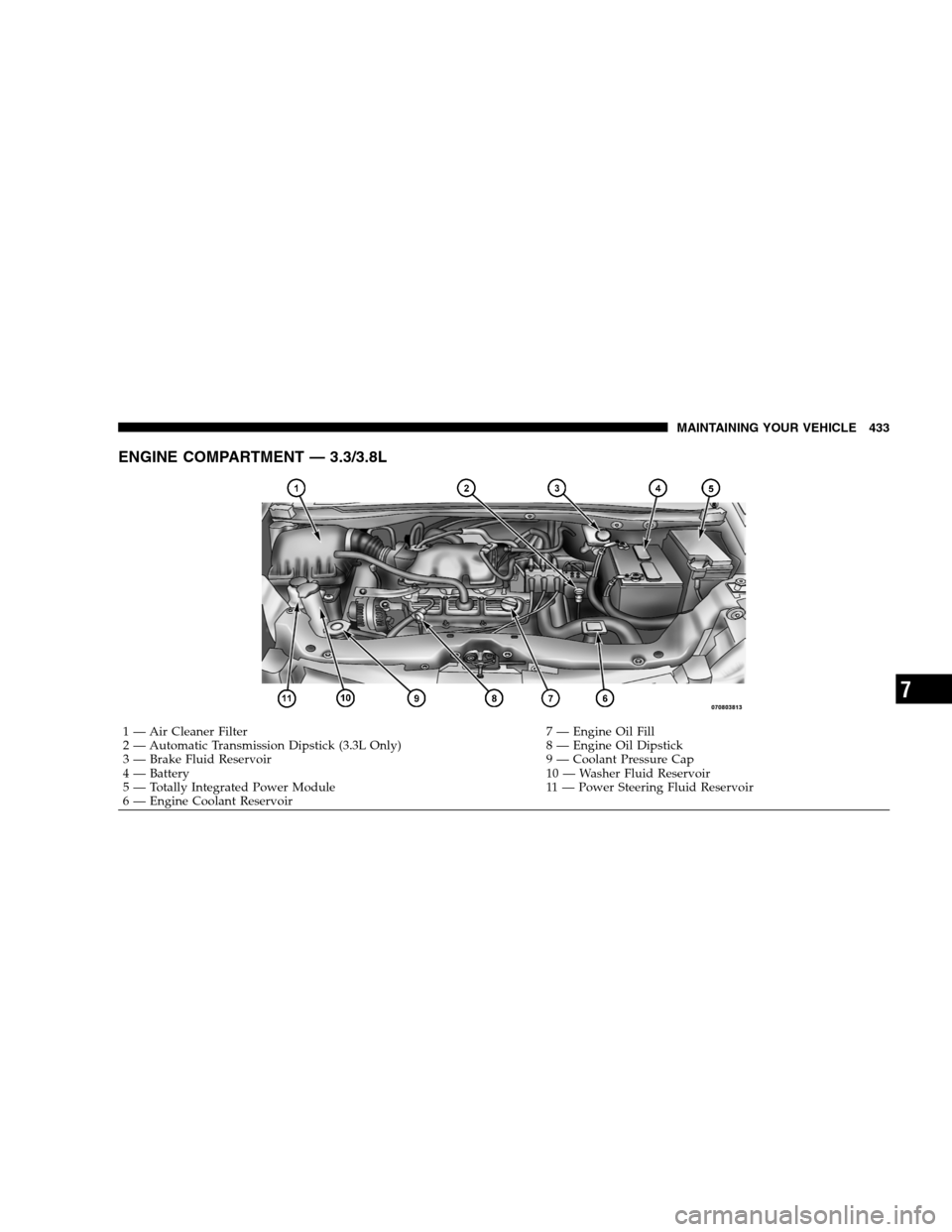
ENGINE COMPARTMENT — 3.3/3.8L
1 — Air Cleaner Filter
7 — Engine Oil Fill
2 — Automatic Transmission Dipstick (3.3L Only) 8 — Engine Oil Dipstick
3 — Brake Fluid Reservoir 9 — Coolant Pressure Cap
4 — Battery 10 — Washer Fluid Reservoir
5 — Totally Integrated Power Module 11 — Power Steering Fluid Reservoir
6 — Engine Coolant Reservoir MAINTAINING YOUR VEHICLE 433 7
Page 436 of 535
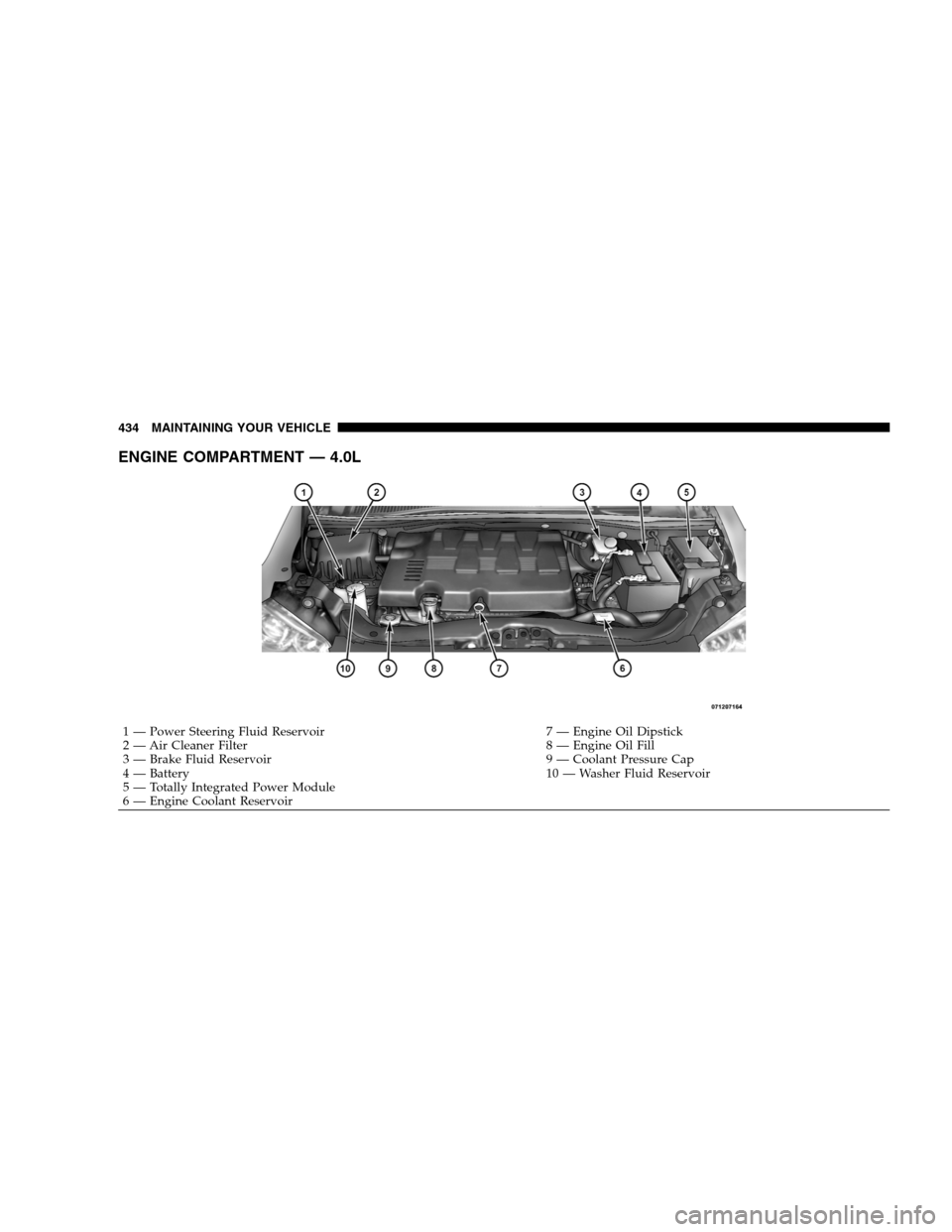
ENGINE COMPARTMENT — 4.0L
1 — Power Steering Fluid Reservoir
7 — Engine Oil Dipstick
2 — Air Cleaner Filter 8 — Engine Oil Fill
3 — Brake Fluid Reservoir 9 — Coolant Pressure Cap
4 — Battery 10 — Washer Fluid Reservoir
5 — Totally Integrated Power Module
6 — Engine Coolant Reservoir
434 MAINTAINING YOUR VEHICLE
Page 459 of 535
Master Cylinder — Brake Fluid Level CheckThe fluid level in the master cylinder should be checked
when performing underhood services, or immediately if
the “Brake System Warning Light” indicates system
failure.
Clean the top of the master cylinder area before removing
the cap. Add fluid to bring the level up to the top of the
“FULL” mark on the side of the master cylinder reservoir.
Overfilling of fluid is not recommended because it may
cause leaking in the system.
Add enough fluid to bring the level up to the require-
ments described on the brake fluid reservoir. With disc
brakes, fluid level can be expected to fall as the brake
pads wear. However, low fluid level may be caused by a
leak and a checkup may be needed.
Use only manufacturer’s recommended brake fluid. Re-
fer to “Fluids, Lubricants, and Genuine Parts” in this
section for the correct fluid type. WARNING!
Overfilling the brake fluid reservoir can result in
spilling brake fluid on hot engine parts and the
brake fluid catching fire.
Use of a brake fluid that has a lower initial boiling
point than the recommended MOPARt DOT 3
product or a brake fluid that is unidentified as to
FMVSS specification may result in sudden brake
failure during hard prolonged braking. You could
have an accident.
Use only brake fluid that has been in a tightly closed
container to avoid contamination from foreign matter or
moisture.
MAINTAINING YOUR VEHICLE 457 7
Page 460 of 535
CAUTION!Do not allow petroleum based fluid to contaminate
the brake fluid — all brake seal components could be
damaged, causing partial or complete brake failure.
Automatic Transaxle
The automatic transaxle and differential assembly are
contained within a single housing.
The fluid level in the automatic transaxle should be
checked whenever the vehicle is serviced. Operation with
an improper fluid level will greatly reduce the life of the
transaxle and the fluid.
All four–speed transaxles are equipped with a conven-
tional filler tube and dipstick. If fluid is added, it should
be added through the filler tube.
All six–speed transaxles are equipped with a capped
dipstick tube. It is sealed and should not be tampered
with. Your authorized dealer has the necessary tools to
ensure that the fluid level is set properly.
Selection of Lubricant
It is important that the proper lubricant is used in the
transaxle to assure optimum transaxle performance. Use
only the manufacturer’s recommended transmission
fluid. Refer to “Fluids, Lubricants and Genuine Parts” in
this section for the correct fluid type. It is important that
the transmission fluid be maintained at the prescribed
level using the recommended fluid. No chemical flushes
should be used in any transaxle; only the approved
lubricant may be used.
458 MAINTAINING YOUR VEHICLE