steering DODGE GRAND CARAVAN 2009 5.G Owner's Manual
[x] Cancel search | Manufacturer: DODGE, Model Year: 2009, Model line: GRAND CARAVAN, Model: DODGE GRAND CARAVAN 2009 5.GPages: 535, PDF Size: 18.61 MB
Page 351 of 535
application, and then applies optimum pressure to the
brakes. This can help reduce braking distances. The BAS
complements the ABS. Applying the brakes very quickly
results in the best BAS assistance. To receive the benefit of
the system, you must apply continuous braking pressure
during the stopping sequence. Do not reduce brake pedal
pressure unless braking is no longer desired. Once the
brake pedal is released, the BAS is deactivated.WARNING!
The BAS cannot prevent the natural laws of phys-
ics from acting on the vehicle, nor can it increase
the traction afforded by prevailing road condi-
tions.
(Continued) WARNING! (Continued)
The BAS cannot prevent accidents, including
those resulting from excessive speed in turns,
driving on very slippery surfaces, or hydroplan-
ing. Only a safe, attentive, and skillful driver can
prevent accidents.
The capabilities of a BAS-equipped vehicle must
never be exploited in a reckless or dangerous
manner which could jeopardize the user’s safety
or the safety of others.
Electronic Stability Program (ESP)
The Electronic Stability Program (ESP) enhances direc-
tional control and stability of the vehicle under various
driving conditions. ESP corrects for over/under steering
of the vehicle by applying the brake of the appropriate
wheel to assist in counteracting the over/under steer
condition. Engine power may also be reduced to help the
vehicle maintain the desired path.
STARTING AND OPERATING 349 5
Page 352 of 535
ESP uses sensors in the vehicle to determine the vehicle
path intended by the driver and compares it to the actual
path of the vehicle. When the actual path does not match
the intended path, ESP applies the brake of the appropri-
ate wheel to assist in counteracting the oversteer or
understeer condition.
Oversteer - when the vehicle is turning more than
appropriate for the steering wheel position.
Understeer - when the vehicle is turning less than
appropriate for the steering wheel position.
ESP On
This mode is the normal operating mode for ESP on
two-wheel drive vehicles. Whenever the vehicle is
started, the ESP system will be in this mode. This mode
should be used for most driving situations. ESP should
only be turned off for specific reasons as noted below. ESP Partial Off
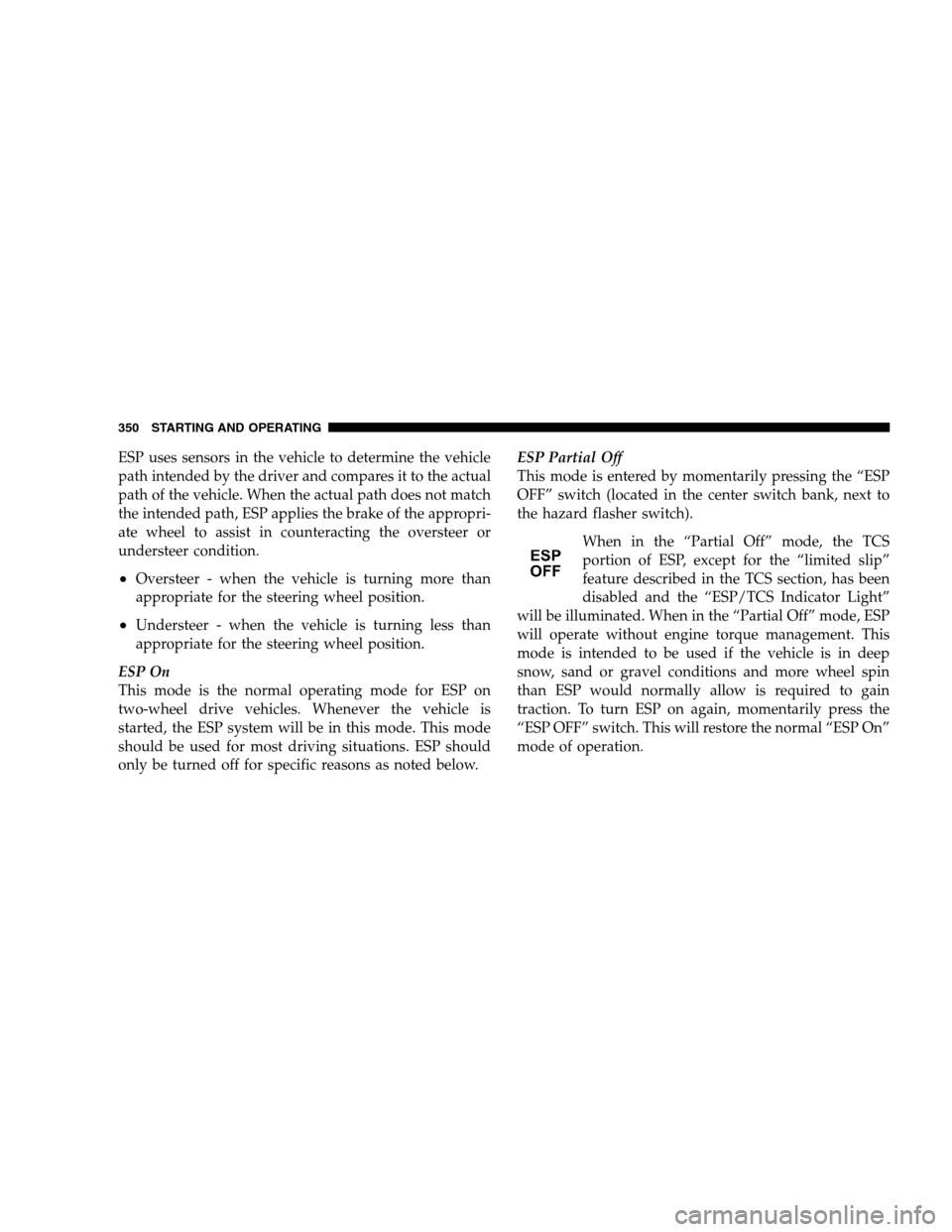
This mode is entered by momentarily pressing the “ESP
OFF” switch (located in the center switch bank, next to
the hazard flasher switch).
When in the “Partial Off” mode, the TCS
portion of ESP, except for the “limited slip”
feature described in the TCS section, has been
disabled and the “ESP/TCS Indicator Light”
will be illuminated. When in the “Partial Off” mode, ESP
will operate without engine torque management. This
mode is intended to be used if the vehicle is in deep
snow, sand or gravel conditions and more wheel spin
than ESP would normally allow is required to gain
traction. To turn ESP on again, momentarily press the
“ESP OFF” switch. This will restore the normal “ESP On”
mode of operation. 350 STARTING AND OPERATING
Page 362 of 535
WARNING!Overloading of your tires is dangerous. Overloading
can cause tire failure, affect vehicle handling, and
increase your stopping distance. Use tires of the
recommended load capacity for your vehicle. Never
overload them.
TIRES — GENERAL INFORMATION
Tire Pressure
Proper tire inflation pressure is essential to the safe and
satisfactory operation of your vehicle. Three primary
areas are affected by improper tire pressure.
Safety
WARNING!
Improperly inflated tires are dangerous and can
cause accidents.
Under-inflation increases tire flexing and can re-
sult in over-heating and tire failure.
Over-inflation reduces a tire’s ability to cushion
shock. Objects on the road and chuckholes can
cause damage that result in tire failure.
Unequal tire pressures can cause steering prob-
lems. You could lose control of your vehicle.
Over-inflated or under-inflated tires can affect
vehicle handling and can fail suddenly, resulting
in loss of vehicle control. (Continued)
360 STARTING AND OPERATING
Page 369 of 535
WARNING!
Do not use a tire, wheel size or rating other than
that specified for your vehicle. Some combinations
of unapproved tires and wheels may change sus-
pension dimensions and performance characteris-
tics, resulting in changes to steering, handling, and
braking of your vehicle. This can cause unpredict-
able handling and stress to steering and suspen-
sion components. You could lose control and have
an accident resulting in serious injury or death.
Use only the tire and wheel sizes with load ratings
approved for your vehicle.
Never use a tire with a smaller load index or
capacity, than what was originally equipped on
your vehicle. Using a tire with a smaller load index
could result in tire overloading and failure. You
could lose control and have an accident.
(Continued) WARNING! (Continued)
Failure to equip your vehicle with tires having
adequate speed capability can result in sudden tire
failure and loss of vehicle control. CAUTION!
Replacing original tires with tires of a different size
may result in false speedometer and odometer read-
ings.
TIRE CHAINS
Use only compact chains, or other traction aids that meet
SAE type “Class S” specifications. Chains must be the
proper size for the vehicle, as recommended by the chain
manufacturer.
NOTE:
Do not use tire chains on a compact spare tire.
STARTING AND OPERATING 367 5
Page 371 of 535
SNOW TIRESSome areas of the country require the use of snow tires
during Winter. Standard tires are of the all-season type
and satisfy this requirement as indicated by the M+S
designation on the tire sidewall.
If you need snow tires, select tires equivalent in size and
type to the original equipment tires. Use snow tires only
in sets of four; failure to do so may adversely affect the
safety and handling of your vehicle.
Snow tires generally have lower speed ratings than what
was originally equipped with your vehicle and should
not be operated at sustained speeds over 75 mph
(120 km/h).
TIRE ROTATION
Tires on the front and rear axles of vehicles operate at
different loads and perform different steering, driving,
and braking functions. For these reasons, they wear at
unequal rates, and tend to develop irregular wear pat-
terns.
These effects can be reduced by timely rotation of tires.
The benefits of rotation are especially worthwhile with
aggressive tread designs such as those on All-Season type
tires. Rotation will increase tread life, help to maintain
mud, snow, and wet traction levels, and contribute to a
smooth, quiet ride.
Refer to the “Maintenance Schedule” in Section 8 for the
proper maintenance intervals. More frequent rotation is
permissible if desired. The reasons for any rapid or
unusual wear should be corrected prior to rotation being
performed.
STARTING AND OPERATING 369
5
Page 396 of 535
WARNING!It is important that you do not exceed the maximum
front or rear GAWR. A dangerous driving condition
can result if either rating is exceeded. You could lose
control of the vehicle and have an accident.
Trailer Tongue Weight (TW)
The TW is the downward force exerted on the hitch ball
by the trailer. In most cases it should not be less than 10%
or more than 15% of the trailer load. You must consider
this as part of the load on your vehicle.
Frontal Area
The frontal area is the maximum height and maximum
width of the front of a trailer.
Trailer Sway Control
The trailer sway control is a telescoping link that can be
installed between the hitch receiver and the trailer tongue
that typically provides adjustable friction associated with
the telescoping motion to dampen any unwanted trailer
swaying motions while traveling.
Weight-Carrying Hitch
A weight-carrying hitch supports the trailer tongue
weight, just as if it were luggage located at a hitch ball or
some other connecting point of the vehicle. This type of
hitch is the most popular on the market today and is
commonly used to tow small- and medium-sized trailers.
Weight-Distributing Hitch
A weight-distributing system works by applying lever-
age through spring (load) bars. They are typically used
for heavier loads to distribute trailer tongue weight to the
tow vehicle’s front axle and the trailer’s axle(s). When
used in accordance with the manufacturer’s directions, it
provides for a more level ride, offering more consistent
steering and brake control thereby enhancing towing
safety. The addition of a friction/hydraulic sway control
394 STARTING AND OPERATING
Page 404 of 535
When hauling cargo or towing a trailer, do not over-
load your vehicle or trailer. Overloading can cause a
loss of control, poor performance or damage to brakes,
axle, engine, transaxle, steering, suspension, chassis
structure or tires.
Safety chains must always be used between your
vehicle and trailer. Always connect the chains to the
frame or hook retainers of the vehicle hitch. Cross the
chains under the trailer tongue and allow enough
slack for turning corners.
Vehicles with trailers should not be parked on a grade.
When parking, apply the parking brake on the tow
vehicle. Put the tow vehicle automatic transmission in
PARK. Always, block or
9chock9the trailer wheels.
GCWR must not be exceeded.
Total weight must be distributed between the tow
vehicle and the trailer such that the following four
ratings are not exceeded:
1. GVWR
2. GTW
3. GAWR
4. Trailer tongue weight rating for that trailer hitch.
(This requirement may limit the ability to always
achieve the 10% to 15% range of trailer tongue weight
as a percentage of total trailer weight.)
402 STARTING AND OPERATING
Page 429 of 535
FREEING A STUCK VEHICLEIf your vehicle becomes stuck in mud, sand or snow, it
can often be moved by a rocking motion. Turn your
steering wheel right and left to clear the area around the
front wheels. Then move the shift lever back and forth
between REVERSE and DRIVE. Using minimal accelera-
tor pedal pressure to maintain the rocking motion, with-
out spinning the wheels, is most effective.
WARNING!
Fast spinning tires can be dangerous. Forces gener-
ated by excessive wheel speeds may cause tire dam-
age or failure. A tire could explode and injure some-
one. Do not spin your vehicle’s wheels faster than
35 mph (55 km/h) when you are stuck. Do not let
anyone near a spinning wheel, no matter what the
speed. CAUTION!
Revving the engine or spinning the wheels too fast
may lead to transmission overheating and failure. It
can also damage the tires. Do not spin the wheels
above 35 mph (55 km/h).
TOWING A DISABLED VEHICLE
Towing With The Ignition Key
Your vehicle may be towed under the following condi-
tions:
The shift lever must be in NEUTRAL.
The distance to be traveled must not exceed 100 miles
(160 km).
The towing speed must not exceed 44 mph (72 km/h).
WHAT TO DO IN EMERGENCIES 427
6
Page 430 of 535
CAUTION!Exceeding these towing limits may cause a transmis-
sion gear failure.
If the transmission is inoperative, or if the vehicle is to be
towed more than 100 miles (160 km), the vehicle must be
towed with the front wheels off the ground. CAUTION!
Do not attempt to tow this vehicle from the front
with sling-type towing equipment. Damage to the
front fascia will result.
(Continued) CAUTION! (Continued)
Always use wheel lift equipment when towing
from the front. The only other approved method of
towing is with a flatbed truck.
Do not tow the vehicle from the rear. Damage to
the rear sheet metal, liftgate and fascia will occur.
Do not push or tow this vehicle with another
vehicle as damage to the bumper fascia and trans-
mission may result.
If the vehicle being towed requires steering, the
ignition switch must be in the OFF position, not in
the LOCK or ACC positions.
428 WHAT TO DO IN EMERGENCIES
Page 435 of 535
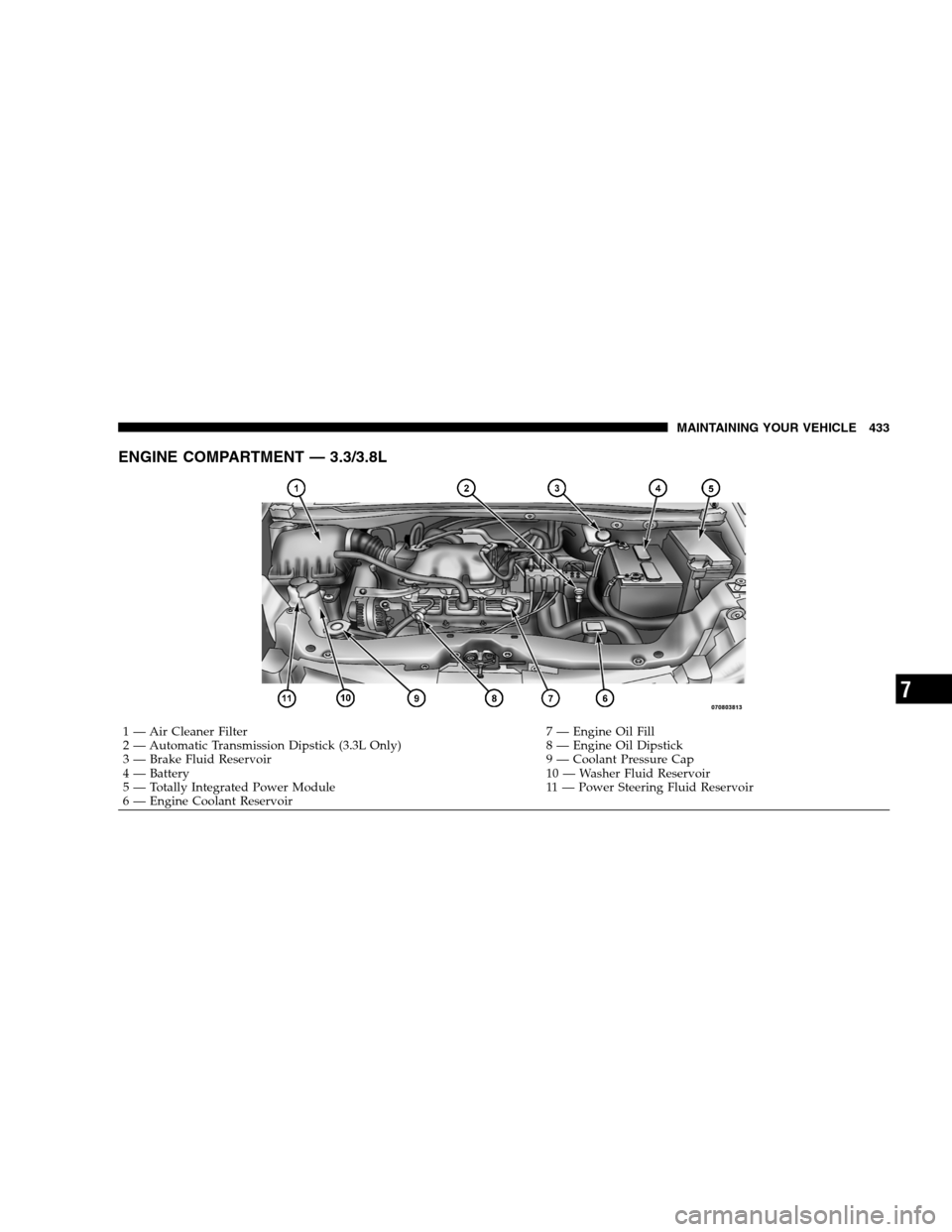
ENGINE COMPARTMENT — 3.3/3.8L
1 — Air Cleaner Filter
7 — Engine Oil Fill
2 — Automatic Transmission Dipstick (3.3L Only) 8 — Engine Oil Dipstick
3 — Brake Fluid Reservoir 9 — Coolant Pressure Cap
4 — Battery 10 — Washer Fluid Reservoir
5 — Totally Integrated Power Module 11 — Power Steering Fluid Reservoir
6 — Engine Coolant Reservoir MAINTAINING YOUR VEHICLE 433 7