tow DODGE GRAND CARAVAN 2016 5.G Owners Manual
[x] Cancel search | Manufacturer: DODGE, Model Year: 2016, Model line: GRAND CARAVAN, Model: DODGE GRAND CARAVAN 2016 5.GPages: 707, PDF Size: 5.24 MB
Page 32 of 707
4. To assemble the RKE transmitter case, snap the twohalves together.
General Information
This device complies with Part 15 of the FCC rules and
RSS-210 of Industry Canada. Operation is subject to the
following conditions:
•This device may not cause harmful interference.
• This device must accept any interference received,
including interference that may cause undesired op-
eration.
NOTE: Changes or modifications not expressly approved
by the party responsible for compliance could void the
user’s authority to operate the equipment.
If your RKE transmitter fails to operate from a normal
distance, check for these two conditions:
1.
A weak battery in the transmitter. The expected life of the
battery is a minimum of three years with normal usage.
2. Closeness to a radio transmitter such as a radio station tower, airport transmitter, and some mobile or CB
radios.
REMOTE STARTING SYSTEM — IF EQUIPPED
This system uses the Remote Keyless Entry
(RKE) transmitter to start the engine conve-
niently from outside the vehicle while still
maintaining security. The system has a range of
approximately 300 ft (91 m).
NOTE:
• The vehicle must be equipped with an automatic
transmission to be equipped with Remote Start.
• Obstructions between the vehicle and the Key Fob may
reduce this range.
30 THINGS TO KNOW BEFORE STARTING YOUR VEHICLE
Page 50 of 707
Sliding Side Door Child Protection Lock
To provide a safer environment for small children riding
in the rear seats, the sliding doors are equipped with a
Child Protection Door Lock system.
NOTE:When the Child Protection Door Lock system is
engaged, the door can be opened only by using the
outside door handle even though the inside door lock is
in the unlocked position.
To Engage The Child Protection Door Lock
1. Open the sliding side door.
2. Slide the Child Protection Door Lock control inward (toward the vehicle) to engage the Child Protection
Door Lock.
Overhead Console Power Sliding Door Power Switch
1 — Left Sliding Door
2 — Liftgate
3 — Right Sliding Door
4 — Power Switch 48 THINGS TO KNOW BEFORE STARTING YOUR VEHICLE
Page 60 of 707
position the Seat Belt Reminder Light will turn on and
remain on until both outboard front seat belts are buck-
led. The outboard front passenger seat BeltAlert is not
active when an outboard front passenger seat is unoccu-
pied.
BeltAlert Warning Sequence
The BeltAlert warning sequence is activated when the
vehicle is moving above a specified vehicle speed range
and the driver or outboard front seat passenger is un-
buckled (if equipped with outboard front passenger seat
BeltAlert). The BeltAlert warning sequence starts by
blinking the Seat Belt Reminder Light and sounding an
intermittent chime. Once the BeltAlert warning sequence
has completed, the Seat Belt Reminder Light will remain
on until the seat belts are buckled. The BeltAlert warning
sequence may repeat based on vehicle speed until thedriver and occupied outboard front seat passenger seat
belts are buckled. The driver should instruct all occu-
pants to buckle their seat belts.
Change Of Status
If the driver or outboard front seat passenger (if
equipped with outboard front passenger seat BeltAlert)
unbuckles their seat belt while the vehicle is traveling,
the BeltAlert warning sequence will begin until the seat
belts are buckled again.
The outboard front passenger seat BeltAlert is not active
when the outboard front passenger seat is unoccupied.
BeltAlert may be triggered when an animal or heavy
object is on the outboard front passenger seat or when the
seat is folded flat (if equipped). It is recommended that
pets be restrained in the rear seat (if equipped) in pet
harnesses or pet carriers that are secured by seat belts,
and cargo is properly stowed.
58 THINGS TO KNOW BEFORE STARTING YOUR VEHICLE
Page 66 of 707
5. Position the shoulder belt across the shoulder andchest with minimal, if any slack so that it is comfort-
able and not resting on your neck. The retractor will
withdraw any slack in the shoulder belt.
6. To release the seat belt, push the red button on the buckle. The seat belt will automatically retract to its
stowed position. If necessary, slide the latch plate
down the webbing to allow the seat belt to retract
fully.
Lap/Shoulder Belt Untwisting Procedure
Use the following procedure to untwist a twisted lap/
shoulder belt.
1. Position the latch plate as close as possible to theanchor point. 2. At about 6 to 12 in (15 to 30 cm) above the latch plate,
grasp and twist the seat belt webbing 180 degrees to
create a fold that begins immediately above the latch
plate.
3. Slide the latch plate upward over the folded webbing. The folded webbing must enter the slot at the top of
the latch plate.
4. Continue to slide the latch plate up until it clears the folded webbing and the seat belt is no longer twisted.
Adjustable Upper Shoulder Belt Anchorage
In the front and second row outboard seats the shoulder
belt can be adjusted upward or downward to position the
seat belt away from your neck. Push or squeeze the
anchorage button to release the anchorage, and move it
up or down to the position that serves you best.
64 THINGS TO KNOW BEFORE STARTING YOUR VEHICLE
Page 68 of 707
1. Remove the mini-latch plate and regular latch platefrom its stowed position in the headliner slightly
behind the third row seat. 2. Grasp the mini-latch plate and pull the seat belt over
the seat.
Mini-Latch Stowage
Mini-Latch Stowage
66 THINGS TO KNOW BEFORE STARTING YOUR VEHICLE
Page 71 of 707
8. Position the shoulder belt on your chest so that it iscomfortable and not resting on your neck. The retrac-
tor will withdraw any slack in the seat belt.
9.
To release the seat belt, push the red button on the buckle.
10. To disengage the mini-latch plate from the mini- buckle for storage, insert the regular latch plate into
the center red slot on the mini-buckle. The seat belt
will automatically retract to its stowed position. If
necessary, slide the latch plate down the webbing to
allow the seat belt to retract fully. Insert the mini-
latch plate and regular latch plate into its stowed
position.
WARNING!
•If the mini-latch plate and mini-buckle are not
properly connected when the seat belt is used by an
occupant, the seat belt will not be able to provide
proper restraint and will increase the risk of injury
in a collision.
• When reattaching the mini-latch plate and mini-
buckle, ensure the seat belt webbing is not twisted.
If the webbing is twisted, follow the preceding
procedure to detach the mini-latch plate and mini-
buckle, untwist the webbing, and reattach the
mini-latch plate and mini-buckle.
Seat Belt Extender
If a seat belt is not long enough to fit properly, even when
the webbing is fully extended and the adjustable upper
shoulder belt anchorage (if equipped) is in its lowest
position, your authorized dealer can provide you with a
2
THINGS TO KNOW BEFORE STARTING YOUR VEHICLE 69
Page 106 of 707
Frequently Asked Questions About Installing Child Restraints With LATCH
Can the rear-facing child restraint touch the back of the front passenger seat? Yes
The child seat may touch the back of the
front passenger seat if the child restraint
manufacturer also allows contact. See your child restraint owner ’s manual for more information.
Can the head restraints be removed? YesThe 2nd row head restraints on bench and
fixed quad seats are removable. 2nd row
stow ’n go head restraints are not remov- able. The 3rd row center head restraint is removable in all vehicles.
104 THINGS TO KNOW BEFORE STARTING YOUR VEHICLE
Page 109 of 707
rear-facing child restraints will also be equipped with a
tether strap. The tether strap will have a hook at the end
to attach to the top tether anchorage and a way to tighten
the strap after it is attached to the anchorage.
Center Seat LATCH
If a child restraint installed in the center position blocks
the seat belt webbing or buckle for the outboard position,
do not use that outboard position. If a child seat in the
center position blocks the outboard LATCH anchors or
seat belt, do not install a child seat in that outboard
position.
WARNING!
Never use the same lower anchorage to attach more
than one child restraint. Please refer to “Installing
The LATCH-Compatible Child Restraint System” for
typical installation instructions.Always follow the directions of the child restraint manu-
facturer when installing your child restraint. Not all child
restraint systems will be installed as described here.
To Install A LATCH-Compatible Child Restraint
If the selected seating position has a Switchable Auto-
matic Locking Retractor (ALR) seat belt, stow the seat
belt, following the instructions below. See the section
“Installing Child Restraints Using the Vehicle Seat Belt”
to check what type of seat belt each seating position has.
1. Loosen the adjusters on the lower straps and on the
tether strap of the child seat so that you can more
easily attach the hooks or connectors to the vehicle
anchorages.
2. Place the child seat between the lower anchorages for that seating position. For some second row seats, you
may need to recline the seat and / or raise the head
restraint to get a better fit. If the rear seat can be moved
2
THINGS TO KNOW BEFORE STARTING YOUR VEHICLE 107
Page 110 of 707
forward and rearward in the vehicle, you may wish to
move it to its rear-most position to make room for the
child seat. You may also move the front seat forward
to allow more room for the child seat.
3. Attach the lower hooks or connectors of the child restraint to the lower anchorages in the selected seat-
ing position.
4. If the child restraint has a tether strap, connect it to the top tether anchorage. See the section “Installing Child
Restraints Using the Top Tether Anchorage” for direc-
tions to attach a tether anchor.
5. Tighten all of the straps as you push the child restraint rearward and downward into the seat. Remove slack
in the straps according to the child restraint manufac-
turer ’s instructions. 6. Test that the child restraint is installed tightly by
pulling back and forth on the child seat at the belt
path. It should not move more than 1 inch (25.4 mm)
in any direction.
How To Stow An Unused ALR Seat Belt:
When using the LATCH attaching system to install a child
restraint, stow all ALR seat belts that are not being used by
other occupants or being used to secure child restraints. An
unused belt could injure a child if they play with it and
accidentally lock the seat belt retractor. Before installing a
child restraint using the LATCH system, buckle the seat
belt behind the child restraint and out of the child’s reach.
If the buckled seat belt interferes with the child restraint
installation, instead of buckling it behind the child re-
straint, route the seat belt through the child restraint belt
path and then buckle it. Do not lock the seat belt. Remind
all children in the vehicle that the seat belts are not toys and
that they should not play with them.
108 THINGS TO KNOW BEFORE STARTING YOUR VEHICLE
Page 114 of 707
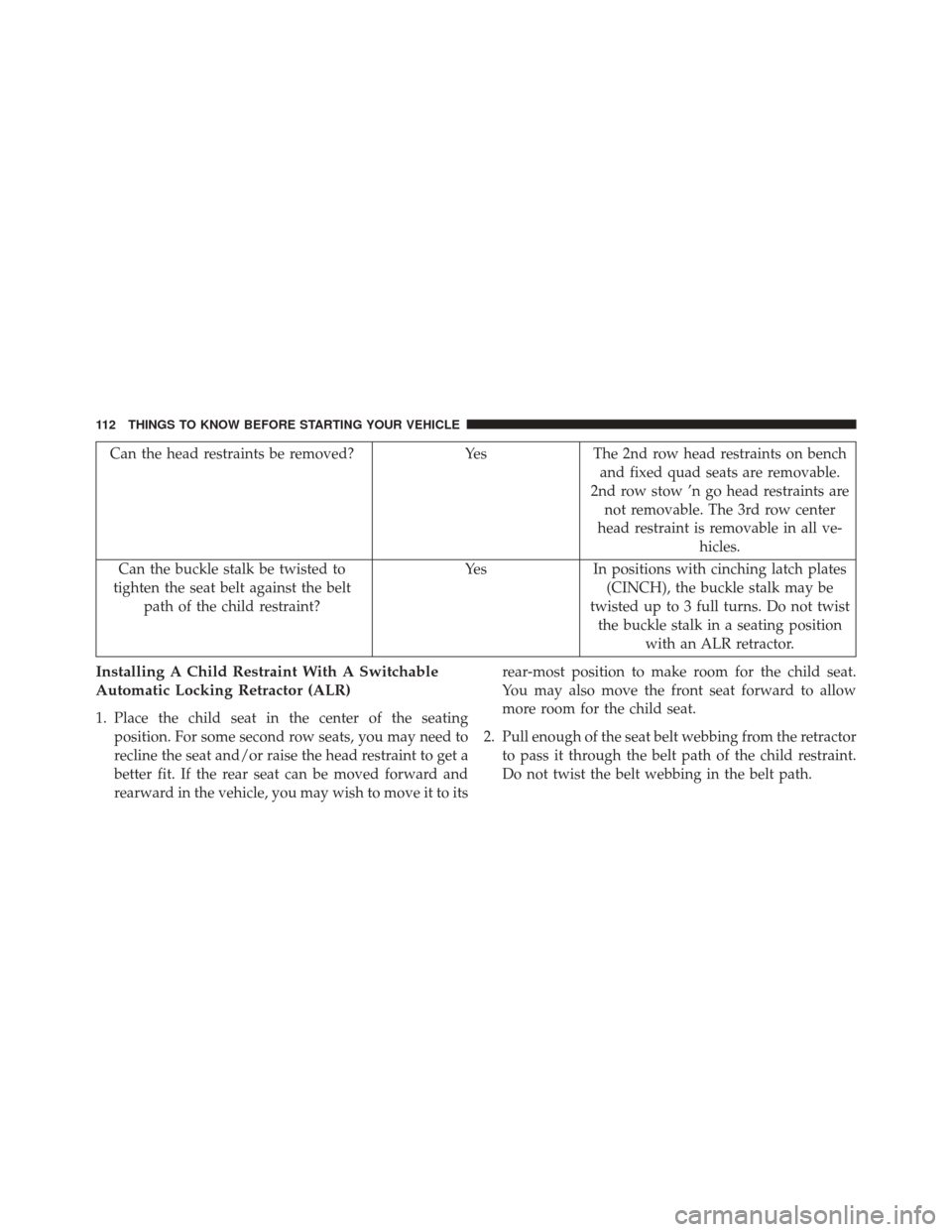
Can the head restraints be removed?YesThe 2nd row head restraints on bench
and fixed quad seats are removable.
2nd row stow ’n go head restraints are not removable. The 3rd row center
head restraint is removable in all ve- hicles.
Can the buckle stalk be twisted to
tighten the seat belt against the belt path of the child restraint? Yes
In positions with cinching latch plates
(CINCH), the buckle stalk may be
twisted up to 3 full turns. Do not twist the buckle stalk in a seating position with an ALR retractor.
Installing A Child Restraint With A Switchable
Automatic Locking Retractor (ALR)
1. Place the child seat in the center of the seatingposition. For some second row seats, you may need to
recline the seat and/or raise the head restraint to get a
better fit. If the rear seat can be moved forward and
rearward in the vehicle, you may wish to move it to its rear-most position to make room for the child seat.
You may also move the front seat forward to allow
more room for the child seat.
2. Pull enough of the seat belt webbing from the retractor to pass it through the belt path of the child restraint.
Do not twist the belt webbing in the belt path.
112 THINGS TO KNOW BEFORE STARTING YOUR VEHICLE