cooling DODGE GRAND CARAVAN 2017 5.G User Guide
[x] Cancel search | Manufacturer: DODGE, Model Year: 2017, Model line: GRAND CARAVAN, Model: DODGE GRAND CARAVAN 2017 5.GPages: 530, PDF Size: 5.01 MB
Page 474 of 530
After the engine has warmed, operate the defroster for a
few minutes to reduce the possibility of smearing or
freezing the fluid on the cold windshield. MOPAR All
Weather Windshield Washer Solution or equivalent, used
with water as directed on the container, aids cleaning
action, reduces the freezing point to avoid line clogging,
and is not harmful to paint or trim.
Cooling System
WARNING!
•When working near the radiator cooling fan, discon-
nect the fan motor lead or turn the ignition switch to
the OFF position. The fan is temperature controlled
and can start at anytime the ignition switch is in the
ON position.
• You or others can be badly burned by hot engine
coolant (antifreeze) or steam from your radiator. If
you see or hear steam coming from under the hood,
do not open the hood until the radiator has had time
to cool. Never try to open a cooling system pressure
cap when the radiator is hot.
Coolant Checks
Check the engine coolant (antifreeze) protection every 12
months (before the onset of freezing weather, where appli-
cable). If the engine coolant (antifreeze) is dirty, the system
should be drained, flushed, and refilled with fresh OAT
coolant (conforming to MS.90032) only by an authorized
dealer. Check the front of the A/C condenser for any
accumulation of bugs, leaves, etc. If dirty, clean by gently
spraying water from a garden hose vertically down the face
of the condenser.
Check the coolant recovery bottle tubing for brittle rubber,
cracking, tears, cuts and tightness of the connection at the
bottle and radiator. Inspect the entire system for leaks.
With the engine at normal operating temperature (but not
running), check the cooling system pressure cap for proper
vacuum sealing by draining a small amount of engine
coolant (antifreeze) from the radiator drain cock. If the cap
is sealing properly, the engine coolant (antifreeze) will
begin to drain from the coolant recovery bottle. DO NOT
REMOVE THE COOLANT PRESSURE CAP WHEN THE
COOLING SYSTEM IS HOT.
472 MAINTAINING YOUR VEHICLE
Page 475 of 530
Cooling System — Drain, Flush And Refill
NOTE:Some vehicles require special tools to add coolant
properly. Failure to fill these systems properly could lead to
severe internal engine damage. If any coolant is needed to
be added to the system, please contact your local autho-
rized dealer.
If the engine coolant (antifreeze) is dirty or contains visible
sediment, have an authorized dealer clean and flush with
OAT coolant (antifreeze) (conforming to MS.90032).
Refer to the “Maintenance Schedule” for the proper main-
tenance intervals.
Selection Of Coolant
Refer to “Fluids, Lubricants, And Genuine Parts” in “Main-
taining Your Vehicle” for further information.
CAUTION!
• Mixing of engine coolant (antifreeze) other than
specified Organic Additive Technology (OAT) en-
gine coolant (antifreeze), may result in engine dam-
age and may decrease corrosion protection. Organic
(Continued)
CAUTION! (Continued)
Additive Technology (OAT) engine coolant is differ-
ent and should not be mixed with Hybrid Organic
Additive Technology (HOAT) engine coolant (anti-
freeze) or any “globally compatible” coolant (anti-
freeze). If a non-OAT engine coolant (antifreeze) is
introduced into the cooling system in an emergency,
the cooling system will need to be drained, flushed,
and refilled with fresh OAT coolant (conforming to
MS.90032), by an authorized dealer as soon as pos-
sible.
• Do not use water alone or alcohol-based engine
coolant (antifreeze) products. Do not use additional
rust inhibitors or antirust products, as they may not
be compatible with the engine coolant and may plug
the radiator.
• This vehicle has not been designed for use with
propylene glycol-based engine coolant (antifreeze).
Use of propylene glycol-based engine coolant (anti-
freeze) is not recommended.
Adding Coolant
Your vehicle has been built with an improved engine
coolant (OAT coolant conforming to MS.90032) that allows
7
MAINTAINING YOUR VEHICLE 473
Page 476 of 530
extended maintenance intervals. This engine coolant (anti-
freeze) can be used up to ten years or 150,000 miles
(240,000 km) before replacement. To prevent reducing this
extended maintenance period, it is important that you use
the same engine coolant (OAT coolant conforming to
MS.90032) throughout the life of your vehicle.
Please review these recommendations for using Organic
Additive Technology (OAT) engine coolant (antifreeze)
that meets the requirements of FCA Material Standard
MS.90032. When adding engine coolant (antifreeze):
•We recommend using MOPAR Antifreeze/Coolant 10
Year/150,000 Mile Formula OAT (Organic Additive
Technology) that meets the requirements of FCA Mate-
rial Standard MS.90032.
• Mix a minimum solution of 50% OAT engine coolant
that meets the requirements of FCA Material Standard
MS.90032 and distilled water. Use higher concentrations
(not to exceed 70%) if temperatures below 34°F (37°C)
are anticipated. Please contact your authorized dealer
for assistance. •
Use only high purity water such as distilled or deionized
water when mixing the water/engine coolant (anti-
freeze) solution. The use of lower quality water will
reduce the amount of corrosion protection in the engine
cooling system.
NOTE:
• It is the owner’s responsibility to maintain the proper
level of protection against freezing according to the
temperatures occurring in the area where the vehicle is
operated.
• Some vehicles require special tools to add coolant prop-
erly. Failure to fill these systems properly could lead to
severe internal engine damage. If any coolant is needed
to be added to the system, please contact your local
authorized dealer.
• Mixing engine coolant (antifreeze) types is not recom-
mended and can result in cooling system damage. If
HOAT and OAT coolant are mixed in an emergency,
have a authorized dealer drain, flush, and refill with
OAT coolant (conforming to MS.90032) as soon as pos-
sible.
474 MAINTAINING YOUR VEHICLE
Page 477 of 530
Cooling System Pressure Cap
The cap must be fully tightened to prevent loss of engine
coolant (antifreeze), and to ensure that engine coolant
(antifreeze) will return to the radiator from the coolant
recovery tank.
The cap should be inspected and cleaned if there is any
accumulation of foreign material on the sealing surfaces.
WARNING!
•Do not open hot engine cooling system. Never add
engine coolant (antifreeze) when the engine is over-
heated. Do not loosen or remove the cap to cool an
overheated engine. Heat causes pressure to build up
in the cooling system. To prevent scalding or injury,
do not remove the pressure cap while the system is
hot or under pressure.
• Do not use a pressure cap other than the one speci-
fied for your vehicle. Personal injury or engine
damage may result.
Disposal Of Used Engine Coolant
Used ethylene glycol-based engine coolant (antifreeze) is a
regulated substance requiring proper disposal. Check with
your local authorities to determine the disposal rules for your community. To prevent ingestion by animals or
children, do not store ethylene glycol-based engine coolant
in open containers or allow it to remain in puddles on the
ground. If ingested by a child or pet, seek emergency
assistance immediately. Clean up any ground spills imme-
diately.
Coolant Level
The coolant bottle provides a quick visual method for
determining that the coolant level is adequate. With the
engine OFF and cold, the level of the engine coolant
(antifreeze) in the bottle should be between the ranges
indicated on the bottle.
The radiator normally remains completely full, so there is
no need to remove the radiator/coolant pressure cap
unless checking for engine coolant (antifreeze) freeze point
or replacing coolant. Advise your service attendant of this.
As long as the engine operating temperature is satisfactory,
the coolant bottle need only be checked once a month.
When additional engine coolant (antifreeze) is needed to
maintain the proper level, only OAT coolant that meets the
requirements of FCA Material Standard MS.90032 should
be added to the coolant bottle. Do not overfill.
7
MAINTAINING YOUR VEHICLE 475
Page 478 of 530
Points To Remember
NOTE:When the vehicle is stopped after a few miles/
kilometers of operation, you may observe vapor coming
from the front of the engine compartment. This is normally
a result of moisture from rain, snow, or high humidity
accumulating on the radiator and being vaporized when
the thermostat opens, allowing hot engine coolant (anti-
freeze) to enter the radiator.
If an examination of your engine compartment shows no
evidence of radiator or hose leaks, the vehicle may be
safely driven. The vapor will soon dissipate.
• Do not overfill the coolant expansion bottle.
• Check the coolant freeze point in the radiator and in the
coolant expansion bottle. If engine coolant (antifreeze)
needs to be added, the contents of the coolant expansion
bottle must also be protected against freezing.
• If frequent engine coolant (antifreeze) additions are
required, the cooling system should be pressure tested
for leaks.
• Maintain engine coolant (antifreeze) concentration at a
minimum of 50% OAT coolant (conforming to MS.90032) and distilled water for proper corrosion pro-
tection of your engine which contains aluminum com-
ponents.
• Make sure that the coolant expansion bottle overflow
hoses are not kinked or obstructed.
• Keep the front of the radiator clean. If your vehicle is
equipped with air conditioning, keep the front of the
condenser clean.
• Do not change the thermostat for Summer or Winter
operation. If replacement is ever necessary, install ONLY
the correct type thermostat. Other designs may result in
unsatisfactory engine coolant (antifreeze) performance,
poor gas mileage, and increased emissions.
Brake System
In order to assure brake system performance, all brake
system components should be inspected periodically. Refer
to the “Maintenance Schedule” for the proper maintenance
intervals.
476 MAINTAINING YOUR VEHICLE
Page 497 of 530
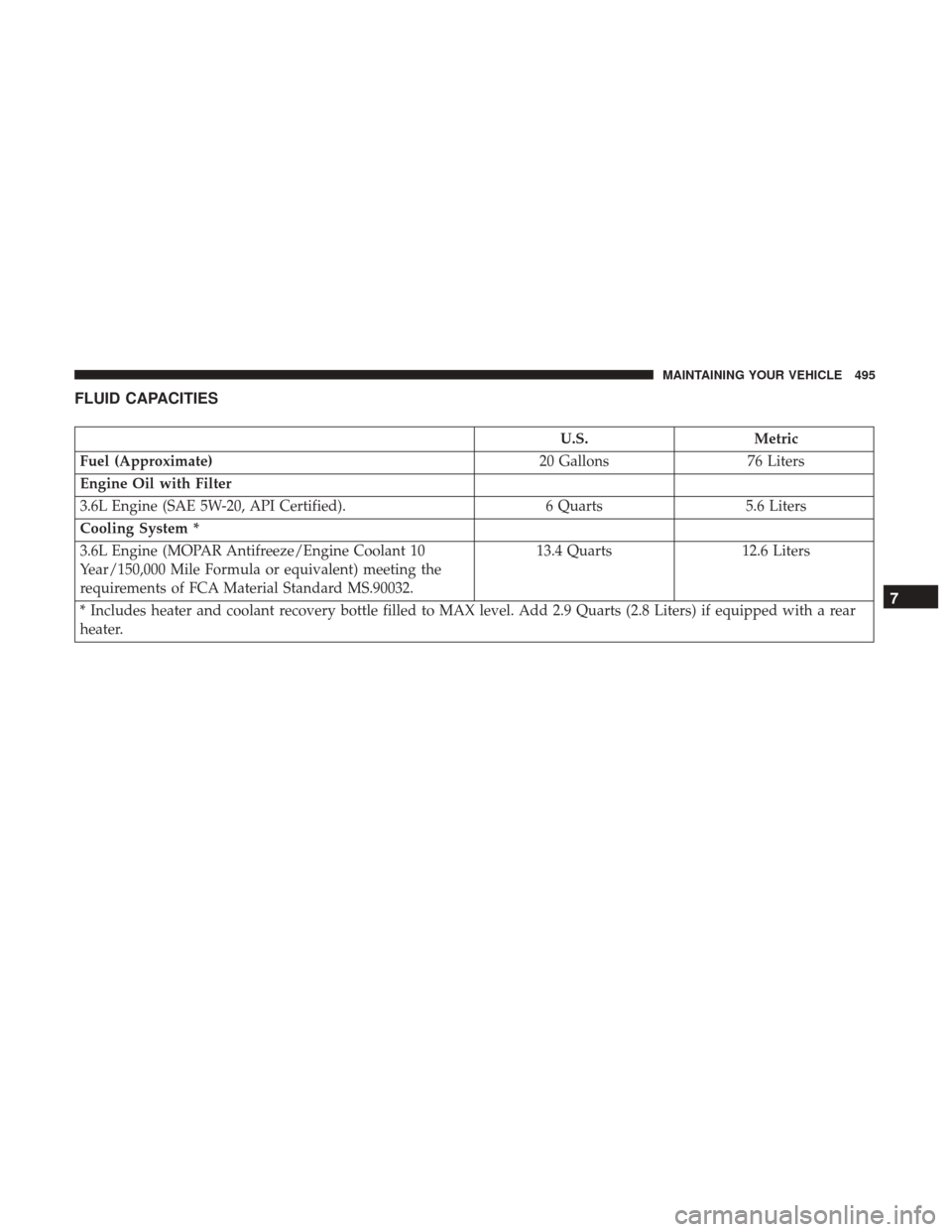
FLUID CAPACITIES
U.S.Metric
Fuel (Approximate) 20 Gallons76 Liters
Engine Oil with Filter
3.6L Engine (SAE 5W-20, API Certified). 6 Quarts5.6 Liters
Cooling System *
3.6L Engine (MOPAR Antifreeze/Engine Coolant 10
Year/150,000 Mile Formula or equivalent) meeting the
requirements of FCA Material Standard MS.90032. 13.4 Quarts
12.6 Liters
* Includes heater and coolant recovery bottle filled to MAX level. Add 2.9 Quarts (2.8 Liters) if equipped with a rear
heater.
7
MAINTAINING YOUR VEHICLE 495
Page 499 of 530
CAUTION!
•Mixing of engine coolant (antifreeze) other than
specified Organic Additive Technology (OAT) en-
gine coolant (antifreeze), may result in engine dam-
age and may decrease corrosion protection. Organic
Additive Technology (OAT) engine coolant is differ-
ent and should not be mixed with Hybrid Organic
Additive Technology (HOAT) engine coolant (anti-
freeze) or any “globally compatible” coolant (anti-
freeze). If a non-OAT engine coolant (antifreeze) is
introduced into the cooling system in an emergency,
the cooling system will need to be drained, flushed,
(Continued)
CAUTION! (Continued)
and refilled with fresh OAT coolant (conforming to
MS.90032), by an authorized dealer as soon as pos-
sible.
• Do not use water alone or alcohol-based engine
coolant (antifreeze) products. Do not use additional
rust inhibitors or antirust products, as they may not
be compatible with the radiator engine coolant and
may plug the radiator.
• This vehicle has not been designed for use with
propylene glycol-based engine coolant (antifreeze).
Use of propylene glycol-based engine coolant (anti-
freeze) is not recommended.
7
MAINTAINING YOUR VEHICLE 497
Page 503 of 530
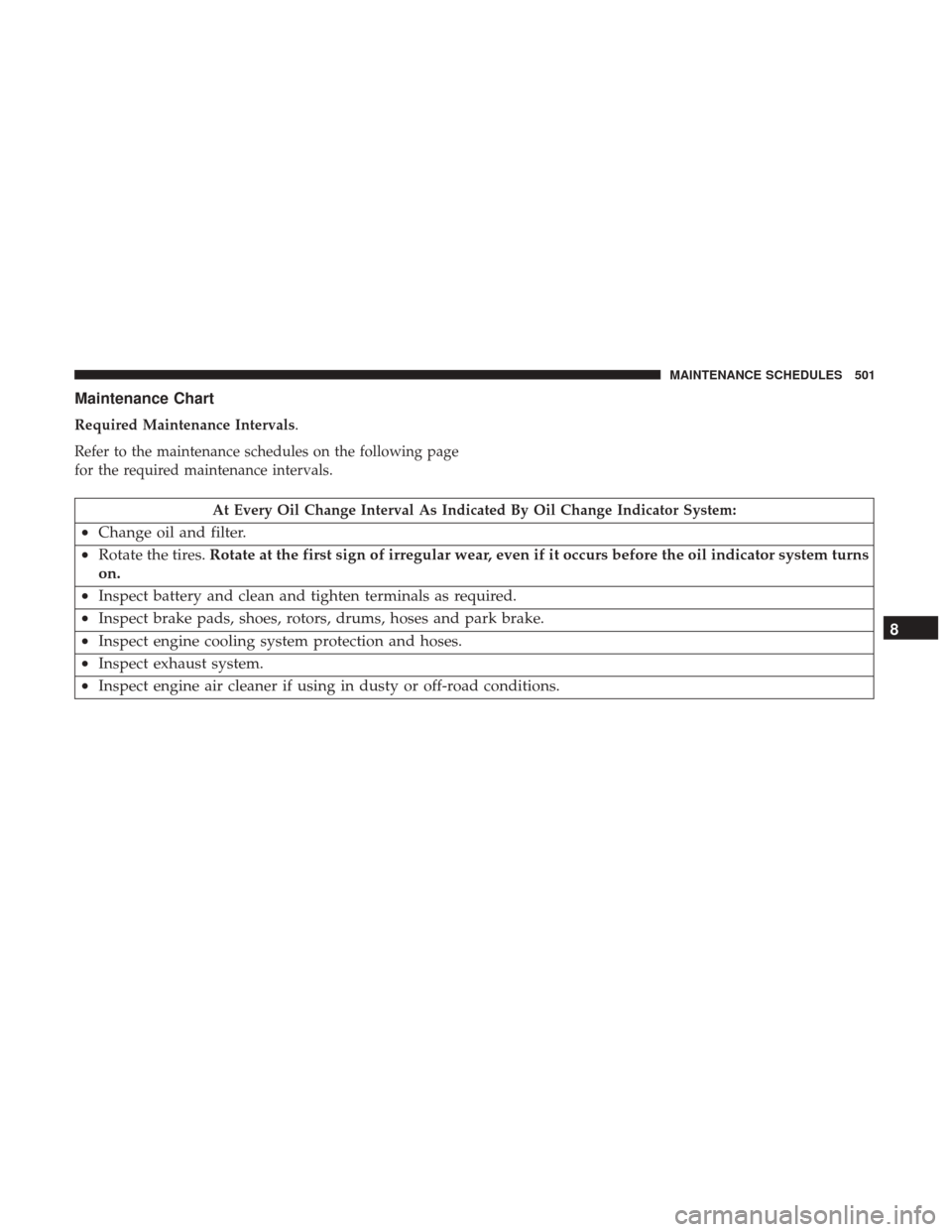
Maintenance Chart
Required Maintenance Intervals.
Refer to the maintenance schedules on the following page
for the required maintenance intervals.
At Every Oil Change Interval As Indicated By Oil Change Indicator System:
•Change oil and filter.
• Rotate the tires. Rotate at the first sign of irregular wear, even if it occurs before the oil indicator system turns
on.
• Inspect battery and clean and tighten terminals as required.
• Inspect brake pads, shoes, rotors, drums, hoses and park brake.
• Inspect engine cooling system protection and hoses.
• Inspect exhaust system.
• Inspect engine air cleaner if using in dusty or off-road conditions. 8
MAINTENANCE SCHEDULES 501
Page 516 of 530
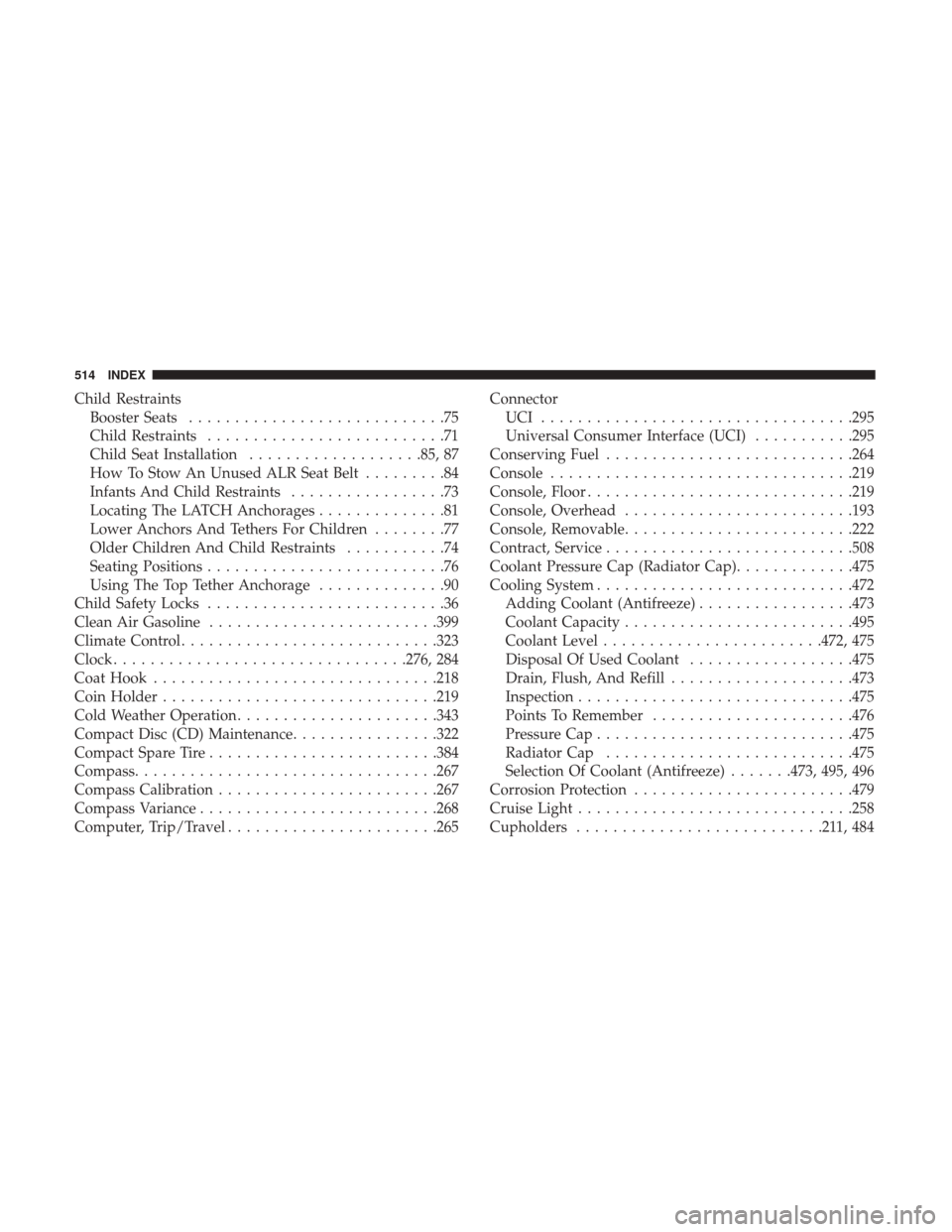
Child RestraintsBooster Seats ............................75
Child Restraints ..........................71
Child Seat Installation ...................85, 87
How To Stow An Unused ALR Seat Belt .........84
Infants And Child Restraints .................73
Locating The LATCH Anchorages ..............81
Lower Anchors And Tethers For Children ........77
Older Children And Child Restraints ...........74
Seating Positions ..........................76
Using The Top Tether Anchorage ..............90
Child Safety Locks ..........................36
Clean Air Gasoline ........................ .399
Climate Control ............................323
Clock ............................... .276, 284
Coat Hook ...............................218
Coin Holder ............................. .219
Cold Weather Operation ..................... .343
Compact Disc (CD) Maintenance ................322
Compact Spare Tire ........................ .384
Compass .................................267
Compass Calibration ........................267
Compass Variance ..........................268
Computer, Trip/Travel .......................265 Connector
UCI ..................................295
Universal Consumer Interface (UCI) ...........295
Conserving Fuel .......................... .264
Console .................................219
Console, Floor ............................ .219
Console, Overhead ........................ .193
Console, Removable ........................ .222
Contract, Service .......................... .508
Coolant Pressure Cap (Radiator Cap) .............475
Cooling System ............................472
Adding Coolant (Antifreeze) .................473
Coolant Capacity ........................ .495
Coolant Level ........................472, 475
Disposal Of Used Coolant ..................475
Drain, Flush,
And Refill ....................473
Inspection ............................. .475
Points To Remember ..................... .476
Pressure Cap ............................475
Radiator Cap .......................... .475
Selection Of Coolant (Antifreeze) .......473, 495, 496
Corrosion Protection ........................479
Cruise Light ............................. .258
Cupholders ...........................211,484
514 INDEX
Page 518 of 530
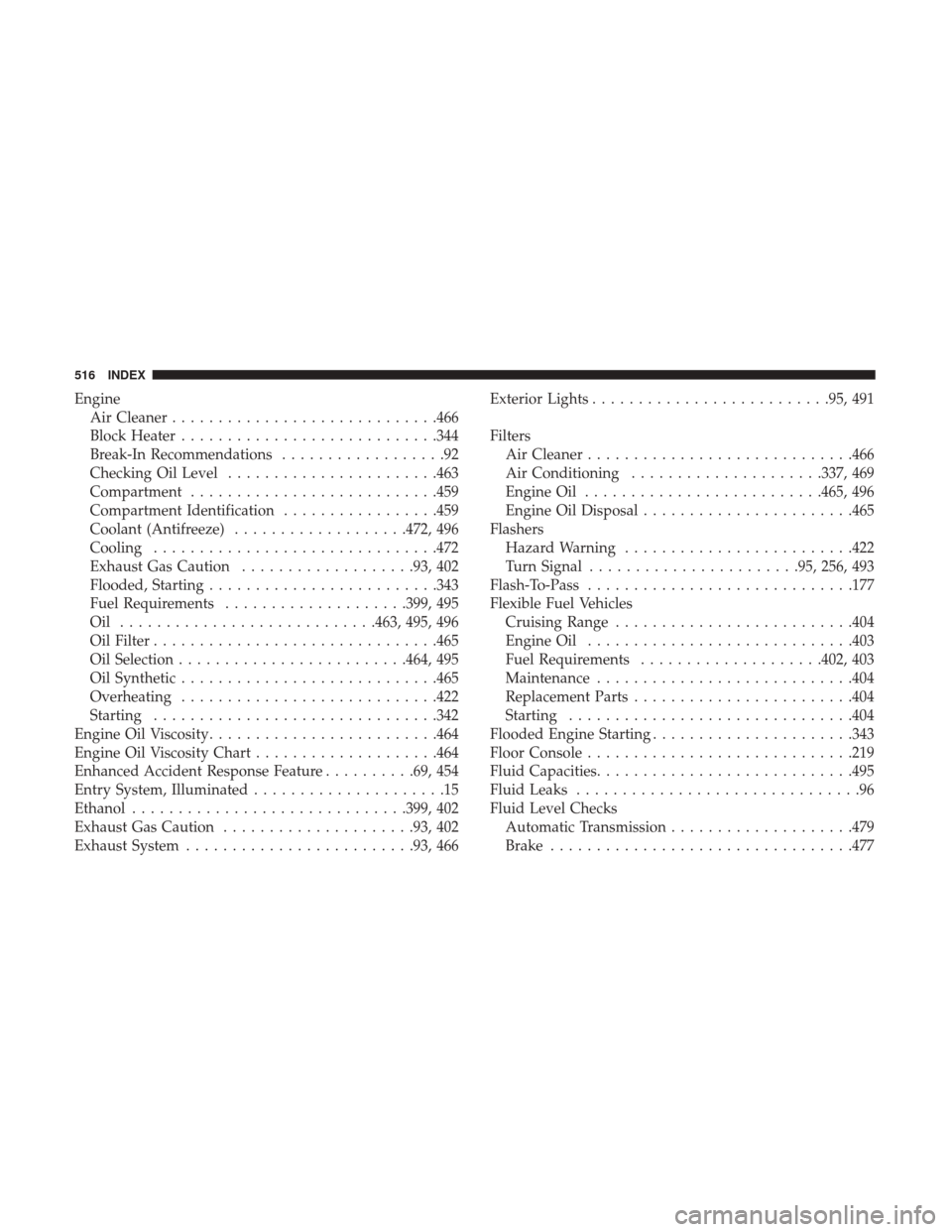
EngineAir Cleaner ............................ .466
Block Heater ............................344
Break-In Recommendations ..................92
Checking Oil Level .......................463
Compartment .......................... .459
Compartment Identification .................459
Coolant (Antifreeze) ...................472, 496
Cooling ...............................472
Exhaust Gas Caution ...................93, 402
Flooded, Starting ........................ .343
Fuel Requirements ....................399, 495
Oil ............................463, 495, 496
Oil Filter ...............................465
Oil Selection ........................ .464, 495
Oil Synthetic ............................465
Overheating ............................422
Starting ...............................342
Engine Oil Viscosity ........................ .464
Engine Oil Viscosity Chart ....................464
Enhanced Accident Response Feature ..........69, 454
Entry System, Illuminated .....................15
Ethanol ............................. .399, 402
Exhaust Gas Caution .....................93, 402
Exhaust System ........................ .93, 466Exterior Lights
..........................95, 491
Filters Air Cleaner ............................ .466
Air Conditioning .....................337, 469
Engine Oil ..........................465, 496
Engine Oil Disposal .......................465
Flashers Hazard Warning ........................ .422
Turn Signal .......................95, 256, 493
Flash-To-Pass ............................ .177
Flexible Fuel Vehicles Cruising Range ..........................404
Engine Oil ............................ .403
Fuel Requir
ements ....................402, 403
Maintenance ............................404
Replacement Parts ........................404
Starting ...............................404
Flooded Engine Starting ..................... .343
Floor Console ............................ .219
Fluid Capacities ............................495
Fluid Leaks ...............................96
Fluid Level Checks Automatic Transmission ....................479
Brake .................................477
516 INDEX