fuel DODGE HORNET 2023 Owner's Guide
[x] Cancel search | Manufacturer: DODGE, Model Year: 2023, Model line: HORNET, Model: DODGE HORNET 2023Pages: 288, PDF Size: 14.2 MB
Page 210 of 288
208IN CASE OF EMERGENCY
(Continued)
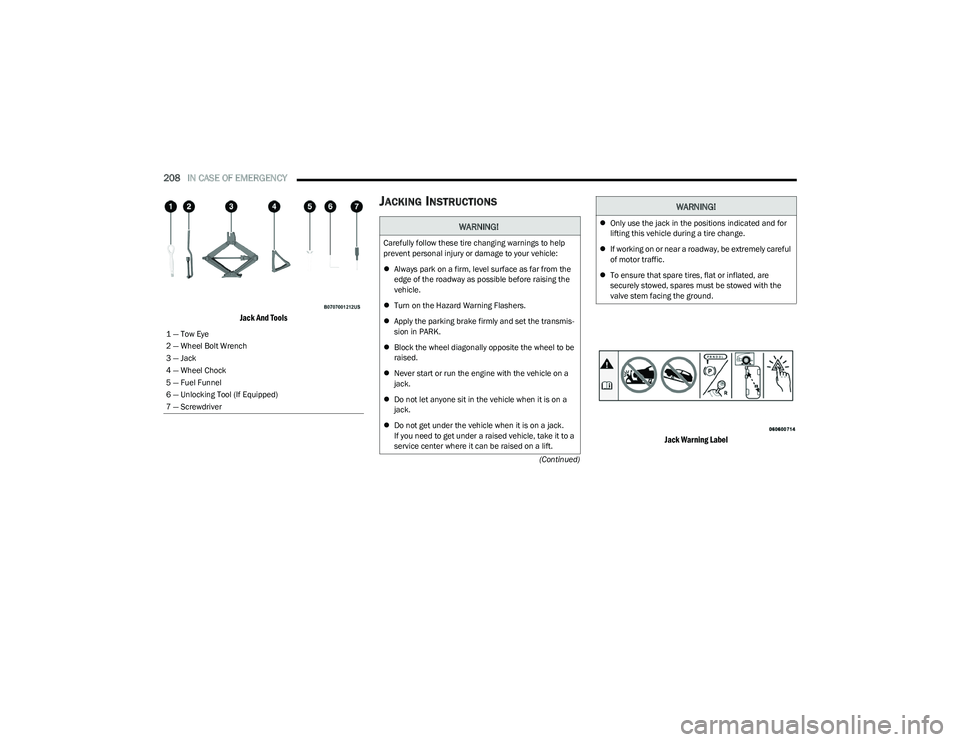
Jack And Tools
JACKING INSTRUCTIONS
Jack Warning Label
1 — Tow Eye
2 — Wheel Bolt Wrench
3 — Jack
4 — Wheel Chock
5 — Fuel Funnel
6 — Unlocking Tool (If Equipped)
7 — Screwdriver
WARNING!
Carefully follow these tire changing warnings to help
prevent personal injury or damage to your vehicle:
Always park on a firm, level surface as far from the
edge of the roadway as possible before raising the
vehicle.
Turn on the Hazard Warning Flashers.
Apply the parking brake firmly and set the transmis -
sion in PARK.
Block the wheel diagonally opposite the wheel to be
raised.
Never start or run the engine with the vehicle on a
jack.
Do not let anyone sit in the vehicle when it is on a
jack.
Do not get under the vehicle when it is on a jack.
If you need to get under a raised vehicle, take it to a
service center where it can be raised on a lift.
Only use the jack in the positions indicated and for
lifting this vehicle during a tire change.
If working on or near a roadway, be extremely careful
of motor traffic.
To ensure that spare tires, flat or inflated, are
securely stowed, spares must be stowed with the
valve stem facing the ground.
WARNING!
23_GG_OM_EN_USC_t.book Page 208
Page 218 of 288
216IN CASE OF EMERGENCY
JUMP STARTING PROCEDURE
Connecting The Jumper Cables
1. Connect the positive
(+) end of the jumper cable to
the positive (+)
post of the discharged vehicle.
2. Connect the opposite end of the positive (+) jumper
cable to the positive (+) post of the booster battery.
3. Connect the negative (-) end of the jumper cable to
the negative (-) post of the booster battery.
4. Connect the opposite end of the negative (-) jumper
cable to a good engine ground. A “ground” is an
exposed metallic/unpainted part of the engine, frame
or chassis, such as an accessory bracket or large bolt.
The ground must be away from the battery and the
fuel injection system.
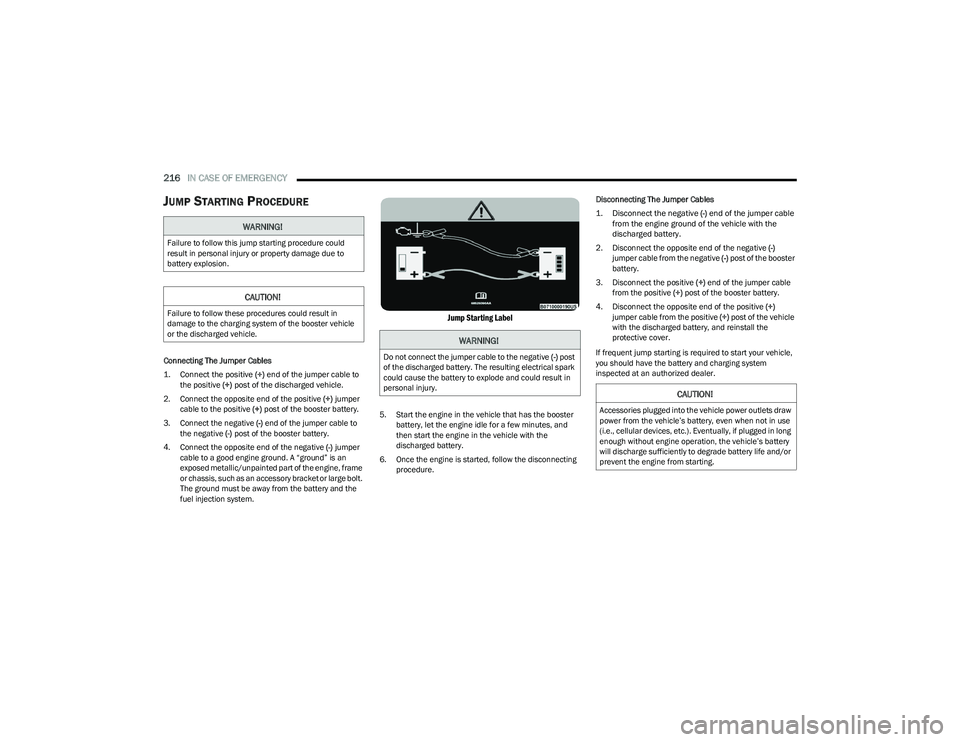
Jump Starting Label
5. Start the engine in the vehicle that has the booster battery, let the engine idle for a few minutes, and
then start the engine in the vehicle with the
discharged battery.
6. Once the engine is started, follow the disconnecting procedure. Disconnecting The Jumper Cables
1. Disconnect the negative
(-)
end of the jumper cable
from the engine ground of the vehicle with the
discharged battery.
2. Disconnect the opposite end of the negative (-)
jumper cable from the negative (-) post of the booster
battery.
3. Disconnect the positive (+) end of the jumper cable
from the positive (+) post of the booster battery.
4. Disconnect the opposite end of the positive (+)
jumper cable from the positive (+) post of the vehicle
with the discharged battery, and reinstall the
protective cover.
If frequent jump starting is required to start your vehicle,
you should have the battery and charging system
inspected at an authorized dealer.
WARNING!
Failure to follow this jump starting procedure could
result in personal injury or property damage due to
battery explosion.
CAUTION!
Failure to follow these procedures could result in
damage to the charging system of the booster vehicle
or the discharged vehicle.
WARNING!
Do not connect the jumper cable to the negative (-) post
of the discharged battery. The resulting electrical spark
could cause the battery to explode and could result in
personal injury.
CAUTION!
Accessories plugged into the vehicle power outlets draw
power from the vehicle’s battery, even when not in use
(i.e., cellular devices, etc.). Eventually, if plugged in long
enough without engine operation, the vehicle’s battery
will discharge sufficiently to degrade battery life and/or
prevent the engine from starting.
23_GG_OM_EN_USC_t.book Page 216
Page 219 of 288
IN CASE OF EMERGENCY217
REFUELING IN EMERGENCY
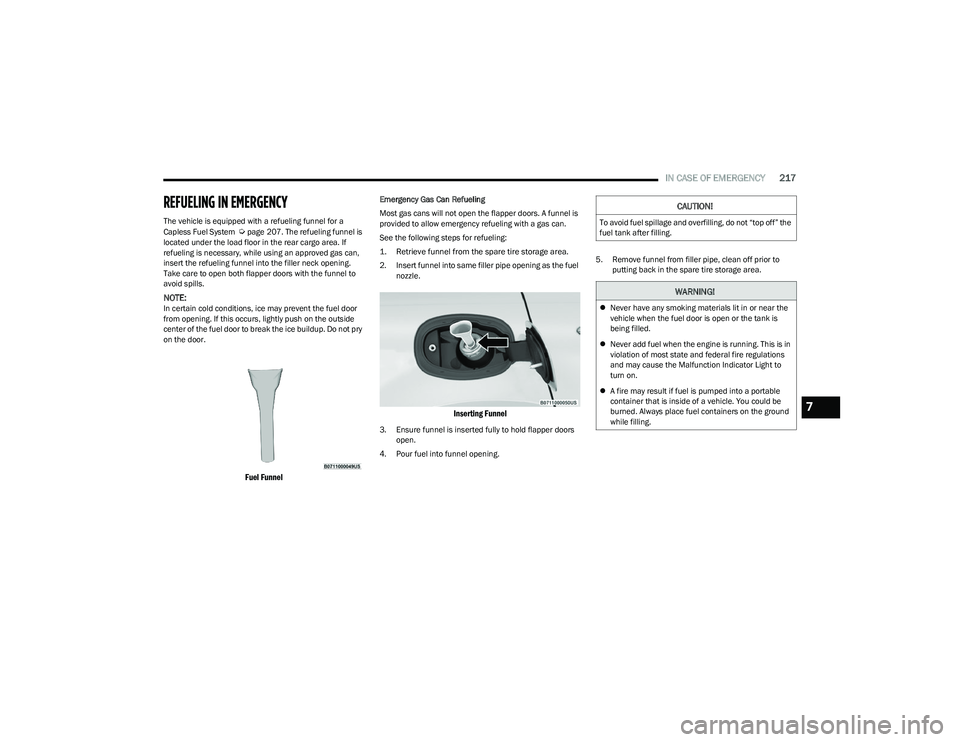
The vehicle is equipped with a refueling funnel for a
Capless Fuel System Úpage 207. The refueling funnel is
located under the load floor in the rear cargo area. If
refueling is necessary, while using an approved gas can,
insert the refueling funnel into the filler neck opening.
Take care to open both flapper doors with the funnel to
avoid spills.
NOTE:In certain cold conditions, ice may prevent the fuel door
from opening. If this occurs, lightly push on the outside
center of the fuel door to break the ice buildup. Do not pry
on the door.
Fuel Funnel
Emergency Gas Can Refueling
Most gas cans will not open the flapper doors. A funnel is
provided to allow emergency refueling with a gas can.
See the following steps for refueling:
1. Retrieve funnel from the spare tire storage area.
2. Insert funnel into same filler pipe opening as the fuel nozzle.
Inserting Funnel
3. Ensure funnel is inserted fully to hold flapper doors open.
4. Pour fuel into funnel opening. 5. Remove funnel from filler pipe, clean off prior to
putting back in the spare tire storage area.
CAUTION!
To avoid fuel spillage and overfilling, do not “top off” the
fuel tank after filling.
WARNING!
Never have any smoking materials lit in or near the
vehicle when the fuel door is open or the tank is
being filled.
Never add fuel when the engine is running. This is in
violation of most state and federal fire regulations
and may cause the Malfunction Indicator Light to
turn on.
A fire may result if fuel is pumped into a portable
container that is inside of a vehicle. You could be
burned. Always place fuel containers on the ground
while filling.
7
23_GG_OM_EN_USC_t.book Page 217
Page 229 of 288
SERVICING AND MAINTENANCE227
CHECKING OIL LEVEL
To ensure proper engine lubrication, the engine oil must
be maintained at the correct level. Check the oil level at
regular intervals, such as every fuel stop. The best time to
check the engine oil level is about five minutes after a fully
warmed up engine is shut off.
Checking the oil while the vehicle is on level ground will
improve the accuracy of the oil level readings.
There are four possible dipstick types:
Crosshatched zone.
Crosshatched zone marked SAFE.
Crosshatched zone marked with MIN at the low end of
the range and MAX at the high end of the range.
Crosshatched zone marked with dimples at the MIN
and the MAX ends of the range.
NOTE:Always maintain the oil level within the crosshatch
markings on the dipstick.
Adding 1 qt (1 L) of oil when the reading is at the low end
of the dipstick range will raise the oil level to the high end
of the range marking.
ADDING WASHER FLUID
The fluid reservoir is located in the front of the engine
compartment. Be sure to check the fluid level in the
reservoir at regular intervals. Fill the reservoir with
windshield washer solvent (not radiator antifreeze) and
operate the system for a few seconds to flush out the
residual washer fluid.
When refilling the washer fluid reservoir, take some
washer fluid, apply it to a cloth or towel, and wipe clean the
wiper blades; this will help blade performance.
To prevent freeze-up of your windshield washer system in
cold weather, select a solution or mixture that meets or
exceeds the temperature range of your climate. This rating
information can be found on most washer fluid containers.
MAINTENANCE-FREE BATTERY
Your vehicle is equipped with a maintenance-free battery.
You will never have to add water, and periodic
maintenance is not required.CAUTION!
Overfilling or underfilling the engine oil will cause
aeration or loss of oil pressure. This could damage your
engine.
WARNING!
Commercially available windshield washer solvents are
flammable. They could ignite and burn you. Care must
be exercised when filling or working around the washer
solution.
WARNING!
Battery fluid is a corrosive acid solution and can burn
or even blind you. Do not allow battery fluid to
contact your eyes, skin, or clothing. Do not lean over
a battery when attaching clamps. If acid splashes in
eyes or on skin, flush the area immediately with large
amounts of water
Úpage 215.
Battery gas is flammable and explosive. Keep flame
or sparks away from the battery. Do not use a
booster battery or any other booster source with an
output greater than 12 Volts. Do not allow cable
clamps to touch each other.
Battery posts, terminals, and related accessories
contain lead and lead compounds. Wash hands after
handling.
CAUTION!
It is essential when replacing the cables on the
battery that the positive cable is attached to the posi -
tive post and the negative cable is attached to the
negative post. Battery posts are marked positive (+)
and negative (-) and are identified on the battery
case. Cable clamps should be tight on the terminal
posts and free of corrosion.
If a “fast charger” is used while the battery is in the
vehicle, disconnect both vehicle battery cables
before connecting the charger to the battery. Do not
use a “fast charger” to provide starting voltage.
8
23_GG_OM_EN_USC_t.book Page 227
Page 234 of 288
232SERVICING AND MAINTENANCE
Rear Wiper Blade Removal/Installation
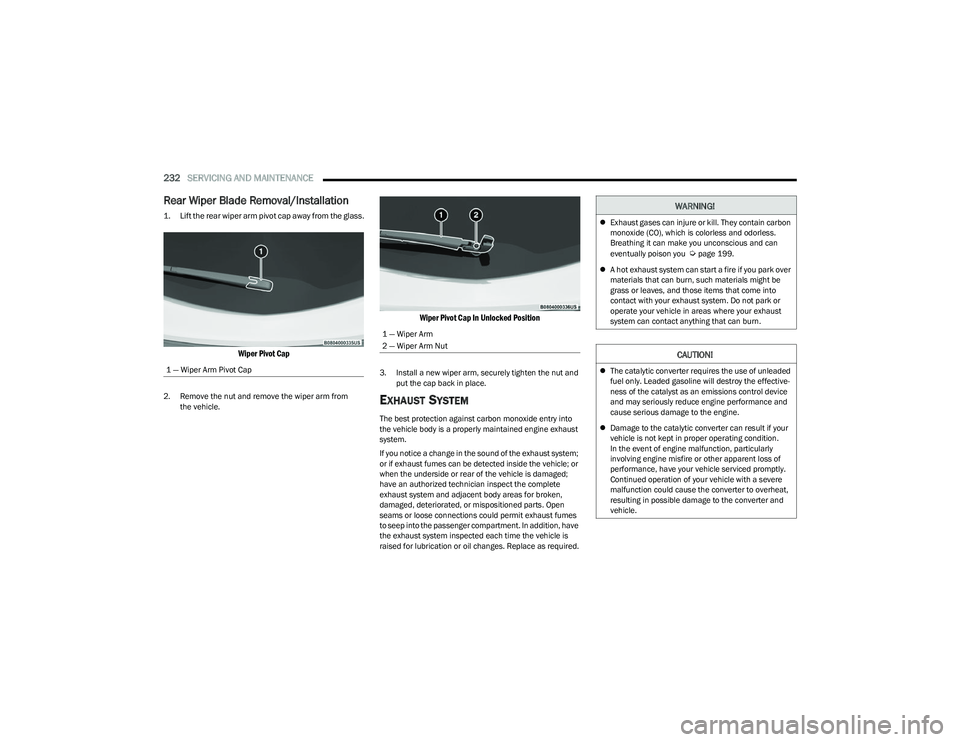
1. Lift the rear wiper arm pivot cap away from the glass.
Wiper Pivot Cap
2. Remove the nut and remove the wiper arm from
the vehicle.
Wiper Pivot Cap In Unlocked Position
3. Install a new wiper arm, securely tighten the nut and put the cap back in place.
EXHAUST SYSTEM
The best protection against carbon monoxide entry into
the vehicle body is a properly maintained engine exhaust
system.
If you notice a change in the sound of the exhaust system;
or if exhaust fumes can be detected inside the vehicle; or
when the underside or rear of the vehicle is damaged;
have an authorized technician inspect the complete
exhaust system and adjacent body areas for broken,
damaged, deteriorated, or mispositioned parts. Open
seams or loose connections could permit exhaust fumes
to seep into the passenger compartment. In addition, have
the exhaust system inspected each time the vehicle is
raised for lubrication or oil changes. Replace as required.
1 — Wiper Arm Pivot Cap
1 — Wiper Arm
2 — Wiper Arm Nut
WARNING!
Exhaust gases can injure or kill. They contain carbon
monoxide (CO), which is colorless and odorless.
Breathing it can make you unconscious and can
eventually poison you
Úpage 199.
A hot exhaust system can start a fire if you park over
materials that can burn, such materials might be
grass or leaves, and those items that come into
contact with your exhaust system. Do not park or
operate your vehicle in areas where your exhaust
system can contact anything that can burn.
CAUTION!
The catalytic converter requires the use of unleaded
fuel only. Leaded gasoline will destroy the effective -
ness of the catalyst as an emissions control device
and may seriously reduce engine performance and
cause serious damage to the engine.
Damage to the catalytic converter can result if your
vehicle is not kept in proper operating condition.
In the event of engine malfunction, particularly
involving engine misfire or other apparent loss of
performance, have your vehicle serviced promptly.
Continued operation of your vehicle with a severe
malfunction could cause the converter to overheat,
resulting in possible damage to the converter and
vehicle.
23_GG_OM_EN_USC_t.book Page 232
Page 242 of 288
240SERVICING AND MAINTENANCE
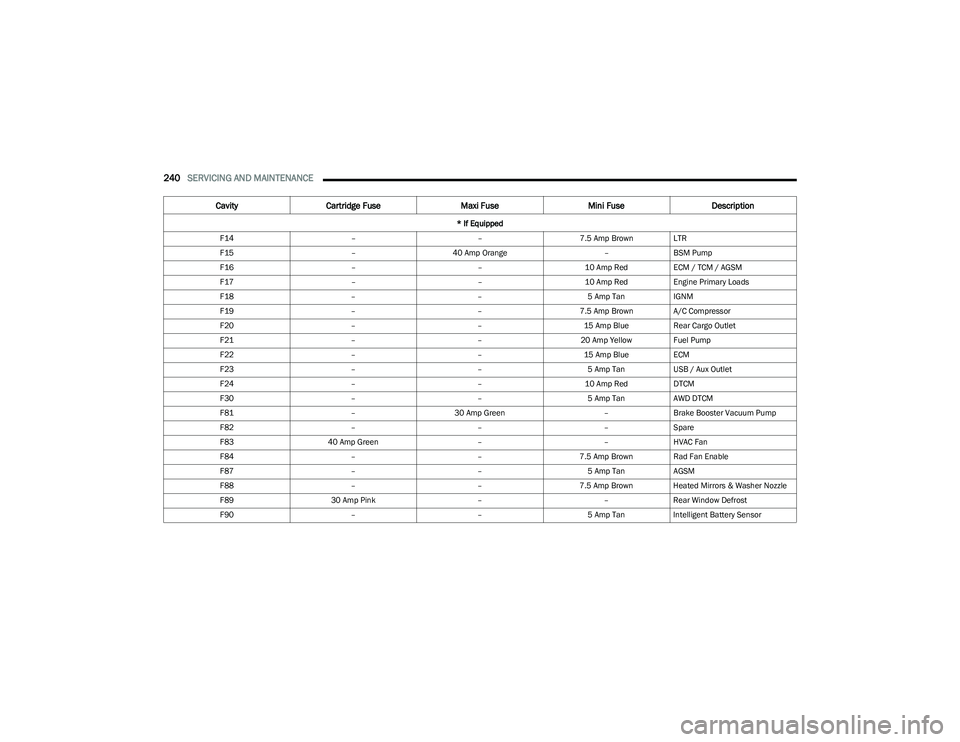
F14 ––7.5 Amp Brown LTR
F15 –40 Amp Orange –BSM Pump
F16 ––10 Amp RedECM / TCM / AGSM
F17 ––10 Amp RedEngine Primary Loads
F18 ––5 Amp TanIGNM
F19 ––7.5 Amp Brown A/C Compressor
F20 ––15 Amp BlueRear Cargo Outlet
F21 ––20 Amp Yellow Fuel Pump
F22 ––15 Amp BlueECM
F23 ––5 Amp TanUSB / Aux Outlet
F24 ––10 Amp RedDTCM
F30 ––5 Amp TanAWD DTCM
F81 –30 Amp Green –Brake Booster Vacuum Pump
F82 –––Spare
F83 40 Amp Green ––HVAC Fan
F84 ––7.5 Amp Brown Rad Fan Enable
F87 ––5 Amp TanAGSM
F88 ––7.5 Amp Brown Heated Mirrors & Washer Nozzle
F89 30 Amp Pink ––Rear Window Defrost
F90 ––5 Amp TanIntelligent Battery Sensor
Cavity Cartridge Fuse Maxi FuseMini FuseDescription
* If Equipped
23_GG_OM_EN_USC_t.book Page 240
Page 243 of 288
SERVICING AND MAINTENANCE241
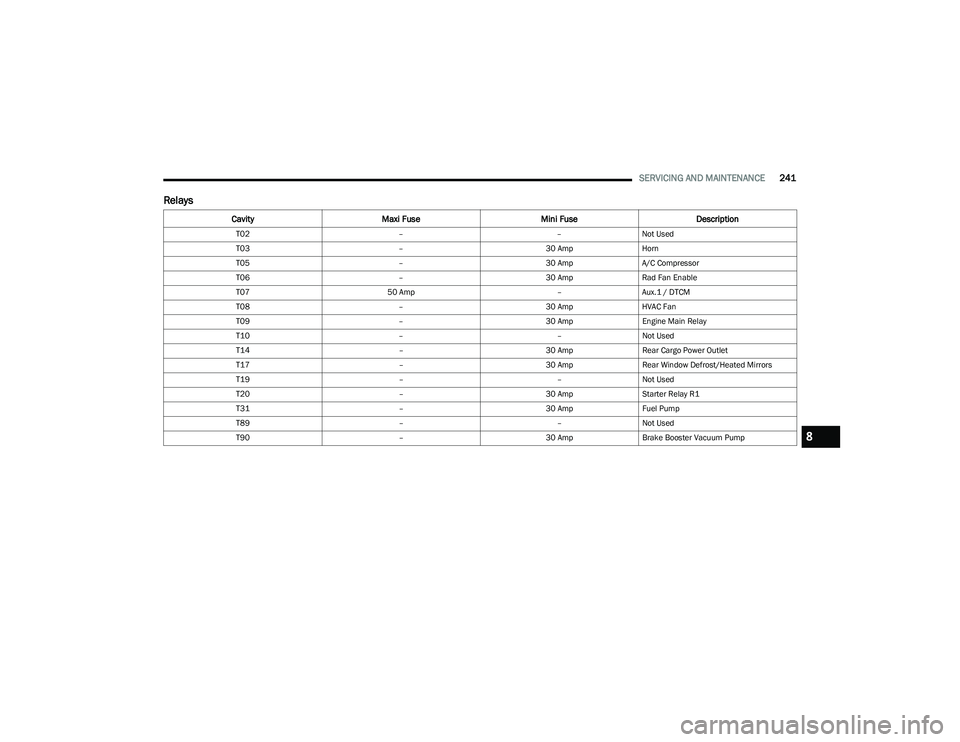
Relays
Cavity Maxi Fuse Mini FuseDescription
T02 ––Not Used
T03 –30 AmpHorn
T05 –30 AmpA/C Compressor
T06 –30 AmpRad Fan Enable
T07 50 Amp –Aux.1 / DTCM
T08 –30 AmpHVAC Fan
T09 –30 AmpEngine Main Relay
T10 ––Not Used
T14 –30 AmpRear Cargo Power Outlet
T17 –30 AmpRear Window Defrost/Heated Mirrors
T19 ––Not Used
T20 –30 AmpStarter Relay R1
T31 –30 AmpFuel Pump
T89 ––Not Used
T90 –30 AmpBrake Booster Vacuum Pump
8
23_GG_OM_EN_USC_t.book Page 241
Page 256 of 288
254SERVICING AND MAINTENANCE
(Continued)
TIRES — GENERAL INFORMATION
Tire Pressure
Proper tire inflation pressure is essential to the safe and
satisfactory operation of your vehicle. Four primary areas
are affected by improper tire pressure:
Safety
Fuel Economy
Tread Wear
Ride Comfort and Vehicle Stability
Safety Both underinflation and overinflation affect the stability of
the vehicle and can produce a feeling of sluggish response
or over responsiveness in the steering.
NOTE:
Unequal tire pressures from side to side may cause
erratic and unpredictable steering response.
Unequal tire pressure from side to side may cause the
vehicle to drift left or right.
Fuel Economy
Underinflated tires will increase tire rolling resistance
resulting in higher fuel consumption.
Tread Wear
Improper cold tire inflation pressures can cause abnormal
wear patterns and reduced tread life, resulting in the need
for earlier tire replacement.
Ride Comfort And Vehicle Stability
Proper tire inflation contributes to a comfortable ride.
Overinflation produces a jarring and uncomfortable ride.
Tire Inflation Pressures
The proper cold tire inflation pressure is listed on the
driver's side B-pillar or rear edge of the driver's side door.
At least once a month:
Check and adjust tire pressure with a good quality
pocket-type pressure gauge. Do not make a visual judg -
ment when determining proper inflation. Tires may look
properly inflated even when they are underinflated.
Inspect tires for signs of tire wear or visible damage.
Inflation pressures specified on the placard are always
“cold tire inflation pressure”. Cold tire inflation pressure is
defined as the tire pressure after the vehicle has not been
driven for at least three hours, or driven less than 1 mile
(1.6 km) after sitting for a minimum of three hours. The
cold tire inflation pressure must not exceed the maximum
inflation pressure molded into the tire sidewall.
Check tire pressures more often if subject to a wide range
of outdoor temperatures, as tire pressures vary with
temperature changes.
Tire pressures change by approximately 1 psi (7 kPa) per
12°F (7°C) of air temperature change. Keep this in mind
when checking tire pressure inside a garage, especially in
the Winter.
WARNING!
Improperly inflated tires are dangerous and can
cause collisions.
Underinflation increases tire flexing and can result in
overheating and tire failure.
Overinflation reduces a tire's ability to cushion shock.
Objects on the road and chuckholes can cause
damage that result in tire failure.
Overinflated or underinflated tires can affect vehicle
handling and can fail suddenly, resulting in loss of
vehicle control.
Unequal tire pressures can cause steering problems.
You could lose control of your vehicle.
Unequal tire pressures from one side of the vehicle
to the other can cause the vehicle to drift to the
right or left.
Always drive with each tire inflated to the recom -
mended cold tire inflation pressure.
WARNING!
CAUTION!
After inspecting or adjusting the tire pressure, always
reinstall the valve stem cap. This will prevent moisture
and dirt from entering the valve stem, which could
damage the valve stem.
23_GG_OM_EN_USC_t.book Page 254
Page 268 of 288
266TECHNICAL SPECIFICATIONS
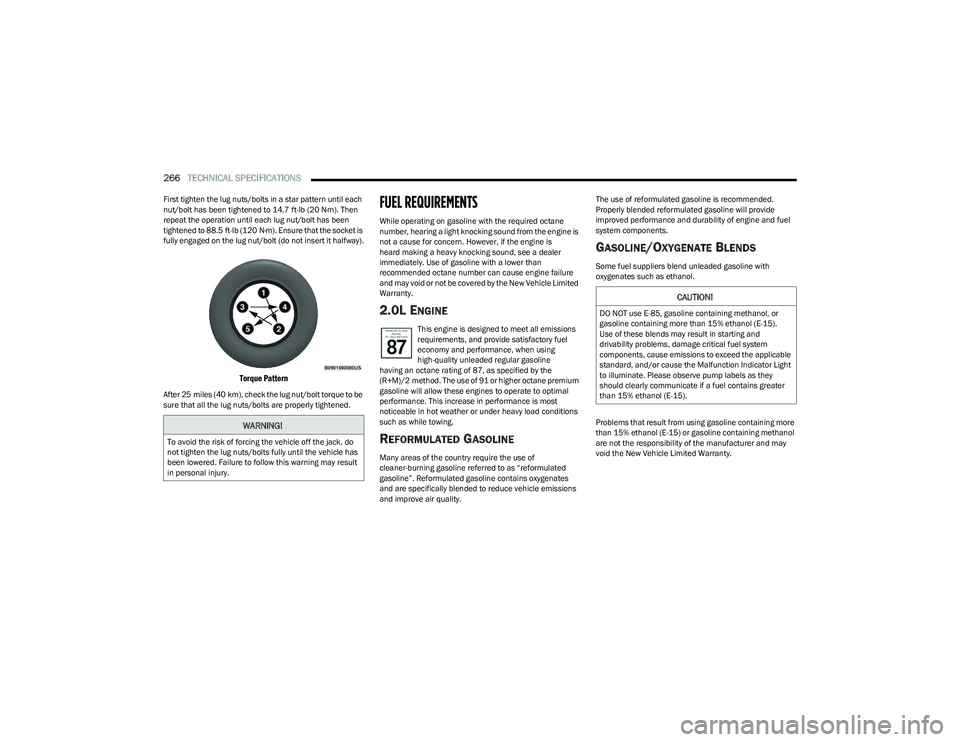
First tighten the lug nuts/bolts in a star pattern until each
nut/bolt has been tightened to 14.7 ft-lb (20 N·m). Then
repeat the operation until each lug nut/bolt has been
tightened to 88.5 ft-lb (120 N·m). Ensure that the socket is
fully engaged on the lug nut/bolt (do not insert it halfway).
Torque Pattern
After 25 miles (40 km), check the lug nut/bolt torque to be
sure that all the lug nuts/bolts are properly tightened.
FUEL REQUIREMENTS
While operating on gasoline with the required octane
number, hearing a light knocking sound from the engine is
not a cause for concern. However, if the engine is
heard making a heavy knocking sound, see a dealer
immediately. Use of gasoline with a lower than
recommended octane number can cause engine failure
and may void or not be covered by the New Vehicle Limited
Warranty.
2.0L ENGINE
This engine is designed to meet all emissions
requirements, and provide satisfactory fuel
economy and performance, when using
high-quality unleaded regular gasoline
having an octane rating of 87, as specified by the
(R+M)/2 method. The use of 91 or higher octane premium
gasoline will allow these engines to operate to optimal
performance. This increase in performance is most
noticeable in hot weather or under heavy load conditions
such as while towing.
REFORMULATED GASOLINE
Many areas of the country require the use of
cleaner-burning gasoline referred to as “reformulated
gasoline”. Reformulated gasoline contains oxygenates
and are specifically blended to reduce vehicle emissions
and improve air quality. The use of reformulated gasoline is recommended.
Properly blended reformulated gasoline will provide
improved performance and durability of engine and fuel
system components.
GASOLINE/OXYGENATE BLENDS
Some fuel suppliers blend unleaded gasoline with
oxygenates such as ethanol.
Problems that result from using gasoline containing more
than 15% ethanol (E-15) or gasoline containing methanol
are not the responsibility of the manufacturer and may
void the New Vehicle Limited Warranty.
WARNING!
To avoid the risk of forcing the vehicle off the jack, do
not tighten the lug nuts/bolts fully until the vehicle has
been lowered. Failure to follow this warning may result
in personal injury.
CAUTION!
DO NOT use E-85, gasoline containing methanol, or
gasoline containing more than 15% ethanol (E-15).
Use of these blends may result in starting and
drivability problems, damage critical fuel system
components, cause emissions to exceed the applicable
standard, and/or cause the Malfunction Indicator Light
to illuminate. Please observe pump labels as they
should clearly communicate if a fuel contains greater
than 15% ethanol (E-15).
23_GG_OM_EN_USC_t.book Page 266
Page 269 of 288
TECHNICAL SPECIFICATIONS267
E-85 USAGE IN NON-FLEX FUEL
V
EHICLES
Non-Flex Fuel Vehicles (FFV) are compatible with gasoline
containing up to 15% ethanol (E-15). Gasoline with higher
ethanol content may void the New Vehicle Limited
Warranty.
If a Non-FFV vehicle is inadvertently fueled with E-85 fuel,
the engine will have some or all of these symptoms:
Operate in a lean mode.
OBD II Malfunction Indicator Light on.
Poor engine performance.
Poor cold start and cold drivability.
Increased risk for fuel system component corrosion.
CNG AND LP FUEL SYSTEM
M
ODIFICATIONS
Modifications that allow the engine to run on Compressed
Natural Gas (CNG) or Liquid Propane (LP) may result in
damage to the engine, emissions, and fuel system
components. Problems that result from running CNG or LP
are not the responsibility of the manufacturer and may
void the New Vehicle Limited Warranty.
METHYLCYCLOPENTADIENYL
M
ANGANESE TRICARBONYL (MMT) IN
G
ASOLINE
MMT is a manganese-containing metallic additive that is
blended into some gasolines to increase octane. Gasoline
blended with MMT provides no performance advantage
beyond gasoline of the same octane number without
MMT. Gasoline blended with MMT reduces spark plug life
and reduces emissions system performance in some
vehicles. The manufacturer recommends that gasoline
without MMT be used in your vehicle. The MMT content of
gasoline may not be indicated on the gasoline pump,
therefore, you should ask the gasoline retailer whether or
not his/her gasoline contains MMT. MMT is prohibited in
Federal and California reformulated gasoline.
MATERIALS ADDED TO FUEL
Besides using unleaded gasoline with the proper octane
rating, gasolines that contain detergents, corrosion and
stability additives are recommended. Using gasolines that
have these additives will help improve fuel economy,
reduce emissions, and maintain vehicle performance.
Designated TOP TIER Detergent Gasoline
contains a higher level of detergents to further
aide in minimizing engine and fuel system
deposits. When available, the usage of
TOP TIER Detergent gasoline is recommended. Visit
www.toptiergas.com for a list of TOP TIER Detergent
Gasoline retailers. Indiscriminate use of fuel system cleaning agents should
be avoided. Many of these materials intended for gum and
varnish removal may contain active solvents or similar
ingredients. These can harm fuel system gasket and
diaphragm materials.
FUEL SYSTEM CAUTIONS
NOTE:Intentional tampering with the emissions control system
can result in civil penalties being assessed against you.
CAUTION!
Follow these guidelines to maintain your vehicle’s
performance:
The use of leaded gasoline is prohibited by Federal
law. Using leaded gasoline can impair engine perfor -
mance and damage the emissions control system.
An out-of-tune engine or certain fuel or ignition
malfunctions can cause the catalytic converter to
overheat. If you notice a pungent burning odor or
some light smoke, your engine may be out of tune or
malfunctioning and may require immediate service.
Contact an authorized dealer for service assistance.
The use of fuel additives, which are now being sold
as octane enhancers, is not recommended. Most of
these products contain high concentrations of meth -
anol. Fuel system damage or vehicle performance
problems resulting from the use of such fuels or
additives is not the responsibility of the manufac -
turer and may void or not be covered under the
New Vehicle Limited Warranty.
9
23_GG_OM_EN_USC_t.book Page 267