eco DODGE JOURNEY 2010 1.G Owner's Guide
[x] Cancel search | Manufacturer: DODGE, Model Year: 2010, Model line: JOURNEY, Model: DODGE JOURNEY 2010 1.GPages: 512
Page 74 of 512
the vehicle’s seat belts properly. If the child cannot sit
with knees bent over the vehicle’s seat cushion while the
child’s back is against the seatback, they should use a
belt-positioning booster seat. The child and belt-
positioning booster seat are held in the vehicle by the
lap/shoulder belt.
Integrated Child Booster Seat — If Equipped
The Integrated Child Booster Seat is located in each
outboard second-row passenger seat. The Booster Seat is
designed for children weighing between 48 and 85 lbs (22
and 39 kg) and between 47 in (119 cm) and 57 in (145 cm)
tall.
To position a child into the Integrated Child Booster Seat
follow these steps:
1. Slide the second row seat to the full rear position to
use the Integrated Child Booster Seat.NOTE:
The second row bench with Integrated Child
Booster Seat must remain in the full rear position during
use.
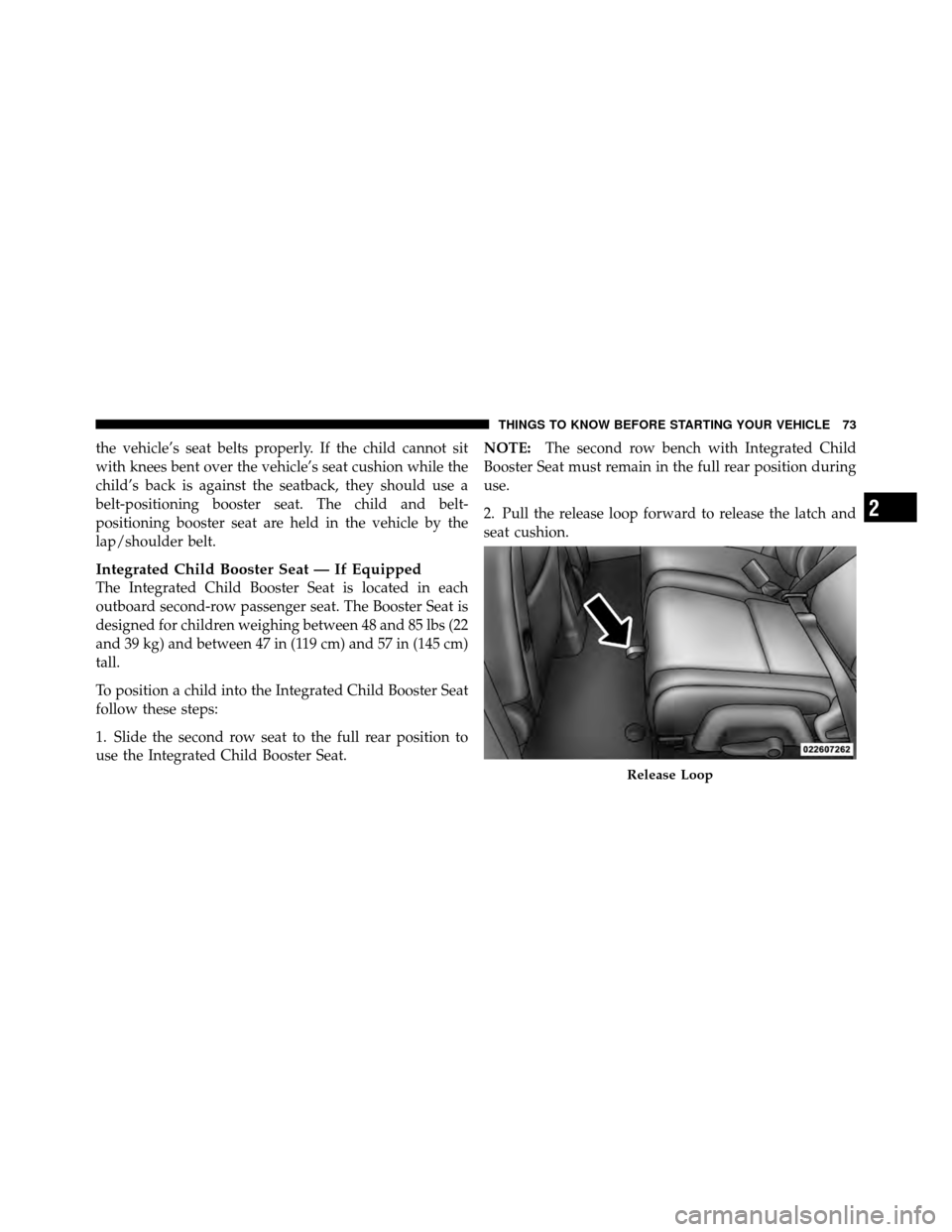
2. Pull the release loop forward to release the latch and
seat cushion.
Release Loop
2
THINGS TO KNOW BEFORE STARTING YOUR VEHICLE 73
Page 77 of 512
WARNING!
•Improper installation can lead to failure of an
infant or child restraint. It could come loose in a
collision. The child could be badly injured or
killed. Follow the manufacturer’s directions ex-
actly when installing an infant or child restraint.
•A rearward-facing child restraint should only be
used in a rear seat. A rearward-facing child re-
straint in the front seat may be struck by a deploy-
ing passenger airbag, which may cause severe or
fatal injury to the infant.
Here are some tips on getting the most out of your child
restraint:
•Before buying any restraint system, make sure that it
has a label certifying that it meets all applicable Safety Standards. We also recommend that you make sure
that you can install the child restraint in the vehicle
where you will use it before you buy it.
•The restraint must be appropriate for your child’s
weight and height. Check the label on the restraint for
weight and height limits.
•Carefully follow the instructions that come with the
restraint. If you install the restraint improperly, it may
not work when you need it.
•Buckle the child into the seat according to the child
restraint manufacturer’s directions.
•When your child restraint is not in use, secure it in the
vehicle with the seat belt or remove it from the vehicle.
Do not leave it loose in the vehicle. In a sudden stop or
collision, it could strike the occupants or seatbacks and
cause serious personal injury.
76 THINGS TO KNOW BEFORE STARTING YOUR VEHICLE
Page 78 of 512
LATCH — Child Seat Anchor System (Lower
Anchors and Tether for CHildren)
Your vehicle’s second row passenger seats are equipped
with the child restraint anchor system called LATCH. The
LATCH system provides for the installation of the child
restraint without using the vehicle’s seat belts, instead
securing the child restraint using lower anchors and
upper tether straps from the child restraint to the vehicle
structure.
LATCH-compatible child restraint systems are now avail-
able. However, because the lower anchors are to beintroduced over a period of years, child restraint systems
having attachments for those anchors will continue to
have features for installation using the vehicle’s seat
belts. Child restraints having tether straps and hooks for
connection to the top tether anchors have been available
for some time. For some older child restraints, many
child restraint manufacturers offer add-on tether strap
kits or retrofit kits. You are urged to take advantage of all
the available attachments provided with your child re-
straint in any vehicle.
2
THINGS TO KNOW BEFORE STARTING YOUR VEHICLE 77
Page 79 of 512
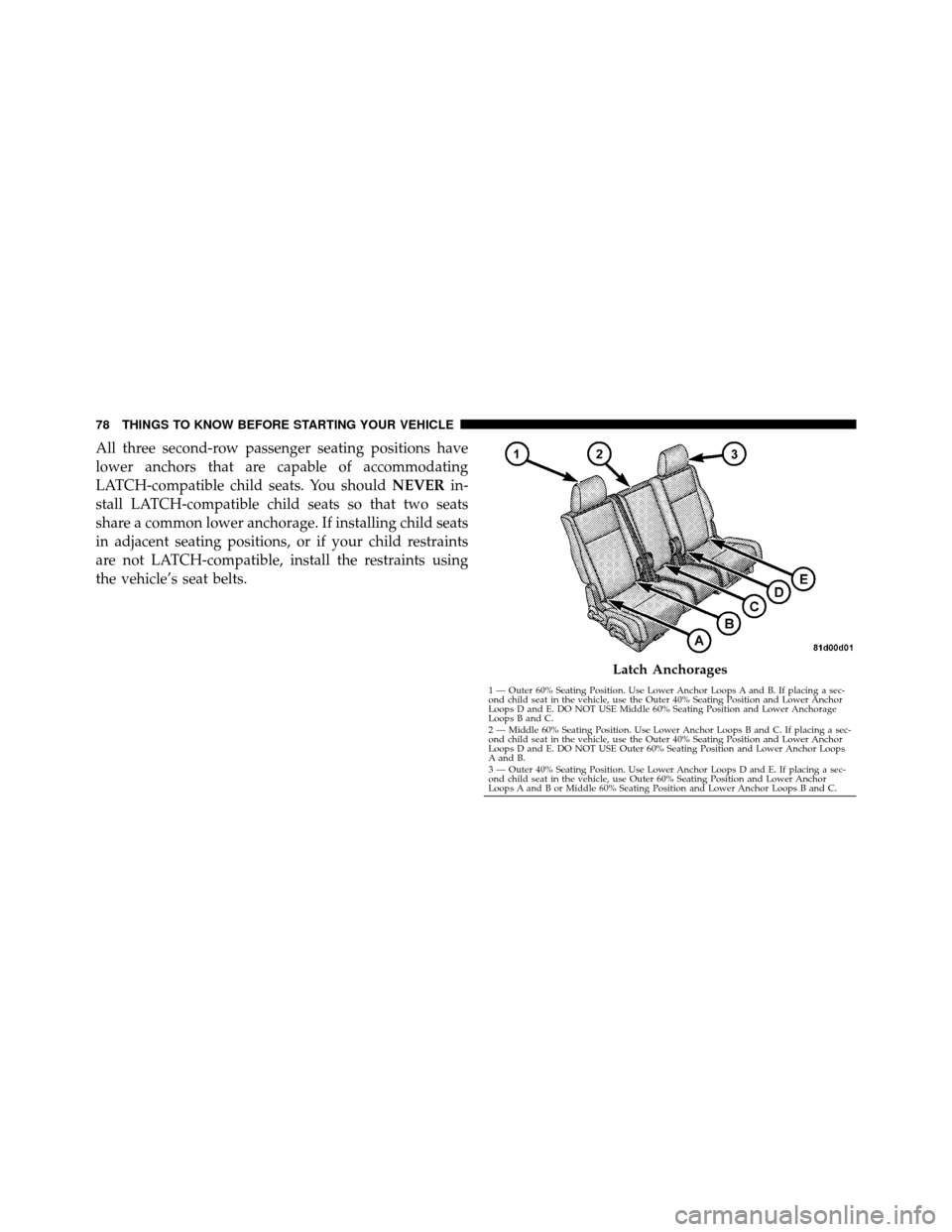
All three second-row passenger seating positions have
lower anchors that are capable of accommodating
LATCH-compatible child seats. You shouldNEVERin-
stall LATCH-compatible child seats so that two seats
share a common lower anchorage. If installing child seats
in adjacent seating positions, or if your child restraints
are not LATCH-compatible, install the restraints using
the vehicle’s seat belts.
Latch Anchorages
1 — Outer 60% Seating Position. Use Lower Anchor Loops A and B. If placing a sec-
ond child seat in the vehicle, use the Outer 40% Seating Position and Lower Anchor
Loops D and E. DO NOT USE Middle 60% Seating Position and Lower Anchorage
Loops B and C.
2 — Middle 60% Seating Position. Use Lower Anchor Loops B and C. If placing a sec-
ond child seat in the vehicle, use the Outer 40% Seating Position and Lower Anchor
Loops D and E. DO NOT USE Outer 60% Seating Position and Lower Anchor Loops
A and B.
3 — Outer 40% Seating Position. Use Lower Anchor Loops D and E. If placing a sec-
ond child seat in the vehicle, use Outer 60% Seating Position and Lower Anchor
Loops A and B or Middle 60% Seating Position and Lower Anchor Loops B and C.
78 THINGS TO KNOW BEFORE STARTING YOUR VEHICLE
Page 81 of 512
hook for attachment to the tether strap anchor and a
means of adjusting the tension of the strap.
You will first loosen the adjusters on the lower straps and
on the tether strap so that you can more easily attach the
hooks or connectors to the vehicle anchors. Next, attach
the lower hooks or connectors over the top of the
seatcover material. Then attach the tether strap to the
anchor directly behind the seat where you are placing the
child restraint, being careful to route the tether strap to
provide the most direct path between the anchor and the
child restraint, preferably between the head restraint
posts underneath the head restraint. Finally, tighten all
three straps as you push the child restraint rearward and
downward into the seat, removing slack in the straps
according to the child restraint manufacturer’s instruc-
tions.NOTE:
•Ensure that the tether strap does not slip into the
opening between the seatbacks as you remove slack in
the strap.
•When using the LATCH attaching system to install a
child restraint, please ensure that all seat belts not
being used for occupant restraints are stowed and out
of reach of children. It is recommended that before
installing the child restraint, buckle the seat belt so the
seat belt is tucked behind the child restraint. This
should stow the seat belt out of the reach of an
inquisitive child. Remind all children in the vehicle
that the seat belts are not toys and that they should not
play with them. In addition, never leave unattended
children in the vehicle.
80 THINGS TO KNOW BEFORE STARTING YOUR VEHICLE
Page 84 of 512
NOTE:Ensure that the tether strap does not slip into the
opening between the seatbacks as you remove slack in
the strap.
WARNING!
An incorrectly anchored tether strap could lead to
increased head motion and possible injury to the
child. Use only the anchor positions directly behind
the child seat to secure a child restraint top tether
strap.
Transporting Pets
Airbags deploying in the front seat could harm your pet.
An unrestrained pet will be thrown about and possibly
injured, or injure a passenger during panic braking or in
a collision.
Pets should be restrained in the rear seat in pet harnesses
or pet carriers that are secured by seat belts.
ENGINE BREAK-IN RECOMMENDATIONS
A long break-in period is not required for the engine and
drivetrain (transmission and axle) in your vehicle.
Drive moderately during the first 300 mi (500 km). After
the initial 60 mi (100 km), speeds up to 50 or 55 mph (80
or 90 km/h) are desirable.
While cruising, brief full-throttle acceleration, within the
limits of local traffic laws, contributes to a good break-in.
Wide-open throttle acceleration in low gear can be detri-
mental and should be avoided.
The engine oil installed in the engine at the factory is a
high-quality energy-conserving type lubricant. Oil
changes should be consistent with anticipated climate
conditions under which vehicle operations will occur. For
the recommended viscosity and quality grades refer to
“Maintenance Procedures” in “Maintaining Your Ve-
hicle”. NON-DETERGENT OR STRAIGHT MINERAL
OILS MUST NEVER BE USED.
2
THINGS TO KNOW BEFORE STARTING YOUR VEHICLE 83
Page 85 of 512
A new engine may consume some oil during its first few
thousand miles (kilometers) of operation. This should be
considered a normal part of the break-in and not inter-
preted as an indication of difficulty.
SAFETY TIPS
Transporting Passengers
NEVER TRANSPORT PASSENGERS IN THE CARGO
AREA.
WARNING!
•Do not leave children or animals inside parked
vehicles in hot weather. Interior heat build-up may
cause serious injury or death.(Continued)
WARNING! (Continued)
•It is extremely dangerous to ride in a cargo area,
inside or outside of a vehicle. In a collision, people
riding in these areas are more likely to be seri-
ously injured or killed.
•Do not allow people to ride in any area of your
vehicle that is not equipped with seats and seat
belts.
•Be sure everyone in your vehicle is in a seat and
using a seat belt properly.
•On seven passenger models, do not drive the
vehicle with the second row passenger seat in the
easy entry/exit position (seat cushion flipped up-
ward and seat moved forward), as this position is
only intended for entering and exiting the third
row seats. Failure to follow this warning may
result in personal injury.(Continued)
84 THINGS TO KNOW BEFORE STARTING YOUR VEHICLE
Page 86 of 512
WARNING! (Continued)
•On seven passenger models, do not allow a pas-
senger to sit in a third row seat with the second
row seatback(s) folded flat. In a collision, the
passenger could slide underneath the seat belt and
be seriously or even fatally injured.
Exhaust Gas
WARNING!
•Exhaust gases can injure or kill. They contain
carbon monoxide (CO), which is colorless and
odorless. Breathing it can make you unconscious
and can eventually poison you. To avoid breathing
CO follow these safety tips:Do not run the engine in a closed garage or in confined
areas any longer than needed to move your vehicle in or
out of the area.
If it is necessary to sit in a parked vehicle with the engine
running, adjust your heating or cooling controls to force
outside air into the vehicle. Set the blower at high speed.
If you are required to drive with the liftgate open, make
sure that all windows are closed, and the blower switch
on the climate control is set at high speed. DO NOT use
the recirculation mode.
The best protection against carbon monoxide entry into
the vehicle body is a properly maintained engine exhaust
system.
Whenever a change is noticed in the sound of the exhaust
system, when exhaust fumes can be detected inside the
vehicle, or when the underside or rear of the vehicle is
2
THINGS TO KNOW BEFORE STARTING YOUR VEHICLE 85
Page 87 of 512
damaged, have a competent mechanic inspect the com-
plete exhaust system and adjacent body areas for broken,
damaged, deteriorated, or mispositioned parts. Open
seams or loose connections could permit exhaust fumes
to seep into the passenger compartment. In addition,
inspect the exhaust system each time the vehicle is raised
for lubrication or oil change. Replace as required.
Safety Checks You Should Make Inside the
Vehicle
Seat Belts
Inspect the seat belt system periodically, checking for
cuts, frays, and loose parts. Damaged parts must be
replaced immediately. Do not disassemble or modify the
system.
Front seat belt assemblies must be replaced after a
collision. Rear seat belt assemblies must be replaced after
a collision if they have been damaged (i.e., bent retractor,torn webbing, etc.). If there is any question regarding belt
or retractor condition, replace the seat belt.
Airbag Warning Light
The light should turn on and remain on for four to six
seconds as a bulb check when the ignition switch is first
turned ON. If the light is not lit during starting, or if the
light stays on, flickers, or turns on while driving, have the
system checked by an authorized dealer.
Defroster
Check operation by selecting the defrost mode and place
the blower control on high speed. You should be able to
feel the air directed against the windshield. See your
authorized dealer for service if your defroster is
inoperable.
Floor Mat Safety Information
Always use floor mats designed to fit the foot well of
your vehicle. Use only floor mats that leave the pedal
area unobstructed and that are firmly secured so that
86 THINGS TO KNOW BEFORE STARTING YOUR VEHICLE
Page 88 of 512
they cannot slip out of position and interfere with the
pedals or impair safe operation of your vehicle in other
ways.
WARNING!
Pedals that cannot move freely can cause loss of
vehicle control and increase the risk of serious per-
sonal injury.
•Always make sure that floor mats are properly
attached to the floor mat fasteners.
•Never place or install floor mats or other floor
coverings in the vehicle that cannot be properly
secured to prevent them from moving and inter-
fering with the pedals or the ability to control the
vehicle.(Continued)
WARNING! (Continued)
•Never put floor mats or other floor coverings on
top of already installed floor mats. Additional
floor mats and other coverings will reduce the size
of the pedal area and interfere with the pedals.
•Check mounting of mats on a regular basis. Al-
ways properly reinstall and secure floor mats that
have been removed for cleaning.
•Always make sure that objects cannot fall into the
driver foot well while the vehicle is moving.
Objects can become trapped under the brake pedal
and accelerator pedal causing a loss of vehicle
control.
•If required, mounting posts must be properly
installed, if not equipped from the factory.(Continued)
2
THINGS TO KNOW BEFORE STARTING YOUR VEHICLE 87