oil DODGE JOURNEY 2013 1.G Owner's Guide
[x] Cancel search | Manufacturer: DODGE, Model Year: 2013, Model line: JOURNEY, Model: DODGE JOURNEY 2013 1.GPages: 630
Page 560 of 630
Fluid And Filter Changes
Refer to the “Maintenance Schedule” for the proper
maintenance intervals.
In addition, change the fluid and filter if the transmission
is disassembled for any reason.
Rear Drive Assembly (RDA) – AWD Models Only
Lubricant Selection
Use only the manufacturer’s recommended fluid. Refer
to “Fluids, Lubricants, and Genuine Parts” in “Maintain-
ing Your Vehicle” for further information.
Fluid Level Check
Visually inspect the unit at each oil change for leakage. If
leakage is detected, check the fluid level by removing the
fill plug. The fluid level should be maintained between the
bottom of the fill hole to 1/8 in (4 mm) below the fill hole.
Add fluid, if necessary, to maintain the proper level.
Frequency Of Fluid Change
Refer to the “Maintenance Schedule” for the proper
maintenance intervals.
Power Transfer Unit (PTU) – AWD Models Only
Lubricant Selection
Use only the manufacturer’s recommended fluid. Refer
to “Fluids, Lubricants, and Genuine Parts” in “Maintain-
ing Your Vehicle” for further information.
Fluid Level Check
Visually inspect the unit at each oil change for leakage. If
leakage is detected, Check the fluid level by removing the
fill plug. The fluid level should be maintained between the
bottom of the fill hole to 1/8 in (4 mm) below the fill hole.
Add fluid, if necessary, to maintain the proper level.
558 MAINTAINING YOUR VEHICLE
Page 563 of 630
•If you detect any stone chips or scratches in the paint,
touch them up immediately. The cost of such repairs is
considered the responsibility of the owner.
•If your vehicle is damaged due to a collision or similar
cause that destroys the paint and protective coating,
have your vehicle repaired as soon as possible. The
cost of such repairs is considered the responsibility of
the owner.
•If you carry special cargo such as chemicals, fertilizers,
de-icer salt, etc., be sure that such materials are well
packaged and sealed.
•If a lot of driving is done on gravel roads, consider
mud or stone shields behind each wheel.
•Use MOPAR® Touch Up Paint on scratches as soon as
possible. Your authorized dealer has touch up paint to
match the color of your vehicle.Wheel And Wheel Trim Care
•All wheels and wheel trim, especially aluminum and
chrome plated wheels, should be cleaned regularly
with a mild soap and water to prevent corrosion.
•To remove heavy soil and/or excessive brake dust, use
MOPAR® Wheel Cleaner.
CAUTION!
Do not use scouring pads, steel wool, a bristle brush,
or metal polishes. Do not use oven cleaner. These
products may damage the wheel’s protective finish.
Avoid automatic car washes that use acidic solutions
or harsh brushes that may damage the wheel’s pro-
tective finish. Only MOPAR® Wheel Cleaner or
equivalent is recommended.
7
MAINTAINING YOUR VEHICLE 561
Page 565 of 630
Cleaning Leather Upholstery
MOPAR® Total Clean or equivalent is specifically recom-
mended for leather upholstery.
Your leather upholstery can be best preserved by regular
cleaning with a damp soft cloth. Small particles of dirt can
act as an abrasive and damage the leather upholstery and
should be removed promptly with a damp cloth. Stubborn
soils can be removed easily with a soft cloth and MOPAR®
Total Clean or equivalent. Care should be taken to avoid
soaking your leather upholstery with any liquid. Please do
not use polishes, oils, cleaning fluids, solvents, detergents,
or ammonia-based cleaners to clean your leather uphol-
stery. Application of a leather conditioner is not required to
maintain the original condition.
WARNING!
Do not use volatile solvents for cleaning purposes.
Many are potentially flammable, and if used in
closed areas they may cause respiratory harm.
Cleaning Headlights
Your vehicle is equipped with plastic headlights and fog
lights (if equipped) that are lighter and less susceptible to
stone breakage than glass headlights.
Plastic is not as scratch resistant as glass and therefore
different lens cleaning procedures must be followed.
7
MAINTAINING YOUR VEHICLE 563
Page 577 of 630
CAUTION!
Do not touch the new bulb with your fingers. Oil
contamination will severely shorten bulb life. If the
bulb comes in contact with any oily surface, clean the
bulb with rubbing alcohol.
4. Install the bulb and connector assembly into the
headlamp housing and rotate it ¼ turn clockwise to
lock it in place.
Front Fog Lamp
NOTE:Turn the steering wheel to the right if replacing
the left front fog lamp or to the left if replacing the right
front fog lamp to allow for easier access to the front of the
wheel well.
1. Remove the fasteners retaining the front lower wheel
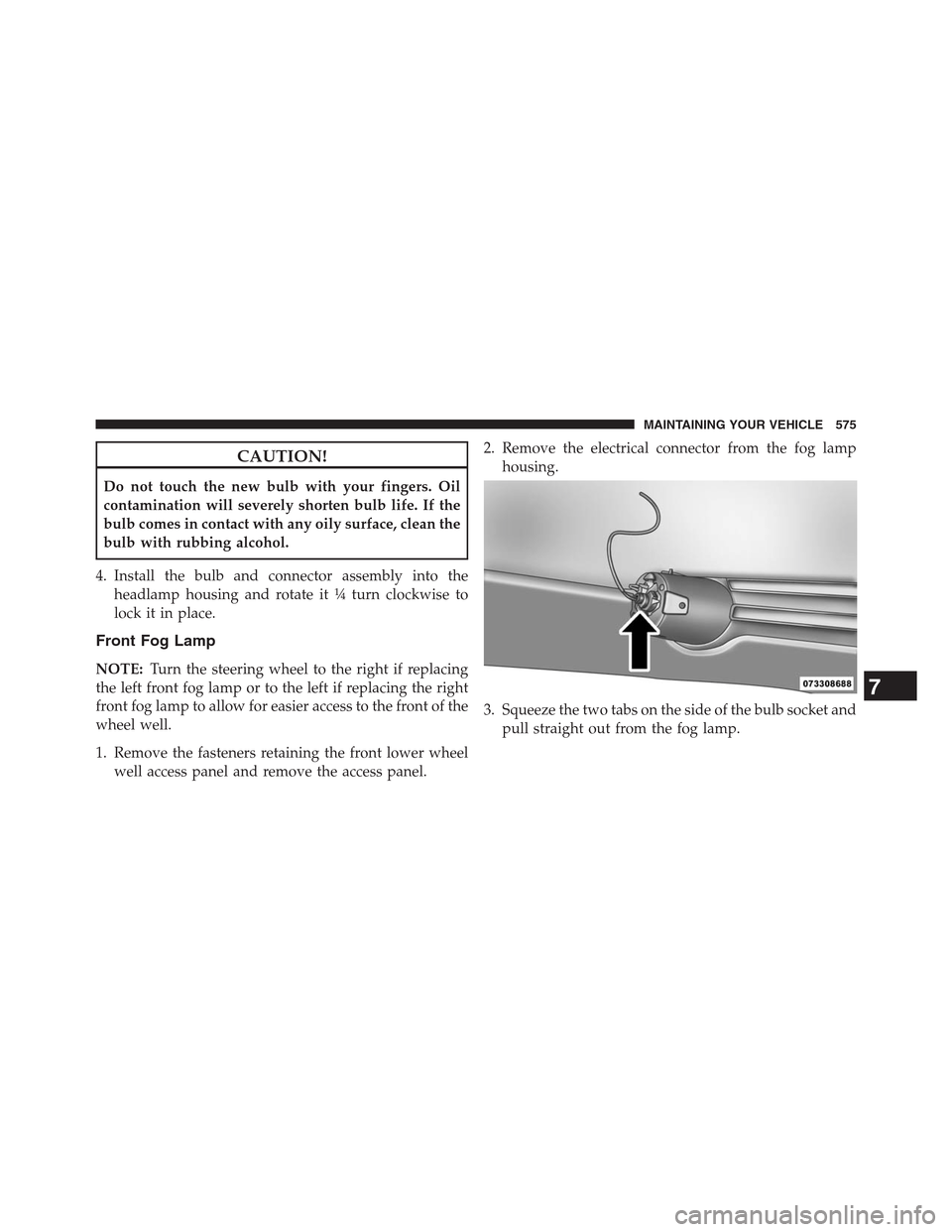
well access panel and remove the access panel.2. Remove the electrical connector from the fog lamp
housing.
3. Squeeze the two tabs on the side of the bulb socket and
pull straight out from the fog lamp.
7
MAINTAINING YOUR VEHICLE 575
Page 578 of 630
CAUTION!
Do not touch the new bulb with your fingers. Oil
contamination will severely shorten bulb life. If the
bulb comes in contact with an oily surface, clean the
bulb with rubbing alcohol.
4. Install the replacement bulb and connector assembly
straight into the fog lamp until it locks into place.
5. Reinstall the front lower wheel well access panel and
fasteners.
Rear Turn Signal And Backup Lamp
The taillamps are a two-piece design. The tail/stop/rear
turn signal lamps are located in the rear corner body
panels. The tail and backup lamps are located in the
liftgate.
Changing The Rear Turn Signal Lamp
1. Open the liftgate.
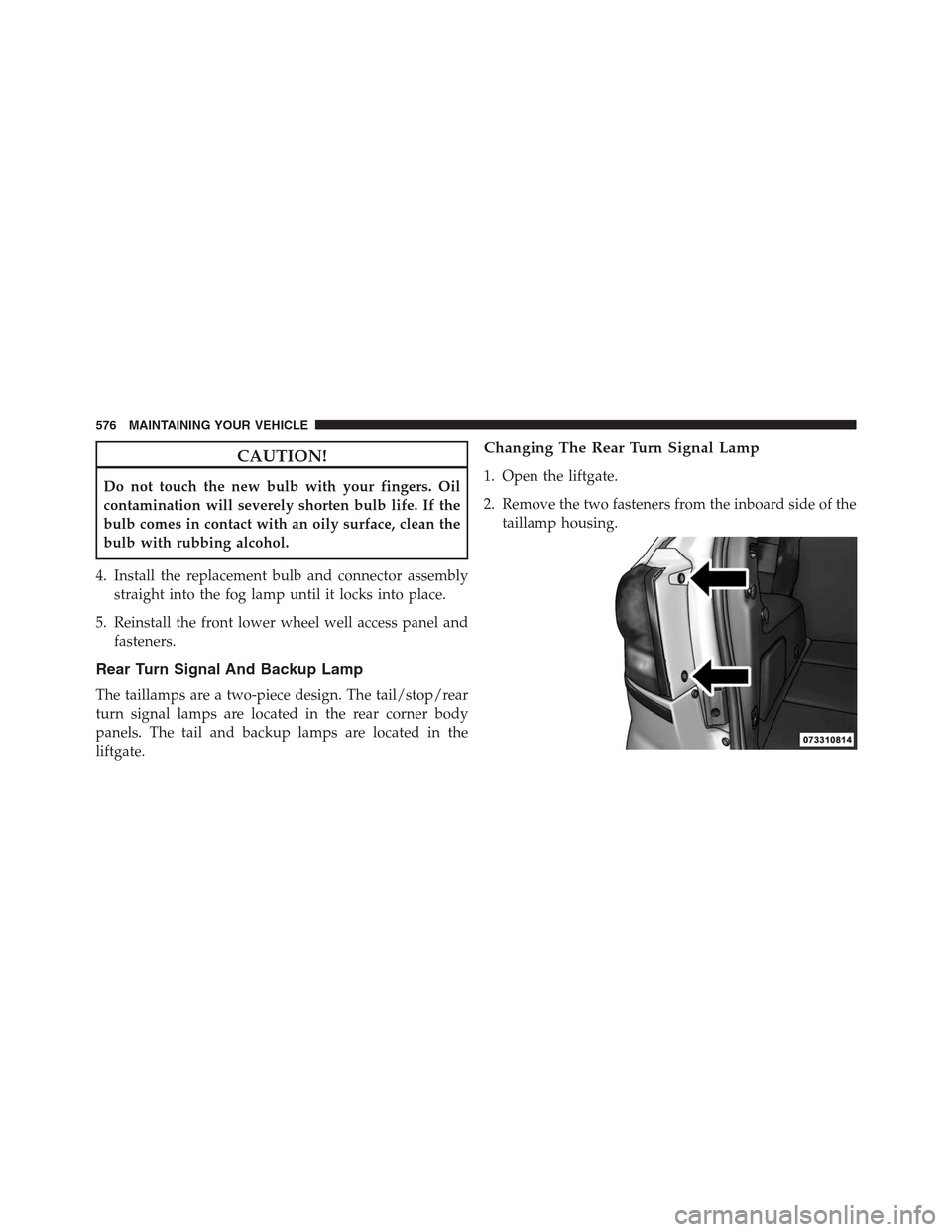
2. Remove the two fasteners from the inboard side of the
taillamp housing.
576 MAINTAINING YOUR VEHICLE
Page 582 of 630
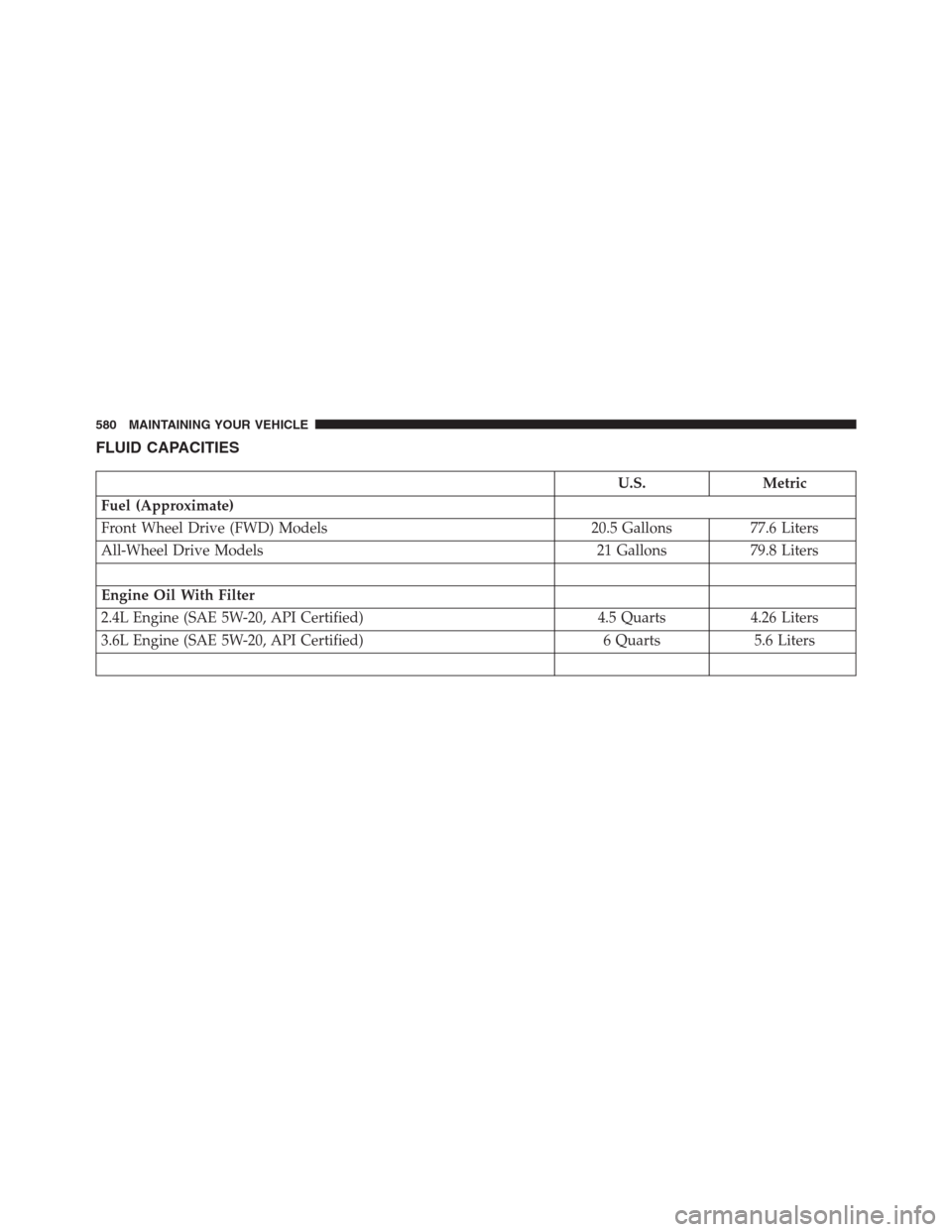
FLUID CAPACITIES
U.S. Metric
Fuel (Approximate)
Front Wheel Drive (FWD) Models 20.5 Gallons 77.6 Liters
All-Wheel Drive Models 21 Gallons 79.8 Liters
Engine Oil With Filter
2.4L Engine (SAE 5W-20, API Certified) 4.5 Quarts 4.26 Liters
3.6L Engine (SAE 5W-20, API Certified) 6 Quarts 5.6 Liters
580 MAINTAINING YOUR VEHICLE
Page 584 of 630
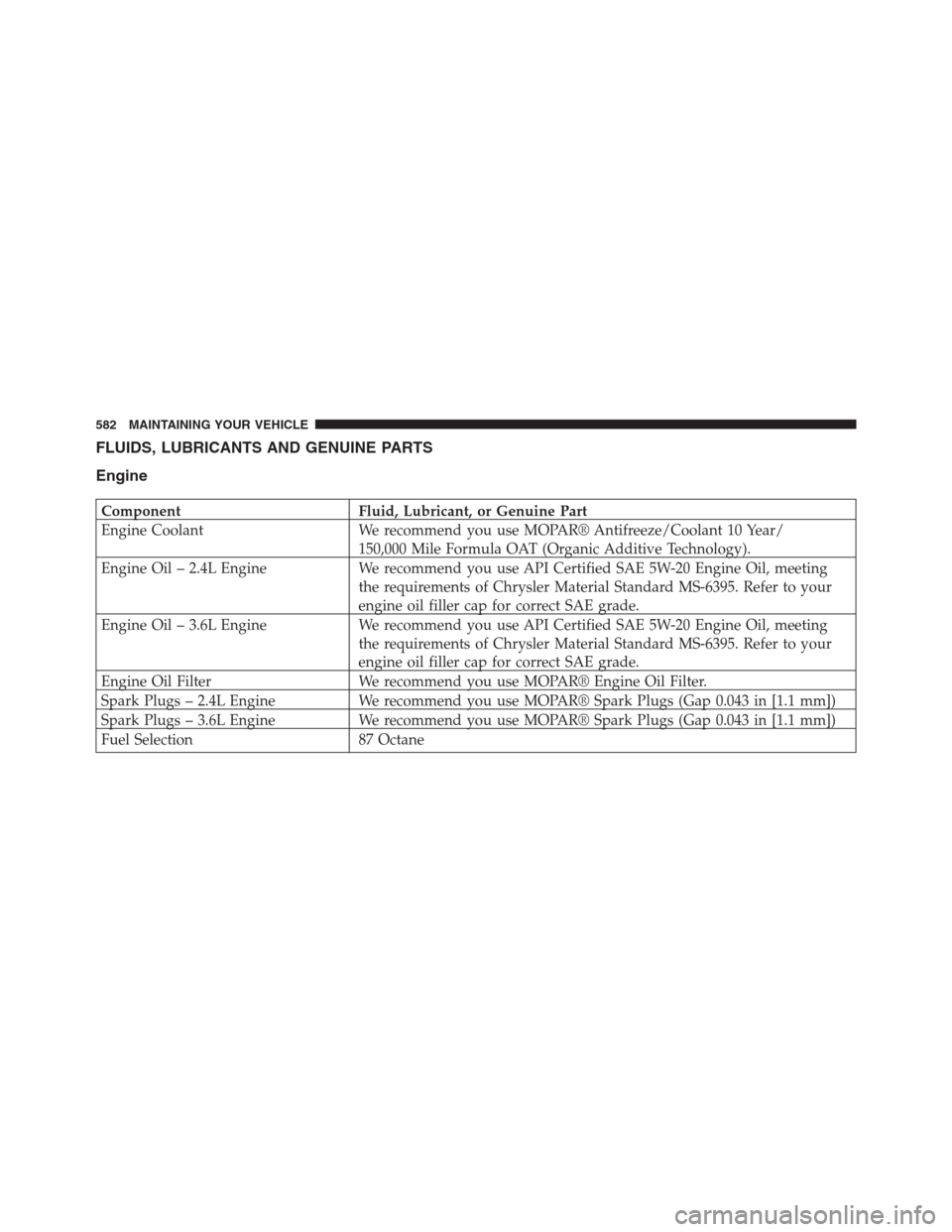
FLUIDS, LUBRICANTS AND GENUINE PARTS
Engine
Component Fluid, Lubricant, or Genuine Part
Engine Coolant We recommend you use MOPAR® Antifreeze/Coolant 10 Year/
150,000 Mile Formula OAT (Organic Additive Technology).
Engine Oil – 2.4L Engine We recommend you use API Certified SAE 5W-20 Engine Oil, meeting
the requirements of Chrysler Material Standard MS-6395. Refer to your
engine oil filler cap for correct SAE grade.
Engine Oil – 3.6L Engine We recommend you use API Certified SAE 5W-20 Engine Oil, meeting
the requirements of Chrysler Material Standard MS-6395. Refer to your
engine oil filler cap for correct SAE grade.
Engine Oil Filter We recommend you use MOPAR® Engine Oil Filter.
Spark Plugs – 2.4L Engine We recommend you use MOPAR® Spark Plugs (Gap 0.043 in [1.1 mm])
Spark Plugs – 3.6L Engine We recommend you use MOPAR® Spark Plugs (Gap 0.043 in [1.1 mm])
Fuel Selection 87 Octane
582 MAINTAINING YOUR VEHICLE
Page 588 of 630
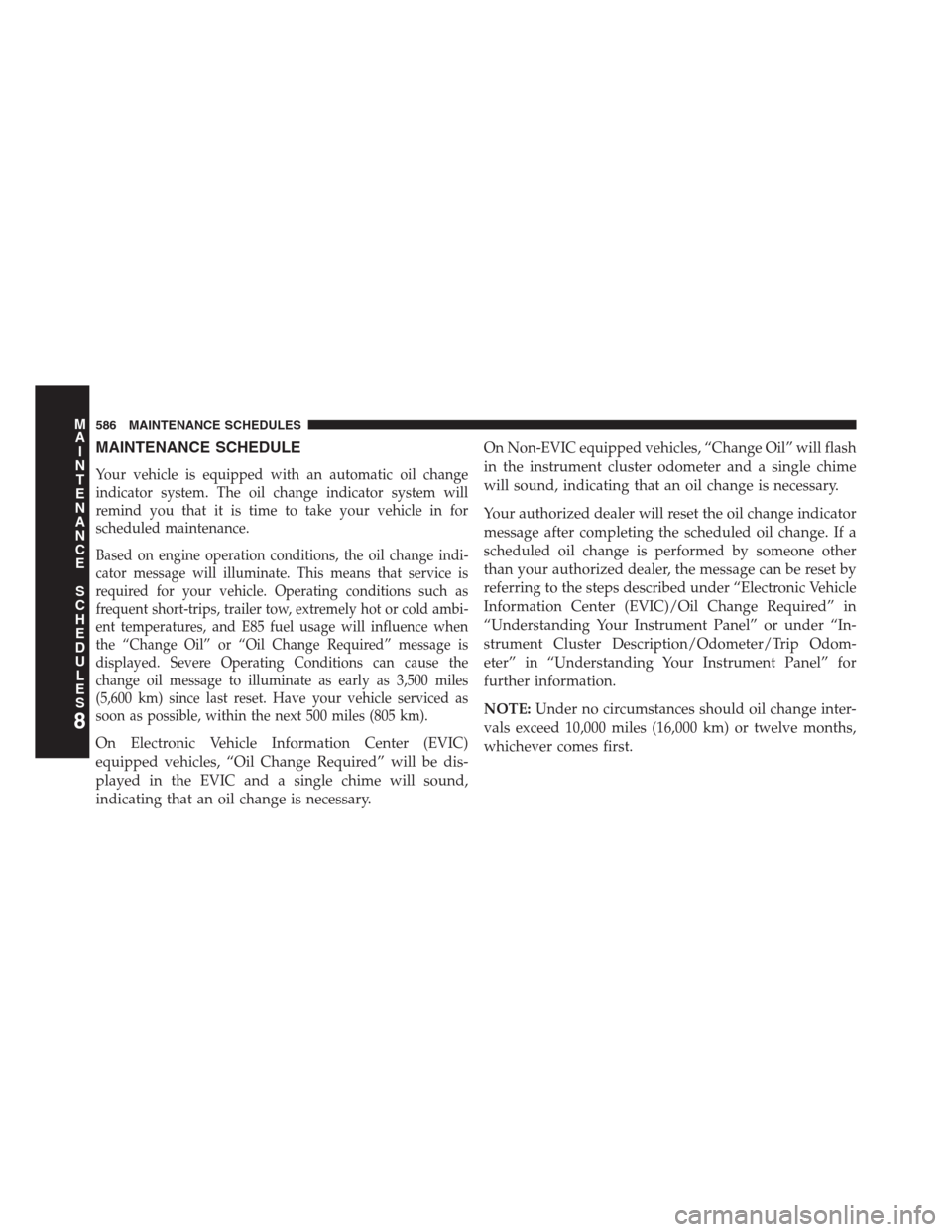
MAINTENANCE SCHEDULE
Your vehicle is equipped with an automatic oil change
indicator system. The oil change indicator system will
remind you that it is time to take your vehicle in for
scheduled maintenance.
Based on engine operation conditions, the oil change indi-
cator message will illuminate. This means that service is
required for your vehicle. Operating conditions such as
frequent short-trips, trailer tow, extremely hot or cold ambi-
ent temperatures, and E85 fuel usage will influence when
the “Change Oil” or “Oil Change Required” message is
displayed. Severe Operating Conditions can cause the
change oil message to illuminate as early as 3,500 miles
(5,600 km) since last reset. Have your vehicle serviced as
soon as possible, within the next 500 miles (805 km).
On Electronic Vehicle Information Center (EVIC)
equipped vehicles, “Oil Change Required” will be dis-
played in the EVIC and a single chime will sound,
indicating that an oil change is necessary.On Non-EVIC equipped vehicles, “Change Oil” will flash
in the instrument cluster odometer and a single chime
will sound, indicating that an oil change is necessary.
Your authorized dealer will reset the oil change indicator
message after completing the scheduled oil change. If a
scheduled oil change is performed by someone other
than your authorized dealer, the message can be reset by
referring to the steps described under “Electronic Vehicle
Information Center (EVIC)/Oil Change Required” in
“Understanding Your Instrument Panel” or under “In-
strument Cluster Description/Odometer/Trip Odom-
eter” in “Understanding Your Instrument Panel” for
further information.
NOTE:Under no circumstances should oil change inter-
vals exceed 10,000 miles (16,000 km) or twelve months,
whichever comes first.
8
M
A
I
N
T
E
N
A
N
C
E
S
C
H
E
D
U
L
E
S586 MAINTENANCE SCHEDULES
Page 589 of 630
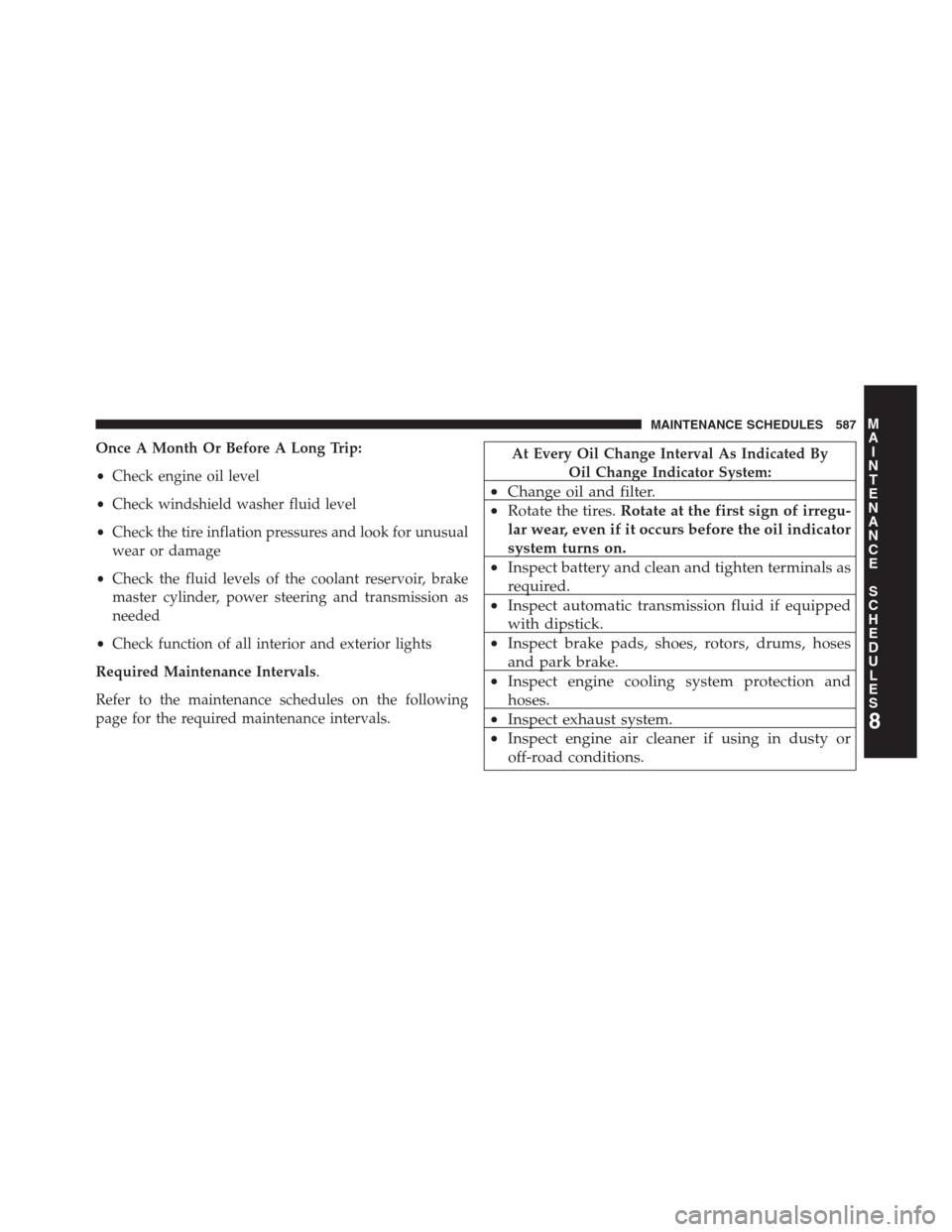
Once A Month Or Before A Long Trip:
•Check engine oil level
•Check windshield washer fluid level
•Check the tire inflation pressures and look for unusual
wear or damage
•Check the fluid levels of the coolant reservoir, brake
master cylinder, power steering and transmission as
needed
•Check function of all interior and exterior lights
Required Maintenance Intervals.
Refer to the maintenance schedules on the following
page for the required maintenance intervals.At Every Oil Change Interval As Indicated By
Oil Change Indicator System:
•Change oil and filter.
•Rotate the tires.Rotate at the first sign of irregu-
lar wear, even if it occurs before the oil indicator
system turns on.
•Inspect battery and clean and tighten terminals as
required.
•Inspect automatic transmission fluid if equipped
with dipstick.
•Inspect brake pads, shoes, rotors, drums, hoses
and park brake.
•Inspect engine cooling system protection and
hoses.
•Inspect exhaust system.
•Inspect engine air cleaner if using in dusty or
off-road conditions.
8
M
A
I
N
T
E
N
A
N
C
E
S
C
H
E
D
U
L
E
SMAINTENANCE SCHEDULES 587
Page 608 of 630
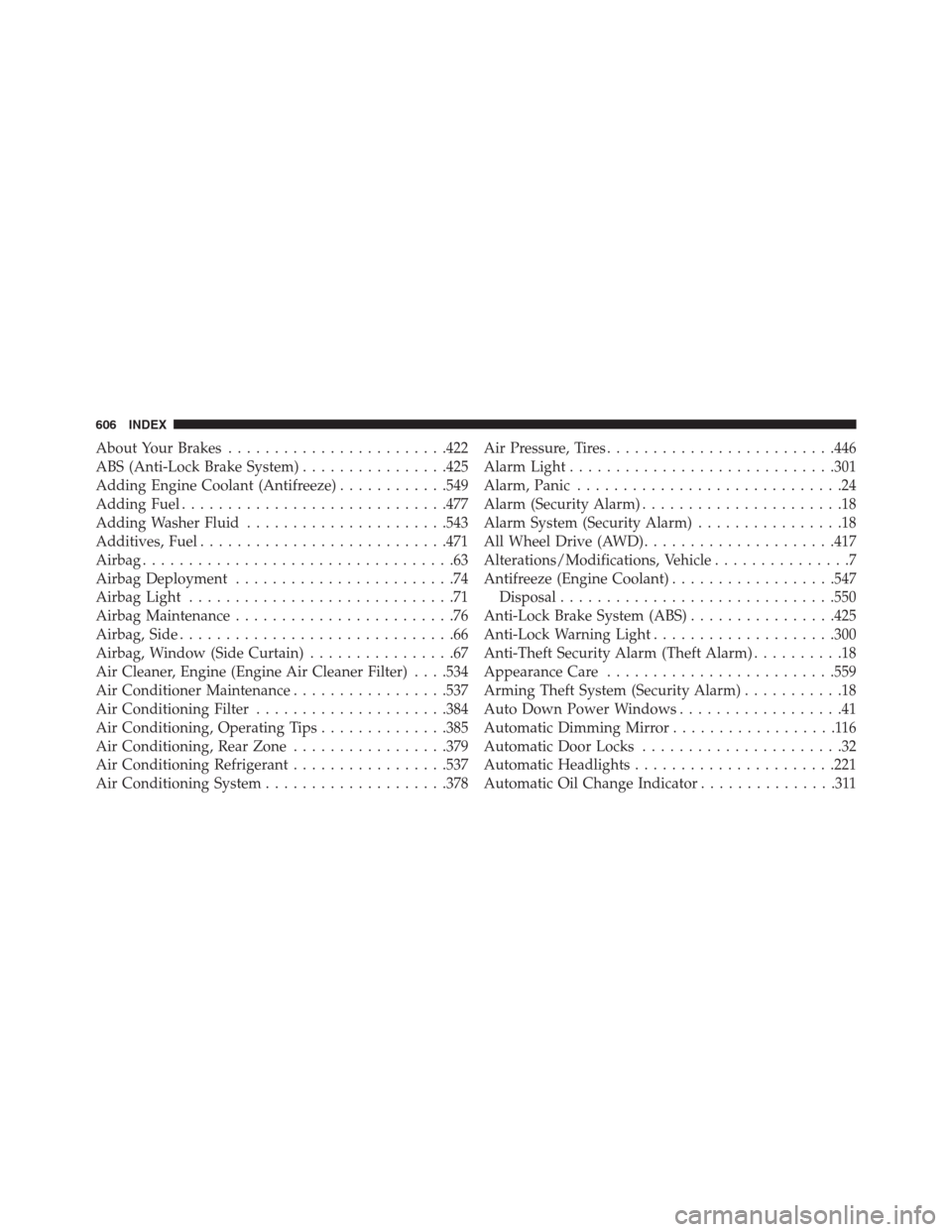
About Your Brakes........................422
ABS (Anti-Lock Brake System)................425
Adding Engine Coolant (Antifreeze)............549
Adding Fuel.............................477
Adding Washer Fluid......................543
Additives, Fuel...........................471
Airbag..................................63
Airbag Deployment........................74
Airbag Light.............................71
Airbag Maintenance........................76
Airbag, Side..............................66
Airbag, Window (Side Curtain)................67
Air Cleaner, Engine (Engine Air Cleaner Filter). . . .534
Air Conditioner Maintenance.................537
Air Conditioning Filter.....................384
Air Conditioning, Operating Tips..............385
Air Conditioning, Rear Zone.................379
Air Conditioning Refrigerant.................537
Air Conditioning System....................378Air Pressure, Tires.........................446
Alarm Light.............................301
Alarm, Panic.............................24
Alarm (Security Alarm)......................18
Alarm System (Security Alarm)................18
All Wheel Drive (AWD).....................417
Alterations/Modifications, Vehicle...............7
Antifreeze (Engine Coolant)..................547
Disposal..............................550
Anti-Lock Brake System (ABS)................425
Anti-Lock Warning Light....................300
Anti-Theft Security Alarm (Theft Alarm)..........18
Appearance Care.........................559
Arming Theft System (Security Alarm)...........18
Auto Down Power Windows..................41
Automatic Dimming Mirror..................116
Automatic Door Locks......................32
Automatic Headlights......................221
Automatic Oil Change Indicator...............311
606 INDEX