lock DODGE JOURNEY 2013 1.G Service Manual
[x] Cancel search | Manufacturer: DODGE, Model Year: 2013, Model line: JOURNEY, Model: DODGE JOURNEY 2013 1.GPages: 630
Page 86 of 630
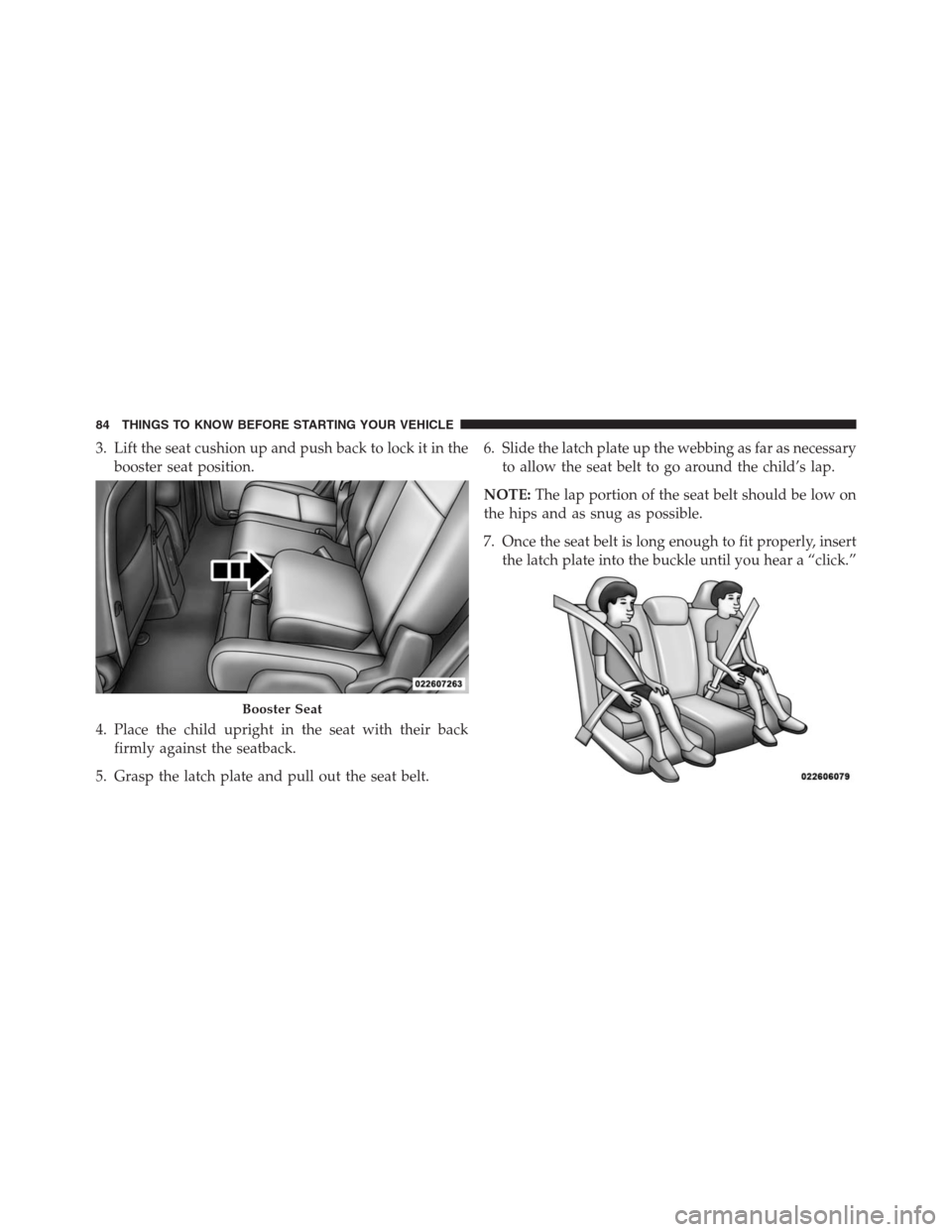
3. Lift the seat cushion up and push back to lock it in the
booster seat position.
4. Place the child upright in the seat with their back
firmly against the seatback.
5. Grasp the latch plate and pull out the seat belt.6. Slide the latch plate up the webbing as far as necessary
to allow the seat belt to go around the child’s lap.
NOTE:The lap portion of the seat belt should be low on
the hips and as snug as possible.
7. Once the seat belt is long enough to fit properly, insert
the latch plate into the buckle until you hear a “click.”
Booster Seat
84 THINGS TO KNOW BEFORE STARTING YOUR VEHICLE
Page 87 of 630
8. To remove the slack from the lap belt, pull upward on
the shoulder portion of the seat belt.
9. To release the seat belt, push the red button on the
buckle.
WARNING!
Securely lock the seat cushion into position before
using the seat. Otherwise, the seat will not provide
the proper stability for child seats and/or passengers.
An improperly latched seat cushion could cause
serious injury.
Children Too Large For Booster Seats
Children who are large enough to wear the shoulder belt
comfortably, and whose legs are long enough to bend
over the front of the seat when their back is against theseatback, should use the seat belt in a rear seat. Use this
simple 5-step test to decide whether the child can use the
vehicle’s seat belt alone:
1. Can the child sit all the way back against the back of
the vehicle seat?
2. Do the child’s knees bend comfortably over the front
of the vehicle seat – while they are still sitting all the
way back?
3. Does the shoulder belt cross the child’s shoulder
between their neck and arm?
4. Is the lap part of the belt as low as possible, touching
the child’s thighs and not their stomach?
5. Can the child stay seated like this for the whole trip?
2
THINGS TO KNOW BEFORE STARTING YOUR VEHICLE 85
Page 94 of 630
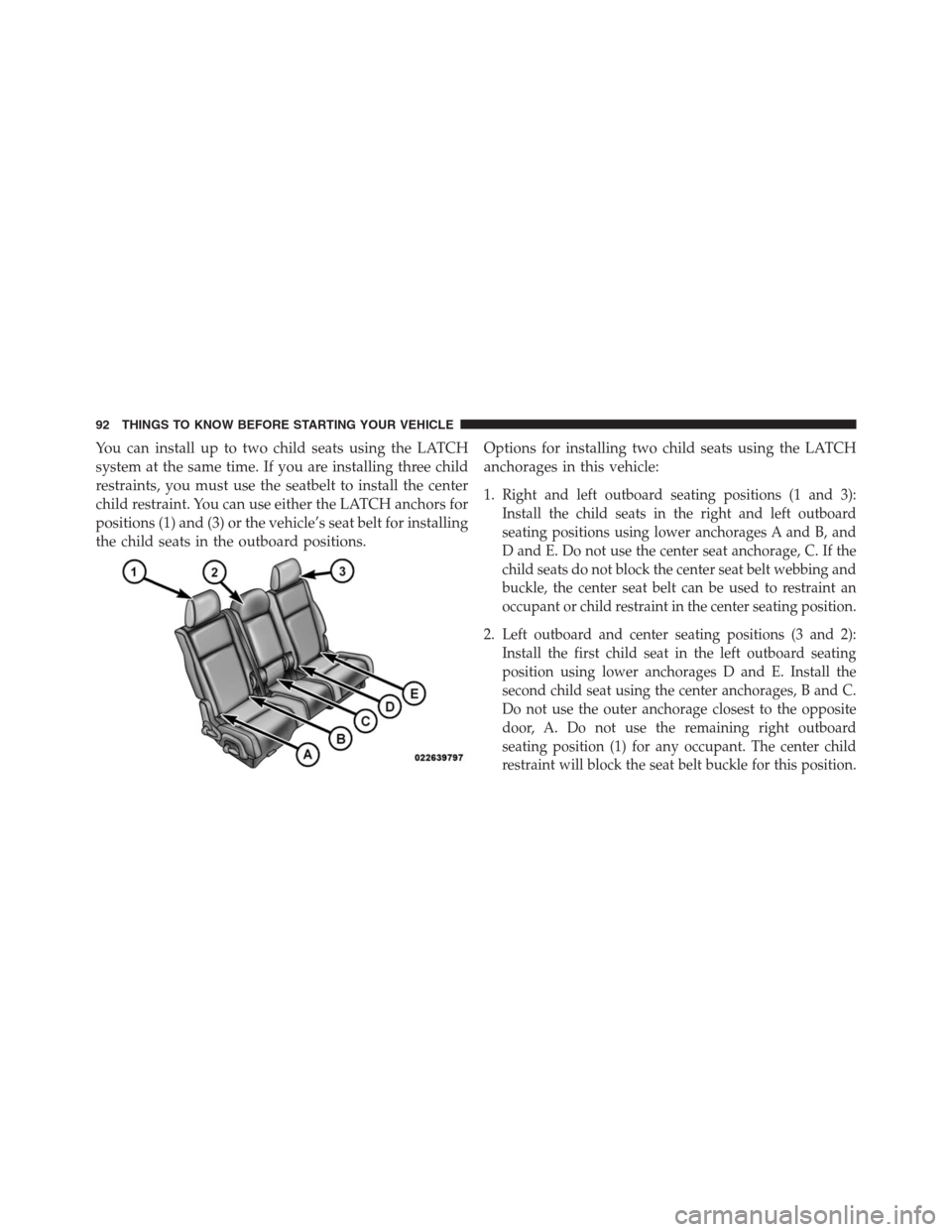
You can install up to two child seats using the LATCH
system at the same time. If you are installing three child
restraints, you must use the seatbelt to install the center
child restraint. You can use either the LATCH anchors for
positions (1) and (3) or the vehicle’s seat belt for installing
the child seats in the outboard positions.Options for installing two child seats using the LATCH
anchorages in this vehicle:
1.
Right and left outboard seating positions (1 and 3):
Install the child seats in the right and left outboard
seating positions using lower anchorages A and B, and
D and E. Do not use the center seat anchorage, C. If the
child seats do not block the center seat belt webbing and
buckle, the center seat belt can be used to restraint an
occupant or child restraint in the center seating position.
2.Left outboard and center seating positions (3 and 2):
Install the first child seat in the left outboard seating
position using lower anchorages D and E. Install the
second child seat using the center anchorages, B and C.
Do not use the outer anchorage closest to the opposite
door, A. Do not use the remaining right outboard
seating position (1) for any occupant. The center child
restraint will block the seat belt buckle for this position.
92 THINGS TO KNOW BEFORE STARTING YOUR VEHICLE
Page 95 of 630
WARNING!
•Use anchorages B and C to install a LATCH-
compatible child restraint in the center seating
position (2). Do not install a LATCH-compatible
child restraint using anchorages C and D. This is
not a LATCH-compatible position in your vehicle.
•A child restraint installed in the center position (2)
will block the seat belt buckle for the empty right
outboard seat behind the front passenger (1). Do
not use this seat for another occupant.
•Never use the same lower anchorage to attach more
than one child restraint.
(Continued)
WARNING!(Continued)
•If you are installing three child restraints next to
each other, you must use the seat belt and the center
tether anchor for the center position. You can then
use either the LATCH anchors or the vehicle’s seat
belt for installing the child seats in the outboard
positions. Please refer to “Installing the LATCH-
Compatible Child Restraint System” for typical
installation instructions.
Always follow the directions of the child restraint manu-
facturer when installing your child restraint. Not all child
restraint systems will be installed as described here.
2
THINGS TO KNOW BEFORE STARTING YOUR VEHICLE 93
Page 96 of 630
To Install A LATCH-compatible Child Restraint
1. If the selected seating position has a Switchable Auto-
matic Locking Retractor (ALR) seat belt, stow the seat
belt, following the instructions below. See the section
“Installing Child Restraints Using the Vehicle Seat
Belt” to check what type of seat belt each seating
position has.
2. Loosen the adjusters on the lower straps and on the
tether strap of the child seat so that you can more
easily attach the hooks or connectors to the vehicle
anchorages.
3. Place the child seat between the lower anchorages for
that seating position. For some second row seats, you
may need to recline the seat and / or raise the head
restraint to get a better fit.4. Attach the lower hooks or connectors of the child
restraint to the lower anchorages in the selected seat-
ing position.
5. If the child restraint has a tether strap, connect it to the
top tether anchorage. See the section “Installing Child
Restraints Using the Top Tether Anchorage” for direc-
tions to attach a tether anchor.
6. Tighten all of the straps as you push the child restraint
rearward and downward into the seat. Remove slack
in the straps according to the child restraint manufac-
turer ’s instructions.
7. Test that the child restraint is installed tightly by
pulling back and forth on the child seat at the belt
path. It should not move more than 1 inch (25.4 mm)
in any direction.
94 THINGS TO KNOW BEFORE STARTING YOUR VEHICLE
Page 97 of 630
How To Stow An Unused ALR Seatbelt
When using the LATCH attaching system to install a child
restraint, stow all ALR seat belts that are not being used by
other occupants or being used to secure child restraints. An
unused belt could injure a child if they play with it and
accidentally lock the seatbelt retractor. Before installing a
child restraint using the LATCH system, buckle the seat
belt behind the child restraint and out of the child’s reach.
If the buckled seat belt interferes with the child restraint
installation, instead of buckling it behind the child re-
straint, route the seat belt through the child restraint belt
path and then buckle it. Do not lock the seatbelt. Remind
all children in the vehicle that the seat belts are not toys and
that they should not play with them.
WARNING!
Improper installation of a child restraint to the
LATCH anchorages can lead to failure of the re-
straint. The child could be badly injured or killed.
Follow the child restraint manufacturer ’s directions
exactly when installing an infant or child restraint.
Installing Child Restraints Using The Vehicle Seat
Belt
The seat belts in the passenger seating positions are
equipped with either a Switchable Automatic Locking
Retractor (ALR) or a cinching latch plate or both. Both
types of seat belts are designed to keep the lap portion of
the seat belt tight around the child restraint so that it is
2
THINGS TO KNOW BEFORE STARTING YOUR VEHICLE 95
Page 98 of 630
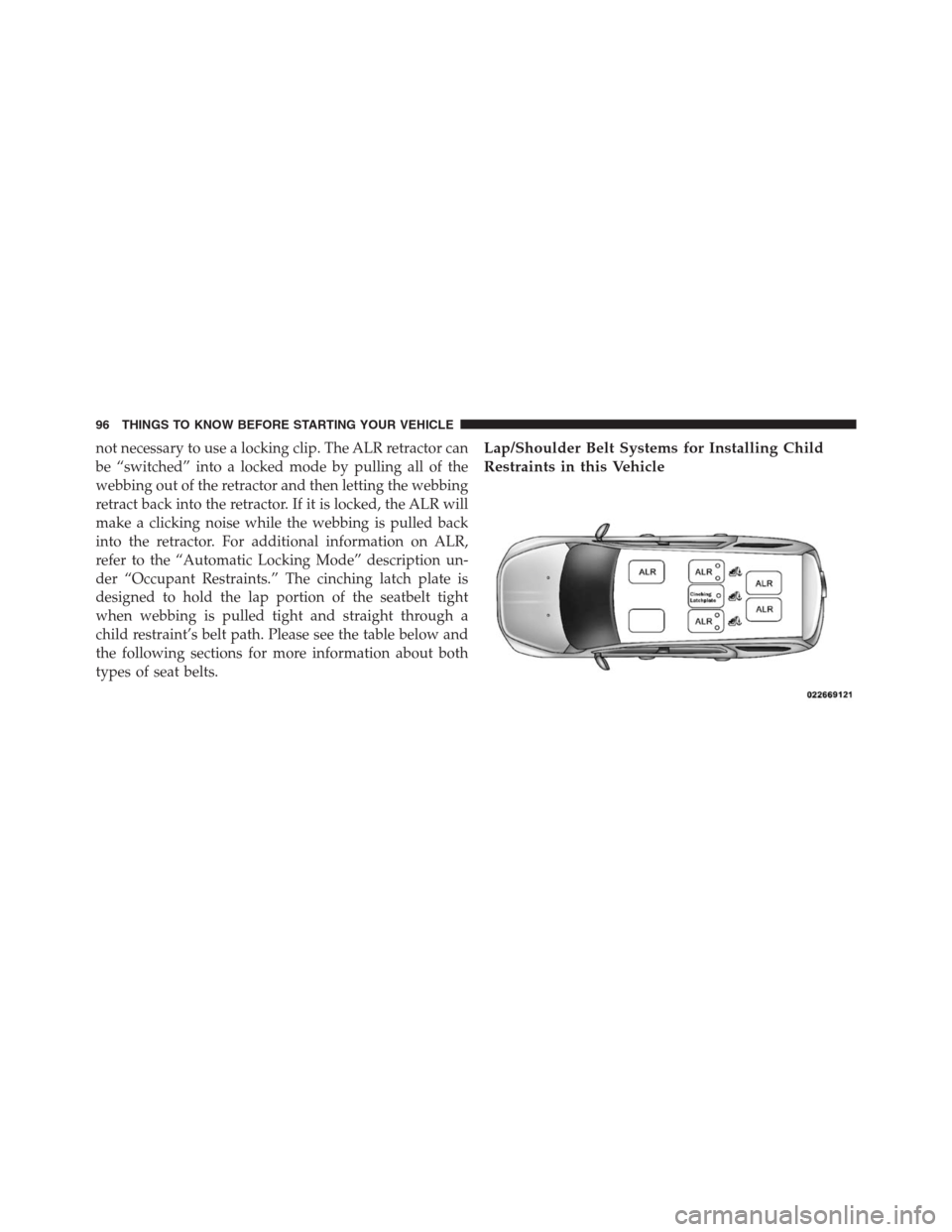
not necessary to use a locking clip. The ALR retractor can
be “switched” into a locked mode by pulling all of the
webbing out of the retractor and then letting the webbing
retract back into the retractor. If it is locked, the ALR will
make a clicking noise while the webbing is pulled back
into the retractor. For additional information on ALR,
refer to the “Automatic Locking Mode” description un-
der “Occupant Restraints.” The cinching latch plate is
designed to hold the lap portion of the seatbelt tight
when webbing is pulled tight and straight through a
child restraint’s belt path. Please see the table below and
the following sections for more information about both
types of seat belts.Lap/Shoulder Belt Systems for Installing Child
Restraints in this Vehicle
96 THINGS TO KNOW BEFORE STARTING YOUR VEHICLE
Page 100 of 630
Installing A Child Restraint with a Switchable
Automatic Locking Retractor (ALR)
1. Place the child seat in the center of the seating
position. For some second row seats, you may need to
recline the seat and/or raise the head restraint to get a
better fit.
2. Pull enough of the seat belt webbing from the retractor
to pass it through the belt path of the child restraint.
Do not twist the belt webbing in the belt path.
3. Slide the latch plate into the buckle until you hear a
“click.”
4. Pull on the webbing to make the lap portion tight
against the child seat.5. To lock the seat belt, pull down on the shoulder part of
the belt until you have pulled all the seat belt webbing
out of the retractor. Then, allow the webbing to retract
back into the retractor. As the webbing retracts, you
will hear a clicking sound. This means the seat belt is
now in the Automatic Locking mode.
6. Try to pull the webbing out of the retractor. If it is
locked, you should not be able to pull out any web-
bing. If the retractor is not locked, repeat step 5.
7. Finally, pull up on any excess webbing to tighten the
lap portion around the child restraint while you push
the child restraint rearward and downward into the
vehicle seat.
98 THINGS TO KNOW BEFORE STARTING YOUR VEHICLE
Page 110 of 630
Periodic Safety Checks You Should Make Outside
The Vehicle
Tires
Examine tires for excessive tread wear and uneven wear
patterns. Check for stones, nails, glass, or other objects
lodged in the tread or sidewall. Inspect the tread for cuts
and cracks. Inspect sidewalls for cuts, cracks and bulges.
Check the wheel nuts for tightness. Check the tires
(including spare) for proper cold inflation pressure.
Lights
Have someone observe the operation of brake lights and
exterior lights while you work the controls. Check turn
signal and high beam indicator lights on the instrument
panel.
Door Latches
Check for positive closing, latching, and locking.
Fluid Leaks
Check area under vehicle after overnight parking for fuel,
engine coolant, oil, or other fluid leaks. Also, if gasoline
fumes are detected or if fuel, power steering fluid, or
brake fluid leaks are suspected, the cause should be
located and corrected immediately.
108 THINGS TO KNOW BEFORE STARTING YOUR VEHICLE
Page 117 of 630
MIRRORS
Inside Day/Night Mirror
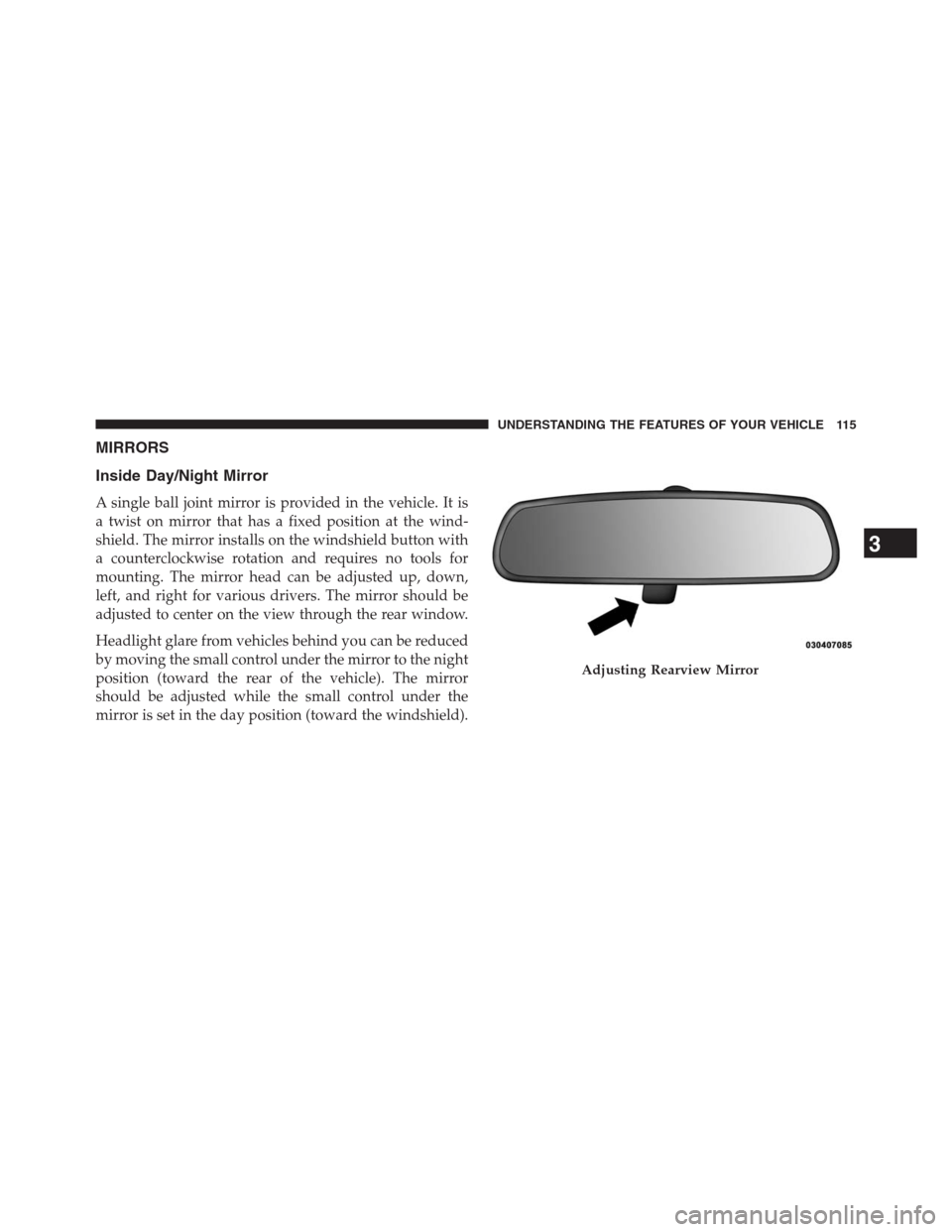
A single ball joint mirror is provided in the vehicle. It is
a twist on mirror that has a fixed position at the wind-
shield. The mirror installs on the windshield button with
a counterclockwise rotation and requires no tools for
mounting. The mirror head can be adjusted up, down,
left, and right for various drivers. The mirror should be
adjusted to center on the view through the rear window.
Headlight glare from vehicles behind you can be reduced
by moving the small control under the mirror to the night
position (toward the rear of the vehicle). The mirror
should be adjusted while the small control under the
mirror is set in the day position (toward the windshield).
Adjusting Rearview Mirror
3
UNDERSTANDING THE FEATURES OF YOUR VEHICLE 115