belt DODGE JOURNEY 2013 1.G Workshop Manual
[x] Cancel search | Manufacturer: DODGE, Model Year: 2013, Model line: JOURNEY, Model: DODGE JOURNEY 2013 1.GPages: 630
Page 214 of 630
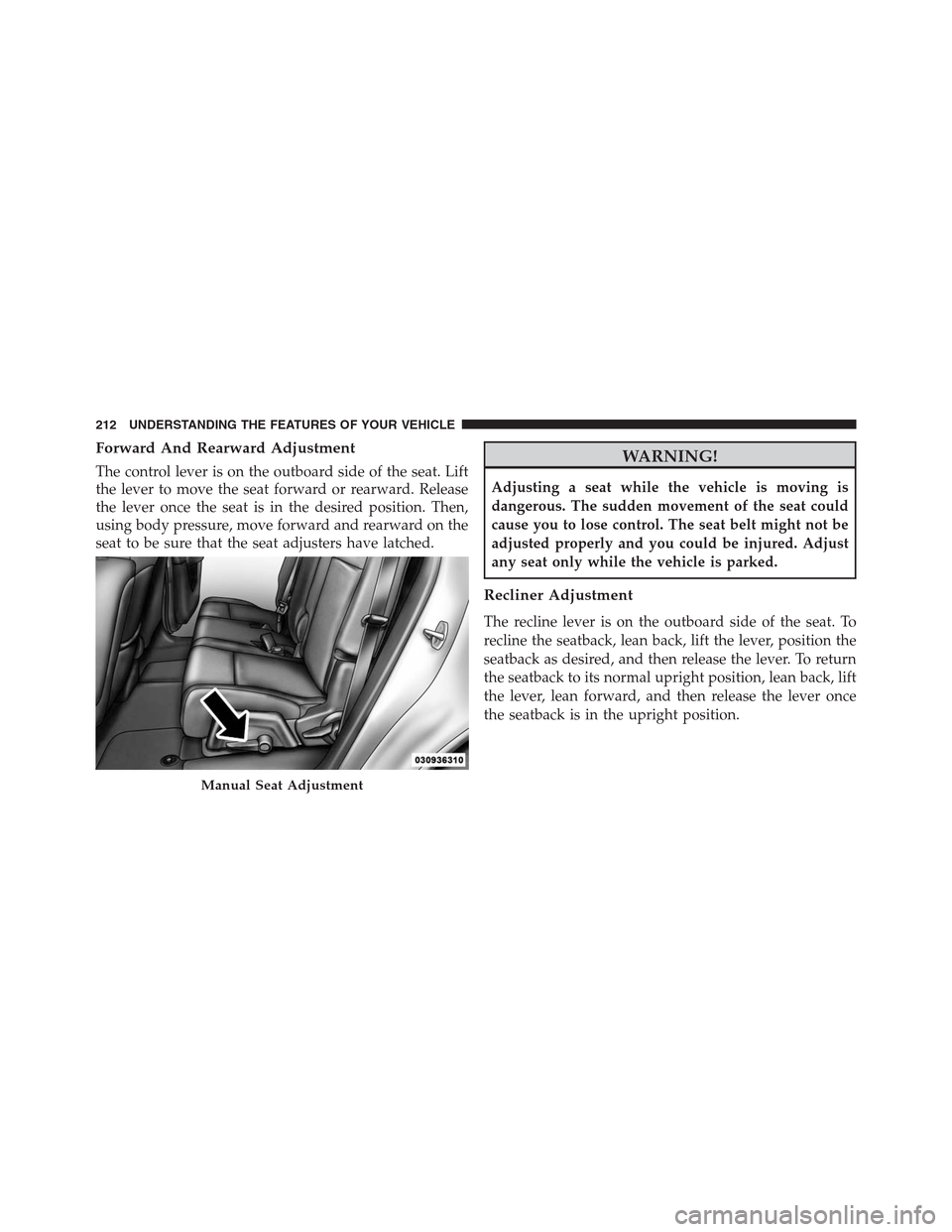
Forward And Rearward Adjustment
The control lever is on the outboard side of the seat. Lift
the lever to move the seat forward or rearward. Release
the lever once the seat is in the desired position. Then,
using body pressure, move forward and rearward on the
seat to be sure that the seat adjusters have latched.WARNING!
Adjusting a seat while the vehicle is moving is
dangerous. The sudden movement of the seat could
cause you to lose control. The seat belt might not be
adjusted properly and you could be injured. Adjust
any seat only while the vehicle is parked.
Recliner Adjustment
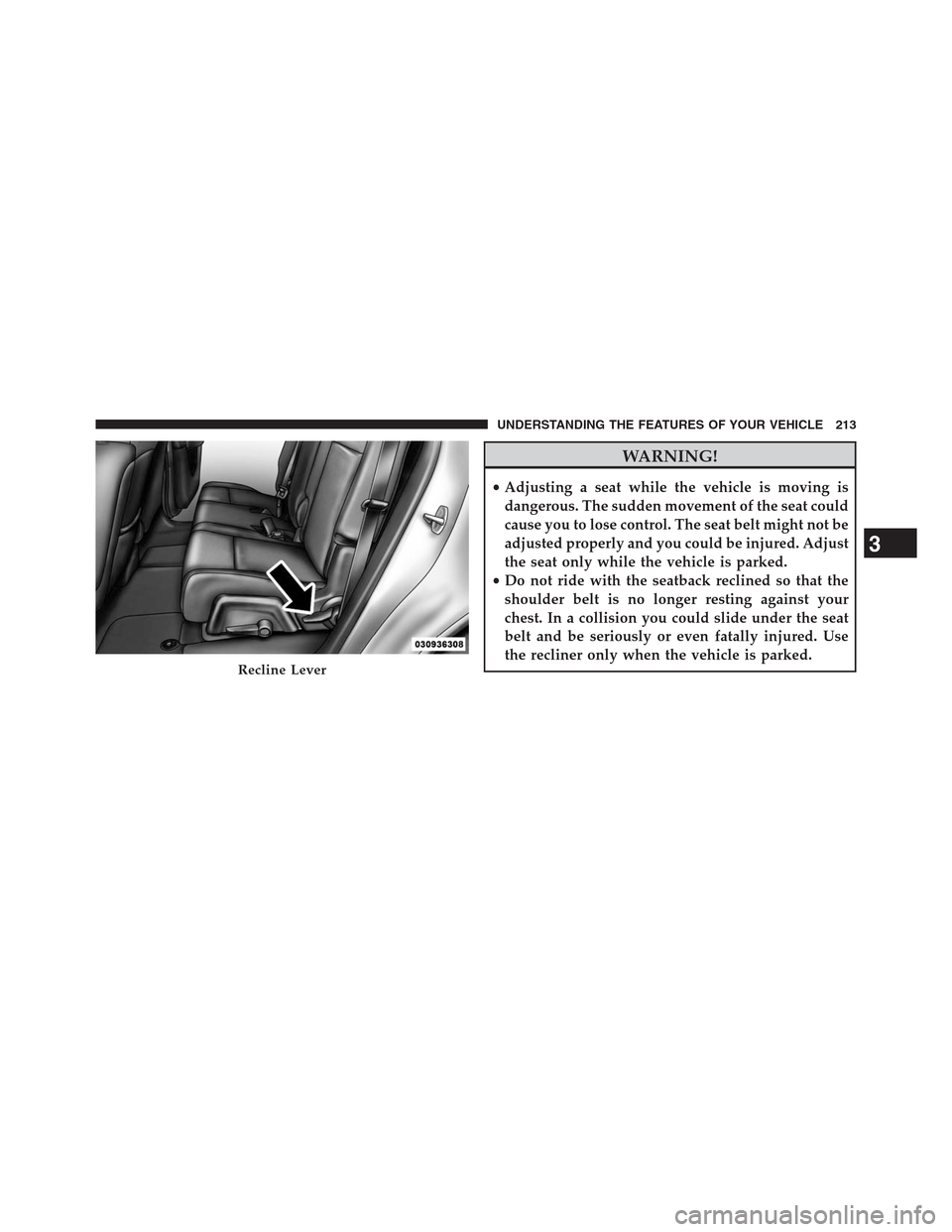
The recline lever is on the outboard side of the seat. To
recline the seatback, lean back, lift the lever, position the
seatback as desired, and then release the lever. To return
the seatback to its normal upright position, lean back, lift
the lever, lean forward, and then release the lever once
the seatback is in the upright position.
Manual Seat Adjustment
212 UNDERSTANDING THE FEATURES OF YOUR VEHICLE
Page 215 of 630
WARNING!
•Adjusting a seat while the vehicle is moving is
dangerous. The sudden movement of the seat could
cause you to lose control. The seat belt might not be
adjusted properly and you could be injured. Adjust
the seat only while the vehicle is parked.
•Do not ride with the seatback reclined so that the
shoulder belt is no longer resting against your
chest. In a collision you could slide under the seat
belt and be seriously or even fatally injured. Use
the recliner only when the vehicle is parked.
Recline Lever
3
UNDERSTANDING THE FEATURES OF YOUR VEHICLE 213
Page 220 of 630
The seatback can also be locked in the reclined position.
To do so, pull the latch release-loop located at the top of
the seatback upward, allow the seatback to recline, and
release the release-loop.
WARNING!
•Be certain that the seatback is locked securely into
position. Otherwise, the seat will not provide the
proper stability for passengers. An improperly
latched seat could cause serious injury.
•
Do not allow a passenger to sit in a third row seat
without having the head restraint unfolded and
locked in place. Failure to follow this warning may
result in personal injury to the passenger in the event
of a collision.
•Do not allow a passenger to sit in a third row seat
with the second row seatback(s) folded flat. In a
collision, the passenger could slide underneath the
seat belt and be seriously or even fatally injured.
TO OPEN AND CLOSE THE HOOD
Two latches must be released to open the hood.
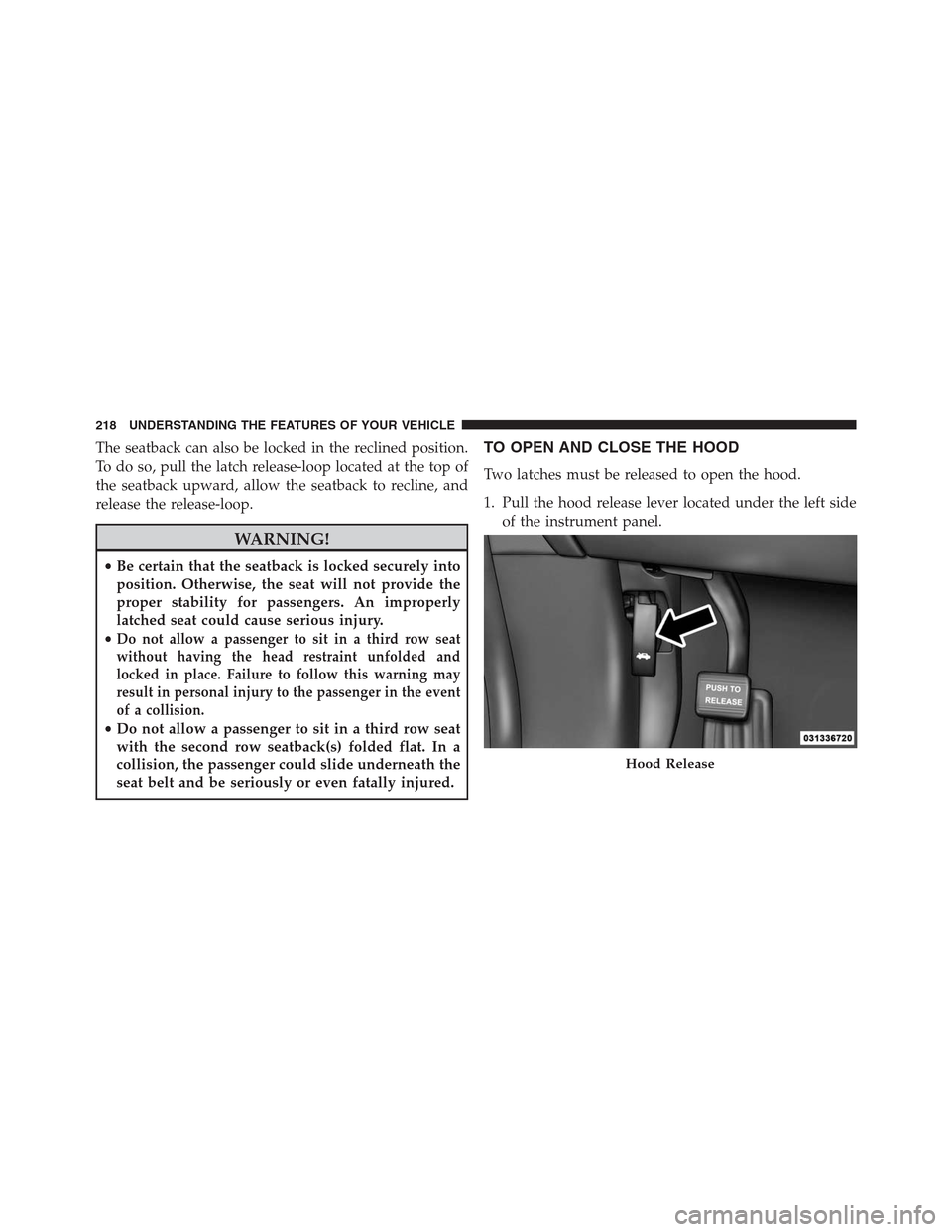
1. Pull the hood release lever located under the left side
of the instrument panel.
Hood Release
218 UNDERSTANDING THE FEATURES OF YOUR VEHICLE
Page 261 of 630
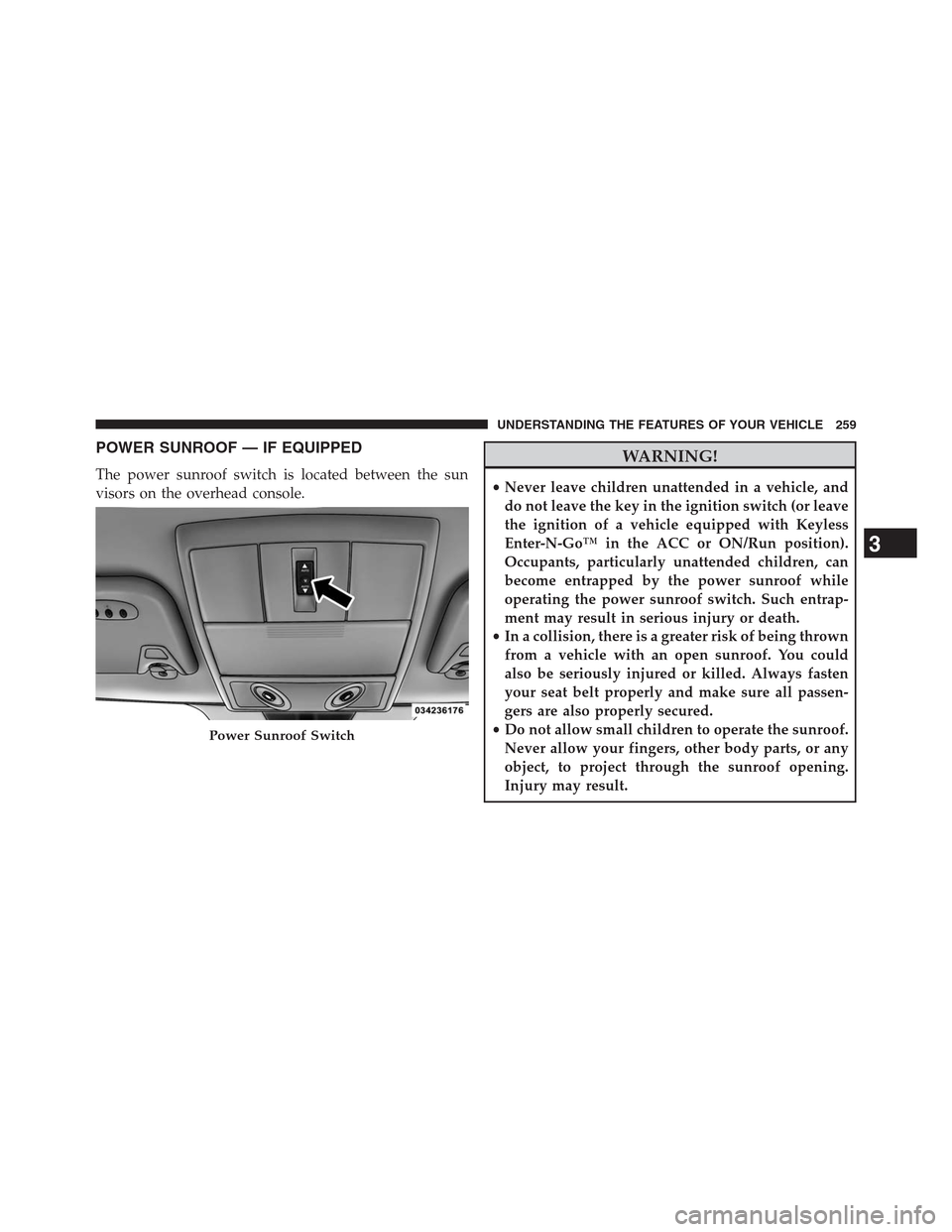
POWER SUNROOF — IF EQUIPPED
The power sunroof switch is located between the sun
visors on the overhead console.
WARNING!
•Never leave children unattended in a vehicle, and
do not leave the key in the ignition switch (or leave
the ignition of a vehicle equipped with Keyless
Enter-N-Go™ in the ACC or ON/Run position).
Occupants, particularly unattended children, can
become entrapped by the power sunroof while
operating the power sunroof switch. Such entrap-
ment may result in serious injury or death.
•In a collision, there is a greater risk of being thrown
from a vehicle with an open sunroof. You could
also be seriously injured or killed. Always fasten
your seat belt properly and make sure all passen-
gers are also properly secured.
•Do not allow small children to operate the sunroof.
Never allow your fingers, other body parts, or any
object, to project through the sunroof opening.
Injury may result.
Power Sunroof Switch
3
UNDERSTANDING THE FEATURES OF YOUR VEHICLE 259
Page 282 of 630
WARNING!
The weight and position of cargo and passengers can
change the vehicle center of gravity and vehicle
handling. To avoid loss of control resulting in per-
sonal injury, follow these guidelines for loading your
vehicle:
•Do not carry loads that exceed the load limits de-
scribed on the label attached to the left door or left
door center pillar.
•Always place cargo evenly on the cargo floor. Put
heavier objects as low and as far forward as possible.
•
Place as much cargo as possible in front of the rear axle.
Too much weight or improperly placed weight over or
behind the rear axle can cause the vehicle to sway.
•Do not pile luggage or cargo higher than the top of the
seatback. This could impair visibility or become a
dangerous projectile in a sudden stop or collision.
•To help protect against personal injury, passengers
should not be seated in the rear cargo area. The rear
cargo space is intended for load carrying purposes
only, not for passengers, who should sit in seats and
use seat belts.
Retractable Cargo Area Cover (If Equipped) —
Five Passenger Models
NOTE:The purpose of this cover is for privacy, not to
secure loads. It will not prevent cargo from shifting or
protect passengers from loose cargo.
280 UNDERSTANDING THE FEATURES OF YOUR VEHICLE
Page 301 of 630
11. Seat Belt Reminder Light
When the ignition switch is first turned to ON/
RUN, this light will turn on for four to eight sec-
onds as a bulb check. During the bulb check, if the
driver or front passenger’s seat belt is unbuckled, a chime
will sound. After the bulb check or when driving, if the
driver’s seat belt remains unbuckled, the Seat Belt Re-
minder Light will illuminate and the chime will sound.
Refer to “Occupant Restraints” in “Things To Know
Before Starting Your Vehicle” for further information.
12. Brake Warning Light
This light monitors various brake functions,
including brake fluid level and parking brake
application. If the brake light turns on it may
indicate that the parking brake is applied, that
the brake fluid level is low, or that there is a problem with
the anti-lock brake system reservoir.If the light remains on when the parking brake has been
disengaged, and the fluid level is at the full mark on the
master cylinder reservoir, it indicates a possible brake
hydraulic system malfunction or that a problem with the
Brake Booster has been detected by the Anti-Lock Brake
System (ABS) / Electronic Stability Control (ESC) system.
In this case, the light will remain on until the condition
has been corrected. If the problem is related to the brake
booster, the ABS pump will run when applying the brake
and a brake pedal pulsation may be felt during each stop.
The dual brake system provides a reserve braking capac-
ity in the event of a failure to a portion of the hydraulic
system. A leak in either half of the dual brake system is
indicated by the Brake Warning Light, which will turn on
when the brake fluid level in the master cylinder has
dropped below a specified level.
The light will remain on until the cause is corrected.
4
UNDERSTANDING YOUR INSTRUMENT PANEL 299
Page 394 of 630
STARTING PROCEDURES
Before starting your vehicle, adjust your seat, adjust the
inside and outside mirrors, fasten your seat belt, and if
present, instruct all other occupants to buckle their seat belts.
WARNING!
Never leave children alone in a vehicle, or with
access to an unlocked vehicle. Leaving children in a
vehicle unattended is dangerous for a number of
reasons. A child or others could be seriously or
fatally injured. Children should be warned not to
touch the parking brake, brake pedal or the shift
lever. Do not leave the key fob in or near the vehicle
(or in a location accessible to children), and do not
leave the ignition in the of a vehicle equipped with
Enter-N-Go™ ACC or RUN position. A child could
operate power windows, other controls, or move the
vehicle.
Automatic Transmission
The shift lever must be in the NEUTRAL or PARK position
before you can start the engine. Apply the brakes before
shifting into any driving gear.
CAUTION!
Damage to the transmission may occur if the follow-
ing precautions are not observed:
•
Do not shift from REVERSE, PARK, or NEUTRAL
into any forward gear when the engine is above idle
speed.
•Shift into PARK only after the vehicle has come to
a complete stop.
•
Shift into or out of REVERSE only after the vehicle
has come to a complete stop and the engine is at idle
speed.
•Before shifting into any gear, make sure your foot
is firmly on the brake pedal.
392 STARTING AND OPERATING
Page 539 of 630
Air Conditioner Maintenance
For best possible performance, your air conditioner should
be checked and serviced by an authorized dealer at the
start of each warm season. This service should include
cleaning of the condenser fins and a performance test.
Drive belt tension should also be checked at this time.
CAUTION!
Do not use chemical flushes in your air conditioning
system as the chemicals can damage your air condi-
tioning components. Such damage is not covered by
the New Vehicle Limited Warranty.
WARNING!
•Use only refrigerants and compressor lubricants
approved by the manufacturer for your air condi-
tioning system. Some unapproved refrigerants are
flammable and can explode, injuring you. Other
unapproved refrigerants or lubricants can cause the
system to fail, requiring costly repairs. Refer to
Warranty Information Book, located on the DVD,
for further warranty information.
•The air conditioning system contains refrigerant
under high pressure. To avoid risk of personal
injury or damage to the system, adding refrigerant
or any repair requiring lines to be disconnected
should be done by an experienced technician.
7
MAINTAINING YOUR VEHICLE 537
Page 566 of 630
To minimize the possibility of scratching the lenses
and reducing light output, avoid wiping with a dry cloth.
To remove road dirt, wash with a mild soap solution
followed by rinsing.
Do not use abrasive cleaning components, solvents, steel
wool or other aggressive material to clean the lenses.
Glass Surfaces
All glass surfaces should be cleaned on a regular basis with
MOPAR® Glass Cleaner, or any commercial household-
type glass cleaner. Never use an abrasive type cleaner. Use
caution when cleaning the inside rear window equipped
with electric defrosters or the right rear quarter window
equipped with the radio antenna. Do not use scrapers or
other sharp instrument that may scratch the elements.
When cleaning the rear view mirror, spray cleaner on the
towel or rag that you are using. Do not spray cleaner
directly on the mirror.
Cleaning Plastic Instrument Cluster Lenses
The lenses in front of the instruments in this vehicle are
molded in clear plastic. When cleaning the lenses, care
must be taken to avoid scratching the plastic.
1.
Clean with a wet soft rag. A mild soap solution may be
used, but do not use high alcohol content or abrasive
cleaners. If soap is used, wipe clean with a clean damp
rag.
2. Dry with a soft cloth.
Seat Belt Maintenance
Do not bleach, dye, or clean the belts with chemical
solvents or abrasive cleaners. This will weaken the fabric.
Sun damage can also weaken the fabric.
If the belts need cleaning, use MOPAR® Total Clean, a mild
soap solution, or lukewarm water. Do not remove the belts
from the vehicle to wash them. Dry with a soft cloth.
564 MAINTAINING YOUR VEHICLE
Page 567 of 630
Replace the belts if they appear frayed or worn or if the
buckles do not work properly.
Cleaning The Cupholders
Clean with a damp cloth or towel using a mild detergent.
FUSES
Interior Fuses
The interior fuse panel is located on the passenger side
under the instrument panel.
CavityCar-
tridge
FuseMini-
FuseDescription
F100 30 Amp
Pink110V AC Inverter –
If Equipped
F101 10 Amp
RedInterior Lights
CavityCar-
tridge
FuseMini-
FuseDescription
F102 20 Amp
YellowCigar Lighter in
Instrument Panel/
Left Rear Power
Outlet
F103 20 Amp
YellowPower Outlet in
Console Bin/Power
Outlet in Rear of
Console
F105 20 Amp
YellowHeated Seats –
If Equipped
F106 20 Amp
YellowRear Power Outlet
F107 10 Amp
RedRear Camera –
If Equipped
7
MAINTAINING YOUR VEHICLE 565