transmission DODGE JOURNEY 2013 1.G Repair Manual
[x] Cancel search | Manufacturer: DODGE, Model Year: 2013, Model line: JOURNEY, Model: DODGE JOURNEY 2013 1.GPages: 630
Page 556 of 630
WARNING!(Continued)
fluid in a open container absorbs moisture from the
air resulting in a lower boiling point. This may
cause it to boil unexpectedly during hard or pro-
longed braking, resulting in sudden brake failure.
This could result in a collision.
•Overfilling the brake fluid reservoir can result in
spilling brake fluid on hot engine parts, causing
the brake fluid to catch fire. Brake fluid can also
damage painted and vinyl surfaces, care should be
taken to avoid its contact with these surfaces.
•Do not allow petroleum based fluid to contaminate
the brake fluid. Brake seal components could be
damaged, causing partial or complete brake failure.
This could result in a collision.
Automatic Transmission
Selection Of Lubricant
It is important to use the proper transmission fluid to
ensure optimum transmission performance and life. Use
only the manufacturer ’s recommended transmission
fluid. Refer to “Fluids, Lubricants, and Genuine Parts” in
“Maintaining Your Vehicle” for fluid specifications. It is
important to maintain the transmission fluid at the
correct level using the recommended fluid. No chemical
flushes should be used in any transmission; only the
approved lubricant should be used.
554 MAINTAINING YOUR VEHICLE
Page 557 of 630
CAUTION!
Using a transmission fluid other than the manufac-
turer ’s recommended fluid may cause deterioration
in transmission shift quality and/or torque converter
shudder, and will require more frequent fluid and
filter changes. Refer to “Fluids, Lubricants, and
Genuine Parts” in “Maintaining Your Vehicle” for
fluid specifications.
Special Additives
The manufacturer strongly recommends against using
any special additives in the transmission.
Automatic Transmission Fluid (ATF) is an engineered prod-
uct and its performance may be impaired by supplemental
additives. Therefore, do not add any fluid additives to the
transmission. The only exception to this policy is the use of
special dyes for diagnosing fluid leaks. Avoid using trans-
mission sealers as they may adversely affect seals.
CAUTION!
Do not use chemical flushes in your transmission as
the chemicals can damage your transmission compo-
nents. Such damage is not covered by the New
Vehicle Limited Warranty.
Fluid Level Check – 2.4L Engine
Use the following procedure to check the transmission
fluid level properly:
1. Park the vehicle on level ground.
2. Run the engine at normal idle speed for at least
60 seconds, and leave the engine running for the rest
of this procedure.
3. Fully apply the parking brake, and press the brake
pedal.
7
MAINTAINING YOUR VEHICLE 555
Page 558 of 630
4.Place the shift lever momentarily into each gear position
(allowing time for the transmission to fully engage in
each position), ending with the shift lever in PARK.
5. Wipe the area around the dipstick clean to prevent dirt
from entering the transmission.
6.
Remove the dipstick and determine if the fluid is hot or
cold. Hot fluid is approximately 180°F (82°C), which is
the normal operating temperature after the vehicle is
driven at least 15 miles (24 km). Hot fluid cannot be held
comfortably between the fingertips. Cold fluid is at a
temperature of approximately 80°F (27°C).
7. Wipe the dipstick clean and reinsert it until seated.
Then, remove the dipstick and note the reading.
•If the fluid is hot, the reading should be in the
crosshatched area marked “HOT” (between the up-
per two holes in the dipstick).
•If the fluid is cold, the fluid level should be between
the lower two holes in the area marked “COLD.”If the fluid level is low, add fluid through the dipstick
tube to bring it to the proper level. Do not overfill. After
adding any quantity of oil through the dipstick tube, wait
at least two minutes for the oil to fully drain into the
transmission before rechecking the fluid level.
NOTE:If it is necessary to check the transmission below
the operating temperature, the fluid level should be
between the two COLD (lower) holes on the dipstick
with the fluid at approximately 80°F (27°C). If the fluid
level is correctly established at 80°F (27°C), it should be
between the HOT (upper) reference holes when the
transmission reaches 180°F (82°C). Remember it is best to
check the level at the normal operating temperature.
8. Check for leaks. Release the parking brake.
556 MAINTAINING YOUR VEHICLE
Page 559 of 630
CAUTION!
•Using a transmission fluid other than the manufac-
turer’s recommended fluid may cause deterioration
in transmission shift quality and/or torque con-
verter shudder, and will require more frequent
fluid and filter changes. Refer to “Fluids, Lubri-
cants, and Genuine Parts” in “Maintaining Your
Vehicle” for fluid specifications.
•Dirt and water in the transmission can cause seri-
ous damage. To prevent dirt and water from enter-
ing the transmission after checking or replenishing
fluid, make sure that the dipstick cap is re-seated
properly.
Fluid Level Check – 3.6L Engine
The fluid level is preset at the factory and does not
require adjustment under normal operating conditions.
Routine fluid level checks are not required, therefore the
transmission has no dipstick. Your authorized dealer can
check your transmission fluid level using a special ser-
vice dipstick. If you notice fluid leakage or transmission
malfunction, visit your authorized dealer immediately to
have the transmission fluid level checked. Operating the
vehicle with an improper fluid level can cause severe
transmission damage.
CAUTION!
If a transmission fluid leak occurs, visit your autho-
rized dealer immediately. Severe transmission dam-
age may occur. Your authorized dealer has the proper
tools to adjust the fluid level accurately.
7
MAINTAINING YOUR VEHICLE 557
Page 560 of 630
Fluid And Filter Changes
Refer to the “Maintenance Schedule” for the proper
maintenance intervals.
In addition, change the fluid and filter if the transmission
is disassembled for any reason.
Rear Drive Assembly (RDA) – AWD Models Only
Lubricant Selection
Use only the manufacturer’s recommended fluid. Refer
to “Fluids, Lubricants, and Genuine Parts” in “Maintain-
ing Your Vehicle” for further information.
Fluid Level Check
Visually inspect the unit at each oil change for leakage. If
leakage is detected, check the fluid level by removing the
fill plug. The fluid level should be maintained between the
bottom of the fill hole to 1/8 in (4 mm) below the fill hole.
Add fluid, if necessary, to maintain the proper level.
Frequency Of Fluid Change
Refer to the “Maintenance Schedule” for the proper
maintenance intervals.
Power Transfer Unit (PTU) – AWD Models Only
Lubricant Selection
Use only the manufacturer’s recommended fluid. Refer
to “Fluids, Lubricants, and Genuine Parts” in “Maintain-
ing Your Vehicle” for further information.
Fluid Level Check
Visually inspect the unit at each oil change for leakage. If
leakage is detected, Check the fluid level by removing the
fill plug. The fluid level should be maintained between the
bottom of the fill hole to 1/8 in (4 mm) below the fill hole.
Add fluid, if necessary, to maintain the proper level.
558 MAINTAINING YOUR VEHICLE
Page 585 of 630
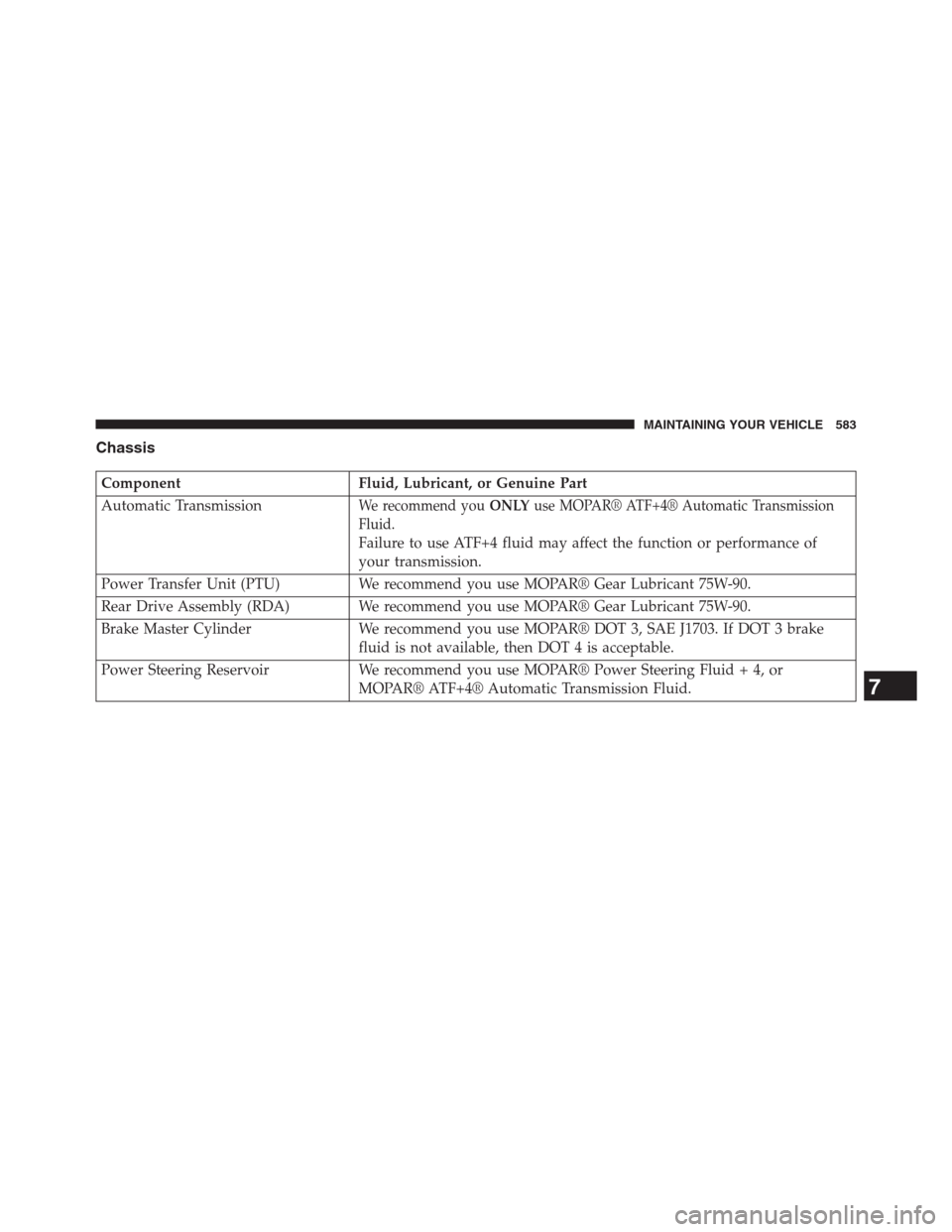
Chassis
Component Fluid, Lubricant, or Genuine Part
Automatic Transmission
We recommend youONLYuse MOPAR® ATF+4® Automatic Transmission
Fluid.
Failure to use ATF+4 fluid may affect the function or performance of
your transmission.
Power Transfer Unit (PTU) We recommend you use MOPAR® Gear Lubricant 75W-90.
Rear Drive Assembly (RDA) We recommend you use MOPAR® Gear Lubricant 75W-90.
Brake Master Cylinder We recommend you use MOPAR® DOT 3, SAE J1703. If DOT 3 brake
fluid is not available, then DOT 4 is acceptable.
Power Steering Reservoir We recommend you use MOPAR® Power Steering Fluid + 4, or
MOPAR® ATF+4® Automatic Transmission Fluid.
7
MAINTAINING YOUR VEHICLE 583
Page 589 of 630
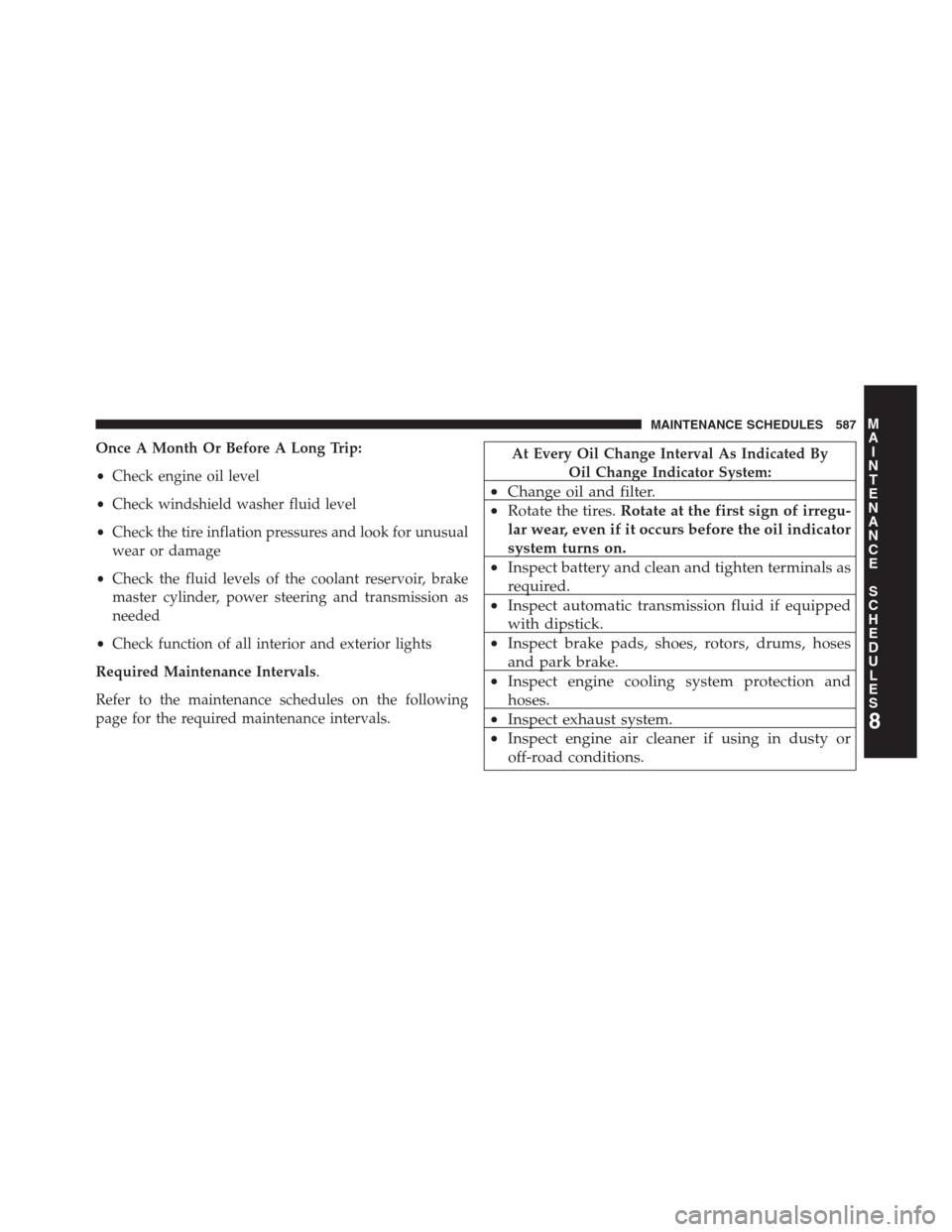
Once A Month Or Before A Long Trip:
•Check engine oil level
•Check windshield washer fluid level
•Check the tire inflation pressures and look for unusual
wear or damage
•Check the fluid levels of the coolant reservoir, brake
master cylinder, power steering and transmission as
needed
•Check function of all interior and exterior lights
Required Maintenance Intervals.
Refer to the maintenance schedules on the following
page for the required maintenance intervals.At Every Oil Change Interval As Indicated By
Oil Change Indicator System:
•Change oil and filter.
•Rotate the tires.Rotate at the first sign of irregu-
lar wear, even if it occurs before the oil indicator
system turns on.
•Inspect battery and clean and tighten terminals as
required.
•Inspect automatic transmission fluid if equipped
with dipstick.
•Inspect brake pads, shoes, rotors, drums, hoses
and park brake.
•Inspect engine cooling system protection and
hoses.
•Inspect exhaust system.
•Inspect engine air cleaner if using in dusty or
off-road conditions.
8
M
A
I
N
T
E
N
A
N
C
E
S
C
H
E
D
U
L
E
SMAINTENANCE SCHEDULES 587
Page 591 of 630
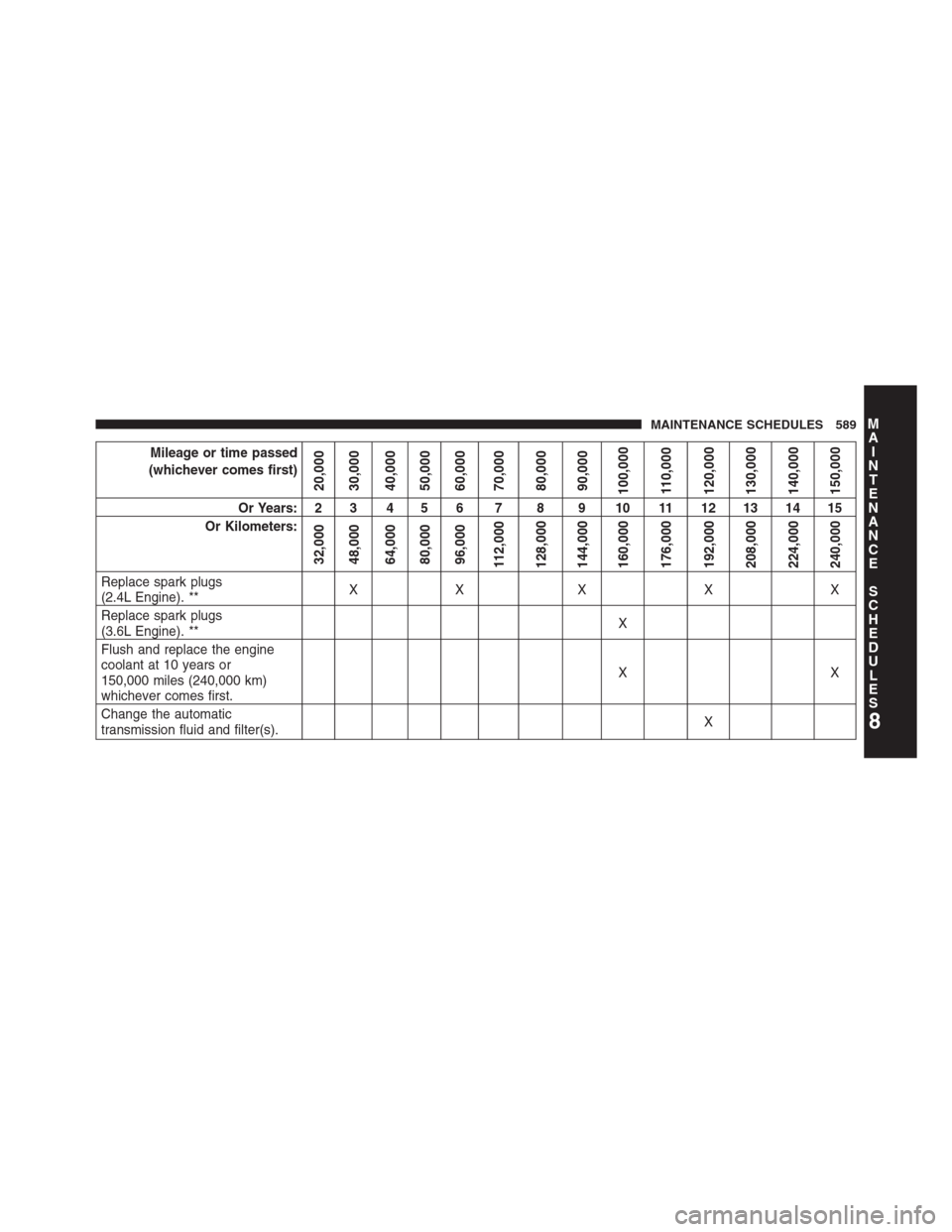
Mileage or time passed
(whichever comes first)
20,000
30,000
40,000
50,000
60,000
70,000
80,000
90,000
100,000
110,000
120,000
130,000
140,000
150,000
Or Years: 2 3 4 5 6 7 8 9 10 11 12 13 14 15
Or Kilometers:
32,000
48,000
64,000
80,000
96,000
112,000
128,000
144,000
160,000
176,000
192,000
208,000
224,000
240,000
Replace spark plugs
(2.4L Engine). **XX X X X
Replace spark plugs
(3.6L Engine). **X
Flush and replace the engine
coolant at 10 years or
150,000 miles (240,000 km)
whichever comes first.XX
Change the automatic
transmission fluid and filter(s).X
8
M
A
I
N
T
E
N
A
N
C
E
S
C
H
E
D
U
L
E
SMAINTENANCE SCHEDULES 589
Page 609 of 630
Automatic Temperature Control (ATC)..........378
Automatic Transmission....................397
Adding Fluid..........................555
Autostick.............................415
Fluid and Filter Changes..................558
Fluid Change..........................558
Fluid Level Check.......................555
Fluid Type............................554
Gear Ranges...........................401
Special Additives.......................555
Autostick...............................415
Auto Unlock, Doors........................32
Auxiliary Electrical Outlet (Power Outlet)........262
Auxiliary Power Outlet.....................262
Back-Up Lights...........................576
Battery.................................535
Keyless Transmitter Replacement (RKE)........25
Location..............................535Belts, Seat...............................49
Body Mechanism Lubrication.................540
B-Pillar Location..........................440
Brake Assist System.......................428
Brake Control System, Electronic..............426
Brake Fluid.............................583
Brake, Parking...........................422
Brakes.................................424
Brake System............................424
Anti-Lock (ABS)........................425
Fluid Check...........................553
Master Cylinder........................553
Parking..............................422
Warning Light.........................299
Brake/Transmission Interlock.................399
Break-In Recommendations, New Vehicle........103
Brightness, Interior Lights..................
.226
10
INDEX 607
Page 612 of 630
Diagnostic System, Onboard.................527
Dimmer Switch, Headlight...................225
Dipsticks
Automatic Transmission..................555
Oil (Engine)...........................531
Power Steering.........................421
Disabled Vehicle Towing....................519
Disposal
Antifreeze (Engine Coolant)................550
Door Locks..............................30
Door Locks, Automatic......................32
Door Opener, Garage.......................250
Driving
Through Flowing, Rising, or Shallow
Standing Water.........................418
Driving to Achieve Maximum Fuel Economy......312
E-85 Fuel...............................473
Electrical Outlet, Auxiliary (Power Outlet)........262Electrical Power Outlets.....................262
Electric Remote Mirrors.....................117
Electronic Brake Control System...............426
Anti-Lock Brake System..................425
Brake Assist System.....................428
Traction Control System...................429
Electronic Roll Mitigation (ERM)..............429
Electronic Speed Control (Cruise Control)........234
Electronic Stability Control (ESC)..............430
Electronic Vehicle Information Center (EVIC)......245
Emergency, In Case of
Freeing Vehicle When Stuck................517
Hazard Warning Flasher..................498
Jacking...............................500
Jump Starting..........................512
Overheating...........................498
Towing..............................519
Emission Control System Maintenance..........528
610 INDEX