clock DODGE JOURNEY 2015 1.G User Guide
[x] Cancel search | Manufacturer: DODGE, Model Year: 2015, Model line: JOURNEY, Model: DODGE JOURNEY 2015 1.GPages: 648
Page 387 of 648
Rear Temperature Control
To change the temperature in the rear of the vehicle,
rotate the temperature knob counterclockwise to lower
the temperature, and clockwise to increase the tempera-
ture. The rear temperature settings are displayed in the
Uconnect® system.
When rear controls are locked by the Uconnect® system,
the Rear Temperature Lock symbol on the temperature
knob is illuminated and any rear overhead adjustments
are ignored.
Rear Mode Control
Headliner Mode
Air comes from the outlets in the headliner. Each
of these outlets can be individually adjusted to
direct the flow of air. Moving the air vanes of the outlets
to one side will shut off the airflow.
Bi-Level Mode
Air comes from both the headliner outlets and the
floor outlets.
NOTE:In many temperature positions, the Bi-Level
mode is designed to provide cooler air out of the head-
liner outlets and warmer air from the floor outlets.
Floor Mode
Air comes from the floor outlets.
4
UNDERSTANDING YOUR INSTRUMENT PANEL 385
Page 393 of 648
Blower Control Knob On The Faceplate
The blower speed increases as you turn the blower
control knob clockwise from the lowest blower setting.
The blower speed decreases as you turn the blower
control knob counterclockwise.
Buttons On The Touchscreen
Use the small blower icon to reduce the blower setting
and the large blower icon to increase the blower setting.
Blower can also be selected by pressing the blower bar
area between the icons.
12. Modes
The airflow distribution mode can be adjusted so air
comes from the instrument panel outlets, floor outlets
and demist outlets. The Mode settings are as follows:
•Panel Mode
Air comes from the outlets in the instrument
panel. Each of these outlets can be individu-
ally adjusted to direct the flow of air. The air
vanes of the center outlets and outboard outlets can
be moved up and down or side to side to regulate
airflow direction. There is a shut off wheel located
below the air vanes to shut off or adjust the amount
of airflow from these outlets.
•Bi-Level Mode
Air comes from the instrument panel outlets
and floor outlets. A slight amount of air is
directed through the defrost and side window
demister outlets.
NOTE:BI-LEVEL mode is designed under comfort con-
ditions to provide cooler air out of the panel outlets and
warmer air from the floor outlets.
4
UNDERSTANDING YOUR INSTRUMENT PANEL 391
Page 399 of 648
Controlling The Rear Climate Controls From The
Front ATC Panel
The Three-Zone ATC system allows for adjustment of the
rear climate controls from the front ATC panel.
To change the rear system settings:
•Press#REAR#button to change control to rear control
mode, Rear display (below) will appear. Control func-
tions now operate rear system.
•To return to Front screen, press#REAR#button again,
or it will revert to the Front screen after six seconds.
Rear Lock
Pressing the Rear Temperature Lock button on the
Uconnect® touchscreen, illuminates a lock symbol in the
rear display. The rear temperature and air source are
controlled from the front Uconnect® system.
Rear second row occupants can only adjust the rear ATC
control when the Rear Temperature Lock button is turned
off.
The rear ATC is located in the headliner, near the center
of the vehicle.
•Press the Rear Temperature Lock button on the
Uconnect® touchscreen. This turns off the Rear Tem-
perature Lock icon in the rear temperature knob.
•Rotate the Rear Blower, Rear Temperature and the
Rear Mode Control knobs to suit your comfort needs.
•ATC is selected by adjusting the rear blower knob
counterclockwise to AUTO.
Once the desired temperature is displayed, the ATC
System will automatically achieve and maintain that
comfort level. When the system is set up for your comfort
4
UNDERSTANDING YOUR INSTRUMENT PANEL 397
Page 401 of 648
to high. This allows the rear seat occupants to control the
volume of air circulated in the rear of the vehicle.
CAUTION!
Interior air enters the Rear Automatic Temperature
Control System through an intake grille, located in
the right side trim panel behind the third row seats.
The rear outlets are located in the right side trim
panel of the 3rd Row seat. Do not block or place
objects directly in front of the inlet grille or heater
outlets. The electrical system could overload causing
damage to the blower motor.
Rear Temperature Control
To change the temperature in the rear of the vehicle,
rotate the temperature knob counterclockwise to lower
the temperature, and clockwise to increase the tempera-
ture. The rear temperature settings are displayed in the
Uconnect® system.
When rear controls are locked by the Uconnect® system,
the Rear Temperature Lock symbol on the temperature
knob is illuminated and any rear overhead adjustments
are ignored.
Rear Mode Control
Auto Mode
•The rear system automatically maintains the correct
mode and comfort level desired by the rear seat
occupants.
Headliner Mode
Air comes from the outlets in the headliner. Each
of these outlets can be individually adjusted to
direct the flow of air. Moving the air vanes of the outlets
to one side will shut off the airflow.
4
UNDERSTANDING YOUR INSTRUMENT PANEL 399
Page 519 of 648
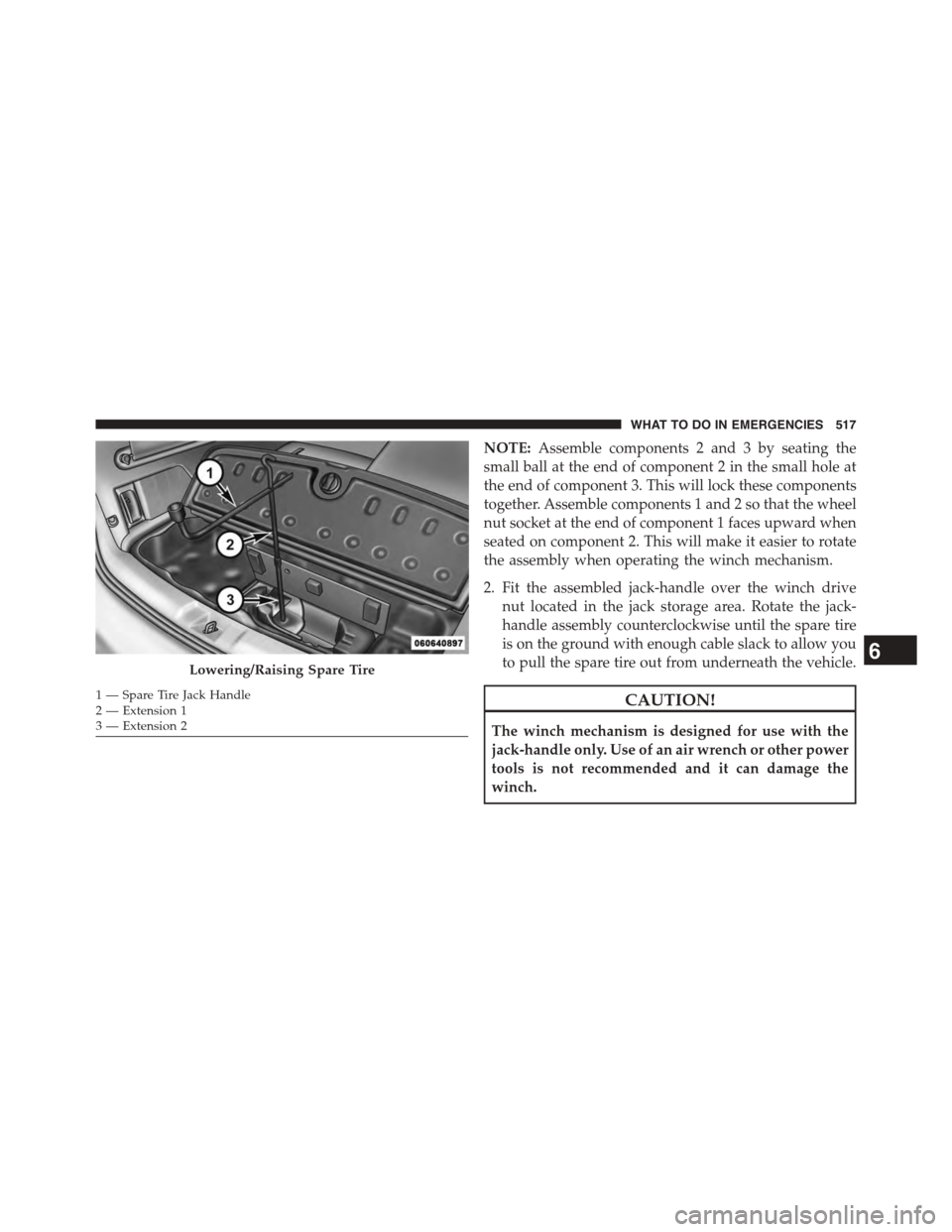
NOTE:Assemble components 2 and 3 by seating the
small ball at the end of component 2 in the small hole at
the end of component 3. This will lock these components
together. Assemble components 1 and 2 so that the wheel
nut socket at the end of component 1 faces upward when
seated on component 2. This will make it easier to rotate
the assembly when operating the winch mechanism.
2. Fit the assembled jack-handle over the winch drive
nut located in the jack storage area. Rotate the jack-
handle assembly counterclockwise until the spare tire
is on the ground with enough cable slack to allow you
to pull the spare tire out from underneath the vehicle.
CAUTION!
The winch mechanism is designed for use with the
jack-handle only. Use of an air wrench or other power
tools is not recommended and it can damage the
winch.
Lowering/Raising Spare Tire
1—SpareTireJackHandle2—Extension13—Extension2
6
WHAT TO DO IN EMERGENCIES 517
Page 520 of 648
3. Pull the spare tire out from underneath the vehicle and
raise it upright so the tire’s tread is on the ground.
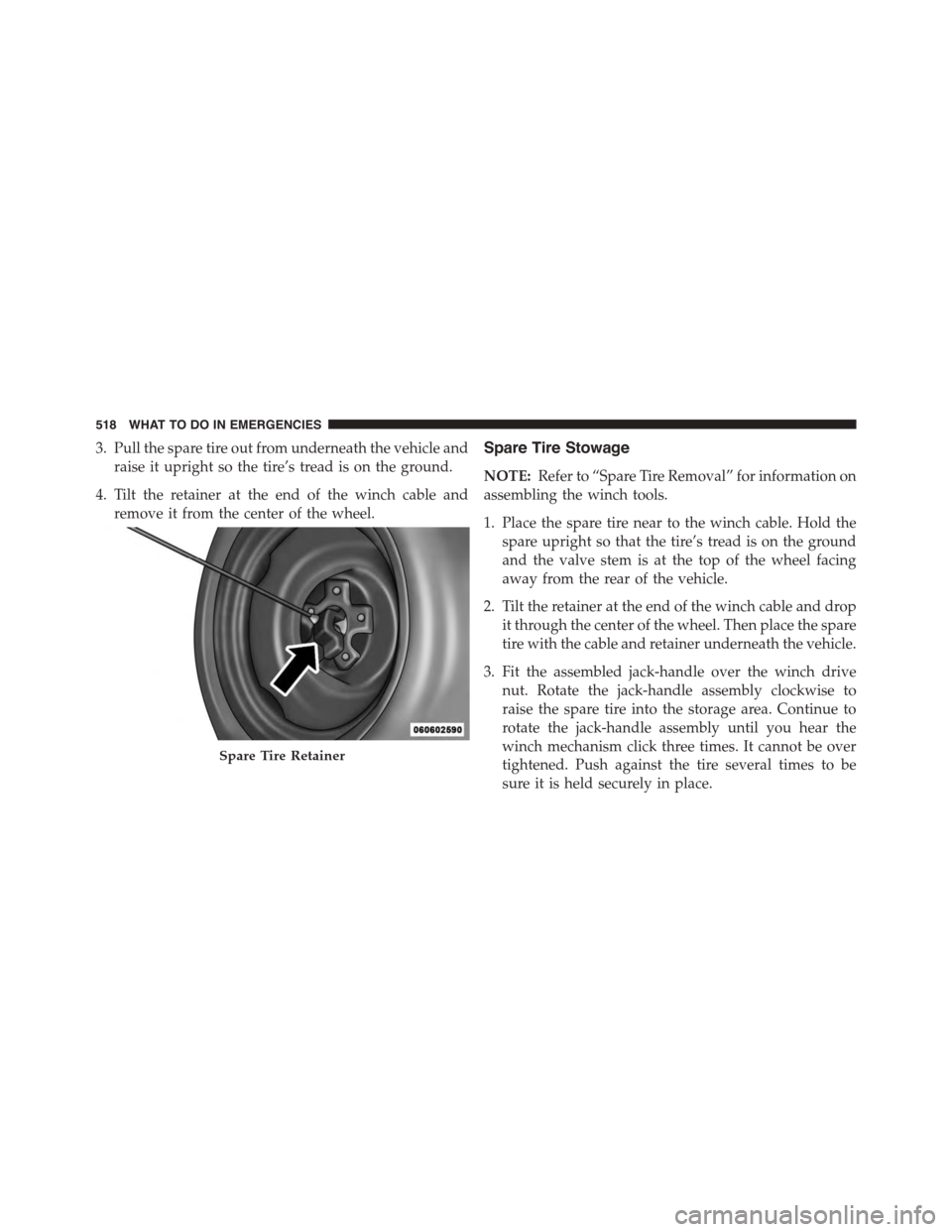
4. Tilt the retainer at the end of the winch cable and
remove it from the center of the wheel.
Spare Tire Stowage
NOTE:Refer to “Spare Tire Removal” for information on
assembling the winch tools.
1. Place the spare tire near to the winch cable. Hold the
spare upright so that the tire’s tread is on the ground
and the valve stem is at the top of the wheel facing
away from the rear of the vehicle.
2. Tilt the retainer at the end of the winch cable and drop
it through the center of the wheel. Then place the spare
tire with the cable and retainer underneath the vehicle.
3. Fit the assembled jack-handle over the winch drive
nut. Rotate the jack-handle assembly clockwise to
raise the spare tire into the storage area. Continue to
rotate the jack-handle assembly until you hear the
winch mechanism click three times. It cannot be over
tightened. Push against the tire several times to be
sure it is held securely in place.
Spare Tire Retainer
518 WHAT TO DO IN EMERGENCIES
Page 522 of 648
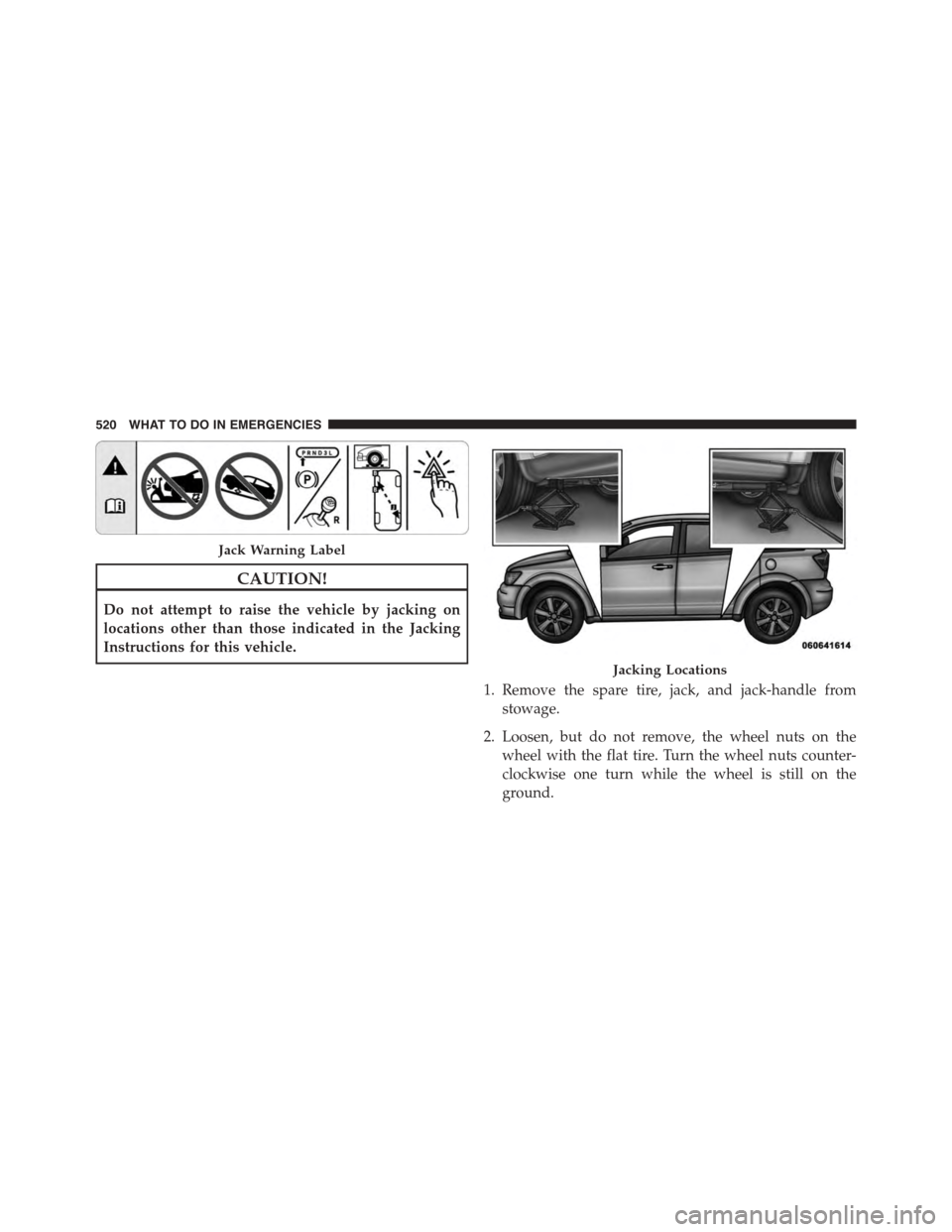
CAUTION!
Do not attempt to raise the vehicle by jacking on
locations other than those indicated in the Jacking
Instructions for this vehicle.
1. Remove the spare tire, jack, and jack-handle from
stowage.
2. Loosen, but do not remove, the wheel nuts on the
wheel with the flat tire. Turn the wheel nuts counter-
clockwise one turn while the wheel is still on the
ground.
Jack Warning Label
Jacking Locations
520 WHAT TO DO IN EMERGENCIES
Page 523 of 648
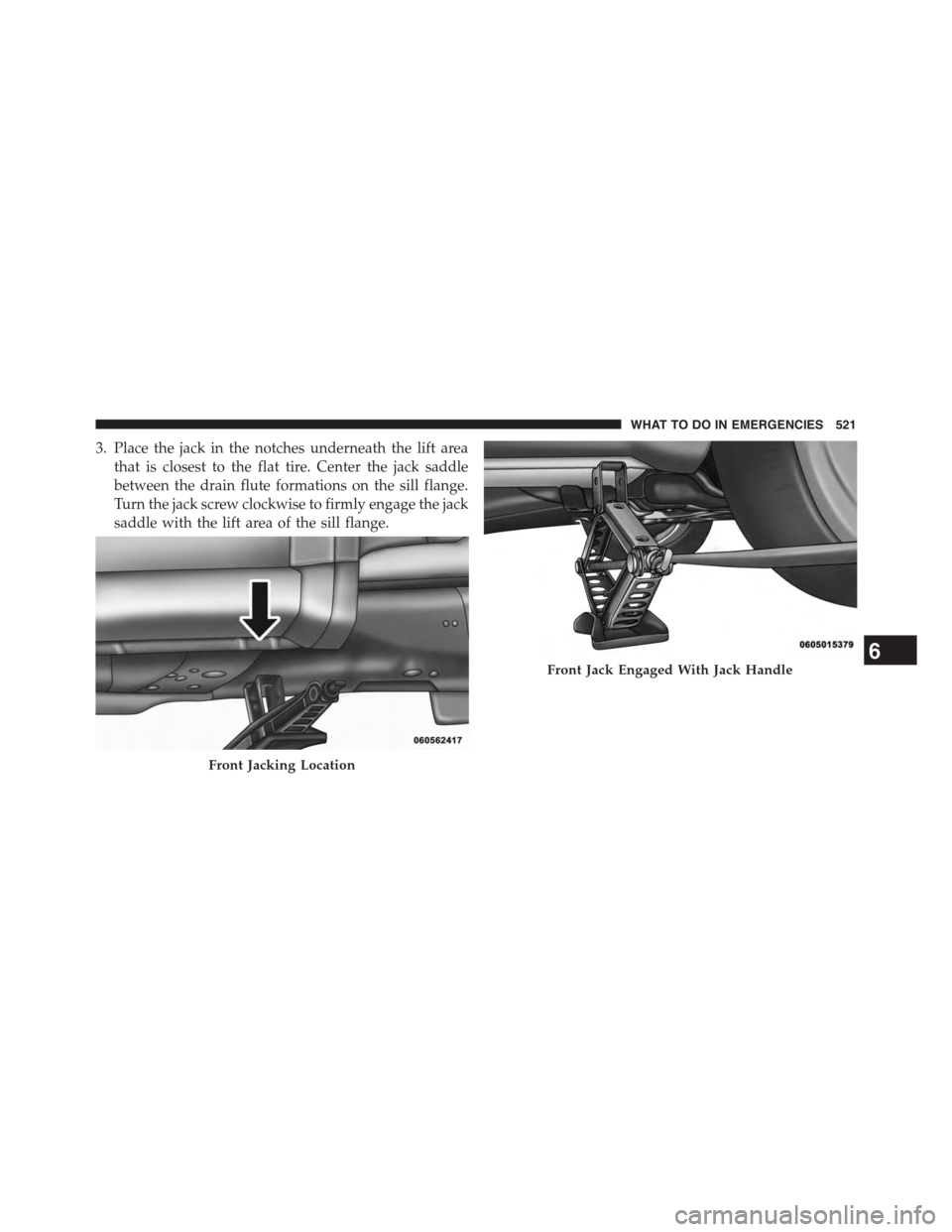
3. Place the jack in the notches underneath the lift area
that is closest to the flat tire. Center the jack saddle
between the drain flute formations on the sill flange.
Turn the jack screw clockwise to firmly engage the jack
saddle with the lift area of the sill flange.
Front Jacking Location
Front Jack Engaged With Jack Handle6
WHAT TO DO IN EMERGENCIES 521
Page 524 of 648
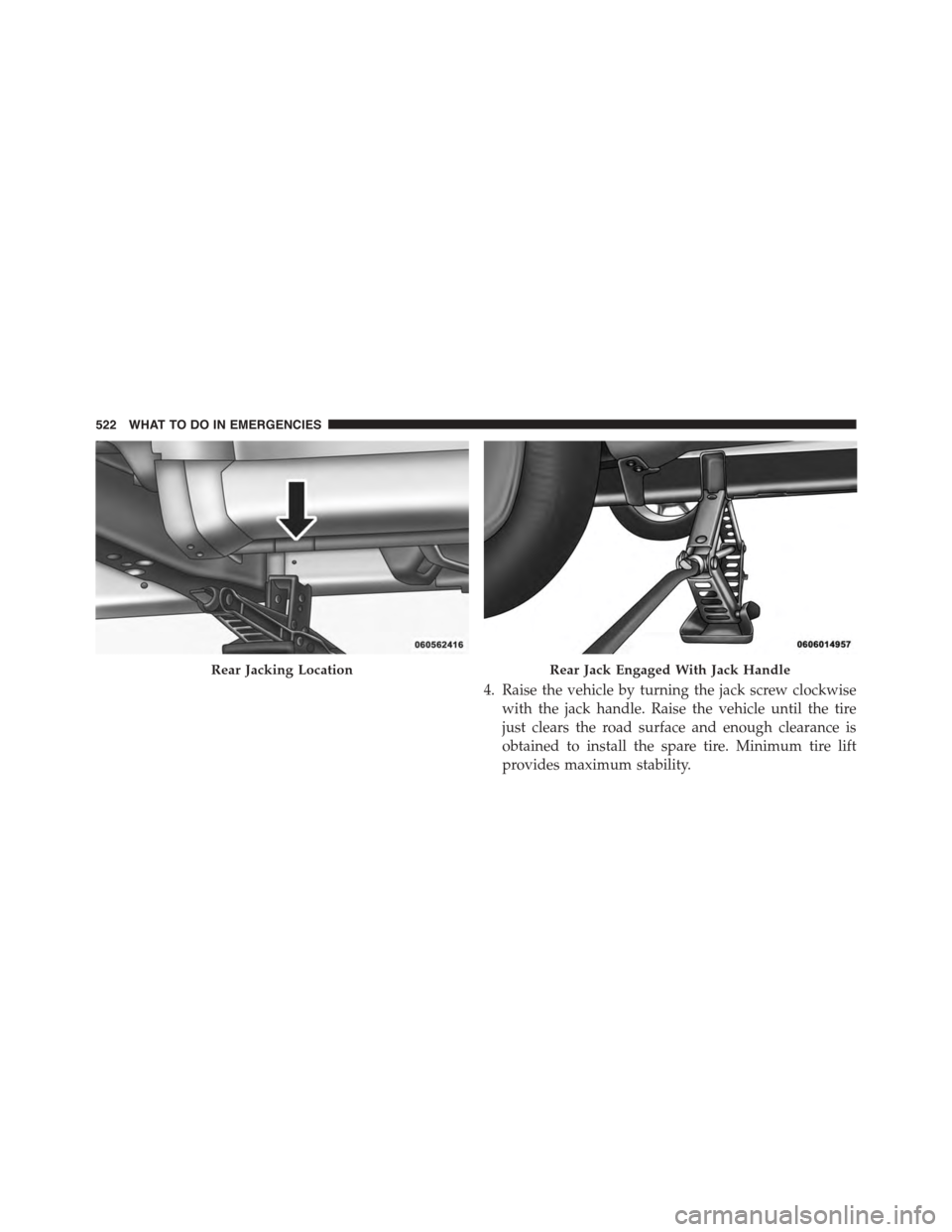
4. Raise the vehicle by turning the jack screw clockwise
with the jack handle. Raise the vehicle until the tire
just clears the road surface and enough clearance is
obtained to install the spare tire. Minimum tire lift
provides maximum stability.
Rear Jacking LocationRear Jack Engaged With Jack Handle
522 WHAT TO DO IN EMERGENCIES
Page 526 of 648
NOTE:
•For vehicles so equipped, do not attempt to install a
center cap or wheel cover on the compact spare.
•Refer to “Compact Spare Tire” and to “Limited-Use
Spare” under “Tires — General Information” in
“Starting and Operating” for additional warnings,
cautions, and information about the spare tire, its
use, and operation.
7. Install the wheel nuts with the cone-shaped end of the
nut toward the wheel. Lightly tighten the wheel nuts.
WARNING!
To avoid the risk of forcing the vehicle off the jack,
do not tighten the lug nuts fully until the vehicle has
been lowered. Failure to follow this warning may
result in personal injury.
8. Lower the vehicle by turning the jack screw counter-
clockwise with the jack handle.
9. Finish tightening the lug nuts. Push down on the
wrench while at the end of the handle for increased
leverage. Tighten the lug nuts in a star pattern until
each nut has been tightened twice. For the correct lug
nut torque refer to Torque Specifications in this sec-
tion. If in doubt about the correct tightness, have them
checked with a torque wrench by your authorized
dealer or service station.
10. Lower the jack to its fully closed position.
11. Place the deflated (flat) tire in the cargo area.Do not
stow the deflated tire in the spare tire stowage
location.Have the deflated (flat) tire repaired or
replaced as soon as possible.
524 WHAT TO DO IN EMERGENCIES