Oil change DODGE JOURNEY 2017 1.G User Guide
[x] Cancel search | Manufacturer: DODGE, Model Year: 2017, Model line: JOURNEY, Model: DODGE JOURNEY 2017 1.GPages: 510
Page 439 of 510
Engine Oil Filter
The engine oil filter should be replaced with a new filter at
every engine oil change.
Engine Oil Filter Selection
This manufacturer’s engines have a full-flow type oil filter.
Use a filter of this type for replacement. The quality of
replacement filters varies considerably. Only high quality
filters should be used to assure most efficient service.
MOPAR engine oil filters are a high quality oil filter and are
recommended.
Engine Air Cleaner Filter
Refer to the “Maintenance Schedule” in the “Maintenance
Schedules” section for the proper maintenance intervals.
WARNING!
The air induction system (air cleaner, hoses, etc.) can
provide a measure of protection in the case of engine
backfire. Do not remove the air induction system (air
cleaner, hoses, etc.) unless such removal is necessary
for repair or maintenance. Make sure that no one is
(Continued)
WARNING!(Continued)
near the engine compartment before starting the ve-
hicle with the air induction system (air cleaner, hoses,
etc.) removed. Failure to do so can result in serious
personal injury.
Engine Air Cleaner Filter Selection
The quality of replacement engine air cleaner filters varies
considerably. Only high quality filters should be used to
assure most efficient service. MOPAR engine air cleaner
filters are a high quality filter and are recommended.
Maintenance-Free Battery
Your vehicle is equipped with a maintenance-free battery.
You will never have to add water, nor is periodic mainte-
nance required.
NOTE: The battery is stored in a compartment that is
located behind the left front fender and is accessible
through the wheel well. The wheel and tire assembly do
not need to be removed to access the compartment.
Remote battery terminals are located in the engine com-
partment for jump-starting. Refer to “Jump-Starting Pro-
cedures” in “What To Do In Emergencies” for further
information.
7
MAINTAINING YOUR VEHICLE 437
Page 445 of 510
5. Lower the wiper blade and snap the pivot cap intoplace.
Adding Washer Fluid
The windshield washer and the rear window washer share
the same fluid reservoir. The fluid reservoir is located in the
engine compartment. Be sure to check the fluid level in the
reservoir at regular intervals. Fill the reservoir with wind-
shield washer solvent (not radiator antifreeze) and operate
the system for a few seconds to flush out the residual
water.
When refilling the washer fluid reservoir, apply some
washer fluid to a cloth or towel and wipe the wiper blades
clean. This will help blade performance.
To prevent freeze-up of your windshield washer system in
cold weather, select a solution or mixture that meets or
exceeds the temperature range of your climate. This rating
information can be found on most washer fluid containers.
The fluid reservoir will hold nearly 1 gal (4 l) of washer
fluid when the message “LoWASH” appears in the instru-
ment cluster.
WARNING!
Commercially available windshield washer solvents
are flammable. They could ignite and burn you. Care
must be exercised when filling or working around the
washer solution.
Exhaust System
The best protection against carbon monoxide entry into the
vehicle body is a properly maintained engine exhaust
system.
If you notice a change in the sound of the exhaust system;
or if the exhaust fumes can be detected inside the vehicle;
or when the underside or rear of the vehicle is damaged;
have an authorized technician inspect the complete ex-
haust system and adjacent body areas for broken, dam-
aged, deteriorated, or mispositioned parts. Open seams or
loose connections could permit exhaust fumes to seep into
the passenger compartment. In addition, have the exhaust
system inspected each time the vehicle is raised for lubri-
cation or oil change. Replace as required.
7
MAINTAINING YOUR VEHICLE 443
Page 455 of 510
two minutes for the oil to fully drain into the transmission
before rechecking the fluid level.
NOTE:If it is necessary to check the transmission below
the operating temperature, the fluid level should be be-
tween the two COLD (lower) holes on the dipstick with the
fluid at approximately 80°F (27°C). If the fluid level is
correctly established at 80°F (27°C), it should be between
the HOT (upper) reference holes when the transmission
reaches 180°F (82°C). Remember it is best to check the level
at the normal operating temperature.
8. Check for leaks. Release the parking brake.
CAUTION!
•Using a transmission fluid other than the manufactur-
er’s recommended fluid may cause deterioration in
transmission shift quality and/or torque converter shud-
der, and will require more frequent fluid and filter
changes. Refer to “Fluids, Lubricants, And Genuine
Parts” in this section for fluid specifications.
• Dirt and water in the transmission can cause serious
damage. To prevent dirt and water from entering the
transmission after checking or replenishing fluid,
make sure that the dipstick cap is re-seated properly.
Fluid Level Check — Six-Speed Automatic
Transmission
The fluid level is preset at the factory and does not require
adjustment under normal operating conditions. Routine
fluid level checks are not required, therefore the transmis-
sion filler tube is capped and no dipstick is provided. Your
authorized dealer can check your transmission fluid level
using a special service dipstick. If you notice fluid leakage
or transmission malfunction, visit your authorized dealer
immediately to have the transmission fluid level checked.
Operating the vehicle with an improper fluid level can
cause severe transmission damage.
CAUTION!
If a transmission fluid leak occurs, visit your autho-
rized dealer immediately. Severe transmission damage
may occur. Your authorized dealer has the proper tools
to adjust the fluid level accurately.
Fluid And Filter Changes
Refer to the “Maintenance Schedule” for the proper main-
tenance intervals.
7
MAINTAINING YOUR VEHICLE 453
Page 456 of 510
In addition, change the fluid and filter if the fluid becomes
contaminated (with water, etc.), or if the transmission is
disassembled for any reason.
Rear Drive Assembly (RDA) – AWD Models Only
Lubricant Selection
Use only the manufacturer’s recommended fluid. Refer to
“Fluids, Lubricants, And Genuine Parts” in “Maintaining
Your Vehicle” for further information.
Fluid Level Check
Visually inspect the unit at each oil change for leakage. If
leakage is detected, check the fluid level by removing the
fill plug. The fluid level should be maintained between the
bottom of the fill hole to 1/8 inch (4 mm) below the fill
hole.
Add fluid, if necessary, to maintain the proper level.
Frequency Of Fluid Change
Refer to the “Maintenance Schedule” for the proper main-
tenance intervals.
Power Transfer Unit (PTU) – AWD Models Only
Lubricant Selection
Use only the manufacturer’s recommended fluid. Refer to
“Fluids, Lubricants, And Genuine Parts” in “Maintaining
Your Vehicle” for further information.
Fluid Level Check
Visually inspect the unit at each oil change for leakage. If
leakage is detected, Check the fluid level by removing the
fill plug. The fluid level should be maintained between the
bottom of the fill hole to 1/8 inch (4 mm) below the fill
hole.
Add fluid, if necessary, to maintain the proper level.
Frequency Of Fluid Change
Refer to the “Maintenance Schedule” for the proper main-
tenance intervals.
Appearance Care And Protection From Corrosion
Protection Of Body And Paint From Corrosion
Vehicle body care requirements vary according to geo-
graphic locations and usage. Chemicals that make roads
passable in snow and ice and those that are sprayed on
trees and road surfaces during other seasons are highly
454 MAINTAINING YOUR VEHICLE
Page 480 of 510
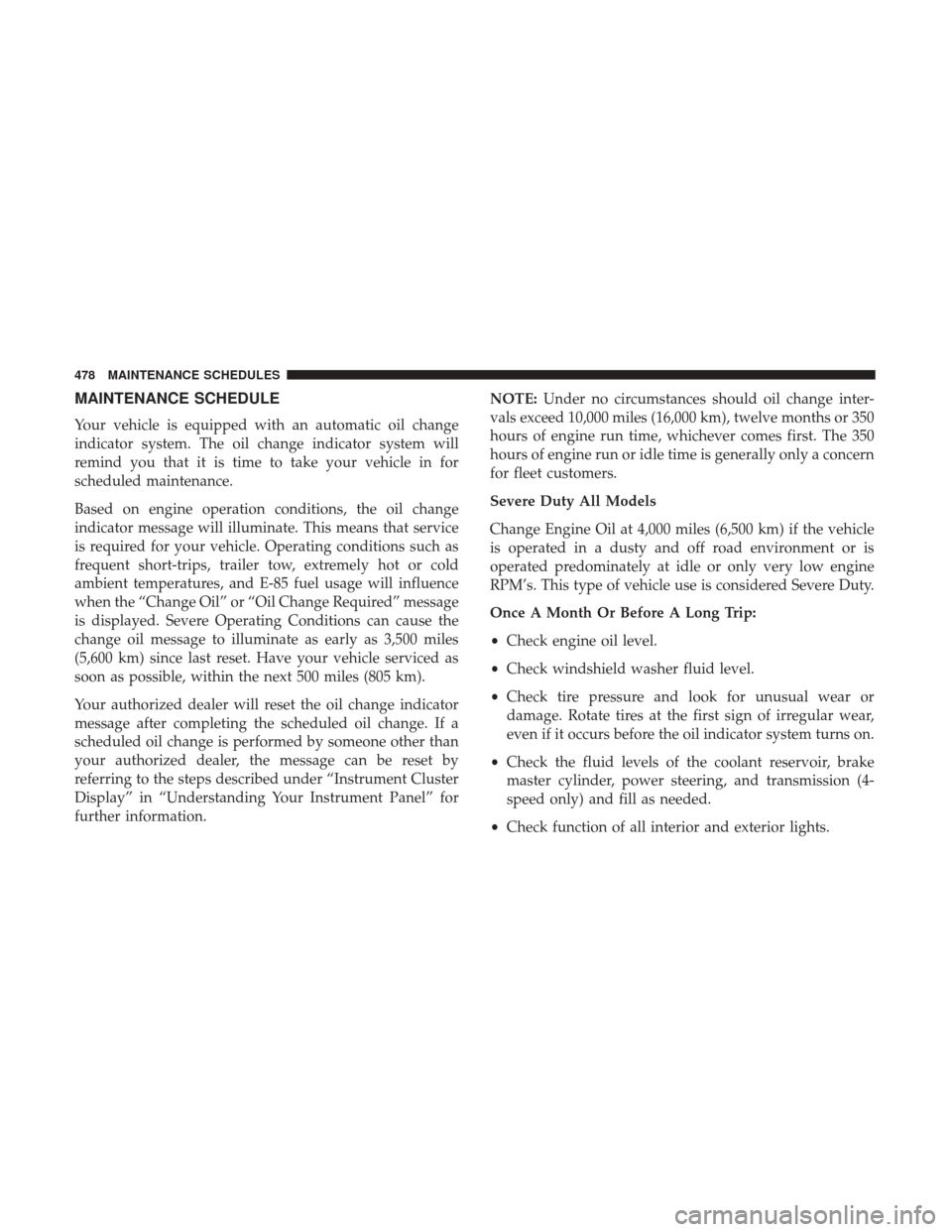
MAINTENANCE SCHEDULE
Your vehicle is equipped with an automatic oil change
indicator system. The oil change indicator system will
remind you that it is time to take your vehicle in for
scheduled maintenance.
Based on engine operation conditions, the oil change
indicator message will illuminate. This means that service
is required for your vehicle. Operating conditions such as
frequent short-trips, trailer tow, extremely hot or cold
ambient temperatures, and E-85 fuel usage will influence
when the “Change Oil” or “Oil Change Required” message
is displayed. Severe Operating Conditions can cause the
change oil message to illuminate as early as 3,500 miles
(5,600 km) since last reset. Have your vehicle serviced as
soon as possible, within the next 500 miles (805 km).
Your authorized dealer will reset the oil change indicator
message after completing the scheduled oil change. If a
scheduled oil change is performed by someone other than
your authorized dealer, the message can be reset by
referring to the steps described under “Instrument Cluster
Display” in “Understanding Your Instrument Panel” for
further information.NOTE:
Under no circumstances should oil change inter-
vals exceed 10,000 miles (16,000 km), twelve months or 350
hours of engine run time, whichever comes first. The 350
hours of engine run or idle time is generally only a concern
for fleet customers.
Severe Duty All Models
Change Engine Oil at 4,000 miles (6,500 km) if the vehicle
is operated in a dusty and off road environment or is
operated predominately at idle or only very low engine
RPM’s. This type of vehicle use is considered Severe Duty.
Once A Month Or Before A Long Trip:
• Check engine oil level.
• Check windshield washer fluid level.
• Check tire pressure and look for unusual wear or
damage. Rotate tires at the first sign of irregular wear,
even if it occurs before the oil indicator system turns on.
• Check the fluid levels of the coolant reservoir, brake
master cylinder, power steering, and transmission (4-
speed only) and fill as needed.
• Check function of all interior and exterior lights.
478 MAINTENANCE SCHEDULES
Page 481 of 510
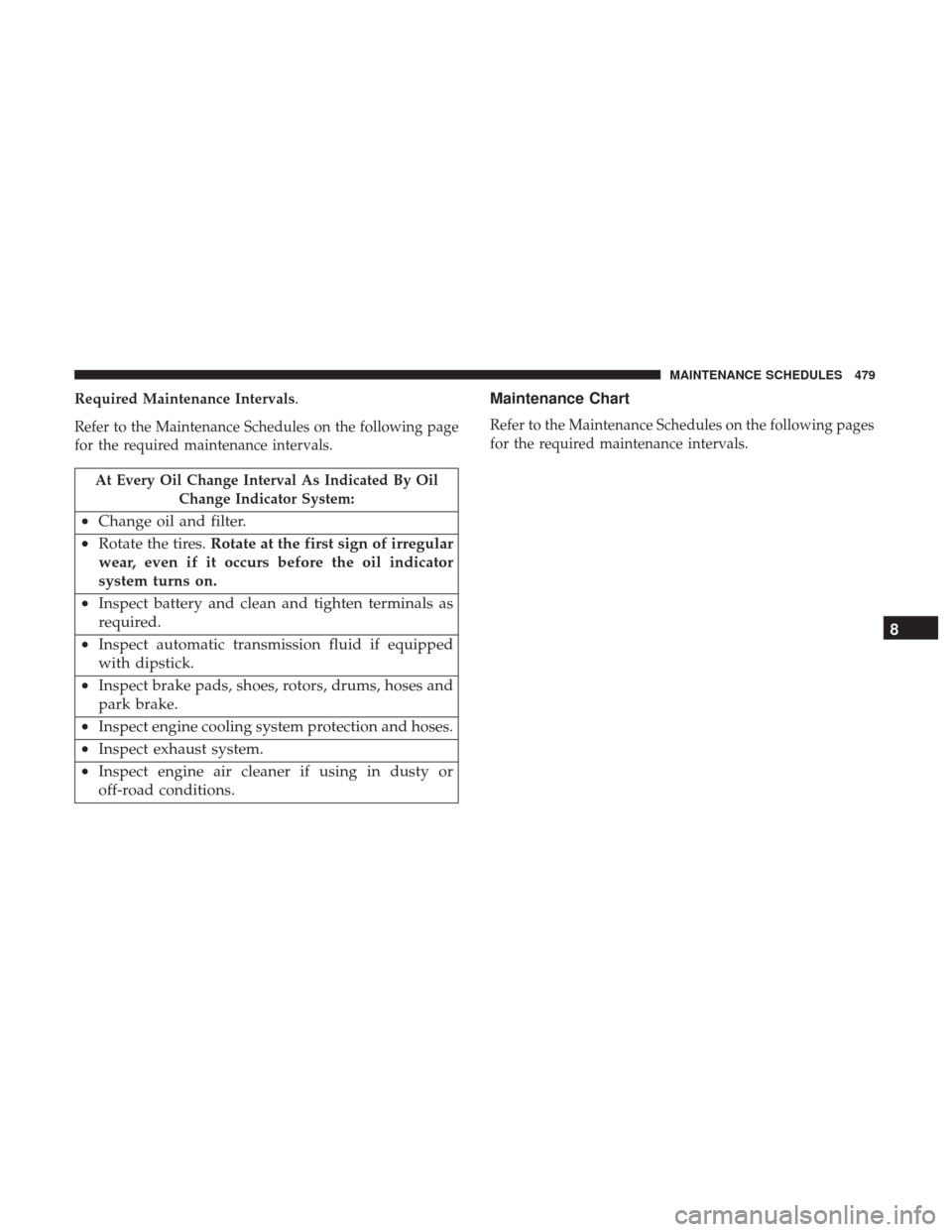
Required Maintenance Intervals.
Refer to the Maintenance Schedules on the following page
for the required maintenance intervals.
At Every Oil Change Interval As Indicated By OilChange Indicator System:
•Change oil and filter.
• Rotate the tires. Rotate at the first sign of irregular
wear, even if it occurs before the oil indicator
system turns on.
• Inspect battery and clean and tighten terminals as
required.
• Inspect automatic transmission fluid if equipped
with dipstick.
• Inspect brake pads, shoes, rotors, drums, hoses and
park brake.
• Inspect engine cooling system protection and hoses.
• Inspect exhaust system.
• Inspect engine air cleaner if using in dusty or
off-road conditions. Maintenance Chart
Refer to the Maintenance Schedules on the following pages
for the required maintenance intervals.
8
MAINTENANCE SCHEDULES 479
Page 492 of 510
About Your Brakes..................... .341, 343
Adding Engine Coolant (Antifreeze) .............446
Adding Fuel ............................. .386
Adding Washer Fluid ....................... .443
Additives, Fuel ........................... .382
Adjust Down ................................ .149
Forward .............................. .149
Rearward ............................. .149
Up.................................. .149
AirBag ..................................48 Air Bag Operation .........................50
Air Bag Warning Light .....................57
Driver Knee Air Bag .......................51
Enhanced Accident Response ..............56, 425
Event Data Recorder (EDR) .................425
If A Deployment Occurs ....................55
Knee Impact Bolsters .......................50
Maintaining Your Air Bag System ..............58
Side Air Bags ............................51
Air Bag Light ....................... .57, 82, 226
Air Bag Maintenance .........................58
Air Cleaner, Engine (Engine Air Cleaner Filter) ......437
Air Conditioner Maintenance ..................438
Air Conditioning Filter ...................319, 439 Air Conditioning, Operating Tips
............318, 320
Air Conditioning, Rear Zone ...............304, 314
Air Conditioning Refrigerant ...............438, 439
Air Conditioning System .....................438
Air Pressure, Tires ......................... .363
Alarm, Panic ...............................17
Alarm (Security Alarm) ....................13, 228
Alarm System (Security Alarm) .................13
All Wheel Drive (AWD) ..................... .337
Alterations/Modifications, Vehicle ................6
Antifreeze (Engine Coolant) ................446, 472
Disposal .............................. .448
Anti-Lock Brake System (ABS) .................344
Anti-Lock Warning Light .....................238
Appearance Care .......................... .454
Arming
System (Security Alarm) ................13
Assist, Hill Start .......................... .346
Auto Down Power Windows ...................31
Automatic Dimming Mirror ....................89
Automatic Door Locks ........................24
Automatic Headlights ...................... .168
Automatic Oil Change Indicator ................244
Automatic Transmission ..................329, 451
Adding Fluid .....................452, 453, 475
Fluid And Filter Changes ...................453
490 INDEX
Page 496 of 510
Hazard Warning Flasher...................404
Jacking ............................... .407
Jump Starting .......................... .417
Overheating ........................... .404
Towing ............................... .423
Emission Control System Maintenance ............432
Engine ................................. .429
Air Cleaner ............................ .437
Block Heater ........................... .328
Break-In Recommendations ..................80
Checking Oil Level ...................... .434
Compartment ....................... .429, 430
Compartment Identification .................430
Coolant (Antifreeze) ...................445, 473
Cooling .............................. .445
Exhaust Gas Caution ...................81, 383
Fails To Start ........................... .327
Flooded, Starting ........................ .327
Fuel Requirements ....................... .380
Jump Starting .......................... .417
Oil ........................... .434, 472, 473
Oil Change Interval ...................... .244
Oil Filler Cap ....................... .429, 435
Oil Filter .............................. .437
Oil Selection ........................ .435, 472Oil Synthetic
........................... .436
Overheating ........................... .404
Starting .............................. .325
Engine Oil Viscosity .....................435, 436
Engine Oil Viscosity Chart ....................436
Enhanced Accident Response Feature ..........56, 425
Entry System, Illuminated .....................15
Ethanol ............................. .381, 384
Exhaust Gas Caution .....................81, 383
Exhaust System ........................ .81, 443
Exterior
Folding Mirrors ......................92
Exterior Lighting .......................... .168
Exterior Lights .............................84
Filler Location Fuel ........................ .386
Filters Air Cleaner ............................ .437
Air Conditioning .....................319, 439
Engine Oil ......................... .437, 473
Engine Oil Disposal ...................... .436
Flashers Hazard Warning ........................ .404
Turn Signal ...................... .84, 171, 241
Flash-To-Pass ............................ .172
Flexible Fuel Vehicles
494 INDEX
Page 501 of 510
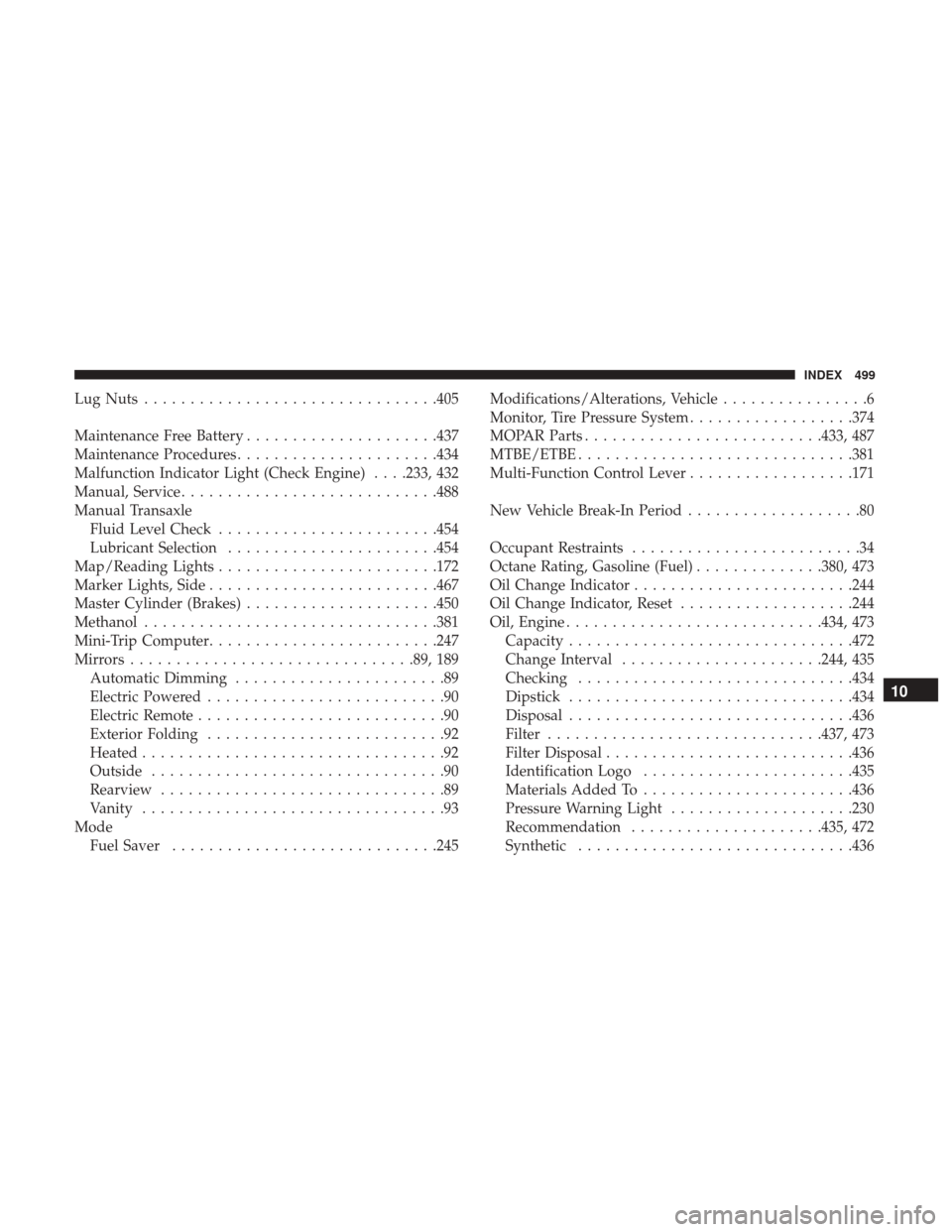
Lug Nuts............................... .405
Maintenance Free Battery .....................437
Maintenance Procedures ..................... .434
Malfunction Indicator Light (Check Engine) . . . .233, 432
Manual, Service ........................... .488
Manual Transaxle Fluid Level Check ....................... .454
Lubricant Selection ...................... .454
Map/Reading Lights ....................... .172
Marker Lights, Side ........................ .467
Master Cylinder (Brakes) .....................450
Methanol ............................... .381
Mini-Trip Computer ........................ .247
Mirrors .............................. .89, 189
Automatic Dimming .......................89
Electric Powered ..........................90
Electric Remote ...........................90
Exterior Folding ..........................92
Heated .................................92
Outside ................................90
Rearview ...............................89
Vanity .................................93
Mode Fuel Saver ............................ .245Modifications/Alterations, Vehicle
................6
Monitor, Tire Pressure System ..................374
MOPAR Parts ......................... .433, 487
MTBE/ETBE ............................. .381
Multi-Function Control Lever ..................171
New Vehicle Break-In Period ...................80
Occupant Restraints .........................34
Octane Rating, Gasoline (Fuel) ..............380, 473
Oil Change Indicator ....................... .244
Oil Change Indicator, Reset ...................244
Oil, Engine ........................... .434, 473
Capacity .............................. .472
Change Interval ..................... .244, 435
Checking ............................. .434
Dipstick .............................. .434
Disposal .............................. .436
Filter ............................. .437,
473
Filter Disposal .......................... .436
Identification Logo ...................... .435
Materials Added To ...................... .436
Pressure Warning Light ....................230
Recommendation .....................435, 472
Synthetic ............................. .436
10
INDEX 499
Page 502 of 510
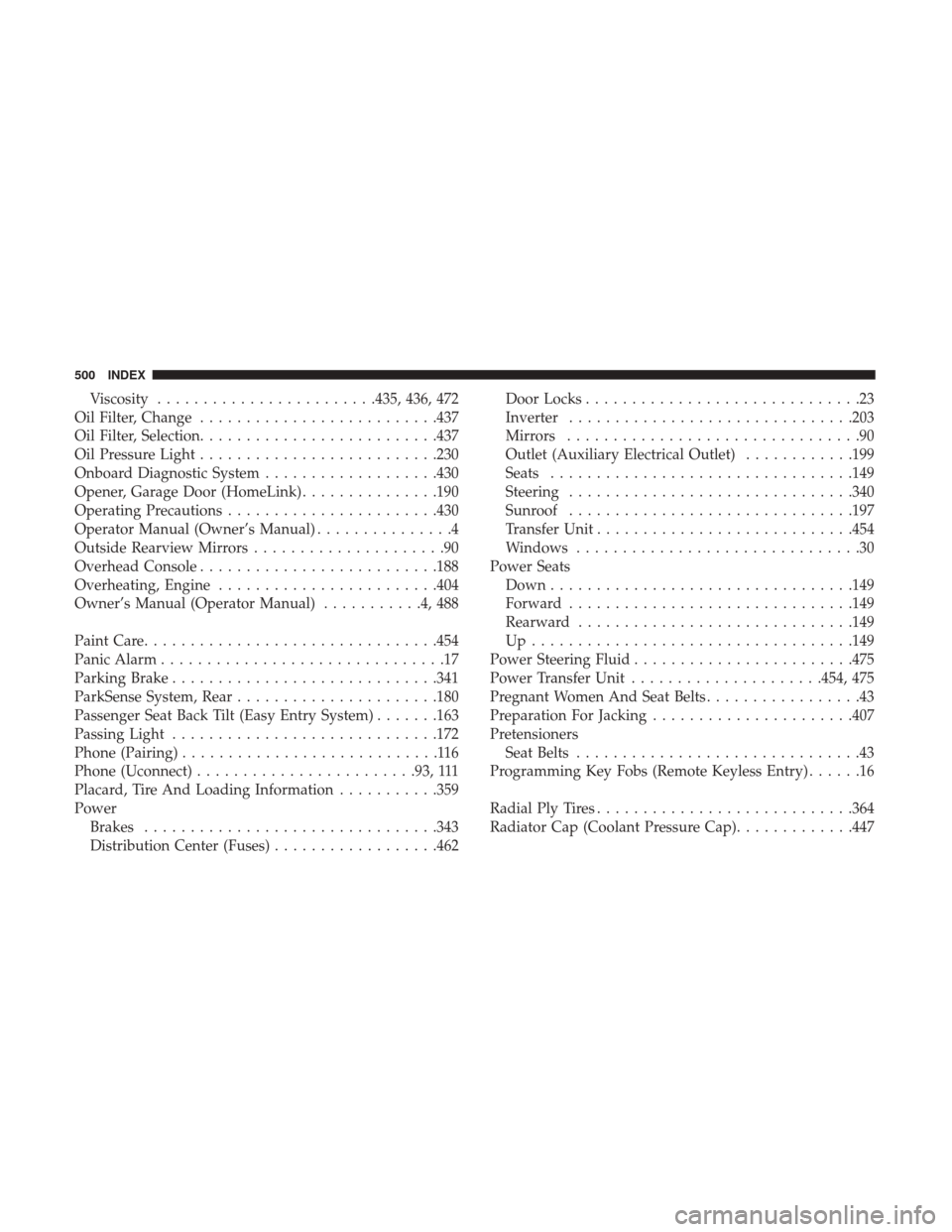
Viscosity....................... .435, 436, 472
Oil Filter, Change ......................... .437
Oil Filter, Selection ......................... .437
Oil Pressure Light ......................... .230
Onboard Diagnostic System ...................430
Opener, Garage Door (HomeLink) ...............190
Operating Precautions ...................... .430
Operator Manual (Owner’s Manual) ...............4
Outside Rearview Mirrors .....................90
Overhead Console ......................... .188
Overheating, Engine ....................... .404
Owner’s Manual (Operator Manual) ...........4,488
Paint Care ............................... .454
Panic Alarm ...............................17
Parking Brake ............................ .341
ParkSense System, Rear ..................... .180
Passenger Seat Back Tilt (Easy Entry System) .......163
Passing Light ............................ .172
Phone (Pairing) ............................116
Phone (Uconnect) ....................... .93, 111
Placard, Tire And Loading Information ...........359
Power Brakes ............................... .343
Distribution Center (Fuses) ..................462 Door Locks
..............................23
Inverter .............................. .203
Mirrors ................................90
Outlet (Auxiliary Electrical Outlet) ............199
Seats ................................ .149
Steering .............................. .340
Sunroof .............................. .197
Transfer Unit ........................... .454
Windows ...............................30
Power Seats Down ................................ .149
Forward .............................. .149
Rearward ............................. .149
Up.................................. .149
Power Steering Fluid ....................... .475
Power
Transfer Unit .....................454, 475
Pregnant Women And Seat Belts .................43
Preparation For Jacking ..................... .407
Pretensioners Seat Belts ...............................43
Programming Key Fobs (Remote Keyless Entry) ......16
Radial Ply Tires ........................... .364
Radiator Cap (Coolant Pressure Cap) .............447
500 INDEX