flat tire DODGE JOURNEY 2020 User Guide
[x] Cancel search | Manufacturer: DODGE, Model Year: 2020, Model line: JOURNEY, Model: DODGE JOURNEY 2020Pages: 396, PDF Size: 25.53 MB
Page 202 of 396
200 IN CASE OF EMERGENCY
SPARE TIRE LOCATION AND REMOVAL
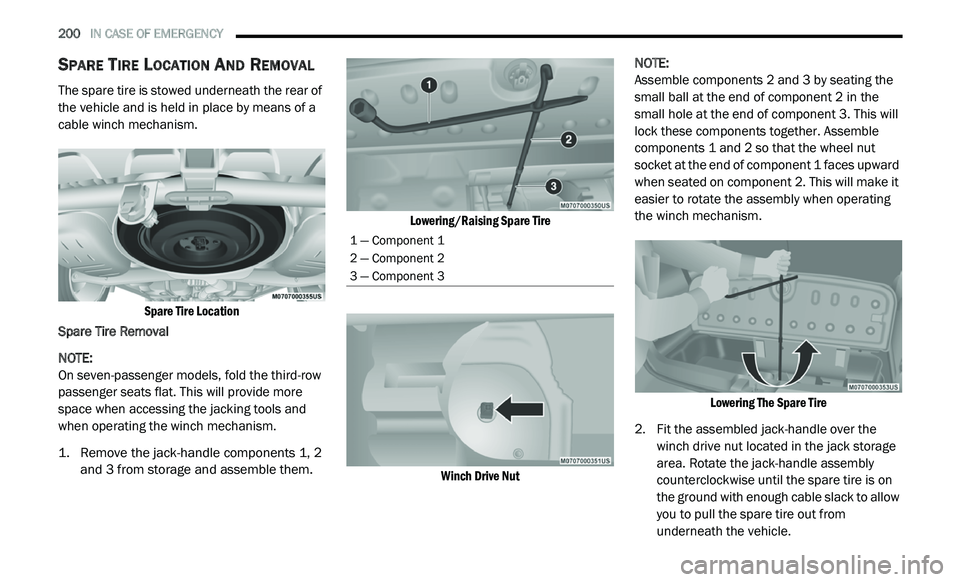
The spare tire is stowed underneath the rear of
the vehicle and is held in place by means of a
cable winch mechanism.
Spare Tire Location
Spare Tire Removal
NOTE:
On seven-passenger models, fold the third-row
p a
ssenger seats flat. This will provide more
space when accessing the jacking tools and
when operating the winch mechanism.
1. Remove the jack-handle components 1, 2 a
nd 3 from storage and assemble them.
Lowering/Raising Spare Tire
Winch Drive Nut
NOTE:
Assemble components 2 and 3 by seating the
s m
all ball at the end of component 2 in the
s m
all hole at the end of component 3. This will
lock these components together. Assemble
components 1 and 2 so that the wheel nut
socket at the end of component 1 faces upward
when seated on component 2. This will make it
easier to rotate the assembly when operating
the winch mechanism.
Lowering The Spare Tire
2. F it the assembled jack-handle over the
w
inch drive nut located in the jack storage
area. Rotate the jack-handle assembly
counterclockwise until the spare tire is on
the ground with enough cable slack to allow
you to pull the spare tire out from
underneath the vehicle.
1 — Component 1
2 — Component 2
3 — Component 3
Page 204 of 396
202 IN CASE OF EMERGENCY
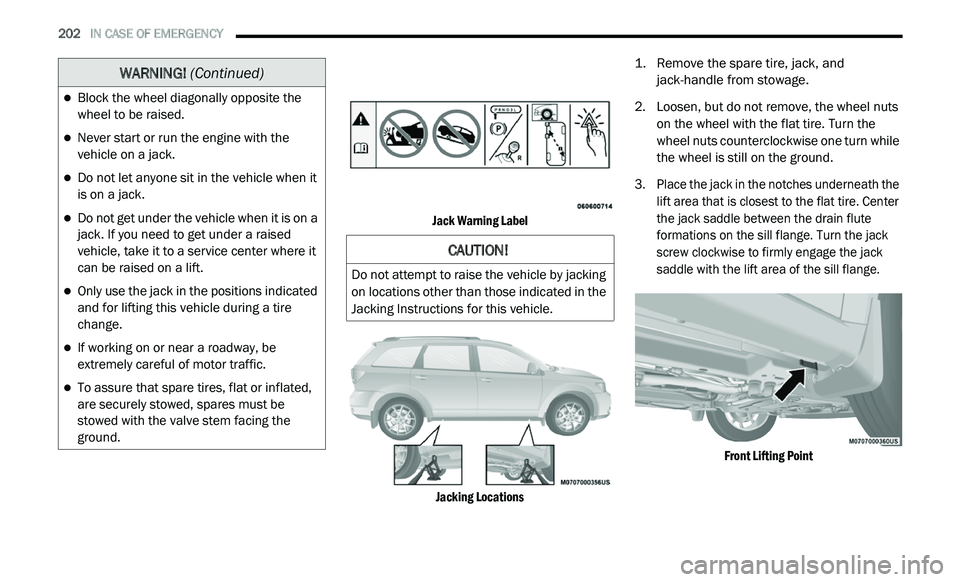
Jack Warning Label
Jacking Locations
1. R
emove the spare tire, jack, and
j
ack-handle from stowage.
2. Lo osen, but do not remove, the wheel nuts
o
n the wheel with the flat tire. Turn the
wheel nuts counterclockwise one turn while
the wheel is still on the ground.
3. Place the jack in the notches underneath the l
ift area that is closest to the flat tire. Center
the jack saddle between the drain flute
formations on the sill flange. Turn the jack
screw clockwise to firmly engage the jack
saddle with the lift area of the sill flange.
Front Lifting Point
Block the wheel diagonally opposite the
wheel to be raised.
Never start or run the engine with the
vehicle on a jack.
Do not let anyone sit in the vehicle when it
is on a jack.
Do not get under the vehicle when it is on a
jack. If you need to get under a raised
vehicle, take it to a service center where it
can be raised on a lift.
Only use the jack in the positions indicated
and for lifting this vehicle during a tire
change.
If working on or near a roadway, be
extremely careful of motor traffic.
To assure that spare tires, flat or inflated,
are securely stowed, spares must be
stowed with the valve stem facing the
ground.
WARNING! (Continued)
CAUTION!
Do not attempt to raise the vehicle by jacking
on locations other than those indicated in the
Jacking Instructions for this vehicle.
Page 206 of 396
204 IN CASE OF EMERGENCY
NOTE:
For vehicles so equipped, do not attempt to
install a center cap or wheel cover on the
compact spare.
Refer to “Compact Spare Tire” and to
“Limited Use Spare” under “Tires” in
“Servicing And Maintenance” for additional
warnings, cautions, and information about
the spare tire, its use, and operation.
7. I nstall the wheel nuts with the cone-shaped
e
nd of the nut toward the wheel. Lightly
tighten the wheel nuts.
8. Lo wer the vehicle by turning the jack screw
c
ounterclockwise with the jack handle.
9. F
inish tightening the lug nuts. Push down on
t
he wrench while at the end of the handle for
increased leverage. Tighten the lug nuts in
a star pattern until each nut has been
t i
ghtened twice. For the correct lug nut
torque, refer to “Wheel And Tire Torque
Specifications” in “Technical Specifications”.
If in doubt about the correct tightness, have
them checked with a torque wrench by an
authorized dealer or service station.
10. Lo wer the jack to its fully closed position.
1
1. P lace the deflated (flat) tire in the cargo
a
rea. Do not stow the deflated tire in the
spare tire stowage location. Have the
deflated (flat) tire repaired or replaced as
soon as possible.
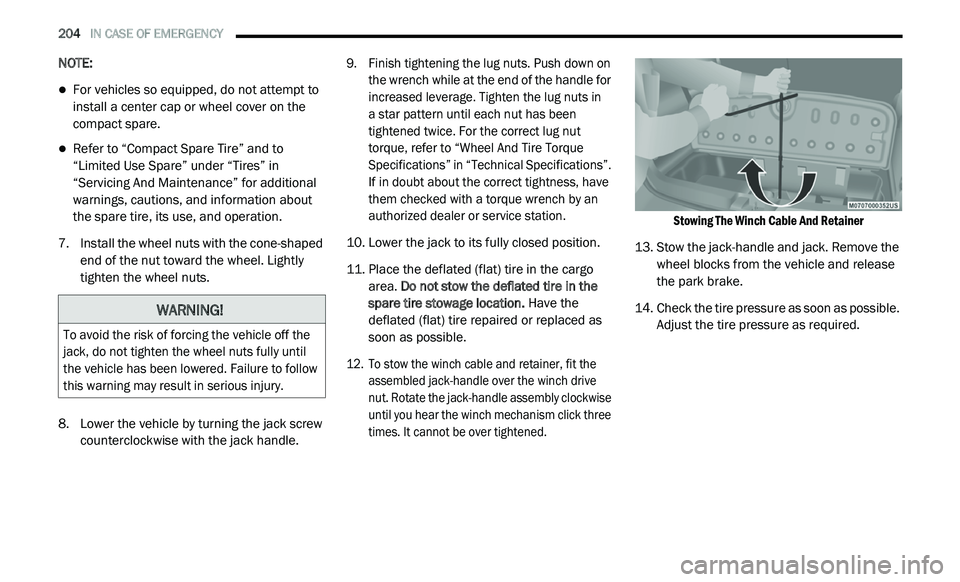
12. T o stow the winch cable and retainer, fit the
a
ssembled jack-handle over the winch drive
nut. Rotate the jack-handle assembly clockwise
until you hear the winch mechanism click three
times. It cannot be over tightened.
Stowing The Winch Cable And Retainer
13. S tow the jack-handle and jack. Remove the
w
heel blocks from the vehicle and release
the park brake.
14. C heck the tire pressure as soon as possible.
A
djust the tire pressure as required.WARNING!
To avoid the risk of forcing the vehicle off the
jack, do not tighten the wheel nuts fully until
the vehicle has been lowered. Failure to follow
this warning may result in serious injury.
Page 216 of 396
214 IN CASE OF EMERGENCY
Tow Eye Usage Precautions
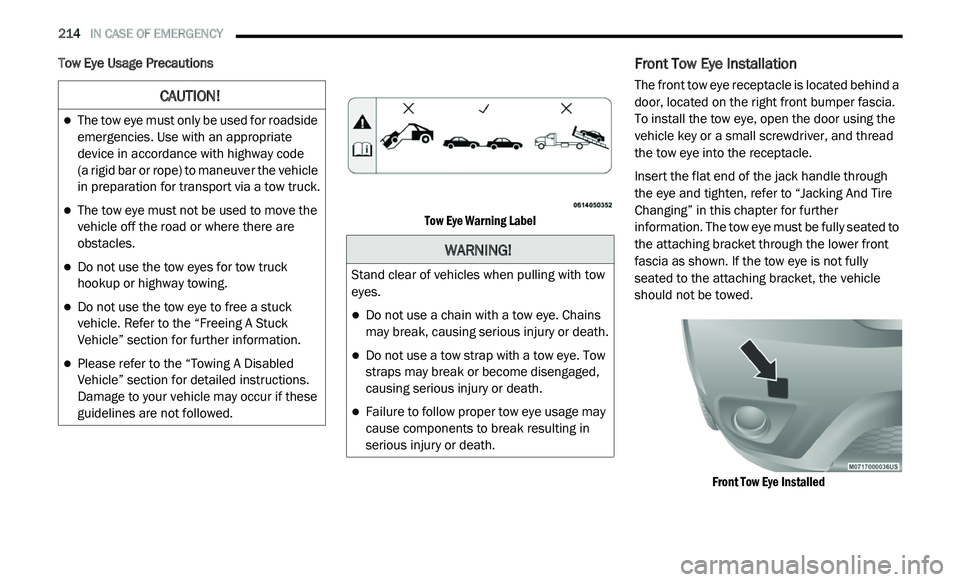
Tow Eye Warning Label
Front Tow Eye Installation
The front tow eye receptacle is located behind a
door, located on the right front bumper fascia.
To install the tow eye, open the door using the
vehicle key or a small screwdriver, and thread
the tow eye into the receptacle.
Insert the flat end of the jack handle through
th
e eye and tighten, refer to “Jacking And Tire
Changing” in this chapter for further
information. The tow eye must be fully seated to
the attaching bracket through the lower front
fascia as shown. If the tow eye is not fully
seated to the attaching bracket, the vehicle
should not be towed.
Front Tow Eye Installed
CAUTION!
The tow eye must only be used for roadside
emergencies. Use with an appropriate
device in accordance with highway code
(a rigid bar or rope) to maneuver the vehicle
i n
preparation for transport via a tow truck.
The tow eye must not be used to move the
vehicle off the road or where there are
obstacles.
Do not use the tow eyes for tow truck
hookup or highway towing.
Do not use the tow eye to free a stuck
vehicle. Refer to the “Freeing A Stuck
Vehicle” section for further information.
Please refer to the “Towing A Disabled
Vehicle” section for detailed instructions.
D a
mage to your vehicle may occur if these
guidelines are not followed.
WARNING!
Stand clear of vehicles when pulling with tow
eyes.
Do not use a chain with a tow eye. Chains
may break, causing serious injury or death.
Do not use a tow strap with a tow eye. Tow
straps may break or become disengaged,
causing serious injury or death.
Failure to follow proper tow eye usage may
cause components to break resulting in
serious injury or death.
Page 217 of 396
IN CASE OF EMERGENCY 215
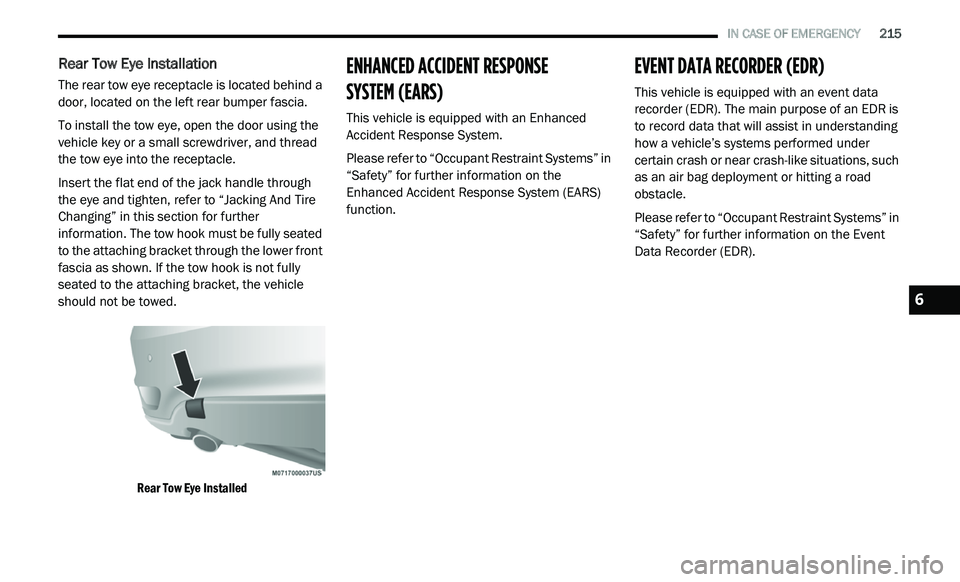
Rear Tow Eye Installation
The rear tow eye receptacle is located behind a
door, located on the left rear bumper fascia.
To install the tow eye, open the door using the
ve
hicle key or a small screwdriver, and thread
the tow eye into the receptacle.
Insert the flat end of the jack handle through
t h
e eye and tighten, refer to “Jacking And Tire
Changing” in this section for further
information. The tow hook must be fully seated
to the attaching bracket through the lower front
fascia as shown. If the tow hook is not fully
seated to the attaching bracket, the vehicle
should not be towed.
Rear Tow Eye Installed
ENHANCED ACCIDENT RESPONSE
SYSTEM (EARS)
This vehicle is equipped with an Enhanced
Accident Response System.
Please refer to “Occupant Restraint Systems” in
“ S
afety” for further information on the
Enhanced Accident Response System (EARS)
function.
EVENT DATA RECORDER (EDR)
This vehicle is equipped with an event data
recorder (EDR). The main purpose of an EDR is
to record data that will assist in understanding
how a vehicle’s systems performed under
certain crash or near crash-like situations, such
as an air bag deployment or hitting a road
obstacle.
Please refer to “Occupant Restraint Systems” in
“ S
afety” for further information on the Event
Data Recorder (EDR).
6
Page 239 of 396
SERVICING AND MAINTENANCE 237
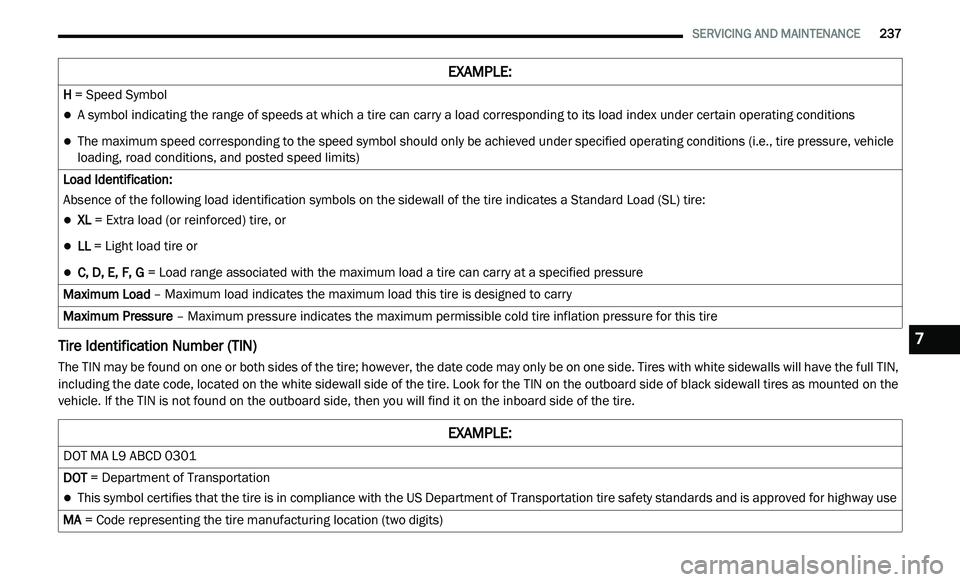
Tire Identification Number (TIN)
The TIN may be found on one or both sides of the tire; however, the date code may only be on one side. Tires with white sidewalls will have the full TIN,
including the date code, located on the white sidewall side of the tire. Look for the TIN on the outboard side of black sidewall tires as mounted on the
vehicle. If the TIN is not found on the outboard side, then you will find it on the inboard side of the tire.H = Speed Symbol
A symbol indicating the range of speeds at which a tire can carry a load corresponding to its load index under certain operating conditions
The maximum speed corresponding to the speed symbol should only be achieved under specified operating conditions (i.e., tire pressure, vehicle
loading, road conditions, and posted speed limits)
Load Identification:
Absence of the following load identification symbols on the sidewall of the tire indicates a Standard Load (SL) tire:
XL = Extra load (or reinforced) tire, or
LL = Light load tire or
C, D, E, F, G = Load range associated with the maximum load a tire can carry at a specified pressure
Maximum Load –
Maximum load indicates the maximum load this tire is designed to carry
Maximum Pressure –
Maximum pressure indicates the maximum permissible cold tire inflation pressure for this tire
EXAMPLE:
DOT MA L9 ABCD 0301
DOT = Department of Transportation
This symbol certifies that the tire is in compliance with the US Department of Transportation tire safety standards and is approved for highway use
MA = Code representing the tire manufacturing location (two digits)
EXAMPLE:
7
Page 240 of 396
238 SERVICING AND MAINTENANCE
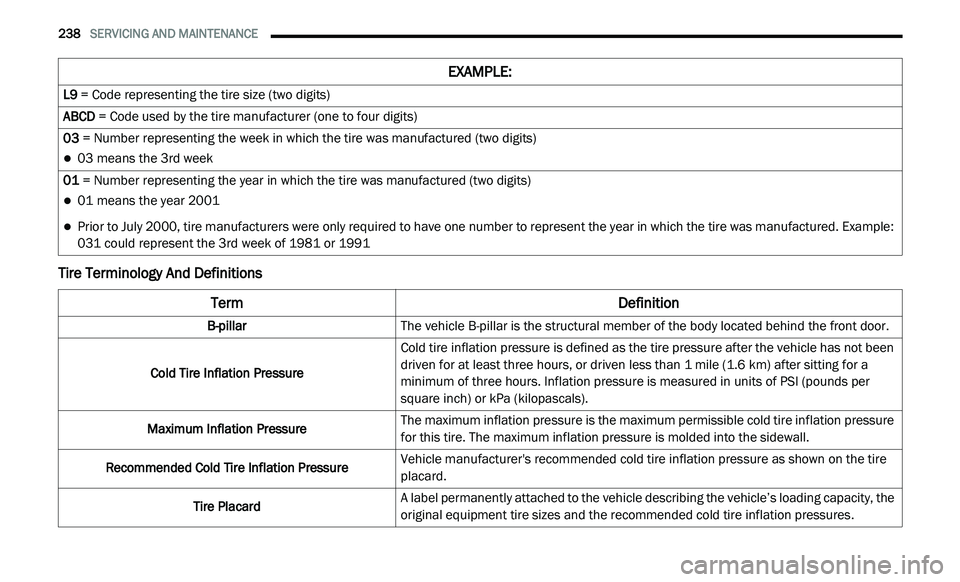
Tire Terminology And Definitions
L9 = Code representing the tire size (two digits)
ABCD = Code used by the tire manufacturer (one to four digits)
0
3 = Number representing the week in which the tire was manufactured (two digits)
03 means the 3rd week
01 = Number representing the year in which the tire was manufactured (two digits)
01 means the year 2001
Prior to July 2000, tire manufacturers were only required to have one number to represent the year in which the tire was manufactured. Example:
031 could represent the 3rd week of 1981 or 1991
Term Definition
B-pillarThe vehicle B-pillar is the structural member of the body located behind the front door.
Cold Tire Inflation Pressure Cold tire inflation pressure is defined as the tire pressure after the vehicle has not been
d
r
iven for at least three hours, or driven less than 1 mile (1.6 km) after sitting for a
m i
nimum of three hours. Inflation pressure is measured in units of PSI (pounds per
square inch) or kPa (kilopascals).
Maximum Inflation Pressure The maximum inflation pressure is the maximum permissible cold tire inflation pressure
f
o
r this tire. The maximum inflation pressure is molded into the sidewall.
Recommended Cold Tire Inflation Pressure Vehicle manufacturer's recommended cold tire inflation pressure as shown on the tire
p
l
acard.
Tire Placard A label permanently attached to the vehicle describing the vehicle’s loading capacity, the
o
r
iginal equipment tire sizes and the recommended cold tire inflation pressures.
EXAMPLE:
Page 241 of 396
SERVICING AND MAINTENANCE 239
Tire Loading And Tire Pressure
NOTE:
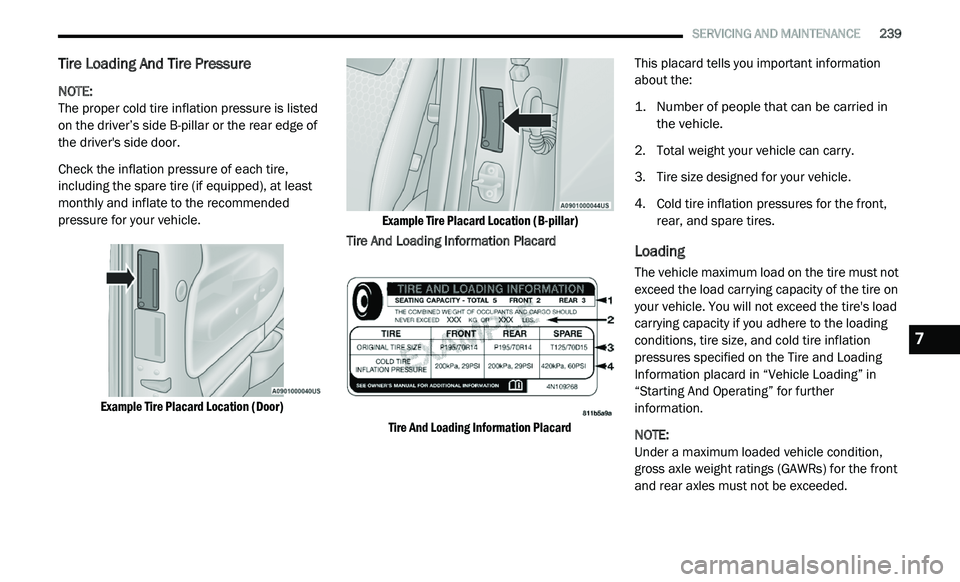
The proper cold tire inflation pressure is listed
o n
the driver’s side B-pillar or the rear edge of
the driver's side door.
Check the inflation pressure of each tire,
i n
cluding the spare tire (if equipped), at least
monthly and inflate to the recommended
pressure for your vehicle.
Example Tire Placard Location (Door) Example Tire Placard Location (B-pillar)
Tire And Loading Information Placard
Tire And Loading Information Placard
This placard tells you important information
a
b
out the:
1. N umber of people that can be carried in
t
he vehicle.
2. T otal weight your vehicle can carry.
3
. T ire size designed for your vehicle.
4
. C old tire inflation pressures for the front,
r
ear, and spare tires.
Loading
The vehicle maximum load on the tire must not
exceed the load carrying capacity of the tire on
your vehicle. You will not exceed the tire's load
carrying capacity if you adhere to the loading
conditions, tire size, and cold tire inflation
pressures specified on the Tire and Loading
Information placard in “Vehicle Loading” in
“Starting And Operating” for further
information.
NOTE:
Under a maximum loaded vehicle condition,
g r
oss axle weight ratings (GAWRs) for the front
and rear axles must not be exceeded.
7
Page 244 of 396
242 SERVICING AND MAINTENANCE
TIRES — GENERAL INFORMATION
Tire Pressure
Proper tire inflation pressure is essential to the
safe and satisfactory operation of your vehicle.
Four primary areas are affected by improper tire
pressure:
Safety
Fuel Economy
Tread Wear
Ride Comfort and Vehicle Stability Safety
Both underinflation and overinflation affect the
st
ability of the vehicle and can produce a feeling
of sluggish response or over responsiveness in
the steering.
NOTE:
Unequal tire pressures from side to side may
cause erratic and unpredictable steering
response.
Unequal tire pressure from side to side may
cause the vehicle to drift left or right.
Fuel Economy
Underinflated tires will increase tire rolling
r e
sistance resulting in higher fuel consumption.
Tread Wear
Improper cold tire inflation pressures can cause
ab
normal wear patterns and reduced tread life,
resulting in the need for earlier tire replacement.
Ride Comfort And Vehicle Stability
Proper tire inflation contributes to a
c o
mfortable ride. Overinflation produces a
jarring and uncomfortable ride.
WARNING!
Overloading of your tires is dangerous.
Overloading can cause tire failure, affect
vehicle handling, and increase your stopping
distance. Use tires of the recommended load
capacity for your vehicle. Never overload them.
WARNING!
Improperly inflated tires are dangerous and
can cause collisions.
Underinflation increases tire flexing and
can result in overheating and tire failure.
Overinflation reduces a tire's ability to
cushion shock. Objects on the road and
chuckholes can cause damage that result
in tire failure.
Overinflated or underinflated tires can
affect vehicle handling and can fail
suddenly, resulting in loss of vehicle
control.
Unequal tire pressures can cause steering
problems. You could lose control of your
vehicle.
Unequal tire pressures from one side of the
vehicle to the other can cause the vehicle
to drift to the right or left.
Always drive with each tire inflated to the
recommended cold tire inflation pressure.
Page 245 of 396
SERVICING AND MAINTENANCE 243
Tire Inflation Pressures
The proper cold tire inflation pressure is listed
on the driver's side B-pillar or rear edge of the
driver's side door.
At least once a month:
Check and adjust tire pressure with a good
quality pocket-type pressure gauge. Do not
make a visual judgement when determining
proper inflation. Tires may look properly
inflated even when they are under-inflated.
Inspect tires for signs of tire wear or visible
damage.
Inflation pressures specified on the placard are
a l
ways “cold tire inflation pressure”. Cold tire
inflation pressure is defined as the tire pressure
after the vehicle has not been driven for at least
three hours, or driven less than 1 mile (1.6 km)
a f
ter sitting for a minimum of three hours. The
cold tire inflation pressure must not exceed the maximum inflation pressure molded into the
tire sidewall.
Check tire pressures more often if subject to a
w
i
de range of outdoor temperatures, as tire
pressures vary with temperature changes.
Tire pressures change by approximately 1 psi
(7 kPa) per 12°F (7°C) of air temperature
c h
ange. Keep this in mind when checking tire
pressure inside a garage, especially in the
Winter.
Example: If garage temperature = 68°F (20°C)
a n
d the outside temperature = 32°F (0°C) then
the cold tire inflation pressure should be
increased by 3 psi (21 kPa), which equals 1 psi
(7 kPa) for every 12°F (7°C) for this outside
temperature condition.
Tire pressure may increase from 2 to 6 psi
(13 to 40 kPa) during operation. DO NOT reduce
t h
is normal pressure build up or your tire
pressure will be too low.
Tire Pressures For High Speed Operation
The manufacturer advocates driving at safe
speeds and within posted speed limits. Where
speed limits or conditions are such that the
vehicle can be driven at high speeds, maintaining
correct tire inflation pressure is very important. Increased tire pressure and reduced vehicle
loading may be required for high-speed vehicle
operation. Refer to an authorized tire dealer
or original equipment vehicle dealer for
r e
commended safe operating speeds, loading
and cold tire inflation pressures.
Radial Ply Tires
CAUTION!
After inspecting or adjusting the tire pressure,
always reinstall the valve stem cap. This will
prevent moisture and dirt from entering the valve
stem, which could damage the valve stem.
WARNING!
High speed driving with your vehicle under
maximum load is dangerous. The added
strain on your tires could cause them to fail.
You could have a serious collision. Do not
drive a vehicle loaded to the maximum
capacity at continuous speeds above 75
mph
( 1
20 km/h).
WARNING!
Combining radial ply tires with other types of
tires on your vehicle will cause your vehicle to
handle poorly. The instability could cause a
collision. Always use radial ply tires in sets of
four. Never combine them with other types of
tires.
7