lock DODGE MONACO 1965 1.G User Guide
[x] Cancel search | Manufacturer: DODGE, Model Year: 1965, Model line: MONACO, Model: DODGE MONACO 1965 1.GPages: 46, PDF Size: 8.12 MB
Page 33 of 46
28
TATION WAG N
AN
JACK TORA PARE
WHEEL
E
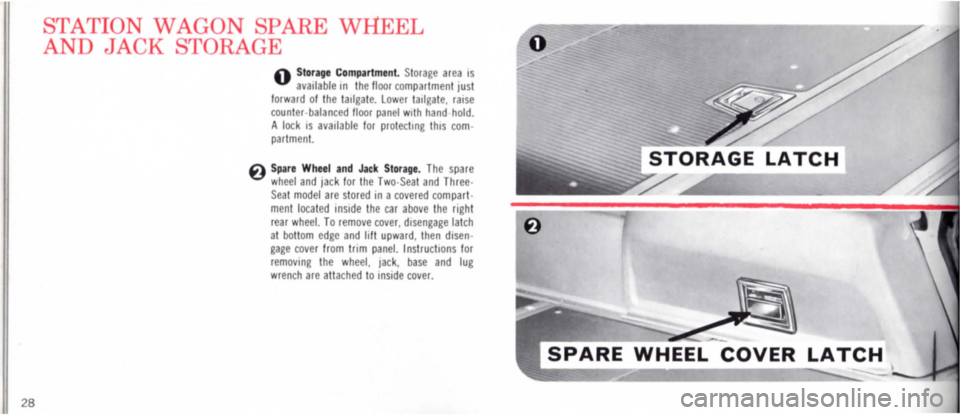
o Storage Compartment. Storage area IS available In the floor compartment lust forward of the tailgate. lower tailgate, raise counter· balanced floor panel with hand hold.
A lock IS available for protectrng this com· partment.
E) Spare Wheel and Jack Storage. The spare wheel and Jack for the Two·Seat and Three· Seat model are stored rn a covered compart· ment located Inside the car above the light rear wheel. To remove cover, disengage latch at bottom edge and hft upward, then dlsen· gage cover from tllm panel. Instructrons for removing the wheel, Jack, base and lug wrench are attached to inside cover.
SPARE WHEEL COVER LATCH
Page 34 of 46
CONVERTmLE TOP . . . OPERATION
AND MAINTENANCE
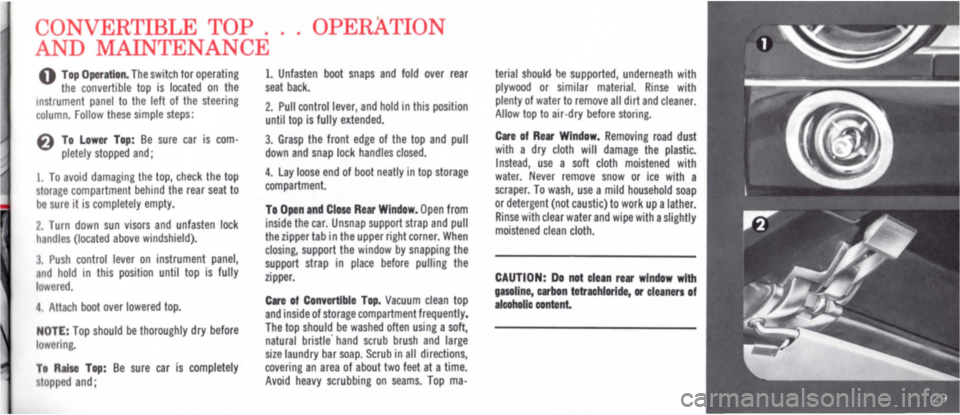
o Top Operation. The switch lor operating the convertible top is located on the Instrument panel to the left of the steering column. Follow these simple steps:
6 To Lower Top: Be sure car is com· pletely stopped and;
1. To avoid damaging the top, check the top storage compartment behind the rear seat to be sure it is completely empty.
2. Turn down sun visors and unfasten lock handles (located above windshield).
3. Push control lever on instrument panel, nd hold in this position until top is fully lowered.
4 .
Attach boot over lowered top.
NOTE: Top should be thoroughly dry before lowering.
To R.lse Top: Be sure car is completely topped and;
1. Unfasten boot snaps and fold over rear seat back.
2. Pull control lever, and hold in this position until top is fully extended.
3. Grasp the front edge of the top and pull down and snap lock handles closed.
4. Lay loose end of boot neatly in top storage compartment.
To Open and Close Rear Window. Open from inside the car. Unsnap support strap and pull the zipper tab in the upper right corner. When closing, support the window by snapping the support strap in place before pulling the zipper.
Care of Convertible Top. Vacuum clean top and inside of storage compartment frequently. The top should be washed otten using a soft, natural bristle' hand scrub brush and large size laundry bar soap. Scrub in all directions, covering an area of about two feet at a time. Avoid heavy scrubbing on seams. Top mao
terial should be supported, underneath with plywood or similar material. Rinse with plenty of water to remove all dirt and cleaner. Allow top to air-dry before storing.
Care of Rear Window. Removing road dust with a dry cloth will damage the plastic. Instead, use a soft cloth moistened with water. Never remove snow or ice with a scraper. To wash, use a mild household soap or detergent (not caustic) to work up a lather. Rinse with clear water and wipe with a slightly moistened clean cloth.
CAUTION: Do not clean rear window with gasoline, carbon tetrachloride, or cleaners of lcoholic content.
Page 36 of 46
THE SAFE WAY TO CHANGE A WHEEL
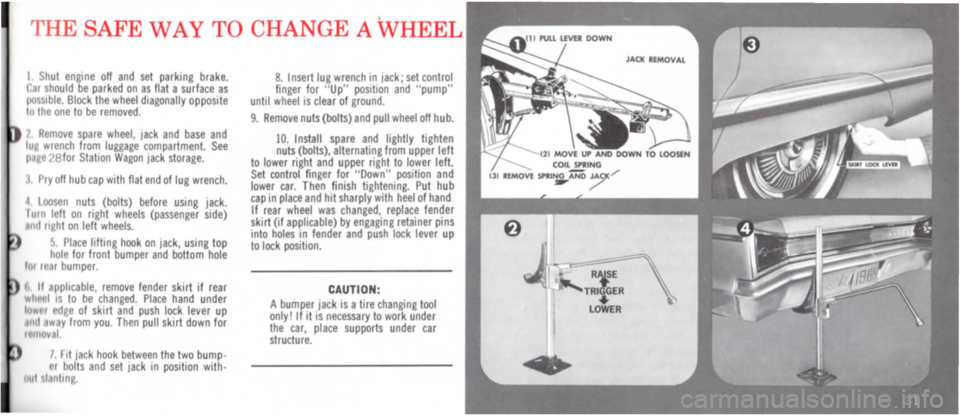
I Shut engine off and set parking brake. C. r should be parked on as flat a surface as possible. Block the wheel diagonally opposite to the one to be removed.
7 R move spare wheel. lack and base and IUR wrench from luggage compartment. See II lie ;>8for StatIOn Wagon lack storage.
Pry off hub cap With flat end of lug wrench.
" Loosen nuts (bolts) before uSing lack. I urn left on right wheels (passenger side) nd ueht on left wheels.
5. Place lifting hook on lack, uSing top hole for front bumper and bottom hole till r ,r bumper.
! II applicable, remove fender skirt If rear ",II I IS to be changed. Place hand under 111"'1'1 dge of skirt and push lock lever up 1111 way from you. Then pull skirt down for I IIIOV I.
I r I t lack hook between the two bumpr bolts and set lack In position withlui I nling.
8. I nsert lug wrench In lack; set control finger for "Up" posllion and "pump" until wheelis clear of ground.
9 . Remove nuts (bolts) and pull wheel off hub.
10. Install spare and lightly tighten nuts (bolts), alternating from upper left to lower right and upper right to lower left . Set control finger for "Down" position and lower car. Then finish tightening. Put hub cap in place and hit sharply with heel of hand If rear wheel was changed, replace fender skirt (if applicable) by engaging retainer pins into holes in fender and push lock lever up to lock poslhon.
CAUTION: A bumper jack is a tire changing tool only! If It IS necessary to work under the car, place supports under car structure.
Page 40 of 46
(CONTINUlU)
CAUTION: To prevent possible wiring damage, certain precautions should be observed: It IS essential when replacing the cables on the battery, or when uSing a "booster" battery, thai the positive cable IS attached to the positive post and the negative cable IS attached to Ihe negative post. The negative cable IS attached to the engine block. Battery posts are marked plus (+ ) and minus (-). Also, If a "fast charger" is used while battery IS in car, disconnect both car battery cables before connecting the charger to battery. Do not use a "fast charger" to provide starting voltage.
which requires the following service attention. Two types are used -one has a wrapper on the carburetor air cleaner, and other does not. With Wrapper: Do the following every 6 months-inspect venhlator valve operation, clean filler cap, InSpect and clean air cleaner element and wash outer wrapper In kerosene and shake or blot dry. Every year-replace ventilator valve. Every two years-replace air cleaner element and wrapper. Without Wrapper: Do the follOWing at each change of engine Oil-inspect ventilator valve operation, Inspect and clean air cleaner element. Every year-replace ventilator valve and replace air cleaner element. More frequent servicing Crankcase Ventilation System. The engine in may be required if the car IS used for short. your car was equipped at the factory with a trip driving and prolonged engine idling. posItive ventilating system to reduce the emission of harmful fumes into the at mos· Ant/·Freele. So that your cooling system Will phere. Periodic and proper inspection and operate without freezing and Without over· cleaning of thiS valve is essential for good heating due to rust formation, the following engine performance and durability. Valve procedures should be observed. operation should be checked every 6 months O . . . by your Dealer, and more frequently if car IS Fall. Open ~adlator dralncock and remo~e used for short-trip driVing and prolonged threaded drain plugs In engine block to drain engine idling. Replace valve once a year. cooling system. Mov~ heat~r selector lever to ''HI'' or "Heat" position (If so eqUipped) to A special crankcase ventilation system is permit draining the heater lines. Thoroughly used on cars built for the state of California flush cooling system with clear water, then
36
close radiator draincock and replace engine block drain plugs. Install MoPar Anti·Freeze (or other high-quality equivalent) to assure cooling system protection for the lowest anticipated temperature in the area where vehicle IS operated dUring the winter months. The cooling system should contain a minimum of 400:, anll-freeze for proper corrosion protection. I n geographiC areas where anli· freeze protecllon IS not necessary, after flushing, fill with clear water and add MoPar Rust ReSistor (or other hlgh·quality co~rosion inhibitor) to prevent the formation of rust deposits. This service IS reqUired annually.
It the vehicle was placed into service after January I , 1965, the first required Fall cooling system service may be eliminated. With the approach of cool weather, however, it IS very important to test the coolant for adequate anti-freeze protection and InSpect the system for eVidence of rust or leaks.
Only glycols and synthetic alcohol (Methanol) are acceptable bases for automobile antifreeze. Solutions containing salts, sugar, honey, glucose, mineral oils, kerosene or similar material should never be used in the cooling system.
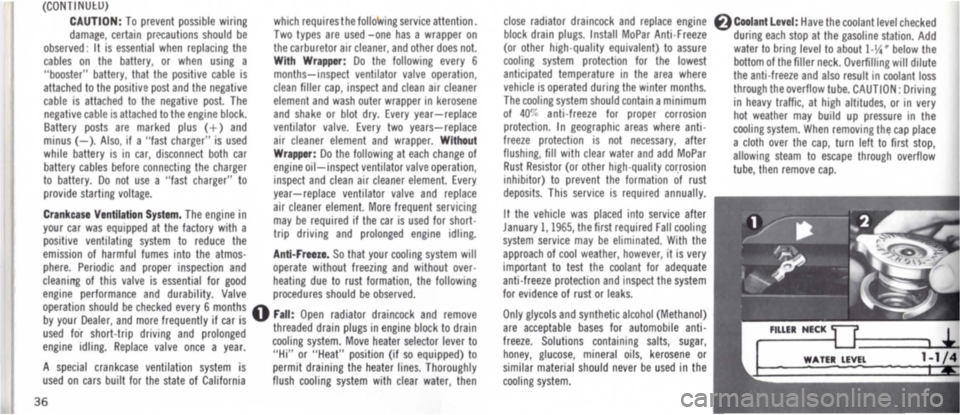
@Coolant Level: Have the coolant level checked during each stop at the gasoline station. Add water to bring level to about I-~' below the bottom of the filler neck. Overfilling Will dilute the anti-freeze and also result In coolant loss through the overflow tube. CAUTION: DriVing in heavy traffic, at high altitudes, or In very hot weather may build up pressure in the cooling system. When removing the cap place a cloth over the cap, turn left to first stop, allowing steam to escape through overflow tube, then remove cap.