coolant temperature DODGE NEON 2000 Service User Guide
[x] Cancel search | Manufacturer: DODGE, Model Year: 2000, Model line: NEON, Model: DODGE NEON 2000Pages: 1285, PDF Size: 29.42 MB
Page 191 of 1285
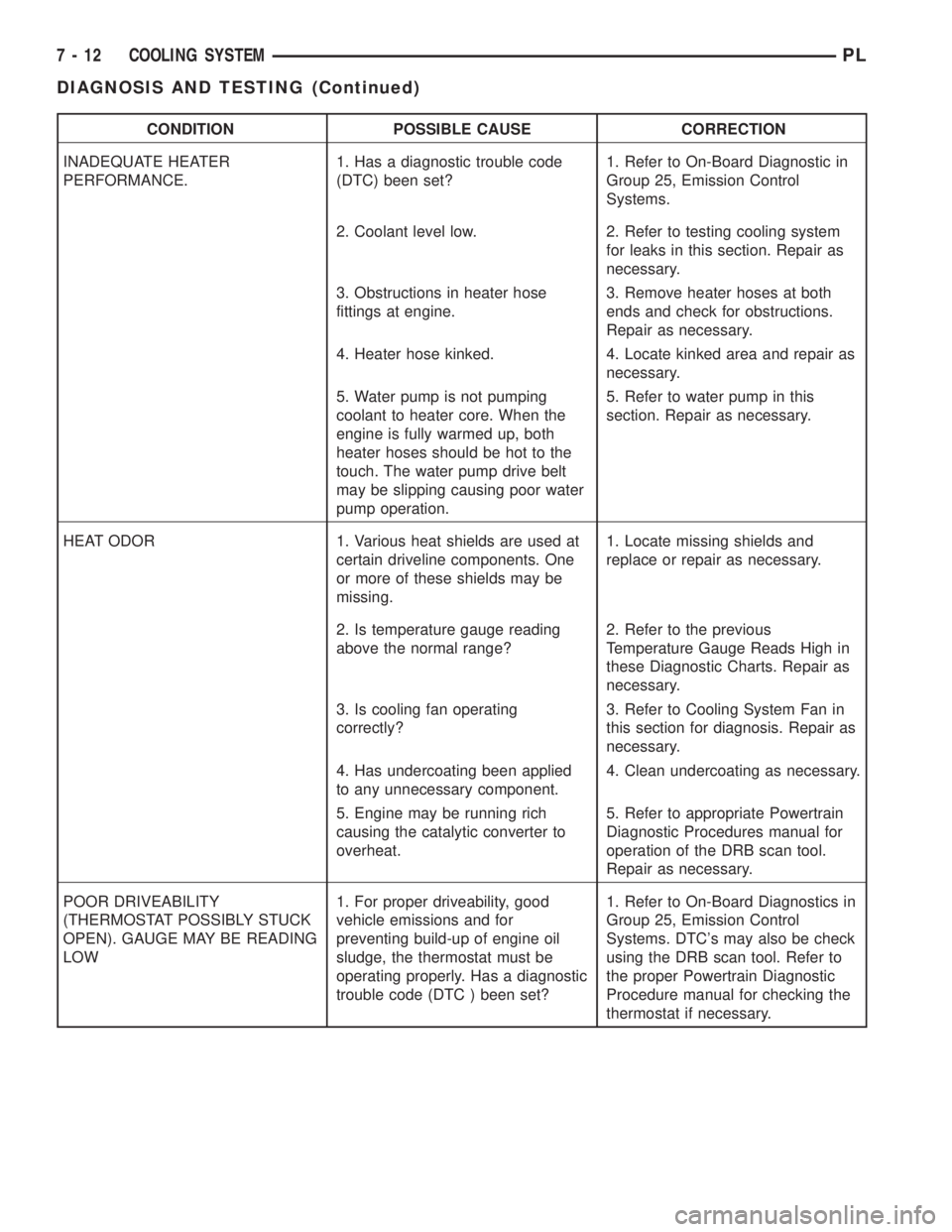
CONDITION POSSIBLE CAUSE CORRECTION
INADEQUATE HEATER
PERFORMANCE.1. Has a diagnostic trouble code
(DTC) been set?1. Refer to On-Board Diagnostic in
Group 25, Emission Control
Systems.
2. Coolant level low. 2. Refer to testing cooling system
for leaks in this section. Repair as
necessary.
3. Obstructions in heater hose
fittings at engine.3. Remove heater hoses at both
ends and check for obstructions.
Repair as necessary.
4. Heater hose kinked. 4. Locate kinked area and repair as
necessary.
5. Water pump is not pumping
coolant to heater core. When the
engine is fully warmed up, both
heater hoses should be hot to the
touch. The water pump drive belt
may be slipping causing poor water
pump operation.5. Refer to water pump in this
section. Repair as necessary.
HEAT ODOR 1. Various heat shields are used at
certain driveline components. One
or more of these shields may be
missing.1. Locate missing shields and
replace or repair as necessary.
2. Is temperature gauge reading
above the normal range?2. Refer to the previous
Temperature Gauge Reads High in
these Diagnostic Charts. Repair as
necessary.
3. Is cooling fan operating
correctly?3. Refer to Cooling System Fan in
this section for diagnosis. Repair as
necessary.
4. Has undercoating been applied
to any unnecessary component.4. Clean undercoating as necessary.
5. Engine may be running rich
causing the catalytic converter to
overheat.5. Refer to appropriate Powertrain
Diagnostic Procedures manual for
operation of the DRB scan tool.
Repair as necessary.
POOR DRIVEABILITY
(THERMOSTAT POSSIBLY STUCK
OPEN). GAUGE MAY BE READING
LOW1. For proper driveability, good
vehicle emissions and for
preventing build-up of engine oil
sludge, the thermostat must be
operating properly. Has a diagnostic
trouble code (DTC ) been set?1. Refer to On-Board Diagnostics in
Group 25, Emission Control
Systems. DTC's may also be check
using the DRB scan tool. Refer to
the proper Powertrain Diagnostic
Procedure manual for checking the
thermostat if necessary.
7 - 12 COOLING SYSTEMPL
DIAGNOSIS AND TESTING (Continued)
Page 192 of 1285
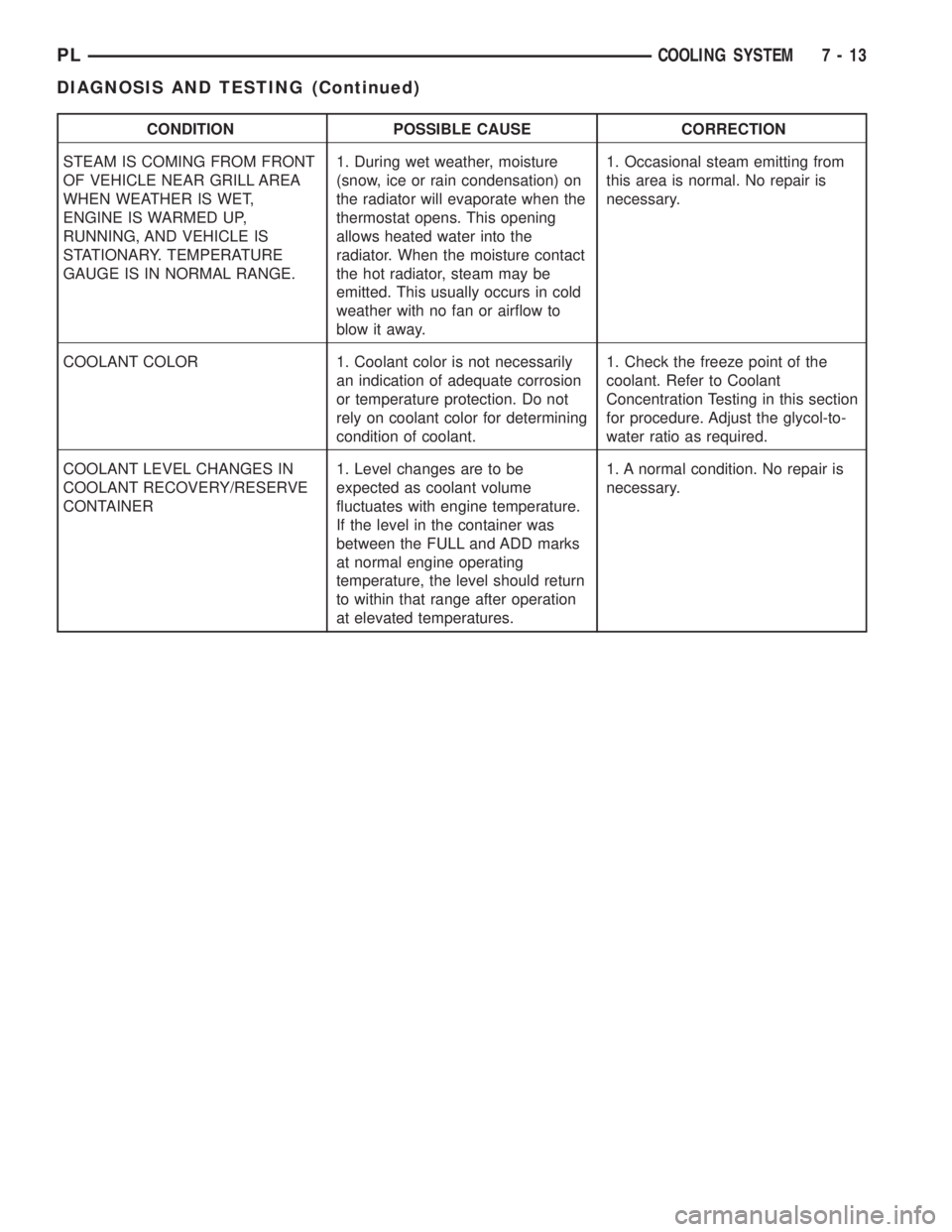
CONDITION POSSIBLE CAUSE CORRECTION
STEAM IS COMING FROM FRONT
OF VEHICLE NEAR GRILL AREA
WHEN WEATHER IS WET,
ENGINE IS WARMED UP,
RUNNING, AND VEHICLE IS
STATIONARY. TEMPERATURE
GAUGE IS IN NORMAL RANGE.1. During wet weather, moisture
(snow, ice or rain condensation) on
the radiator will evaporate when the
thermostat opens. This opening
allows heated water into the
radiator. When the moisture contact
the hot radiator, steam may be
emitted. This usually occurs in cold
weather with no fan or airflow to
blow it away.1. Occasional steam emitting from
this area is normal. No repair is
necessary.
COOLANT COLOR 1. Coolant color is not necessarily
an indication of adequate corrosion
or temperature protection. Do not
rely on coolant color for determining
condition of coolant.1. Check the freeze point of the
coolant. Refer to Coolant
Concentration Testing in this section
for procedure. Adjust the glycol-to-
water ratio as required.
COOLANT LEVEL CHANGES IN
COOLANT RECOVERY/RESERVE
CONTAINER1. Level changes are to be
expected as coolant volume
fluctuates with engine temperature.
If the level in the container was
between the FULL and ADD marks
at normal engine operating
temperature, the level should return
to within that range after operation
at elevated temperatures.1. A normal condition. No repair is
necessary.
PLCOOLING SYSTEM 7 - 13
DIAGNOSIS AND TESTING (Continued)
Page 193 of 1285
ENGINE THERMOSTAT TESTING
The thermostat is operated by a wax filled con-
tainer (pellet) which is sealed. When heated coolant
reaches a predetermined temperature the wax pellet
expands enough to overcome the closing spring and
water pump pressure, which forces the valve to open.
Coolant leakage into the pellet will cause a thermo-
stat to fail open. Do not attempt to free up a thermo-
stat with a screwdriver.
The thermostat that opens too soon type failure
mode is included in the on-board diagnosis. Thecheck engine light will not be lit by an open too soon
condition. If it has failed open, a diagnostic trouble
code (DTC) will be set. Do not change a thermostat
for lack of heater performance or temperature gauge
position, unless a DTC is present. See Diagnosis for
other probable causes. Thermostat failing shut is the
normal long term mode of failure, and normally, only
on high mileage vehicles. The temperature gauge will
indicate this. Refer to Diagnosis in this section.
ACCESSORY DRIVE BELT DIAGNOSIS
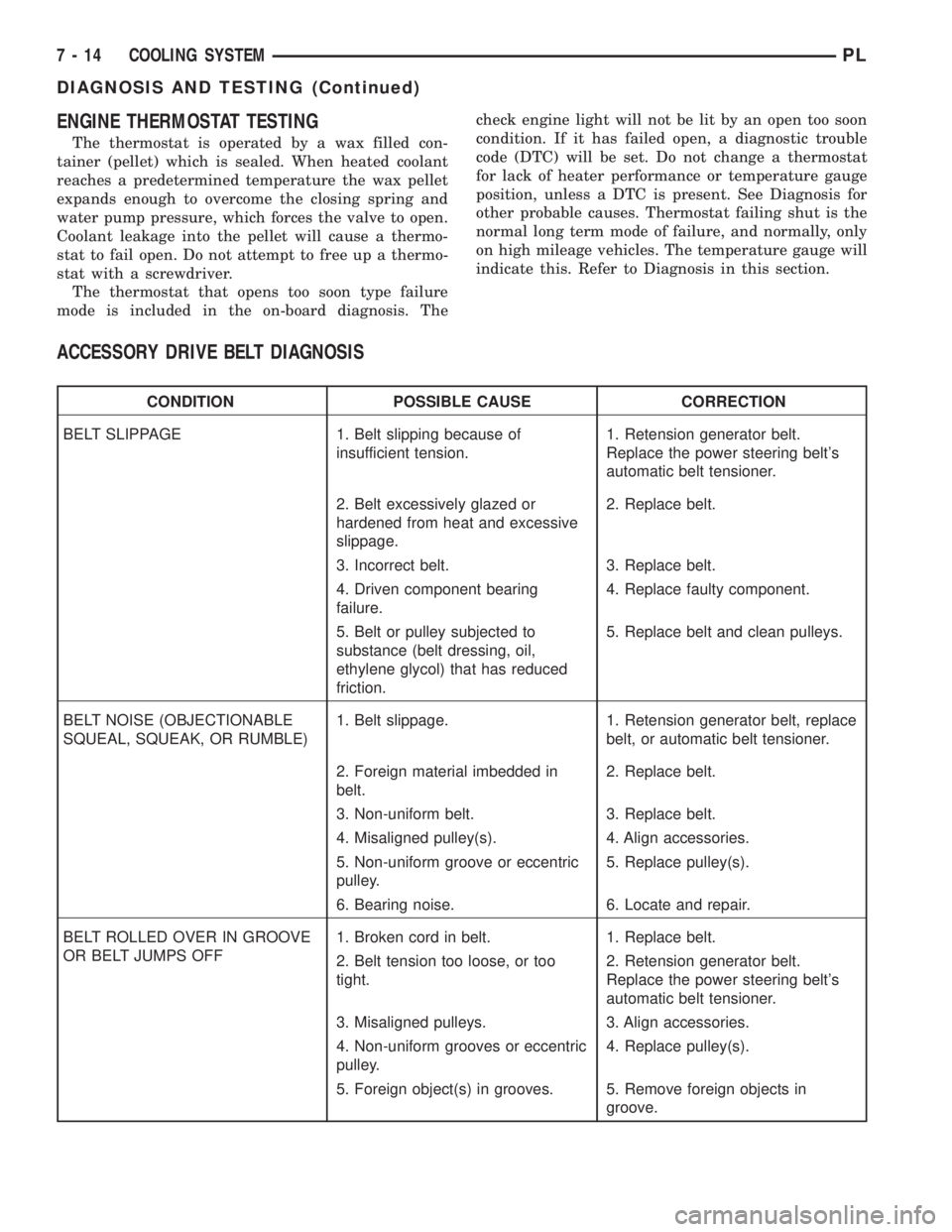
CONDITION POSSIBLE CAUSE CORRECTION
BELT SLIPPAGE 1. Belt slipping because of
insufficient tension.1. Retension generator belt.
Replace the power steering belt's
automatic belt tensioner.
2. Belt excessively glazed or
hardened from heat and excessive
slippage.2. Replace belt.
3. Incorrect belt. 3. Replace belt.
4. Driven component bearing
failure.4. Replace faulty component.
5. Belt or pulley subjected to
substance (belt dressing, oil,
ethylene glycol) that has reduced
friction.5. Replace belt and clean pulleys.
BELT NOISE (OBJECTIONABLE
SQUEAL, SQUEAK, OR RUMBLE)1. Belt slippage. 1. Retension generator belt, replace
belt, or automatic belt tensioner.
2. Foreign material imbedded in
belt.2. Replace belt.
3. Non-uniform belt. 3. Replace belt.
4. Misaligned pulley(s). 4. Align accessories.
5. Non-uniform groove or eccentric
pulley.5. Replace pulley(s).
6. Bearing noise. 6. Locate and repair.
BELT ROLLED OVER IN GROOVE
OR BELT JUMPS OFF1. Broken cord in belt. 1. Replace belt.
2. Belt tension too loose, or too
tight.2. Retension generator belt.
Replace the power steering belt's
automatic belt tensioner.
3. Misaligned pulleys. 3. Align accessories.
4. Non-uniform grooves or eccentric
pulley.4. Replace pulley(s).
5. Foreign object(s) in grooves. 5. Remove foreign objects in
groove.
7 - 14 COOLING SYSTEMPL
DIAGNOSIS AND TESTING (Continued)
Page 194 of 1285
WATER PUMP DIAGNOSIS
A quick flow test to tell whether or not the pump is
working is to see if the heater warms properly. A
defective pump will not be able to circulate heated
coolant through the long heater hose.
Another flow test to help determine pump opera-
tion:
WARNING: DO NOT remove radiator cap if the cool-
ing system is hot or under pressure.
(1) Remove cooling system pressure cap.
(2) Remove a small amount of coolant from the
system.
(3) Start the engine and warm up until thermostat
opens.
(4) With the thermostat open and coolant level low,
visually inspect for coolant flow. If flow is present,
the water pump is pumping coolant through the sys-
tem.
COOLING SYSTEM FLOW CHECK
To determine whether coolant is flowing through
the cooling system, use the following procedures:
(1) If engine is cold, idle engine until normal oper-
ating temperature is reached. Then feel the upper
radiator hose. If it is hot, coolant is circulating.
WARNING: DO NOT REMOVE THE COOLING SYS-
TEM PRESSURE CAP WITH THE SYSTEM HOT AND
UNDER PRESSURE BECAUSE SERIOUS BURNS
FROM COOLANT CAN OCCUR.
(2) Remove pressure cap when engine is cold,
remove small amount of coolant Idle engine until
thermostat opens, you should observe coolant flow
while looking down the filler neck. Once flow is
detected install the pressure cap.
ELECTRIC FAN MOTOR TEST
Refer to Powertrain Diagnostic Manual for proce-
dure.
COOLANT CONCENTRATION TESTING
Coolant concentration should be checked when any
additional coolant was added to system or after a
coolant drain, flush and refill. The coolant mixture
offers optimum engine cooling and protection against
corrosion when mixed to a freeze point of -37ÉC
(-34ÉF) to -59ÉC (-50ÉF). The use of a hydrometer or a
refractometer can be used to test coolant concentra-
tion.
A hydrometer will test the amount of glycol in a
mixture by measuring the specific gravity of the mix-
ture. The higher the concentration of ethylene glycol,
the larger the number of balls that will float, andhigher the freeze protection (up to a maximum of
70% by volume glycol).
A refractometer will test the amount of glycol in a
coolant mixture by measuring the amount a beam of
light bends as it passes through the fluid.
Some coolant manufactures use other types of gly-
cols into their coolant formulations. Propylene glycol
is the most common new coolant. However, propylene
glycol based coolants do not provide the same freez-
ing protection and corrosion protection and is only
recommended for limited usage. Refer to appropriate
Technical Service Bulletin(s) regarding use of propy-
lene glycol based coolants.
CAUTION: Do not mix types of coolantÐcorrosion
protection will be severely reduced.
Because ethylene glycol and propylene glycol do
not have the same specific gravities, the use of a
hydrometer will be inaccurate. Therefore, Special
Tool 8286 refractometer, is recommended when test-
ing either ethylene or propylene glycol coolants.
TESTING COOLING SYSTEM FOR LEAKS
The system should be full. With the engine not
running, wipe the filler neck sealing seat clean.
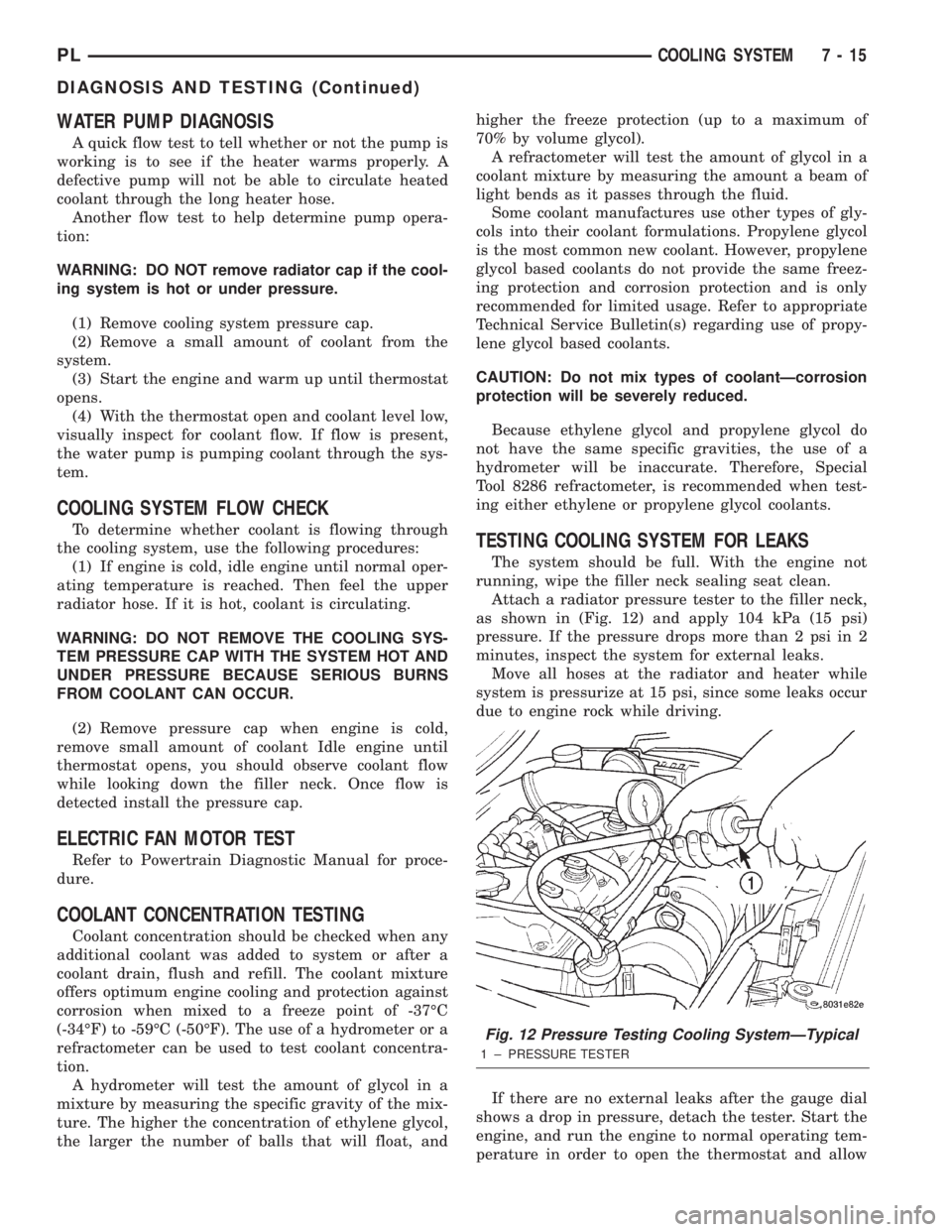
Attach a radiator pressure tester to the filler neck,
as shown in (Fig. 12) and apply 104 kPa (15 psi)
pressure. If the pressure drops more than 2 psi in 2
minutes, inspect the system for external leaks.
Move all hoses at the radiator and heater while
system is pressurize at 15 psi, since some leaks occur
due to engine rock while driving.
If there are no external leaks after the gauge dial
shows a drop in pressure, detach the tester. Start the
engine, and run the engine to normal operating tem-
perature in order to open the thermostat and allow
Fig. 12 Pressure Testing Cooling SystemÐTypical
1 ± PRESSURE TESTER
PLCOOLING SYSTEM 7 - 15
DIAGNOSIS AND TESTING (Continued)
Page 196 of 1285
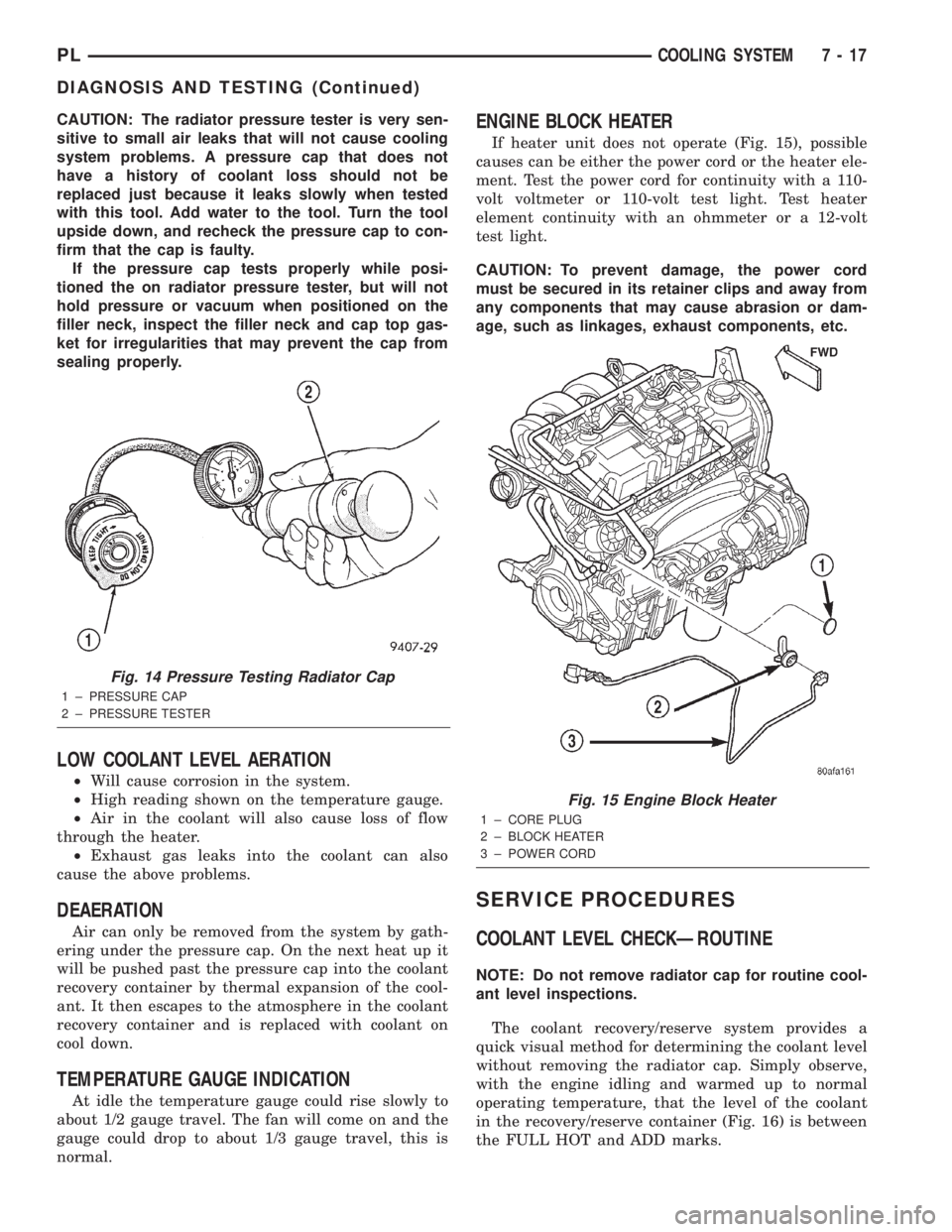
CAUTION: The radiator pressure tester is very sen-
sitive to small air leaks that will not cause cooling
system problems. A pressure cap that does not
have a history of coolant loss should not be
replaced just because it leaks slowly when tested
with this tool. Add water to the tool. Turn the tool
upside down, and recheck the pressure cap to con-
firm that the cap is faulty.
If the pressure cap tests properly while posi-
tioned the on radiator pressure tester, but will not
hold pressure or vacuum when positioned on the
filler neck, inspect the filler neck and cap top gas-
ket for irregularities that may prevent the cap from
sealing properly.
LOW COOLANT LEVEL AERATION
²Will cause corrosion in the system.
²High reading shown on the temperature gauge.
²Air in the coolant will also cause loss of flow
through the heater.
²Exhaust gas leaks into the coolant can also
cause the above problems.
DEAERATION
Air can only be removed from the system by gath-
ering under the pressure cap. On the next heat up it
will be pushed past the pressure cap into the coolant
recovery container by thermal expansion of the cool-
ant. It then escapes to the atmosphere in the coolant
recovery container and is replaced with coolant on
cool down.
TEMPERATURE GAUGE INDICATION
At idle the temperature gauge could rise slowly to
about 1/2 gauge travel. The fan will come on and the
gauge could drop to about 1/3 gauge travel, this is
normal.
ENGINE BLOCK HEATER
If heater unit does not operate (Fig. 15), possible
causes can be either the power cord or the heater ele-
ment. Test the power cord for continuity with a 110-
volt voltmeter or 110-volt test light. Test heater
element continuity with an ohmmeter or a 12-volt
test light.
CAUTION: To prevent damage, the power cord
must be secured in its retainer clips and away from
any components that may cause abrasion or dam-
age, such as linkages, exhaust components, etc.
SERVICE PROCEDURES
COOLANT LEVEL CHECKÐROUTINE
NOTE: Do not remove radiator cap for routine cool-
ant level inspections.
The coolant recovery/reserve system provides a
quick visual method for determining the coolant level
without removing the radiator cap. Simply observe,
with the engine idling and warmed up to normal
operating temperature, that the level of the coolant
in the recovery/reserve container (Fig. 16) is between
the FULL HOT and ADD marks.
Fig. 14 Pressure Testing Radiator Cap
1 ± PRESSURE CAP
2 ± PRESSURE TESTER
Fig. 15 Engine Block Heater
1 ± CORE PLUG
2 ± BLOCK HEATER
3 ± POWER CORD
PLCOOLING SYSTEM 7 - 17
DIAGNOSIS AND TESTING (Continued)
Page 201 of 1285
(10) Radiator can now be lifted free from engine
compartment.Care should be taken not to dam-
age radiator cooling fins or water tubes during
removal.
INSTALLATION
(1) Slide radiator down into position behind radia-
tor support (yoke).
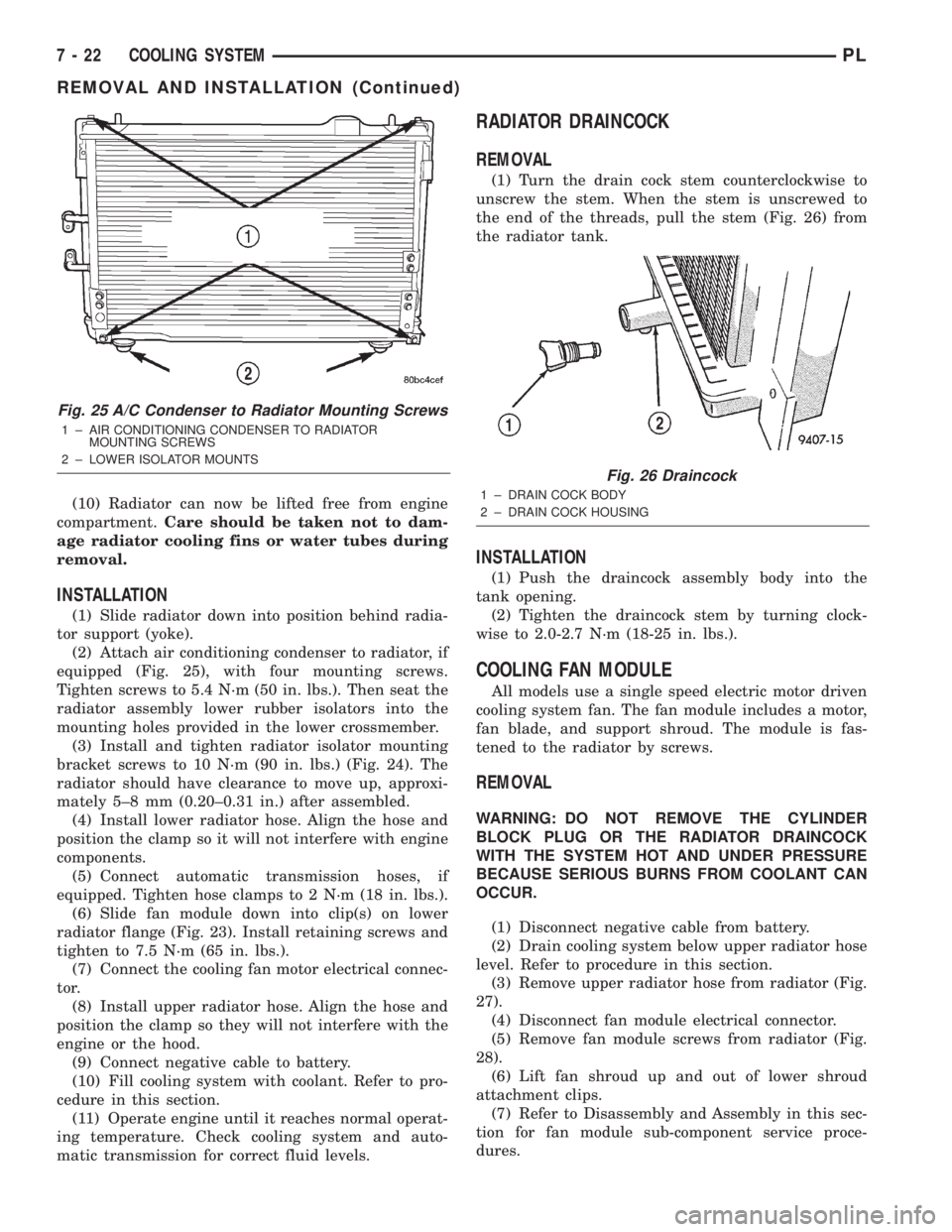
(2) Attach air conditioning condenser to radiator, if
equipped (Fig. 25), with four mounting screws.
Tighten screws to 5.4 N´m (50 in. lbs.). Then seat the
radiator assembly lower rubber isolators into the
mounting holes provided in the lower crossmember.
(3) Install and tighten radiator isolator mounting
bracket screws to 10 N´m (90 in. lbs.) (Fig. 24). The
radiator should have clearance to move up, approxi-
mately 5±8 mm (0.20±0.31 in.) after assembled.
(4) Install lower radiator hose. Align the hose and
position the clamp so it will not interfere with engine
components.
(5) Connect automatic transmission hoses, if
equipped. Tighten hose clamps to 2 N´m (18 in. lbs.).
(6) Slide fan module down into clip(s) on lower
radiator flange (Fig. 23). Install retaining screws and
tighten to 7.5 N´m (65 in. lbs.).
(7) Connect the cooling fan motor electrical connec-
tor.
(8) Install upper radiator hose. Align the hose and
position the clamp so they will not interfere with the
engine or the hood.
(9) Connect negative cable to battery.
(10) Fill cooling system with coolant. Refer to pro-
cedure in this section.
(11) Operate engine until it reaches normal operat-
ing temperature. Check cooling system and auto-
matic transmission for correct fluid levels.
RADIATOR DRAINCOCK
REMOVAL
(1) Turn the drain cock stem counterclockwise to
unscrew the stem. When the stem is unscrewed to
the end of the threads, pull the stem (Fig. 26) from
the radiator tank.
INSTALLATION
(1) Push the draincock assembly body into the
tank opening.
(2) Tighten the draincock stem by turning clock-
wise to 2.0-2.7 N´m (18-25 in. lbs.).
COOLING FAN MODULE
All models use a single speed electric motor driven
cooling system fan. The fan module includes a motor,
fan blade, and support shroud. The module is fas-
tened to the radiator by screws.
REMOVAL
WARNING: DO NOT REMOVE THE CYLINDER
BLOCK PLUG OR THE RADIATOR DRAINCOCK
WITH THE SYSTEM HOT AND UNDER PRESSURE
BECAUSE SERIOUS BURNS FROM COOLANT CAN
OCCUR.
(1) Disconnect negative cable from battery.
(2) Drain cooling system below upper radiator hose
level. Refer to procedure in this section.
(3) Remove upper radiator hose from radiator (Fig.
27).
(4) Disconnect fan module electrical connector.
(5) Remove fan module screws from radiator (Fig.
28).
(6) Lift fan shroud up and out of lower shroud
attachment clips.
(7) Refer to Disassembly and Assembly in this sec-
tion for fan module sub-component service proce-
dures.
Fig. 25 A/C Condenser to Radiator Mounting Screws
1 ± AIR CONDITIONING CONDENSER TO RADIATOR
MOUNTING SCREWS
2 ± LOWER ISOLATOR MOUNTS
Fig. 26 Draincock
1 ± DRAIN COCK BODY
2 ± DRAIN COCK HOUSING
7 - 22 COOLING SYSTEMPL
REMOVAL AND INSTALLATION (Continued)
Page 410 of 1285
8W-02 COMPONENT INDEX
Component Page
A/C Compressor Clutch Relay............8W-42
A/C Compressor Clutch.................8W-42
A/C Cycling Switch....................8W-42
A/C Heater Blower Motor...............8W-42
A/C Heater Control....................8W-42
A/C Pressure Switches..................8W-42
Airbag Control Module.................8W-43
Airbags.............................8W-43
Antenna.............................8W-47
Automatic Shut Down Relay.............8W-30
Back-Up Lamp Switch..................8W-51
Back-Up Lamps.......................8W-51
Battery.............................8W-20
Blower Motor Resistor Block.............8W-42
Brake Lamp Switch....................8W-30
Brake Shift Interlock Solenoid...........8W-30
Brake Warning Indicator Switch..........8W-40
Camshaft Position Sensor...............8W-30
Cargo Lamp..........................8W-44
Center High Mounted Stop Lamp.........8W-51
Center Stack Lamp....................8W-44
Cigar Lighter/Power Outlet..............8W-41
Circuit Breakers (FB)..................8W-11
City Lamps..........................8W-50
Clockspring.....................8W-33, 41, 43
Clutch Interlock Switch.................8W-30
Combination Flasher...................8W-52
Controller Anti-Lock Brake..............8W-35
Crankshaft Position Sensor..............8W-30
Data Link Connector...................8W-30
Decklid Release Switch.................8W-44
Decklid Solenoid......................8W-61
Diode No. 1..........................8W-42
Dome Lamp..........................8W-44
Dome Lamp/Intrusion Sensor............8W-44
Door Ajar Switches....................8W-40
Door Lock Motors.....................8W-61
Engine Coolant Temperature Sensor.......8W-30
Engine Oil Pressure Switch..............8W-30
Engine Starter Motor Relay.............8W-21
Engine Starter Motor..................8W-21
Fog Lamps........................8W-50, 51
Front Fog Lamp Switch.................8W-50
Fuel Injectors........................8W-30
Fuel Pump Module....................8W-30
Fuel Pump Relay......................8W-30
Fuel Tank...........................8W-30
Fuses (FB)...........................8W-11
Fuses (PDC).........................8W-10
Fuse Block...........................8W-11
Fusible Link A11...................8W-20, 21
Grounds.............................8W-15Component Page
Generator...........................8W-20
Glove Box Lamp/Switch.................8W-44
Headlamp Beam Select..............8W-40, 50
Headlamp Leveling Motors..............8W-50
Headlamp Leveling Switch Illumination....8W-50
Headlamp Leveling Switch..............8W-50
Headlamp Switch...................8W-50, 51
Headlamps..........................8W-50
Horns..............................8W-41
Horn Relay..........................8W-41
Horn Switch.........................8W-41
Hood Ajar Switch......................8W-39
Idle Air Control Motor..................8W-30
Ignition Coil.........................8W-30
Ignition Switch.......................8W-10
Indicators...........................8W-40
Indicator Drivers......................8W-40
Inlet Air Temperature Sensor............8W-30
Instrument Cluster....................8W-40
Instrument Panel Drivers...............8W-40
Knock Sensor.........................8W-30
Leak Detection Pump..................8W-30
License Lamps........................8W-51
Manifold Absolute Pressure Sensor........8W-30
Map/Reading Lamps...................8W-44
Multi- Function Switch.........8W-40, 50, 51, 52
Noise Suppressor......................8W-30
Oxygen Sensors.......................8W-30
Park Brake Switch....................8W-40
Park/Neutral Position Switch............8W-51
Park/Turn Signal Lamps................8W-52
Power Distribution Center...............8W-10
Power Mirror Switch...................8W-62
Power Steering Pressure Switch..........8W-30
Powertrain Control Module..............8W-30
PRNDL Lamp........................8W-44
Proportional Evap/Purge Solenoid.........8W-30
Radiator Fan Motor....................8W-42
Radiator Fan Relay....................8W-42
Radio...............................8W-47
Rear Window Defogger Switch...........8W-48
Rear Window Defogger.................8W-48
Remote Keyless Entry Module............8W-39
Repeater Lamps......................8W-52
Seat Belt Switch......................8W-40
Sentry Key Immobilizer Module..........8W-39
Side Marker Lamps....................8W-50
Siren...............................8W-39
Speakers............................8W-47
Splice Information.....................8W-70
Sunroof Control Module................8W-64
Sunroof Motor........................8W-64
PL8W - 02 COMPONENT INDEX 8W - 02 - 1
Page 474 of 1285
8W-30 FUEL/IGNITION SYSTEM
Component Page
A/C Compressor Clutch Relay...........8W-30-9
A/C High Pressure Switch.............8W-30-11
Airbag Control Module................8W-30-4
Automatic Shut Down Relay........8W-30-2, 3, 5
Brake Lamp Switch............8W-30-12, 13, 14
Brake Shift Interlock Solenoid.........8W-30-13
Brake Warning Indicator Switch........8W-30-13
Camshaft Position Sensor..............8W-30-7
Center High Mounted Stop Lamp.......8W-30-14
Clockspring........................8W-30-12
Clutch Interlock Switch..............8W-30-15
Controller Anti-Lock Brake..........8W-30-4, 13
Crankshaft Position Sensor............8W-30-7
Data Link Connector................8W-30-2, 4
Engine Coolant Temperature Sensor.....8W-30-7
Engine Oil Pressure Switch............8W-30-2
Engine Starter Motor Relay...........8W-30-15
Fuel Injector No. 1...................8W-30-5
Fuel Injector No. 2...................8W-30-5
Fuel Injector No. 3...................8W-30-5
Fuel Injector No. 4...................8W-30-5
Fuel Pump Module..................8W-30-10
Fuel Pump Relay...................8W-30-10
Fuel Tank.........................8W-30-10
Fuse 6 (FB)........................8W-30-13
Fuse 7 (FB)........................8W-30-13
Fuse 10 (FB).....................8W-30-9, 10
Fuse 11 (FB).....................8W-30-9, 10
Fuse 21 (PDC)..................8W-30-2, 4, 10
Fuse 23 (PDC)......................8W-30-13
Fuse Block....................8W-30-9, 10, 13
G101........................8W-30-3, 12, 15Component Page
G102.......................8W-30-2, 4, 13, 15
G201.............................8W-30-12
G303.............................8W-30-10
Generator.........................8W-30-11
Idle Air Control Motor................8W-30-8
Ignition Coil........................8W-30-5
Inlet Air Temperature Sensor...........8W-30-6
Instrument Cluster................8W-30-4, 10
Knock Sensor.......................8W-30-6
Leak Detection Pump.................8W-30-9
Left Tail/Stop Lamp.................8W-30-14
Manifold Absolute Pressure Sensor......8W-30-6
Multi-Function Switch...............8W-30-14
Noise Suppressor....................8W-30-5
Oxygen Sensor 1/1 Upstream...........8W-30-3
Oxygen Sensor 1/2 Downstream.........8W-30-3
Park/Neutral Position Switch..........8W-30-15
Power Distribution Center......8W-30-2, 4, 10, 13
Power Steering Pressure Switch........8W-30-15
Powertrain Control Module.....8W-30-2, 3, 4, 5, 6,
7, 8, 9, 10, 11, 12, 13, 15
Proportional Evap/Purge Solenoid.......8W-30-15
Radiator Fan Relay...................8W-30-9
Remote Keyless Entry Module..........8W-30-4
Right Tail/Stop Lamp................8W-30-14
Sentry Key Immobilizer Module.........8W-30-4
Throttle Position Sensor...............8W-30-6
Torque Converter Clutch Solenoid.......8W-30-9
Vehicle Speed Control Servo........8W-30-12, 13
Vehicle Speed Control Switch..........8W-30-12
Vehicle Speed Sensor.................8W-30-8
PL8W - 30 FUEL/IGNITION SYSTEM 8W - 30 - 1
Page 480 of 1285

312
CRANKSHAFT
POSITION
SENSOR
8V
SUPPLYSENSOR
GROUND
K7
20
OR
1
32
8V
SUPPLY
SENSOR
GROUNDCAMSHAFT
POSITION
SENSOR
CAMSHAFT
POSITION
SENSOR
SIGNAL
S123
K24
20
GY/BK
K4
20
BK/LB
K4
20
BK/LB
K4
20
BK/LB
C243
SENSOR
GROUND
1
2
S130
C1
2632C1 C133
K44
20
TN/YL
SENSOR TEMPERATURE
COOLANT
ENGINE
CRANKSHAFT
POSITION
SENSOR
SIGNALCAMSHAFT
POSITION
SENSOR
SIGNALENGINE
COOLANT
TEMPERATURE
SENSOR
SIGNAL CRANKSHAFT
POSITION
SENSOR
SIGNAL
MODULE CONTROL
POWERTRAIN
BK/LB20 K4
C1012
BK/LB18 K4
S113
K2
20
TN/BK
K4
20
BK/LB
C244
SUPPLY8V K7
20
OR
K7
20
OR
C1014K7
20
OR
(8W-70-2)
(8W-70-3)
(8W-30-6)
PL8W-30 FUEL/IGNITION SYSTEM 8W - 30 - 7
PLI03007008W-10
Page 508 of 1285
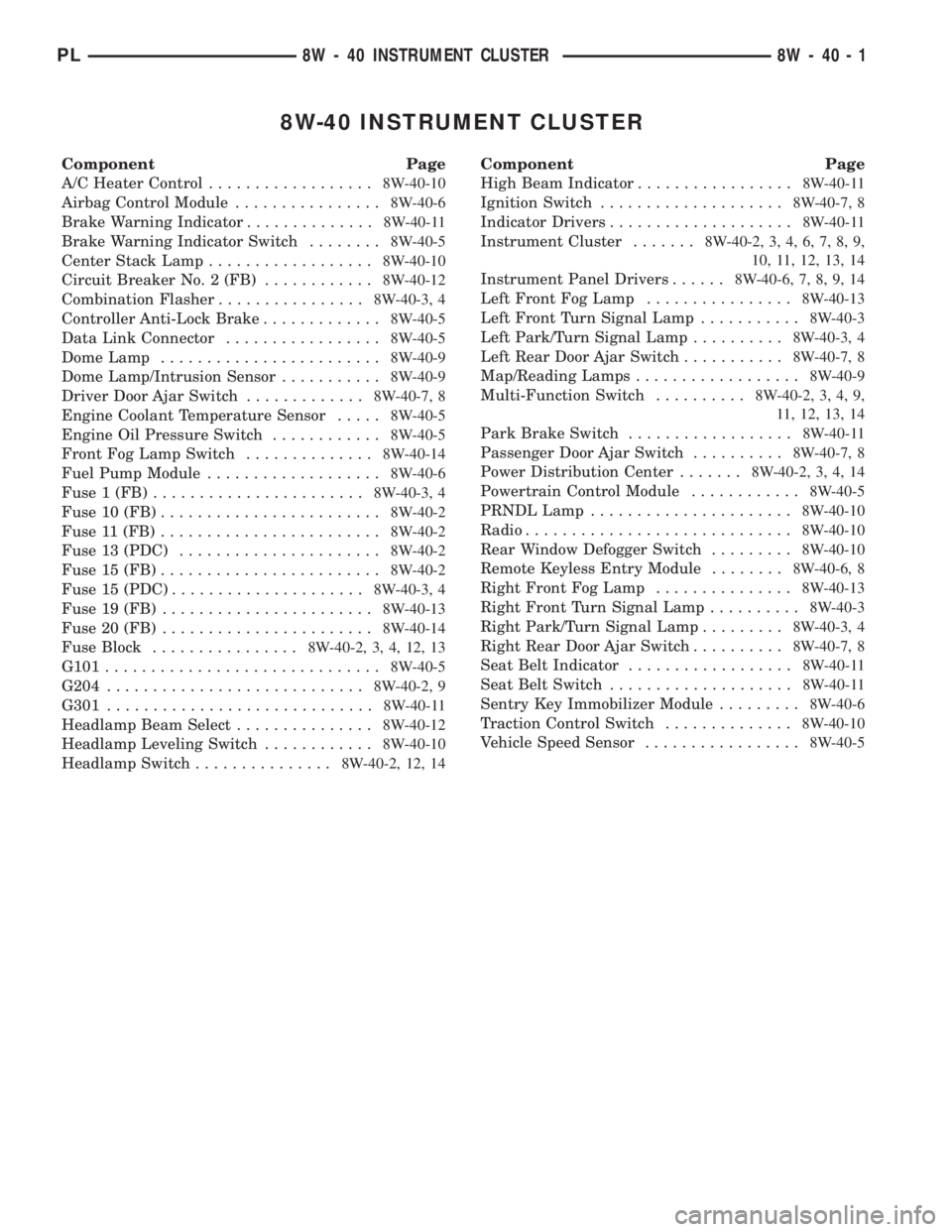
8W-40 INSTRUMENT CLUSTER
Component Page
A/C Heater Control..................8W-40-10
Airbag Control Module................8W-40-6
Brake Warning Indicator..............8W-40-11
Brake Warning Indicator Switch........8W-40-5
Center Stack Lamp..................8W-40-10
Circuit Breaker No. 2 (FB)............8W-40-12
Combination Flasher................8W-40-3, 4
Controller Anti-Lock Brake.............8W-40-5
Data Link Connector.................8W-40-5
Dome Lamp........................8W-40-9
Dome Lamp/Intrusion Sensor...........8W-40-9
Driver Door Ajar Switch.............8W-40-7, 8
Engine Coolant Temperature Sensor.....8W-40-5
Engine Oil Pressure Switch............8W-40-5
Front Fog Lamp Switch..............8W-40-14
Fuel Pump Module...................8W-40-6
Fuse 1 (FB).......................8W-40-3, 4
Fuse 10 (FB)........................8W-40-2
Fuse 11 (FB)........................8W-40-2
Fuse 13 (PDC)......................8W-40-2
Fuse 15 (FB)........................8W-40-2
Fuse 15 (PDC).....................8W-40-3, 4
Fuse 19 (FB).......................8W-40-13
Fuse 20 (FB).......................8W-40-14
Fuse Block................8W-40-2, 3, 4, 12, 13
G101..............................8W-40-5
G204............................8W-40-2, 9
G301.............................8W-40-11
Headlamp Beam Select...............8W-40-12
Headlamp Leveling Switch............8W-40-10
Headlamp Switch...............8W-40-2, 12, 14Component Page
High Beam Indicator.................8W-40-11
Ignition Switch....................8W-40-7, 8
Indicator Drivers....................8W-40-11
Instrument Cluster.......8W-40-2, 3, 4, 6, 7, 8, 9,
10, 11, 12, 13, 14
Instrument Panel Drivers......8W-40-6, 7, 8, 9, 14
Left Front Fog Lamp................8W-40-13
Left Front Turn Signal Lamp...........8W-40-3
Left Park/Turn Signal Lamp..........8W-40-3, 4
Left Rear Door Ajar Switch...........8W-40-7, 8
Map/Reading Lamps..................8W-40-9
Multi-Function Switch..........8W-40-2, 3, 4, 9,
11, 12, 13, 14
Park Brake Switch..................8W-40-11
Passenger Door Ajar Switch..........8W-40-7, 8
Power Distribution Center.......8W-40-2, 3, 4, 14
Powertrain Control Module............8W-40-5
PRNDL Lamp......................8W-40-10
Radio.............................8W-40-10
Rear Window Defogger Switch.........8W-40-10
Remote Keyless Entry Module........8W-40-6, 8
Right Front Fog Lamp...............8W-40-13
Right Front Turn Signal Lamp..........8W-40-3
Right Park/Turn Signal Lamp.........8W-40-3, 4
Right Rear Door Ajar Switch..........8W-40-7, 8
Seat Belt Indicator..................8W-40-11
Seat Belt Switch....................8W-40-11
Sentry Key Immobilizer Module.........8W-40-6
Traction Control Switch..............8W-40-10
Vehicle Speed Sensor.................8W-40-5
PL8W - 40 INSTRUMENT CLUSTER 8W - 40 - 1