flat tire DODGE NEON 2000 Service Owner's Manual
[x] Cancel search | Manufacturer: DODGE, Model Year: 2000, Model line: NEON, Model: DODGE NEON 2000Pages: 1285, PDF Size: 29.42 MB
Page 1078 of 1285
CLEANING AND INSPECTION
CLEANING TIRES
Remove the protective coating on the tires before
delivery of a vehicle. This coating may cause deteri-
oration of the tires.
To remove the protective coating, apply warm
water and let it soak for a few minutes. Afterwards,
scrub the coating away with a soft bristle brush.Steam cleaning may also be used to remove the coat-
ing.
NOTE: DO NOT use gasoline, mineral oil, oil-based
solvent or a wire brush for cleaning.
SPECIFICATIONS
TIRE SPECIFICATIONS
The following guide should help you understand the tire designations:
P Passenger car tire (or ªTº for temporary-use tire).
185 Nominal width of tire in millimeters.
70 Tire height-to-width ratio.
R Radial-ply tire (or ªDº for bias-ply tire).
14 Nominal rim diameter in inches.
Do not install smaller than minimum size tires shown on the tire inflation placard on the vehicle.
PLTIRES AND WHEELS 22 - 9
Page 1079 of 1285
WHEELS
TABLE OF CONTENTS
page page
DESCRIPTION AND OPERATION
WHEEL................................10
WHEEL COVER (LOCK-ON).................11
DIAGNOSIS AND TESTING
WHEEL INSPECTION......................11
TIRE AND WHEEL RUNOUT................12
SERVICE PROCEDURES
TIRE AND WHEEL BALANCE................13REMOVAL AND INSTALLATION
WHEEL COVER (LOCK-ON).................15
WHEEL COVER RETAINING NUT............15
TIRE AND WHEEL ASSEMBLY...............16
SPECIFICATIONS
WHEEL SPECIFICATIONS..................17
DESCRIPTION AND OPERATION
WHEEL
Original equipment wheels are designed for proper
operation at all loads up to the specified maximum
vehicle capacity.All models use steel or cast aluminum drop center
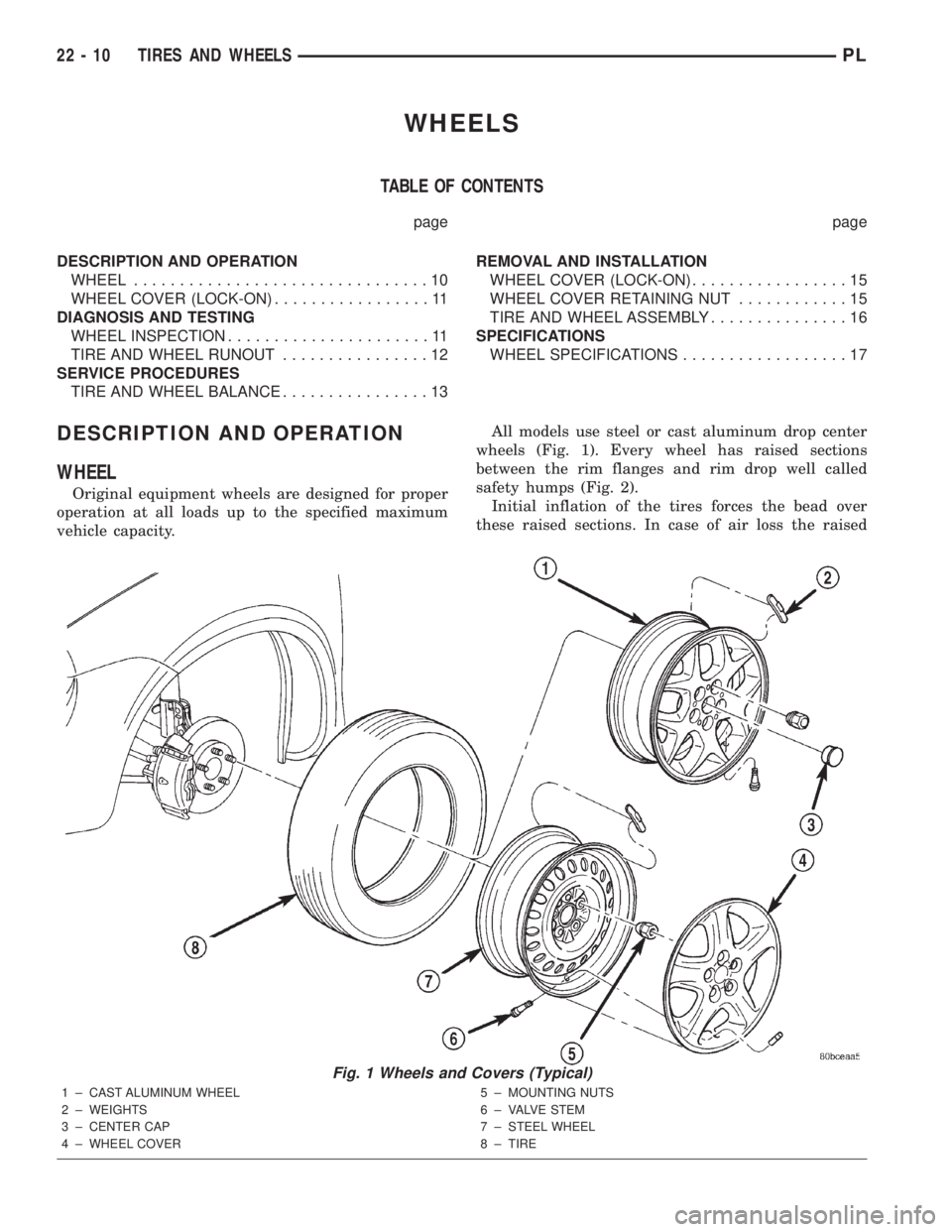
wheels (Fig. 1). Every wheel has raised sections
between the rim flanges and rim drop well called
safety humps (Fig. 2).
Initial inflation of the tires forces the bead over
these raised sections. In case of air loss the raised
Fig. 1 Wheels and Covers (Typical)
1 ± CAST ALUMINUM WHEEL
2 ± WEIGHTS
3 ± CENTER CAP
4 ± WHEEL COVER5 ± MOUNTING NUTS
6 ± VALVE STEM
7 ± STEEL WHEEL
8 ± TIRE
22 - 10 TIRES AND WHEELSPL
Page 1081 of 1285
pilot hole and bolt circle of the wheel should be the
same as the original wheel.
WARNING: FAILURE TO USE EQUIVALENT
REPLACEMENT WHEELS MAY ADVERSELY AFFECT
THE SAFETY AND HANDLING OF THE VEHICLE.
USED WHEELS ARE NOT RECOMMENDED. THE
SERVICE HISTORY OF THE WHEEL MAY HAVE
INCLUDED SEVERE TREATMENT OR VERY HIGH
MILEAGE. THE RIM COULD FAIL WITHOUT WARN-
ING.
TIRE AND WHEEL RUNOUT
NOTE: Runout should always be measured off the
vehicle and on a suitable balance machine.
Radial run out is the difference between the high
and low points on the outer edge of the tire or wheel.
Lateral run out is the total side±to±side wobble of
the tire or wheel.
Radial run out of more than 1.5 mm (.060 inch)
measured at the center line of the tread may cause
the vehicle to shake.
Lateral run out of more than 2.0 mm (.080 inch)
measured at the side of the tire as close to the tread
as possible may cause the vehicle to shake.
Sometimes radial run out can be reduced by relo-
cating the wheel and tire on the wheel studs (See
Method 1). If this does not reduce run out to an
acceptable level, the tire can be rotated on the wheel.
(See Method 2).
METHOD 1 (RELOCATE WHEEL ON HUB)
Check accuracy of the wheel mounting surface;
adjust wheel bearings.
Drive vehicle a short distance to eliminate tire flat
spotting from a parked position.
Verify all wheel nuts are tightened and properly
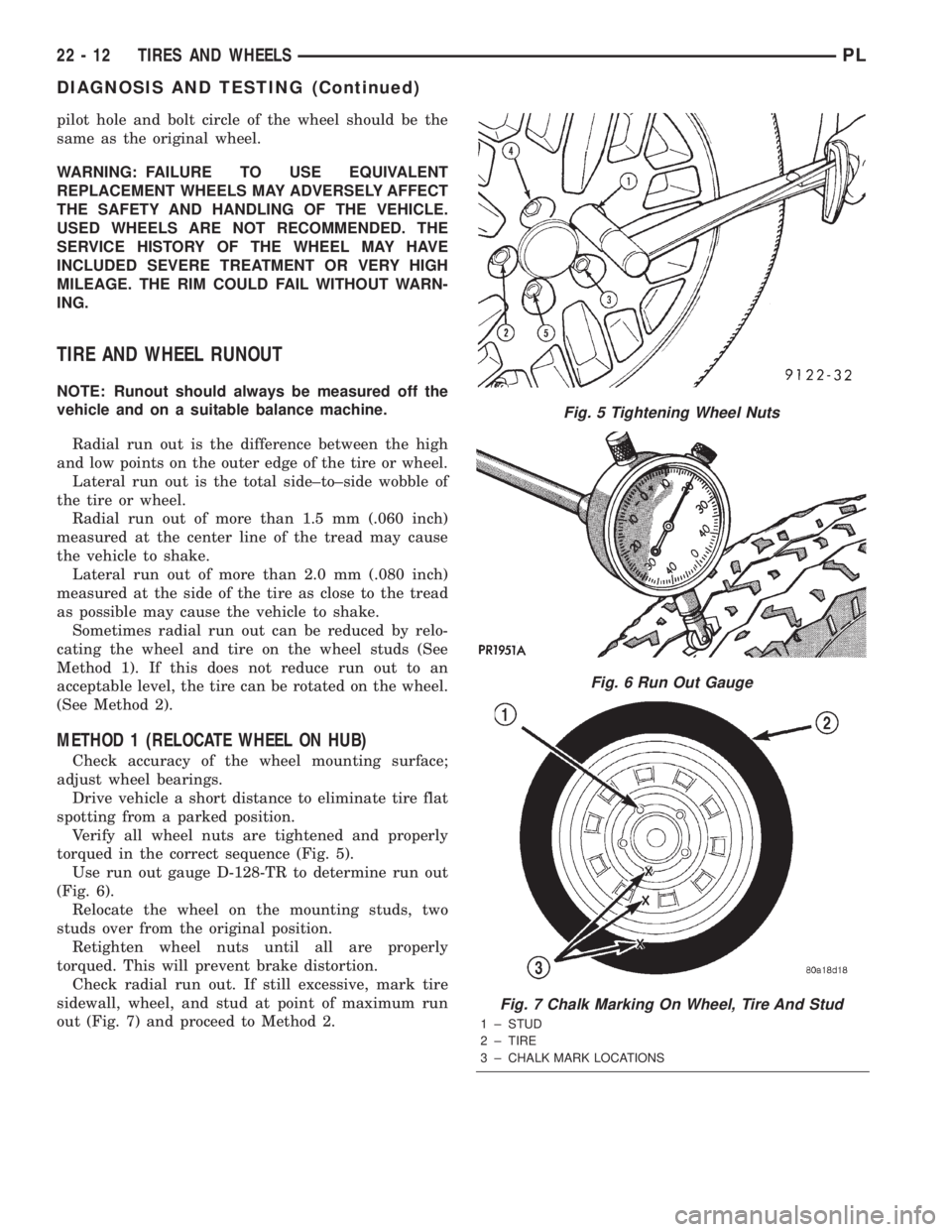
torqued in the correct sequence (Fig. 5).
Use run out gauge D-128-TR to determine run out
(Fig. 6).
Relocate the wheel on the mounting studs, two
studs over from the original position.
Retighten wheel nuts until all are properly
torqued. This will prevent brake distortion.
Check radial run out. If still excessive, mark tire
sidewall, wheel, and stud at point of maximum run
out (Fig. 7) and proceed to Method 2.
Fig. 5 Tightening Wheel Nuts
Fig. 6 Run Out Gauge
Fig. 7 Chalk Marking On Wheel, Tire And Stud
1 ± STUD
2 ± TIRE
3 ± CHALK MARK LOCATIONS
22 - 12 TIRES AND WHEELSPL
DIAGNOSIS AND TESTING (Continued)