parking brake DODGE NEON 2000 Service Service Manual
[x] Cancel search | Manufacturer: DODGE, Model Year: 2000, Model line: NEON, Model: DODGE NEON 2000Pages: 1285, PDF Size: 29.42 MB
Page 984 of 1285
(4) Clean the oil pan and magnet. Reinstall pan
using new Mopar Silicone Adhesive sealant. Tighten
oil pan bolts to 19 N´m (165 in. lbs.).
(5) Pour four quarts of MopartATF+4 (Automatic
Transmission Fluid) Type 9602 through the dipstick
opening.
(6) Start engine and allow to idle for at least one
minute. Then, with parking and service brakes
applied, move selector lever momentarily to each
position, ending in the park or neutral position.
(7) Check the transaxle fluid level and add an
appropriate amount to bring the transaxle fluid level
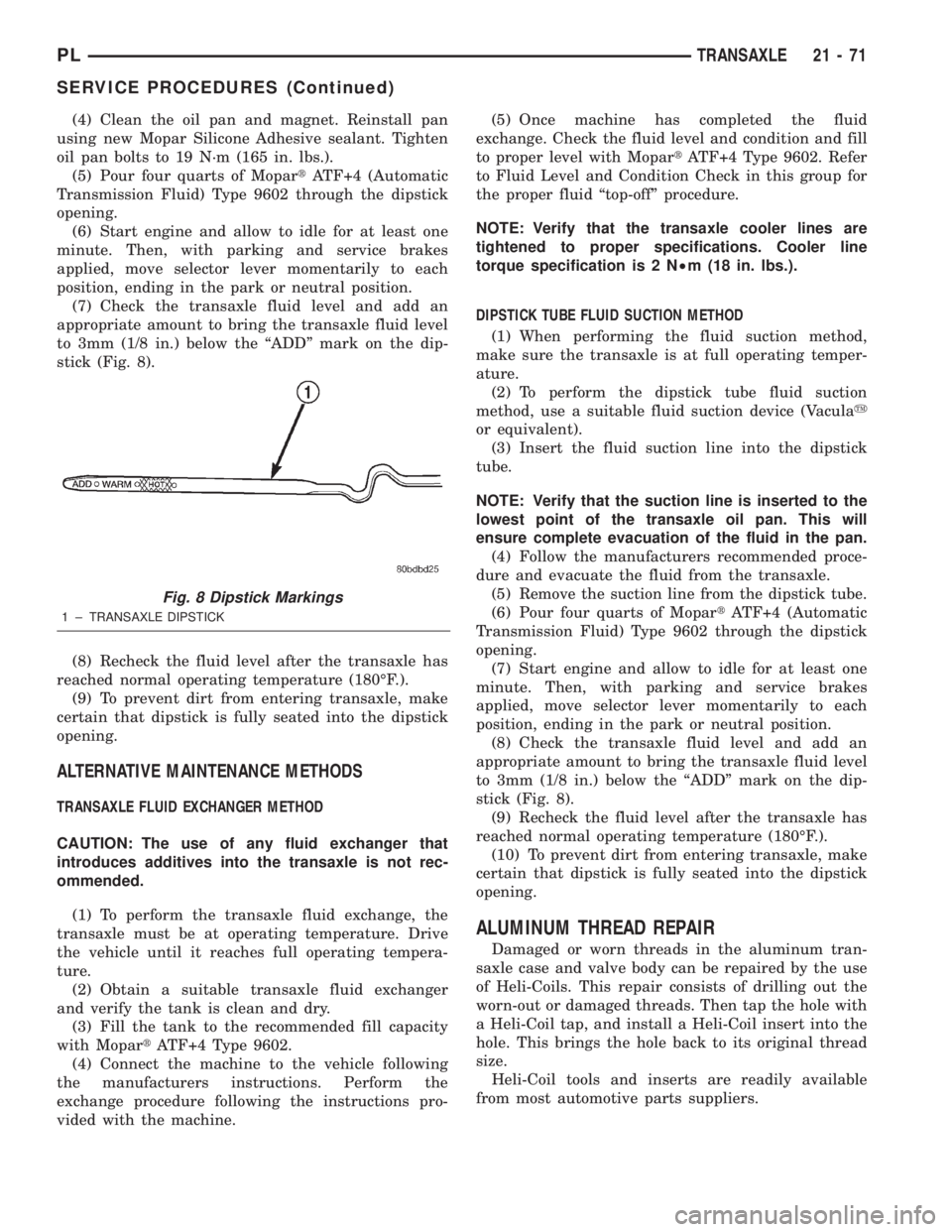
to 3mm (1/8 in.) below the ªADDº mark on the dip-
stick (Fig. 8).
(8) Recheck the fluid level after the transaxle has
reached normal operating temperature (180ÉF.).
(9) To prevent dirt from entering transaxle, make
certain that dipstick is fully seated into the dipstick
opening.
ALTERNATIVE MAINTENANCE METHODS
TRANSAXLE FLUID EXCHANGER METHOD
CAUTION: The use of any fluid exchanger that
introduces additives into the transaxle is not rec-
ommended.
(1) To perform the transaxle fluid exchange, the
transaxle must be at operating temperature. Drive
the vehicle until it reaches full operating tempera-
ture.
(2) Obtain a suitable transaxle fluid exchanger
and verify the tank is clean and dry.
(3) Fill the tank to the recommended fill capacity
with MopartATF+4 Type 9602.
(4) Connect the machine to the vehicle following
the manufacturers instructions. Perform the
exchange procedure following the instructions pro-
vided with the machine.(5) Once machine has completed the fluid
exchange. Check the fluid level and condition and fill
to proper level with MopartATF+4 Type 9602. Refer
to Fluid Level and Condition Check in this group for
the proper fluid ªtop-offº procedure.
NOTE: Verify that the transaxle cooler lines are
tightened to proper specifications. Cooler line
torque specification is 2 N²m (18 in. lbs.).
DIPSTICK TUBE FLUID SUCTION METHOD
(1) When performing the fluid suction method,
make sure the transaxle is at full operating temper-
ature.
(2) To perform the dipstick tube fluid suction
method, use a suitable fluid suction device (Vaculay
or equivalent).
(3) Insert the fluid suction line into the dipstick
tube.
NOTE: Verify that the suction line is inserted to the
lowest point of the transaxle oil pan. This will
ensure complete evacuation of the fluid in the pan.
(4) Follow the manufacturers recommended proce-
dure and evacuate the fluid from the transaxle.
(5) Remove the suction line from the dipstick tube.
(6) Pour four quarts of MopartATF+4 (Automatic
Transmission Fluid) Type 9602 through the dipstick
opening.
(7) Start engine and allow to idle for at least one
minute. Then, with parking and service brakes
applied, move selector lever momentarily to each
position, ending in the park or neutral position.
(8) Check the transaxle fluid level and add an
appropriate amount to bring the transaxle fluid level
to 3mm (1/8 in.) below the ªADDº mark on the dip-
stick (Fig. 8).
(9) Recheck the fluid level after the transaxle has
reached normal operating temperature (180ÉF.).
(10) To prevent dirt from entering transaxle, make
certain that dipstick is fully seated into the dipstick
opening.
ALUMINUM THREAD REPAIR
Damaged or worn threads in the aluminum tran-
saxle case and valve body can be repaired by the use
of Heli-Coils. This repair consists of drilling out the
worn-out or damaged threads. Then tap the hole with
a Heli-Coil tap, and install a Heli-Coil insert into the
hole. This brings the hole back to its original thread
size.
Heli-Coil tools and inserts are readily available
from most automotive parts suppliers.
Fig. 8 Dipstick Markings
1 ± TRANSAXLE DIPSTICK
PLTRANSAXLE 21 - 71
SERVICE PROCEDURES (Continued)
Page 1171 of 1285
(3) Disengage clips attaching trim to lower quarter
panel.
(4) Remove seat belt from slot in trim panel.
(5) Remove lower quarter trim from vehicle (Fig.
66).
INSTALLATION
(1) Position lower quarter trim panel to vehicle.
(2) Install seat belt to slot in trim panel.
(3) Align locating pins on backside of trim panel to
mating holes in inner quarter panel.
(4) Press clips on trim panel into slots in inner
quarter panel.
(5) Install rear seat back and cushion.
(6) Install upper quarter trim panel.
FLOOR CONSOLE
REMOVAL
(1) Fully apply parking brake.
(2) Remove screw cover plugs over screws just
rearward of cup holders.
(3) Remove screws in cup holders attaching con-
sole to floor bracket.
(4) Open console storage compartment lid, if so
equipped.
(5) Remove screw cover plugs over screws near
rear of console.
(6) Remove screws attaching console to floor
bracket.
(7) Remove shift lever knob, if vehicle is equipped
with a manual transmission.
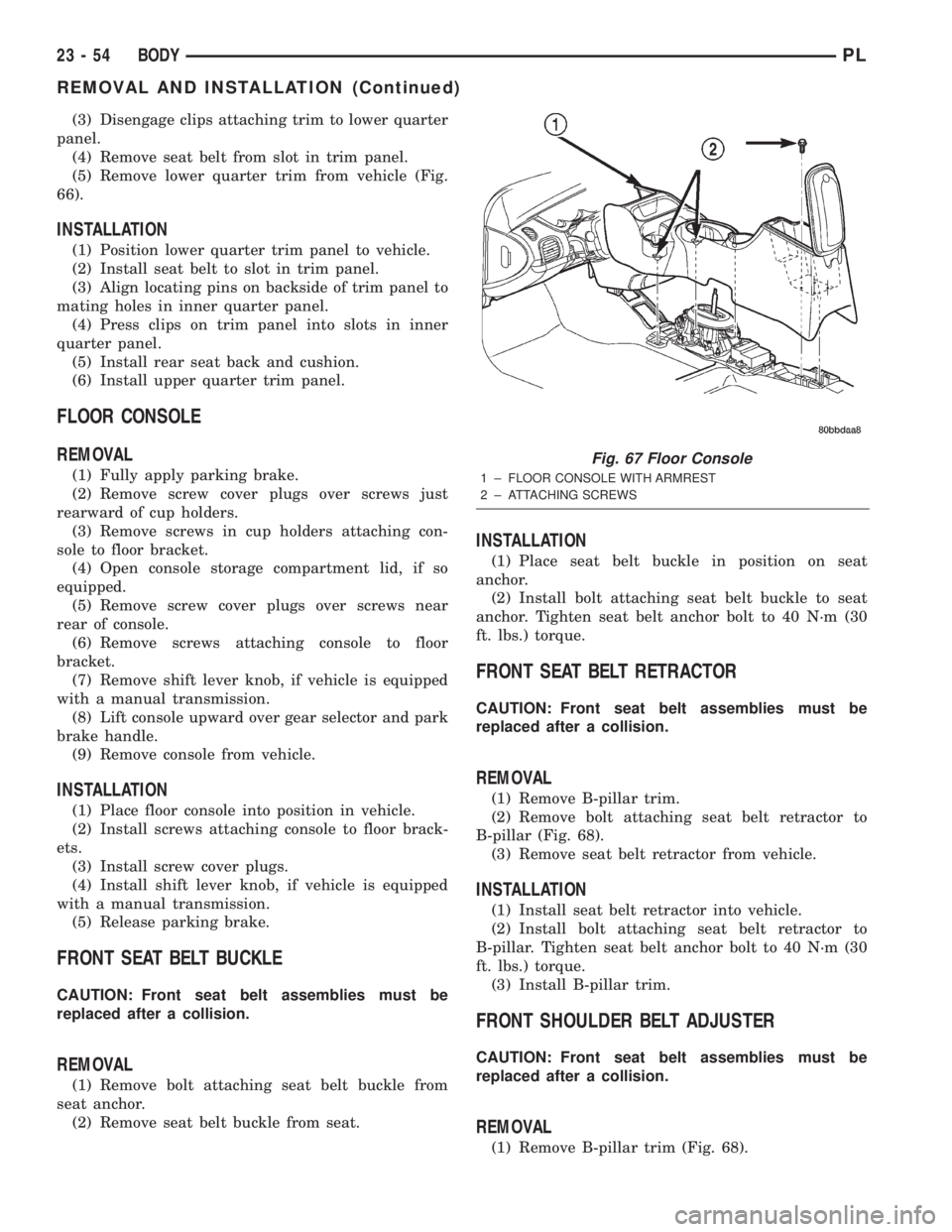
(8) Lift console upward over gear selector and park
brake handle.
(9) Remove console from vehicle.
INSTALLATION
(1) Place floor console into position in vehicle.
(2) Install screws attaching console to floor brack-
ets.
(3) Install screw cover plugs.
(4) Install shift lever knob, if vehicle is equipped
with a manual transmission.
(5) Release parking brake.
FRONT SEAT BELT BUCKLE
CAUTION: Front seat belt assemblies must be
replaced after a collision.
REMOVAL
(1) Remove bolt attaching seat belt buckle from
seat anchor.
(2) Remove seat belt buckle from seat.
INSTALLATION
(1) Place seat belt buckle in position on seat
anchor.
(2) Install bolt attaching seat belt buckle to seat
anchor. Tighten seat belt anchor bolt to 40 N´m (30
ft. lbs.) torque.
FRONT SEAT BELT RETRACTOR
CAUTION: Front seat belt assemblies must be
replaced after a collision.
REMOVAL
(1) Remove B-pillar trim.
(2) Remove bolt attaching seat belt retractor to
B-pillar (Fig. 68).
(3) Remove seat belt retractor from vehicle.
INSTALLATION
(1) Install seat belt retractor into vehicle.
(2) Install bolt attaching seat belt retractor to
B-pillar. Tighten seat belt anchor bolt to 40 N´m (30
ft. lbs.) torque.
(3) Install B-pillar trim.
FRONT SHOULDER BELT ADJUSTER
CAUTION: Front seat belt assemblies must be
replaced after a collision.
REMOVAL
(1) Remove B-pillar trim (Fig. 68).
Fig. 67 Floor Console
1 ± FLOOR CONSOLE WITH ARMREST
2 ± ATTACHING SCREWS
23 - 54 BODYPL
REMOVAL AND INSTALLATION (Continued)
Page 1176 of 1285
SPECIFICATIONS
BODY LUBRICATION
LUBRICATION REQUIREMENTS
Body mechanisms and linkages should be
inspected, cleaned, and lubricated, as required, to
maintain ease of operation and to provide protection
against rust and wear. When performing other
underhood services, the hood latch release mecha-
nism and safety catch should be inspected, cleaned,
and lubricated. During the winter season, external
door lock cylinders should be lubricated to assure
proper operation when exposed to water and ice.
Prior to the application of any lubricant, the parts
concerned should be wiped clean to remove dust and
grit. If necessary, a suitable solvent can be used to
clean the item to be lubricated. After lubricating a
component, any excess oil or grease should be
removed.
LUBRICANT APPLICATION
DOOR LOCK CYLINDERS
(1) Apply a small amount of lubricant directly into
the lock cylinder.
(2) Apply a small amount of lubricant to the key.
(3) Insert key into lock cylinder and cycle the
mechanism from the locked to the unlocked position.
NOTE: Do not add more lubricant.
(4) Cycle the lock cylinder mechanism several
times to allow the lubricant to flow throughout the
cylinder.
(5) Wipe all lubricant from exterior of lock cylinder
and key.
ALL OTHER BODY MECHANISMS
(1) Clean component as described above.(2) Apply specified lubricant to all pivoting and
sliding contact areas of component.
LUBRICANT USAGE
ENGINE OIL
²Decklid Hinges
MOPARTSPRAY WHITE LUBE OR EQUIVALENT
²Ash Receiver
²Fuel Filler Door Remote Control Latch Mecha-
nism
²Parking Brake Mechanism
²Sliding Seat Tracks
²Decklid Latch
MOPARTMULTIPURPOSE GREASE OR
EQUIVALENT
²All Other Hood Mechanisms
MOPARTLOCK CYLINDER LUBRICANT OR
EQUIVALENT
²Door Lock Cylinders
²Decklid Lock Cylinder
SPECIAL TOOLS
BODY
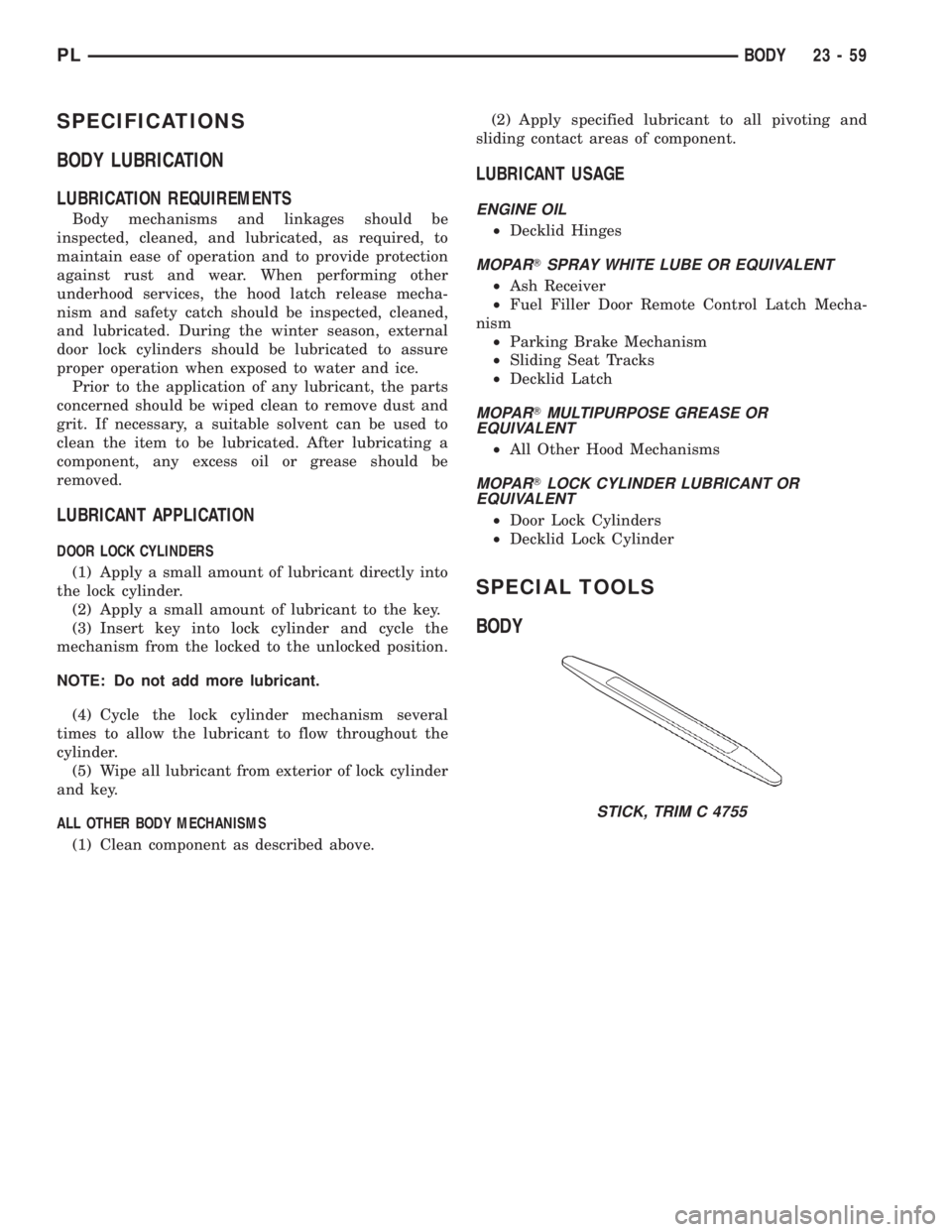
STICK, TRIM C 4755
PLBODY 23 - 59
Page 1177 of 1285
SPECIFICATIONS
TABLE OF CONTENTS
page page
SPECIFICATIONS
BODY LUBRICATION SPECIFICATIONS........60
BODY GAP AND FLUSH MEASUREMENTS.....61
BODY OPENING DIMENSION...............62BODY SEALING LOCATIONS................64
STRUCTURAL ADHESIVE LOCATIONS........74
TORQUE SPECIFICATIONS.................76
WELD LOCATIONS.......................77
SPECIFICATIONS
BODY LUBRICATION SPECIFICATIONS
LUBRICATION REQUIREMENTS
Body mechanisms and linkages should be
inspected, cleaned, and lubricated, as required, to
maintain ease of operation and to provide protection
against rust and wear. When performing other under
hood services, the hood latch release mechanism and
safety catch should be inspected, cleaned, and lubri-
cated. During the winter season, external door lock
cylinders should be lubricated to assure proper oper-
ation when exposed to water and ice.
Prior to the application of any lubricant, the parts
concerned should be wiped clean to remove dust and
grit. If necessary, a suitable solvent can be used to
clean the item to be lubricated. After lubricating a
component, any excess oil or grease should be
removed.
LUBRICANT APPLICATION
DOOR LOCK CYLINDERS
(1) Apply a small amount of lubricant directly into
the lock cylinder.
(2) Apply a small amount of lubricant to the key.
(3) Insert key into lock cylinder and cycle the
mechanism from the locked to the unlocked position.
NOTE: Do not add more lubricant.
(4) Cycle the lock cylinder mechanism several
times to allow the lubricant to flow throughout the
cylinder.
(5) Wipe all lubricant from exterior of lock cylinder
and key.ALL OTHER BODY MECHANISMS
(1) Clean component as described above.
(2) Apply specified lubricant to all pivoting and
sliding contact areas of component.
LUBRICANT USAGE
ENGINE OIL
²Door Hinges ± Hinge Pin and Pivot Contact
Areas
²Hood Hinges ± Pivot Points
²Liftgate Hinges
²Decklid Hinges
MOPARTSPRAY WHITE CUBE OR EQUIVALENT
²Door Check Straps
²Liftgate Latches
²Liftgate Prop Pivots
²Ash Receiver
²Fuel Filler Door Remote Control Latch Mecha-
nism
²Parking Brake Mechanism
²Sliding Seat Tracks
²Decklid Latch
MOPARTMultipurpose GREASE OR EQUIVALENT
²All Other Hood Mechanisms
MOPARTLOCK CYLINDER LUBRICANT OR
EQUIVALENT
²Door Lock Cylinders
²Decklid Lock Cylinder
23 - 60 BODYPL