No start DODGE NEON 2000 Service Repair Manual
[x] Cancel search | Manufacturer: DODGE, Model Year: 2000, Model line: NEON, Model: DODGE NEON 2000Pages: 1285, PDF Size: 29.42 MB
Page 1 of 1285
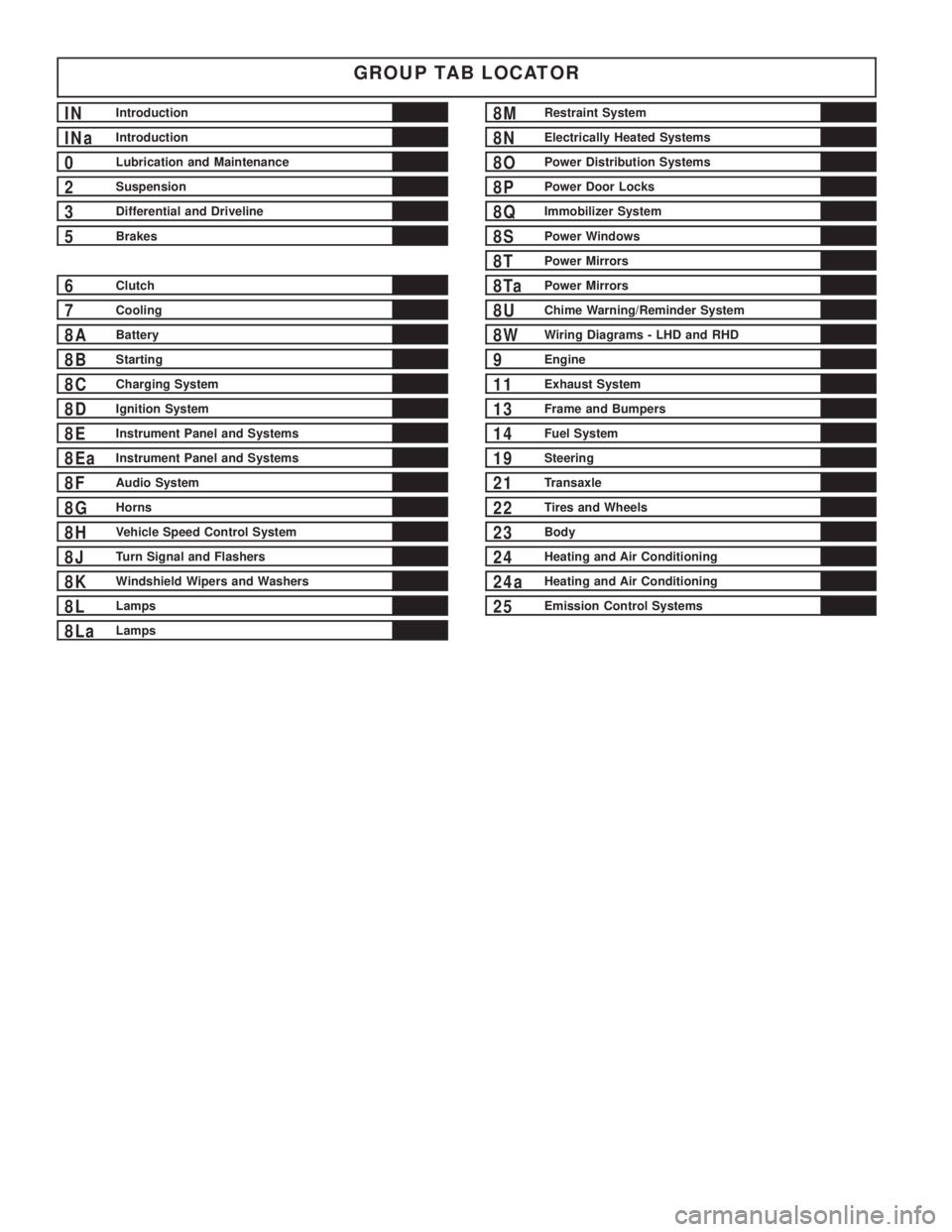
GROUP TAB LOCATORINIntroductionINaIntroduction0Lubrication and Maintenance2Suspension3Differential and Driveline5Brakes6Clutch7Cooling8ABattery8BStarting8CCharging System8DIgnition System8EInstrument Panel and Systems8EaInstrument Panel and Systems8FAudio System8GHorns8HVehicle Speed Control System8JTurn Signal and Flashers8KWindshield Wipers and Washers8LLamps8LaLamps8MRestraint System8NElectrically Heated Systems8OPower Distribution Systems8PPower Door Locks8QImmobilizer System8SPower Windows8TPower Mirrors8TaPower Mirrors8UChime Warning/Reminder System8WWiring Diagrams - LHD and RHD9Engine11Exhaust System13Frame and Bumpers14Fuel System19Steering21Transaxle22Tires and Wheels23Body24Heating and Air Conditioning24aHeating and Air Conditioning25Emission Control Systems
Page 2 of 1285
LUBRICATION AND MAINTENANCE
TABLE OF CONTENTS
page page
LUBRICANTS............................. 1
MAINTENANCE SCHEDULES................. 3JUMP STARTING, TOWING, AND HOISTING..... 7
LUBRICANTS
TABLE OF CONTENTS
page page
DESCRIPTION AND OPERATION
PARTS AND LUBRICANT
RECOMMENDATIONS....................1
CLASSIFICATION OF LUBRICANTS............1
INTERNATIONAL SYMBOLS.................2FLUID CHECK/FILL POINTS AND
LUBRICATION LOCATIONS.................2
LUBRICATION POINT LOCATIONS............2
SPECIFICATIONS
FLUID CAPACITIES........................2
DESCRIPTION AND OPERATION
PARTS AND LUBRICANT RECOMMENDATIONS
When service is required, DaimlerChrysler Corpo-
ration recommends that only Mopartbrand parts,
lubricants and chemicals be used. Mopar provides
the best engineered products for servicing
DaimlerChrysler Corporation vehicles.
CLASSIFICATION OF LUBRICANTS
DESCRIPTION
Only lubricants bearing designations defined by
the following organization should be used to service a
DaimlerChrysler Corporation vehicle.
²Society of Automotive Engineers (SAE)
²American Petroleum Institute (API) (Fig. 1)
²National Lubricating Grease Institute (NLGI)
(Fig. 2)
SAE VISCOSITY RATING
An SAE viscosity grade is used to specify the vis-
cosity of engine oil. These are specified with a dual
SAE viscosity grade which indicates the cold-to-hot
temperature viscosity range. Example SAE 5W-30 =
multiple grade engine oil.DaimlerChrysler Corporation only recommends
multiple grade engine oils.
API QUALITY CLASSIFICATION
This symbol (Fig. 1) on the front of an oil container
means that the oil has been certified by the Ameri-
can Petroleum Institute (API) to meet all the lubri-
cation requirements specified by DaimlerChrysler
Corporation.
Refer to Group 9, Engine for gasoline engine oil
specification.
GEAR LUBRICANTS
SAE ratings also apply to multiple grade gear
lubricants. In addition, API classification defines the
lubricants usage. Such as API GL-5 and SAE 80W-90.
Fig. 1 API Symbol
PLLUBRICATION AND MAINTENANCE 0 - 1
Page 8 of 1285
JUMP STARTING, TOWING, AND HOISTING
TABLE OF CONTENTS
page page
DESCRIPTION AND OPERATION
JUMP STARTING PROCEDURE...............7
TOWING RECOMMENDATIONS...............7
HOISTING RECOMMENDATIONS.............7SERVICE PROCEDURES
JUMP STARTING PROCEDURE...............7
TOWING RECOMMENDATIONS...............8
HOISTING RECOMMENDATIONS.............9
DESCRIPTION AND OPERATION
JUMP STARTING PROCEDURE
Describes the procedure for starting a disable vehi-
cle.
TOWING RECOMMENDATIONS
Describes the recommended towing procedures.
HOISTING RECOMMENDATIONS
Describes the location of hoisting and jacking
points so that the vehicle can be lifted by a floor jack
or hoist.
SERVICE PROCEDURES
JUMP STARTING PROCEDURE
WARNING: REVIEW ALL SAFETY PRECAUTIONS
AND WARNINGS IN GROUP 8A, BATTERY/START-
ING/CHARGING SYSTEMS DIAGNOSTICS. DO NOT
JUMP START A FROZEN BATTERY, PERSONAL
INJURY CAN RESULT. DO NOT JUMP START WHEN
MAINTENANCE FREE BATTERY INDICATOR DOT IS
YELLOW OR BRIGHT COLOR. DO NOT JUMP
START A VEHICLE WHEN THE BATTERY FLUID IS
BELOW THE TOP OF LEAD PLATES. DO NOT
ALLOW JUMPER CABLE CLAMPS TO TOUCH
EACH OTHER WHEN CONNECTED TO A BOOSTER
SOURCE. DO NOT USE OPEN FLAME NEAR BAT-
TERY. REMOVE METALLIC JEWELRY WORN ON
HANDS OR WRISTS TO AVOID INJURY BY ACCI-
DENTAL ARCING OF BATTERY CURRENT. WHEN
USING A HIGH OUTPUT BOOSTING DEVICE, DO
NOT ALLOW BATTERY VOLTAGE TO EXCEED 16
VOLTS. REFER TO INSTRUCTIONS PROVIDED
WITH DEVICE BEING USED.
CAUTION: When using another vehicle as a
booster, do not allow vehicles to touch. Electrical
systems can be damaged on either vehicle.
TO JUMP START A DISABLED VEHICLE:
(1) Raise hood on disabled vehicle and visually
inspect engine compartment for:
²Battery cable clamp condition, clean if necessary.
²Frozen battery.
²Yellow or bright color test indicator, if equipped.
²Low battery fluid level.
²Generator drive belt condition and tension.
²Fuel fumes or leakage, correct if necessary.
CAUTION: If the cause of starting problem on dis-
abled vehicle is severe, damage to booster vehicle
charging system can result.
(2) When using another vehicle as a booster
source, park the booster vehicle within cable reach.
Turn off all accessories, set the parking brake, place
the automatic transmission in PARK or the manual
transmission in NEUTRAL and turn the ignition
OFF.
(3) On disabled vehicle, place gear selector in park
or neutral and set park brake. Turn off all accesso-
ries.
(4) Connect jumper cables to booster battery. RED
clamp to positive terminal (+). BLACK clamp to neg-
ative terminal (-). DO NOT allow clamps at opposite
end of cables to touch, electrical arc will result.
Review all warnings in this procedure.
(5) On disabled vehicle, connect RED jumper cable
clamp to positive (+) terminal. Connect BLACK
jumper cable clamp to engine ground as close to the
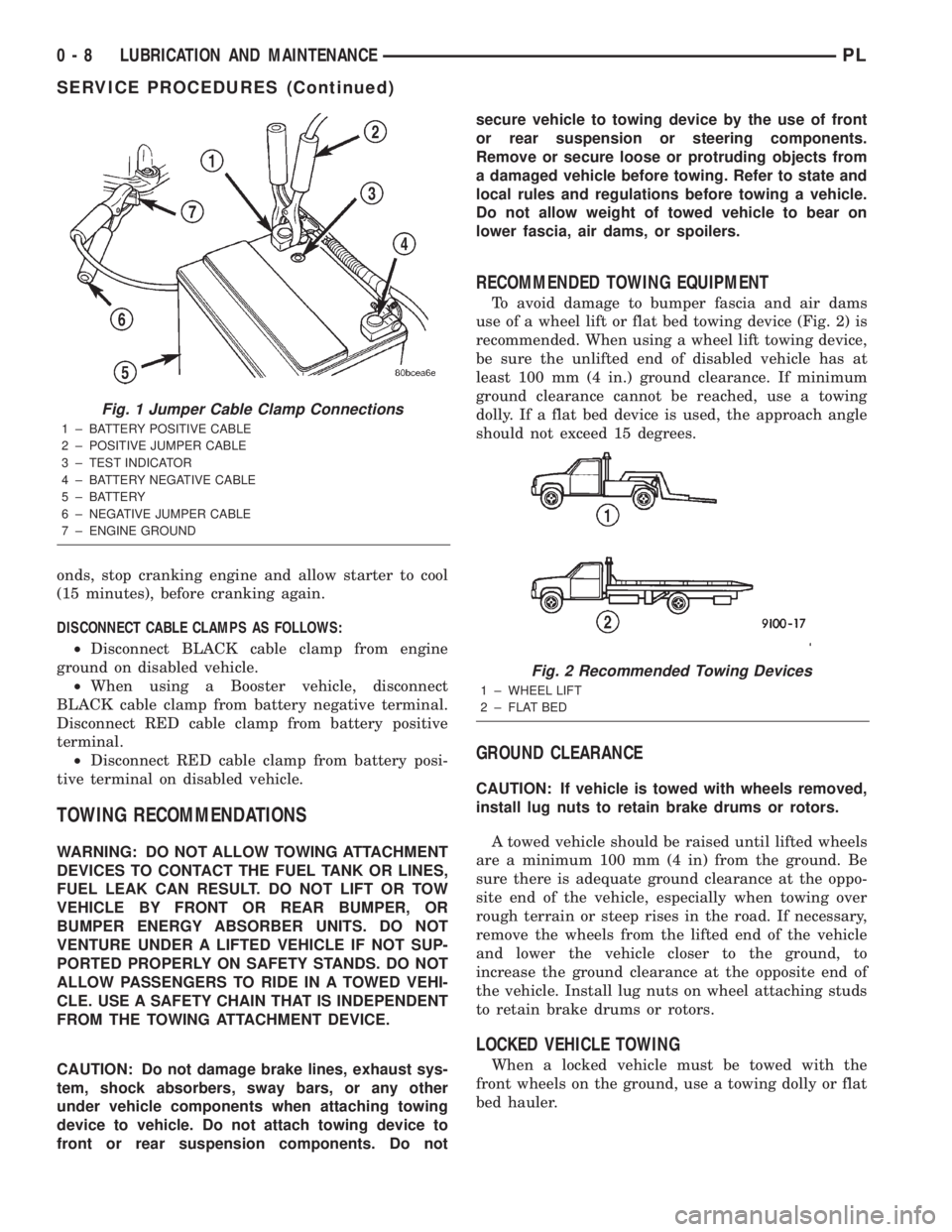
ground cable attaching point as possible (Fig. 1).
(6) Start the engine in the vehicle which has the
booster battery, let the engine idle a few minutes,
then start the engine in the vehicle with the dis-
charged battery.
CAUTION: Do not crank starter motor on disabled
vehicle for more than 15 seconds, starter will over-
heat and could fail.
(7) Allow battery in disabled vehicle to charge to
at least 12.4 volts (75% charge) before attempting to
start engine. If engine does not start within 15 sec-
PLLUBRICATION AND MAINTENANCE 0 - 7
Page 9 of 1285
onds, stop cranking engine and allow starter to cool
(15 minutes), before cranking again.
DISCONNECT CABLE CLAMPS AS FOLLOWS:
²Disconnect BLACK cable clamp from engine
ground on disabled vehicle.
²When using a Booster vehicle, disconnect
BLACK cable clamp from battery negative terminal.
Disconnect RED cable clamp from battery positive
terminal.
²Disconnect RED cable clamp from battery posi-
tive terminal on disabled vehicle.
TOWING RECOMMENDATIONS
WARNING: DO NOT ALLOW TOWING ATTACHMENT
DEVICES TO CONTACT THE FUEL TANK OR LINES,
FUEL LEAK CAN RESULT. DO NOT LIFT OR TOW
VEHICLE BY FRONT OR REAR BUMPER, OR
BUMPER ENERGY ABSORBER UNITS. DO NOT
VENTURE UNDER A LIFTED VEHICLE IF NOT SUP-
PORTED PROPERLY ON SAFETY STANDS. DO NOT
ALLOW PASSENGERS TO RIDE IN A TOWED VEHI-
CLE. USE A SAFETY CHAIN THAT IS INDEPENDENT
FROM THE TOWING ATTACHMENT DEVICE.
CAUTION: Do not damage brake lines, exhaust sys-
tem, shock absorbers, sway bars, or any other
under vehicle components when attaching towing
device to vehicle. Do not attach towing device to
front or rear suspension components. Do notsecure vehicle to towing device by the use of front
or rear suspension or steering components.
Remove or secure loose or protruding objects from
a damaged vehicle before towing. Refer to state and
local rules and regulations before towing a vehicle.
Do not allow weight of towed vehicle to bear on
lower fascia, air dams, or spoilers.
RECOMMENDED TOWING EQUIPMENT
To avoid damage to bumper fascia and air dams
use of a wheel lift or flat bed towing device (Fig. 2) is
recommended. When using a wheel lift towing device,
be sure the unlifted end of disabled vehicle has at
least 100 mm (4 in.) ground clearance. If minimum
ground clearance cannot be reached, use a towing
dolly. If a flat bed device is used, the approach angle
should not exceed 15 degrees.
GROUND CLEARANCE
CAUTION: If vehicle is towed with wheels removed,
install lug nuts to retain brake drums or rotors.
A towed vehicle should be raised until lifted wheels
are a minimum 100 mm (4 in) from the ground. Be
sure there is adequate ground clearance at the oppo-
site end of the vehicle, especially when towing over
rough terrain or steep rises in the road. If necessary,
remove the wheels from the lifted end of the vehicle
and lower the vehicle closer to the ground, to
increase the ground clearance at the opposite end of
the vehicle. Install lug nuts on wheel attaching studs
to retain brake drums or rotors.
LOCKED VEHICLE TOWING
When a locked vehicle must be towed with the
front wheels on the ground, use a towing dolly or flat
bed hauler.
Fig. 1 Jumper Cable Clamp Connections
1 ± BATTERY POSITIVE CABLE
2 ± POSITIVE JUMPER CABLE
3 ± TEST INDICATOR
4 ± BATTERY NEGATIVE CABLE
5 ± BATTERY
6 ± NEGATIVE JUMPER CABLE
7 ± ENGINE GROUND
Fig. 2 Recommended Towing Devices
1 ± WHEEL LIFT
2 ± FLAT BED
0 - 8 LUBRICATION AND MAINTENANCEPL
SERVICE PROCEDURES (Continued)
Page 29 of 1285
once installed. Install the nuts. Holding the bolts in
place tighten the nuts to a torque of 53 N´m (40 ft.
lbs.) plus an additional 90É turn after the specified
torque is met.
(6) Place the tie rod heat shield on the steering
knuckle arm so that the shield is positioned straight
away from the steering gear and tie rod end once
installed. Algn the hole in the shield with the hole in
the steering knucle arm.
(7) Install the outer tie rod ball stud into the hole
in the steering knuckle arm. Start the tie rod attach-
ing nut onto the stud. Hold the tie rod end stud with
a wrench while tightening the nut with a standard
wrench or crowfoot wrench (Fig. 9). To fully tighten
the nut to specifications, use a crowfoot wrench on a
torque wrench to turn the nut, and a wrench on the
stud. Tighten the nut to a torque of 55 N´m (40 ft.
lbs.).
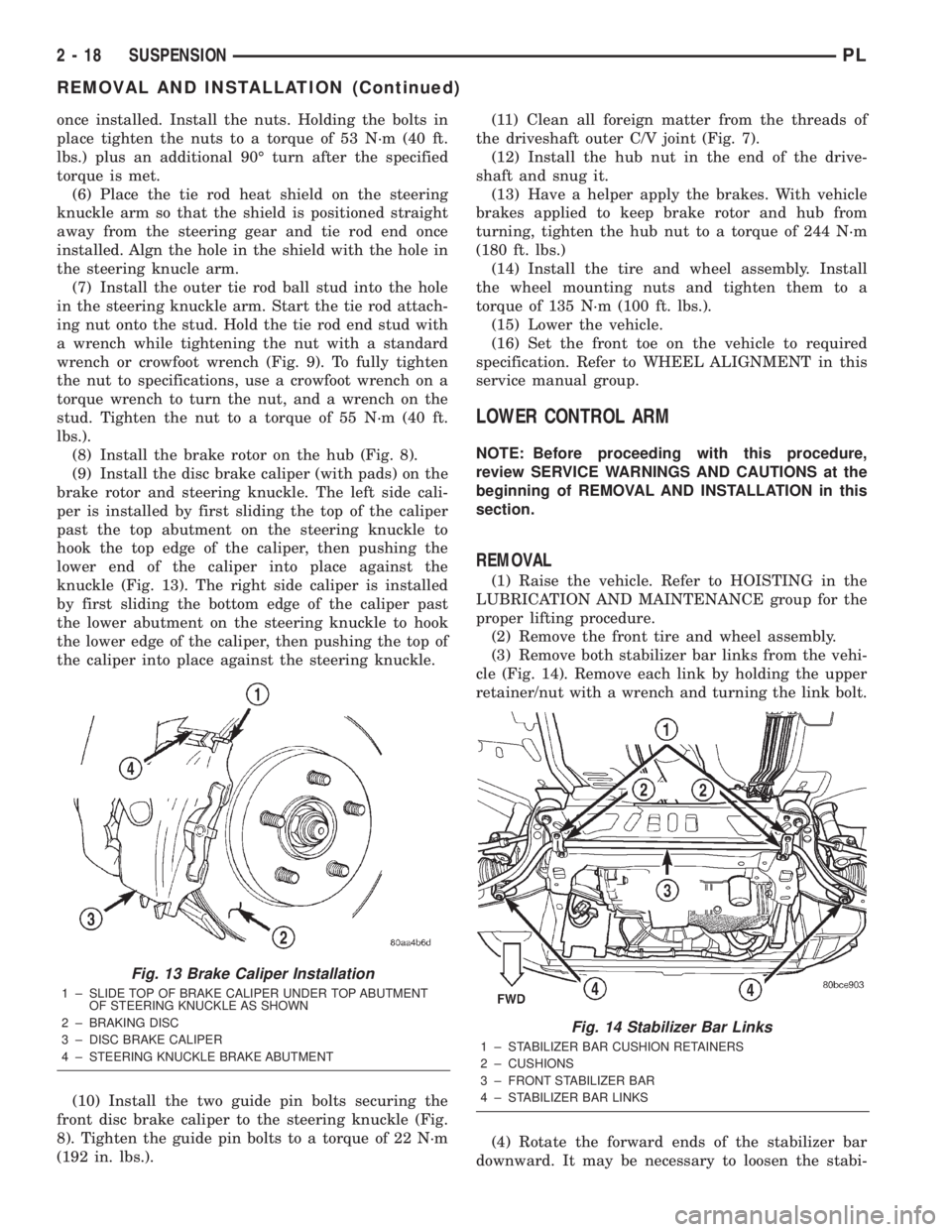
(8) Install the brake rotor on the hub (Fig. 8).
(9) Install the disc brake caliper (with pads) on the
brake rotor and steering knuckle. The left side cali-
per is installed by first sliding the top of the caliper
past the top abutment on the steering knuckle to
hook the top edge of the caliper, then pushing the
lower end of the caliper into place against the
knuckle (Fig. 13). The right side caliper is installed
by first sliding the bottom edge of the caliper past
the lower abutment on the steering knuckle to hook
the lower edge of the caliper, then pushing the top of
the caliper into place against the steering knuckle.
(10) Install the two guide pin bolts securing the
front disc brake caliper to the steering knuckle (Fig.
8). Tighten the guide pin bolts to a torque of 22 N´m
(192 in. lbs.).(11) Clean all foreign matter from the threads of
the driveshaft outer C/V joint (Fig. 7).
(12) Install the hub nut in the end of the drive-
shaft and snug it.
(13) Have a helper apply the brakes. With vehicle
brakes applied to keep brake rotor and hub from
turning, tighten the hub nut to a torque of 244 N´m
(180 ft. lbs.)
(14) Install the tire and wheel assembly. Install
the wheel mounting nuts and tighten them to a
torque of 135 N´m (100 ft. lbs.).
(15) Lower the vehicle.
(16) Set the front toe on the vehicle to required
specification. Refer to WHEEL ALIGNMENT in this
service manual group.
LOWER CONTROL ARM
NOTE: Before proceeding with this procedure,
review SERVICE WARNINGS AND CAUTIONS at the
beginning of REMOVAL AND INSTALLATION in this
section.
REMOVAL
(1) Raise the vehicle. Refer to HOISTING in the
LUBRICATION AND MAINTENANCE group for the
proper lifting procedure.
(2) Remove the front tire and wheel assembly.
(3) Remove both stabilizer bar links from the vehi-
cle (Fig. 14). Remove each link by holding the upper
retainer/nut with a wrench and turning the link bolt.
(4) Rotate the forward ends of the stabilizer bar
downward. It may be necessary to loosen the stabi-
Fig. 13 Brake Caliper Installation
1 ± SLIDE TOP OF BRAKE CALIPER UNDER TOP ABUTMENT
OF STEERING KNUCKLE AS SHOWN
2 ± BRAKING DISC
3 ± DISC BRAKE CALIPER
4 ± STEERING KNUCKLE BRAKE ABUTMENT
Fig. 14 Stabilizer Bar Links
1 ± STABILIZER BAR CUSHION RETAINERS
2 ± CUSHIONS
3 ± FRONT STABILIZER BAR
4 ± STABILIZER BAR LINKS
2 - 18 SUSPENSIONPL
REMOVAL AND INSTALLATION (Continued)
Page 31 of 1285
with the notch formed in the side of the ball joint
stud.
(4) If the right lower control arm has been ser-
viced, install the engine torque strut (Fig. 16). Follow
the procedure described in the ENGINE service man-
ual group to properly align and tighten the torque
strut.
(5) Install a new ball joint stud pinch bolt and nut
(Fig. 15). Tighten the nut to a torque of 95 N´m (70
ft. lbs.).
(6) Rotate the forward ends of the stabilizer bar
into mounting position.
(7) Install both stabilizer bar links back on vehicle
(Fig. 14). Start each stabilizer bar link bolt with
bushing from the bottom, through the stabilizer bar,
inner link bushings, lower control arm, and into the
upper retainer/nut and bushing (Fig. 1). Do not fully
tighten the link assemblies at this time.
(8) Lower the vehicle to ground level.
NOTE: It may be necessary to put the vehicle on a
platform hoist or alignment rack to gain access to
the stabilizer bar mounting bolts with the vehicle at
curb height.
(9) Tighten each stabilizer bar link by holding the
upper retainer/nut with a wrench and turning the
link bolt. Tighten each link bolt to a torque of 23
N´m (200 in. lbs.).
(10) If previously loosened, tighten the stabilizer
bar cushion retainer bolts to a torque of 28 N´m (250
in. lbs.).
STABILIZER BAR (FRONT)
NOTE: Before proceeding with this procedure,
review SERVICE WARNINGS AND CAUTIONS at the
beginning of REMOVAL AND INSTALLATION in this
section.
REMOVAL
(1) Raise the vehicle. Refer to HOISTING in the
LUBRICATION AND MAINTENANCE group for the
proper lifting procedure.
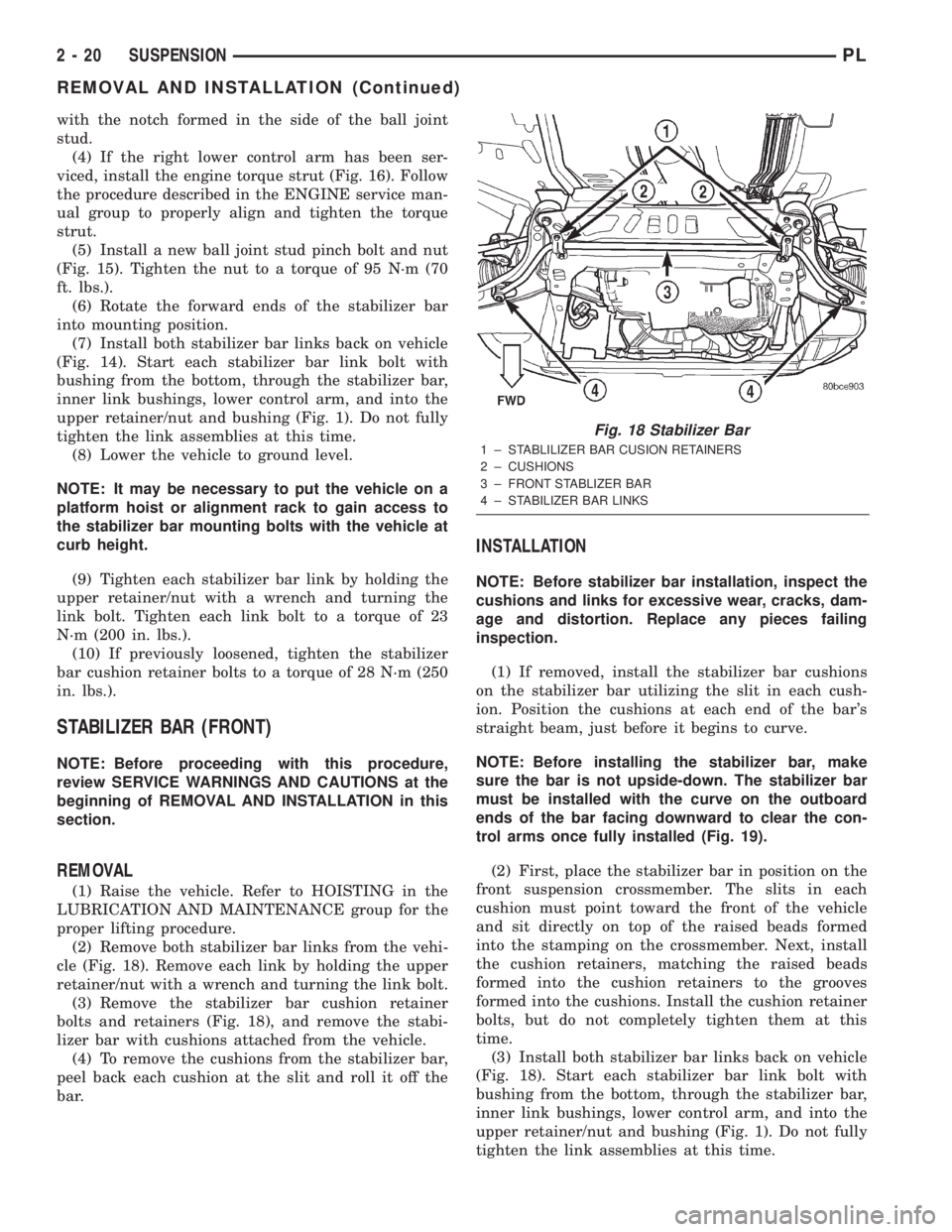
(2) Remove both stabilizer bar links from the vehi-
cle (Fig. 18). Remove each link by holding the upper
retainer/nut with a wrench and turning the link bolt.
(3) Remove the stabilizer bar cushion retainer
bolts and retainers (Fig. 18), and remove the stabi-
lizer bar with cushions attached from the vehicle.
(4) To remove the cushions from the stabilizer bar,
peel back each cushion at the slit and roll it off the
bar.
INSTALLATION
NOTE: Before stabilizer bar installation, inspect the
cushions and links for excessive wear, cracks, dam-
age and distortion. Replace any pieces failing
inspection.
(1) If removed, install the stabilizer bar cushions
on the stabilizer bar utilizing the slit in each cush-
ion. Position the cushions at each end of the bar's
straight beam, just before it begins to curve.
NOTE: Before installing the stabilizer bar, make
sure the bar is not upside-down. The stabilizer bar
must be installed with the curve on the outboard
ends of the bar facing downward to clear the con-
trol arms once fully installed (Fig. 19).
(2) First, place the stabilizer bar in position on the
front suspension crossmember. The slits in each
cushion must point toward the front of the vehicle
and sit directly on top of the raised beads formed
into the stamping on the crossmember. Next, install
the cushion retainers, matching the raised beads
formed into the cushion retainers to the grooves
formed into the cushions. Install the cushion retainer
bolts, but do not completely tighten them at this
time.
(3) Install both stabilizer bar links back on vehicle
(Fig. 18). Start each stabilizer bar link bolt with
bushing from the bottom, through the stabilizer bar,
inner link bushings, lower control arm, and into the
upper retainer/nut and bushing (Fig. 1). Do not fully
tighten the link assemblies at this time.
Fig. 18 Stabilizer Bar
1 ± STABLILIZER BAR CUSION RETAINERS
2 ± CUSHIONS
3 ± FRONT STABLIZER BAR
4 ± STABILIZER BAR LINKS
2 - 20 SUSPENSIONPL
REMOVAL AND INSTALLATION (Continued)
Page 42 of 1285
ball joint bottoms against the lower control arm ball
joint bore. Do not apply excessive pressure against
ball joint and lower control arm once the ball joint
bottoms.
(5) Remove the tools and arm from the hydraulic
press.
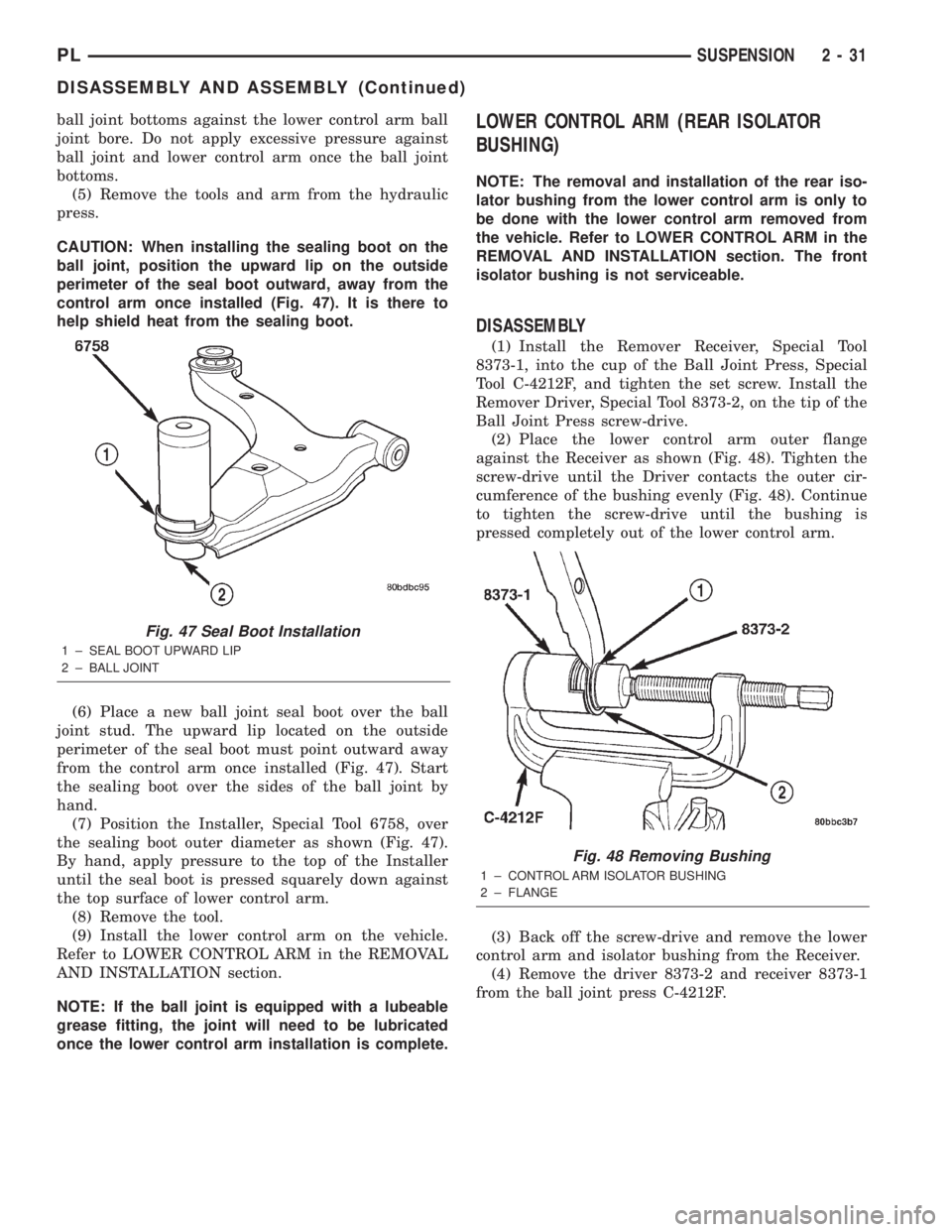
CAUTION: When installing the sealing boot on the
ball joint, position the upward lip on the outside
perimeter of the seal boot outward, away from the
control arm once installed (Fig. 47). It is there to
help shield heat from the sealing boot.
(6) Place a new ball joint seal boot over the ball
joint stud. The upward lip located on the outside
perimeter of the seal boot must point outward away
from the control arm once installed (Fig. 47). Start
the sealing boot over the sides of the ball joint by
hand.
(7) Position the Installer, Special Tool 6758, over
the sealing boot outer diameter as shown (Fig. 47).
By hand, apply pressure to the top of the Installer
until the seal boot is pressed squarely down against
the top surface of lower control arm.
(8) Remove the tool.
(9) Install the lower control arm on the vehicle.
Refer to LOWER CONTROL ARM in the REMOVAL
AND INSTALLATION section.
NOTE: If the ball joint is equipped with a lubeable
grease fitting, the joint will need to be lubricated
once the lower control arm installation is complete.LOWER CONTROL ARM (REAR ISOLATOR
BUSHING)
NOTE: The removal and installation of the rear iso-
lator bushing from the lower control arm is only to
be done with the lower control arm removed from
the vehicle. Refer to LOWER CONTROL ARM in the
REMOVAL AND INSTALLATION section. The front
isolator bushing is not serviceable.
DISASSEMBLY
(1) Install the Remover Receiver, Special Tool
8373-1, into the cup of the Ball Joint Press, Special
Tool C-4212F, and tighten the set screw. Install the
Remover Driver, Special Tool 8373-2, on the tip of the
Ball Joint Press screw-drive.
(2) Place the lower control arm outer flange
against the Receiver as shown (Fig. 48). Tighten the
screw-drive until the Driver contacts the outer cir-
cumference of the bushing evenly (Fig. 48). Continue
to tighten the screw-drive until the bushing is
pressed completely out of the lower control arm.
(3) Back off the screw-drive and remove the lower
control arm and isolator bushing from the Receiver.
(4) Remove the driver 8373-2 and receiver 8373-1
from the ball joint press C-4212F.
Fig. 47 Seal Boot Installation
1 ± SEAL BOOT UPWARD LIP
2 ± BALL JOINT
Fig. 48 Removing Bushing
1 ± CONTROL ARM ISOLATOR BUSHING
2 ± FLANGE
PLSUSPENSION 2 - 31
DISASSEMBLY AND ASSEMBLY (Continued)
Page 43 of 1285
ASSEMBLY
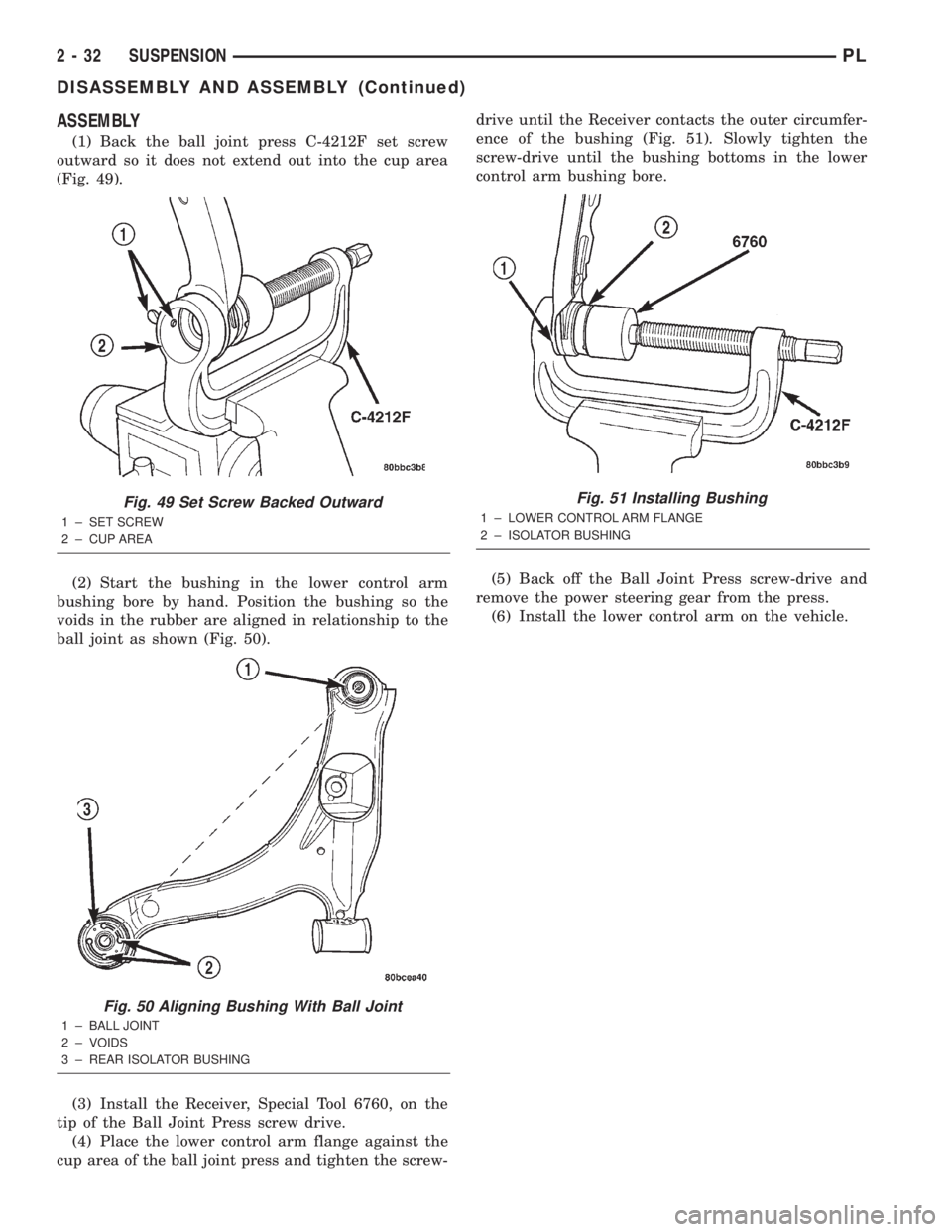
(1) Back the ball joint press C-4212F set screw
outward so it does not extend out into the cup area
(Fig. 49).
(2) Start the bushing in the lower control arm
bushing bore by hand. Position the bushing so the
voids in the rubber are aligned in relationship to the
ball joint as shown (Fig. 50).
(3) Install the Receiver, Special Tool 6760, on the
tip of the Ball Joint Press screw drive.
(4) Place the lower control arm flange against the
cup area of the ball joint press and tighten the screw-drive until the Receiver contacts the outer circumfer-
ence of the bushing (Fig. 51). Slowly tighten the
screw-drive until the bushing bottoms in the lower
control arm bushing bore.
(5) Back off the Ball Joint Press screw-drive and
remove the power steering gear from the press.
(6) Install the lower control arm on the vehicle.
Fig. 49 Set Screw Backed Outward
1 ± SET SCREW
2 ± CUP AREA
Fig. 50 Aligning Bushing With Ball Joint
1 ± BALL JOINT
2 ± VOIDS
3 ± REAR ISOLATOR BUSHING
Fig. 51 Installing Bushing
1 ± LOWER CONTROL ARM FLANGE
2 ± ISOLATOR BUSHING
2 - 32 SUSPENSIONPL
DISASSEMBLY AND ASSEMBLY (Continued)
Page 52 of 1285
CAUTION: The strut-to-knuckle attaching bolts are
serrated and must not be turned during removal.
Hold the bolts stationary in the steering knuckle
while removing the nuts, then tap the bolts out
using a pin punch.
(7) Remove the two nuts and bolts attaching the
strut to the rear knuckle (Fig. 1).
(8) Lower the vehicle just enough to access the
luggage compartment without letting the tires touch
the floor. Access to rear upper strut mount attaching
bolts is through the luggage compartment.
(9) Open the deck lid.
(10) If equipped, remove the carpet from the top of
the strut tower.
(11) Loosen, but do not completely remove the 3
nuts securing the strut assembly to the strut tower
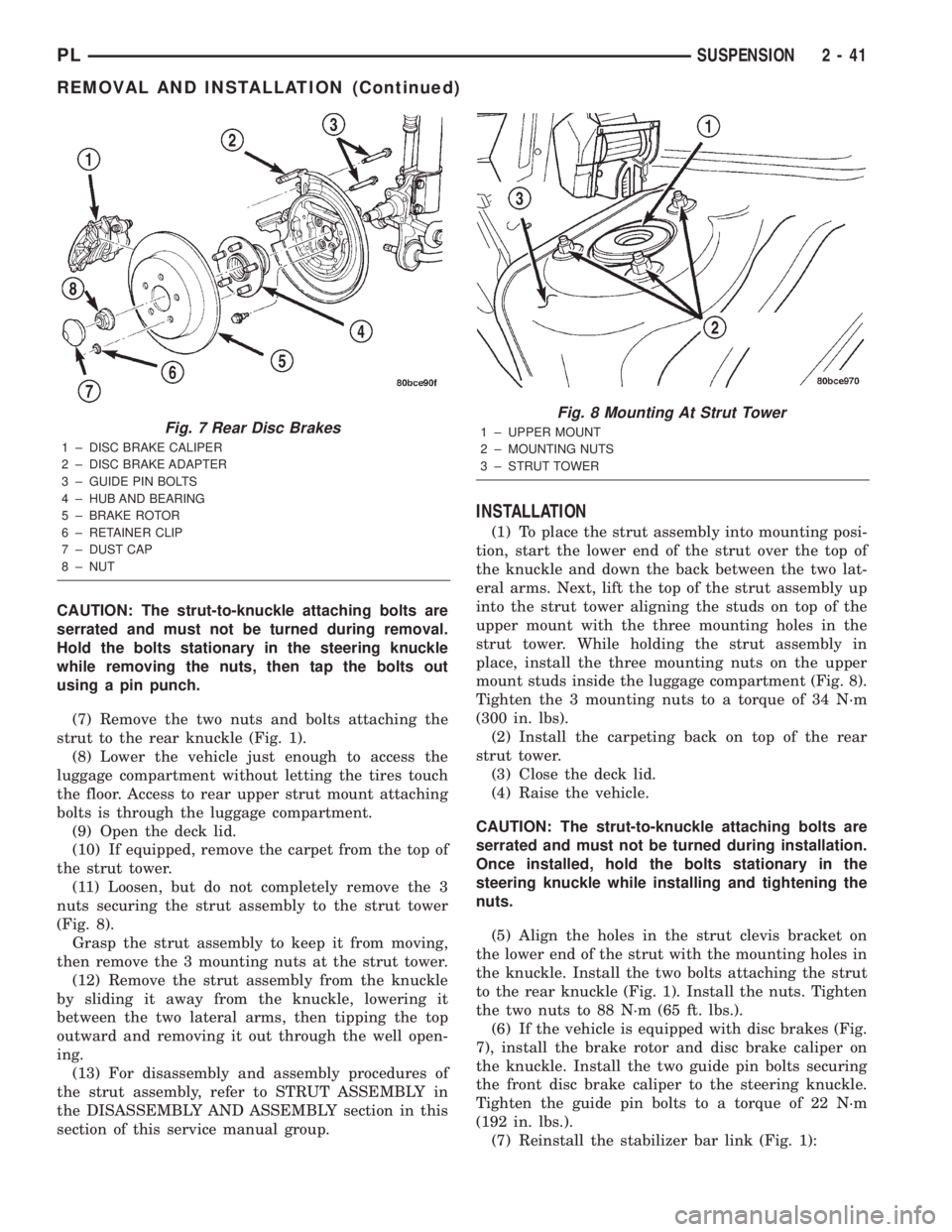
(Fig. 8).
Grasp the strut assembly to keep it from moving,
then remove the 3 mounting nuts at the strut tower.
(12) Remove the strut assembly from the knuckle
by sliding it away from the knuckle, lowering it
between the two lateral arms, then tipping the top
outward and removing it out through the well open-
ing.
(13) For disassembly and assembly procedures of
the strut assembly, refer to STRUT ASSEMBLY in
the DISASSEMBLY AND ASSEMBLY section in this
section of this service manual group.
INSTALLATION
(1) To place the strut assembly into mounting posi-
tion, start the lower end of the strut over the top of
the knuckle and down the back between the two lat-
eral arms. Next, lift the top of the strut assembly up
into the strut tower aligning the studs on top of the
upper mount with the three mounting holes in the
strut tower. While holding the strut assembly in
place, install the three mounting nuts on the upper
mount studs inside the luggage compartment (Fig. 8).
Tighten the 3 mounting nuts to a torque of 34 N´m
(300 in. lbs).
(2) Install the carpeting back on top of the rear
strut tower.
(3) Close the deck lid.
(4) Raise the vehicle.
CAUTION: The strut-to-knuckle attaching bolts are
serrated and must not be turned during installation.
Once installed, hold the bolts stationary in the
steering knuckle while installing and tightening the
nuts.
(5) Align the holes in the strut clevis bracket on
the lower end of the strut with the mounting holes in
the knuckle. Install the two bolts attaching the strut
to the rear knuckle (Fig. 1). Install the nuts. Tighten
the two nuts to 88 N´m (65 ft. lbs.).
(6) If the vehicle is equipped with disc brakes (Fig.
7), install the brake rotor and disc brake caliper on
the knuckle. Install the two guide pin bolts securing
the front disc brake caliper to the steering knuckle.
Tighten the guide pin bolts to a torque of 22 N´m
(192 in. lbs.).
(7) Reinstall the stabilizer bar link (Fig. 1):
Fig. 7 Rear Disc Brakes
1 ± DISC BRAKE CALIPER
2 ± DISC BRAKE ADAPTER
3 ± GUIDE PIN BOLTS
4 ± HUB AND BEARING
5 ± BRAKE ROTOR
6 ± RETAINER CLIP
7 ± DUST CAP
8 ± NUT
Fig. 8 Mounting At Strut Tower
1 ± UPPER MOUNT
2 ± MOUNTING NUTS
3 ± STRUT TOWER
PLSUSPENSION 2 - 41
REMOVAL AND INSTALLATION (Continued)
Page 53 of 1285
²Place the link center sleeve and bushings
between the eye in the end of the stabilizer bar and
the link mounting bracket on the strut.
²Start the stabilizer bar link bolt with bushing
from the top, down through the stabilizer bar, inner
link bushings and sleeve, and strut link mounting
bracket.
²Install a lower bushing, then the nut. Do not
tighten the nut at this time.
(8) If the vehicle is equipped with the antilock
brake system (ABS), install the screw securing the
ABS wheel speed sensor bracket to the rear of the
strut assembly (Fig. 6). Tighten the mounting screw
to a torque of 13 N´m (120 in. lbs.).
(9) If the vehicle is equipped with rear drum
brakes, install the screw securing the brake hose
bracket to the rear of the strut assembly (Fig. 5).
Tighten the screw to a torque of 31 N´m (275 in. lbs.).
(10) Install the tire and wheel assembly on vehicle.
Tighten the wheel mounting stud nuts in proper
sequence until all nuts are torqued to half specifica-
tion. Repeat the tightening sequence, this time, to
full specified torque of 135 N´m (100 ft. lbs.).
(11) Lower the vehicle to ground level.
(12) Tighten the stabilizer bar link nut to a torque
of 23 N´m (200 in. lbs.).
(13) Set the rear toe on the vehicle to the required
specification if necessary. Refer to WHEEL ALIGN-
MENT in this service manual group.
KNUCKLE (REAR)
NOTE: Before proceeding with this procedure,
review SERVICE WARNINGS AND CAUTIONS at the
beginning of REMOVAL AND INSTALLATION in this
section.
REMOVAL
(1) Raise the vehicle. Refer to HOISTING in the
LUBRICATION AND MAINTENANCE group for the
proper lifting procedure.
(2) Remove the rear wheel and tire assembly from
the vehicle.
(3) If the vehicle is equipped with rear drum
brakes, remove the screw securing the brake hose
bracket to the rear of the strut assembly (Fig. 5).
(4) If the vehicle is equipped with the antilock
brake system (ABS), remove the screw securing the
ABS wheel speed sensor bracket to the rear of the
strut assembly (Fig. 6).
(5) If the vehicle is equipped with rear drum
brakes, remove any retainer clips from the wheel
mounting studs, then pull the brake drum off the
hub and bearing.
(6) If the vehicle is equipped with rear disc brakes
(Fig. 7), perform the following:²Remove the two guide pin bolts securing the
front disc brake caliper to the steering knuckle.
²Remove the disc brake caliper from the knuckle
and brake rotor.
²Hang the caliper out of the way using a wire
hanger or cord. Do not support the caliper by letting
it hang by the hydraulic hose.
²Remove any retainer clips from the wheel
mounting studs, then pull the brake rotor off the hub
and bearing.
(7) Remove the dust cap from the hub and bearing
assembly (Fig. 7).
(8) Remove the retaining nut, then the hub and
bearing from the knuckle's spindle (Fig. 7).
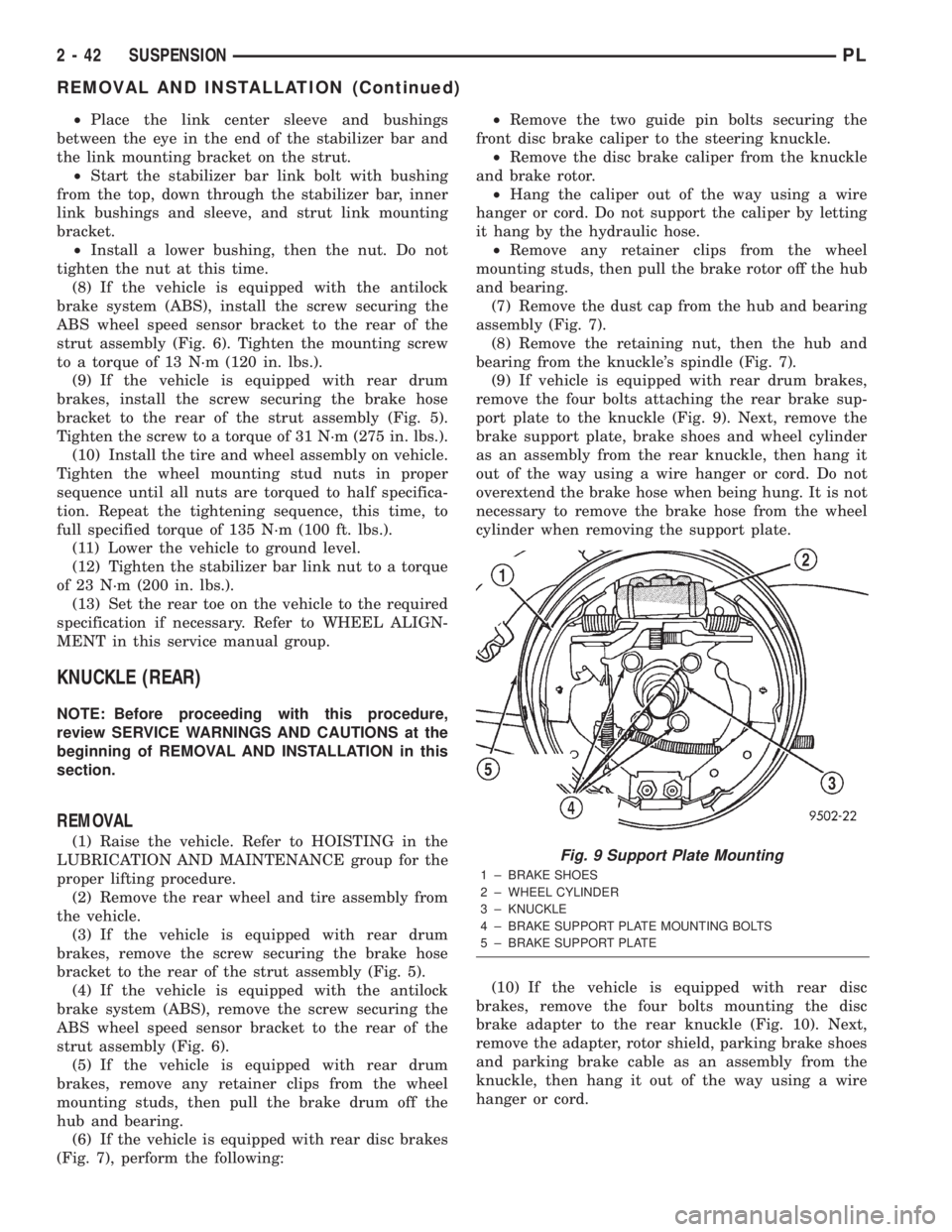
(9) If vehicle is equipped with rear drum brakes,
remove the four bolts attaching the rear brake sup-
port plate to the knuckle (Fig. 9). Next, remove the
brake support plate, brake shoes and wheel cylinder
as an assembly from the rear knuckle, then hang it
out of the way using a wire hanger or cord. Do not
overextend the brake hose when being hung. It is not
necessary to remove the brake hose from the wheel
cylinder when removing the support plate.
(10) If the vehicle is equipped with rear disc
brakes, remove the four bolts mounting the disc
brake adapter to the rear knuckle (Fig. 10). Next,
remove the adapter, rotor shield, parking brake shoes
and parking brake cable as an assembly from the
knuckle, then hang it out of the way using a wire
hanger or cord.Fig. 9 Support Plate Mounting
1 ± BRAKE SHOES
2 ± WHEEL CYLINDER
3 ± KNUCKLE
4 ± BRAKE SUPPORT PLATE MOUNTING BOLTS
5 ± BRAKE SUPPORT PLATE
2 - 42 SUSPENSIONPL
REMOVAL AND INSTALLATION (Continued)