No start DODGE NEON 2000 Service User Guide
[x] Cancel search | Manufacturer: DODGE, Model Year: 2000, Model line: NEON, Model: DODGE NEON 2000Pages: 1285, PDF Size: 29.42 MB
Page 54 of 1285
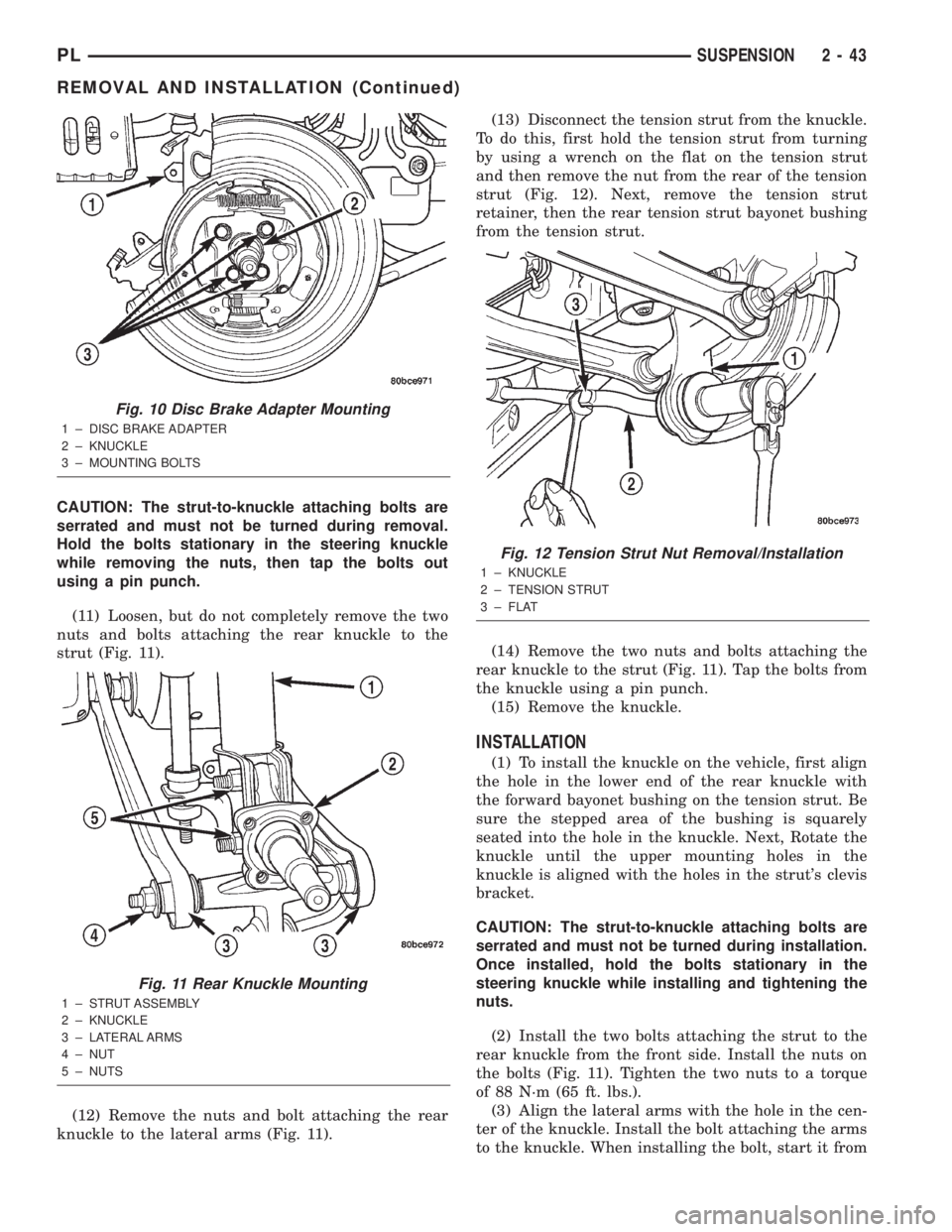
CAUTION: The strut-to-knuckle attaching bolts are
serrated and must not be turned during removal.
Hold the bolts stationary in the steering knuckle
while removing the nuts, then tap the bolts out
using a pin punch.
(11) Loosen, but do not completely remove the two
nuts and bolts attaching the rear knuckle to the
strut (Fig. 11).
(12) Remove the nuts and bolt attaching the rear
knuckle to the lateral arms (Fig. 11).(13) Disconnect the tension strut from the knuckle.
To do this, first hold the tension strut from turning
by using a wrench on the flat on the tension strut
and then remove the nut from the rear of the tension
strut (Fig. 12). Next, remove the tension strut
retainer, then the rear tension strut bayonet bushing
from the tension strut.
(14) Remove the two nuts and bolts attaching the
rear knuckle to the strut (Fig. 11). Tap the bolts from
the knuckle using a pin punch.
(15) Remove the knuckle.
INSTALLATION
(1) To install the knuckle on the vehicle, first align
the hole in the lower end of the rear knuckle with
the forward bayonet bushing on the tension strut. Be
sure the stepped area of the bushing is squarely
seated into the hole in the knuckle. Next, Rotate the
knuckle until the upper mounting holes in the
knuckle is aligned with the holes in the strut's clevis
bracket.
CAUTION: The strut-to-knuckle attaching bolts are
serrated and must not be turned during installation.
Once installed, hold the bolts stationary in the
steering knuckle while installing and tightening the
nuts.
(2) Install the two bolts attaching the strut to the
rear knuckle from the front side. Install the nuts on
the bolts (Fig. 11). Tighten the two nuts to a torque
of 88 N´m (65 ft. lbs.).
(3) Align the lateral arms with the hole in the cen-
ter of the knuckle. Install the bolt attaching the arms
to the knuckle. When installing the bolt, start it from
Fig. 10 Disc Brake Adapter Mounting
1 ± DISC BRAKE ADAPTER
2 ± KNUCKLE
3 ± MOUNTING BOLTS
Fig. 11 Rear Knuckle Mounting
1 ± STRUT ASSEMBLY
2 ± KNUCKLE
3 ± LATERAL ARMS
4 ± NUT
5 ± NUTS
Fig. 12 Tension Strut Nut Removal/Installation
1 ± KNUCKLE
2 ± TENSION STRUT
3 ± FLAT
PLSUSPENSION 2 - 43
REMOVAL AND INSTALLATION (Continued)
Page 58 of 1285
nuts are torqued to half specification. Repeat the
tightening sequence, this time, to full specified
torque of 135 N´m (100 ft. lbs.).
(8) Lower the vehicle to ground level.
(9) Set the rear toe on the vehicle to the required
specification if necessary. Refer to WHEEL ALIGN-
MENT in this service manual group.
STABILIZER BAR (REAR)
NOTE: Before proceeding with this procedure,
review SERVICE WARNINGS AND CAUTIONS at the
beginning of REMOVAL AND INSTALLATION in this
section.
REMOVAL
(1) Raise the vehicle. Refer to HOISTING in the
LUBRICATION AND MAINTENANCE group for the
proper lifting procedure.
(2) Remove both rear wheel and tire assemblies
from the vehicle.
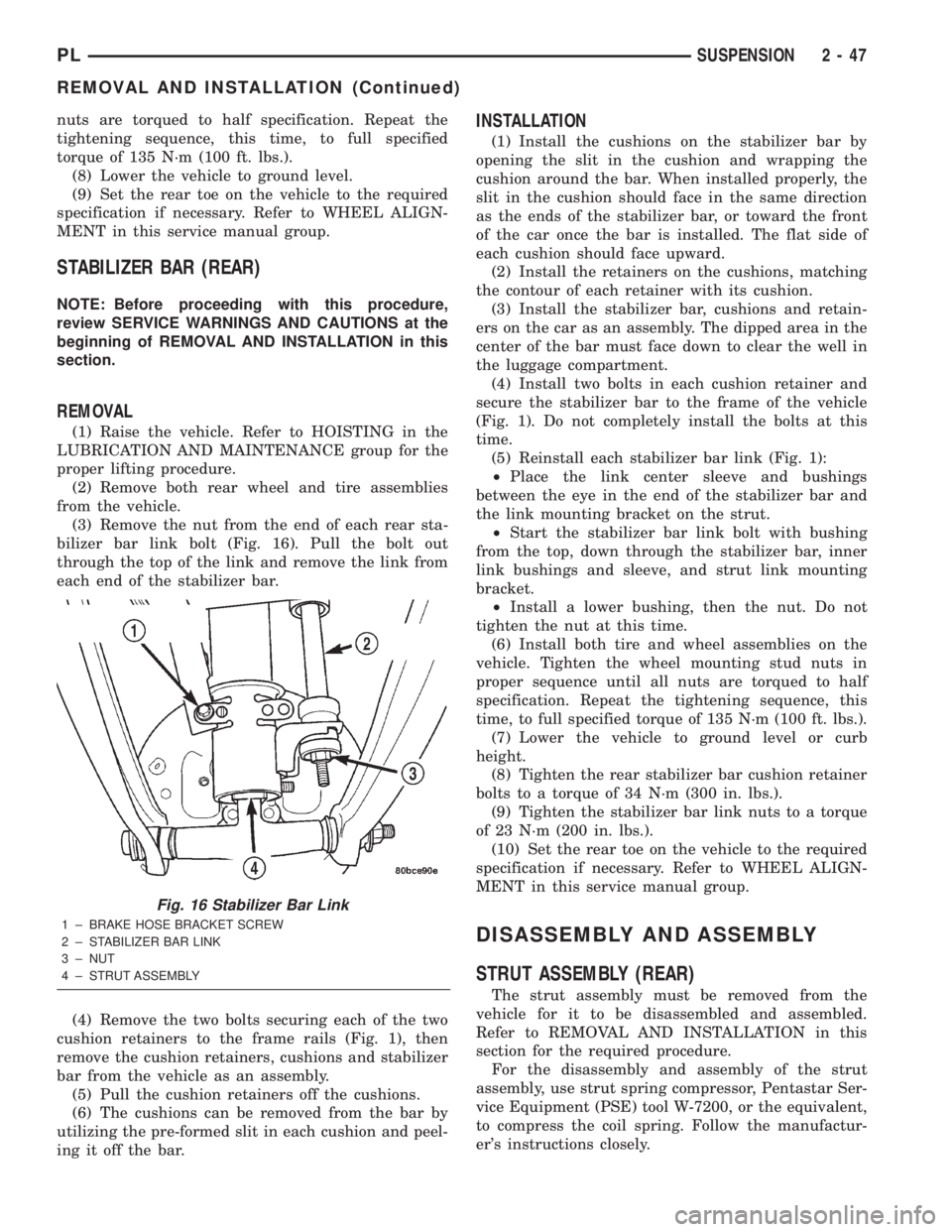
(3) Remove the nut from the end of each rear sta-
bilizer bar link bolt (Fig. 16). Pull the bolt out
through the top of the link and remove the link from
each end of the stabilizer bar.
(4) Remove the two bolts securing each of the two
cushion retainers to the frame rails (Fig. 1), then
remove the cushion retainers, cushions and stabilizer
bar from the vehicle as an assembly.
(5) Pull the cushion retainers off the cushions.
(6) The cushions can be removed from the bar by
utilizing the pre-formed slit in each cushion and peel-
ing it off the bar.
INSTALLATION
(1) Install the cushions on the stabilizer bar by
opening the slit in the cushion and wrapping the
cushion around the bar. When installed properly, the
slit in the cushion should face in the same direction
as the ends of the stabilizer bar, or toward the front
of the car once the bar is installed. The flat side of
each cushion should face upward.
(2) Install the retainers on the cushions, matching
the contour of each retainer with its cushion.
(3) Install the stabilizer bar, cushions and retain-
ers on the car as an assembly. The dipped area in the
center of the bar must face down to clear the well in
the luggage compartment.
(4) Install two bolts in each cushion retainer and
secure the stabilizer bar to the frame of the vehicle
(Fig. 1). Do not completely install the bolts at this
time.
(5) Reinstall each stabilizer bar link (Fig. 1):
²Place the link center sleeve and bushings
between the eye in the end of the stabilizer bar and
the link mounting bracket on the strut.
²Start the stabilizer bar link bolt with bushing
from the top, down through the stabilizer bar, inner
link bushings and sleeve, and strut link mounting
bracket.
²Install a lower bushing, then the nut. Do not
tighten the nut at this time.
(6) Install both tire and wheel assemblies on the
vehicle. Tighten the wheel mounting stud nuts in
proper sequence until all nuts are torqued to half
specification. Repeat the tightening sequence, this
time, to full specified torque of 135 N´m (100 ft. lbs.).
(7) Lower the vehicle to ground level or curb
height.
(8) Tighten the rear stabilizer bar cushion retainer
bolts to a torque of 34 N´m (300 in. lbs.).
(9) Tighten the stabilizer bar link nuts to a torque
of 23 N´m (200 in. lbs.).
(10) Set the rear toe on the vehicle to the required
specification if necessary. Refer to WHEEL ALIGN-
MENT in this service manual group.
DISASSEMBLY AND ASSEMBLY
STRUT ASSEMBLY (REAR)
The strut assembly must be removed from the
vehicle for it to be disassembled and assembled.
Refer to REMOVAL AND INSTALLATION in this
section for the required procedure.
For the disassembly and assembly of the strut
assembly, use strut spring compressor, Pentastar Ser-
vice Equipment (PSE) tool W-7200, or the equivalent,
to compress the coil spring. Follow the manufactur-
er's instructions closely.
Fig. 16 Stabilizer Bar Link
1 ± BRAKE HOSE BRACKET SCREW
2 ± STABILIZER BAR LINK
3 ± NUT
4 ± STRUT ASSEMBLY
PLSUSPENSION 2 - 47
REMOVAL AND INSTALLATION (Continued)
Page 75 of 1285
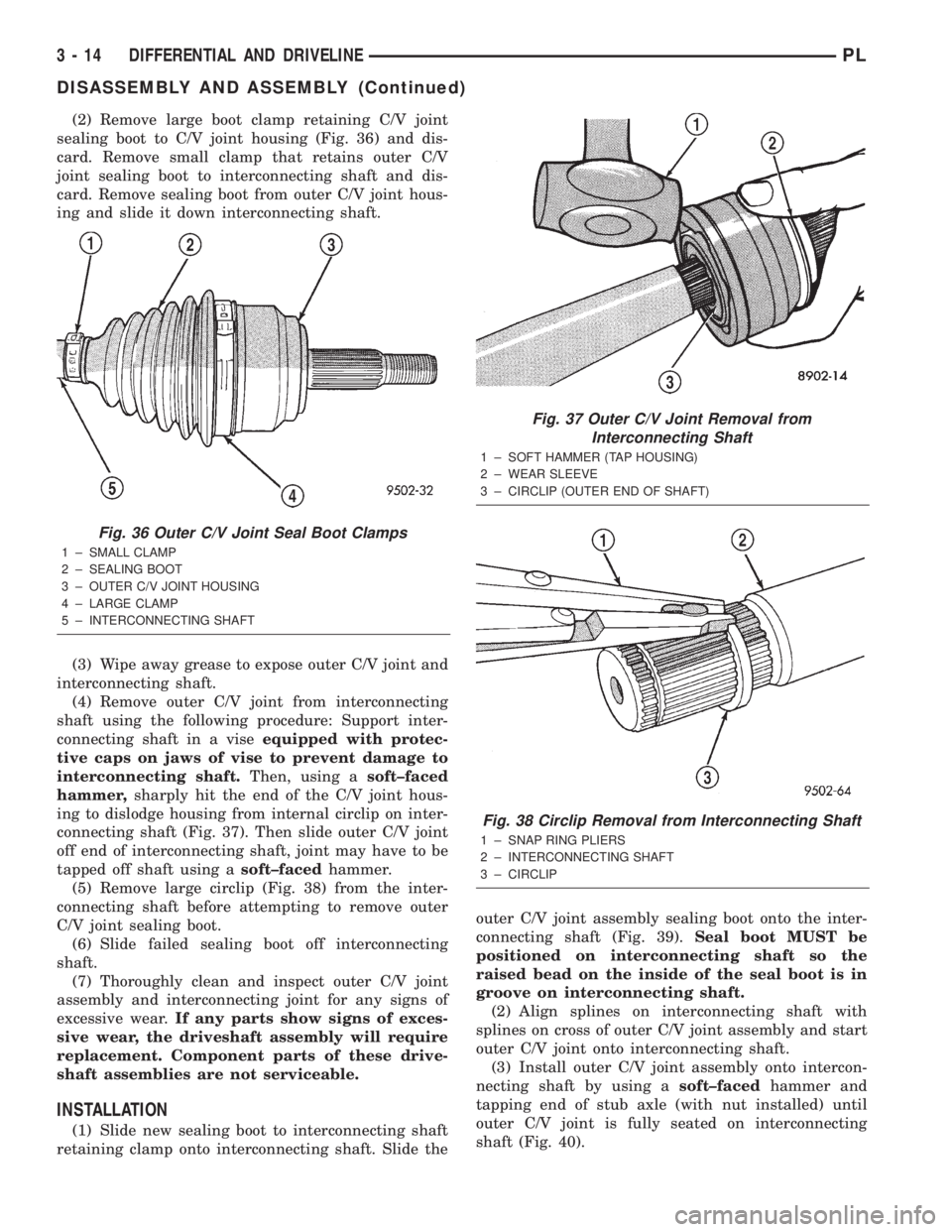
(2) Remove large boot clamp retaining C/V joint
sealing boot to C/V joint housing (Fig. 36) and dis-
card. Remove small clamp that retains outer C/V
joint sealing boot to interconnecting shaft and dis-
card. Remove sealing boot from outer C/V joint hous-
ing and slide it down interconnecting shaft.
(3) Wipe away grease to expose outer C/V joint and
interconnecting shaft.
(4) Remove outer C/V joint from interconnecting
shaft using the following procedure: Support inter-
connecting shaft in a viseequipped with protec-
tive caps on jaws of vise to prevent damage to
interconnecting shaft.Then, using asoft±faced
hammer,sharply hit the end of the C/V joint hous-
ing to dislodge housing from internal circlip on inter-
connecting shaft (Fig. 37). Then slide outer C/V joint
off end of interconnecting shaft, joint may have to be
tapped off shaft using asoft±facedhammer.
(5) Remove large circlip (Fig. 38) from the inter-
connecting shaft before attempting to remove outer
C/V joint sealing boot.
(6) Slide failed sealing boot off interconnecting
shaft.
(7) Thoroughly clean and inspect outer C/V joint
assembly and interconnecting joint for any signs of
excessive wear.If any parts show signs of exces-
sive wear, the driveshaft assembly will require
replacement. Component parts of these drive-
shaft assemblies are not serviceable.
INSTALLATION
(1) Slide new sealing boot to interconnecting shaft
retaining clamp onto interconnecting shaft. Slide theouter C/V joint assembly sealing boot onto the inter-
connecting shaft (Fig. 39).Seal boot MUST be
positioned on interconnecting shaft so the
raised bead on the inside of the seal boot is in
groove on interconnecting shaft.
(2) Align splines on interconnecting shaft with
splines on cross of outer C/V joint assembly and start
outer C/V joint onto interconnecting shaft.
(3) Install outer C/V joint assembly onto intercon-
necting shaft by using asoft±facedhammer and
tapping end of stub axle (with nut installed) until
outer C/V joint is fully seated on interconnecting
shaft (Fig. 40).
Fig. 36 Outer C/V Joint Seal Boot Clamps
1 ± SMALL CLAMP
2 ± SEALING BOOT
3 ± OUTER C/V JOINT HOUSING
4 ± LARGE CLAMP
5 ± INTERCONNECTING SHAFT
Fig. 37 Outer C/V Joint Removal from
Interconnecting Shaft
1 ± SOFT HAMMER (TAP HOUSING)
2 ± WEAR SLEEVE
3 ± CIRCLIP (OUTER END OF SHAFT)
Fig. 38 Circlip Removal from Interconnecting Shaft
1 ± SNAP RING PLIERS
2 ± INTERCONNECTING SHAFT
3 ± CIRCLIP
3 - 14 DIFFERENTIAL AND DRIVELINEPL
DISASSEMBLY AND ASSEMBLY (Continued)
Page 90 of 1285
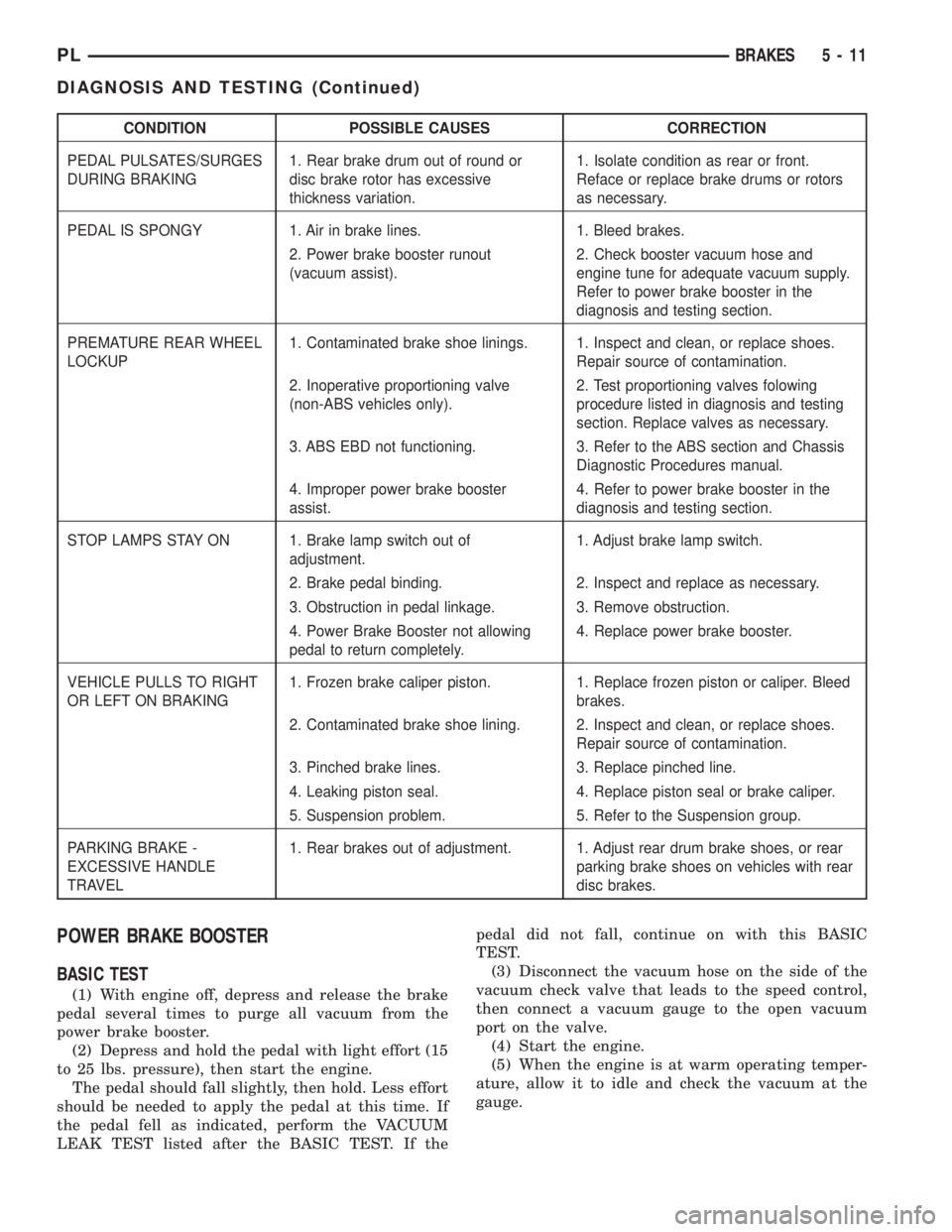
CONDITION POSSIBLE CAUSES CORRECTION
PEDAL PULSATES/SURGES
DURING BRAKING1. Rear brake drum out of round or
disc brake rotor has excessive
thickness variation.1. Isolate condition as rear or front.
Reface or replace brake drums or rotors
as necessary.
PEDAL IS SPONGY 1. Air in brake lines. 1. Bleed brakes.
2. Power brake booster runout
(vacuum assist).2. Check booster vacuum hose and
engine tune for adequate vacuum supply.
Refer to power brake booster in the
diagnosis and testing section.
PREMATURE REAR WHEEL
LOCKUP1. Contaminated brake shoe linings. 1. Inspect and clean, or replace shoes.
Repair source of contamination.
2. Inoperative proportioning valve
(non-ABS vehicles only).2. Test proportioning valves folowing
procedure listed in diagnosis and testing
section. Replace valves as necessary.
3. ABS EBD not functioning. 3. Refer to the ABS section and Chassis
Diagnostic Procedures manual.
4. Improper power brake booster
assist.4. Refer to power brake booster in the
diagnosis and testing section.
STOP LAMPS STAY ON 1. Brake lamp switch out of
adjustment.1. Adjust brake lamp switch.
2. Brake pedal binding. 2. Inspect and replace as necessary.
3. Obstruction in pedal linkage. 3. Remove obstruction.
4. Power Brake Booster not allowing
pedal to return completely.4. Replace power brake booster.
VEHICLE PULLS TO RIGHT
OR LEFT ON BRAKING1. Frozen brake caliper piston. 1. Replace frozen piston or caliper. Bleed
brakes.
2. Contaminated brake shoe lining. 2. Inspect and clean, or replace shoes.
Repair source of contamination.
3. Pinched brake lines. 3. Replace pinched line.
4. Leaking piston seal. 4. Replace piston seal or brake caliper.
5. Suspension problem. 5. Refer to the Suspension group.
PARKING BRAKE -
EXCESSIVE HANDLE
TRAVEL1. Rear brakes out of adjustment. 1. Adjust rear drum brake shoes, or rear
parking brake shoes on vehicles with rear
disc brakes.
POWER BRAKE BOOSTER
BASIC TEST
(1) With engine off, depress and release the brake
pedal several times to purge all vacuum from the
power brake booster.
(2) Depress and hold the pedal with light effort (15
to 25 lbs. pressure), then start the engine.
The pedal should fall slightly, then hold. Less effort
should be needed to apply the pedal at this time. If
the pedal fell as indicated, perform the VACUUM
LEAK TEST listed after the BASIC TEST. If thepedal did not fall, continue on with this BASIC
TEST.
(3) Disconnect the vacuum hose on the side of the
vacuum check valve that leads to the speed control,
then connect a vacuum gauge to the open vacuum
port on the valve.
(4) Start the engine.
(5) When the engine is at warm operating temper-
ature, allow it to idle and check the vacuum at the
gauge.
PLBRAKES 5 - 11
DIAGNOSIS AND TESTING (Continued)
Page 91 of 1285
If the vacuum supply is 12 inches Hg (40.5 kPa) or
more, the power brake booster is defective and must
be replaced. If the vacuum supply is below 12 inches,
continue on with this BASIC TEST.
(6) Shut off the engine.
(7) Connect the vacuum gauge to the vacuum ref-
erence port on the engine intake manifold.
(8)
Start the engine and observe the vacuum gauge.
If the vacuum is still low, check the engine tune
and repair as necessary. If the vacuum is above 12
inches, the hose or check to the booster has a restric-
tion or leak.
Once an adequate vacuum supply is obtained,
repeat the BASIC TEST.
VACUUM LEAK TEST
(1) Disconnect the vacuum hose on the side of the
power brake booster vacuum check valve that leads
to the speed control, then connect a vacuum gauge to
the open vacuum port on the valve.
(2) Remove the remaining hose on the vacuum
check valve that is not the vacuum supply hose com-
ing from the intake manifold. Cap off the open port
on the check valve.
(3) Start the engine.
(4) Allow the engine to warm up to normal operat-
ing temperature and engine idle.
(5) Using vacuum line pliers, close off the vacuum
supply hose near the booster and observe the vacuum
gauge.
If the vacuum drop exceeds 1.0 inch Hg (3.3 kPa)
in one minute, repeat the above steps to confirm the
reading. The vacuum loss should be less than 1.0
inch Hg in one minute time span. If the loss is more
than 1.0 inch Hg, replace the power brake booster. If
it is not, continue on with this test.
(6) Remove the pliers from the hose temporarily.
(7) Apply light effort (approximately 15 lbs. of
force) to the brake pedal and hold the pedal steady.
Do not move the pedal once the pressure is applied
or the test results may vary.
(8) Have an assistant reattach the pliers to the
vacuum supply hose.
(9) Allow 5 seconds for stabilization, then observe
the vacuum gauge.
If the vacuum drop exceeds 3.0 inches Hg (10 kPa)
in 15 seconds, repeat the above steps to confirm the
reading. The vacuum loss should be less than 3.0
inches Hg in 15 seconds time span. If the loss is
more than 3.0 inches Hg, replace the power brake
booster. If it is not, the booster is not defective.
DRUM BRAKE AUTOMATIC ADJUSTER
To properly test the drum brake automatic
adjuster, the aide of a helper inside the vehicle to
apply the brakes will be necessary.(1) Raise the vehicle. Refer to HOISTING in the
LUBRICATION AND MAINTENANCE group for the
proper lifting procedure.
(2) Remove the access plug from the rear adjust-
ment slot in each brake support plate.
(3) Insert a thin screwdriver in the adjustment
slot and push back the adjustment lever. With the
lever in this position, back the star wheel adjustment
off approximately 10 notches. This will eliminate the
possibility that the brake is at full adjustment, and
can be adjusted no further.
(4)
Remove the screwdriver from the adjustment slot.
(5) Watch the star wheel through the adjustment
slot, while a helper applies the brake pedal. As the
brake shoes apply, the adjustment lever should move
downward, turning the star wheel. A definite rotation
of the adjuster star wheel can be observed if the
automatic adjuster is working properly.
If the star wheel does not move as indicated, the
brake drum needs to be removed and further inspec-
tion of the rear brakes is necessary.
(6) If the star wheel is operating properly, readjust
the brakes. Refer to ADJUSTMENTS in this section
of this service manual group.
(7) Reinstall the adjustment slot access plug.
(8) Lower the vehicle.
BRAKE ROTOR
Any servicing of the rotor requires extreme care to
maintain the rotor within service tolerances to
ensure proper brake action.
Excessive runout or wobble in a rotor can increase
pedal travel due to piston knock-back. This increases
guide pin sleeve wear due to the tendency of the cal-
iper to follow the rotor wobble.
When diagnosing a brake noise or pulsation, the
machined disc braking surface should be checked and
inspected.
BRAKING SURFACE INSPECTION
Light braking surface scoring and wear is accept-
able. If heavy scoring or warping is evident, the rotor
must be refaced or replaced. Refer to SERVICE PRO-
CEDURES in this section of this group for informa-
tion on brake rotor machining.
Excessive wear and scoring of the rotor can cause
improper lining contact on the rotor's braking sur-
face. If the ridges on the rotor are not removed before
new brake shoes are installed, improper wear of the
shoes will result.
If a vehicle has not been driven for a period of
time, the rotor's braking surface will rust in the
areas not covered by the brake shoes at that time.
Once the vehicle is driven, noise and chatter from
the disc brakes can result when the brakes are
applied.
5 - 12 BRAKESPL
DIAGNOSIS AND TESTING (Continued)
Page 118 of 1285
(1) Completely retract the caliper piston back into
piston bore of the caliper.
(2) Lubricate both adapter caliper slide abutments
with a liberal amount of MopartMultipurpose Lubri-
cant, or an equivalent.
CAUTION: Use care when installing the caliper
assembly onto adapter so the guide pin bushings
and sleeves do not get damaged by the mounting
bosses on adapter.
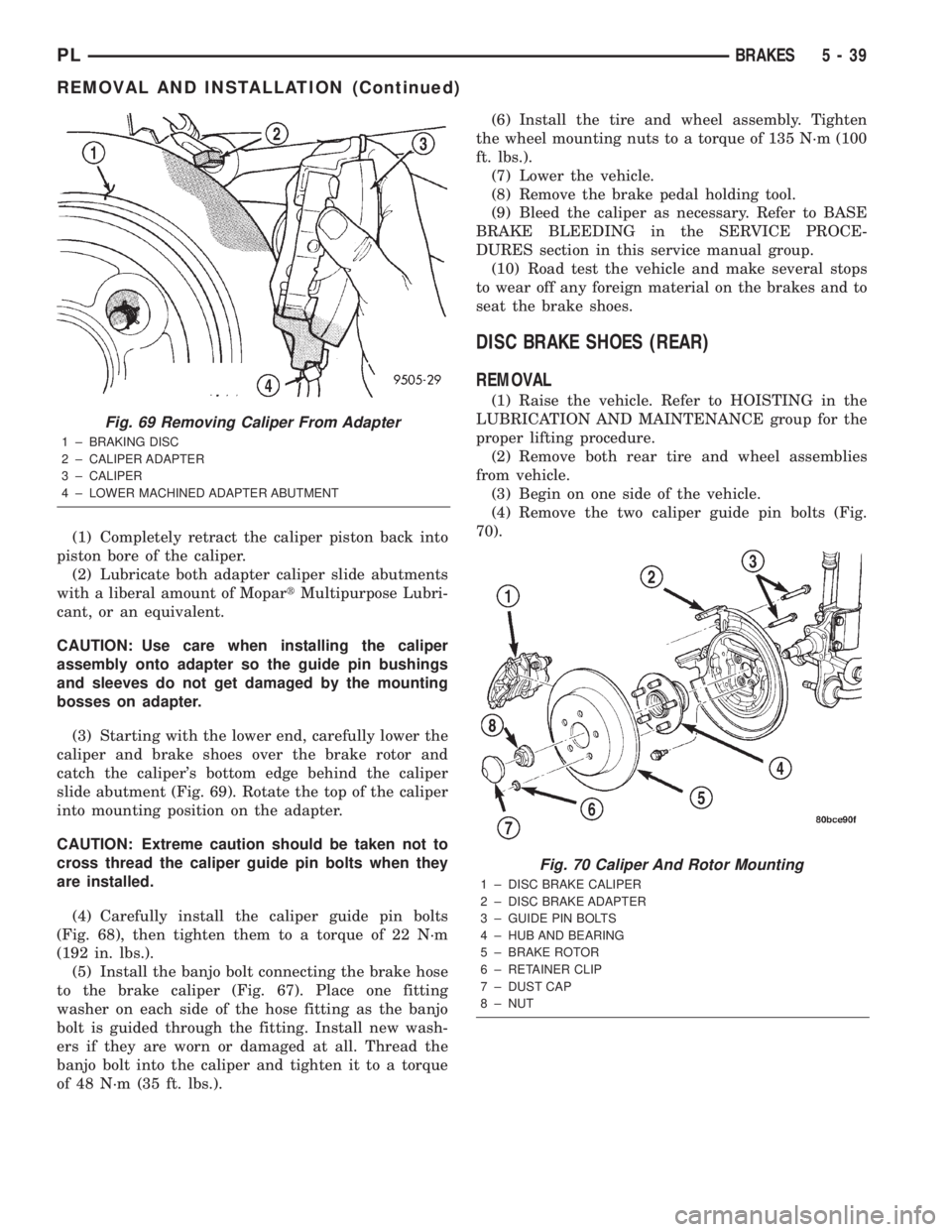
(3) Starting with the lower end, carefully lower the
caliper and brake shoes over the brake rotor and
catch the caliper's bottom edge behind the caliper
slide abutment (Fig. 69). Rotate the top of the caliper
into mounting position on the adapter.
CAUTION: Extreme caution should be taken not to
cross thread the caliper guide pin bolts when they
are installed.
(4) Carefully install the caliper guide pin bolts
(Fig. 68), then tighten them to a torque of 22 N´m
(192 in. lbs.).
(5) Install the banjo bolt connecting the brake hose
to the brake caliper (Fig. 67). Place one fitting
washer on each side of the hose fitting as the banjo
bolt is guided through the fitting. Install new wash-
ers if they are worn or damaged at all. Thread the
banjo bolt into the caliper and tighten it to a torque
of 48 N´m (35 ft. lbs.).(6) Install the tire and wheel assembly. Tighten
the wheel mounting nuts to a torque of 135 N´m (100
ft. lbs.).
(7) Lower the vehicle.
(8) Remove the brake pedal holding tool.
(9) Bleed the caliper as necessary. Refer to BASE
BRAKE BLEEDING in the SERVICE PROCE-
DURES section in this service manual group.
(10) Road test the vehicle and make several stops
to wear off any foreign material on the brakes and to
seat the brake shoes.
DISC BRAKE SHOES (REAR)
REMOVAL
(1) Raise the vehicle. Refer to HOISTING in the
LUBRICATION AND MAINTENANCE group for the
proper lifting procedure.
(2) Remove both rear tire and wheel assemblies
from vehicle.
(3) Begin on one side of the vehicle.
(4) Remove the two caliper guide pin bolts (Fig.
70).
Fig. 69 Removing Caliper From Adapter
1 ± BRAKING DISC
2 ± CALIPER ADAPTER
3 ± CALIPER
4 ± LOWER MACHINED ADAPTER ABUTMENT
Fig. 70 Caliper And Rotor Mounting
1 ± DISC BRAKE CALIPER
2 ± DISC BRAKE ADAPTER
3 ± GUIDE PIN BOLTS
4 ± HUB AND BEARING
5 ± BRAKE ROTOR
6 ± RETAINER CLIP
7 ± DUST CAP
8 ± NUT
PLBRAKES 5 - 39
REMOVAL AND INSTALLATION (Continued)
Page 120 of 1285
(6) Lubricate both adapter caliper slide abutments
with a liberal amount of MopartMultipurpose Lubri-
cant, or an equivalent.
CAUTION: Use care when installing the caliper
assembly onto adapter so the guide pin bushings
and sleeves do not get damaged by the mounting
bosses on adapter.
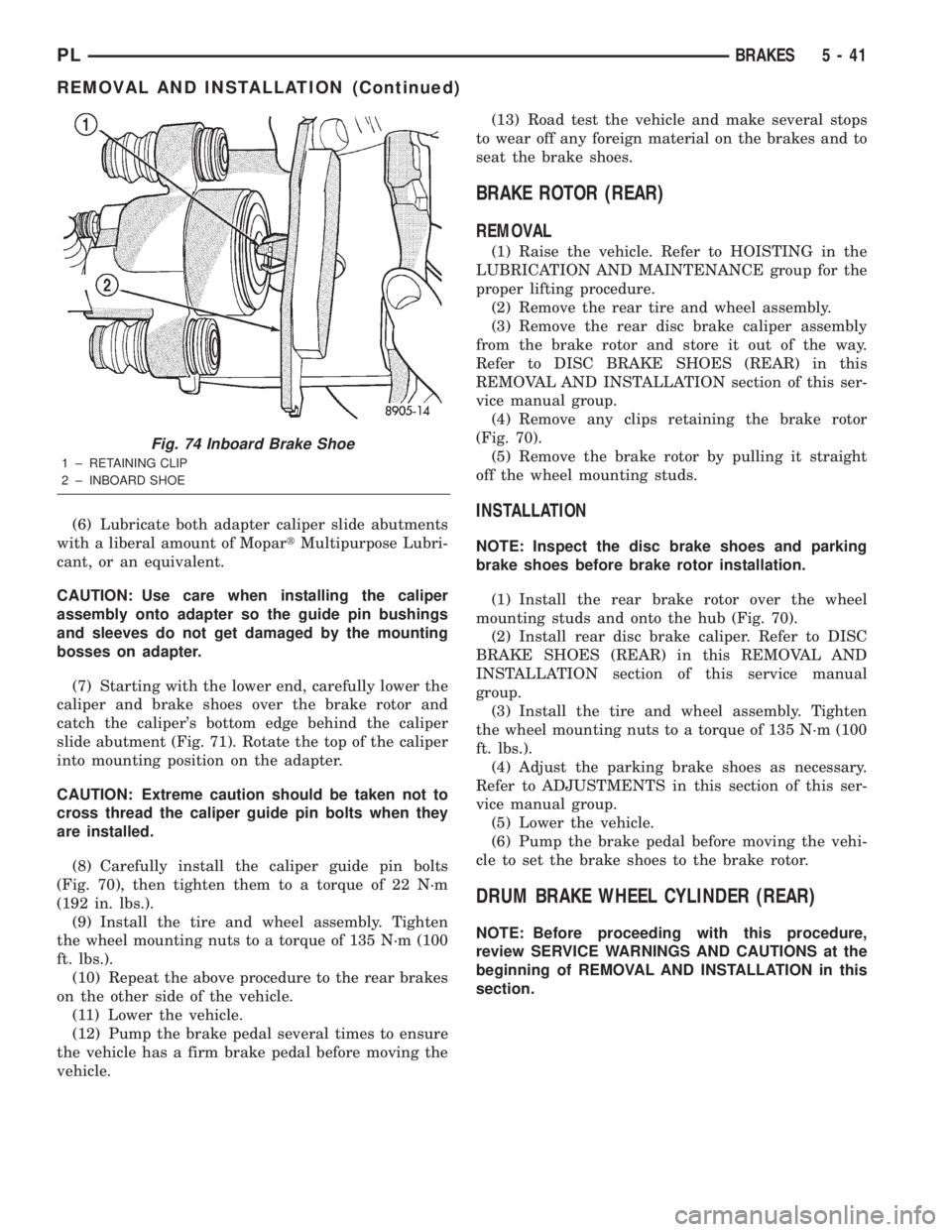
(7) Starting with the lower end, carefully lower the
caliper and brake shoes over the brake rotor and
catch the caliper's bottom edge behind the caliper
slide abutment (Fig. 71). Rotate the top of the caliper
into mounting position on the adapter.
CAUTION: Extreme caution should be taken not to
cross thread the caliper guide pin bolts when they
are installed.
(8) Carefully install the caliper guide pin bolts
(Fig. 70), then tighten them to a torque of 22 N´m
(192 in. lbs.).
(9) Install the tire and wheel assembly. Tighten
the wheel mounting nuts to a torque of 135 N´m (100
ft. lbs.).
(10) Repeat the above procedure to the rear brakes
on the other side of the vehicle.
(11) Lower the vehicle.
(12) Pump the brake pedal several times to ensure
the vehicle has a firm brake pedal before moving the
vehicle.(13) Road test the vehicle and make several stops
to wear off any foreign material on the brakes and to
seat the brake shoes.
BRAKE ROTOR (REAR)
REMOVAL
(1) Raise the vehicle. Refer to HOISTING in the
LUBRICATION AND MAINTENANCE group for the
proper lifting procedure.
(2) Remove the rear tire and wheel assembly.
(3) Remove the rear disc brake caliper assembly
from the brake rotor and store it out of the way.
Refer to DISC BRAKE SHOES (REAR) in this
REMOVAL AND INSTALLATION section of this ser-
vice manual group.
(4) Remove any clips retaining the brake rotor
(Fig. 70).
(5) Remove the brake rotor by pulling it straight
off the wheel mounting studs.
INSTALLATION
NOTE: Inspect the disc brake shoes and parking
brake shoes before brake rotor installation.
(1) Install the rear brake rotor over the wheel
mounting studs and onto the hub (Fig. 70).
(2) Install rear disc brake caliper. Refer to DISC
BRAKE SHOES (REAR) in this REMOVAL AND
INSTALLATION section of this service manual
group.
(3) Install the tire and wheel assembly. Tighten
the wheel mounting nuts to a torque of 135 N´m (100
ft. lbs.).
(4) Adjust the parking brake shoes as necessary.
Refer to ADJUSTMENTS in this section of this ser-
vice manual group.
(5) Lower the vehicle.
(6) Pump the brake pedal before moving the vehi-
cle to set the brake shoes to the brake rotor.
DRUM BRAKE WHEEL CYLINDER (REAR)
NOTE: Before proceeding with this procedure,
review SERVICE WARNINGS AND CAUTIONS at the
beginning of REMOVAL AND INSTALLATION in this
section.
Fig. 74 Inboard Brake Shoe
1 ± RETAINING CLIP
2 ± INBOARD SHOE
PLBRAKES 5 - 41
REMOVAL AND INSTALLATION (Continued)
Page 121 of 1285
REMOVAL
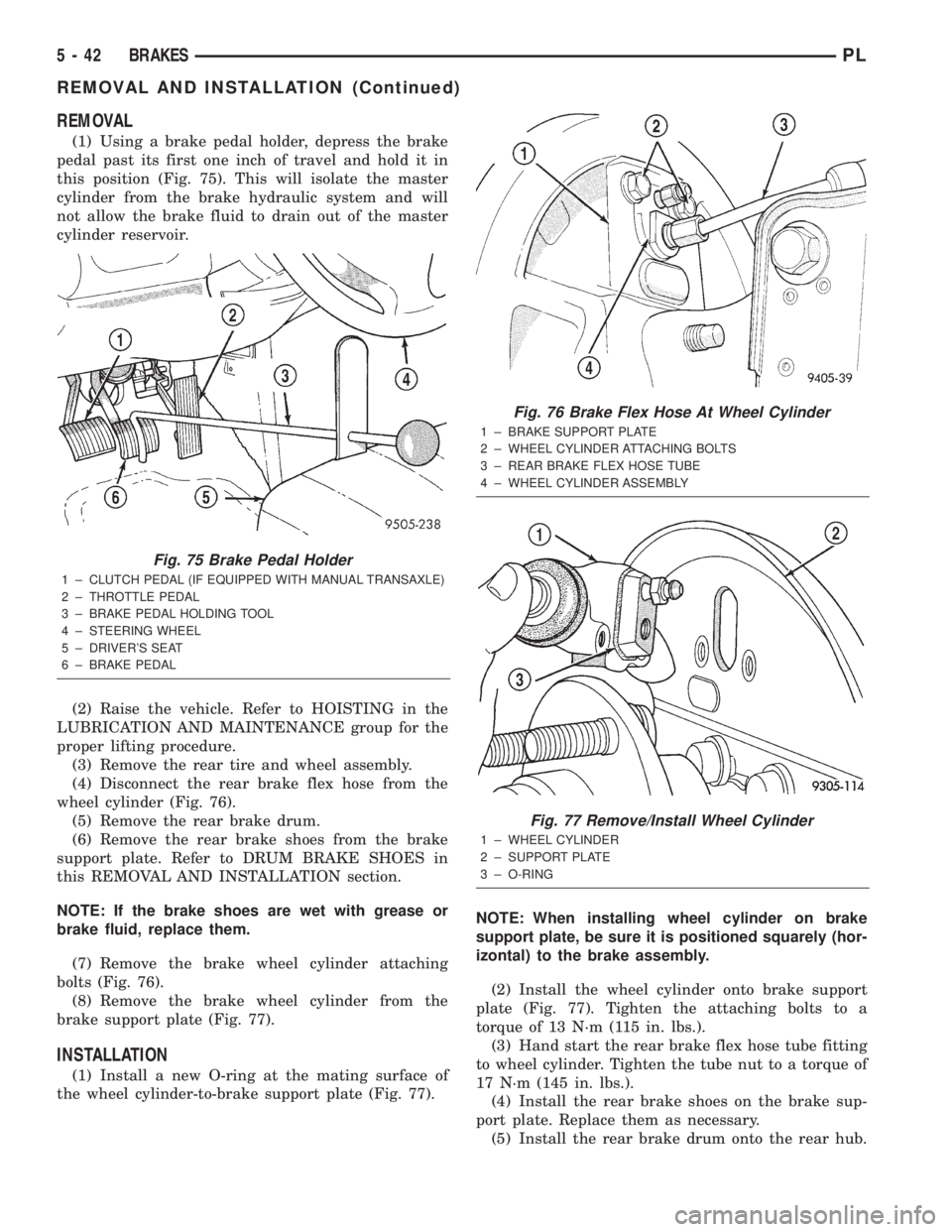
(1) Using a brake pedal holder, depress the brake
pedal past its first one inch of travel and hold it in
this position (Fig. 75). This will isolate the master
cylinder from the brake hydraulic system and will
not allow the brake fluid to drain out of the master
cylinder reservoir.
(2) Raise the vehicle. Refer to HOISTING in the
LUBRICATION AND MAINTENANCE group for the
proper lifting procedure.
(3) Remove the rear tire and wheel assembly.
(4) Disconnect the rear brake flex hose from the
wheel cylinder (Fig. 76).
(5) Remove the rear brake drum.
(6) Remove the rear brake shoes from the brake
support plate. Refer to DRUM BRAKE SHOES in
this REMOVAL AND INSTALLATION section.
NOTE: If the brake shoes are wet with grease or
brake fluid, replace them.
(7) Remove the brake wheel cylinder attaching
bolts (Fig. 76).
(8) Remove the brake wheel cylinder from the
brake support plate (Fig. 77).
INSTALLATION
(1) Install a new O-ring at the mating surface of
the wheel cylinder-to-brake support plate (Fig. 77).NOTE: When installing wheel cylinder on brake
support plate, be sure it is positioned squarely (hor-
izontal) to the brake assembly.
(2) Install the wheel cylinder onto brake support
plate (Fig. 77). Tighten the attaching bolts to a
torque of 13 N´m (115 in. lbs.).
(3) Hand start the rear brake flex hose tube fitting
to wheel cylinder. Tighten the tube nut to a torque of
17 N´m (145 in. lbs.).
(4) Install the rear brake shoes on the brake sup-
port plate. Replace them as necessary.
(5) Install the rear brake drum onto the rear hub.
Fig. 75 Brake Pedal Holder
1 ± CLUTCH PEDAL (IF EQUIPPED WITH MANUAL TRANSAXLE)
2 ± THROTTLE PEDAL
3 ± BRAKE PEDAL HOLDING TOOL
4 ± STEERING WHEEL
5 ± DRIVER'S SEAT
6 ± BRAKE PEDAL
Fig. 76 Brake Flex Hose At Wheel Cylinder
1 ± BRAKE SUPPORT PLATE
2 ± WHEEL CYLINDER ATTACHING BOLTS
3 ± REAR BRAKE FLEX HOSE TUBE
4 ± WHEEL CYLINDER ASSEMBLY
Fig. 77 Remove/Install Wheel Cylinder
1 ± WHEEL CYLINDER
2 ± SUPPORT PLATE
3 ± O-RING
5 - 42 BRAKESPL
REMOVAL AND INSTALLATION (Continued)
Page 126 of 1285
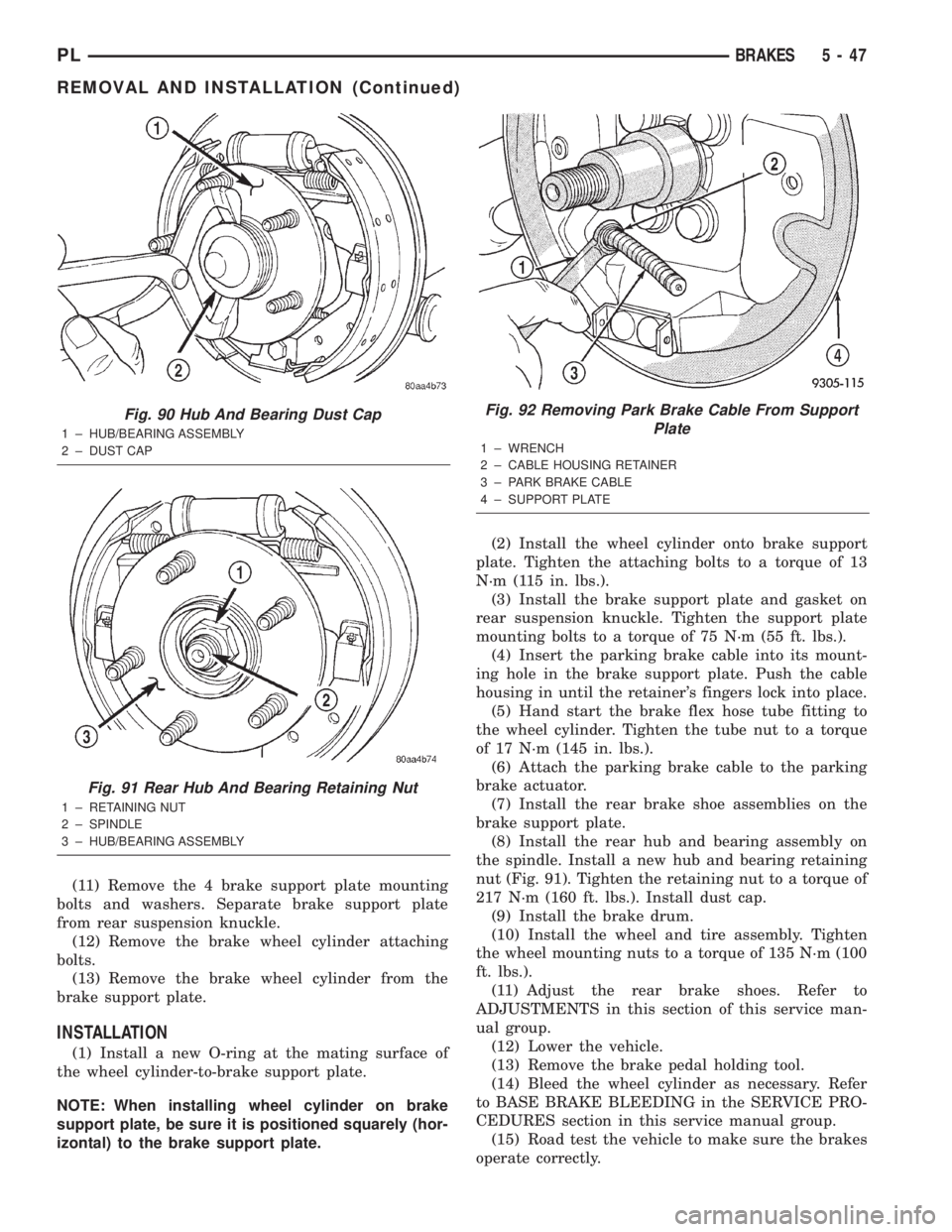
(11) Remove the 4 brake support plate mounting
bolts and washers. Separate brake support plate
from rear suspension knuckle.
(12) Remove the brake wheel cylinder attaching
bolts.
(13) Remove the brake wheel cylinder from the
brake support plate.
INSTALLATION
(1) Install a new O-ring at the mating surface of
the wheel cylinder-to-brake support plate.
NOTE: When installing wheel cylinder on brake
support plate, be sure it is positioned squarely (hor-
izontal) to the brake support plate.(2) Install the wheel cylinder onto brake support
plate. Tighten the attaching bolts to a torque of 13
N´m (115 in. lbs.).
(3) Install the brake support plate and gasket on
rear suspension knuckle. Tighten the support plate
mounting bolts to a torque of 75 N´m (55 ft. lbs.).
(4) Insert the parking brake cable into its mount-
ing hole in the brake support plate. Push the cable
housing in until the retainer's fingers lock into place.
(5) Hand start the brake flex hose tube fitting to
the wheel cylinder. Tighten the tube nut to a torque
of 17 N´m (145 in. lbs.).
(6) Attach the parking brake cable to the parking
brake actuator.
(7) Install the rear brake shoe assemblies on the
brake support plate.
(8) Install the rear hub and bearing assembly on
the spindle. Install a new hub and bearing retaining
nut (Fig. 91). Tighten the retaining nut to a torque of
217 N´m (160 ft. lbs.). Install dust cap.
(9) Install the brake drum.
(10) Install the wheel and tire assembly. Tighten
the wheel mounting nuts to a torque of 135 N´m (100
ft. lbs.).
(11) Adjust the rear brake shoes. Refer to
ADJUSTMENTS in this section of this service man-
ual group.
(12) Lower the vehicle.
(13) Remove the brake pedal holding tool.
(14) Bleed the wheel cylinder as necessary. Refer
to BASE BRAKE BLEEDING in the SERVICE PRO-
CEDURES section in this service manual group.
(15) Road test the vehicle to make sure the brakes
operate correctly.
Fig. 90 Hub And Bearing Dust Cap
1 ± HUB/BEARING ASSEMBLY
2 ± DUST CAP
Fig. 91 Rear Hub And Bearing Retaining Nut
1 ± RETAINING NUT
2 ± SPINDLE
3 ± HUB/BEARING ASSEMBLY
Fig. 92 Removing Park Brake Cable From Support
Plate
1 ± WRENCH
2 ± CABLE HOUSING RETAINER
3 ± PARK BRAKE CABLE
4 ± SUPPORT PLATE
PLBRAKES 5 - 47
REMOVAL AND INSTALLATION (Continued)
Page 137 of 1285
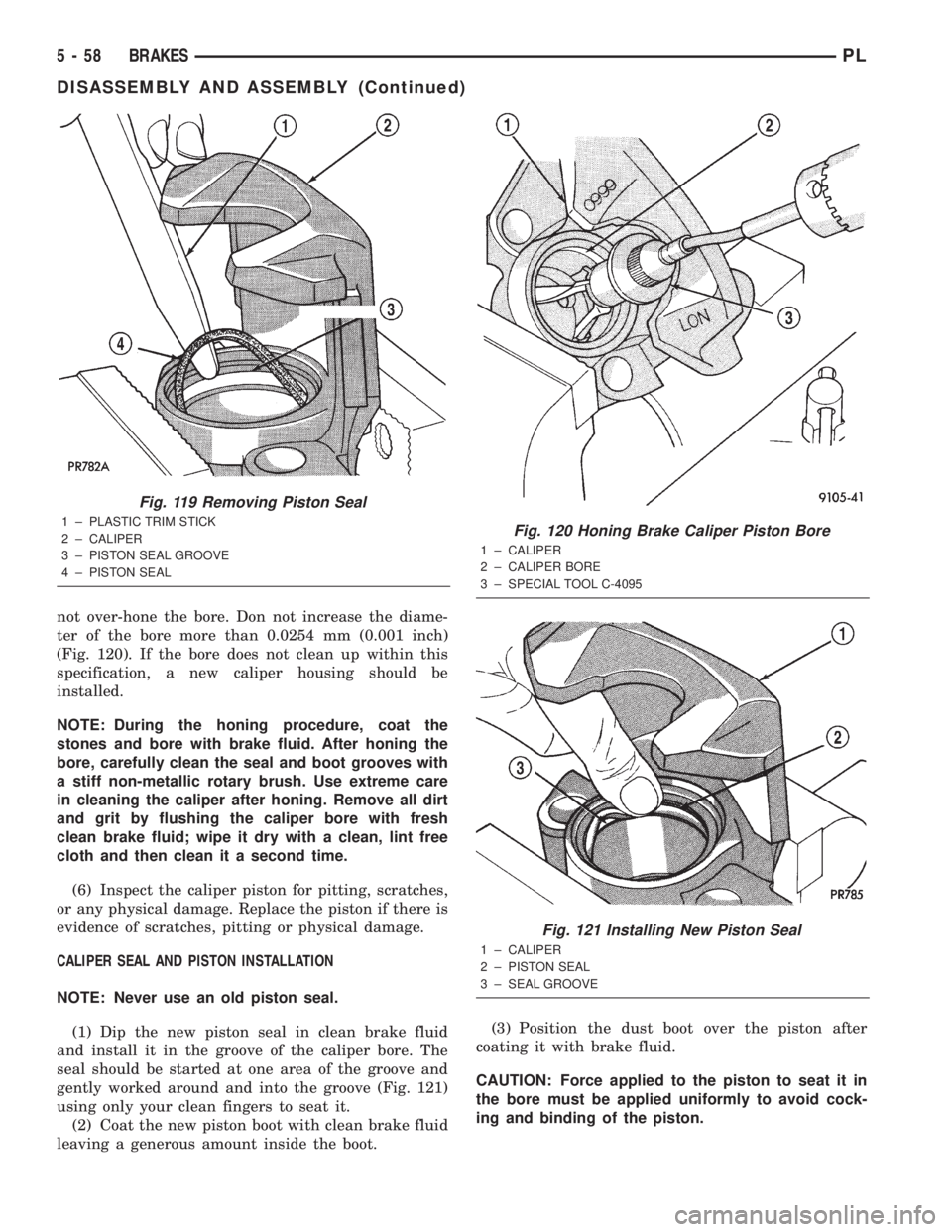
not over-hone the bore. Don not increase the diame-
ter of the bore more than 0.0254 mm (0.001 inch)
(Fig. 120). If the bore does not clean up within this
specification, a new caliper housing should be
installed.
NOTE: During the honing procedure, coat the
stones and bore with brake fluid. After honing the
bore, carefully clean the seal and boot grooves with
a stiff non-metallic rotary brush. Use extreme care
in cleaning the caliper after honing. Remove all dirt
and grit by flushing the caliper bore with fresh
clean brake fluid; wipe it dry with a clean, lint free
cloth and then clean it a second time.
(6) Inspect the caliper piston for pitting, scratches,
or any physical damage. Replace the piston if there is
evidence of scratches, pitting or physical damage.
CALIPER SEAL AND PISTON INSTALLATION
NOTE: Never use an old piston seal.
(1) Dip the new piston seal in clean brake fluid
and install it in the groove of the caliper bore. The
seal should be started at one area of the groove and
gently worked around and into the groove (Fig. 121)
using only your clean fingers to seat it.
(2) Coat the new piston boot with clean brake fluid
leaving a generous amount inside the boot.(3) Position the dust boot over the piston after
coating it with brake fluid.
CAUTION: Force applied to the piston to seat it in
the bore must be applied uniformly to avoid cock-
ing and binding of the piston.
Fig. 119 Removing Piston Seal
1 ± PLASTIC TRIM STICK
2 ± CALIPER
3 ± PISTON SEAL GROOVE
4 ± PISTON SEALFig. 120 Honing Brake Caliper Piston Bore
1 ± CALIPER
2 ± CALIPER BORE
3 ± SPECIAL TOOL C-4095
Fig. 121 Installing New Piston Seal
1 ± CALIPER
2 ± PISTON SEAL
3 ± SEAL GROOVE
5 - 58 BRAKESPL
DISASSEMBLY AND ASSEMBLY (Continued)