lights DODGE NEON 2004 2.G User Guide
[x] Cancel search | Manufacturer: DODGE, Model Year: 2004, Model line: NEON, Model: DODGE NEON 2004 2.GPages: 241, PDF Size: 3.75 MB
Page 78 of 241
INSTRUMENT CLUSTER DESCRIPTIONS
1. Front Fog Light Indicator Ð If Equipped
This light shows when the front fog lights are
ON.
2. Brake System Warning Light
This light monitors various brake functions,
including brake fluid level and parking
brake application. If the brake light comes
on, it may indicate that the parking brake is
applied, or there is a low brake fluid level. On vehicles
equipped with Anti-lock brakes (ABS), it may also
indicate an ABS malfunction that could lead to re-
duced braking performance.WARNING!
Driving a vehicle with the brake light on is danger-
ous. A significant decrease in braking performance
or vehicle stability during braking may occur. It will
take you longer to stop the vehicle or will make your
vehicle harder to control. You could have an acci-
dent. Have the vehicle checked immediately.
The operation of the Brake Warning light can be checked
by turning the ignition key from the OFF to the ON
position. The light should illuminate for three seconds, or
until the engine is started, whichever comes first. The
light should then go out unless the parking brake is
applied or a brake fault is detected. If the light does not
illuminate, have the light inspected and serviced as soon
as possible.
The light will also come on when the parking brake is
applied with the ignition in the ON position.
NOTE:This light shows only that the parking brake is
on. It does not show the degree of brake application.
78 UNDERSTANDING YOUR INSTRUMENT PANEL
Page 79 of 241

If the parking brake is off and the light remains on, have
the brake system inspected as soon as possible.
3. Anti-Lock Warning Light (ABS) Ð If Equipped
This light monitors the Anti-Lock Brake System
(ABS) described elsewhere in this manual. This
light will come on when the ignition key is turned to
the ON position and may stay on for as long as four
seconds.
If the ABS light remains on or comes on during driving,
it indicates that the Anti-Lock portion of the brake system
is not functioning and that service is required, however,
the conventional brake system will continue to operate
normally provided that the BRAKE warning light is not
on.
If the ABS light is on, the brake system should be serviced
as soon as possible to restore the benefit of Anti-Lock
Brakes.
The warning light should be checked frequently to assure
that it is operating properly. Turn the ignition key to apoint midway between ON and START. The light should
come on. If the light does not come on, have the system
checked by an authorized dealer.
4. Speedometer
Indicates vehicle speed.
5. Turn Signal Indicators
The arrows will flash in unison with the exterior
turn signal, when using the turn signal lever.
6. High Beam Indicator
This light shows that the headlights are on high
beam. Pull the turn signal lever toward the
steering wheel to switch the headlights from high or
low beam.
7. Tachometer Ð If Equipped
The white area of the scale shows the permissible engine
revolutions-per-minute (rpm x 1000) for each gear range.
Before reaching the red area, ease up on the accelerator to
prevent engine damage.
UNDERSTANDING YOUR INSTRUMENT PANEL 79
4
Page 99 of 241

6 DISC CD CHANGER Ð IF EQUIPPED
The CD changer is located below the radio in the
instrument panel. The changer plays only 43¤4inch (12
cm) discs. The changer holds up to 6 discs. Each disc is
loaded and ejected through a single slot in front of the
changer. Each disc has a numbered button with an amber
light above it which, when illuminated, indicates that a
disc is loaded in that particular chamber.
Loading the CD Changer
When inserting the first CD into the changer if the radio
is on, wait until the single slot is illuminated on both
sides and simply insert the first disc.To insert additional CDs into the changer, the instructions
follow:
1. Select and press any numbered button without an
illuminated light above it.
2. Insert the CD while the light above the chosen button
is flashing and the two lights on either side of the slot are
illuminated.
3. Upon insertion, the CD will begin to play, and both the
button light and the lights in the corner of the loading
slot will illuminate.
4. Repeat the process for loading any additional CDs.
The CD player will stop while additional CDs are loaded.
Playing Discs
The radio will show the CD number, the CD track
number, and the Track Time Elapsed while the radio is in
the CD mode. If more than one CD is loaded in the
changer, the changer will automatically play the next disc
after playing the last track of the current disc.
UNDERSTANDING YOUR INSTRUMENT PANEL 99
4
Page 149 of 241
and Loading Information placard. Refer to the Tire±
Safety Information Section in this manual.
²The ªDº range can be selected when towing. However,
if frequent shifting occurs while in this range, the ª3º
range must be selected.
NOTE:Using the ª3º range while operating the vehicle
under heavy operating conditions will improve perfor-
mance and extend transaxle life by reducing excessive
shifting and heat build up.
WARNING!
Connecting trailer brakes to your vehicle's hydraulic
brake lines can overload your brake system and
cause it to fail. You might not have brakes when you
need them and could have an accident.
²Do not attempt to tow a trailer while using a compact
spare tire.
²Whenever you pull a trailer, regardless of the trailer
size, stop lights and turn signals on the trailer are
recommended for motoring safety.
²The automatic transaxle fluid and filter should be
changed if you REGULARLY tow a trailer for more
than 45 minutes of continuous operation. See Schedule
ªBº in section 8 of this manual for transaxle fluid
change intervals.
NOTE:Check the automatic transaxle fluid level before
towing.
NOTE:For vehicles equipped with Autostick. By using
the Autostick modes, and selecting a specific gear range,
frequent shifting can be avoided. The highest gear range
should be selected that allows for adequate performance.
For example, choose ª4º if the desired speed can be
maintained. Choose ª3º or ª2º if needed to maintain the
desired speed.
NOTE:Extended driving at high RPM should be
avoided to prevent excess heat generation. A reduction in
vehicle speed may be required to avoid extended driving
at high RPM. Retirn to a higher gear range or vehicle
speed when road conditions and RPM level allows.
STARTING AND OPERATING 149
5
Page 164 of 241

NHoses And Vacuum/Vapor Harnesses.......184
NBrake System........................185
NAutomatic Transaxle...................187
NManual Transaxle.....................189
NAppearance Care And Protection From
Corrosion...........................190
mFuses...............................195
NUnderhood Fuses
(Power Distribution Center)..............195
NInterior Fuses........................195
mVehicle Storage........................196
mReplacement Bulbs.....................196
mBulb Replacement......................197
NHeadlight Bulb Replacement.............197
NFront Park/Turn Signal Lights............199
NFront Sidemarker Light.................199
NTail/Stop, Rear Turn Signals And Back-Up
Lights.............................199
NCenter High Mounted Stop Light..........199
mFluids And Capacities...................200
mRecommended Fluids, Lubricants And Genuine
Parts
...............................201
NEngine.............................201
NChassis............................201
164 MAINTAINING YOUR VEHICLE
Page 193 of 241
Interior Care
Use Mopar Fabric Cleaner to clean fabric upholstery and
carpeting.
Use Mopar Vinyl Cleaner to clean vinyl upholstery.
Mopar Vinyl Cleaner is specifically recommended for
vinyl trim.
Your leather upholstery can be best preserved by regular
cleaning with a damp soft cloth. Small particles of dirt
can act as an abrasive and damage the leather upholstery
and should be removed promptly with a damp cloth.
Stubborn soils can be removed easily with a soft cloth
and Mopar Total Clean. Care should be taken to avoid
soaking your leather upholstery with any liquid. Please
do not use polishes, oils, cleaning fluids, solvents, deter-
gents, or ammonia based cleaners to clean your leather
upholstery. Application of a leather conditioner is not
required to maintain the original condition.WARNING!
Do not use volatile solvents for cleaning purposes.
Many are potentially flammable, and if used in
closed areas they may cause respiratory harm.
Cleaning Headlights
Your vehicle has plastic headlights that are lighter and
less susceptible to stone breakage than glass headlights.
Plastic is not as scratch resistant as glass and therefore
different lens cleaning procedures must be followed.
To minimize the possibility of scratching the lenses and
reducing light output, avoid wiping with a dry cloth. To
remove road dirt, wash with a mild soap solution fol-
lowed by rinsing.
Do not use abrasive cleaning components, solvents, steel
wool or other aggressive material to clean the lenses.
MAINTAINING YOUR VEHICLE 193
7
Page 197 of 241
LIGHTS BULBS Ð Outside Bulb No.
Headlight.............................9007
Front Park/Turn Signal Light.............3457AK
Front Side Marker Light.................... 168
Front Fog Light.......................... 899
Center High Mounted Stop Light
(CHMSL).........................921±W16W
Rear Tail/Stop/Turn Signal Light......3157±P27/7W
Backup Light......................921±W16W
License Light........................... 168
BULB REPLACEMENT
Headlight Bulb Replacement
CAUTION!
Do not touch the new headlight bulb with your
fingers. Oil contamination will severely shorten
bulb life.
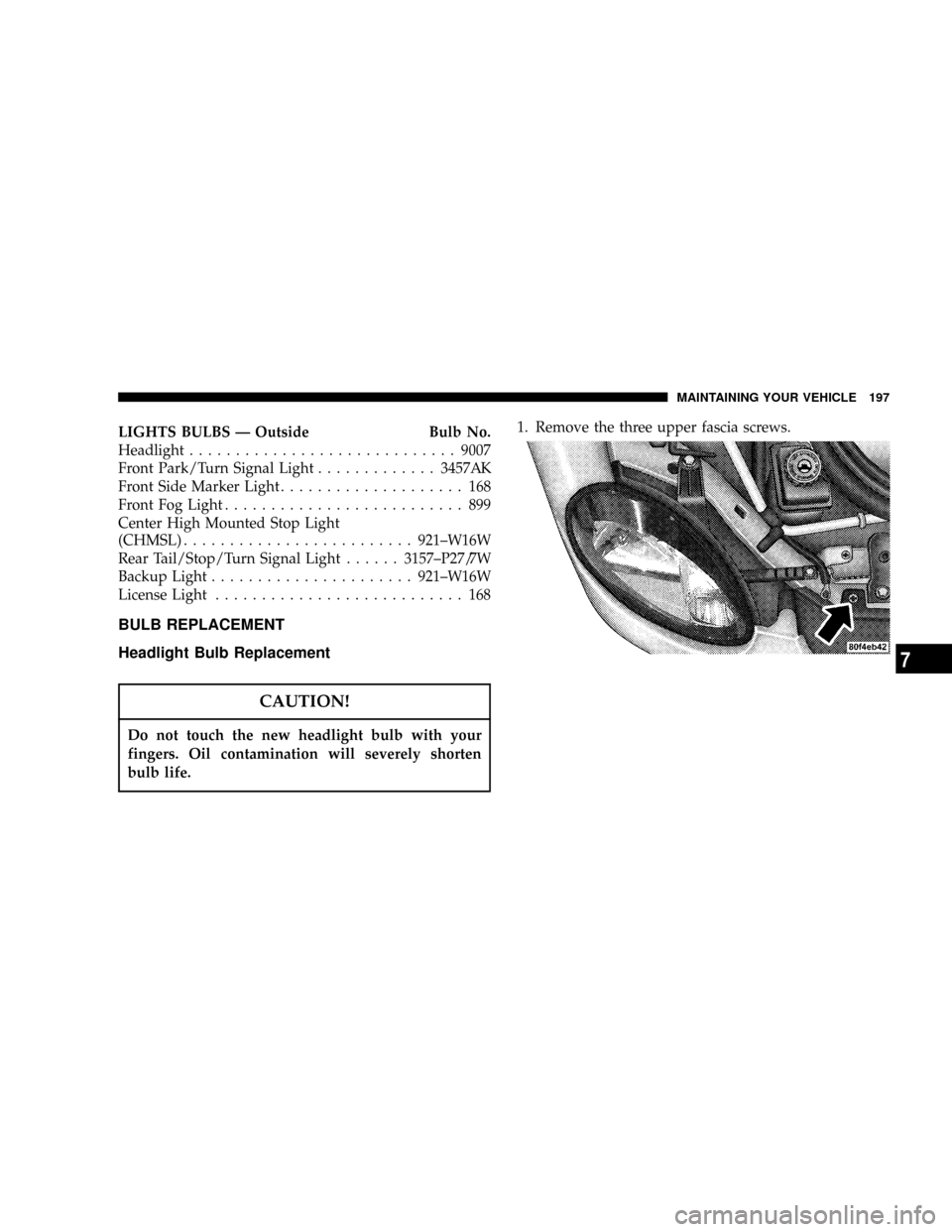
1. Remove the three upper fascia screws.
MAINTAINING YOUR VEHICLE 197
7
Page 199 of 241

Front Park/Turn Signal Lights
1. Remove the headlight assembly
2. Twist the bulb socket 1/4 turn and remove.
3. Pull the bulb from the socket and replace.
Front Sidemarker Light
1. Remove the screws and push-pins from the front
fender splash shield.
2. Reach between the fender and the splash shield, grasp
the bulb and socket assembly and turn it counterclock-
wise. Remove the bulb and socket assembly from the
light housing.
3. Pull the bulb out of the socket and replace the bulb.
Reinstall the bulb and socket assembly and replace the
fender splash shield.
Tail/Stop, Rear Turn Signals and Back-up Lights
1. Open the trunk and move the trunk liner away from
the rear light mounting area.
2. Twist the bulb socket 1/4 turn to remove it from the
housing.
3. Pull bulb from socket and replace
Center High Mounted Stop Light
1. Twist the socket 1/4 turn and remove it from the
housing.
2. Pull the bulb out of the socket and replace.
MAINTAINING YOUR VEHICLE 199
7
Page 205 of 241
²If equipped for and operating with E-85 (ethanol)
fuel.
NOTE:IfANYof these apply to you then change your
engine oil every 3,000 miles (5 000 km) or 3 months,
whichever comes first and follow schedule ªBº of the
9Maintenance Schedules9section of this manual.
NOTE:Most vehicles are operated under the conditions
listed for Schedule9B9.
Second is ScheduleªAº. It is for vehicles that are not
operated under any of the conditions listed under Sched-
ule9B9.
Use the schedule that best describes your driving condi-
tions. Where time and mileage are listed, follow the
interval that occurs first.
CAUTION!
Failure to perform the required maintenance items
may result in damage to the vehicle.
At Each Stop for Fuel
²
Check the engine oil level about 5 minutes after a fully
warmed engine is shut off. Checking the oil level while
the vehicle is on level ground will improve the accu-
racy of the oil level reading. Add oil only when the
level is at or below the ADD or MIN mark.
²Check the windshield washer solvent and add if
required.
Once a Month
²
Check tire pressure and look for unusual wear or
damage.
²Inspect the battery and clean and tighten the terminals
as required.
²Check the fluid levels of coolant reservoir, brake
master cylinder, power steering and transaxle and add
as needed.
²Check all lights and all other electrical items for correct
operation.
MAINTENANCE SCHEDULES 205
8
M
A
I
N
T
E
N
A
N
C
E
S
C
H
E
D
U
L
E
S
Page 231 of 241

Brake System.......................123,185
Anti-Lock........................... 124
Hoses.............................. 185
Master Cylinder...................... 186
Parking............................ 121
Warning Light........................ 78
Brakes............................123,185
Brake/Transmission Interlock.............. 116
Break-In Recommendations, New Vehicle...... 46
Bulb Replacement...................196,197
Calibration, Compass..................... 54
Capacities, Antifreeze (Engine Coolant)...... 200
Capacities, Fluid....................... 200
Caps, Filler
Fuel............................... 145
Carbon Monoxide Warning............... 145
Cassette Tape and Player Maintenance........ 98
Cassette Tape Player...................84,86
Catalytic Converter..................... 173
Caution, Exhaust Gas..................... 47
CD Changer.....................87,92,93,99
CD Player...........................89,91CD Player Maintenance.................. 101
Cellular Phone......................... 102
Center High Mounted Stop Light........... 199
Central Door Locks...................... 15
Central Locking......................... 15
Chains, Tire........................... 139
Changing A Flat Tire.................... 153
Charging System Light................... 80
Chart, Tire Sizing....................... 126
Child Restraint......................... 39
Child Safety Locks....................... 16
Circuit Breakers........................ 195
Cleaning
Glass.............................. 194
Headlights.......................... 193
Climate Control........................ 102
Clock................................. 83
Compact Disc Changer................... 99
Compact Disc Maintenance............... 101
Compact Spare Tire..................... 136
Compass.............................. 51
Compass Calibration..................... 54
Compass Variance....................... 53
INDEX 231
10