towing DODGE NEON 2004 2.G User Guide
[x] Cancel search | Manufacturer: DODGE, Model Year: 2004, Model line: NEON, Model: DODGE NEON 2004 2.GPages: 241, PDF Size: 3.75 MB
Page 162 of 241

All Transaxles
CAUTION!
If the vehicle being towed requires steering, the
ignition switch must be in the OFF position, not in
the LOCK or ACCESSORY positions.
If it is necessary to use the accessories while being towed
(wipers, defrosters, etc.), the key must be in the ON
position, not the ACCESSORY position. Make certain the
transaxle remains in NEUTRAL.
Without The Ignition Key
Special care must be taken when the vehicle is towed
with the ignition in the LOCK position. A dolly should be
used under the front wheels if the rear wheels are raised.
Proper towing equipment is necessary to prevent dam-
age to the vehicle.
Towing This Vehicle Behind Another Vehicle (Flat
Towing With All Four Wheels On The Ground)
If your vehicle is equipped with a manual transaxle, it
may be towed at any legal highway speed, for any
distance, if the transaxle is in neutral.
If the ignition key is not available, vehicles with auto-
matic transaxles can not be flat towed at any time.
162 WHAT TO DO IN EMERGENCIES
Page 166 of 241

ONBOARD DIAGNOSTIC SYSTEM Ð OBD II
Your vehicle is equipped with a sophisticated onboard
diagnostic system called OBD II. This system monitors
the performance of the emissions, engine, and automatic
transmission control systems. When these systems are
operating properly, your vehicle will provide excellent
performance and fuel economy, as well as engine emis-
sions well within current government regulations.
If any of these systems require service, the OBD II system
will turn on the ªMalfunction Indicator Light.º It will
also store diagnostic codes and other information to
assist your service technician in making repairs. Al-
though your vehicle will usually be drivable and not
need towing, see your dealer for service as soon as
possible.CAUTION!
²Prolonged driving with the ªMalfunction Indica-
tor Lightº on could cause further damage to the
emission control system. It could also affect fuel
economy and driveability. The vehicle must be
serviced before any emissions tests can be per-
formed.
²If the ªMalfunction Indicator Lightº is flashing
while the engine is running, severe catalytic con-
verter damage and power loss will soon occur.
Immediate service is required.
166 MAINTAINING YOUR VEHICLE
Page 170 of 241

the oil level between the MIN and MAX markings on the
dipstick. Adding one quart of oil when the reading is at
the MIN mark will result in a MAX reading on these
engines.
CAUTION!
Overfilling or underfilling will cause aeration or
loss of oil pressure. This could damage your engine.
Change Engine Oil
Road conditions and your kind of driving affects the
interval at which your oil should be changed. Check the
following list to decide if any apply to you.
²Day and night temperatures are below 32ÉF (0ÉC)
²Stop and Go driving
²Extensive engine idling
²Driving in dusty conditions
²Short trips of less than 10 miles (16.2 km)
²More than 50% of your driving is at sustained high
speeds during hot weather, above 90ÉF (32ÉC)
²Trailer towing
²Taxi, Police, or delivery service (commercial service)
²Off-road or desert operation
²If equipped for and operating with E-85 (ethanol) fuel
170 MAINTAINING YOUR VEHICLE
Page 174 of 241
WARNING!
A hot exhaust system can start a fire if you park over
materials that can burn. Such materials might be
grass or leaves coming into contact with your ex-
haust system. Do not park or operate your vehicle in
areas where your exhaust system can contact any-
thing that can burn.
In unusual situations involving grossly malfunctioning
engine operation, a scorching odor may suggest severe
and abnormal catalyst overheating. If this occurs, stop
the vehicle, turn off the engine and allow it to cool.
Service, including a tune up to manufacturers specifica-
tions, should be obtained immediately.
To minimize the possibility of catalyst damage:
²Do not shut off the engine or interrupt the ignition
when the transaxle is in gear and the vehicle is in
motion.
²Do not try to start the engine by pushing or towing the
vehicle.
²Do not idle the engine with any spark plug wires
disconnected for prolonged period.
Engine Timing Belt
Replace the engine timing belt at the intervals described
in the appropriate maintenance schedule.
Ignition Wiring System
The ignition cables should be kept clean and properly
connected. Terminals should be fully seated. Cracked,
damaged, or faulty cables should be replaced.
Crankcase Emission Control System
Proper operation of this system depends on freedom
from sticking or plugging due to deposits. As vehicle
mileage builds up, the PCV valve and passages may
accumulate deposits. If a valve is not working properly,
replace it with a new valve. DO NOT ATTEMPT TO
CLEAN THE OLD PCV VALVE!
Check ventilation hose for indication of damage or
plugging deposits. Replace if necessary.
174 MAINTAINING YOUR VEHICLE
Page 189 of 241
CAUTION!
Do not overfill. Dirt and water in the transaxle can
cause serious damage. To prevent dirt and water
from entering the transaxle after checking or replen-
ishing fluid, make certain that the dipstick cap is
seated properly.
Fluid and Filter Changes
Automatic transmission fluid and filter should be
changed as follows:
Maintenance schedule ªAºÐ No change necessary.
Maintenance schedule ªBº± Every 60,000 miles (96 000
km) change fluid and filter under the following condi-
tions:
²Police, taxi, limousine, commercial type operation, or
trailer towing where the vehicle is drivenregularlyfor
more than 45 minutes of continuous operation.
NOTE:Refer to Section 8 of this manual for mainte-
nance schedules.If the transaxle is disassembled for any reason, the fluid
and filter should be changed.
Special Additives
The manufacturer recommends against the addition of
any fluid additives to the transaxle. The only exception to
this policy is the use of special dyes to aid in detecting
fluid leaks. The use of transmission sealers should be
avoided as they may adversely affect seals.
Manual Transaxle
Lubricant Selection
Use only manufacturers recommended transmission
fluid, refer to Recommended Fluids, Lubricants and
Genuine Parts for correct fluid type.
Fluid Level Check
Check the fluid level by removing the fill plug. The fluid
level should be between the bottom of the fill hole and a
point not more that 3/16º (4.76 mm) below the bottom of
the hole.
Add fluid, if necessary, to maintain the proper level.
MAINTAINING YOUR VEHICLE 189
7
Page 204 of 241
EMISSION CONTROL SYSTEM MAINTENANCE
The ªScheduledº maintenance services, listed inbold
typemust be done at the times or mileages specified to
assure the continued proper functioning of the emission
control system. These, and all other maintenance services
included in this manual, should be done to provide best
vehicle performance and reliability. More frequent main-
tenance may be needed for vehicles in severe operating
conditions such as dusty areas and very short trip
driving.
Inspection and service also should be done any time a
malfunction is suspected.
NOTE:Maintenance, replacement, or repair of the
emission control devices and systems on your vehicle
may be performed by any automotive repair establish-
ment or individual using any automotive part which has
been certified pursuant to U.S. EPA or, in the State of
California, California Air Resources Board regulations.
MAINTENANCE SCHEDULES
There are two maintenance schedules that show the
requiredservice for your vehicle.
First is ScheduleªBº. It is for vehicles that are operated
under the conditions that are listed below and at the
beginning of the schedule.
²Day or night temperatures are below 32ÉF (0ÉC).
²Stop and go driving.
²Extensive engine idling.
²Driving in dusty conditions.
²Short trips of less than 10 miles (16.2 km).
²More than 50% of your driving is sustained high
speeds during hot weather, above 90ÉF (32ÉC).
²Trailer towing.²L
²Taxi, police or delivery service (commercial ser-
vices).²L
²Off-road or desert operation.
204 MAINTENANCE SCHEDULES
8
M
A
I
N
T
E
N
A
N
C
E
S
C
H
E
D
U
L
E
S
Page 207 of 241
Schedule ªBº
Follow schedule ªBº if you usually operate your vehicle
under one or more of the following conditions.
Change the automatic transmission fluid and filter every
60,000 miles (96 000 km) if the vehicle is usually operated
under one or more of the conditions marked with anL.
Change the manual transaxle fluid every 48,000 miles (77
000 km) if the vehicle is usually operated under one or
more of the conditions marked with an ².
²Day or night temperatures are below 32ÉF (0ÉC).
²Stop and go driving.
²Extensive engine idling.
²Driving in dusty conditions.
²Short trips of less than 10 miles (16.2 km).
²More than 50% of your driving is sustained high
speeds during hot weather, above 90ÉF (32ÉC).
²Trailer towing.²L
²Taxi, police or delivery service (commercial services).²
L
²Off-road or desert operation.
²If equipped for and operating with E-85 (ethanol)
fuel.
NOTE:IfANYof these apply to you then change your
engine oil every 3,000 miles (5 000 km) or 3 months,
whichever comes first and follow schedule ªBº of the
9Maintenance Schedules9section of this manual.
If none of these apply to you, then change your engine oil
at every interval shown on schedule9A9of the9Mainte-
nance Schedules9section of this manual.
SCHEDULE ªBº 207
8
M
A
I
N
T
E
N
A
N
C
E
S
C
H
E
D
U
L
E
S
Page 214 of 241
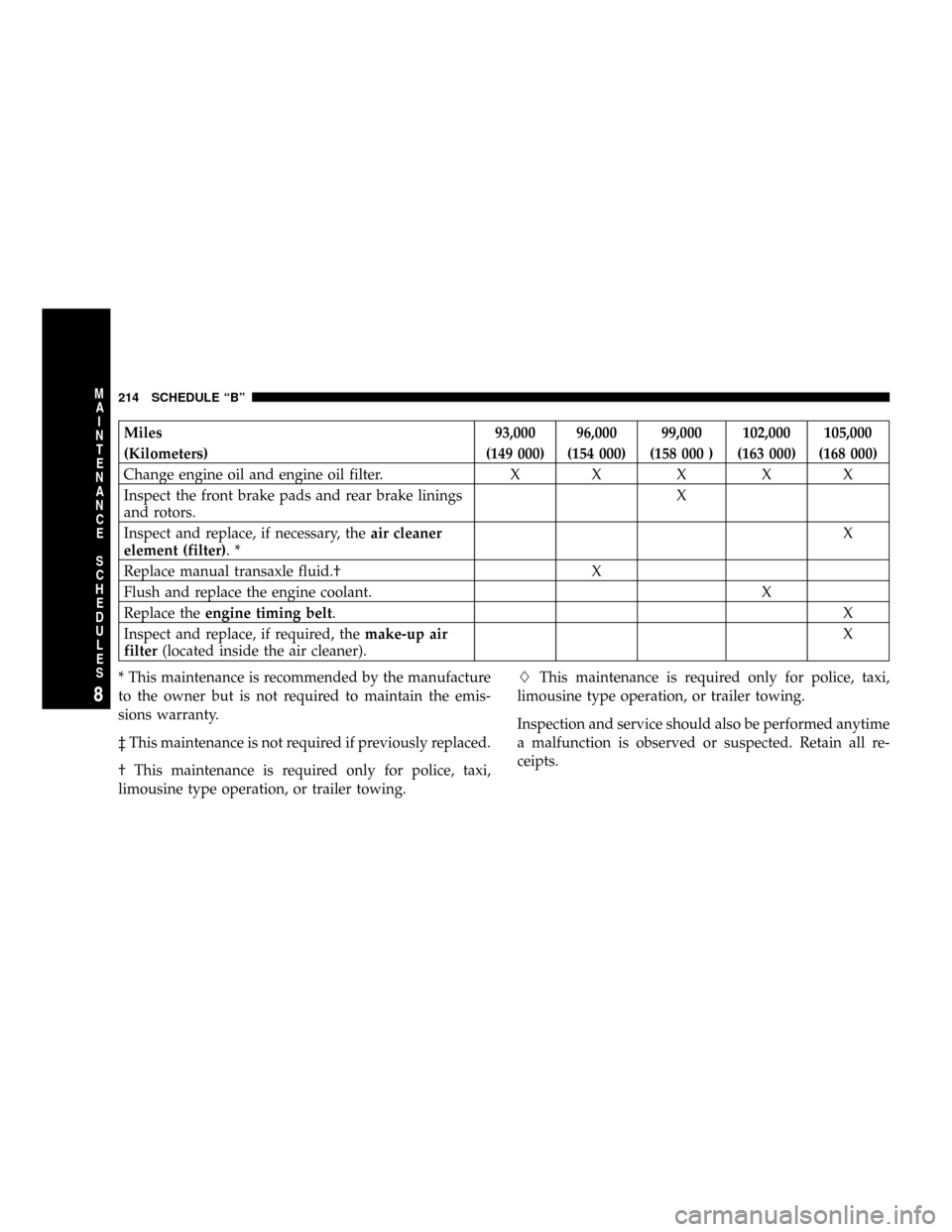
Miles 93,000 96,000 99,000 102,000 105,000
(Kilometers) (149 000) (154 000) (158 000 ) (163 000) (168 000)
Change engine oil and engine oil filter. X X X X X
Inspect the front brake pads and rear brake linings
and rotors.X
Inspect and replace, if necessary, theair cleaner
element (filter).*X
Replace manual transaxle fluid.² X
Flush and replace the engine coolant. X
Replace theengine timing belt.X
Inspect and replace, if required, themake-up air
filter(located inside the air cleaner).X
* This maintenance is recommended by the manufacture
to the owner but is not required to maintain the emis-
sions warranty.
³ This maintenance is not required if previously replaced.
² This maintenance is required only for police, taxi,
limousine type operation, or trailer towing.LThis maintenance is required only for police, taxi,
limousine type operation, or trailer towing.
Inspection and service should also be performed anytime
a malfunction is observed or suspected. Retain all re-
ceipts.
214 SCHEDULE ªBº
8
M
A
I
N
T
E
N
A
N
C
E
S
C
H
E
D
U
L
E
S
Page 232 of 241

Console............................... 69
Contract, Service....................... 222
Coolant........................181,200,201
Cooling System........................ 180
Adding Coolant (Antifreeze)............. 182
Coolant Level.....................180,183
Disposal of Used Coolant............... 181
Drain, Flush, and Refill................. 181
Inspection........................... 183
Points to Remember................182,183
Pressure Cap........................ 182
Rubber and Plastic Components.......... 184
Selection of Coolant................... 181
Corrosion Protection.................... 190
Crankcase Emission Control System......... 174
Cruise Light........................... 82
Cup Holder............................ 69
Customer Assistance.................... 220
Daytime Brightness, Interior Lights.......... 61
Daytime Running Lights.................. 62
Dealer Service......................... 168
Defroster, Rear Window.................. 110Defroster, Windshield...............48,103,106
Deploying, Airbag....................... 37
Diagnostic System, Onboard............... 166
Dimmer Control........................ 60
Dimmer Switch, Headlight................. 62
Disarming, Theft System.................. 21
Disposal
Engine Oil.......................... 172
Domelight............................. 61
Door Locks............................ 14
Door Locks, Automatic................... 16
Downshifting.......................... 121
Drive Belts............................ 173
Driving
On Slippery Surfaces.................. 159
Electric Remote Mirrors................... 54
Electronic Speed Control.................. 65
Emergency, In Case of
Jacking............................. 153
Jump Starting........................ 157
Towing............................. 161
Emergency Trunk Release................. 22
232 INDEX
Page 240 of 241

Snow Tires.......................... 140
Spinning............................ 137
Tread Wear Indicators.................. 137
Towing
Disabled Vehicle...................... 161
Trailer Towing......................... 148
Minimum Requirements................ 148
Trailer and Tongue Weight.............. 149
Warnings........................... 148
Transaxle
Automatic................. 9,114,116,117,187
Manual....................9,67,114,119,189
Overdrive........................... 118
Selection of Lubricant.................. 187
Transmitter Battery Service................ 19
Transporting Pets........................ 46
Tread Wear Indicators................... 137
Trip Odometer.......................... 81
Trip Odometer Reset Button................ 81
Trunk Release Button..................... 21
Trunk Release, Emergency................. 22
Trunk Release Remote Control.............. 21
Turn Signals.........................62,79Underhood Fuses....................... 195
Uniform Tire Quality Grades.............. 226
Untwisting Procedure, Seat Belt............. 29
Vacuum/Vapor Harnesses................ 184
Variance, Compass....................... 53
Vehicle Identification Number............... 6
Vehicle Loading.....................130,147
Vehicle Modifications/Alterations............ 6
Vehicle Storage......................... 196
Warning Lights
(Instrument Cluster Description)............ 78
Warnings and Cautions.................... 6
Warranty Information.................... 222
Washer, Adding Fluid................... 179
Washers, Windshield..................... 63
Washing Vehicle........................ 191
Wheel Alignment and Balance............. 139
Wheel and Wheel Trim Care............... 192
Wind Buffeting......................... 69
Window Fogging....................... 109
240 INDEX