instrument panel DODGE NEON 2005 2.G User Guide
[x] Cancel search | Manufacturer: DODGE, Model Year: 2005, Model line: NEON, Model: DODGE NEON 2005 2.GPages: 246, PDF Size: 3.69 MB
Page 58 of 246
WARNING!
²It is extremely dangerous to ride in a cargo area,
inside or outside of a vehicle. In a collision,
people riding in these areas are more likely to be
seriously injured or killed.
²Do not allow people to ride in any area of your
vehicle that is not equipped with seats and seat-
belts
²Be sure that everyone in your vehicle is in a seat
and using a seatbelt properly.
TO OPEN AND CLOSE THE HOOD
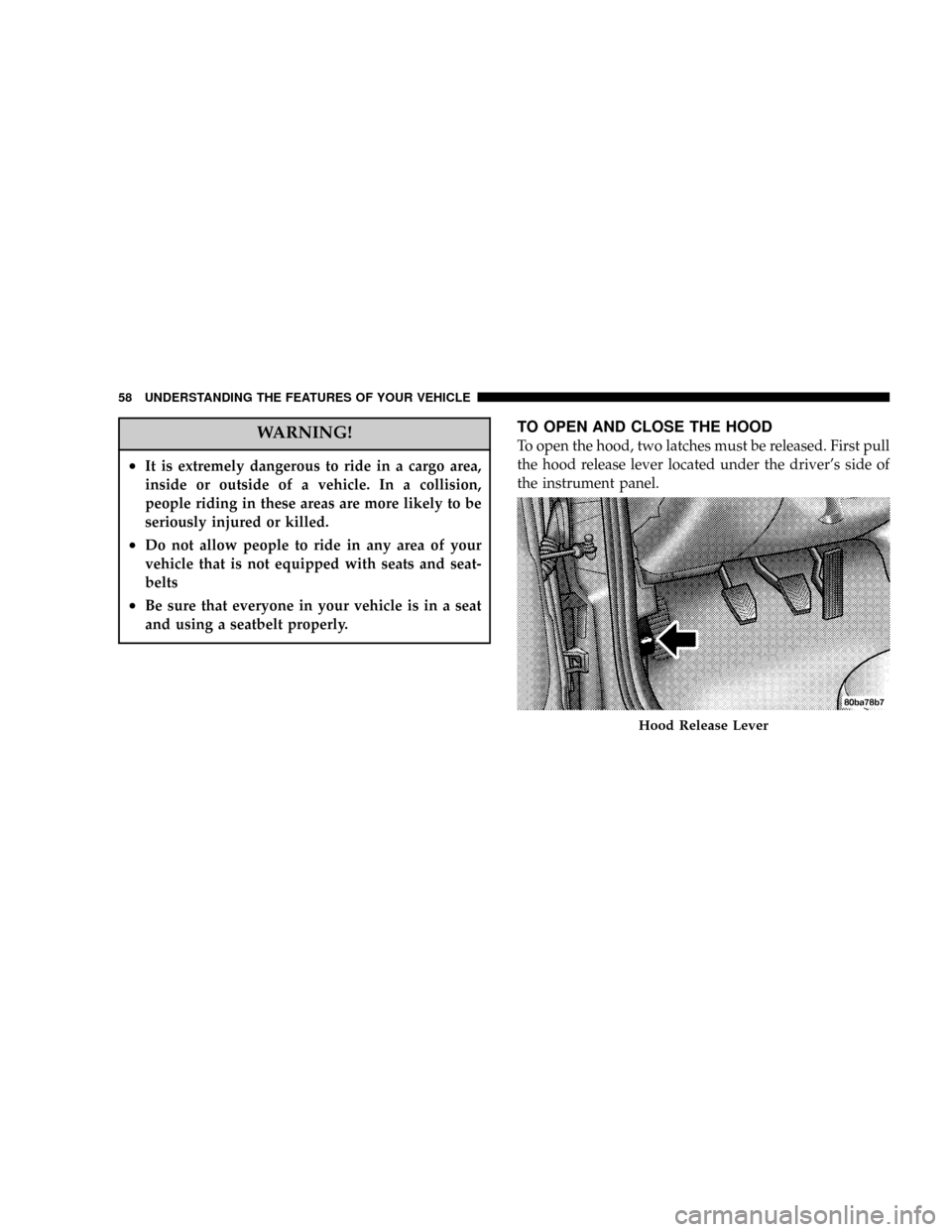
To open the hood, two latches must be released. First pull
the hood release lever located under the driver's side of
the instrument panel.
Hood Release Lever
58 UNDERSTANDING THE FEATURES OF YOUR VEHICLE
Page 60 of 246

LIGHTS
Front Map/Reading Lights Ð If Equipped
These lights, located under the rearview mirror, can be
turned on by means of switches located at the base of the
rearview mirror.
NOTE:The map lights will remain on when the ignition
switch is in the Run or Accessory positions.
Interior Lights
The interior lights come on when a door is opened.
The interior lights will automatically turn off in about 8
minutes if a door is left open or the dimmer control is left
in the Dome light position. Turn the ignition switch ON
to restore the interior light operation.
Dimmer Control
With the park lights or headlights
on, rotating the dimmer control
for the interior lights on the Multi-
Function Control Lever upward
will increase the brightness of the
instrument panel lights.
Front Map/Reading Lights
60 UNDERSTANDING THE FEATURES OF YOUR VEHICLE
Page 61 of 246
Dome Light Position
Rotate the dimmer control com-
pletely upward to the second de-
tent to turn on the interior lights.
The interior lights will remain on
when the dimmer control is in this
position.
Daytime Brightness Feature
Certain instrument panel components can be illuminated
at full brightness during the daytime. These are the
Odometer and Radio. This can be helpful when driving
with your headlights on during the daytime such as in a
parade or a funeral procession. To activate this feature,
rotate the dimmer ring on the left stalk one detent lower
than the dome light.
Multi-Function Control Lever
The Multi-Function Control Lever controls the operation
of the headlights, parking lights, turn signals, headlight
beam selection, instrument panel light dimming, interiorlights, the passing lights, and fog lights. The lever is
located on the left side of the steering column.
Headlights, Parking Lights, Instrument Panel
Lights
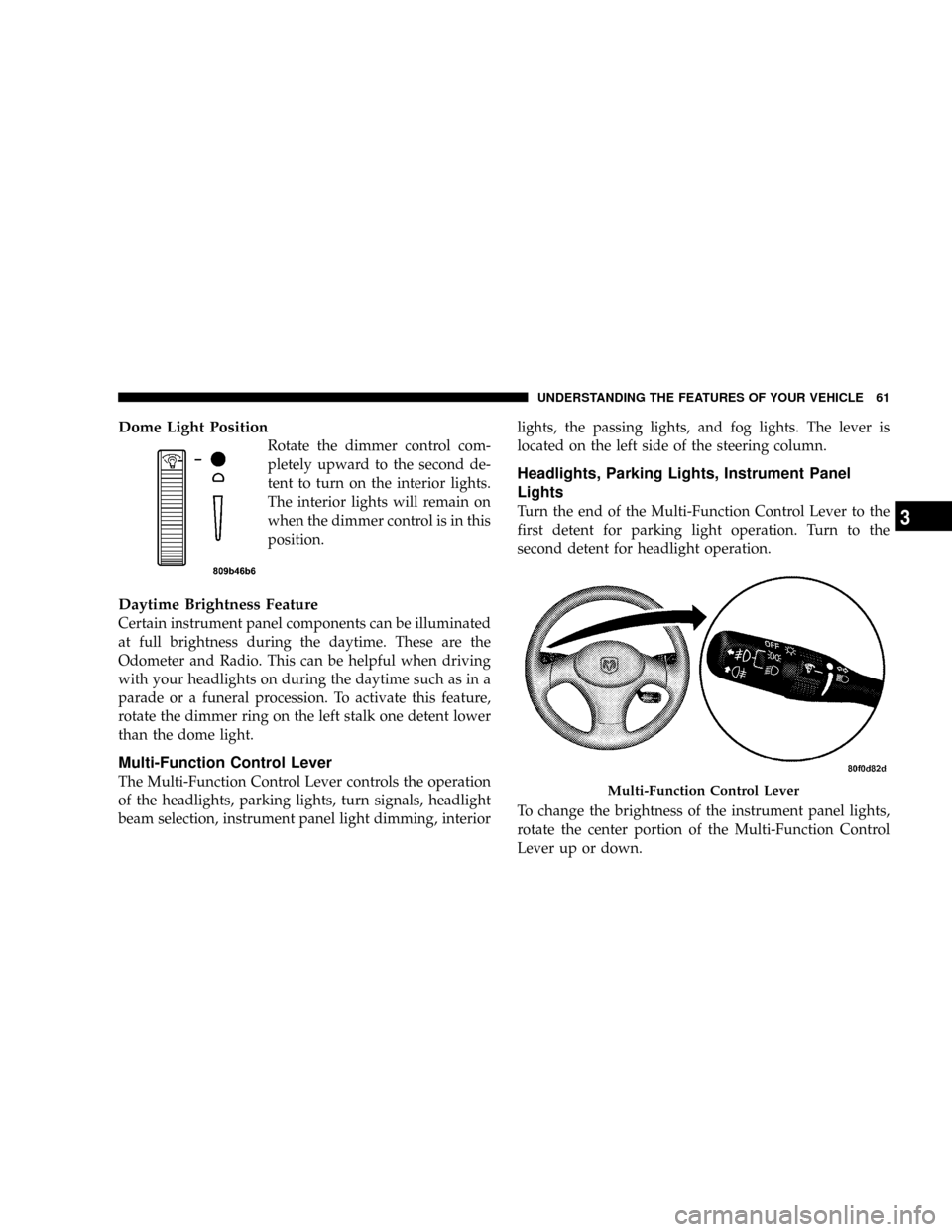
Turn the end of the Multi-Function Control Lever to the
first detent for parking light operation. Turn to the
second detent for headlight operation.
To change the brightness of the instrument panel lights,
rotate the center portion of the Multi-Function Control
Lever up or down.
Multi-Function Control Lever
UNDERSTANDING THE FEATURES OF YOUR VEHICLE 61
3
Page 71 of 246

UNDERSTANDING YOUR INSTRUMENT PANEL
CONTENTS
mInstrument Panel Features................74
mStandard Instrument Cluster...............75
mOptional Instrument Cluster...............76
mInstrument Cluster Descriptions............77
mElectronic Digital Clock..................82
NClock Setting Procedure..................82
mRadio General Information................82
NRadio Broadcast Signals..................82
NTwo Types Of Signals...................82
NElectrical Disturbances...................83
NAM Reception........................83NFM Reception.........................83
mSales Code RBBÐAM/FM Stereo Radio With
Cassette Tape Player And CD Changer
Capability
............................83
NRadio Operation.......................83
NMode Button.........................85
NScan Button (Radio Mode)................85
NCassette Player Features.................86
N
CD Changer Control Capability Ð If Equipped..87
mSales Code RBKÐAM/ FM Stereo Radio With
CD Player And CD Changer Controls
........88
NRadio Operation.......................88
4
Page 72 of 246

NCD Player Operation....................90
N
CD Changer Control Capability Ð If Equipped..92
mSatellite Radio Ð If Equipped..............93
NSystem Activation......................94
NElectronic Serial Number/Sirius Identification
Number (ENS/SID).....................94
NSelecting Satellite Mode In RBB, RAH And RBK
Radios..............................94
NSelecting Satellite Mode In RBP, RBU, RAZ, RB1
And RBQ Radios......................95
NSelecting a Channel.....................95
NStoring And Selecting Pre-Set Channels.......95
NUsing The PTY (Program Type) Button
(If Equipped).........................96
NPTY Button9Scan9......................96
NPTY Button9Seek9......................96
NSatellite Antenna.......................96NReception Quality......................96
mCassette Tape And Player Maintenance.......97
m6 Disc CD Changer Ð If Equipped..........98
NLoading The CD Changer................98
NPlaying Discs.........................99
NSeek Button..........................99
NFF/Tune/RW.........................99
NMode Button.........................99
NProgram Button 1......................99
NProgram Button 4 (Random Play)...........99
NProgram Button 5......................99
NTime Button.........................100
NChanging Modes......................100
NRemoving Discs From The CD Changer.....100
N
CD Changer Operation With The Changer Off. . 100
mCompact Disc Maintenance...............100
72 UNDERSTANDING YOUR INSTRUMENT PANEL
Page 73 of 246

mRadio Operation And Cellular Phones.......101
mClimate Controls......................101
NHeater Only.........................101
NSide Window Demisters.................103NOutside Air Intake....................103
NAir Conditioning Ð If Equipped..........103
NOperating Tips.......................108
mElectric Rear Window Defroster...........110
UNDERSTANDING YOUR INSTRUMENT PANEL 73
4
Page 74 of 246

INSTRUMENT PANEL FEATURES
74 UNDERSTANDING YOUR INSTRUMENT PANEL
Page 75 of 246

STANDARD INSTRUMENT CLUSTER
UNDERSTANDING YOUR INSTRUMENT PANEL 75
4
Page 76 of 246

OPTIONAL INSTRUMENT CLUSTER
76 UNDERSTANDING YOUR INSTRUMENT PANEL
Page 77 of 246
INSTRUMENT CLUSTER DESCRIPTIONS
1. Front Fog Light Indicator Ð If Equipped
This light shows when the front fog lights are
ON. (See page 62 for more information.)
2. Brake System Warning Light
This light monitors various brake functions,
including brake fluid level and parking
brake application. If the brake light comes
on, it may indicate that the parking brake is
applied, or there is a low brake fluid level. On vehicles
equipped with Anti-lock brakes (ABS), it may also
indicate an ABS malfunction that could lead to re-
duced braking performance.
WARNING!
Driving a vehicle with the brake light on is danger-
ous. A significant decrease in braking performance
or vehicle stability during braking may occur. It will
take you longer to stop the vehicle or will make your
vehicle harder to control. You could have an acci-
dent. Have the vehicle checked immediately.
The operation of the Brake Warning light can be checked
by turning the ignition key from the OFF to the ON
position. The light should illuminate for three seconds, or
until the engine is started, whichever comes first. The
light should then go out unless the parking brake is
applied or a brake fault is detected. If the light does not
illuminate, have the light inspected and serviced as soon
as possible.
The light will also come on when the parking brake is
applied with the ignition in the ON position.
NOTE:This light shows only that the parking brake is
on. It does not show the degree of brake application.
If the parking brake is off and the light remains on, have
the brake system inspected as soon as possible.
3. Anti-Lock Warning Light (ABS) Ð If Equipped
This light monitors the Anti-Lock Brake System
(ABS) described elsewhere in this manual. This
light will come on when the ignition key is turned to
the ON position and may stay on for as long as four
seconds.
UNDERSTANDING YOUR INSTRUMENT PANEL 77
4