engine DODGE NEON 2005 2.G Owner's Manual
[x] Cancel search | Manufacturer: DODGE, Model Year: 2005, Model line: NEON, Model: DODGE NEON 2005 2.GPages: 246, PDF Size: 3.69 MB
Page 118 of 246
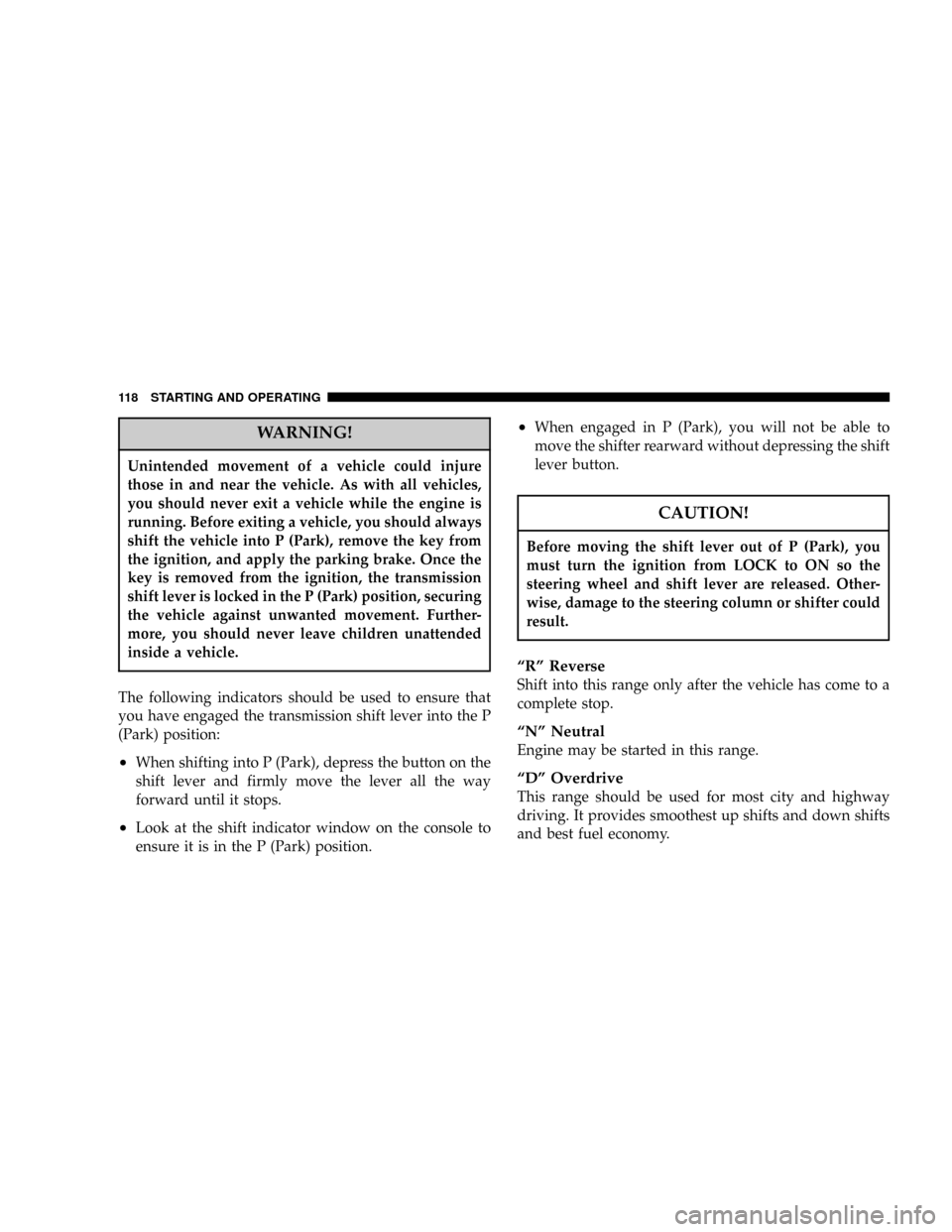
WARNING!
Unintended movement of a vehicle could injure
those in and near the vehicle. As with all vehicles,
you should never exit a vehicle while the engine is
running. Before exiting a vehicle, you should always
shift the vehicle into P (Park), remove the key from
the ignition, and apply the parking brake. Once the
key is removed from the ignition, the transmission
shift lever is locked in the P (Park) position, securing
the vehicle against unwanted movement. Further-
more, you should never leave children unattended
inside a vehicle.
The following indicators should be used to ensure that
you have engaged the transmission shift lever into the P
(Park) position:
²When shifting into P (Park), depress the button on the
shift lever and firmly move the lever all the way
forward until it stops.
²Look at the shift indicator window on the console to
ensure it is in the P (Park) position.
²When engaged in P (Park), you will not be able to
move the shifter rearward without depressing the shift
lever button.
CAUTION!
Before moving the shift lever out of P (Park), you
must turn the ignition from LOCK to ON so the
steering wheel and shift lever are released. Other-
wise, damage to the steering column or shifter could
result.
ªRº Reverse
Shift into this range only after the vehicle has come to a
complete stop.
ªNº Neutral
Engine may be started in this range.
ªDº Overdrive
This range should be used for most city and highway
driving. It provides smoothest up shifts and down shifts
and best fuel economy.
118 STARTING AND OPERATING
Page 119 of 246

When frequent transaxle shifting occurs while using the
Overdrive range, such as when operating the vehicle
under heavy loading conditions (in hilly terrain, travel-
ing into strong head winds, or while towing trailers), use
the ª3º range.
ª3º Drive
This range eliminates shifts into Overdrive. The transaxle
will operate normally in first and second while in this
range.
NOTE:Using the ª3º range while operating the vehicle
under heavy operating conditions will improve perfor-
mance, fuel economy, and extend transaxle life by reduc-
ing excessive shifting and heat build up.
Use the ª3º range when descending steep grades to
prevent brake system distress.
ª1º Low
This range should be used for maximum engine braking
when descending steep grades. In this range, up shifts
will occur only to prevent engine over speed while down
shifts from 2nd to first will occur as early as possible.
MANUAL TRANSAXLE Ð IF EQUIPPED
NOTE:
The parking brake should be engaged and the
gear selector placed in REVERSE before leaving the
vehicle, especially on an incline.
NOTE:Clutch must be depressed for engine to start.
Fully depress the clutch pedal before you shift gears. As
you release the clutch pedal, lightly depress the accelera-
tor pedal.
Use each gear in numerical order - do not skip a gear. Be
sure the transaxle is in FIRST gear, (not THIRD), when
starting from a standing position. Damage to the clutch
can result from starting in THIRD.
For most city driving you will find it easier to use only
the lower gears. For steady highway driving with light
accelerations, 5th gear is recommended.
Never drive with your foot resting on the clutch pedal, or try
to hold the vehicle on a hill with the clutch pedal partially
engaged. This will cause abnormal wear on the clutch.
Never shift into REVERSE until the vehicle has come to a
complete stop.
STARTING AND OPERATING 119
5
Page 120 of 246
NOTE:During cold weather, until the transaxle lubri-
cant has warmed, you may have difficulty shifting. This
is normal and not harmful to the transaxle.
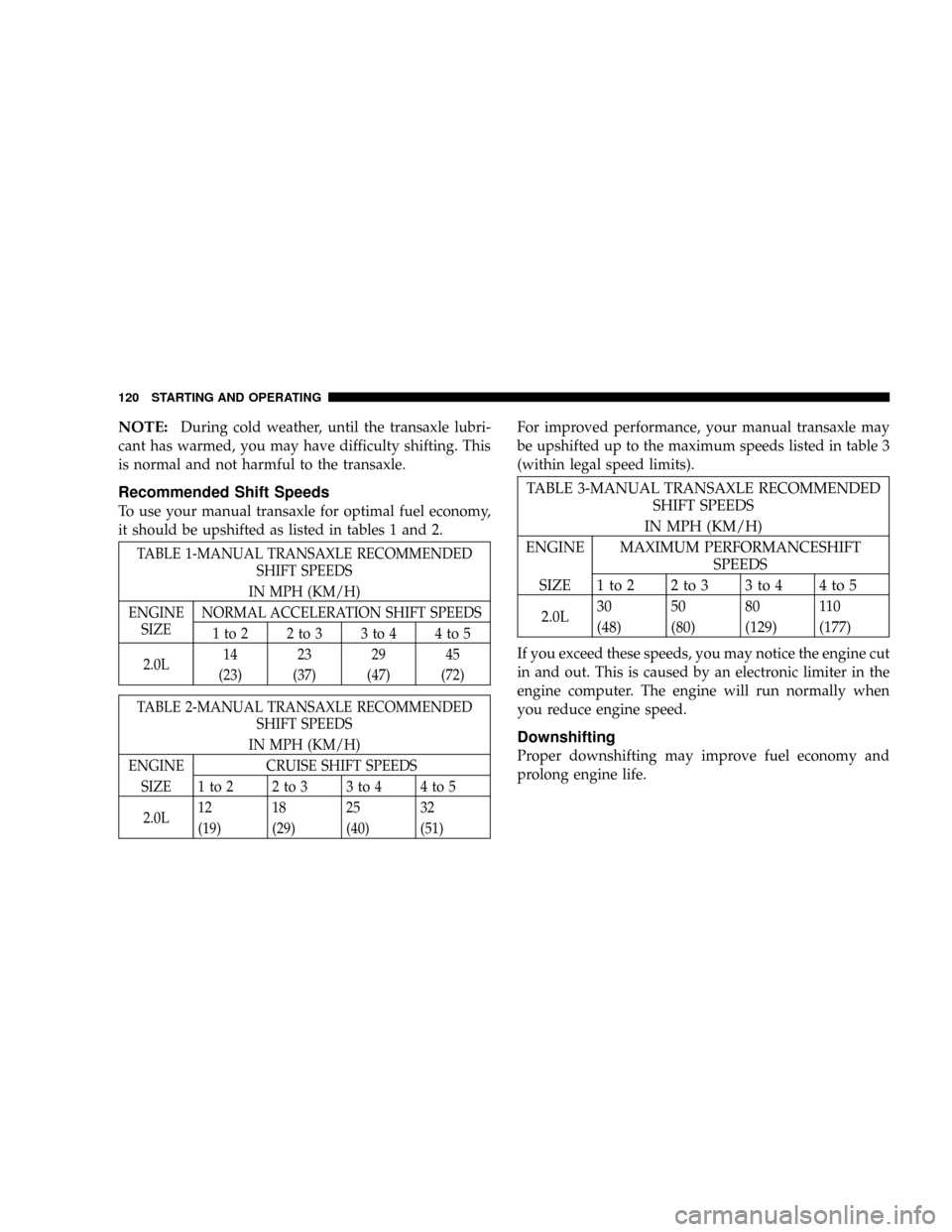
Recommended Shift Speeds
To use your manual transaxle for optimal fuel economy,
it should be upshifted as listed in tables 1 and 2.
TABLE 1-MANUAL TRANSAXLE RECOMMENDED
SHIFT SPEEDS
IN MPH (KM/H)
ENGINE
SIZENORMAL ACCELERATION SHIFT SPEEDS
1to2 2to3 3to4 4to5
2.0L14 23 29 45
(23) (37) (47) (72)
TABLE 2-MANUAL TRANSAXLE RECOMMENDED
SHIFT SPEEDS
IN MPH (KM/H)
ENGINE CRUISE SHIFT SPEEDS
SIZE 1 to 2 2 to 3 3 to 4 4 to 5
2.0L12 18 25 32
(19) (29) (40) (51)
For improved performance, your manual transaxle may
be upshifted up to the maximum speeds listed in table 3
(within legal speed limits).
TABLE 3-MANUAL TRANSAXLE RECOMMENDED
SHIFT SPEEDS
IN MPH (KM/H)
ENGINE MAXIMUM PERFORMANCESHIFT
SPEEDS
SIZE 1 to 2 2 to 3 3 to 4 4 to 5
2.0L30 50 80 110
(48) (80) (129) (177)
If you exceed these speeds, you may notice the engine cut
in and out. This is caused by an electronic limiter in the
engine computer. The engine will run normally when
you reduce engine speed.
Downshifting
Proper downshifting may improve fuel economy and
prolong engine life.
120 STARTING AND OPERATING
Page 121 of 246

CAUTION!
If you skip more than one gear while downshifting
or downshift at too high an engine speed, you could
damage the engine, transaxle, or clutch.
To maintain a safe speed and prolong brake life, shift
down to 2nd or 1st when descending a steep grade.
When turning a corner, or driving up a steep grade, shift
down early so that the engine will not be overburdened.
PARKING BRAKE
When the parking brake is applied with the
ignition on, the Brake Light in the instrument
cluster will come on.
NOTE:This light only shows that the parking brake is
on. It does not show the degree of brake application.
Before leaving the vehicle, make sure that the parking
brake is set. To set the parking brake, pull up firmly on
the lever. Also place the gear selector in the Park position
(automatic transaxle) or Reverse (manual transaxle). Torelease the parking brake, apply the brake pedal and pull
up on the parking brake lever. Push the release button
and lower the lever fully.
When parking on a hill, it is important to set the parking
brake before placing the gear selector in Park, otherwise
the load on the transmission locking mechanism may
make it difficult to move the selector out of Park. As an
added precaution, turn the front wheels toward the curb
on a downhill grade and away from the curb on a uphill
grade.
Parking Brake Lever
STARTING AND OPERATING 121
5
Page 122 of 246
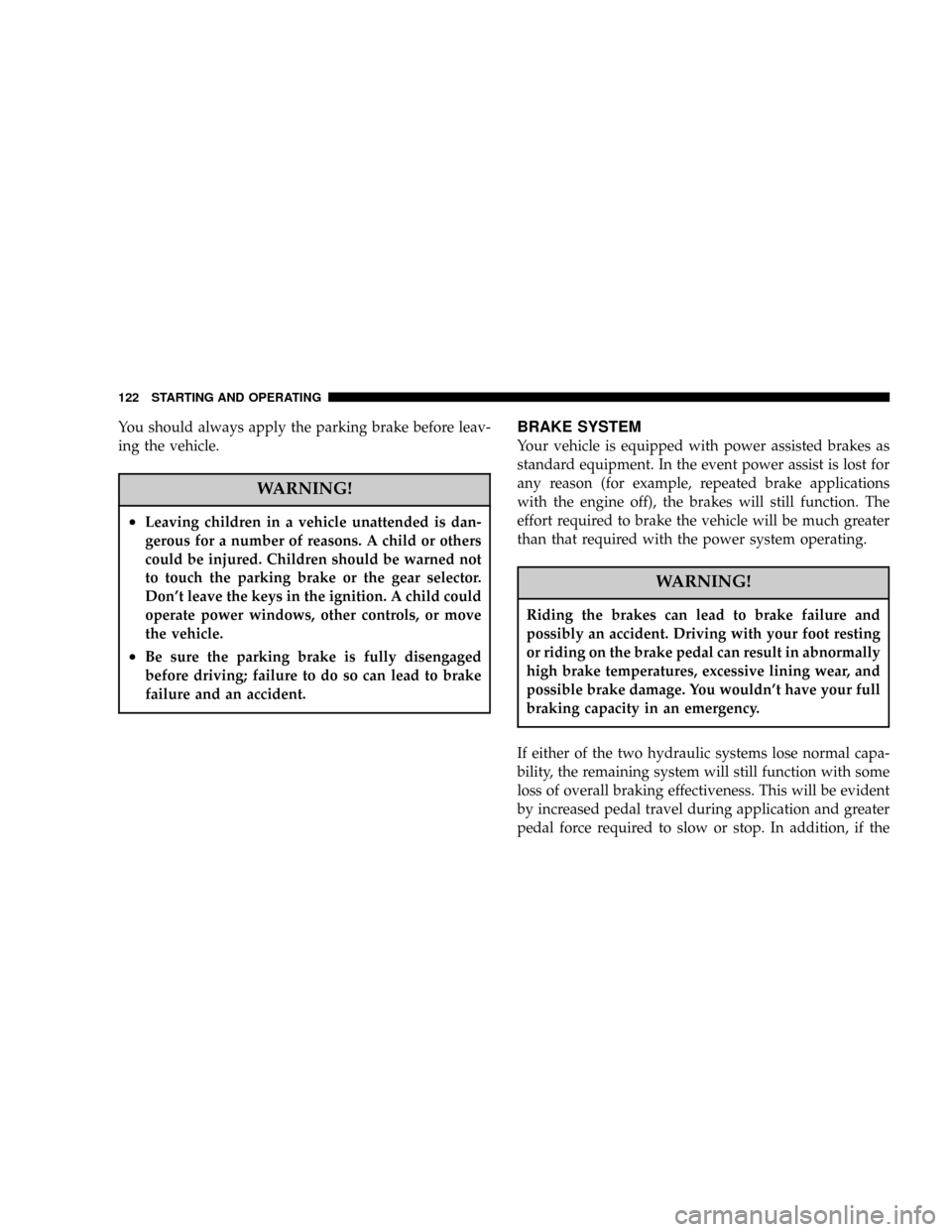
You should always apply the parking brake before leav-
ing the vehicle.
WARNING!
²Leaving children in a vehicle unattended is dan-
gerous for a number of reasons. A child or others
could be injured. Children should be warned not
to touch the parking brake or the gear selector.
Don't leave the keys in the ignition. A child could
operate power windows, other controls, or move
the vehicle.
²Be sure the parking brake is fully disengaged
before driving; failure to do so can lead to brake
failure and an accident.
BRAKE SYSTEM
Your vehicle is equipped with power assisted brakes as
standard equipment. In the event power assist is lost for
any reason (for example, repeated brake applications
with the engine off), the brakes will still function. The
effort required to brake the vehicle will be much greater
than that required with the power system operating.
WARNING!
Riding the brakes can lead to brake failure and
possibly an accident. Driving with your foot resting
or riding on the brake pedal can result in abnormally
high brake temperatures, excessive lining wear, and
possible brake damage. You wouldn't have your full
braking capacity in an emergency.
If either of the two hydraulic systems lose normal capa-
bility, the remaining system will still function with some
loss of overall braking effectiveness. This will be evident
by increased pedal travel during application and greater
pedal force required to slow or stop. In addition, if the
122 STARTING AND OPERATING
Page 135 of 246
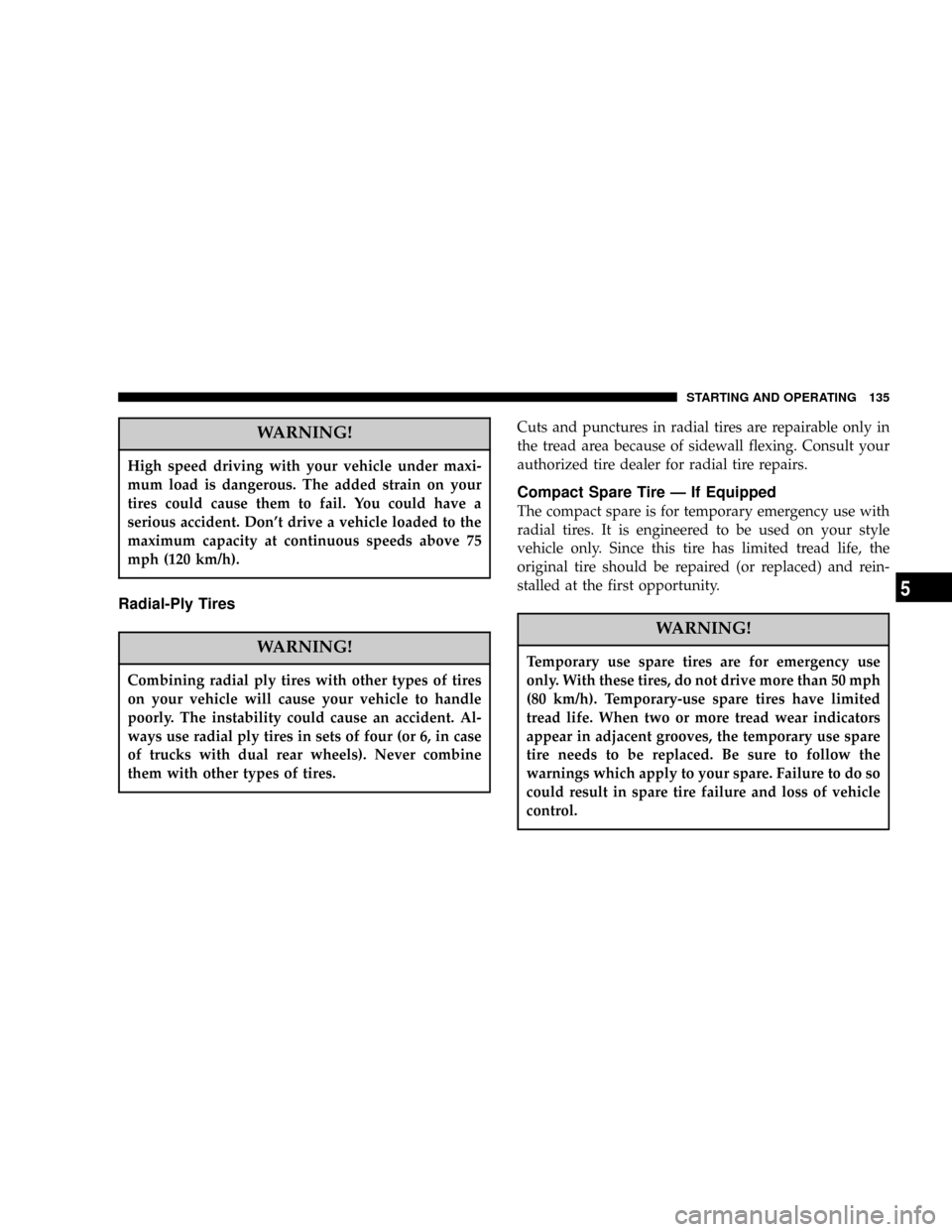
WARNING!
High speed driving with your vehicle under maxi-
mum load is dangerous. The added strain on your
tires could cause them to fail. You could have a
serious accident. Don't drive a vehicle loaded to the
maximum capacity at continuous speeds above 75
mph (120 km/h).
Radial-Ply Tires
WARNING!
Combining radial ply tires with other types of tires
on your vehicle will cause your vehicle to handle
poorly. The instability could cause an accident. Al-
ways use radial ply tires in sets of four (or 6, in case
of trucks with dual rear wheels). Never combine
them with other types of tires.
Cuts and punctures in radial tires are repairable only in
the tread area because of sidewall flexing. Consult your
authorized tire dealer for radial tire repairs.
Compact Spare Tire Ð If Equipped
The compact spare is for temporary emergency use with
radial tires. It is engineered to be used on your style
vehicle only. Since this tire has limited tread life, the
original tire should be repaired (or replaced) and rein-
stalled at the first opportunity.
WARNING!
Temporary use spare tires are for emergency use
only. With these tires, do not drive more than 50 mph
(80 km/h). Temporary-use spare tires have limited
tread life. When two or more tread wear indicators
appear in adjacent grooves, the temporary use spare
tire needs to be replaced. Be sure to follow the
warnings which apply to your spare. Failure to do so
could result in spare tire failure and loss of vehicle
control.
STARTING AND OPERATING 135
5
Page 141 of 246

Tire Rotation Recommendations
Tires on the front and rear axles of vehicles operate at
different loads and perform different steering, driving
and braking functions. For these reasons, they wear at
unequal rates, and tend to develop irregular wear pat-
terns.
These effects can be reduced by timely rotation of tires.
The benefits of rotation are especially worthwhile with
aggressive tread designs such as those on all season type
tires. Rotation will increase tread life, help to maintain
mud, snow and wet traction levels, and contribute to a
smooth, quiet ride.
Follow the recommended tire rotation frequency for your
type of driving found in the ªMaintenance Schedulesº
Section of this manual. More frequent rotation is permis-
sible if desired. The reasons for any rapid or unusual
wear should be corrected before rotating. The suggested
rotation method is the ªforward-crossº shown in the
diagram.
FUEL REQUIREMENTS
Your engine is designed to meet all emis-
sion regulations and provide excellent fuel
economy and performance when using
high quality unleaded ªregularº gasoline
having an octane rating of 87. The use of
premium gasoline is not recommended.
The use of premium gasoline will provide no benefit over
high quality regular gasolines, and in some circum-
stances may result in poorer performance.
STARTING AND OPERATING 141
5
Page 142 of 246

Spark Knock
Light spark knock at low engine speeds is not harmful to
your engine. However, continued heavy spark knock at
high speeds can cause damage and immediate service is
required.
Poor quality gasoline can cause problems such as hard
starting, stalling and hesitations. If you experience these
symptoms, try another brand of ªregularº gasoline be-
fore considering service for the vehicle.
Over 40 automobile manufacturers around the world
have issued and endorsed consistent gasoline specifica-
tions (the World Wide Fuel Charter, WWFC) to define
fuel properties necessary to deliver enhanced emissions,
engine performance, and durability for your vehicle. The
manufacturer recommends the use of gasolines that meet
the WWFC specifications if they are available.
Reformulated Gasoline
Many areas of the country require the use of cleaner
burning fuel referred to as Reformulated Gasoline. Re-
formulated gasolines contain oxygenates, and are specifi-
cally blended to reduce vehicle emissions and improve
air quality.The manufacturer supports the use of reformulated gaso-
lines. Properly blended reformulated gasolines will pro-
vide excellent performance and durability for the engine
and fuel system components.
Gasoline/Oxygenate Blends
Some fuel suppliers blend unleaded gasoline with mate-
rials called oxygenates such as 10% ethanol, MTBE and
ETBE. Oxygenates are required in some areas of the
country during the winter months to reduce carbon
monoxide emissions. Fuels blended with these oxygen-
ates may be used in your vehicle.
CAUTION!
DO NOT use gasolines containing Methanol. Gaso-
line containing methanol may damage critical fuel
system components.
Problems that result from using methanol/gasoline
blends are not the responsibility of The manufacturer.
While MTBE is an oxygenate made from Methanol, it
does not have the negative effects of Methanol.
142 STARTING AND OPERATING
Page 143 of 246

MMT in Gasoline
MMT is a manganese containing metallic additive that is
blended into some gasoline to increase octane. Gasolines
blended with MMT provide no performance advantage
beyond gasolines of the same octane number without
MMT. Gasolines blended with MMT have shown to reduce
spark plug life and reduce emission system performance in
some vehicles. The manufacturer recommends that gaso-
lines free of MMT be used in your vehicle. The MMT
content of gasoline may not be indicated on the gasoline
pump, therefore you should ask your gasoline retailer
whether or not his/her gasoline contains MMT.
It is even more important to look for gasolines without
MMT in Canada because MMT can be used at higher
levels than allowed in the United States.
MMT is prohibited in both Federal and California refor-
mulated gasolines.
Materials Added to Fuel
All gasoline sold in the United States is required to
contain effective detergent additives. Use of additional
detergents or other additives is not needed under normalconditions and would result in unnecessary cost. There-
fore you should not have to add anything to the fuel.
Fuel System Cautions
CAUTION!
Follow these guidelines to maintain your vehicle's
performance:
²The use of leaded gas is prohibited by Federal law.
Using leaded gasoline can impair engine performance,
damage the emission control system.
²An out-of-tune engine, or certain fuel or ignition
malfunctions, can cause the catalytic converter to
overheat. If you notice a pungent burning odor or
some light smoke, your engine may be out of tune or
malfunctioning and may require immediate service.
Contact your dealer for service assistance.
²The use of fuel additives which are now being sold as
octane enhancers is not recommended. Most of these
products contain high concentrations of methanol.
STARTING AND OPERATING 143
5
Page 144 of 246

Fuel system damage or vehicle performance problems
resulting from the use of such fuels or additives is not
the responsibility of the manufacturer.
NOTE:Intentional tampering with emissions control
systems can result in civil penalties being assessed
against you.
Carbon Monoxide Warnings
WARNING!
Carbon monoxide (CO) in exhaust gases is deadly.
Follow the precautions below to prevent carbon
monoxide poisoning:
²Do not inhale exhaust gases. They contain carbon
monoxide, a colorless and odorless gas which can kill.
Never run the engine in a closed area, such as a
garage, and never sit in a parked vehicle with the
engine running for an extended period. If the vehicle is
stopped in an open area with the engine running for
more than a short period, adjust the ventilation system
to force fresh, outside air into the vehicle.
²Guard against carbon monoxide with proper mainte-
nance. Have the exhaust system inspected every time
the vehicle is raised. Have any abnormal conditions
repaired promptly. Until repaired, drive with all side
windows fully open.
²Keep the trunk closed when driving your vehicle to
prevent carbon monoxide and other poisonous ex-
haust gases from entering the vehicle.
ADDING FUEL
NOTE:
The fuel tank filler tube has a restricting door
about 2 inches (50 mm) down from the opening. If fuel is
poured from a portable container, the container should
have a flexible nozzle long enough to force open the
restricting door.
Fuel Tank Filler Cap
The gas cap is behind the fuel filler door, on the passen-
ger's side of the vehicle. If the gas cap is lost or damaged,
be sure the replacement cap has been designed for use
with this vehicle.
144 STARTING AND OPERATING